Disclosure: Some links in this post are affiliate links. As an Amazon Associate I earn from qualifying purchases, at no extra cost to you. Learn more
Specs are compiled from manufacturer listings and verified buyer reviews and can change over time — please confirm the key details on the product page before buying.
The case for owning a wood chipper instead of renting one is simple: the brush pile never waits for the weekend. Every storm, every pruning session, every dead limb drops a new heap on your property. A weekend rental means cramming a season of cleanup into two days for several hundred dollars. A 4-inch chipper turns that heap into mulch on your own schedule, one afternoon at a time. The picks below are sorted by what actually matters to a homeowner staring down a mountain of branches — engine displacement, real-world capacity, and how easily the machine feeds without jamming.
This guide is built by comparing the manufacturers’ published specifications and the patterns across verified customer reviews, so you get each pick’s real strengths and trade-offs instead of marketing spin.
Most machines in this class advertise a 3-inch ceiling, but a handful push to a genuine 4 inches with bigger flywheels and heavier blades. The best 4 Inch Wood Chipper for your property depends on matching engine displacement to your debris volume, not chasing the biggest sticker number.
Top Picks


How To Choose The Best 4 Inch Wood Chipper
The biggest mistake first-time buyers make is treating the advertised capacity number as a promise. A machine that claims 4 inches handles 4 inches of soft, straight, freshly cut branches — not the gnarled hardwood stump you fought with last spring. Your job is to figure out what you actually feed the machine, then pick an engine and hopper design that survives that reality. Here is what earns its place in the decision.
Engine Displacement And What It Really Delivers
A gas engine’s displacement — measured in cc — sets the ceiling on how much torque it can put into the flywheel. A 212cc engine is the common workhorse in this class, while 274cc and larger engines push through thicker limbs with noticeably less bogging. Torque is the rotational force that keeps the blade spinning when a branch bites into it. More torque means the engine recovers instead of stalling, which is the single biggest difference between a satisfying session and a frustrating one. If your property produces mostly dry oak or hardwood, lean toward the larger displacement range.
Chipper Versus Chipper Shredder
A chipper has a single chute that pulls branches toward a spinning blade, turning them into coin-sized chips. A chipper shredder adds a second top hopper that shreds leaves, twigs, and lighter yard debris into finer mulch. If you mainly fight limbs, a dedicated chipper feeds straighter and clogs less. If your fall cleanup is leaf-heavy, the shredder hopper earns its keep — but be honest about how often you will actually feed leaves loosely and slowly, because a packed hopper bridges and jams. Many owners end up grabbing a tarp instead.
Fed By Hand Or Pulled Behind A Tractor
Walk-behind chippers run on their own gas engine and roll on wheels, so one person can position them anywhere in the yard. A PTO-driven chipper runs off your tractor’s rear power take-off, the spinning shaft that transfers engine power to attachments. PTO units have no engine of their own, which means you need a tractor rated for the load and the right RPM setting at the hitch. The trade-off is real: a PTO machine costs more upfront but outruns a handheld unit on volume once you have the tractor.
Side-by-Side Comparison
| Model | Best For | Engine | Max Capacity | Weight | Amazon |
|---|---|---|---|---|---|
| Patriot CSV-3090B★ Best Overall | Big-property chipping and shredding | 9 hp Briggs | 3″ diameter | 139 lb | Amazon |
| S3 Wood ChipperBudget Champion | First-time gas-chipper owners | 7HP 212cc | 3″ diameter | — | Amazon |
| EFCUT R30 Chipper ShredderCompact Pick | Compact storage and easy blade swaps | 7HP 212cc | 3″ diameter | 121.7 lb | Amazon |
| BILT HARD Chipper Shredder | Towing behind an ATV or mower | 7HP 209cc | 3″ diameter | 48 lb | Amazon |
| GARDENBEAUT R30 | Small lots with woody-only debris | 7HP 212cc | 3″ diameter | 120.7 lb | Amazon |
| SuperHandy 3-in-1 | Homeowners who want a leaf vacuum option | 7HP horizontal | 3″ diameter | 133.7 lb | Amazon |
| Earthquake K32 | Storm-cleanup volume on a mid-size lot | 212cc Viper | 3″ diameter | 118 lb | Amazon |
| EFCUT C40 | True 4-inch branches on a serious lot | 9HP 274cc | 4″ diameter | 136.7 lb | Amazon |
| MechMaxx 4″ Tow Bar | Towing across a working farm | 212cc 7HP DUCAR | 4″ diameter | 267 lb | Amazon |
| MechMaxx 6″ E-Start | Heavy brush clearing and towing | 420cc 15hp ZONSEN | 6″ diameter | 639 lb | Amazon |
| Titan Attachments PTO | Tractor owners who want no gas engine | PTO-driven | 4″ diameter | 391 lb | Amazon |
Detailed Reviews
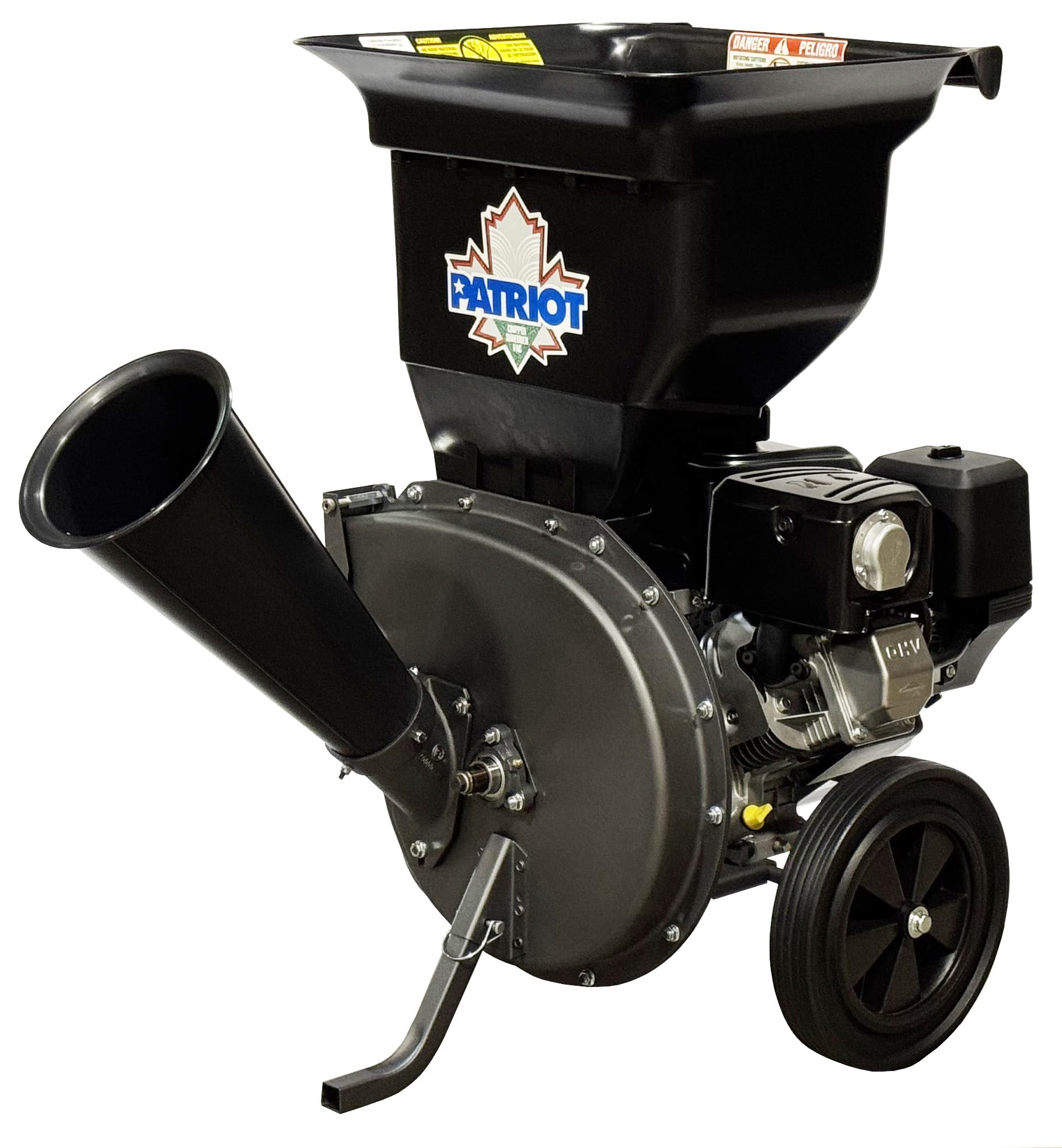
1. Patriot Products CSV-3090B Gas Wood Chipper Leaf Shredder
Our pick — 4.5+★ from 150+ verified ratings; the strongest balance of quality and price.
The 139-pound workhorse that starts on the first pull and shreds leaves like a machine twice its size.
For anyone with a genuine acreage and a debris pile that never stops growing, this is the pick that earns its keep season after season. The 9 hp Briggs engine gives it a 29% power edge over the 7HP S3 chipper in this same roundup, and that gap shows up the moment you feed it real wood. Run branches up to 3 inches in diameter down the funnel-shaped cone and you get coin-sized chips instead of bruised, half-chewed sticks.
What wins people over is the quality of the build. The rugged frame and greasable outboard bearing — a grease point you service with a standard grease gun, so the shaft stays smooth — are the reason owners keep reporting multi-year runs with light maintenance. One long-running three-acre property owner ran it against a rental habit and never looked back, reporting the engine fires on the first cold pull. The swinging y-hammer system inside the shredder hopper is what turns dry leaves into fine mulch, and it drops that mulch from the side discharge so you can stand in one spot all day and let the pile build beside you.
The honest catch is the hopper throat. Thin or woody twigs and damp leaves bridge across the opening and need a stick to push through, and branches have to be reasonably straight to travel down the cone without stalling. Blades also dull faster on dead or dry hardwood, and sharpening runs on a schedule closer to every eight hours of hard use than every season. None of that changes the verdict for a big property, but it does mean this is a machine you learn.
Where It Earns Its Keep
- 9 hp Briggs engine outpowers the 7HP units here, so hardwood branches don’t bog it down the way they do lighter machines.
- The swinging y-hammer shredder drops dry leaves into fine mulch, which most pure chippers simply cannot do.
- Side discharge means you work from one position all day without repositioning the machine.
- Greasable outboard bearing keeps the shaft smooth with routine maintenance rather than repair.
The Trade-Offs You Live With
- The narrow hopper throat bridges on thin woody debris and damp leaves, so keep a stick or length of PVC nearby to clear it.
- Blades dull quickly on dry dead hardwood and want sharpening around every eight hours of heavy chipping.
- Branches must be fairly straight to feed cleanly down the funnel cone; crooked limbs stall.
Built for: Anyone with a large property and a year-round debris problem who wants one machine that chips branches and shreds leaves.
Think twice if: You mostly feed gnarly, curved limbs or dry dead wood, where the straight-feed cone and fast blade wear will test your patience.
2. S3 Wood Chipper Shredder
The entry-level gas chipper that fires on the first pull and turns five truckloads of brush into one.
This is the machine for the homeowner who has never owned a chipper before and wants a gas-powered one without gambling a fortune. The 7HP 212cc horizontal engine handles branches up to 3 inches in diameter, and the 15:1 reduction ratio means fifteen piles of debris go in for every one pile of chips that comes out. Buyers report it starts on the first pull every time and that yard cleanup dropped from four or five truckloads down to a single trip.
The vertical extended discharge chute is a detail worth understanding — it throws chips downward with an adjustable guide that swings through a 90°-145° range, so you aim the pile where you want it instead of raking chips out of the lawn. The machine runs on 87+ unleaded gasoline with a 0.7-gallon maximum tank capacity, and no ethanol is recommended, which is worth remembering at the pump.
The split in owner experience depends on the blade and the hopper. Some buyers love the value and the easy feeding; others find the blades lose their edge after a handful of sessions and the hopper opening is narrow enough that you feed leaves loosely and slowly or they bridge and jam. The handle design is also an admitted weak point — a loose nut working free into the blade path has been a reported headache. Feed it dry wood rather than wet, go slow on anything thick, and this one does its job. The honest note: it takes its time, so expect to nurse thicker material through rather than shove it.
Value read: For a first gas chipper, the payoff math is straightforward — a few sessions of cleanup cover what a single weekend rental would have cost.
Feed it right: Dry wood chips far better than wet, and 3-inch pieces go through cleanly only when fed slowly rather than dropped in.
Reach for this if: You want your first gas chipper and sizeable debris loads without a big outlay.
Look elsewhere if: You expect to shove thick wet branches through without slowing down or plan to feed loose leaves in bulk.
3. EFCUT Wood Chipper Shredder R30
The folding chipper you can tuck into a shed corner and still runs nine straight hours on heavy use.
If your garage is already full, the foldable design on this R30 is the feature that decides it. Fold the chute down and storage space drops dramatically, while the 121.7-pound frame stays movable enough for one person to reposition. The 7HP 212cc horizontal engine with a 3600 RPM maximum speed spins a cutting roller with double-lasting blades, and the long neck chute simplifies loading without asking you to lean over a hot engine.
The blade-access design is what earns the praise. Two bolts pull the chute off for storage or servicing, and a heavy-use owner running fourteen trees across two seasons reported the blades still cutting sharp afterward. That same owner turned a nine-foot pile of limbs into a single 30-gallon bag of mulch and gets a first-pull start even after a winter sitting idle. The cutting roller keeps your hands at a safe distance from the blades, which matters when you’re feeding a machine that pulls material in on its own.
Assembly is the wildcard. Some owners finished in thirty to forty-five minutes and found it straightforward; others found the pictures-on-instructions approach thin on words and needed to study closely. The 3-inch max capacity is also optimistic on hardwood — expect closer to 2 inches on dense white oak, with 3 inches reserved for softer or greener branches. This is a chipper, not a shredder, so it will not handle leaves or vines, and it clogs when fed light, leafy material. Buy it for branches, not for fall leaf cleanup.
Storage-first design: The removable chute and foldable frame are why this earns compact status — it takes up minimal floor space between sessions.
Hardwood reality: The 15:1 reduction ratio holds, but dense hardwood tops out nearer 2 inches while soft wood can reach the 3-inch rating.
Best for: Owners short on storage space who chip woody branches and value easy blade access.
Skip if: Your cleanup is mostly leaves and vines, or your branches are predominantly dense hardwood.
4. BILT HARD Wood Chipper Shredder
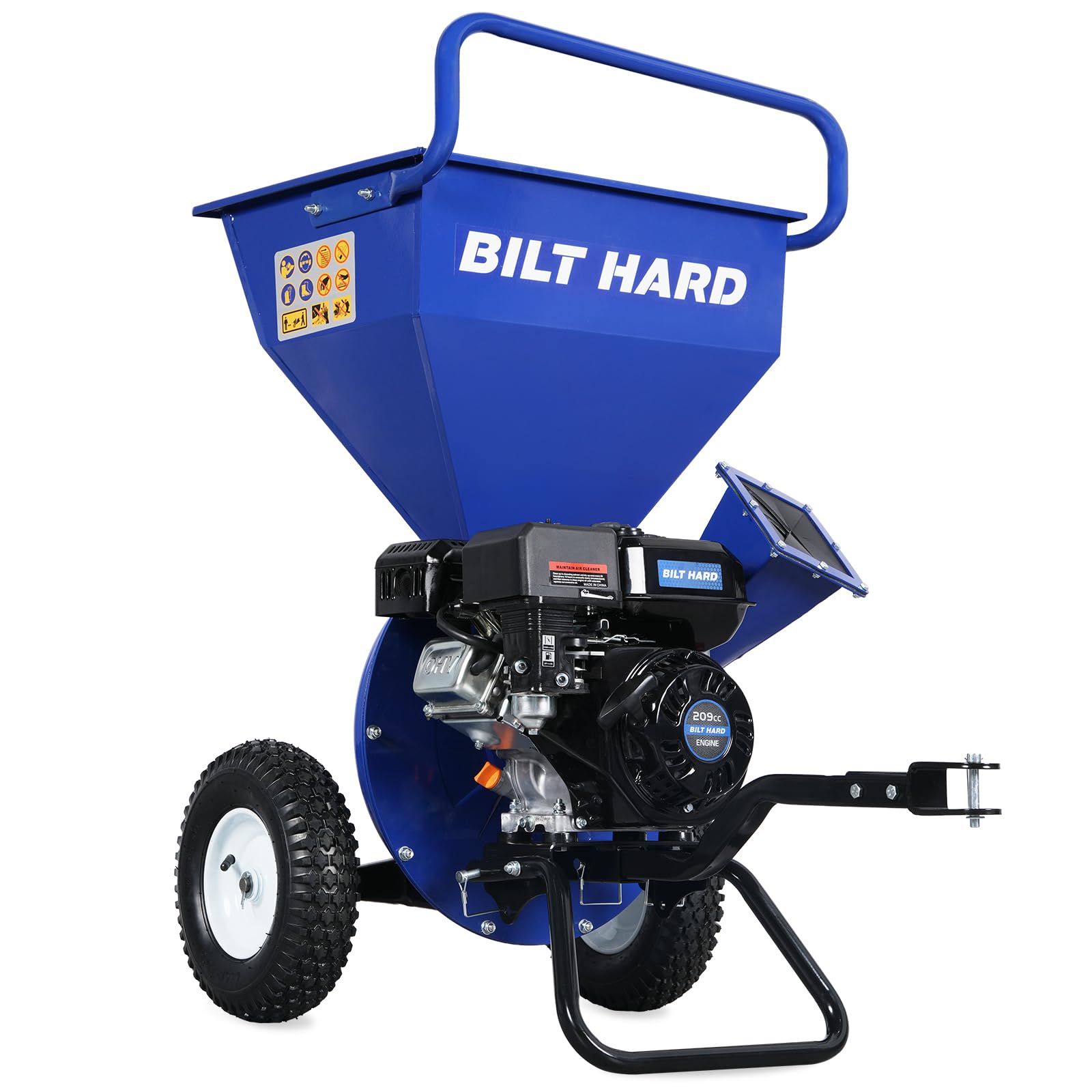
A 48-pound towable chipper that hooks to an ATV and follows you to the brush.
At 48 pounds, this is by far the lightest machine in this roundup — the S3 chipper and most of the walk-behinds here weigh more than twice as much. That is the whole pitch: a tow hitch and stable frame let you drag it behind an ATV or lawn tractor to wherever the branches fell, instead of hauling brush to the machine. The 7HP 209cc 4-stroke OHV engine delivers 9.14 ft-lbs of torque and sips from a 0.9-gallon fuel tank running 87+ unleaded.
The 3-in-1 design splits the work cleanly. A 3-inch side chute handles branch chipping, while a 1/2-inch top hopper shreds leaves, twigs, and lighter yard debris into mulch you can use for landscaping or composting. Two chipper blades and six J-type hammer blades sit on a reinforced rotor disc — the J-shaped hammers are what pulverize lighter material after the main blades cut it. A 2.0-bushel collection bag catches the output so you are not raking afterward. The general verdict from owners is functional, easy to assemble, and starts on the first pull — that is what earns it a spot.
The honest limit is what feeds it. Small pieces around one inch have been a trouble spot for some owners — the machine prefers a steady stream of larger branches to lighter, erratic debris. The 90-day warranty is shorter than the one-year registration warranties on the EFCUT and GARDENBEAUT machines in this roundup, which is a real difference if you plan on heavy use. The inspection window makes clearing jams easier without full disassembly. For a homeowner with a large lot who wants to tow the machine to the mess, this is the one.
Why It Travels Well
- At 48 pounds it is the lightest in this lineup, so one person can move it without strain.
- The tow hitch lets you pull it behind an ATV or lawn tractor straight to the debris pile.
- Three functions — 3″ side chute, 1/2″ top hopper, and mulch output — cover branches and lighter yard waste in one machine.
- The inspection window opens for quick jam clearing and blade checks without taking the machine apart.
Where It Asks More
- Feeding smaller one-inch pieces is where owners mention mixed results — it prefers larger branches.
- The 90-day warranty window is shorter than the 1-year options on several machines in this roundup.
Tows to the brush: Perfect for large lots where dragging the chipper to the debris beats hauling debris to the chipper.
Not for: You want a long warranty or you plan to feed mostly small, erratic one-inch pieces.
5. GARDENBEAUT R30 Wood Chipper

A direct-drive chipper with no belts to slip, sized right for lots under a quarter acre.
For a quarter-acre lot with a steady supply of woody branches, the GARDENBEAUT R30 hits a useful target. It runs a 7HP 212cc engine through a direct drive — meaning no belts or clutches between engine and blade — which removes the parts most likely to wear out or need adjustment. A 15:1 reduction ratio compresses yard waste into manageable mulch, and a large 4.75″ x 5.5″ throat swallows branches without forcing. Customers note chips in the 1/4″ to 3/4″ range, ideal for garden paths and compost.
The double-sided blades flip and reuse, which is why owners describe blade maintenance as simple — flip them once the edge dulls instead of buying replacements immediately. Setting up takes about twenty minutes with the hinged funnel making it easier to access the cutting chamber. Check the crankcase oil: 10W-40 goes in, and the fill takes about half a quart with the rest saved for a break-in change around the five-hour mark. The reason to keep an eye on oil is that stalling the engine hard can damage the crankshaft, so cut power to the feed before it grinds to a stop.
The thickest branches are where the capacity claim tightens. Hardwood tops out around 2 inches in practice; anything over that needs to be fed slowly to avoid stalling. A misaligned hopper lip and an internal flange of about one inch have been reported catching branches, requiring a jiggle to feed them through. Assembly instructions are also famously vague on this machine — extra numbered parts arrived without matching steps for some owners. None of that disqualifies it on a small lot, but you should expect to figure out the assembly yourself.
Small-lot fit: Sized for lots up to about 10,000 square feet, where a full-size walk-behind would be overkill.
Blade economics: Double-sided blades flip for a second life, so you sharpen less and replace later.
Great match for: A quarter-acre property with woody branches and a buyer comfortable sorting out the assembly.
Wrong fit if: You need to chip leaves, vines, or hardwood branches over 2 inches without slowing down.
6. SuperHandy Wood Chipper Shredder Mulcher
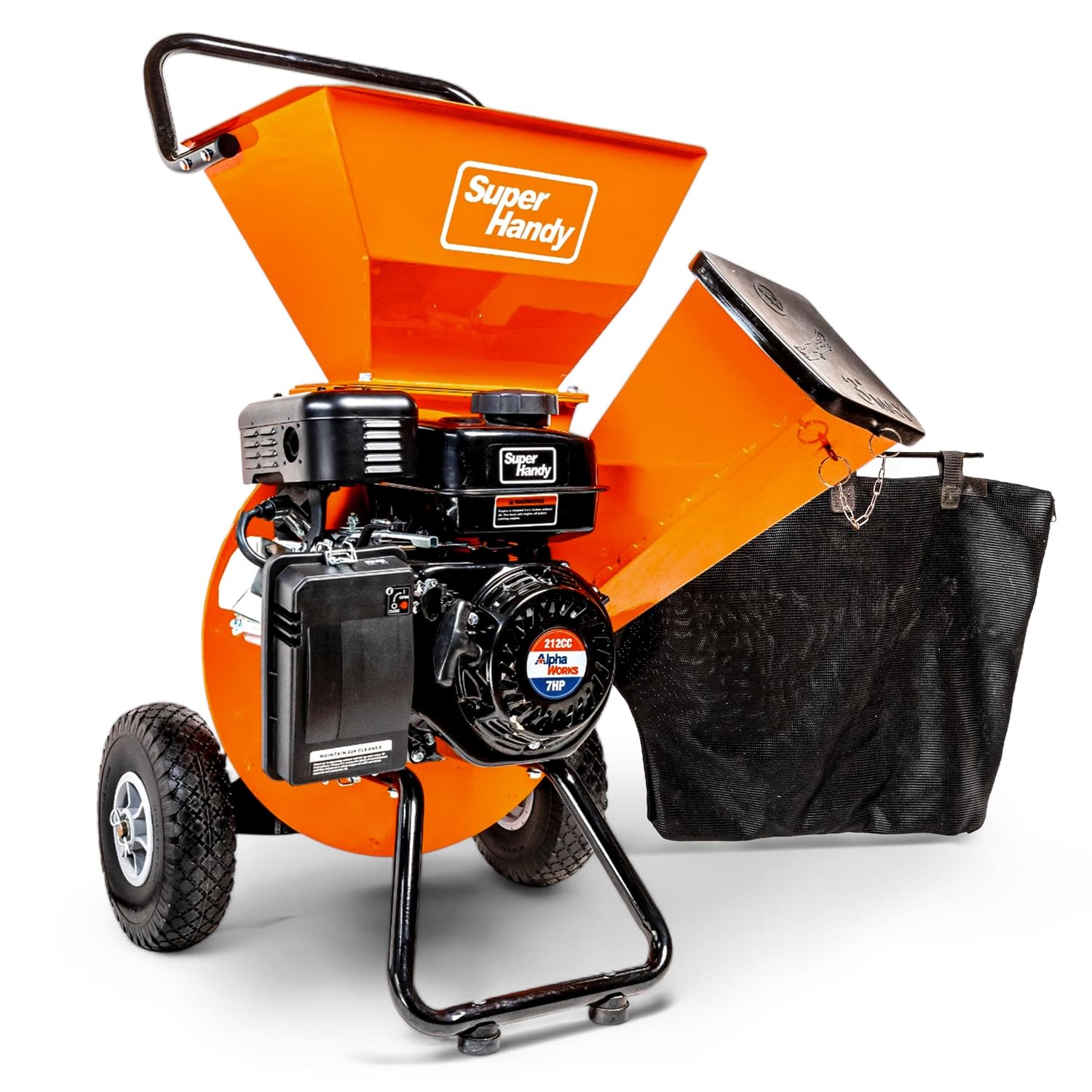
Three feeding points and a slanted housing that fights jams — the Swiss Army chipper of the group.
Where most machines here do one job, the SuperHandy splits the work three ways: a top hopper for 1/2-inch maximum shredding at a 15:1 reduction ratio, a side chute for 3-inch maximum branches, and a vacuum inlet that pairs with an optional leaf vacuum kit for mulching. The slanted housing design exists specifically to reduce jamming, which is the single biggest frustration in chipping light, leafy debris. The 7HP horizontal 4-stroke engine runs on 87+ unleaded fuel from a 0.7-gallon maximum tank with no ethanol recommended.
The optional add-ons matter to how you use it day to day. A tow bar kit lets you pull the machine behind an ATV, lawn mower, or small tractor, and the vacuum inlet turns it into a leaf mulching station — both are sold separately, so budget for them if you want either feature. The 133.7-pound frame rides on large tires and rolls well once in position. Owners consistently find it works on both green and dry wood, assemble without drama, and consider the value solid. One reviewer noted it paid for itself after a single large job.
The trade-offs come from the feeding design. The top shredder hopper will not pull small or pine pieces through — you may need to push them down with a stick. Kickback risk exists if you overload, and branches above 2 inches occasionally jam hard enough to require disassembly. The plastic discharge bag fills fast and one owner reported a cloth bag wearing out, though the seller replaced a torn one without argument. Read the fuel rule carefully: pure gas, no ethanol, or you will be rebuilding the carburetor. It is the machine for the homeowner who wants one tool for multiple cleanup jobs, not for someone who wants the simplest possible feed.
What Makes It Flexible
- Three feed points — top hopper, side chute, and vacuum inlet — cover chipping, shredding, and leaf mulching.
- The slanted housing is engineered to reduce jams compared to standard chipper geometry.
- The 15:1 reduction ratio delivers fine mulch from the top-hopper shredding function.
- Tow bar compatibility lets you pull it behind an ATV, mower, or small tractor for transport.
- Rolls well on large tires and assembles without much fuss.
Where It Needs Attention
- Branches over 2 inches occasionally jam hard, requiring disassembly to clear.
- The top shredder hopper will not pull small or pine pieces — they need help getting down.
- Kickback risk exists if you overload the feed.
- The discharge bag fills fast and wears over time.
Pick it for: Homeowners who want a single machine that chips branches, shreds debris, and mulches leaves.
Avoid if: You want the simplest possible feeding experience or plan to chip branches comfortably above 2 inches.
7. Earthquake K32 Chipper Shredder

A 20:1 reduction machine built for the pile of storm debris already sitting in your yard.
When a storm drops a season’s worth of brush in one afternoon, the Earthquake K32 is designed around that exact scenario. Its 212cc 4-cycle Viper engine chips branches up to 3 inches in diameter in the chipper cone, while smaller twigs and leaves go into the top hopper where a series of Tri-Hammers and J-hammers shreds them into mulch. The 20:1 reduction ratio is the highest in this roundup — twenty piles of debris in for every one pile of chips out — and it turns brush piles into useful mulch you can spread back on beds.
The 11-inch airless wheels never go flat, which is the detail owners notice on uneven ground, and they roll the 118-pound machine between cleanup sites easily. It measures 25.4″ wide by 29.9″ long, so it fits into a corner of the garage without dominating the space. The included debris bag makes collection cleaner than raking after the fact, and the machine runs roughly three hours of heavy work on one tank before a refuel. Reviewers point out long, trouble-free runs and a reliable first-pull start after sitting idle for months.
The honest pushback lands on two points. Starting requires a firm, strong pull — not a problem for most, but a noticeable effort for some. Quality on small parts has been the bigger complaint — plastic connectors and leaf hopper welds have been reported cracking or failing on a minority of units, with one owner citing a frustrating warranty back-and-forth over replacement parts. The machine also needs some mechanical expertise on setup: manuals have been reported running ahead of what actually shipped, and the hopper siding plate is awkward to seat. None of that touches the core performance, but it is worth flagging.
Reduction math: The 20:1 ratio leads every other machine in this roundup, turning the biggest debris piles into the smallest mulch volumes.
Garage footprint: At 25.4″ wide by 29.9″ long it stores easily between storms without crowding the space.
Destined for: Storm-heavy regions and mid-size lots where the pile arrives all at once and needs to shrink fast.
Consider something else if: You prefer electric-start convenience or need the assembly process to be completely simple to use.
8. EFCUT C40 Wood Chipper

The genuine 4-inch machine — a bigger engine, bigger flywheel, and bigger appetite for thick branches.
If your keyword search is the point — you actually need to chip 4-inch branches, not just 3-inch ones — the EFCUT C40 is the one in this roundup built for that. A 9HP 274cc heavy-duty engine powers a 15.9-inch flywheel — the heavy spinning disc that carries the blades and gives them inertia to slice through dense wood — and the blades are crafted entirely from high-speed steel. That combination out-feeds the 3-inch machines and cuts more branches at once with less downtime. The 15:1 reduction ratio keeps mulch output high, and a precise adjustment discharge chute directs chips wherever you want them.
Performance is what earns the praise. A dedicated 2.5-to-3-inch chipping report shows clean cuts with bolts labeled by size for easy assembly, and the machine runs cooler and quieter than expected. A heavy outdoor-use owner ran it several hours continuously without issue and reports a consistent chip size ideal for garden paths and landscaping. Setup is simple enough that most owners get through it without help, and an upgraded L-bracket mounting and reinforced hardware on newer units are designed to add stability under load.
The honest split is right in the reviews. Some shoppers say the installed blades arrived subpar and needed replacing before the machine could chip even 1-inch branches; others found the recoil start takes a strong pull — one owner at 6 feet and 200 pounds needed fifteen to twenty pulls with choke adjustments. Durability on the aluminum hardware is the biggest mixed signal, with stripped or sheared bolts reported during assembly. On the positive side, once blades and hardware are sorted, the machine is a consistent performer. Expect to budget for a blade upgrade and to keep an eye on the bolts.
Where the 4-Inch Claim Holds
- The 9HP 274cc engine with a 15.9-inch flywheel is the reason it can claim a true 4-inch capacity others only approximate.
- High-speed steel blades cut more branches at once with less downtime than the 3-inch machines.
- Consistent chip size makes output suitable for landscaping and garden paths.
- Reinforced L-bracket mounting and upgraded hardware add stability under load.
- Runs cooler and quieter than expected, with several-hour continuous use reported.
What You Accept
- Blades may arrive needing replacement before the machine chips cleanly — a real cost to plan for.
- The recoil start takes a strong pull, reported to be hard for some owners.
- Aluminum bolts and washers have been reported stripping or shearing during assembly.
Designed for: Buyers who actually need 4-inch capacity and are willing to upgrade the blades if the originals disappoint.
Not for: Anyone who prefers electric start or wants plug-and-play assembly with no hardware surprises.
9. MechMaxx 4” Wood Chipper

A tow-bar farm chipper that hitches to a vehicle and rolls to the pile on 14-inch wheels.
For a working farm or a very large lot, this MechMaxx tows the work to the wood. A trailer bar and two 14-inch wheels let you drag it behind a vehicle to different jobsites, and a DUCAR 212cc 7HP recoil-start 4-stroke engine handles branches up to 4 inches in diameter. The 267-pound frame is heavy by walk-behind standards, but the tow bar turns moving it into a non-event. A 360° rotary discharge chute with an adjustable deflector aims chips precisely, and a small storage box beside the feed chute holds manuals and tools.
The cutting design is where it stands out. Two blades plus one anvil work together — the anvil is a stationary block the spinning blade shears against, sharpening the cut — and the double-edge blades are made of CR alloy steel with better corrosion resistance and wear resistance than standard steel. A 20:1 reduction ratio matches the highest in the roundup, and Kevlar belts between the engine and rotor resist wear longer than ordinary belts do, reducing how often you service the machine. The emergency stop button sits right next to the feed port where the operator’s hand is, so a misfeed can be shut down instantly.
What you do need to know: assembly is a heavy job. The 267-pound weight means two people at minimum, and buyers report a missing jumper wire on some units, plus a defective battery that had to be replaced out of pocket. Customer support has been slow to respond until a credit card dispute gets involved for some buyers — though once running, the machine handles 3.5-to-4-inch fresh logs cleanly and blade access for resharpening is easy. The capacity claim is accurate for fresh wood but expect drier hardwood to top out below the rating.
Blade system: Two CR alloy double-edge blades work with a stationary anvil to shear branches cleanly, which is why owners mention such consistent chip through-put.
Assembly weight: At 267 pounds this is a two-person job; plan space and time before delivery arrives.
Built for: Farmers and large-property owners who need 4-inch capacity and want to tow the machine to the debris.
Caution if: You will be assembling alone or are not prepared to spend time on support calls if a part arrives damaged.
10. MechMaxx 6” Wood Chipper
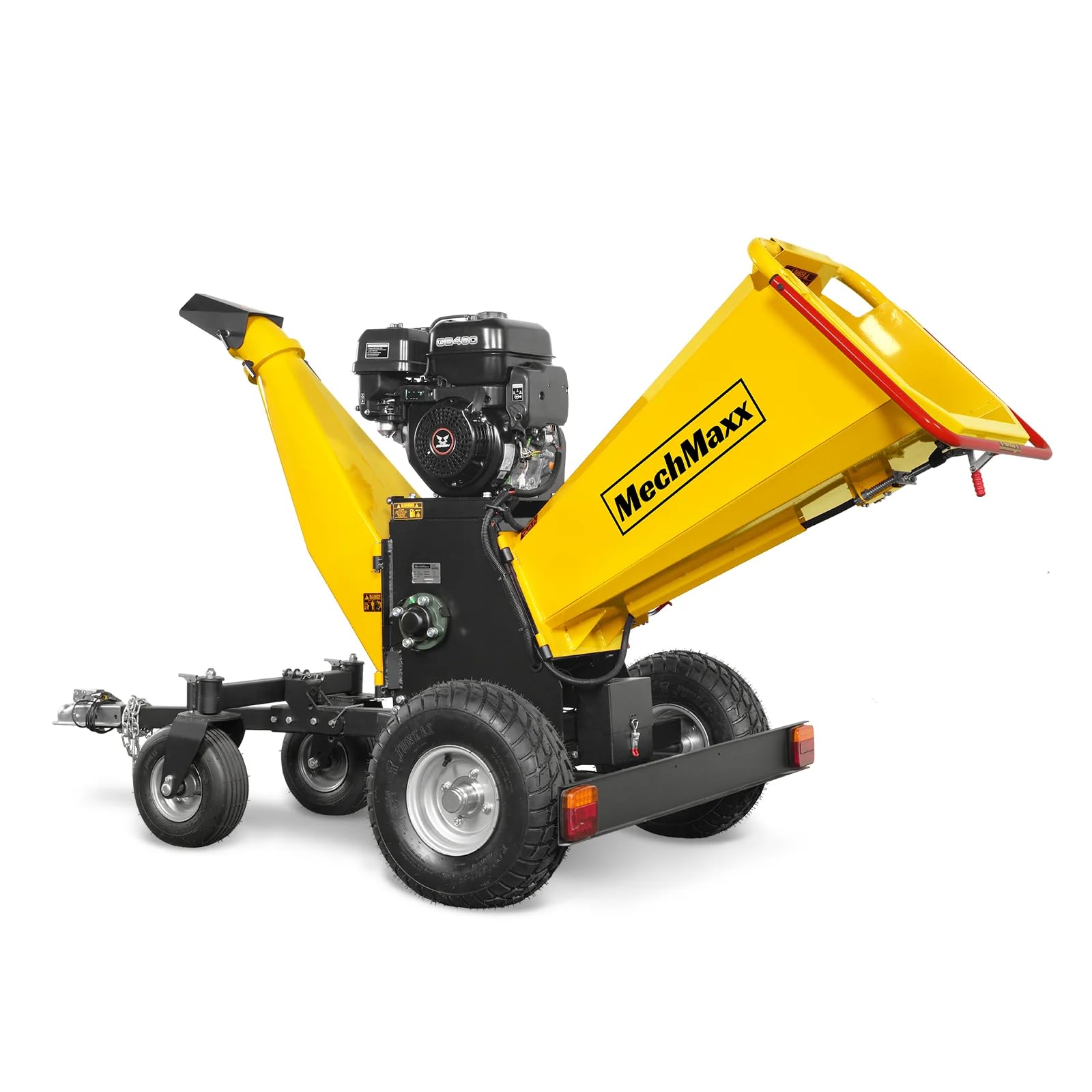
A 639-pound, 15-horsepower machine with an electric start and a safety switch that kills the engine when the chute opens.
This is the biggest machine in the roundup by every measure — a 420cc 15hp ZONSEN engine, a 12V20Ah lead-acid battery for electric start, and a claimed 6-inch capacity. The electric start alone is worth noting: the EFCUT C40 reviews flagged recoil start fatigue as a real problem, and this machine solves that by turning a key. The engine is air-cooled, single-cylinder, OHV, and drives the machine through Kevlar belts and A8-material double-edge blades for the same corrosion and wear resistance as the smaller MechMaxx. Four wheels — 19-inch rears and 13-inch foldable fronts — plus a 48-inch wheelbase for stability when towing.
The safety engineering is genuinely thought through. A limit switch shuts down the gasoline engine automatically whenever the feeding or discharge chute is open, so blade-access maintenance cannot happen while the machine can run. An emergency stop switch sits within reach of the operator, and tail lights sync with the towing vehicle’s brake and turn signals for road transport. The 360° rotary discharge chute aims chips precisely. Customers note it handles 4+ inch branches with slow feed and chews through brush easily, with the electric start getting consistent praise.
The manufacturer is honest about a real expectation gap: their performance tests were run on relatively soft branches, and dry hardwood branches will produce pieces no larger than 80% of the advertised size. In plain terms, expect around 4.8-inch maximums on dense hardwood even though soft wood hits 6. Owners also report loose nuts and bolts from shipping that need tightening before use, blades chipped after about ten hours, and assembly that requires two to three people. For a homeowner with a serious acreage and back trouble, the electric start is what makes this worth it.
Why It Commands Attention
- Electric start with a 12V20Ah lead-acid battery removes the recoil-pull fatigue the smaller machines impose.
- The 15hp ZONSEN engine and 420cc displacement chew through brush and 4+ inch branches with slow feed.
- A limit switch shuts the engine down automatically when the chute is open for safe maintenance access.A8-material double-edge blades and Kevlar belts resist wear, stretching service intervals between repairs.
- Four wheels — 19-inch rears and 13-inch foldables — plus a 48-inch wheelbase give it true towing stability.
Where It Demands More
- Dry hardwood chips to only about 80% of the advertised 6-inch size, so realistic hardwood capacity lands closer to 4.8 inches.
- At 639 pounds, assembly takes two to three people and a solid afternoon.
- Nuts and bolts arrive loose from shipping and need retightening before first use.
Built for: Large-acreage owners handling big brush and heavy debris who want electric-start convenience over pull-cord effort.
Skip if: You have a small lot, want a one-person setup, or expect hardwood to hit the full 6-inch claim.
11. Titan Attachments Wood Chipper

No engine of its own — this chipper runs off your tractor’s PTO and turns limbs into chips at the flip of a lever.
The Titan Attachments chipper is a different kind of machine entirely: no gas engine, no recoil start, no fuel mixing. It mounts to a standard 3-point hitch — the three-arm linkage system at the back of a tractor that holds attachments — and runs off the tractor’s PTO, the spinning shaft that transfers engine power to the implement. It is rated for tractors up to 40HP and operates between 540 and 1,000 RPM. The 25-inch oversized rotor increases chipping efficiency and reduces vibration even on thicker hardwood, and it chips timber up to 4 inches in diameter.
What makes this convenient day to day is the self-feeding chute. Drop a limb in and you are free to grab the next one — unlike pull-behind machines where you manage the feed rate. An adjustable exit chute directs chips exactly where you want them. Reversible blades extend usable life by flipping the cutting edge, integrated air vents prevent overheating during long sessions, and twig breaker paddles handle smaller branches and leaves that would otherwise clog the rotor. The 3-point hookup is a standard mount, so it fits any tractor with that linkage and moves between jobs with the tractor.
The honest limitations deserve a straight explanation. The RPM setting at your tractor’s PTO has to be right — too slow and small twigs spit out instead of chipping. On the capacity claim, some reviewers point out the machine tops out nearer 2.5 inches rather than the advertised 4, with larger pieces wedging and blocking the feed. Fastener tightness is a genuine maintenance item; vibration can loosen bolts over time and the manual organizes torque specs by hardware type rather than location. Assembly is a time-consuming job and shipping has left tie-downs broken and hardware missing on some units. For a tractor owner who wants to skip gas engines entirely, it is a solid attachment once dialed in.
Tractor-first design: Because it runs off the PTO, there is no fuel to mix, no engine to maintain, and no recoil pull to fight — your tractor does all the work.
Setup realities: Expect a multi-hour assembly and a habit of checking bolt torque every few sessions, since vibration is a real factor on this attachment.
Made for: Tractor owners with a 3-point hitch who want a chipper that runs off the PTO with no gas engine to maintain.
Not for: Anyone without a compatible tractor, or buyers who expect the full 4-inch capacity on dense hardwood.
Know the Specs
Engine Displacement (cc) And Horsepower
Displacement is the total volume of air and fuel the engine’s cylinder can pull in, measured in cubic centimeters (cc). Horsepower is the rate at which that engine can do work. In chippers, more cc generally means more torque — the rotational force that keeps the flywheel spinning when a branch bites into the blade. A 7HP 212cc engine is the common workhorse size, while 274cc, 420cc, and larger power the heavier machines. Match this to your hardwood load, not to your machine’s appearance: a 212cc unit chokes on dense oak far sooner than it chokes on green pine.
Max Branch Capacity And Reduction Ratio
Max capacity is the largest branch diameter the maker rates the machine to accept. Treat it as an upper limit, not a daily working number — hardwood handles closer to two-thirds of the rated figure, with soft wood reaching the top. Reduction ratio tells you how much the machine compresses debris: 15:1 means fifteen piles in for one pile of chips out, while 20:1 means twenty in for one out. A higher ratio is not always better day-to-day, though — a very aggressive ratio tends to slow the feed rate, so match the ratio to how much mulch volume you actually want.
Common Questions
Will a 4-inch wood chipper actually chip a 4-inch branch?
Do I need a bigger engine for hardwood than for soft branches?
What is the difference between a chipper and a chipper shredder?
Can I use a PTO wood chipper on any tractor?
Can I chip wet wood and fresh green branches?
How often do I need to sharpen or replace chipper blades?
Do I need to run non-ethanol gasoline?
What size lot justifies owning a wood chipper instead of renting?
Can a 4-inch wood chipper handle pine cones and palm fronds?
How much assembly is required for a gas chipper to work?
The Bottom Line
For most homeowners with a serious debris problem, the 4 inch wood chipper winner is the Patriot Products CSV-3090B because its 9 hp engine has the torque to keep chipping through hardwood where lighter machines stall, and its swinging y-hammer shredder covers leaves as well as branches — a combination none of the pure chippers here offer. That extra power shows against the 7HP S3, and the shredder hopper is the difference between owning one machine and buying two. Most buyers would be satisfied with a lighter machine, but the Patriot is the one that keeps up when the pile gets big.
If you need true 4-inch capacity on thick branches and want the higher-rated engine displacement, the EFCUT C40 is the one that does the job the keyword actually names. Its 9HP 274cc engine and 15.9-inch flywheel push it past every 3-inch machine here, even if the blades may need replacing from the start. And for a working farm where you tow the chipper to the wood rather than hauling brush to a stationary machine, the MechMaxx 4″ with Tow Bar handles 4-inch fresh logs and rolls on 14-inch wheels with the DUCAR 212cc running steady. Match engine size to your hardwood load, plan for realistic capacity, and you will not need to rent again.
How we choose
We do not accept paid placement. Every pick is matched to a real buyer and a real use-case; we do not hands-on test units.
Sources
Specifications: manufacturer listings and product documentation. Review insights: verified customer reviews, as of October 2026. Pricing: not shown on this page (it changes often); check the current price via the retailer link.
As an Amazon Associate, Aappliancez earns from qualifying purchases. This does not affect which products we feature.