Disclosure: Some links in this post are affiliate links. As an Amazon Associate I earn from qualifying purchases, at no extra cost to you. Learn more
Specs are compiled from manufacturer listings and verified buyer reviews and can change over time — please confirm the key details on the product page before buying.
If you want a phone that actually disappears into a jeans pocket and still handles calls, maps and messaging, the short answer is this: the Unihertz Jelly Max is the strongest all-round compact pick here, and the Palm Phone is the one to choose only if you consciously want a tiny second device. Everything else in this list is bigger than the strict 4.5 to 5 inch window, so read the screen and overall-size numbers carefully before you commit to anything.
This guide is built by comparing the manufacturers’ published specifications and the patterns across verified customer reviews, so you get each pick’s real strengths and trade-offs instead of marketing spin.
You will see exactly which handsets keep a genuinely small body, where carrier support limits a good phone, and how battery and camera specs shake out once you shrink the screen. Below is a straight, plain-English set of picks for anyone shopping for a best 4.5 to 5 inch smartphone.
Top Picks


How To Choose The Best 4.5 to 5 Inch Smartphone
Almost every phone sold as “compact” today is 6 inches or larger across the diagonal. That gap is why the shortlist stays so short. So the first job is not picking a brand — it is confirming the actual screen size and body thickness of anything you shortlist, because a phone can have a small-looking spec sheet and still be a two-handed brick.
Screen diagonal is not the same as pocket size
A 5-inch display tells you the glass is 5 inches corner to corner. It does not tell you the phone is thin. The Jelly Max is the clearest example: its 5-inch screen is as compact as this list gets, yet the body is deliberately chunky to fit a 4000mAh battery and a telephoto lens. Check the thickness and weight alongside the diagonal, or you will be surprised when the parcel arrives.
Carrier support is the number one reason a compact phone goes back
“open up” on a listing means no carrier lock — not that every network will accept it. Several phones here are GSM-only or limited to specific US carriers, and that is a hard wall, not a setting you can flip. Before you buy, match the phone’s stated carrier list against the SIM you actually use. A phone your carrier rejects is a paperweight, no matter how small it is.
Decide whether this is your main phone or a second device
That one question reshapes the whole shortlist. A small main phone needs real battery capacity, modern Android, and enough storage for your apps. A small second phone — something for runs, weekends, or a work bag — can trade all of that for weight and size. The Palm Phone is built around the second-device idea; the Jelly Max and the rugged options are built to be your only phone.
Side-by-Side Comparison
| Model | Best For | Screen | Battery | Storage / RAM | Amazon |
|---|---|---|---|---|---|
| Unihertz Jelly Max★ Best Overall | Best overall compact main phone | 5-inch LCD, 720×1520 | 4000mAh | 256GB / 12GB | Amazon |
| Palm Phone PVG100Most Pocketable | Smallest backup handset | 3.3-inch HD | 800mAh | 32GB / — | Amazon |
| Motorola Razr 2025 | Compact when folded, full size open | 6.9-inch LTPO main, 3.6-inch external | 4500mAh | 256GB / 8GB | Amazon |
| Ulefone RugKing 4 Pro | Rugged work phone with huge battery | 6.56-inch 120Hz LCD, 2340×1080 | 10000mAh | 128GB / 16GB (incl. virtual) | Amazon |
| Blackview Rugged Phone | Long standby on a tight budget | 6.56-inch 90Hz, 720×1612 | 10000mAh | 128GB / 12GB (incl. expansion) | Amazon |
| Motorola Moto G05 | Big-screen value with clean Android | 6.67-inch IPS LCD, 720×1604 | 5200mAh | 128GB / 4GB | Amazon |
| T-Mobile REVVL V+ 5G (Renewed) | Budget 5G for T-Mobile users | 6.82-inch HD+, 1640×720 | 5000mAh | 64GB / 4GB | Amazon |
Detailed Reviews
1. Unihertz Jelly Max Unique Smartphone 5G Android 14
A genuine 5-inch screen with flagship-grade memory tucked behind it.
The Jelly Max is the only pick here that puts a real 5-inch display in a body you can genuinely work one-handed — a 720×1520 LCD panel that Unihertz says reaches a 50% screen-to-body ratio. Squeezed into that small shell is the hardware you normally have to buy a big phone to get: 12GB of RAM and 256GB of storage. Put beside the renewed REVVL V+’s 64GB, that is a straightforward storage gap, and it means you will not be deleting photos to make room for a system update.
Charging is the other headline. The included 66W adapter takes the 4000mAh battery to 90% in about 20 minutes, which resets what you expect from a small handset — you plug in while you make coffee and leave with a usable phone. Android 14 runs on a 4nm Dimensity 7300 chipset with LPDDR5 RAM and UFS 3.1 storage, so apps open the way they do on a much larger device. The camera kit is unusually serious for the size too: a 100MP main sensor, a 3.4X optical telephoto lens, and a 32MP front camera. Compared with the Moto G05’s 50MP main and 8MP front, the Jelly Max more than doubles the pixel count on both ends.
The catch is not performance — it is the shape and the network. The Jelly Max is a thick phone; its compactness comes from width, not from being slim, and typing on a narrow vertical keyboard takes adjusting (rotating sideways widens it). Unihertz also states plainly that this model is compatible with T-Mobile and Verizon only, and Verizon buyers must activate the SIM in another Verizon-certified phone first, then move it over. There is also no official rugged case in circulation, so owners who have dropped it have paid for that in cracked glass. Buy it for the 5-inch screen and 12GB/256GB specs, but budget for a third-party case.
Where it earns the top spot
- Real 5-inch display at 720×1520 — the smallest true smartphone screen on this list
- 12GB RAM and 256GB storage, well beyond anything else here
- 66W charging to 90% in roughly 20 minutes from the included adapter
- 100MP main camera plus a 3.4X optical telephoto lens and 32MP front camera
What you are trading for the size
- Noticeably thick body — compact in width, not in depth
- Carrier-restricted to T-Mobile and Verizon, with a SIM-activation workaround on Verizon
- No proper rugged case available, so a drop is a real risk to that screen
Pick this if: you are on T-Mobile or Verizon and you want a pocketable phone that does not feel like a downgrade in speed or storage.
Not the one if: you need an AT&T line or a slim-feeling handset.
2. Palm Phone PVG100 open up 32GB
At 2.2 oz it vanishes into a pocket — and deliberately refuses to be your main phone.
Start with the number that decides this one: 2.2 oz. That is lighter than most car keys and it is why carpenters, runners and cyclists keep buying this as a companion handset. The 3.3-inch HD screen sits well under the 4.5 to 5 inch band, so treat it as the smallest option on the list rather than a true mid-size compact. A 12MP rear camera and an 8MP selfie camera are on board, plus GPS, face open up, Wi-Fi, Bluetooth and IP68 water and dust resistance.
What people love about it is exactly what you would expect from a device this size — it is functional, it fits in a pocket, and it streams. The Palm’s Life Mode silences calls and notifications the moment the screen goes dark, then reconnects when you wake it. That is the feature that makes it a weekend phone instead of a distraction machine. A 68-minute charge time on the 800mAh battery is respectable on paper.
Now the honest part, and it is the biggest caveat on this list: 800mAh does not go far. The battery drains fast under any real use, and owners describe topping it up multiple times a day — reports of four to five hours of mixed activity are common. The tiny screen also makes texting genuinely awkward, to the point that owners describe the keyboard as nearly impossible for real conversations. And on network support, Palm limits this open up model to Verizon and its subsidiary networks, with no AT&T, Sprint or T-Mobile. If you want a small everyday phone, this is not it; if you want a featherweight second device for calls, music and maps, it is the lightest way there.
The real use case: this is a backup and off-grid phone, not a daily driver. It handles calls, texts, GPS and streaming, and it weighs almost nothing doing it.
Weigh the runtime: 800mAh plus a 68-minute charge means you should plan on carrying a power bank, or accept that it lives on a charger between outings.
Reach for this if: you want a sub-3-inch second phone for runs, jobsites or weekends away from your main handset, on Verizon.
Look elsewhere if: you need one phone to do everything, or you are on T-Mobile or AT&T.
3. Motorola Razr 2025 open up 256GB

The compact-phone answer that opens into a 6.9-inch screen when you want one.
If your real complaint is “I hate carrying a big slab,” the Razr 2025 solves it a different way: it folds. Closed, it slips into a purse or a small pocket and snaps shut with a satisfying click. Open, you get a 6.9-inch LTPO main display with Pantone-validated color, plus a 3.6-inch external screen for checking messages and running apps without opening the phone. That is the trade this phone offers — compact in the hand, full-size on the eyes.
Under the hinge you get 8GB of RAM and 256GB of storage, a 50MP camera system with moto ai processing, and a 4500mAh battery that Motorola rates at over a day of use with 30W TurboPower charging. Talk time is listed at 14.15 hours. It is open up for all major US carriers including Verizon, AT&T and T-Mobile, which is a real advantage over several picks here. The titanium hinge plate is the durability upgrade of this generation, and owners who have run over older Razrs report the hardware holding up — a good sign for a folding design.
Two things to keep in mind. The first is the physical reality of folding glass: a small number of buyers report color lines appearing on the main screen, which is the known risk of any foldable and worth insuring against. The second is that the external 3.6-inch screen is genuinely useful but owners describe its utility as modest out of the gate — it is a convenience screen, not a full replacement for opening the phone. Both are foldable trade-offs to accept, not dealbreakers.
What wins people over: the design and screen quality together. It looks and feels like a premium object, the display is bright and clear, and setup and data transfer are quick.
Fit note: if you expect the external display to replace opening the phone most of the time, temper that; it is a quick-glance screen first.
Best for: buyers who want a small carry footprint without giving up a big screen for video and games, on any major US carrier.
Think twice if: you want to avoid folding-screen maintenance entirely.
4. Ulefone RugKing 4 Pro Tough AI Rugged Phone

A 10,000mAh brick built to survive a worksite, not a shirt pocket.
Let’s be clear about size before anything else: this is a 6.56-inch phone, so it does not belong in the strict compact category. It earns its place here for buyers who want the opposite of fragile — a phone that survives a drop, a downpour and a long shift. The 10,000mAh battery is the star of the spec sheet, and it is paired with IP68 and IP69K ratings plus MIL-STD-810G, meaning it is rated to work underwater at up to 2m for 30 minutes and to survive drops from 2m. For anyone who has killed a phone on a job, that is the whole pitch.
Around the battery, the RugKing 4 Pro is well equipped: up to 16GB of memory counting 8GB of RAM plus 8GB of virtual expansion, 128GB of storage that takes a 2TB SD card, a Unisoc T7250 octa-core chip, Android 15, a 6.56-inch 120Hz display at 2340×1080, and a 48MP main camera at f/1.8. It also packs a Google Gemini AI assistant, NFC for Google Pay, a custom key, face and fingerprint open up, and a 120-lumen torch. Three card slots mean you can run two nano SIMs and a memory card at once without choosing.
Network support is the pinch point. The RugKing 4 Pro runs 4G LTE with a long list of bands and works with T-Mobile and many GSM carriers, but Ulefone states outright that it is not compatible with AT&T or Cricket. The other honest limitation is weight — owners describe it as a little heavy, though several say that heft is exactly what they wanted. skip it if you want a light phone; buy it if you need a handset that survives drops and runs for days.
Why it suits rough work
- 10,000mAh battery with dock-charging support (dock sold separately)
- IP68 and IP69K plus MIL-STD-810G drop rating, with a water-lock mode for wet screens
- 6.56-inch 120Hz display at 2340×1080 and a 48MP f/1.8 main camera
- Three card slots, NFC, a 120-lumen torch and a bundled armor case with 180-degree clip
What to plan around
- Not compatible with AT&T or Cricket
- Heavy for a phone — you feel it in a pocket
- Runs 4G LTE rather than 5G
Choose it when: your phone shares a day with tools, weather and drops, and T-Mobile or a GSM carrier is your network.
Pass if: you are on AT&T or Cricket, or you want something light enough to forget.
5. Blackview Rugged Phone 10000mAh Android
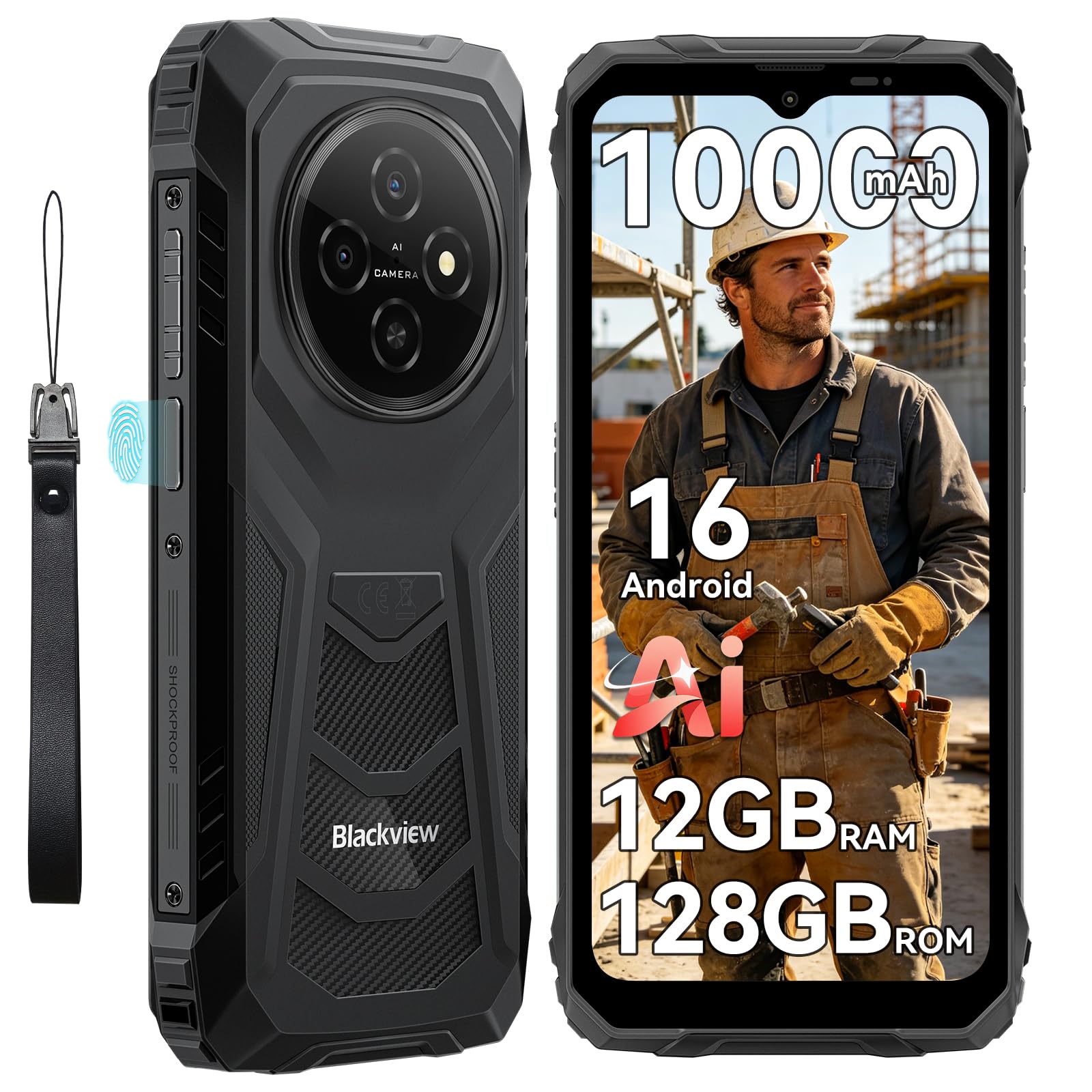
Twenty days of standby on a single charge — if you can live with the size.
The headline here is runtime, not size. Blackview rates this phone at up to 20 days of standby, 20 hours of talk time and 8 hours of video playback from the 10000mAh battery, which is the kind of number that matters if you are away from a socket for a week. It backs that with a 2m drop rating and a 2m, 30-minute waterproof rating plus IP69K, and it carries a panda MN228 screen that Blackview claims is hard to damage. The armoured frame is the point: on a warehouse floor or a campsite, this is a phone you stop worrying about.
The rest of the spec sheet is respectable for the class. A 6.56-inch display at a 720×1612 resolution with up to 450 nits brightness, 128GB of storage that accepts a TF card up to 2TB, dual SIM, NFC, face open up, fingerprint, OTG and Doke OS 4.2 running on an Android base with outdoor tools. It also has a 16MP rear camera and an 8MP front camera. For a phone that also runs a 20-hour talk-time figure, that camera pair is doing a workmanlike job rather than competing with the Jelly Max’s 100MP main lens.
Where the Blackview asks you to compromise is speed and network breadth. Owners describe the software as inconsistent — some find it snappy, some call it slow, and the specs list 4GB of RAM expanded through virtual memory rather than physical memory at the top figure. Network support is GSM-only: T-Mobile, Mint, MetroPCS, Tello and many others work, but AT&T, Cricket, Verizon and US Cellular do not. On a GSM network and prioritizing battery life over speed, it is a solid choice; for responsiveness, look at the Razr instead.
The thing everyone raves about: the battery and the durability pairing. Multi-day use between charges is the pattern, and the sealed body takes knocks, cold and water without drama.
The honest trade-off: it is heavy, the display resolution sits at 720p across 6.56 inches, and speed is the one area where opinions diverge.
Go with it for: long shifts and long trips where charging is a luxury and the phone takes real abuse.
pass on it if: you are on Verizon or AT&T, or you want a small phone.
6. Motorola Moto G05 Dual-SIM 128GB

A clean Android 15 phone with the biggest battery capacity on this list.
Motorola’s G05 carries the largest battery figure in this article: 5200mAh, which beats the Jelly Max’s 4000mAh by a noticeable margin. That pairs with a 6.67-inch IPS LCD screen at 720×1604 pixels (1046 pixels per inch by Motorola’s listing), a 50MP main camera at f/1.8, an 8MP front camera, and dual SIM. Android 15 runs on a Mediatek Helio G81 Extreme chip, and there is a dedicated microSDXC slot alongside the 128GB of storage and 4GB of RAM. Storage and RAM are a step behind the Jelly Max’s 256GB and 12GB, but the camera comparison is closer: 50MP main versus the Jelly Max’s 100MP, and 8MP front versus 32MP.
What people actually praise is the experience — a clean, familiar Motorola Android build with straightforward setup. The Corning Gorilla Glass 3 screen and the 6.52 x 0.32 x 2.99 inch body put it firmly in large-phone territory, so it is not a fit for the compact brief. It is a comfortable two-hand phone for browsing, video and maps.
The one thing to check before you buy is your carrier. This is an international GSM model built for T-Mobile, Metro, Mint, Tello and Ultra, and Motorola explicitly says it does not work on CDMA carriers such as Verizon, Sprint, Boost, Cricket, Xfinity or AT&T. Even on the supported list, some buyers have had trouble: “When I put my IMEI into Tello and Mint, it says this phone is not supported despite it having the right bands,” one buyer reports. Run your IMEI through your carrier’s compatibility checker before you buy.
What earns the nod: the value package — 5200mAh, 128GB, a 50MP main camera and Android 15 in a phone that feels easy to live with.
What to weigh: GSM-only carrier support, and the RAM/storage figures trail the pricier picks.
The right fit for: T-Mobile and Mint users who want a big, friendly Android phone with all-day battery and room for photos.
Not for you if: you need Verizon, AT&T or Cricket, or a genuinely small body.
7. T-Mobile REVVL V+ 5G (Renewed)
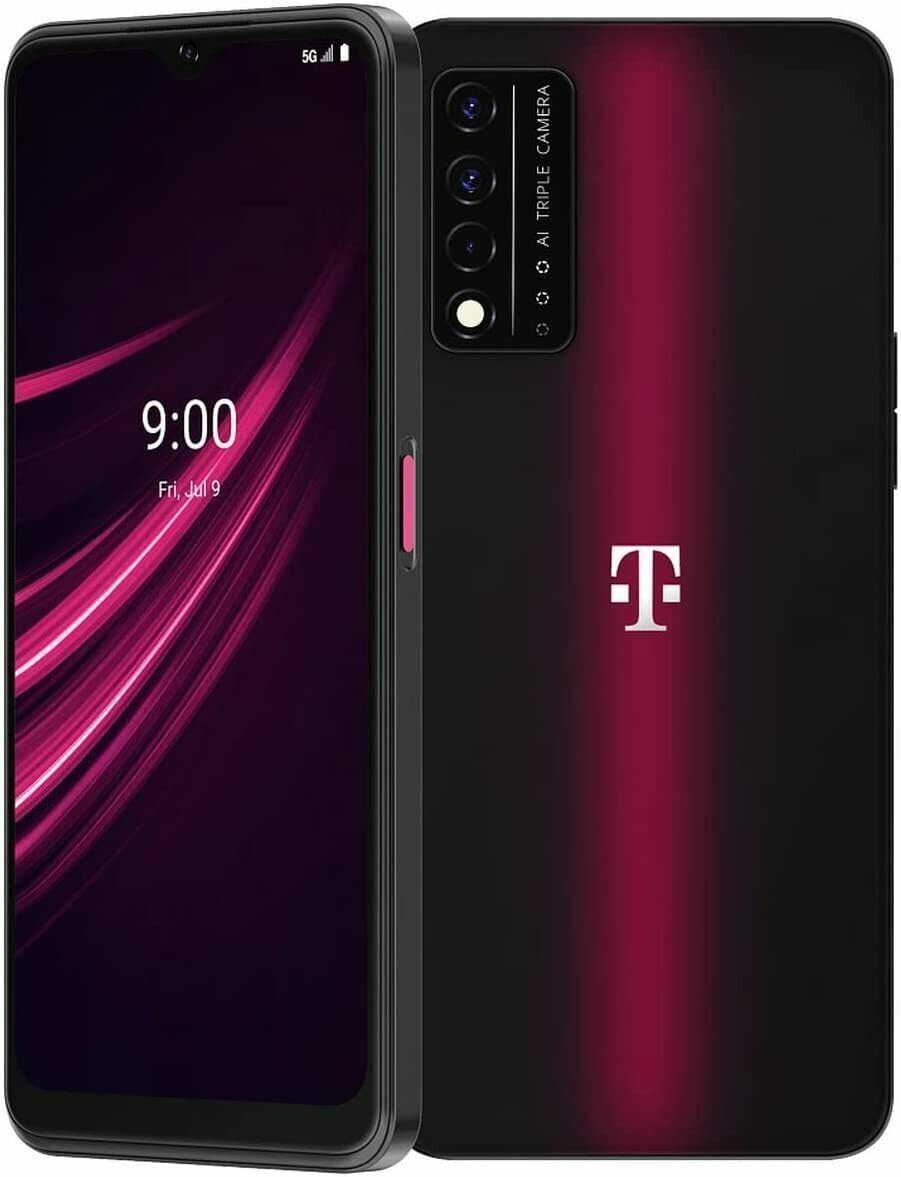
A renewed 5G handset that makes a lot of sense as a spare or travel phone.
Buying renewed is the whole reason this entry exists: it is the least expensive way onto 5G here, and for a backup phone that is a sensible trade. The 6.82-inch HD+ display at 1640×720 is huge for video, and the MediaTek Dimensity 700 processor runs Android with 4GB of RAM and 64GB of storage, expandable up to 2TB with a card (not included). A 5000mAh battery, fingerprint recognition, NFC, Bluetooth 5.1 and VoLTE fill out the practical side. There is a single USB-C cable and a SIM tray ejector in the box.
Owners who use it as a hotspot have had real success — it works with US Mobile’s AT&T, Verizon and T-Mobile networks, and some report pulling down 120Mbps on the AT&T side. You should expect to do a little setup work, though: swapping the SIM is a snap, but getting T-Mobile calls and texts running can require configuring the APN and updating from Android 11 to Android 12 first. That is a weekend project, not a plug-and-play phone.
The renewed condition is what brings the price down, and the hardware reflects it over time. The recurring theme is long-term wear — battery endurance that starts strong and then fades, heat buildup, and one owner reporting “Battery lasts 4 hours but takes 8 hours to charge.” Treat it as a good-value secondary phone rather than a five-year daily driver, and check the renewed seller’s return terms before you buy. As a car hotspot or glovebox spare, the big screen and 5G earn their keep.
What it does well: a big 6.82-inch screen and 5G on a tight budget, with 5000mAh and a 64GB base that takes a memory card.
What you accept with renewed: battery health and heat can vary unit to unit, and setup can take patience.
Buy it as: a cheap 5G spare, a car hotspot, or a first smartphone for someone who mostly watches and calls.
Keep looking if: you need it to be a reliable daily driver for years, or you want a compact phone.
Know the Specs
Screen size and why it does not equal pocket size
Screen size is measured diagonally, corner to corner, in inches — so a 5-inch display tells you how much glass you look at, not how bulky the phone is. The Jelly Max uses a 5-inch panel but stays thick to fit a 4000mAh battery and a telephoto lens, while a folding design like the Razr 2025 keeps a 6.9-inch main screen and still slips into a pocket when closed. Read the thickness and weight alongside the diagonal before you decide a phone is “compact.”
Battery capacity in mAh and what it really buys you
mAh stands for milliamp-hours, a measure of how much charge the battery holds — and higher usually means longer runtime, but screen size and processor eat into it. A tiny 3.3-inch Palm with an 800mAh cell needs multiple daily charges, while a 10000mAh rugged phone can run for days. A 4000mAh compact like the Jelly Max is a reasonable middle ground, especially when the included 66W adapter refills it to 90% in about 20 minutes.
Carrier bands and the GSM versus CDMA question
GSM and CDMA are older network standards that still shape which US carriers a phone works on. Most phones here are GSM-only, which means T-Mobile, Mint, Metro and Tello are fine, but Verizon, AT&T, Cricket and Boost can refuse the SIM outright. Always match the listing’s stated carrier list to your own plan, and on a phone sold as “open up,” confirm the IMEI is accepted before you switch numbers.
RAM, storage and virtual memory
RAM is the short-term working memory that keeps apps open, while storage is where your photos and downloads live. A phone with 12GB of RAM and 256GB of storage like the Jelly Max can hold far more before you feel it. Watch for “virtual memory” claims — some rugged phones count software expansion toward a bigger RAM figure, so read whether the number is physical or boosted.
Common Questions
Is there a real 4.5 to 5 inch smartphone still sold new?
Will the Unihertz Jelly Max work on AT&T or Cricket?
Why does my open up phone say it is not supported by my carrier?
How long does an 800mAh phone battery actually last?
Is a foldable like the Motorola Razr 2025 a good small phone?
What does IP68 or IP69K actually protect against?
Why do rugged phones last so long between charges?
Can a compact phone still take good photos?
Is a renewed phone a safe buy for a spare handset?
Do I need 5G on a small phone?
The Bottom Line
For anyone who genuinely wants a small phone in the 4.5 to 5 inch range, the Unihertz Jelly Max is the one to reach for: a real 5-inch display, 12GB of RAM, 256GB of storage and 66W charging in a body that fits one hand. If pocketability is the whole goal and you want a featherweight companion device, the Palm Phone delivers 2.2 oz on Verizon — as long as you accept its 800mAh battery. And if “small” really means “compact when I need it,” the folding Motorola Razr 2025 gives you a 6.9-inch screen that folds down to pocket size with the versatility of an external 3.6-inch display.
Start with the Jelly Max if carrier support lines up — it is the pick that solves the compact-phone problem without making you give up speed, storage or charging pace.
How we choose
We do not accept paid placement. Every pick is matched to a real buyer and a real use-case; we do not hands-on test units.
Sources
Specifications: manufacturer listings and product documentation. Review insights: verified customer reviews, as of October 2026. Pricing: not shown on this page (it changes often); check the current price via the retailer link.
As an Amazon Associate, Aappliancez earns from qualifying purchases. This does not affect which products we feature.