Disclosure: Some links in this post are affiliate links. As an Amazon Associate I earn from qualifying purchases, at no extra cost to you. Learn more
Specs are compiled from manufacturer listings and verified buyer reviews and can change over time — please confirm the key details on the product page before buying.
A 3-gallon pancake compressor is the smallest tank size that still runs a nail gun and inflates a tire without making you wait all afternoon. That is the whole appeal. It fits on a shelf, it carries in one hand, and it holds enough stored air for trim work and car tires. The trick is picking one that does not deafen you, stall out mid-task, or rattle itself apart on the garage floor.
This guide is built by comparing the manufacturers’ published specifications and the patterns across verified customer reviews, so you get each pick’s real strengths and trade-offs instead of marketing spin.
This list leans on the numbers that actually decide a purchase: tank pressure, motor size, refill speed, and how loud the thing gets when it kicks on beside you. If you came here for a smaller tank that still pulls real work, the 3 gallon air compressor picks below are ordered by how they hold up in daily use.
Top Picks


How To Choose The Best 3 Gallon Air Compressor
Three gallons (about 11 liters of stored air) suits home garages and small jobsites because it holds real pressure yet still lifts into a truck bed. Four numbers decide your pick: the pressure the tank holds, how loud the motor runs, how fast it refills, and how much the unit weighs. Get those right and the rest of the listing copy barely matters.
Max PSI decides which tools will run
Pressure, measured in PSI (pounds per square inch), is the ceiling on what a compressor can drive. A tank that tops out at 110 PSI handles tire inflation, blow guns, and light stapling. A unit rated to 155 PSI pushes harder and keeps a framing nailer fed with less waiting. If your tool list includes impact wrenches or spray guns, buy pressure, not gallons.
Noise level is the spec most buyers wish they had checked
A compressor runs in short bursts, but those bursts are what you live with. Decibels (dB) measure loudness, and a normal conversation sits near 60 dB. Units rated near that mark let you work in a house or a shared garage without ear protection. A motor that measures closer to 84 to 89 dB demands hearing protection and a set of open windows.
Horsepower drives refill speed, not tank size
Horsepower (hp) tells you how quickly the pump rebuilds pressure after a tool drains it. A 0.3 hp motor will get there, just slowly, and a bigger electric motor cuts the wait between nailing passes. Match horsepower to your heaviest tool’s demand and you avoid standing around listening to the pump cycle.
Side-by-Side Comparison
| Model | Best For | Max PSI | Horsepower | Weight | Amazon |
|---|---|---|---|---|---|
| Makita MAC320Q Quiet Series★ Best Overall | Indoor and shared-space work | — | 1.5 hp | — | Amazon |
| Craftsman 3 Gallon Hot DogBest Pressure | Nailing and fast tire fills | 155 PSI | 1.5 hp | 16 pounds | Amazon |
| ECOMAX 3 Gallon Pancake | Kit-included home inflation | 110 PSI | 0.33 hp | 16.3 pounds | Amazon |
| FORNAX Pancake Compressor | Light hauling and small tools | 120 PSI | — | 18.9 pounds | Amazon |
| Ironton Oil-Free Pancake | Stationary garage duty | 110 PSI | 0.33 hp | 20.6 pounds | Amazon |
| McGraw 1/3 HP Pancake | Quick tire top-offs | 110 PSI | 0.33 hp | 16.3 pounds | Amazon |
Detailed Reviews
1. Makita MAC320Q Air Compressor
Our pick — 4.5+★ from 550+ verified ratings; the strongest balance of quality and price.
The compressor you can talk over while it runs, which changes where you can work.
The number that defines this Makita is 60 dB — a loudness level that sits right around a normal spoken conversation. That 60 dB rating is why it earns the top spot: it runs in a finished basement, a garage under a sleeping kid’s room, or a client’s home without apology. Everything else follows from there.
Under the shell sits an oil-free dual-piston pump rated at 1.5 hp, running at a lower 1,750 RPM. That 1,750 RPM speed cuts friction and heat, so the pump wears more slowly across its service life. Compare that 1.5 hp to the 0.33 hp motor on the McGraw and Ironton pancake units and the gap is the difference between a compressor that keeps up with a nail gun and one that makes you wait. The 1.5 hp pump recharges the 3-gallon tank in under a minute, so refill never becomes the bottleneck on a trim job.
The catch is size and weight. Owners who upgraded from a 1-gallon unit report it is noticeably heavier and takes two hands to move. Buyers also describe a bigger footprint than expected, because the compact dimensions printed on the listing don’t match the box on the floor. If your compressor lives on a bench and only moves on occasion, none of that matters. If you carry it up stairs every day, it will remind you.
What earns the top spot
- Runs at 60 dB, quiet enough to hold a conversation beside it
- 1.5 hp oil-free dual-piston pump at a low 1,750 RPM for longer motor life
- Recharges the 3-gallon tank in under a minute between tools
- Full roll-cage construction shrugs off jobsite and truck-bed abuse
- Dual tool ports and gauges let two people work without a splitter
Where it makes you work
- Heavier than a 1-gallon unit and takes two hands to carry
- Physically larger than its listed dimensions suggest
- Premium-tier spend compared with the entry-level pancake options
Built for: anyone working indoors or near other people who cannot tolerate motor racket — the 60 dB rating is the whole reason to buy it.
Think twice if: you need a compressor to ride in a backpack up a ladder all day; the roll cage is solid but the weight is real.
2. Craftsman 3 Gallon Hot Dog Air Compressor, Oil-Free 155 PSI
A hot-dog tank that hits 155 PSI and still lifts with one hand.
Most 3-gallon compressors top out around 110 PSI. This Craftsman pushes to 155 PSI from a 1.5 HP UMC motor, and that extra pressure is what lets it keep pace with a nail gun instead of stalling between shots. One fence builder ran 160 linear feet of nailing without the compressor falling behind. That is the job it was built for.
The hot-dog shape lays the tank flat and low, which is why the whole unit lists at 16 pounds — light enough to grab by the handle and walk it to the truck. The oil-free pump means no oil checks and no oil changes, and the built-in gauge lets you set output pressure and trust it holds through the task. 5 CFM airflow keeps air moving while the motor cycles.
Noise is where expectations and reality part ways. Buyers describe it as loud — one put it plainly: it is noisy enough that quiet neighbors will notice. Others call it no worse than the compressor it replaced, which is fair for the category. The plastic dial and gauge panel also draws some gripes for feeling flimsy next to the solid mechanicals. Treat the panel gently and the rest of the machine is built to take a beating.
The pressure argument: this unit delivers the strongest air spec on this list at 155 PSI (pounds per square inch, the pressure it stores) and 2.6 CFM at 90 PSI (cubic feet per minute, the airflow it sustains). That shows up where it counts — tire fills finish quickly and impact tools get the pressure they need.
One honest note: the plastic gauge panel is the weak point in an otherwise sturdy build, so keep the unit from tipping onto it.
Reach for this if: your work involves nailers, staplers, or bolting — the 155 PSI ceiling keeps tools fed on a 3-gallon tank.
Look elsewhere if: silence is non-negotiable; this one gets loud when the pump kicks in.
3. ECOMAX Air Compressor 3 Gallon

Everything you need to inflate and blow clean, bundled in one box.
Buy a bare compressor and you still need a hose, a chuck, a blow gun, and adapters before you can do anything useful. This ECOMAX ships with all of it: a 25-foot air hose, two quick connectors, a tire chuck, a blow gun, a high-pressure nozzle, an adapter fitting, two inflation needles, a male quick connector, and sealing tape. For a first compressor, that bundle removes a whole shopping trip.
The machine itself is a 3-gallon pancake rated to 110 PSI, pushing 0.6 SCFM at 90 PSI from an oil-free pump. It weighs 16.3 pounds with a flip-up handle, so carrying it to the shed or the driveway is a one-hand job. Dual quick couplers let two tools stay connected at once, and dual gauges show tank and outlet pressure separately.
Here’s the honest part. This is the lowest-rated pick on the list, and the pattern behind that is worth knowing before you buy. Buyers consistently praise its value, versatility, and compact size, with size drawing the most positive mentions of any trait. But some buyers report the motor runs constantly under heavier use and the tank pressure never fully recovers, and the noise runs louder than the advertising implies. It is a compressor for inflation and light blowing, not for driving a nail gun all afternoon.
What it does well: the 25-foot hose and 11-piece kit turn the box into a complete inflation station on day one, and the 16.3-pound frame carries easily.
Where it tops out: sustained tool use drains it faster than it refills, so treat airflow-heavy jobs as outside its lane.
Suits you if: you want one purchase that handles tires, mattresses, and blow-gun cleanup without hunting for fittings.
Not your pick if: you plan to run a brad nailer through a whole room — the airflow spec is the limit here.
4. FORNAX Pancake Air Compressor
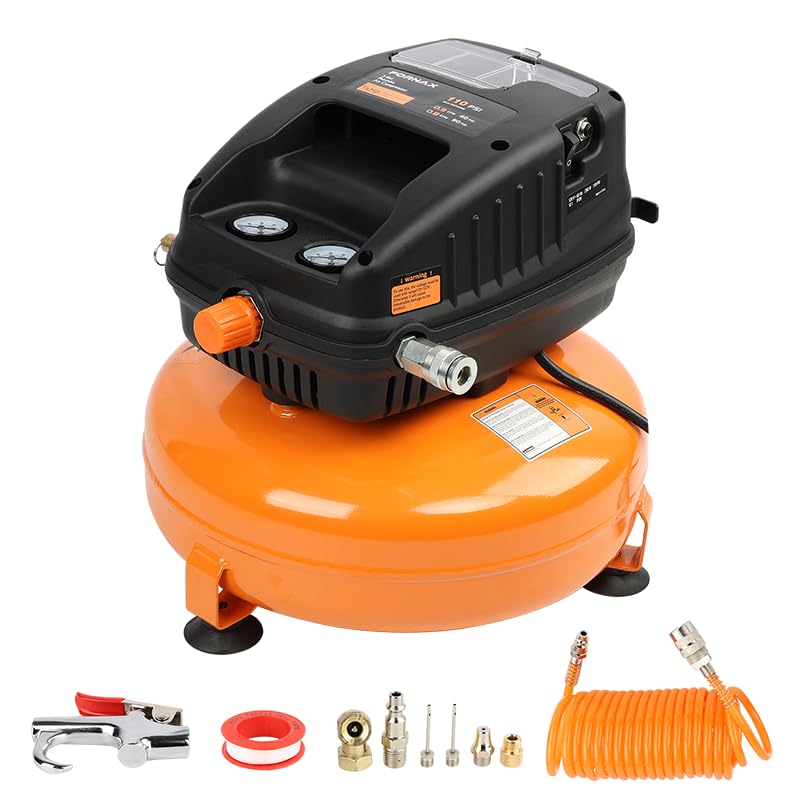
An 18.9-pound pancake with a metal-and-plastic shell that rides on a truck seat.
If lifting matters more than any other trait, the FORNAX makes its case at 18.9 pounds. That is light for a 3-gallon unit, and it shows up in daily use — the tank fits across a truck seat, slides onto a shelf, and does not require a second trip back to the garage. The oil-free pump keeps maintenance to zero, and the 14-piece accessory kit means the hose and fittings are already in the box.
Spec-wise, the tank holds 3 gallons at a max pressure of 120 PSI, moving 0.8 CFM at 90 PSI. That airflow is enough for brad nailers, air inflators, and blow guns, and the listing names spray guns and pneumatic screwdrivers among its uses. The 250-watt motor turns at 4,950 RPM.
Where it stops is the tool drawer. Accessories in the kit also arrive mismatched enough that some pieces need extra adapters to fit together. Know that going in and it does the light work without complaint.
The case for it
- 18.9 pounds makes it genuinely one-person portable
- 120 PSI max pressure on a 3-gallon tank
- 0.8 CFM at 90 PSI runs brad nailers and inflators
- 14-piece accessory kit included in the box
The trade-off
- Air volume runs short for air hammers and sustained nailing
- Some kit accessories need extra adapters to connect
The right buy when: the compressor lives in a truck or moves between floors, and the jobs are tires, trim, and blow-gun cleaning.
Pass on it when: your plans include air-hungry tools that need constant volume, not short bursts.
5. Ironton Oil-Free Pancake Air Compressor

A low, tip-resistant footprint built to sit still on a workbench.
Pick this one up and the first thing you notice is the footprint, not the handle. The wide pancake base keeps the center of gravity near the ground, so it plants itself on a bench and stays put while the pump runs. The 110 PSI ceiling cycles between an auto-on at 85 PSI and an auto-off at 110 PSI, giving you consistent pressure without fiddling with the regulator every few minutes.
The oil-free pump needs no oil checks or oil changes for the life of the unit. A fold-down handle tucks away for storage, and a molded cord wrap and hose retainer keep the power cord and air hose neat on the unit between uses. Airing performance is its strongest trait — owners mention it inflates as effectively as a 6-gallon model, and that trait draws the second-most positive mentions of any feature.
At 20.6 pounds it is the heaviest pick on this list, and that heft is the price of the stability. Refill time and pressure ceiling are also where the complaints cluster: some find it slow to rebuild and short on top-end pressure for bigger tasks, and the motor runs loud — the carton itself lists 84 dB. It is an outdoor and garage compressor, and the spec sheet is honest about that.
What stands out: the wide base plus the auto-cycle at 85 to 110 PSI makes this the most planted, predictable unit here for stationary garage work.
Fair warning: the 84 dB motor is not indoor-friendly, and heavier tools will notice the 0.3 hp ceiling.
Ideal setup: a bench or garage corner where the compressor stays put and gets used for stapling, nailing, and inflation.
Skip the idea if: you need it quiet enough for an indoor room — the decibel rating rules that out.
6. 3 Gallon 1/3 HP 110 PSI Oil-Free Pancake Air Compressor

Sixteen pounds of pancake compressor for tire top-offs and quick jobs.
This McGraw is the budget entry on the list, and the numbers say exactly what it is: a 3-gallon tank, a 1/3 hp motor reaching 110 PSI, and a 16.3-pound body with a fold-down handle. It has a wide base for stability, a cord wrap and hose retainer molded into the shroud, and an oil-free pump that needs no maintenance. For airing up tires and topping off pressure around the house, that combination works.
Compare it to the Makita’s 1.5 hp pump and the gap is plain — 0.33 hp against 1.5 hp is a different class of machine. This one charges up fast for small jobs but takes a while to blow up a full tire, and it is not built to keep pace with a tool that draws air continuously. That is not a flaw so much as a lane, and it stays in it.
The reliability picture is genuinely mixed, and it deserves a straight answer. Some units do the job for years; a minority quit early, with one failure traced to a sheared motor shaft after a couple of hours of running. That is a fit question as much as a quality one — buy this for occasional household inflation and it earns its keep.
Where the value sits: 110 PSI, a 3-gallon tank, and a 16.3-pound frame with a fold-down handle covers household inflation without stretching the budget.
Set expectations: the 0.33 hp motor is for quick, occasional jobs, not continuous tool use.
Best for: the homeowner who airs up tires and blows out debris a few times a month.
Wrong tool for: daily jobsite duty or anything that needs pressure held under constant demand.
Know the Specs
Max PSI
PSI (pounds per square inch) is the pressure ceiling of the tank. Higher numbers let the compressor feed demanding tools like nailers and impact wrenches; lower numbers are fine for tires and blow guns.
Oil-Free Pump
An oil-free pump needs no oil checks or oil changes over its life, which removes maintenance but generally runs louder than an oil-lubricated design.
SCFM / CFM Airflow
CFM (cubic feet per minute) measures how much air moves at a given pressure. It predicts whether a tool runs continuously or stalls between uses.
Tank Capacity
Gallons describe stored air. A 3-gallon tank runs short bursts of tool use and refills between them; larger tanks run longer without recovery cycles.
Common Questions
Can a 3 gallon air compressor run a brad nailer?
How loud is a 3 gallon pancake compressor?
What PSI do I need for car tires?
Is oil-free better than oil-lubricated?
How many gallons do I need for air tools?
Do I need to drain the tank after use?
What does horsepower mean on an air compressor?
Can I use a 3 gallon compressor for spray painting?
The Bottom Line
For most buyers, the 3 gallon air compressor worth owning is the Makita MAC320Q. Its 60 dB (decibels, a measure of loudness) is a spec you feel every time it kicks on, and the 1.5 hp oil-free pump (horsepower, with no oil to check or change) makes the quiet design worth the extra spend. If pressure is the priority, grab the Craftsman 3 Gallon Hot Dog at 155 PSI and 1.5 HP — it keeps a nail gun fed while staying light at 16 pounds. And for the first-time buyer who wants a hose, chuck, and blow gun in one box, the ECOMAX delivers the complete kit. Whichever you pick, check the PSI ceiling against your heaviest tool first — that number decides how useful the compressor will actually be.
How we choose
We do not accept paid placement. Every pick is matched to a real buyer and a real use-case; we do not hands-on test units.
Sources
Specifications: manufacturer listings and product documentation. Review insights: verified customer reviews, as of October 2026. Pricing: not shown on this page (it changes often); check the current price via the retailer link.
As an Amazon Associate, Aappliancez earns from qualifying purchases. This does not affect which products we feature.