Disclosure: Some links in this post are affiliate links. As an Amazon Associate I earn from qualifying purchases, at no extra cost to you. Learn more
Specs are compiled from manufacturer listings and verified buyer reviews and can change over time — please confirm the key details on the product page before buying.
You want to watch an airplane screen or a TV through your wireless earbuds, but the gadget you bought only receives audio — it never sends it. That mix-up is the single most common reason people return these gadgets, and a huge share of “3.5mm Bluetooth transmitter” listings hide it. So before you buy, answer one question about your own setup: does the sound need to leave your device and fly to your headphones, or does it need to arrive from your phone into an old speaker? That one answer narrows these seven devices down to the right one.
This guide is built by comparing the manufacturers’ published specifications and the patterns across verified customer reviews, so you get each pick’s real strengths and trade-offs instead of marketing spin.
The picks below cover both jobs: receivers that add Bluetooth to old hi-fi gear and battery-powered transmitters built for flights and travel. Each one is sorted by what it actually does, so you can stop guessing about your TV, stereo, or next trip and pick the right 3.5mm bluetooth transmitter in a single read.
Top Picks

How To Choose The Best 3.5mm Bluetooth Transmitter
Start with the direction your audio needs to travel. That single question eliminates half the products on the shelf before you check a single spec.
Transmitter vs Receiver — Get This Right First
A transmitter takes sound from a device that is not Bluetooth — a TV, a treadmill, an airplane seat jack — and sends it wirelessly to your headphones. A receiver does the inverse: it takes a wireless signal from your phone and pushes it into an old stereo or speaker that has no Bluetooth of its own. If you want your AirPods to work on a flight, you need a transmitter. If you want your phone to play through a 2003 hi-fi, you need a receiver.
Power: Built-In Battery Or USB-Powered
A battery-powered unit frees you from a wall socket, which matters on a plane seat with no outlet. A USB-powered unit is lighter and never needs charging, but it only works where a USB port lives. Match the power style to where you will actually use the adapter.
Codecs, Range, And Ports
Higher audio codecs like LDAC and aptX carry more musical detail, but only if your headphones support them too. Range matters most at home, while port counts (3.5mm, RCA, dual-prong) decide what you can plug into. Buy for the codecs your own headphones support, not the spec sheet’s bragging rights.
Side-by-Side Comparison
| Model | Best For | Mode | Power | Key Connection | Amazon |
|---|---|---|---|---|---|
| Esinkin Bluetooth Audio Adapter★ Best Overall | Older stereos and hi-fi | Receiver only | USB/AC powered, no battery | 3.5mm and RCA | Amazon |
| UGREEN Bluetooth 6.0 AUX Car ReceiverBest Value | Cars without built-in Bluetooth | Receiver only | USB powered, no battery | 3.5mm AUX and USB | Amazon |
| LAICOMEIN 2-in-1 Bluetooth 6.0 Adapter | Flights and dual-headphone sharing | Transmitter and receiver | Built-in battery, 20+ hours | 3.5mm, RCA, dual-prong | Amazon |
| Twelve South AirFly SE | AirPods on airplane screens | Transmitter only | Built-in battery, 20+ hours | 3.5mm audio jack | Amazon |
| Avantree Relay | Two people sharing one flight screen | Transmitter only | Built-in battery, 25 hours | 3.5mm and dual-prong | Amazon |
| YMOO 2.4GHz Transmitter Receiver Kit | Long-range home audio runs | Transmitter and receiver kit | Mains powered | 3.5mm and RCA | Amazon |
| Avantree Voyager | Travelers who want to see the connection | Transmitter only | Built-in battery | 3.5mm and dual-prong | Amazon |
Detailed Reviews
1. Esinkin Bluetooth Audio Adapter
Our pick — 4.5+★ from 51,000+ verified ratings; the strongest balance of quality and price.
The one that turns a dusty 2003 hi-fi into a phone-streaming machine.
If your stereo, garage receiver, or powered speaker still sounds great but has no Bluetooth, this is the simplest fix going. It plugs into a 3.5mm or RCA cable and works as a receiver — meaning it takes the wireless signal from your phone and feeds it into that old gear. Pairing runs through one large button on the front: a single press connects or disconnects, and holding it for 3 seconds powers the unit on or off. It then reconnects to your last device automatically the next time you switch it on.
Indoors with no walls in the way, the wireless reach runs 30 to 40 ft (10 to 12 m), so you can leave the phone on a counter and still control the playlist across the room. It ships with an AC adapter, a USB cord, and an RCA-to-AUX cable, and it works with phones, tablets, laptops, computers, and any powered speaker or A/V receiver. What wins people over is that it just keeps doing its job — the auto-reconnect is the part buyers rave about. As the review pages sum it up: “I walk all over the house and yard and doesn’t disconnect.”
The honest catch is that this unit is a receiver only — it cannot send audio out to wireless headphones, so it is the wrong tool for a flight or a TV you want to listen to privately. There is also no built-in battery, so it needs to sit near a USB port or wall outlet. The pairing is one-click simple with a single device, though with several phones paired it can occasionally grab the wrong one after a pause — a small quirk, not a deal-breaker.
What earns the top spot
- One-button pairing and automatic reconnect to your last device
- 30-40 ft indoor range, so you can roam while the music keeps playing
- Works from both 3.5mm and RCA outputs, covering stereos and powered speakers alike
Where it stops short
- Receiver only — it cannot transmit to wireless headphones
- No battery, so it needs a nearby USB or AC outlet
- With many paired devices it sometimes connects to the wrong one after a pause
Bring it home if: you have a stereo, receiver, or powered speaker with no Bluetooth and want the cheapest reliable path to streaming.
Leave it on the shelf if: your goal is to use AirPods on a plane or TV — that job needs a transmitter, not this.
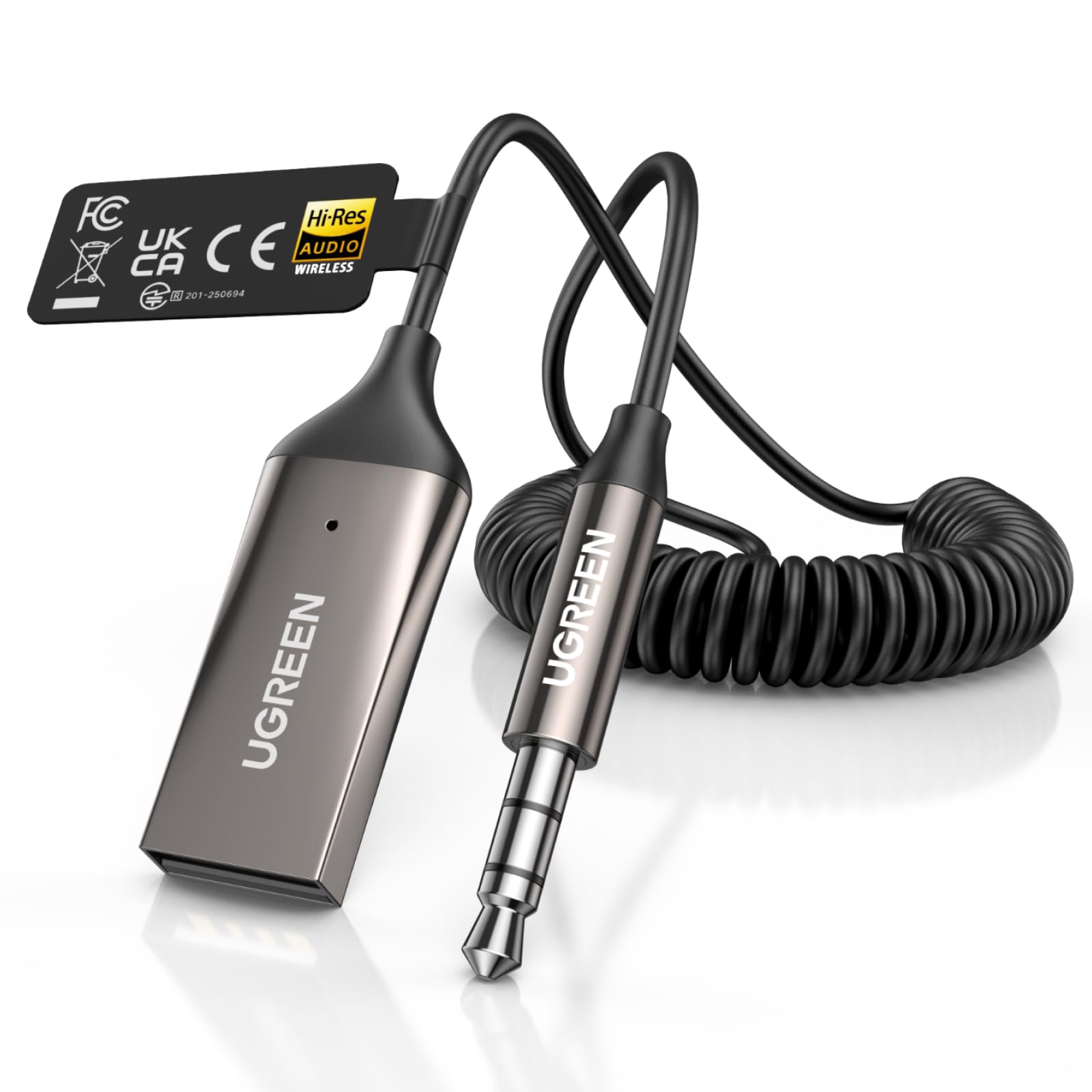
2. UGREEN Bluetooth 6.0 AUX Car Receiver with LDAC
The tiny car fix that gives an old stereo hands-free calling and cleaner sound than an FM transmitter.
You drive a car with a 3.5mm AUX jack (the round headphone-style socket) but no factory Bluetooth, and this compact receiver slots in with almost no footprint. It uses a Bluetooth 6.0 chipset (a newer generation of the wireless chip that talks to your phone) for a stable, low-latency connection, so your music and calls stay in sync instead of lagging behind. It supports LDAC — a high-resolution audio codec (a format that carries more musical detail than a standard Bluetooth signal) — so streaming from a compatible phone sounds richer. It also has a built-in microphone for hands-free calls routed through your car speakers, so you keep both hands on the wheel.
Setup is genuinely plug-and-play. It remembers up to 5 paired devices and reconnects to your phone automatically once you start the car, and it can hold two devices at once for sharing. Buyers report it in use on a “2012 Dodge Caravan factory premium stereo, no built-in BT,” where it delivers clear audio without the static and pops of an FM transmitter. The zinc alloy connectors and flexible TPE cable are built to survive daily car life, and it draws power from a USB port, so there is no battery to charge or replace.
One real limitation: it is a receiver only, so it streams from your phone into the car and cannot send audio out to wireless headphones. It also needs both a 3.5mm AUX socket and a USB port in your vehicle to work — check your dash before ordering. Track control stays on your phone rather than the car’s buttons, and if you park near the vehicle your phone can sometimes default to it. On sound it lands in the same league as a wired AUX cable and clearly ahead of the FM transmitters it replaces. A sure-footed, low-cost entry point for anyone modernizing an older car stereo.
The daily-driver appeal: automatic reconnect on every ignition, plus LDAC detail for anyone streaming high-resolution audio from a compatible phone.
Worth checking first: your car needs a 3.5mm AUX jack and a USB port, and phone track controls replace the steering-wheel buttons.
Match made in the garage: older cars with an AUX input and a USB outlet that need wireless music and hands-free calls.
Wrong lane for: anyone hoping to transmit audio out to headphones — this one only receives.
3. 2026 Upgrade Pro Bluetooth 6.0 Transmitter Receiver
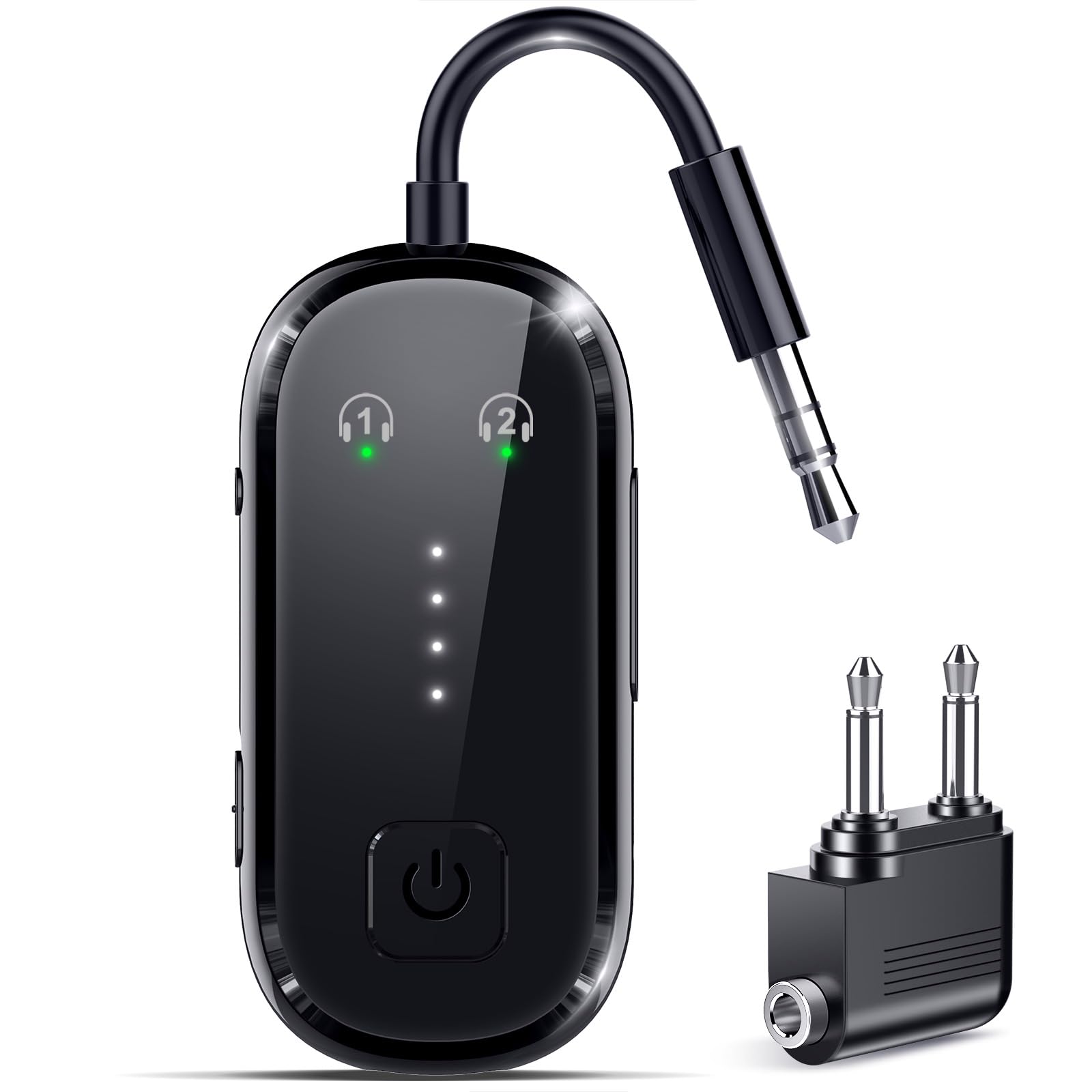
Buy one and cover both directions — it transmits and receives.
One gadget that goes both ways beats a single-direction box, because this adapter runs in TX mode (transmit mode, which sends audio out) to connect an AUX or RCA source like a TV or an airplane seatback to your wireless headphones, and in RX mode (receive mode, which pulls a wireless signal in) to feed your phone or tablet into a speaker that lacks Bluetooth. That flexibility is what owners love: the review pages note it “can be used as both a transmitter and receiver.” Its strongest draw is the connection itself, which holds steady across Apple and Samsung gear alike, and setup takes seconds with instant pairing the moment you power it on.
Travel is the clear target here. The built-in battery delivers over 20 hours of playback, which covers long flights, and it recharges fully in 1.5 hours over USB-C while still running. In TX mode you can pair two sets of headphones at once for shared inflight listening. The kit even includes a dual-prong airplane adapter and a QR guide, so you are ready for a seatback screen without buying extra parts. It is compact and lightweight enough to slip into a pocket or bag, with a dedicated mode button and LED status lights.
Two honest notes. First, it is not built for live instruments, karaoke, or 2.4GHz-sync devices — this is for playback, not performance. Second, connection can take a moment, so be patient on first setup rather than assuming it failed. A few owners want a more precise battery readout than the simple indicator allows. For a one-device-does-both solution that still travels well, this is a smart pick. Cable storage is built in, which keeps the whole thing tidy between uses.
Reasons it stands out
- Two-way TX and RX modes cover headphones, TVs, and Bluetooth-less speakers
- Over 20 hours of battery with USB-C charging in 1.5 hours while in use
- Dual-headphone pairing in TX mode for shared listening, plus a dual-prong airplane adapter included
Points to weigh
- Not built for live music, instruments, karaoke, or 2.4GHz-sync devices
- Connection can be a bit slow on first setup
- Battery indicator is basic, without a digital percentage readout
Reach for it when: you want one adapter that both sends audio to your headphones and receives it into a speaker, and you travel with it.
Steer away if: you need it for instruments or karaoke — those uses are outside what this device is built to do.
4. Twelve South AirFly SE

The name travelers reach for when they want AirPods to work on a seatback screen.
This is a purpose-built transmitter: it plugs into any 3.5mm audio jack — in-flight entertainment, gym equipment, a TV, a gaming device — and beams that audio wirelessly to your AirPods, earbuds, or Bluetooth headphones. If you have watched a movie through standard airline headphones, you already know why this exists. It pairs in seconds with no app involved, holds a stable connection, and swings between your paired devices without fuss. There are on-unit volume buttons for direct control, and its small, snug shape means it disappears into a bag or pocket between trips.
Battery life is the headline: over 20 hours on a single charge, and you can keep using it while it charges over the included USB-C cable, so a long-haul flight will not drain you dry. In practice it flies the distance — owners mention it lasting an entire 10-hour flight and recharging fast afterward. It plays well with more than Apple gear, pairing easily with Beats and other brands too. That breadth across Apple, Beats, and other brands is why it earns its spot here.
It is a transmitter only, so it will not pull wireless audio into an old stereo — for that direction you want the Esinkin above. A few owners have hit a sound drop every 30 to 60 minutes requiring a quick restart, and initial pairing can occasionally take a second try with non-Apple earbuds. Neither is typical, but worth knowing. If your main use is flights and gyms, this delivers precisely what it promises with no app to manage and no re-pairing each time you sit down.
Why travelers shell out: the automatic pairing memory means you plug in, power on, and listen — no fiddling with settings in a cramped seat.
One thing to understand: it only transmits, so it cannot bring Bluetooth into a non-wireless speaker, and a rare unit needs an occasional restart mid-listen.
Your pick if: you fly, use gym equipment, or watch a TV through wireless earbuds and want a proven, app-free transmitter.
Look elsewhere if: you need to receive audio into an old hi-fi — that is the opposite job.
5. Avantree Relay
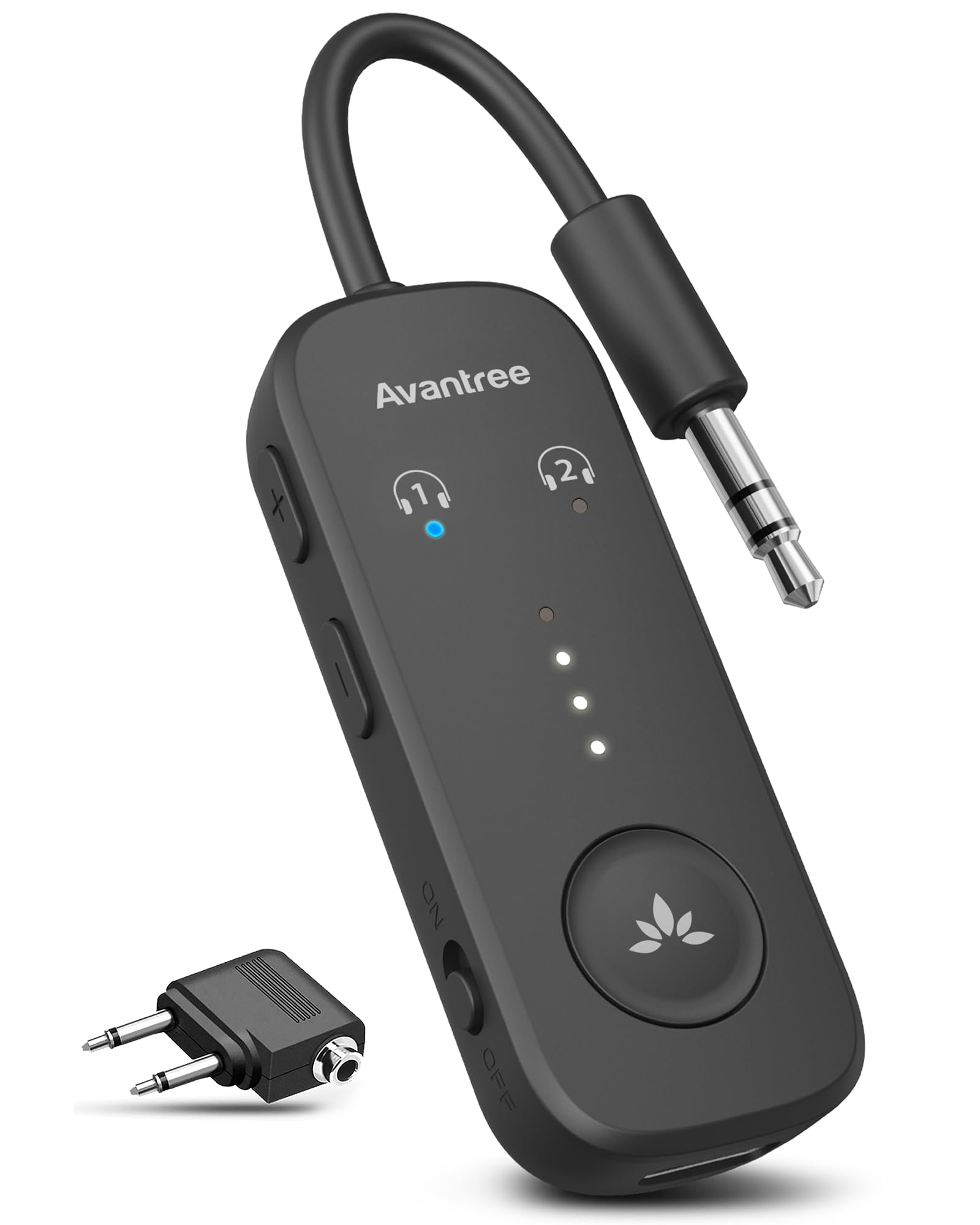
Two passengers, one seatback screen, zero tangled cords between you.
Traveling alongside someone who also wants in on the movie? This transmitter connects two pairs of Bluetooth headphones or earbuds to a single airplane entertainment screen, so you both listen together without splitting a cable. It leans on Qualcomm audio technology with aptX Adaptive and aptX HD support for stable, detailed sound with compatible headphones. Plug it into the 3.5mm jack, put your headphones in pairing mode, and connect — three steps, and a dual-prong airplane adapter is in the box so the seatback socket is covered.
Battery is where it pulls ahead of nearly everything here: up to 25 hours of playtime, with onboard volume controls and a clear battery indicator so you are never guessing mid-flight. Owners put it to work on genuinely long hauls — one reports roughly half the battery used across an 8-hour flight, working while charged over USB-C. Range runs 10 to 15 ft with no dropout, comfortably enough to keep your headphones on and your seat tray tidy. Travelers who compare it against pricier names come away impressed by the value.
It is a transmitter only — no microphone, so it is not for phone calls, and it is not intended for TVs, hearing aids, or musical instruments. Pairing two sets of headphones can take a little patience, and it helps to disable other Bluetooth devices nearby so the Relay grabs the right one. That said, on an eight-hour red-eye it does exactly what a long flight demands. If your trips are long and you rarely travel solo, this is the one built for it.
Built for the long haul
- Up to 25 hours of battery covers long-haul flights without a mid-air recharge
- Connects two pairs of headphones to one screen for shared listening
- aptX Adaptive and aptX HD support deliver detailed audio with compatible gear
Before you commit
- Transmitter only — no microphone, so no hands-free calls
- Pairing two headphone sets can take a few tries
- Not intended for TVs, hearing aids, or musical instruments
Perfect for: couples or travel partners on long flights who want to share one screen with two sets of headphones.
Not the one if: you travel solo and value a lighter, simpler single-headphone transmitter.
6. YMOO 2.4Ghz Wireless Audio Transmitter Receiver
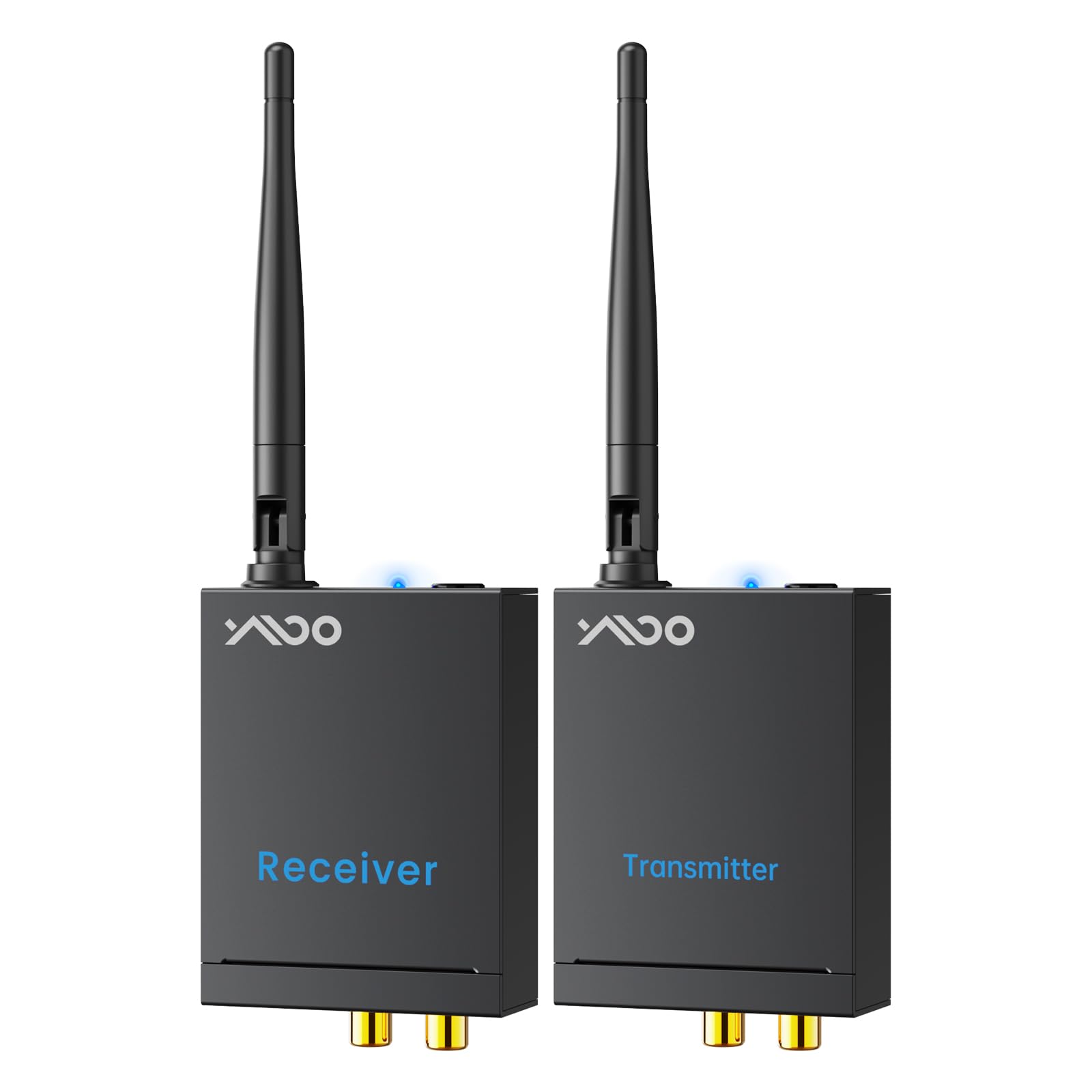
Not Bluetooth — a 2.4GHz pair built to cross a whole house without dropouts.
When the run from your TV or stereo to a distant speaker is simply too long for a wire, this two-piece kit is the answer. It uses 2.4GHz wireless (the same frequency family as many wireless peripherals) rather than Bluetooth, and the included antennas reach up to 320 feet (100m) in an open space and 60 feet (20m) through one or two walls. That reach is the reason to choose it: you can send audio from a basement CD unit or a living-room TV up to a first-floor or backyard powered speaker and still get a clean signal.
You get a matched transmitter and receiver in one kit — the transmitter takes your TV, PC, or MP3 player, the receiver feeds your powered speaker or soundbar — and both units turn on and connect to each other automatically, so you skip the pairing dance. Audio runs at 24-bit stereo, which the maker compares to CD quality, and the design keeps latency (the delay between picture and sound) under 20ms so dialogue stays in sync with the picture. The metal shell resists drops and knocks, and both units carry 3.5mm and RCA jacks (the two common analog audio connectors), with two RCA-to-3.5mm cables in the box. Setup is genuinely easy — the review pages call it “just works from the start,” and one user ran it to stage monitors over XLR adapters for a live event.
Two things to plan around. First, it needs powered speakers — passive speakers require a separate amplifier, so it will not drive an unpowered cabinet directly. Second, it does not support HDMI and wants to stay away from your Wi-Fi router, since 2.4GHz/5.8GHz interference can shrink the range. Signal can occasionally arrive a little crunchy if something else is crowding the band. For long cable-free home runs between rooms or out to a patio, though, this beats what Bluetooth can stretch to.
The case for the kit: 320 feet of open-space reach and 24-bit stereo with sub-20ms latency give you whole-house audio that a short-range Bluetooth link cannot match.
The fine print: it needs powered speakers or an amplifier, skips HDMI entirely, and prefers to sit clear of your router.
Made for: moving audio across rooms, floors, or out to a patio where a speaker has no wired path to the source.
Skip the swap if: you need real Bluetooth, HDMI, or headphones — this is a hardwired-in, powered-speaker setup.
7. Avantree Voyager Airplane Bluetooth Adapter

The transmitter that shows you exactly what is connected before the movie starts.
Most transmitters in this class leave you guessing whether the pairing actually took, but this one shows you: an OLED display (a small screen that lights up each pixel itself) spells out your connected device, battery level, and audio status in plain view. That single feature ends the “is it working?” moment before takeoff. It runs Bluetooth 5.4 (the latest version of the standard) and is Auracast ready (Auracast is a broadcast feature that lets one source send audio to many headphones at once), so it can work not just with today’s AirPods and Bose headphones but with next-generation Auracast headphones and receivers, and it includes a dual 3.5mm adapter and a travel pouch.
The setup is quick and the connection holds. Owners pair it to AirPods and AirFly-style earbuds with almost no lag and get a battery that lasts a full flight — the review pages keep returning to two things: easy pairing and excellent sound with minimal delay. It also works on TVs with a 3.5mm AUX output, connecting audio to wireless headphones. Notably, it can even run to Auracast-enabled Philips Hearlink 9050 hearing aids for audiobooks and music, which is a rare capability in this field.
Read the fine print before you commit. It is a transmitter only and is explicitly not for hearing aids beyond the Auracast case, phones, tablets, musical instruments, or TVs without a 3.5mm AUX output — so it is not a hands-free calling device. Classic Bluetooth also supports a single headset at a time here, and the best low-latency, high-quality sound depends on headphones that support aptX Adaptive or aptX-HD. Buy it as a flight-and-wired-TV transmitter and it delivers exactly that, with a level of on-screen clarity few rivals offer.
what separates it
- OLED display confirms the connected device, battery, and audio status at a glance
- Bluetooth 5.4 with Auracast readiness for today’s and tomorrow’s headphones
- Included dual 3.5mm adapter and travel pouch make it flight-ready from the start
What to know going in
- Transmitter only, with no microphone for calls
- Classic Bluetooth connects a single headset at a time — no dual pairing
- Not for TVs without a 3.5mm AUX output or for musical instruments
Buy it if: you travel often and want a transmitter that shows you its status and grows into Auracast audio.
Pass if: you need dual-headphone sharing or hands-free calls — this model does neither.
Know the Specs
Transmitter vs Receiver
These are opposite jobs and the most common source of buyer confusion. A transmitter takes sound from a non-Bluetooth source — a TV, treadmill, or airplane jack — and sends it to your headphones. A receiver takes a wireless signal from your phone and feeds it into an old stereo or speaker. Some units do both, some do only one, so always confirm which before buying.
LDAC, aptX, And Stereo Clarity
Codecs like LDAC and aptX carry more audio detail than a standard Bluetooth signal — but only if your headphones support them too. Look past the badge and check your own gear. Where a device advertises 24-bit stereo or sub-20ms latency, that is the practical promise: fuller sound and dialogue that stays in sync with the picture.
Range And Interference
Bluetooth reach is usually measured indoors with no walls in the way, so real-world distance shrinks fast behind brick or sheetrock. A 2.4GHz kit can stretch much farther but must stay clear of your Wi-Fi router, which crowds the same band and can cut its effective range.
Battery, Power, And Ports
Some units carry a built-in battery for flights where no outlet exists; others draw power from USB and never need charging but must sit near a port. Match the power style to your setting, then check the ports — 3.5mm, RCA, USB, or dual-prong — to confirm they fit your own equipment.
Common Questions
Will a 3.5mm Bluetooth transmitter let me use my AirPods on a plane?
What is the difference between a Bluetooth transmitter and a receiver?
Does the Esinkin adapter work with headphones?
How long does the battery last on a travel transmitter?
Can I connect two sets of headphones to one Bluetooth transmitter?
Will the UGREEN AUX receiver work in my car?
Is the YMOO kit Bluetooth or something else?
Do I need LDAC or aptX to get good sound?
Can I use a 3.5mm transmitter with my TV?
Do I need to recharge these adapters to use them?
The Bottom Line
For the widest range of buyers, the most useful 3.5mm bluetooth transmitter is the Esinkin Bluetooth Audio Adapter, because it turns almost any old stereo or powered speaker into a wireless player with one-button pairing and automatic reconnect. If your real need is flights and travel, grab the Twelve South AirFly SE for its over-20-hour battery and app-free pairing. And for sharing one screen with a travel partner, the Avantree Relay is the one to reach for with its 25-hour battery and dual-headphone link. Whichever direction your setup calls for, one of these seven adapters covers it.
How we choose
We do not accept paid placement. Every pick is matched to a real buyer and a real use-case; we do not hands-on test units.
Sources
Specifications: manufacturer listings and product documentation. Review insights: verified customer reviews, as of October 2026. Pricing: not shown on this page (it changes often); check the current price via the retailer link.
As an Amazon Associate, Aappliancez earns from qualifying purchases. This does not affect which products we feature.