Disclosure: Some links in this post are affiliate links. As an Amazon Associate I earn from qualifying purchases, at no extra cost to you. Learn more
Specs are compiled from manufacturer listings and verified buyer reviews and can change over time — please confirm the key details on the product page before buying.
If you want one answer up front: the dual-hose ZAFRO 16,000 BTU is the best overall pick here, because its inverter compressor and twin-hose design cool in a steady, even way instead of the on-off blasting most portable units fall back on. The real question for a big room is whether the unit can hold a temperature without running flat out all day, and that depends on three things: whether it pulls in outside air through a second hose, whether the compressor can slow down instead of switching off, and whether you have to empty a water tank every night. Get those right and a 20,000 BTU-class portable air conditioner (BTU measures how much heat the unit moves each hour) cools a whole apartment instead of just blowing cold air.
This guide is built by comparing the manufacturers’ published specifications and the patterns across verified customer reviews, so you get each pick’s real strengths and trade-offs instead of marketing spin.
Coverage, compressor type, and drainage are the three numbers that decide how a big unit actually feels day to day, and below those are compared side by side.
Top Picks
How To Choose The Best 20000 BTU Portable Air Conditioner
The single mistake most people make with a portable unit this size is buying on the BTU number alone. The box number is measured under ideal lab conditions, while the rating that reflects real-world cooling is the smaller SACC figure printed underneath it. A machine sold as 16,000 BTU, for example, typically carries a 12,000 BTU SACC rating, and that lower number is the one to size your room against. Size the unit to the room first, because an undersized one runs at full power all day and still never catches up.
Dual hose versus single hose
A portable AC has to push hot air out of a window hose, and that act creates a slight vacuum in the room, which pulls warm outside air back in through every gap. A dual hose setup (one hose in, one hose out) removes that pressure problem, so the cooling you pay for stays in the room. Dual hose machines tend to cool faster and hold a more even temperature, which matters most in open-plan spaces and rooms with big windows. Single-hose units still work, but they fight the room a little more.
Inverter compressor versus standard
A standard compressor only knows two settings: roaring full tilt or off, and it cycles between them all day. An inverter compressor (one that can dial its own speed up and down) matches its output to the heat in the room, so it holds a steadier temperature and draws less power once the room is cool. That steadiness is also what keeps the noise level low, because the loudest part of a portable AC is the moment the compressor kicks back in.
Side-by-Side Comparison
| Model | Best For | Cooling Power | Coverage | Quietest Level | Amazon |
|---|---|---|---|---|---|
| ZAFRO 16,000 BTU Inverter★ Best Overall | Large rooms needing even, fast cooling | 16,000 BTU | 800 sq. ft. | 42 dB | Amazon |
| Temprium 16,000 BTU Dual HoseHeats Too | Heating and cooling in one unit | 16,000 BTU | 750 sq. ft. | 40 dB | Amazon |
| AGTANA 16,000 BTU Dual HoseBest for Big Rooms | Overcoming window pressure in big rooms | 16,000 BTU | 750 sq. ft. | 42 dB | Amazon |
| KoolSiln 16,000 BTU Inverter | Sleep-focused quiet and fast cooldown | 16,000 BTU | 800 sq. ft. | 40 dB | Amazon |
| TECXERLLON 16,000 BTU | Garages and home offices with high moisture | 16,000 BTU | 850 sq. ft. | 45 dB | Amazon |
| QLF 16,000 BTU | Renters wanting a compact footprint | 16,000 BTU | 800 sq. ft. | 40 dB | Amazon |
| HoneyNov 16,000 BTU WiFi | Temperature-conflict bedrooms | 16,000 BTU | 750 sq. ft. | 40 dB | Amazon |
| NYpeak 16,000 BTU 5-in-1 | Small bedrooms and apartments | 16,000 BTU | 850 sq. ft. claimed | 40 dB | Amazon |
| DOMANKI 16,000 BTU Inverter | Long daily runtimes that keep bills low | 16,000 BTU | 850 sq. ft. | 42 dB | Amazon |
| Whynter ARC-1230WN | Studios and bedrooms that need proven reliability | 14,000 BTU | 600 sq. ft. | — | Amazon |
| ZAFRO 16,000 BTU 38dB | The quietest sleep setup for large rooms | 16,000 BTU | 800 sq. ft. | 38 dB | Amazon |
Detailed Reviews
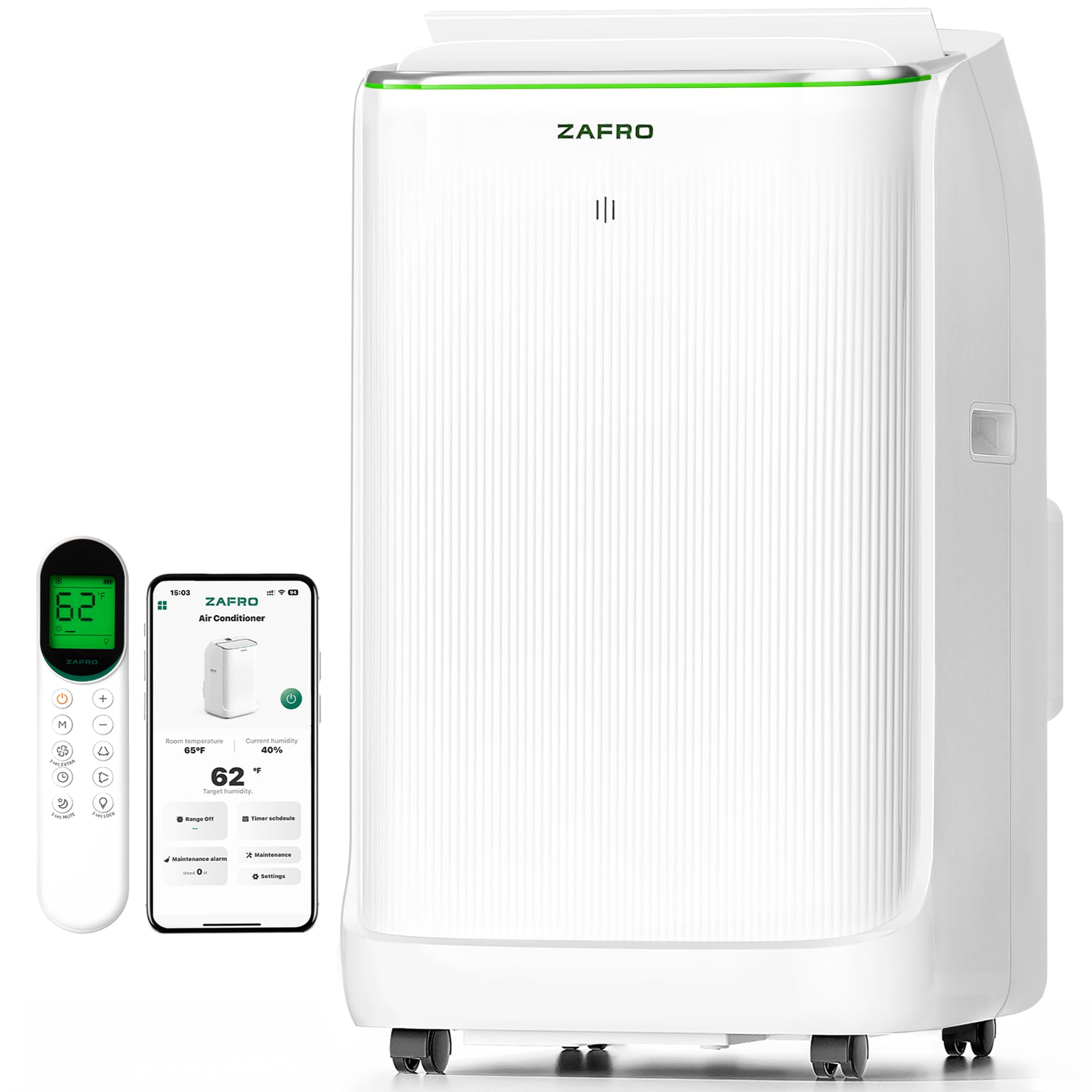
1. ZAFRO 16000 BTU
Our pick — 4.0+★ from 400+ verified ratings; the strongest balance of quality and price.
The dual-hose inverter that holds 800 square feet without you ever touching a drain pan.
Start with the one figure that separates this ZAFRO from most of the field: 500 cubic meters per hour of airflow, fed by two hoses instead of one. That second hose is why the unit pushes air out of the window without sucking hot outside air back in, so the room actually cools instead of being cooled and re-heated at the same time. Its CEER of 12.8 sits well above the 7.83 standard, so each unit of electricity delivers more cooling than a basic machine manages.
What wins people over is how steady it feels in a big open space. Buyers report running two of these as backup when central air failed, and in a 30-year-old open-concept house the pair held the interior at 78–80°F while it was 91°F outside. A large bedroom on a single unit settles around 70°F. That performance comes from the inverter compressor, which speeds up and slows down rather than slamming on and off, so the temperature barely drifts and the noise stays down at 42 decibels — the level of a normal conversation, not the roar most people associate with a portable AC.
Then there is the drainage story, which is where a lot of these machines quietly annoy their owners. This one’s self-evaporating system sends the collected moisture back over the condenser coils to be blown out the exhaust, and in humidity under 90% that means up to 72 hours with no manual draining at all. Six modes — Cool, Dry, Fan, Sleep, Extra, and Eco — plus a 24-hour timer and four-way oscillation give you real control, and the Extra mode locks the thermostat at 61°F and runs flat out when a heat wave hits. The one honest caveat: the exhaust hose itself runs hot, so it pays to wrap it, and the wide dual hoses need roughly a foot and a half of clear space at the window, which is tight in a cramped room. At 4.0+ stars across 400+ ratings, the crowd has clearly made its mind up.
What earns it the top slot
- Dual-hose design cools without pulling hot outside air back in, so 800 square feet of coverage actually holds
- Inverter compressor keeps the temperature steady and the noise at 42 dB
- Up to 72 hours drainage-free in humidity below 90%, so no nightly tank emptying
- Six modes, a 24-hour timer, and app or remote scheduling for pre-cooling before you get home
Where it asks a little patience
- The exhaust hose radiates heat, so insulating it makes a real difference
- The twin hoses eat about 18 inches of floor space at the window, which is a squeeze in small rooms
- The remote occasionally fails to talk to the unit, though the app picks up the slack
Buy it for: a large living room, a loft, or any open plan where the air needs to stay even rather than pulse hot and cold.
Look past it if: your window setup leaves you barely a foot of space to route the two hoses.
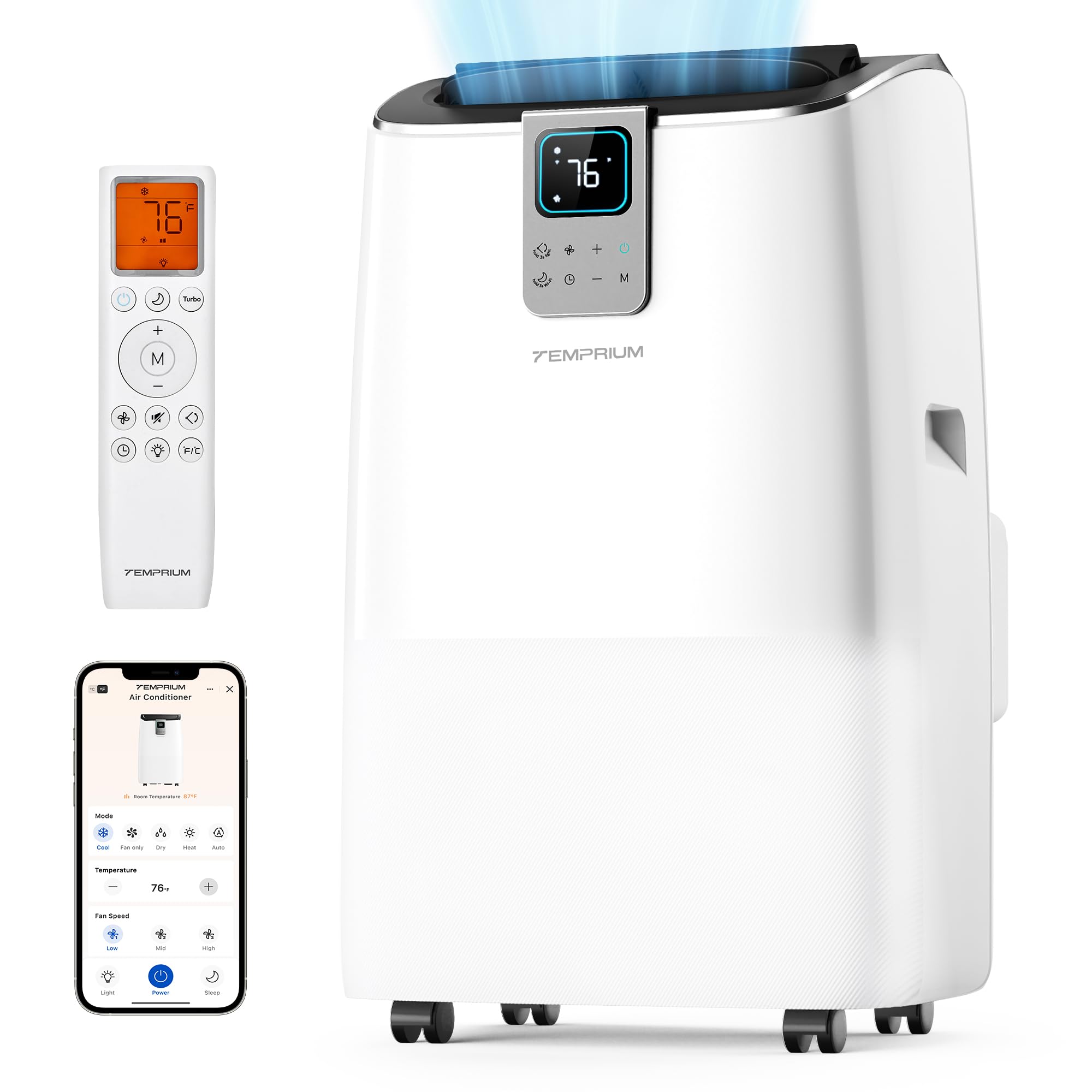
2. Temprium 16,000 BTU Dual Hose
The rare portable unit that warms the room as well as it cools it.
If you want one machine to handle both ends of the year, this is the pick, because it carries a 10,000 BTU heating rating in addition to its 16,000 BTU of cooling. That means a chilly spring morning or an unheated garage office is covered by the same unit taking up one corner. It runs through eight modes — Cool, Heat, Dry, Fan, Sleep, Silent, Turbo, and Eco — and at 40 decibels in its Silent setting it sits right at the quiet end of this whole list, quieter than a whisper.
The hardware under the shell is a brushless DC motor paired with an inverter compressor, and the payoff is an annual energy figure of 938 kilowatt hours per year. For context, the AGTANA also in this list lists 592 kilowatt hours per year, so the Temprium draws more over a full year of running, which is the trade-off you accept for having heat on board. Coverage is quoted at 750 square feet and the cooling is described by owners as a genuine powerhouse, with the unit bringing a whole house down to a comfortable 71°F.
Setup is the part people notice first, because it ships with two exhaust hoses, a window panel, three extension panels, foam seals, and a drain hose — everything you need for a standard sliding or hung window. You also get hands-free voice control through Alexa and Google Assistant, so you can switch it on without getting up. What to weigh before buying: at 938 kilowatt hours per year it is not the cheapest unit here to run, and 750 square feet is a shade less coverage than the ZAFRO above. It is a strong choice for someone who values the heating function and the voice controls over the lowest possible yearly power draw.
Best for shoulder seasons: a unit that switches from cooling to 10,000 BTU of heat without a second appliance.
Worth knowing: ask yourself how often you would actually use the heat function, because you are paying for it in the yearly power figure.
Reach for this one if: your space swings between too hot in July and too cold in April and you want one box to fix both.
Leave it on the shelf if: you only ever need cooling and would rather have the lower annual energy draw.
3. AGTANA 16000 BTU Dual Hose
A dehumidifier disguised as an air conditioner, pulling 96 pints of moisture a day.
The number that stands out here is 96 pints — that is how much moisture this unit can pull out of the air per day in dehumidify mode. In a damp basement or a coastal apartment, that is the difference between a room that feels cool and a room that actually feels dry, and it is the kind of capacity you usually only see on a dedicated dehumidifier. Cooling comes from a 16,000 BTU (12,000 SACC) inverter compressor on the same dual-hose design, which avoids the negative pressure that pulls outside heat back in — the company’s stated reason it cools 45% faster than a comparable standard unit.
It covers up to 750 square feet, and the annual energy figure lands at 592 kilowatt hours per year — by far the leanest figure in this whole comparison, well under the annual 1000 to 1158 kilowatt hours per year the larger-room units list. So if this machine ran all summer, it would draw meaningfully less power than most of the alternatives here, which is a real point in its favor for anyone running it day after day.
It is not a featherweight at 53 pounds, but the 360° wheels and hidden handles make moving it between rooms manageable, and the dual-hose window kit installs in about 10 minutes with no drilling. The trade-off worth flagging: several buyers noted the included window piece needed trimming to fit a smaller opening, so if you are not handy with a saw, measure your window carefully before committing. The quietest setting runs around 42 decibels. This is the pick for someone cooling a genuinely large, humid space who also wants the power bill kept in check.
The energy argument: at 592 kilowatt hours per year it is the lowest draw in this lineup, which adds up over a long summer.
The catch: the window kit may need cutting to fit, and at 53 pounds it is a two-hands job to reposition.
The right call for: humid coastal rooms, finished basements, and any large space where you want the air dried as well as cooled.
Think twice if: your window opening is on the small side and you would rather not modify the included panel.
4. KoolSiln 16,000 BTU Inverter Portable Air Conditioner

Built for light sleepers — this one fades below 40 decibels when the lights go out.
For anyone who has ever lain awake listening to a portable AC clunk on and off, the headline spec here is the noise floor: below 40 decibels in sleep mode, which is around the level of a quiet library. That is quieter than the 42 dB the ZAFRO and AGTANA run at, and the kind of gap you notice at 2 a.m. The new-generation inverter compressor is what makes it possible, since it eases the speed up and down instead of cycling hard, and sleep mode also dims the display and softens the airflow so nothing glows or blows at your face through the night.
The cooling hardware is a 16,000 BTU inverter system paired with an enlarged 77° air outlet and R32 refrigerant, a newer, lower-impact formulation that the spec list credits for faster, greener cooling. The unit is rated to cool up to 800 square feet and carries a 76-pint capacity for moisture. There is also a turbo mode for when you walk into a hot room and want it down fast, and a 3-in-1 setup that lets you switch to fan-only or dehumidify when cooling is not the priority.
Setup is genuinely tool-free — attach the exhaust hose, seat the window bracket, plug it in — and it works with most vertical or horizontal windows, no drilling. Control runs through app, voice, or the included remote. For a bedroom or a nursery where silence matters most, though, this is the one to reach for.
Pick this for: a bedroom or nursery where the unit must be inaudible enough to sleep through.
Move on if: you plan to wheel it between rooms — at 66 pounds it is happier staying put.
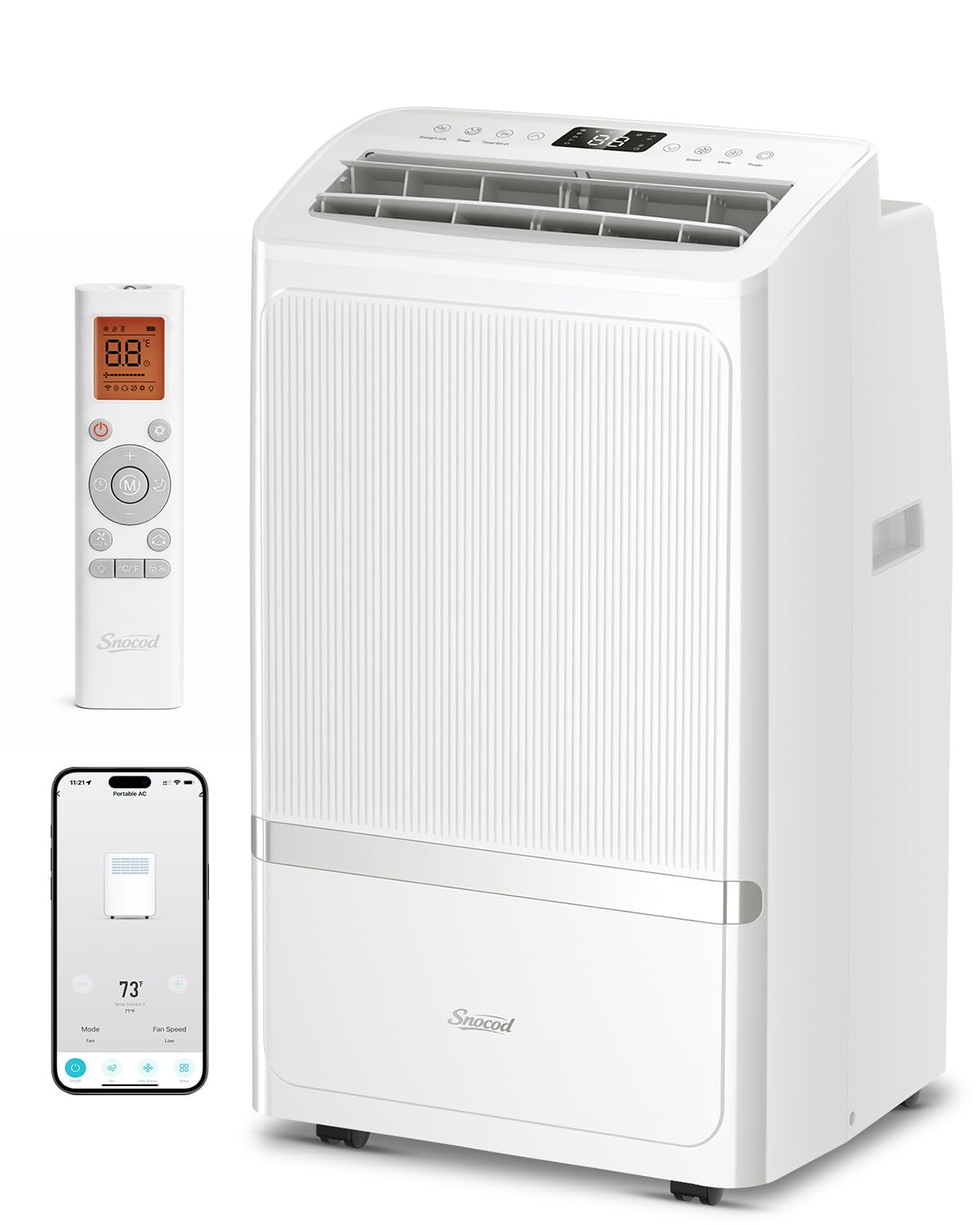
5. TECXERLLON 16,000 BTU

The widest coverage here at 850 square feet, with dehumidifying that rivals a standalone unit.
When your room is the biggest on the block, the coverage number is what matters, and this TECXERLLON tops the group by quoting cooling for spaces from 550 to 850 square feet. That ceiling is the highest advertised figure in this comparison, matched only by the DOMANKI and NYpeak on paper. The 16,000 BTU compressor is a rotary scroll type, and the adjustable range runs from 61°F to 90°F so you can dial the comfort point that suits your space rather than settling for whatever the preset offers.
Moisture control is where it earns its keep, with a 120-pints-per-day dehumidifying capacity. Side by side, that is the same 120-pint figure the ZAFRO lists, so both machines pull serious water out of the air — useful in a garage, a home office, or a humid climate where the stickiness is as much a problem as the heat. The self-evaporating system supports up to 72 hours of drainage-free cooling in humidity below 90%, with a drain hose supplied for the muggy days when even that is not enough.
Control comes three ways — a top LED touch panel, a remote with a 23-foot range, and the Smart Life app, which also lets you shape your own sleep curve. The 45-decibel running level is the loudest in this round-up, so if silence is your priority look to the KoolSiln above instead. The unit is gray, rolls on 360° casters, carries a child lock, and arrives with a full window kit, your choice of app or phone support, and a 3-year compressor warranty. For a large space that needs drying as much as cooling, this covers the most ground.
The coverage lead: 850 square feet is the most this lineup advertises, and 120 pints a day of dehumidifying is serious muscle.
First thing to decide: if your bedroom is the target and 45 dB would keep you up, this is not the quiet one.
Suits: big living areas, garages, and damp spaces where you want the widest reach and real moisture removal.
Not for you if: a low noise floor is non-negotiable — this one runs at the higher end of the group.
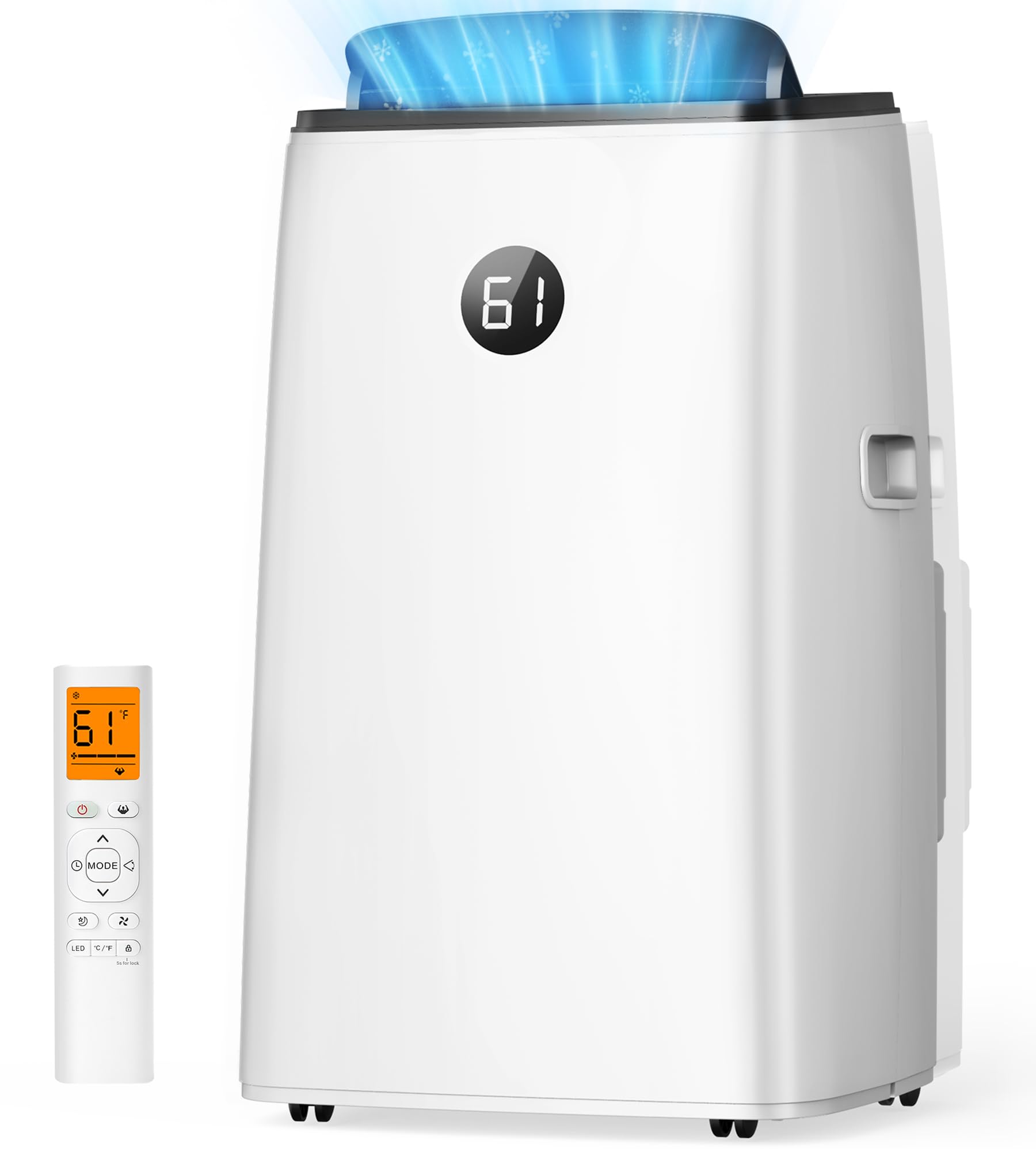
6. QLF 16,000 BTU Portable Air Conditioner
The slim, tall shape that tucks into a corner and still throws cold air eighteen feet.
A tall, narrow cabinet is the whole appeal here, because it lets the unit fit where a bulkier machine will not. The build is quoted at 14.65 inches deep by 11.7 inches wide by 25.32 inches high, and at 60 pounds it rolls neatly on its 360° casters. That slim profile is a real advantage in an apartment where floor space is tight, and the included window sealing kit fits most vertical and horizontal sliding windows for quick setup without tools.
The cooling side delivers 16,000 BTU across 550 to 800 square feet, with airflow reaching up to 18 feet from the unit so a far corner of an open-plan room still gets a share. The 5-in-1 setup covers cooling, a three-speed fan, and dehumidifying, plus sleep mode with a 24-hour timer that you can set in half-hour steps. Noise floors at a minimum of 40 decibels, matching the quietest units in this group, and the temperature range runs from 61°F to 90°F.
Owners praise the build quality in particular. One buyer summed up the stamina this way: the unit ran twelve hours a day for over two months with no drop in performance. The recurring note is about the window adapter, which some found too wide for a narrow opening and had to trim, and the machine’s own energy figure sits toward the higher end. Control is through the LED display, the Smart Life app, or the remote, and the whole thing is designed to be a one-piece appliance you install once and leave in place.
Why the slim shape wins
- Slim 14.65-inch depth tucks into tight apartment corners
- Reaches up to 18 feet, so even a long open-plan space gets airflow
- Minimum 40 dB running noise keeps it among the quietest here
- Runs cool for months of daily use without losing steam
Before you commit
- The window adapter can be too wide for narrow openings and may need cutting
- Its yearly energy draw sits toward the higher end of this group
The match for: apartment dwellers who need big-room cooling in a machine that does not eat floor space.
Reconsider if: you expect to move it often or your window opening is on the narrow side.
7. HoneyNov 16,000 BTU Portable Air Conditioner with WiFi
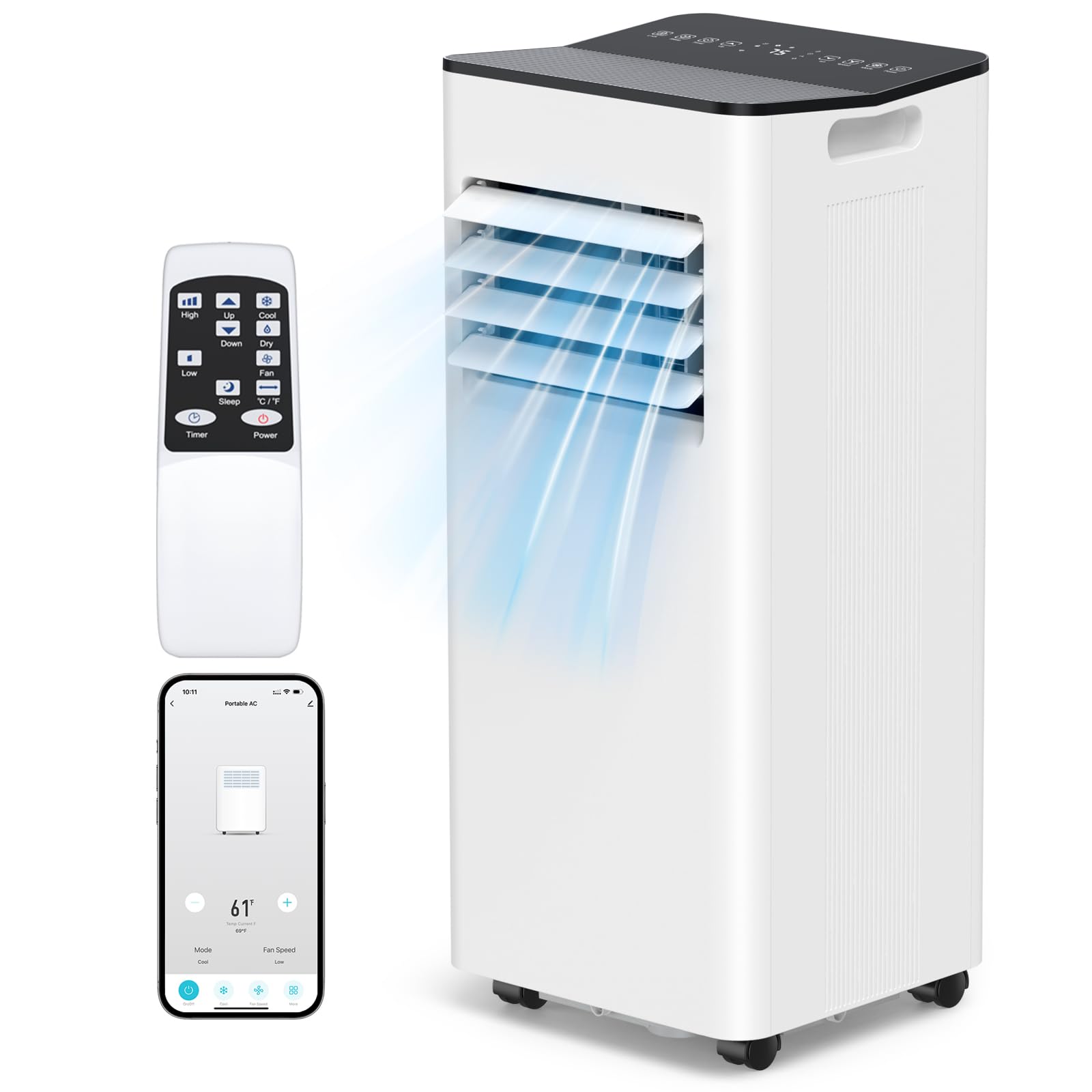
The pick for two people who can’t agree on a thermostat setting.
If your household has a 68°F person and a 78°F person, this is the machine that ends the argument, because it cools one room independently while the rest of the house stays how the other person likes it. It pushes 450 cubic meters per hour of airflow across up to 750 square feet, with a temperature range from 61°F to 90°F and a 40-decibel sleep mode built for light sleepers. The 24-hour timer lets you schedule it to cool the bedroom before you go in and ease off overnight.
The control package is the friendliest part: a smart app, an LED display, a top-mounted panel, and a 23-foot long-range remote that works from the couch. You can switch between Fahrenheit and Celsius right on your phone, and there is a built-in child lock to stop small hands from changing your settings. Installation is tool-free with a universal window kit rated for 20 to 49-inch sliding and double-hung windows, and 360° swivel casters let you roll it between rooms.
One honest note from the owner side: the exhaust hose connection is the fussiest part, and a couple of people found the hose working loose and needing a piece of tape to stay put. The five-in-one mode set — cool, fan, dry, sleep, and timer — covers the basics, and the dry mode helps in humid rooms. For a bedroom or a dorm where you want independent temperature control and easy phone management, it fits the bill neatly, though its 750-square-foot ceiling is a step below the largest units here.
Why it ends thermostat wars: independent bedroom cooling with app scheduling and a child lock for family safety.
The one wrinkle: the hose joint can work loose over time, so check it occasionally.
A smart fit for: couples or roommates who want one room cooler than the rest of the house.
Skip if: you need to cool a space much larger than 750 square feet.
8. NYpeak Portable Air Conditioner 16,000 BTU 5-in-1
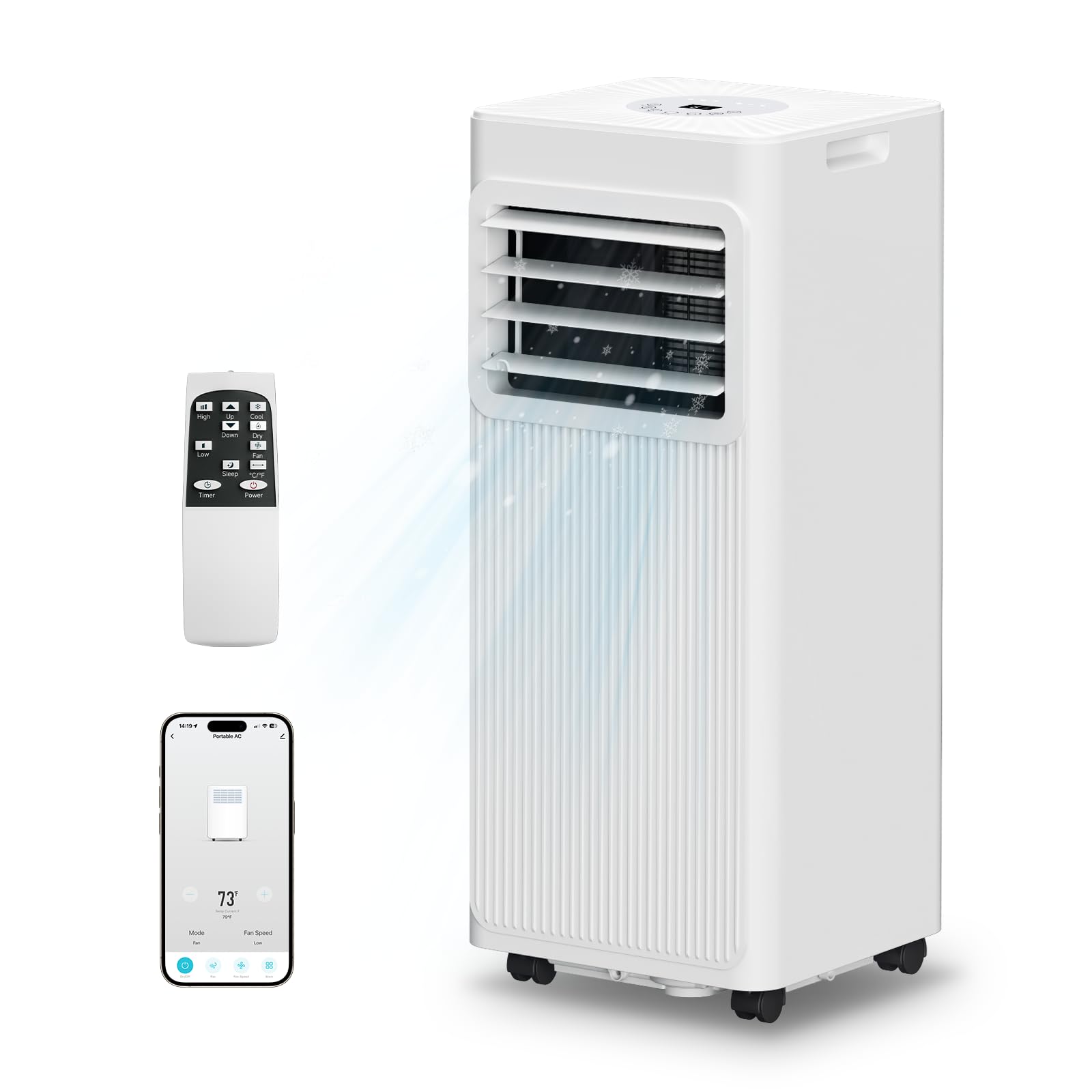
The lightest machine here at 42.9 pounds — easiest to wheel from room to room.
When you plan to move the unit around the house, weight is the number that decides whether you actually bother, and this NYpeak is the lightest here at 42.9 pounds. Hidden side carry handles and rolling casters make it manageable for one person, which is more than can be said for the 60-plus pound machines in this group. The cooling is rated 16,000 BTU across up to 850 square feet, with two fan speeds and a temperature range from 61°F to 90°F.
The airflow story is a strong one for a machine this size. Owners describe cold air reaching fifteen feet away, and in a large L-shaped basement, three separate thermometers showed only a 3°F spread across the room after an hour on a 90°F day. The wide-angle auto-swing louvers spread the air rather than aiming it at one spot, and the unit handled nine-foot ceilings without trouble. That is genuinely useful performance for an open, oddly shaped space.
The caveats are real enough to plan around, so weigh them against your room. A few owners with larger spaces found the vents sit low and cool less effectively unless you are directly in front of them, and the small water pan means the condensation needs draining more often if your home runs humid. One buyer also noted the lower filter is not removable, which makes deep cleaning a slower job. The five modes cover cool, fan, and dehumidify, and it runs below 40 decibels in sleep mode. For a smaller room, or a big space served by a second unit, it is a light, capable choice.
The easy-mover advantage: at 42.9 pounds with hidden handles, it is the one you will actually relocate.
Plan around this: the low vent height and small water pan mean directing the airflow and draining matter more than on the others here.
Worth it for: medium rooms and anyone who wants to roll the same unit between bedrooms or the living room.
Look elsewhere if: you need the airflow aimed high or a big room cooled entirely from one low-standing unit.
9. DOMANKI 16,000 BTU Dual Hose
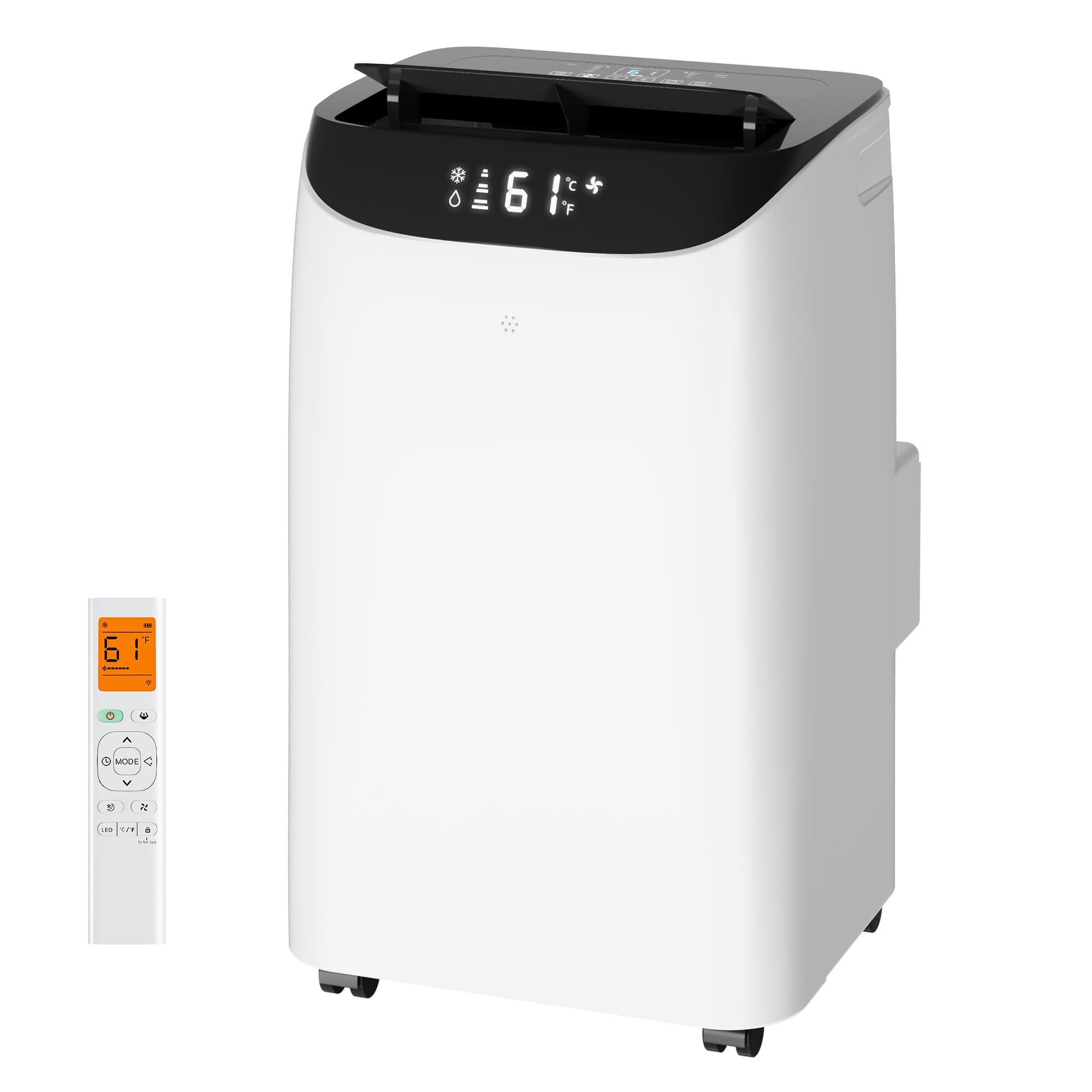
The inverter dual-hose that reaches 470 cubic meters per hour and keeps running costs down.
The airflow figure stands out first: up to 470 cubic meters per hour, one of the highest in this group, pushed through a dual-hose design that brings in fresh air while it exhausts the heat. That balanced circulation prevents outside heat from seeping in, which is the whole point of a two-hose machine. Its inverter compressor trims power draw by up to 40% versus a standard portable AC, and it holds any set point from 61°F to 86°F across 850 square feet.
Inverter technology does double duty on the noise front too, because the compressor modulates rather than cycling hard. Sleep mode drops the machine to a quiet 42 decibels while it eases the fan speed down and dims the display. There are four modes — Cool, Dry, Fan, and Auto — plus humidity settings, four fan speeds, a 15–75° wide auto-swing, a child lock, and a turbo function for blasting a hot room down fast. The remote reaches about 25 feet, so you can work it from the couch, and the filter is removable and washable, which you will appreciate over a long summer.
Installation uses an adjustable window kit that fits both vertical and horizontal sliding windows up to 60 inches wide, with no drilling into the frame required. The unit cleans up at 14 inches wide by 27 inches high by 16.5 inches deep, and 360° casters make it easy to reposition. If you run your AC for long stretches every summer day, the inverter compressor and its energy-saving rating are exactly what you want, and this is a strong pick for anyone cooling a large room on a budget-conscious power plan.
Choose it for: long daily runtimes in a large room where keeping the power draw in check matters.
Keep looking if: you want a built-in heating function — this one is a cooling-only unit.
10. Whynter 14000 BTU ARC-1230WN
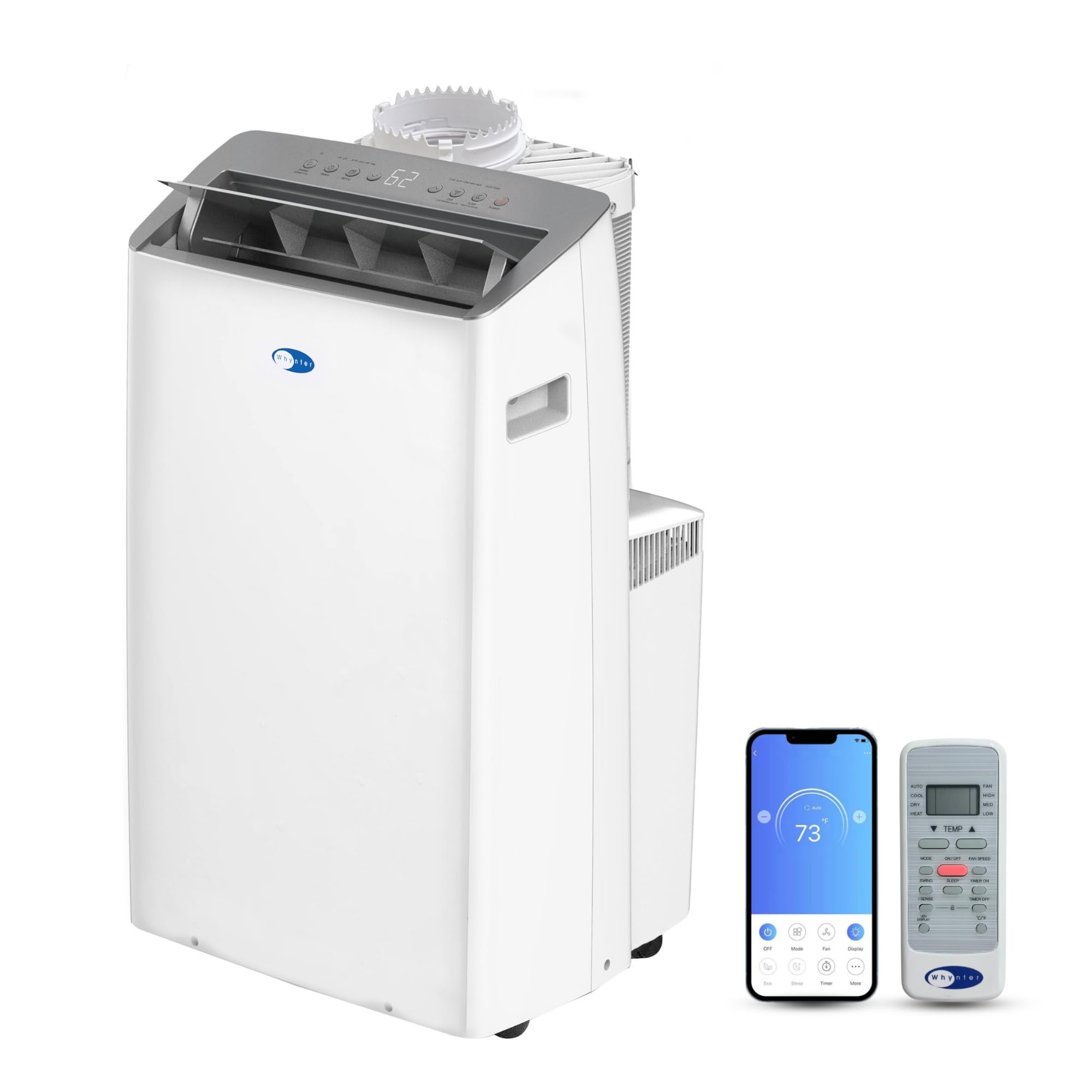
The field veteran with the longest track record and a hose-in-hose design that leaks no heat.
This is the unit with the deepest bench of owner experience behind it, and the standout engineering detail is the hose-in-hose design — a single assembly that carries both the exhaust and intake, extendable up to 47 inches, so no heat leaks back into the room. Its 14,000 BTU dual-hose inverter system covers up to 600 square feet, and the maker rates it 20% more cooling and 40% more efficient than a standard unit. There is also a built-in dehumidifier with a patented auto drain that handles up to 87 pints of condensate a day.
The three operational modes — cool, dehumidify, and fan at three speeds — cover the range, with full thermostatic control from 60°F to 86°F. It connects over WiFi through the NetHome Plus app and works with Alexa and Google Home, so voice commands and remote scheduling are both on the table. Power consumption is listed at a maximum of 1293 watts. Owners describe it as getting really cold really fast, dropping room temperatures by around 8 degrees, and running almost non-stop for a week without missing a beat.
The honest trade-offs are weight and coverage. At 85 pounds it is the heaviest unit here by a wide margin, so it is a place-it-and-forget-it machine, and at 600 square feet its coverage is the smallest in this group — a studio or a bedroom is its balance, not a big open plan. Some found the window kit a challenge on casement or awning windows, and it needs the hose pulled during rain. For a small space where reliability over years of use is what you want, that track record is the reason to choose it.
Why owners trust it: the hose-in-hose design and years of proven reliability make it the safe long-haul bet.
The honest limit: at 85 pounds and 600 square feet of coverage, it suits a studio or bedroom, not a large open space.
The reliable pick for: a studio, bedroom, or small apartment where proven durability matters more than covering maximum square footage.
Rule it out if: you have a casement or awning window, or a room well beyond 600 square feet.
11. ZAFRO 16000 BTU 38dB
The lowest noise figure in the whole round-up, at just 38 decibels.
Here is the number that makes this unit worth a look on its own: 38 decibels, quieter than normal conversation and the lowest of any machine in this comparison. Everything else is shared with the dual-hose ZAFRO at the top of the list — the same 500-cubic-meter-per-hour airflow, the same CEER of 12.8 against a 7.83 standard, the same 800-square-foot coverage, and the same 72-hour drainage-free self-evaporating system below 90% humidity. The six modes are identical too: Cool, Dry, Fan, Sleep, Extra, and Eco, with four-way oscillation and a 24-hour timer.
Where the two ZAFROs part company is the price. This one carries the higher price tag, and in return you get that extra notch of quiet plus a smart app and remote for scheduling. Owners mention fast cooling that brings a room to 62°F in under an hour with barely any cycling, and the inverter compressor keeps the temperature steady. The dual-hose design, the ZAFRO app, and the pre-cooling schedule all carry over here. It weighs a good deal, so the 360° wheels do the heavy lifting when you move it.
The one point worth planning for is the app. A handful of owners found it needed occasional resets and that saved settings could drift, so if you would rather set it and walk away, the remote or the on-unit touch panel is the more dependable route. Given the price and that quirk, this is the pick for someone who specifically wants the quietest possible large-room cooling and is happy to drive it from the remote.
The quietest claim to fame: at 38 decibels it beats every other unit here, including its 42 dB sibling.
Set expectations on: the app needs an occasional reset, so lean on the remote or the touch panel.
The choice for: a large bedroom or study where the absolute lowest noise floor is what you are after.
Pass if: you want the value version of this exact design — the lower-priced ZAFRO at the top delivers the same cooling for less.
Know the Specs
BTU versus SACC
The BTU figure is the one in giant type on the box, but it is measured under ideal lab conditions that never match your living room. The SACC number is the honest one — it reflects real-world cooling, and it is always lower. A machine labeled 16,000 BTU often carries a 12,000 BTU SACC rating, and that lower number is what to size your room against. When you see a unit marketed around a 20,000 BTU figure, the SACC underneath it is the number that decides whether your space actually gets cool.
Decibibel rating
A decibel is a measure of loudness, and a quiet portable AC runs in the low 40s while a standard one runs 50 to 55. Because the loudest moment is when the compressor kicks in, an inverter compressor that eases up and down is quieter overall than one that switches fully on and off. The specs here range from 38 to 45 decibels, so the quietest machines in this round-up sit near a library, while the loudest is still well below the roar of a window unit. For a bedroom, aim for the lowest number you can find.
Common Questions
How many square feet will a 20,000 BTU portable air conditioner cool?
What is the difference between BTU and SACC on a portable air conditioner?
Do I have to empty the water tank on a portable air conditioner?
Is a dual hose portable air conditioner better than a single hose?
Will a portable air conditioner work in a garage or an open basement?
How loud is a portable air conditioner at night?
Does a portable air conditioner pull in hot air from outside?
Can two people set different temperature zones with one portable unit?
What window types fit a portable air conditioner kit?
How much does it cost to run a 20,000 BTU portable air conditioner all summer?
The Bottom Line
For most people cooling a large room or an open-plan home, the winner is the dual-hose ZAFRO 16,000 BTU Inverter because it pairs a heat-blocking dual-hose design with a steady inverter compressor, 800 square feet of coverage, and up to 72 hours of drainage-free cooling. If keeping the yearly power draw low is your priority, the AGTANA 16,000 BTU Dual Hose lists the leanest annual energy figure here at 592 kilowatt hours per year. And for the quietest possible night in a large bedroom, reach for the ZAFRO, 38dB, the lowest noise figure in the entire round-up. Do your own sizing against the SACC number, measure your window opening before ordering, and any of these will turn a hot room into a comfortable one.
How we choose
We do not accept paid placement. Every pick is matched to a real buyer and a real use-case; we do not hands-on test units.
Sources
Specifications: manufacturer listings and product documentation. Review insights: verified customer reviews, as of October 2026. Pricing: not shown on this page (it changes often); check the current price via the retailer link.
As an Amazon Associate, Aappliancez earns from qualifying purchases. This does not affect which products we feature.