Disclosure: Some links in this post are affiliate links. As an Amazon Associate I earn from qualifying purchases, at no extra cost to you. Learn more
Specs are compiled from manufacturer listings and verified buyer reviews and can change over time — please confirm the key details on the product page before buying.
If you want the short answer: the safest pick for most people is a hybrid tube amp that pairs warm tube tone with real solid-state muscle, and the rest of this list splits cleanly into rack-mount pro power for DJs and parties, compact desktop amps for bookshelf speakers, and a pocket-sized practice amp for guitar players. The hard part with a “200 Watt Amp” is that wattage labels lie in both directions — some amps quote peak power, some quote RMS, and some quote one number while the power supply quietly caps another — so this guide walks through what each number actually means for your speakers and your room.
This guide is built by comparing the manufacturers’ published specifications and the patterns across verified customer reviews, so you get each pick’s real strengths and trade-offs instead of marketing spin.
You do not need an engineering degree to pick well here — you need to know whether your speakers are passive or powered, what impedance they run, and how loud you actually listen. From there, this guide on the best 200 watt amp covers nine real options across every budget, each explained in plain English.
Top Picks


How To Choose The Best 200 Watt Amp
Start with the number that actually matters: continuous power per channel, measured in RMS watts. Most “200 watt” amps at this tier deliver 100 watts RMS per channel at 4 ohms — the four-ohm figure is the standard way makers quote power because lower impedance draws more from the same circuit. A 200-watt peak claim with no RMS figure beside it tells you almost nothing about how the amp behaves at high volume.
Match the amp to your speakers, not the other way around
Passive speakers need an amplifier — that is the whole job of every amp on this list except the pocket practice unit. Powered speakers, like most studio monitors, need a preamp output instead, so look for a model that offers a line-level or pre-out connection. If you run tower speakers rated down at 4 ohms, you are asking the amp for more current than an 8-ohm pair, which is exactly where a strong power supply separates a good amp from a strained one.
Inputs decide what you can plug in
A turntable needs a dedicated phono stage (a small circuit that boosts the very weak signal from the needle), while a TV usually wants an optical input to avoid noise. Bluetooth lets you stream from a phone, but if you care about timing — movies, games — a wired digital input is the more stable route. Rack amps typically skip consumer conveniences and give you XLR and 1/4-inch pro connectors instead.
How loud do you actually listen, and how big is the space
A desktop nearfield setup in a small room asks far less of an amp than a garage or a DJ booth. Higher-efficiency speakers (rated 90dB and up) turn a modest wattage into serious volume, while power-hungry panel speakers soak up every watt you can give them. That is why two amps with the same wattage label can deliver very different volume on the same speakers.
Side-by-Side Comparison
| Model | Best For | Power (RMS) | Amplifier Type | Key Inputs | Amazon |
|---|---|---|---|---|---|
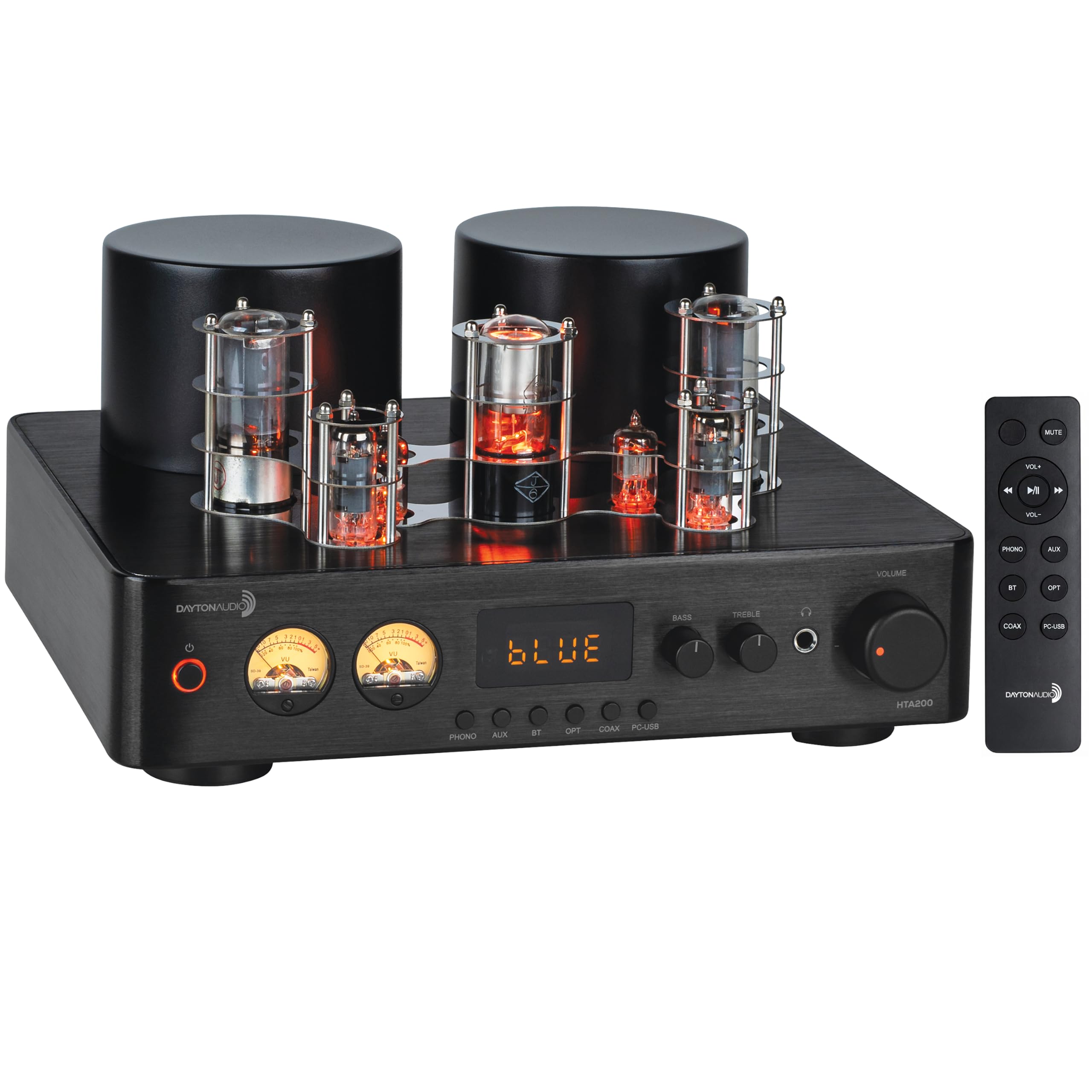
| Dayton Audio HTA200★ Best Overall | Warm home stereo with tube looks | 100W per channel at 4 ohms | Hybrid tube / Class A/B | Bluetooth 5.0, USB DAC, phono, optical, coaxial, AUX | Amazon |
| Rockville RPA5Top Performer | DJ and live sound on a budget | 200W per channel at 4 ohms; 400W bridged at 8 ohms | Class A/B rack mount | Combo XLR / 1/4″, RCA | Amazon |
| FLAMMA FX20Compact Pick | Silent guitar practice anywhere | Headphone-level output | Digital modeling | USB, Bluetooth, guitar input | Amazon |
| LONPOO LP-615 | Compact desk and shelf systems | 200W RMS | Class D, 2.0 channel | Optical, coaxial, USB playback, AUX, Bluetooth | Amazon |
| Pyle PTA1000BT | Rack installs needing many connectors | 1000W per channel stereo; 2000W bridged peak | Class A/B rack mount | TRS, XLR, USB-A, Bluetooth, speakOn | Amazon |
| Fosi Audio V3 | Clean desktop power, upgrade-friendly | 300W x2 (up to 600W total) | Class D, TPA3255 | One analog input, Pre-out | Amazon |
| Douk Audio ST-01 PRO | Small-space hybrid stereo with VU charm | 100W per channel at 4 ohms | Tube preamp / Class D power | Bluetooth 5.0, USB, coaxial, optical, RCA | Amazon |
| Rockville RPA9 | Loud mobile DJ and PA work | 800W RMS; 3000W peak | Class A/B rack mount | XLR, 1/4″, RCA; speakON and banana out | Amazon |
| Crown XLS1002 | Pro installs and serious sub duty | 350W at 4 ohms dual; 550W at 2 ohms dual | Class D DriveCore | Balanced XLR, 1/4″ TRS, RCA | Amazon |
Detailed Reviews
1. Dayton Audio HTA200 200W Integrated Stereo Hybrid Tube Amp
Our pick — 4.5+★ from 200+ verified ratings; the strongest balance of quality and price.
Glowing tubes up front, solid-state muscle behind, and a phono stage that revives your turntable.
The HTA200 is the one to buy if you want your stereo to sound warm and look like it belongs in the room. It delivers 100 watts per channel RMS at 4 ohms — the continuous, real-world power figure — which is enough for large home speakers and demanding tower setups. Amber-toned vacuum tubes handle the preamp stage while a Class A/B design does the heavy lifting, so you get tube character without tube-era fragility. The exposed tubes and classic VU meters (the needle gauges that show your output level) are the aesthetic centerpiece, and the crowd favorite here holds 4.5+ stars across 200+ owners.
What wins people over is the soundstage: owners describe speakers “singing” with a wide, open presentation, and several name-drop Bowers and Wilkins towers as a satisfying match. The versatility is the practical story — Bluetooth 5.0 for streaming from your phone, a built-in USB DAC for computer audio, a dedicated phono input for a turntable, plus optical, coaxial and AUX. There is a full-range preamp output for adding a powered subwoofer, which turns this into an easy 2.1 system. Bass and treble controls, a headphone output, and a motorized volume control with a wireless remote round it out.
The honest catch is the remote. Response is poor, the build is flimsy, and the watch-style battery is awkward to swap — the single recurring gripe in an otherwise glowing review record. The Bluetooth can also drop occasionally, so lean on a wired digital input for critical listening. Build quality and value show up again and again in owner feedback, and the amp runs cool enough that its fan reportedly never kicks on in normal use.
Why owners keep it
- 100W per channel RMS at 4 ohms delivers real power for tower speakers and sub-augmented systems
- Hybrid design pairs vacuum tubes in the preamp with a Class A/B power stage — warm tone, modern reliability
- Bluetooth 5.0, USB DAC, phono, optical, coaxial and AUX cover vinyl, TV, computer and phone in one box
- Dedicated full-range preamp output makes adding a powered subwoofer simple
What to plan around
- The remote is the standout weak point — poor response and a fiddly watch battery
- Bluetooth occasionally drops, so wired digital is the steadier path
- Tube warmth is a preference, not a neutrality guarantee — some ears want flatter
Reach for this if: you want one box that plays vinyl, streams Bluetooth, handles TV audio, and looks the part in a living room.
Think twice if: a dependable remote matters more to you than tube glow — the HTA200’s remote is its soft spot.
2. Rockville RPA5 2-Channel Professional/DJ Rack Mount Power Amplifier
A rack-ready workhorse that hides serious output behind a plain metal faceplate.
The RPA5 nails the exact figure this category is named for: 200 watts RMS per channel at 4 ohms, doubling to 400 watts RMS bridged at 8 ohms, with up to 1000 watts of peak output for transients. That bridged number is the one DJs care about — it lets you drive a single subwoofer hard from both channels at once. A stereo/mono switch and built-in crossover mean you can run it sealed to your subs or full-range to your tops without adding outboard gear.
Reliability is the headline in owner feedback. The amp uses dual quiet cooling fans, IC-controlled protection circuitry, and channel A/B clipping LEDs so you can see when you are pushing too hard. In a DAW or studio context one owner swapped out a dying Parasound and found the RPA5 slightly louder with bridging and crossover engaged, driving studio monitors cleanly. Bass response gets specific praise — running an 18-inch and a 12-inch sub with low pass, the output was strong enough that the house and windows shook. Vocals stay crisp and mids stay unmuddied under hard bass.
The trade-offs are honest. Because it is designed for live sound, the low-end reproduction is where it lives — some listeners find the overall presentation less refined than a hi-fi amp for critical listening, and this is a rack unit, not a coffee-table piece. It is moderate in weight, not featherlight, and the 2U form factor with heavy-duty ears and handles expects a proper rack or shelf. For the price tier, it earns its keep on raw power per dollar.
Where it earns its badge: 200W RMS per channel at 4 ohms, bridgeable to 400W, with built-in crossover and protection circuitry — pro-grade output without pro-grade pricing.
The one caveat: this is a tool for subs and live rigs first, so if you want a neutral studio reference for critical listening, look elsewhere in this list.
Built for: DJs, mobile entertainers, and home setups that need to push big subwoofers with authority.
Not the one for: audiophile nearfield listening where tonal neutrality beats raw output.
3. FLAMMA FX20 Guitar Headphone Amp
A pocket practice rig that packs a modeling amp, drum machine, and recorder into one plug-in dongle.
This one is a different animal from the rack amps on this list — it is a headphone amp that plugs directly into your guitar, built for silent practice and home recording. It carries 52 classic amp models with individual saving functions, plus 40 drum grooves across seven musical styles (POP, BLUES, PUNK, ROCK, METAL, FUNK and JAZZ) with tempo adjustable from 40 to 260 BPM. The effect set is deep for the size: 14 modulations, 5 delay effects, and 5 reverb effects. It charges over USB and connects via Bluetooth for playing along with backing tracks.
What wins people over is how much tone lives in something weighing 59 grams. Owners upgrading from the earlier FX10 cite the app-based programming, Bluetooth, firmware upgrade path, and the expanded effects and cabinet selection as the reasons to move up. The iOS and iPadOS app plus the Android version both get used, and the companion FLAMMA app adds a cloud platform for downloading and sharing presets. One owner plugs it into an amp through a couple of cables and adapters to use every function, including the drum machine. Another runs it with a Traveler Guitar Ultra-light acoustic and a ukulele, cutting their carry load to just the amp and a headphone wire.
The recurring gripes are worth knowing up front. Battery life is the most-flagged complaint — several report only two or three practice sessions per charge, and charging can take over two and a half hours to go green. A few units have developed cracked cases, Bluetooth dropouts, or batteries that stopped holding a charge inside the first year, and preset management forces you to overwrite stock slots since there are no spare banks. Those who treat it as a lightweight practice tool rather than heavy gigging gear tend to be very happy with it, and direct recording to an iPad or any device gets called out as a real strength.
The appeal
- 52 amp models, 14 modulations, 5 delays and 5 reverbs in a 59-gram package
- 40 drum grooves across 7 styles with BPM control from 40 to 260
- Bluetooth, USB audio recording, and a cloud preset-sharing app cover practice and social clips
- Works on both iOS and Android, and plugs into a full amp with adapters when you want speakers
The honest limits
- Battery life is the weak spot — roughly two sessions per charge, with slow charging to match
- No spare preset banks, so new tones overwrite factory slots
- A few units have cracked or lost Bluetooth over time; treat it as practice gear, not tour gear
Best for: guitarists who practice at night, travel with a guitar, or want to record ideas straight to a phone or tablet.
Skip if: you expect gig-night durability and long battery runtime from a battery-powered unit.
4. LONPOO 200W Mini Bluetooth Audio Amplifier Class D

A desk-sized amp that lists the full 200 watts RMS without asking for much space in return.
The LP-615 is a two-channel Class D integrated amp quoted at 200 watts RMS — the higher of the two power figures a maker could choose, and the one worth checking. Class D designs (a switching amplifier that runs cool and draws little current) are the reason a box this small can claim that number at all. It is a 2.0-channel unit, so it drives a pair of passive bookshelf speakers rather than a surround array, and the mini form factor is built to sit on a desk or shelf.
Where it stands apart from the other desktop amps here is source flexibility. You get optical and coaxial digital inputs for a TV or disc player, USB playback straight from a flash drive, Aux-in for analog gear, and Bluetooth for streaming from your phone or tablet. That combination covers more real-world sources than the Fosi Audio V3, which has just one analog input, and it does so while keeping a footprint small enough for a crowded desk. It ships as a single amplifier unit with a one-year warranty.
The honest caveat here is simply that this is the least-documented pick on the list — it has a much smaller review footprint than the rest, so there is less real-world feedback to lean on than the Dayton or the Crown. Structural facts are solid: two channels, advertised 200W RMS, optical/coaxial/USB/AUX/Bluetooth inputs, and a compact chassis. If you want the most-reviewed option, the Fosi V3 or the Dayton HTA200 are the safer bets; if you want a slim, quiet, feature-stacked desktop amp to feed modest bookshelf speakers, this fits the brief neatly.
Best-fit rooms: a desk setup or a small living room where the amp lives on a shelf and the speakers are efficient bookshelf models. The 200W RMS rating gives you real headroom for that scale of listening, and the input spread means you can swap between a TV, a USB stick and your phone without rewiring anything.
The question to ask yourself: do you want the newest design with the widest input set, or the model with years of owner feedback behind it? That trade-off is the only real fork here.
Pick this one if: space is tight, inputs matter, and you want a modern Class D amp for a pair of bookshelf speakers.
Otherwise consider: the more heavily-reviewed desktop pick if tracked owner experience matters to you.
5. Pyle 2-Channel Rack Mount Power Amplifier PTA1000BT
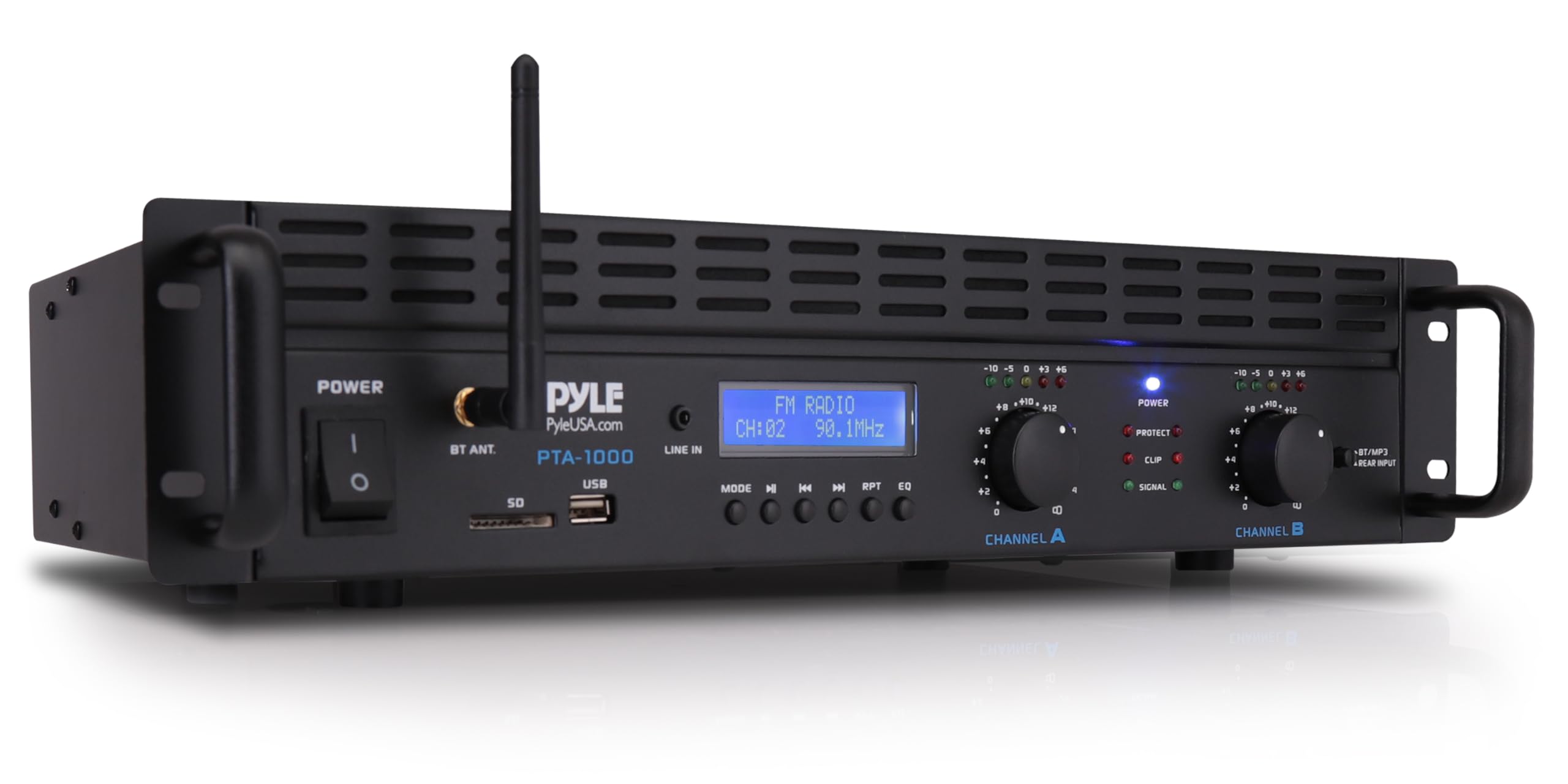
The connector-heavy rack amp: XLR, TRS, speakOn, USB, Bluetooth, LCD — nearly nothing it cannot accept.
The PTA1000BT is built around maximum connectivity for a rack install. It quotes 2000 watts maximum power bridged, or 1000 watts per channel in stereo, with 4-8 ohm impedance support for multi-speaker setups. The Bluetooth chipset streams from phones, tablets, laptops and computers, and the front panel has a real story: an LCD display that shows ID3 tags (the track and artist info sent along with your music), left and right channel level indicators, and power, protect, clip and signal LEDs. Built-in ventilation fans keep heat in check during long sessions.
The input and output list is what earns the versatile label. On the input side you get two 1/4-inch TRS jacks, two XLR jacks, and a USB-A port for direct MP3 playback. Outputs include three speakOn connectors (A, B and Bridged) plus two pairs of binding-post speaker terminals. One owner running two tower speakers and two mini speakers found more than enough power on tap. The retro-styled front panel and easy setup come up repeatedly — packaging is described as excellent and installation as straightforward.
Where honesty matters: the sound quality and power output are mixed in owner experience. Some report it stops working properly well within the first year, and a couple of units arrived non-functional or lost a channel. The rack ears have also been noted as wider than a standard rack, so check your enclosure before mounting. If you buy from a source with easy returns and test it thoroughly in the first months, the value and connectivity story is strong; if you need bulletproof uptime, the Crown below is the more proven rack pick.
The case for it: a full connector suite — TRS, XLR, USB-A, Bluetooth, speakOn and binding posts — for a rack rig that has to accept everything you own.
Watch for: reliability has been uneven in owner reports, and the rack ears run wider than standard. Buy from a return-friendly seller and burn it in hard in the first month.
Suits: rack installations where connector variety and a front-panel display matter more than a track record.
Look elsewhere if: proven long-term reliability is the priority — the Crown XLS1002 is the safer rack room.
6. Fosi Audio V3 Stereo Amplifier 300 Watts x2

A tiny metal brick that drives barely-believable loads and lets you swap its op-amps for fun.
The V3 earns its place on measured performance, not decoration. It runs a TPA3255 Class D chip rated up to 600W total, quoted at 300 watts x2, and it asks for only 2-8 ohm speakers. Internally it uses Japanese NCC, ELNA and German WIMA capacitors plus Japanese Sumida inductors — the parts list of a serious amp, not a toy. Those parts buy a stated SINAD of up to 88dB (a distortion-and-noise score, where higher is cleaner), an SNR of up to 110dB, and a noise floor of just 140uV. Owners skeptical of the 300W x2 at 4 ohms claim found it drove power-hungry Magnepan LRS panels loudly and cleanly, comparing it to much larger monoblocks.
The upgrade path is the fun part. The stock NE5532 op-amps (the small interchangeable chips that shape the analog signal) can be popped out and swapped for options like Sparkos SS3602, MUSES02, OPA2604, OPA2134PA, OP249, AD827, RM4559, LM4562 and LME49720HA. Heat is handled by vents on the top and bottom of the casing plus a whole-body heatsink. The Pre-out level is now controlled by the volume knob — a change that makes adding a sub or powered speakers more flexible than before, and it beats the older Fosi 20a on simplicity and power.
Two things to plan for honestly. There are no tone controls and there is only one analog input, so bass-shy speakers benefit from an inline EQ and multiple sources need a switching preamp or DAC ahead of it. And because the stock power supply is 48V, the supply only supports so much current — the amp runs warm and one owner reasonably flags that the 48V x5A supply cannot physically deliver 300W of continuous output. In practice, the clean headroom and low noise floor are the reasons it holds the desk — as long as you feed it efficient speakers, one owner pairs it with 90dB+ speakers specifically.
What earns its spot
- TPA3255 chip with a SINAD up to 88dB, SNR up to 110dB, and 140uV noise floor
- Swappable op-amps — Sparkos, MUSES02, LM4562 and more — make it a hobbyist’s toy
- Whole-body heatsink with top and bottom vents keeps it stable under load
- Pre-out level tied to the volume knob makes sub and powered-speaker integration simple
What to know before buying
- No tone controls and only one analog input
- Runs warm, and the 48V supply limits how much current it can realistically push
- Some owners find bass character thin without an EQ upstream
Best for: the tinkerer who wants a compact, clean, upgrade-friendly amp for efficient speakers and nearfield listening.
Skip if: you need tone knobs, multiple inputs, or the fat bass feel that tube and A/B designs deliver.
7. Douk Audio ST-01 PRO 200W Bluetooth Amplifier

A dancing VU needle and warm tubes, all inside a box that fits on a shelf corner.
The ST-01 PRO is a hybrid too — real vacuum tubes handling the preamp stage and a TI Class D power IC for the output. Each channel is quoted at 100 watts into 4 ohms, and the amp drives passive speakers from 3-8 ohms comfortably. The three decorative golden circles around the tubes and VU meter (the pointer needle that moves with your music) turn it into a piece of furniture, and the sensitivity adjustment of the meter on the underside lets you tune the needle’s swing to your input level. Bluetooth 5.0, USB, coaxial, optical and stereo RCA inputs cover phones, computers, TVs and CD players.
What wins people over is how warm and quiet this thing sounds for its size. The tubes sit in the real preamp circuit, not decorative shells, and owners who swap in NOS (new-old-stock) tubes like GE JAN 5725W or Soviet Voshkod versions report richer warmth and volume. The 3.5mm AUX output is the smart trick — you can use the ST-01 PRO as a preamp into powered monitors or route it out to another amp or subwoofer, which is a flexibility the Dayton HTA200 lacks. One owner uses it purely as a preamp into KRK powered monitors for a turntable and Bluetooth PC audio, with no heat issues even in an enclosed cabinet.
The gripes to know: it slips into standby after seconds of silence, which interrupts quiet listening; the volume knob steps in notches, so the lowest setting can be too loud late at night; and the built-in DAC is considered weak by some who prefer an external unit through the optical input. An occasional AC adapter has failed in the field, though the amp itself has proven solid over long-term ownership. Some owners also question the “200W” claim, since the printed spec plate shows 100 watts maximum output.
The charm
- Real tube preamp stage — not decorative — with adjustable VU meter sensitivity
- 100W per channel at 4 ohms drives 3-8 ohm passive speakers easily
- Bluetooth 5.0, USB, coaxial, optical and RCA cover nearly every source you own
- AUX output doubles as a pre-out for powered monitors or subwoofers
The annoyances
- Standby kicks in after seconds of silence and interrupts quiet passages
- Volume knob steps in notches — the lowest setting can be too loud at night
- Built-in DAC is modest; an external unit via optical can sound better
Who this suits: small-space listeners who want tube warmth, real VU needle charm, and enough inputs to run a turntable, TV and phone.
Who it frustrates: anyone who needs continuous low-volume listening without standby cutting in.
8. Rockville RPA9 2-Channel Professional/DJ Rack Mount Power Amplifier

The rack amp that will fill a field — literally audibly clear a quarter-mile out.
The RPA9 is a step up in output from the RPA5 on this list. It quotes 3000 watts peak and 800 watts RMS across two channels in a rugged metal chassis built for touring and mobile DJ work. XLR, 1/4-inch and RCA inputs feed it, and speakON plus banana outputs carry the power out. Dual fans and a heatsink design handle cooling for long gigs, and the front panel has volume controls plus LED indicators for low-light operation. It is a 2U rack-mount with pre-attached feet for shelf use.
Owner experience is unusually consistent for a rack power amp: durability and value come up constantly, with two-unit owners running theirs for two to three years. Buyers report it driving Mach2 160W and dual Cerwin Vega speakers cleanly, with output loud enough to carry a quarter mile outdoors. Connections via XLR from a Behringer mixer are described as easy, and the amp has protection circuits plus cooling fans backing its reliability. The overall feel is a lot of real amplification for the price tier.
The two things to know before you buy. First, the fans run loud enough that low-volume living-room listening is not the RPA9’s strength — one owner notes it plainly. Second, treat the peak-wattage number as a marketing figure and match your speaker impedance carefully; more than one owner reminds buyers to reference the RMS rating when you pair speakers, or you risk blowing drivers. If you want amplifier grunt for big rooms and accept the fan noise, this is a serious value. If you want a quiet living-room amp, look at the Fosi V3 or Dayton instead.
Real-world performance read: 800W RMS and XLR-ins that owners run with pro mixers, backed by a rugged all-metal chassis — the RPA9 is designed around mobile sound rather than critical listening.
Fair caveat: fan noise is the recurring complaint, and the wattage peak of 3000 is generous by marketing reckoning. Match your speakers to the RMS rating to stay safe.
Made for: DJs, mobile entertainers and home systems that need brute-force output in a rack.
Not made for: quiet living-room listening where the cooling fans will be noticed.
9. Crown XLS1002 2-Channel Class D DriveCore Professional Power Amplifier

The pro-audio standard, in a Class D box that weighs under 11 pounds.
The XLS1002 is the reference amp of this list. It quotes 550W at 2 ohms dual, 350W at 4 ohms dual, 215W at 8 ohms dual, 1100W at 4 ohms bridged and 700W at 8 ohms bridged — a full power ladder rather than a single headline number. It uses Crown’s ultra-efficient DriveCore Class D technology, weighs less than 11 pounds, and runs on 100-240VAC input. Integrated PureBand Crossover System and efficient forced-air cooling maintain performance during long sessions, and the amp sleeps automatically after a set period of inactivity. Inputs are balanced XLR, 1/4-inch TRS and an RCA pair; outputs are two 1/4-inch speaker jacks. Selectable input sensitivity of 1.4VRMS or.775VRMS lets you match it cleanly to consumer or pro gear.
What owners prize is sheer capability. One owner reports running eight 18-inch subs and four 15-inch tops off a single bridged channel with power to spare. One owner runs a home-theater setup with 5.1.4 Atmos plus eight outdoor speakers, noting hiss is inaudible beyond a couple of feet. Another owner has run it bridged into a 2-ohm load for months without clipping or thermal shutdown, well below its rated impedance. It also carries real flexibility for subwoofer duty: 350W at 4 ohms dual is more than enough to push four 10-inch subs in a serious home-theater rig.
The honest caveat is a knowledge tax. A few owners also find its neutral character needs a good preamp upstream to shine; direct from a DAC it can sound sterile. Get those two things right and it is arguably the most impressive amplifier in this list.
Verified standing: the highest-rated pick here at 4.5+ stars from 400+ owners, and one of the few amps that is comfortable at 2 ohms bridged for months on end without complaint.
Setup matters: pair it with a preamp that has XLR outs, or budget for a matchbox if your home-theater processor runs consumer-level output. A direct DAC feed can sound thin.
This is the one if: you are running a serious home theater, a subwoofer array, or a pro install and you want proven reliability and a proper power ladder.
Skip if: you want plug-and-play with a consumer receiver’s RCA outputs — you will need a matchbox in that path.
Know the Specs
RMS watts vs peak watts — the number on the box that actually matters
RMS stands for root-mean-square, which in plain terms is the continuous power an amplifier can deliver without distorting — the wattage it can hold indefinitely, not just for a fraction of a second. Peak watts describe the briefest of spikes and are always inflated. When a maker quotes 3000W peak or 2000W maximum, the honest thing is the RMS figure sitting next to it. When no RMS figure exists at all, treat the number as a marketing estimate. Match your speakers to the RMS number, not the peak.
Ohms, impedance and why 4-ohm speakers ask for more current
Ohms measure the electrical load your speakers place on the amp. Lower impedance means the amp must push more current for the same voltage — which is why an amplifier rated 200W at 4 ohms almost always delivers less power to an 8-ohm pair. A strong amp stays stable as impedance drops; a weaker one clips and heats up. That is the whole reason rack amps list 2-ohm and 4-ohm figures separately while desktop amps usually quote a single load. Check your speaker’s impedance rating before you assume a 200W label guarantees 200W in your room.
Class A/B, Class D, and hybrid tube designs — what each one does
Class A/B is the traditional design: smooth tone, more heat and more weight from a bigger transformer. Class D is a switching design that runs cool and light but historically carries a less flattering bass personality. Hybrid amps split the difference by using vacuum tubes for the preamp stage (where warmth matters) and a solid-state stage for the power section — the Dayton HTA200 and Douk ST-01 PRO both work this way. Tube warmth versus Class D neutrality is a tonal preference, not a quality ranking.
Inputs, DACs and pre-outs — the parts you actually plug into
A DAC turns digital audio from a computer or TV into the analog signal the amp amplifies. RCA is the standard line-level analog connector; TRS and XLR are the balanced pro equivalents that reject noise over long cable runs; speakOn is a locking speaker connector for high-power rigs; optical and coaxial carry digital. A pre-out or AUX line out lets one amp feed another or push signal to a subwoofer, which is why the models with a dedicated pre-out here are the flexible ones for growing a stereo into a 2.1 system.
Common Questions
Is a 200 watt amp loud enough for a full home stereo?
Will a 200 watt amp drive 8-ohm bookshelf speakers safely?
What is the difference between RMS watts and peak watts on a 200 watt amp?
Can I bridge a 200 watt amp to run a subwoofer?
Which inputs do I need on a 200 watt amp for a turntable and a TV?
Do I need a DAC if I already have a Bluetooth amp?
How do I match speaker impedance to a 200 watt amp?
Is a tube amp or a Class D amp better for a home stereo?
How much ventilation does a 200 watt amp need?
Can I use a 200 watt amp for guitar or only for speakers?
Do 200 watt amps run hot enough to worry about?
The Bottom Line
For most people shopping for the 200 watt amp, the winner is the Dayton Audio HTA200 — it is the rare amp that handles a turntable, a computer, a TV and Bluetooth in one box while keeping 100W per channel of real home power on tap. If your priority is a bright, clean, upgrade-friendly desktop rig, the Fosi Audio V3 is the smarter buy for nearfield listening and efficient speakers. And for the DJ or mobile entertainer who needs to drive big subs with authority, the Rockville RPA9 is the one to reach for.
One last nudge: the Dayton HTA200 sits at 4.5+ stars across 200+ owners, and the Fosi Audio V3 at 4.0+ stars across 300+ — both with clear, repeated praise for sound quality across their review pages. If you are still on the fence, pick by room and source rather than by wattage label. An amp matched to your speakers’ impedance and your listening distance will sound better than one chosen for its wattage label.
How we choose
We do not accept paid placement. Every pick is matched to a real buyer and a real use-case; we do not hands-on test units.
Sources
Specifications: manufacturer listings and product documentation. Review insights: verified customer reviews, as of October 2026. Pricing: not shown on this page (it changes often); check the current price via the retailer link.
As an Amazon Associate, Aappliancez earns from qualifying purchases. This does not affect which products we feature.