Disclosure: Some links in this post are affiliate links. As an Amazon Associate I earn from qualifying purchases, at no extra cost to you. Learn more
Specs are compiled from manufacturer listings and verified buyer reviews and can change over time — please confirm the key details on the product page before buying.
Here is the honest answer most listings won’t give you: no handheld radio talks a clean 20 miles through buildings and trees. Those big range numbers are measured on open water or flat desert with nothing in the way. What you actually want is a pair that stays clear across your farm, your convoy, or your neighborhood — and the picks below are chosen for that real job. The Retevis RB48 is the one that holds up best, with 2000 mAh batteries, an IP67 waterproof build, and a body tested to MIL-STD-810H military durability standards.
This guide is built by comparing the manufacturers’ published specifications and the patterns across verified customer reviews, so you get each pick’s real strengths and trade-offs instead of marketing spin.
Range claims shrink fast once hills, walls, and traffic get involved, so this list sorts the models that stay usable when the terrain turns against you. Below you’ll find the models that actually deliver for the money, plus a plain-English guide to what the specs mean. These are the picks worth checking first if you want dependable 20 mile walkie talkies.
Top Picks

How To Choose The Best 20 Mile Walkie Talkies
Start with the frequency band, because it decides where you are allowed to talk and how far the signal carries. FRS radios (Family Radio Service) are license-free and ready to use the moment you unbox them. GMRS radios (General Mobile Radio Service) can use repeater towers to push your signal much farther, but they require a license from the FCC before you transmit on them.
Read the range number as a best case
A “20 mile” or “25 mile” figure describes a clear, unobstructed line of sight under ideal conditions. Put a hill, a house, or a dense stand of trees between the two handsets and the usable distance drops sharply. Expect a handful of miles in open country, less in the suburbs, and city blocks of reliable talk downtown. That is normal for handheld radios, not a defect.
Battery capacity and how you recharge it
Battery size is quoted in mAh (milliamp-hours) — a bigger number means more talk time per charge. A 1200 mAh pack suits a day of casual family use, while a 2000 mAh pack is built for long shifts outside. Check the charging method too, because USB-C means you can top up from a power bank or car socket instead of hunting for a wall outlet.
Weather sealing and build quality
An IP rating tells you how well the housing keeps out dust and water. IP67 means it survives being dunked, while IP55 or IPx4 handles rain and splashes but not a swim. If your radios ride on a bike, an ATV, or a tractor, look for drop-test claims and sealed button covers.
Side-by-Side Comparison
| Model | Best For | Channels | Battery | Weather Rating | Amazon |
|---|---|---|---|---|---|
| Retevis RB48★ Best Overall | Rugged all-day use | FRS band (22 channels) | 2000 mAh / up to 20 hrs | IP67, MIL-STD-810H | Amazon |
| BAOFENG GM-15 ProMost Capable | Repeater and GMRS coverage | 250 | 1500 mAh / up to 24 hrs | Not rated | Amazon |
| Midd Kacy MK108 | Two-car road trips | 60 | 1800 mAh / up to 60 hrs standby | IP55 | Amazon |
| MaxTalker MT10 | Whole-family packs | 22 | 1200 mAh / up to 72 hrs standby | Not rated | Amazon |
| Cobra ACXT390 | Lightweight packing | 22 | 6 AA NiMH / not stated | Not rated | Amazon |
| Motorola T210TP | Kids and ski hills | 22 | 800 mAh / up to 18 hrs | Not rated | Amazon |
| Motorola T475 | Convoy and trail riding | 22 | 800 mAh NiMH / up to 12 hrs | IPx4 | Amazon |
Detailed Reviews
1. Retevis RB48 FRS Walkie Talkies
Our pick — 4.5+★ from 850+ verified ratings; the strongest balance of quality and price.
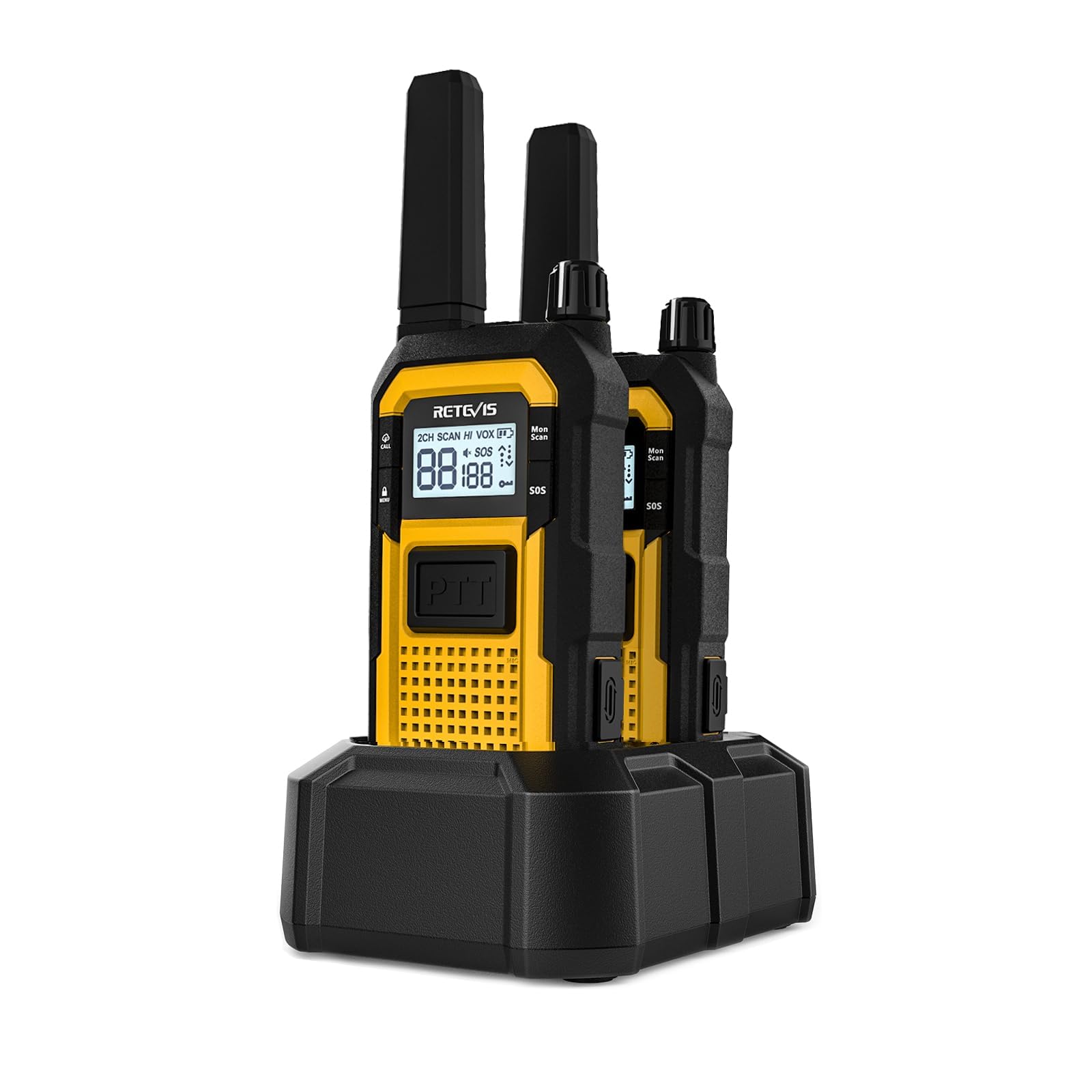
A high-visibility yellow FRS pair rated IP67 and tested to MIL-STD-810H for drops, rain, and dust.
Retevis designed this one for people who work outdoors, not just play there. The RB48 carries a 2000 mAh lithium-ion battery, which Retevis rates for up to 20 hours of use — enough for a full shift in the field or a long day of hunting without a recharge. Its IP67 rating (the housing keeps out dust and survives a dunk) plus a 2-meter drop claim means a slip off a tailgate is not the end of the radio.
Battery capacity is where it separates itself from the BAOFENG GM-15 Pro — 2000 mAh against 1500 mAh. The BAOFENG counters with a longer rated run time of 24 hours versus 18 hours here, though its 250 channels and repeater support are aimed at a more technical user. If you want to hand a radio to a teenager or a farmhand and say “just turn it on,” the Retevis is the simpler tool. A wrist strap or belt clip keeps it on you, and the silicone button covers are there for wet, gloved hands.
What wins people over is pure ruggedness — the build quality is what owners talk about more than anything else, with range close behind. Buyers report clear talk on flat ground and through city driving with buildings in between. The one honest limit is the real-world distance: expect roughly two miles in built-up areas rather than the headlining figure, which puts it in the same realistic band as anything else in this class.
Where it earns its keep
- 2000 mAh battery rated for up to 20 hours of use
- IP67 waterproof and dustproof housing with a 2-meter drop claim
- USB-C charging plus a 2-in-1 charging dock for two radios at once
- High-visibility yellow so you can find it in a truck bed or tall grass
Worth knowing before you buy
- Real-world reach falls well short of the maximum claim once buildings get between units
- Heavier than the compact picks in this list
- Spec notes list an audible noise figure of 80 db, so it is not a whisper-quiet handset
Reach for this if: your radios live on a farm, a hunt, or a job site and need to survive abuse and a full day away from an outlet.
Think twice if: you only need short hops around a suburban block and would rather carry something smaller.
2. BAOFENG GMRS Radio Handheld GM-15 Pro 8W
A 250-channel GMRS handheld with 8 repeater channels and 8W output for extended reach.
Where the Retevis keeps things simple, the GM-15 Pro hands you the controls. It carries 250 memory channels against the Midd Kacy MK108’s 60 — a huge gap for anyone who wants to program local repeaters, scan VHF and UHF, and tuck away extra frequencies. The 22 GMRS channels and 8 repeater channels come pre-loaded, so it works the moment you power it on, and you can add more through the keypad or a PC.
Repeater support is the real prize here. A repeater is a shared tower that re-broadcasts your signal, and using one is how handhelds actually clear real distance. GMRS requires an FCC license to transmit — factor that into your decision before you buy. The 1500 mAh battery is charged by USB-C cable from a wall plug, power bank, laptop, or car, and the radio adds a flashlight, SOS alarm, and hands-free VOX (voice-activated transmit) for when your hands are full.
The manual is the recurring sore spot, and owners say as much. Plan on some trial and error, or program it with software rather than the menus. Owners mention it reaching a 4-mile urban transmission on high power, and the sound stays clear on distant signals out in wooded country. It is a radio for someone willing to learn it — not a grab-and-go toy.
The programming trade-off: 154 privacy codes (50 CTCSS and 104 DCS) let you filter out other chatter on a busy channel, and the 11 NOAA weather channels handle storm warnings. All that flexibility is exactly why the learning curve exists.
Who it is not for: a family that just wants to hand radios to kids will find the menus and licensing step more than they bargained for.
The pick for tinkerers: you get the widest channel count in this lineup and the only repeater-capable option, which is the honest route to genuine long-distance talk.
The catch: GMRS transmission requires a license, and the menus will frustrate anyone who skips the manual.
3. Midd Kacy MK108 Walkie Talkies (2 Pack)
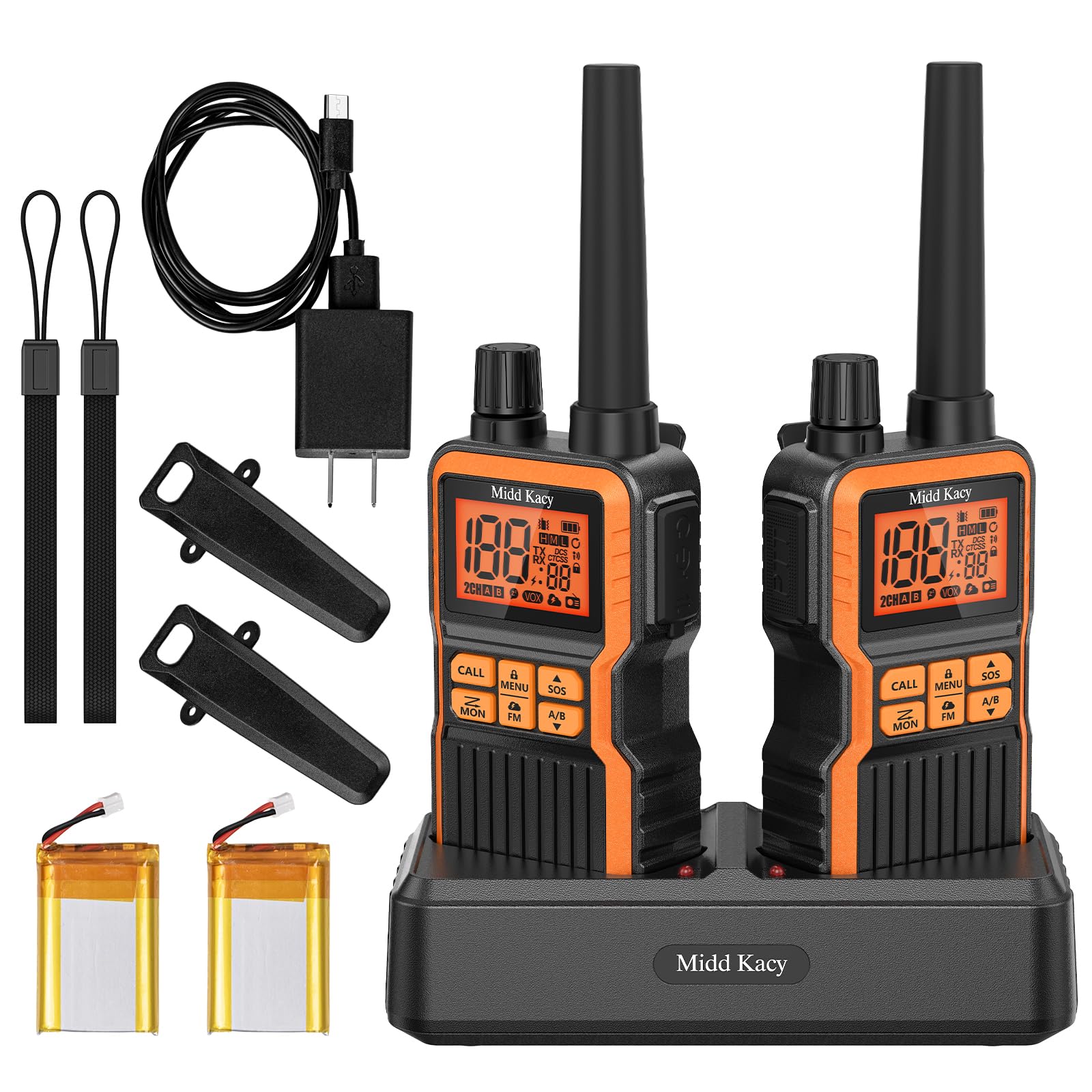
A two-pack with Dual Watch and 121 privacy codes to keep two vehicles on one clear channel.
The MK108 is aimed squarely at the road-trip and property crowd. Each handset runs an 1800 mAh lithium-ion battery with up to 60 hours of standby time, and you can charge it by USB-C or drop both into the included dual-slot desktop charger. Sixty channels and 121 privacy codes mean your group hears each other and not the other traffic on the frequency. A 2.5 mm headphone jack adds a quiet listening option in the car.
Dual Watch is the sleeper feature for drivers. It monitors both the A and B channels at once and scans for activity, so you can watch the convoy channel and a second one without fiddling with the dial. VOX with nine sensitivity levels lets you talk hands-free, and whisper mode keeps your voice down when you don’t want to broadcast to the whole parking lot.
Reliability is the trait that earns the most goodwill here. Owners treat these as dependable daily drivers, and they hold up across highway convoys and repeated family use. The honest caveat on range: it is fine but not remarkable, and you should read the quoted figures as best-case open-air numbers. The other thing to know is water — the IP55 rating handles rain and splashes, but do not submerge it, because it is not a dunk-proof radio.
The practical read: NOAA weather alerts, an SOS alarm, FM radio, and an orange backlit LCD cover the camp-and-highway jobs, and the keypad lock stops accidental channel changes in a pocket.
Best matched to: two-vehicle trips and family property use where clear audio and a durable shell matter more than raw distance.
Not the one for: open-water or deep-backcountry use where you need the longest possible reach.
4. MaxTalker MT10 Walkie Talkies (6 Pack)

Six 1200 mAh FRS radios in one box, each with 22 channels and USB-C charging.
Nobody in this lineup hands you more handsets at once. The MT10 pack ships with six radios, each running a 1200 mAh rechargeable lithium battery rated for up to 72 hours of standby — no more hunting for AA cells when a kid wants to ride bikes. Every unit charges by USB-C, and each has 22 FRS channels with 121 sub-channels so you can dodge a crowded frequency.
This is a family radio first. The colorful housings make it easy to tell whose is whose, the push-to-talk is simple enough for young kids, and the LED flashlight and voice-activated VOX are useful on a camping trip or an evening walk. NOAA weather alerts are built in, which matters if you camp where storms roll in fast.
Know the real reach before you buy. The stated range is 0.6 to 1.5 miles in ordinary conditions and up to 5 miles in ideal ones — enough to cover a neighborhood, a campground, or a cruise deck, but not a stand-in for the stronger picks above. Customers note they are great value for group and recreational use rather than professional-grade long haul.
What the box gives you
- Six full radios with 1200 mAh rechargeable batteries included
- 72 hours of standby time and USB-C charging on each unit
- 22 channels and 121 sub-channels to find a clear frequency
- NOAA weather alerts, LED flashlight, and hands-free VOX built in
Where it falls short
- Shortest realistic reach of the group — fine around a neighborhood, thin across open country
- Aiming for kids and casual use rather than work-ready durability
Buy this when: you need to hand a radio to every member of a big family or a scout troop while staying affordable.
Look elsewhere if: your goal is maximum distance between two points — the higher picks on this list do that job better.
5. Cobra ACXT390 Walkie Talkies

At 3.8 ounces per handset, it clips to a belt or drops into a jacket pocket without weighing you down.
Weight is the headline. Each Cobra comes in at 3.8 ounces — light enough that you forget it is clipped to your belt, and easy to toss in a daypack for a hike. It spans 22 channels and 121 privacy codes to lock out other users, adds 24/7 NOAA weather channels, and offers voice-activated VOX for hands-free transmit while hunting or working. The rechargeable base lets you set both radios down and top them up together.
Cobra advertises up to a 25-mile range, and that figure is the one to treat with care. Reviewers point out solid use in woods and hills at around a mile to a mile and a half, and similar performance in flat, populated areas. That is realistic handheld behavior, and it makes the Cobra a solid tool for keeping tabs on a partner in the field or a kid off at a friend’s house. Weather channels work as advertised.
The honest trade-off is how the accessories hold up. The belt clips have been known to give out, and the speaker clarity is workmanlike rather than premium. Treat this as a light, easy radio for occasional outdoor use, not a daily workhorse for a construction crew.
Where it shines: light carry weight, straightforward controls, and a rechargeable base make it an easy grab for hikes and school events.
The fair caveat: the quoted maximum range is a best-case figure, and real-world intervals in town run closer to a mile or two.
The light-traveler’s choice: pack it when weight matters and your conversations happen within a couple of miles.
Skip it for: hard daily field work that depends on long, uninterrupted range.
6. Motorola T210TP Talkabout (3 Pack)
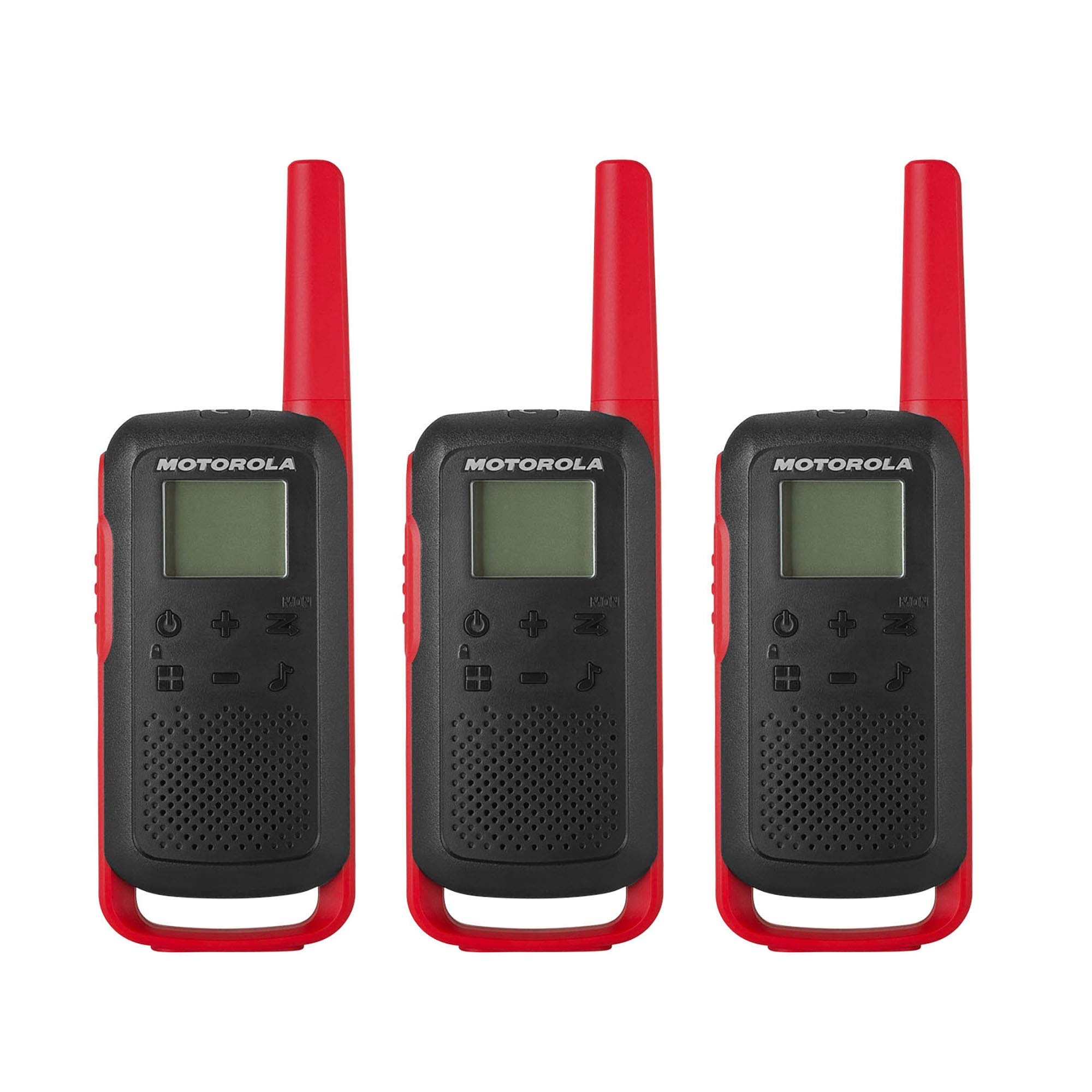
A license-free three-pack with 800 mAh batteries, backlit displays, and NOAA weather alerts.
Motorola’s T210TP comes as a three-pack, which fits the family that wants a radio for each kid plus one for the adult in charge. Each unit runs an 800 mAh battery rated for about 18 hours, charged through a dual micro-USB y-cable so two radios fill from one adapter. The 22 channels and 121 privacy codes are standard, NOAA weather radio and alerts are built in, and the backlit display makes nighttime use easier.
This is a license-free FRS radio, so there is no paperwork to sort out before you hand one to a child. The controls are simple by design and owners routinely describe them as easy for kids to use. A three-pack priced in the same range as some two-packs makes it the practical family pick — you get a spare or a third child covered.
Range is where expectations need setting. Shoppers say strong range in some settings and shortfalls in others, and the manufacturer notes plainly that actual distance depends on terrain and obstructions. Use it around the house, across a ski lodge, or on a trail; do not expect it to reach across a valley. The small 800 mAh battery also means you’ll charge it more often than the higher-capacity picks here.
Why families land here: three radios, license-free operation, a backlit screen, and NOAA weather make it a straightforward hand-off to kids without a manual.
Suits households with kids: a ski slope, a wooded property, or a trail ride where three handsets cover the group.
Not the pick for: long-distance communication or anything needing extended battery endurance.
7. Motorola T475 Extreme Two-Way Radio (2 Pack)
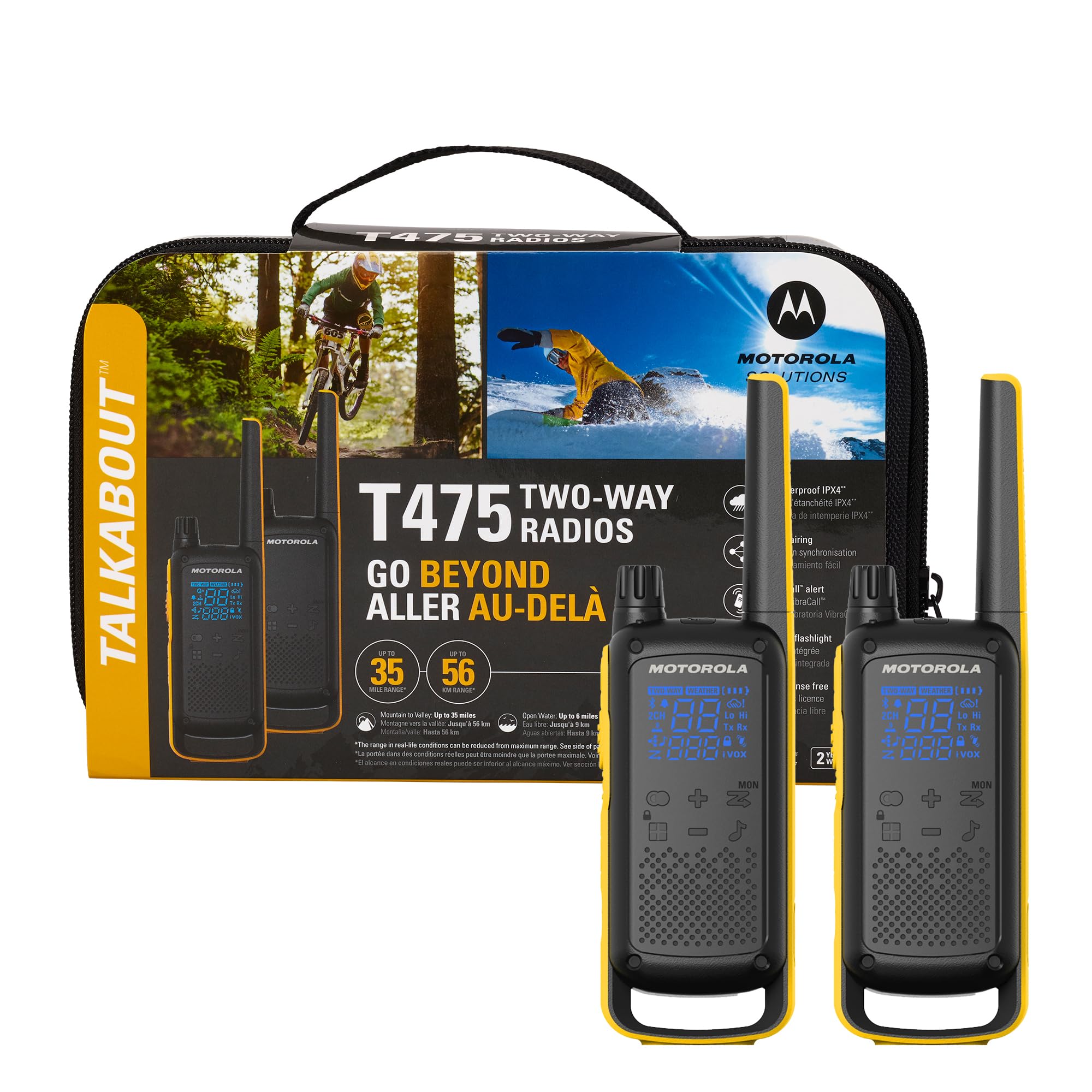
An IPx4 trail radio whose 22 channels and 121 privacy codes combine into 2,662 settings.
The 22 channels and 121 privacy codes give you 2,662 combinations, so a clear channel is almost always available. The 22 channels and 121 privacy codes combine into 2,662 possible settings, so you can nearly always find a clear channel with no one else on it. An IPx4 rating means it shrugs off rain and splashes, and the VibraCall alert delivers a silent buzz rather than a noisy chime when you need to grab someone’s attention.
Built for the outdoors, it adds NOAA weather radio and alerts, a built-in flashlight, and dual power options with the NiMH battery included. The carry case, belt clip, earpiece, and lanyard are in the box, so it is trail-ready out of the gate. For a convoy or camping trip, the combination of weather alerts and a flashlight in a rugged shell is genuinely useful.
Battery life is the honest wrinkle. The 800 mAh NiMH pack is rated at up to 12 hours, and some buyers report needing to recharge every couple of days of regular use or finding charges that don’t hold. Range off-road is a real strength when conditions cooperate, and the speaker is loud enough to cut through background clatter. Consider it a strong trail companion that needs a solid charging routine.
The strongest angle: 2,662 channel combinations and a weather-proof shell make it a dependable convoy radio for riding, camping, and emergency kits.
The weak spot to plan around: a 12-hour rated battery means charging is a routine, not an afterthought.
The right call for: trail rides, convoys, and campers who want a rugged pair with weather alerts and a silent alert feature.
Weigh the battery: if you need day-after-day endurance without charging, a higher-capacity pick beats it.
Know the Specs
Pre-Programmed FRS channels
FRS (Family Radio Service) is the license-free band most family radios use. Once a walkie talkie is pre-programmed, you turn it on, pick a channel, and talk — no code plugs, no pairing step, no license. Compatibility only requires that both radios use the same channel and privacy code, so an FRS radio from one brand will often talk to an FRS radio from another.
Privacy Codes (CTCSS/DCS)
A privacy code is a tone or digital tag that tells a radio which transmissions to open up for. Setting the same code on two handsets makes them act like a private line. Privacy codes do not stop other people from hearing you — they only stop you from hearing everyone else on the channel.
Battery Capacity and Standby Time (mAh)
mAh stands for milliamp-hours — a bigger number generally means more talk time per charge. Standby time is how long a full radio can sit powered on and waiting. A 2000 mAh pack in the Retevis is the largest here, while the 800 mAh Motorola packs are the smallest. With VOX and weather alerts always scanning, a larger battery holds up better through a full day outdoors.
IP Ratings and Weatherproofing
An IP rating is a two-digit code for dust and water protection. IP67 means a device keeps out heavy dust and survives a dunk, while IP55 and IPx4 handle rain and splashes but not a swim. Match the rating to the job — an IP67 radio is built for mud, rain, and a drop in a puddle; an IPx4 radio is fine for a passing shower.
Common Questions
Do 20 mile walkie talkies really reach 20 miles?
Do I need a license to use a GMRS walkie talkie?
Will a Motorola talk to a Retevis or BAOFENG radio?
What is the difference between FRS and GMRS?
How long does a charge last on these radios?
Can walkie talkies get wet?
Does a privacy code make my conversation private?
Will these radios work where there is no cell service?
Do walkie talkies have NOAA weather channels?
Can I charge these from a USB power bank?
The Bottom Line
For most people shopping for 20 mile walkie talkies, the Retevis RB48 is the safest bet. It has an IP67 waterproof shell (sealed against dust and able to survive a dunk in water), a 2000 mAh battery rated for up to 20 hours, and a build tested to MIL-STD-810H (a military durability standard) that shrugs off a drop. If you want the longest legitimate reach and don’t mind a license, the BAOFENG GM-15 Pro gives you repeater support (it can bounce your signal off a relay tower to stretch range) and 250 channels to work with. And when the whole family or a big group needs radios, the six-pack MaxTalker MT10 covers everyone at once.
How we choose
We do not accept paid placement. Every pick is matched to a real buyer and a real use-case; we do not hands-on test units.
Sources
Specifications: manufacturer listings and product documentation. Review insights: verified customer reviews, as of October 2026. Pricing: not shown on this page (it changes often); check the current price via the retailer link.
As an Amazon Associate, Aappliancez earns from qualifying purchases. This does not affect which products we feature.