Disclosure: Some links in this post are affiliate links. As an Amazon Associate I earn from qualifying purchases, at no extra cost to you. Learn more
Specs are compiled from manufacturer listings and verified buyer reviews and can change over time — please confirm the key details on the product page before buying.
You want to see which line is ringing, hold one call without dropping the other, and sound like an office instead of a walkie-talkie. The problem is that most listings bury the few specs that actually matter — how many handsets you can add, whether the corded handset still works in a power cut, and how many of your cell phones can link in at once. This guide separates the systems that genuinely handle two lines from the ones that only claim to.
This guide is built by comparing the manufacturers’ published specifications and the patterns across verified customer reviews, so you get each pick’s real strengths and trade-offs instead of marketing spin.
The picks below range from a full four-line office base to compact cordless duos, and each one earns its place on a different strength. If you already know if you need a corded base, start with the comparison table. Then read the full reviews for the honest trade-offs on a great 2-line phone system.
Top Picks

How To Choose The Best 2-Line Phone System
Two lines means two different phone numbers arriving on one desk, and your system has to keep them apart without making you think about it. Four things decide it: how many handsets you need, if you want a corded backup, whether your mobile phones need to ring through the landline, and how the answering machine splits its recording time. Get those four right and everything else is detail.
Corded, cordless, or both
A corded handset draws its power from the phone line itself, so it keeps working during an outage — that is the single biggest reason small offices still want one on the desk. A cordless handset is the one you carry into another room, and it runs on rechargeable batteries that sit in a charging cradle. Systems that include both give you the reliability of the corded base with the freedom of a cordless handset, which is why the mixed corded/cordless designs dominate this category.
DECT 6.0 range and what blocks it
DECT 6.0 is the wireless standard these phones use, and it broadcasts on a frequency that avoids most home Wi-Fi congestion. That matters because crowded Wi-Fi is what makes a cheap cordless phone crackle. The practical limit is walls and floors: a base in a basement will usually reach the second floor, but not always both directions. If you work across a split level or a thick-walled building, range is the spec worth checking first.
Cell linking and Bluetooth handoff
Link2Cell and Connect-to-Cell are two brand names for the same trick: pairing your mobile phone to the landline base over Bluetooth so incoming cell calls ring on the landline handsets. This is genuinely useful for a home office, because you stop sprinting for your mobile when it buzzes in another room. The catch is that most systems only keep one Bluetooth device active for a call at a time, so read carefully if you plan to run two mobiles plus a wireless headset.
Side-by-Side Comparison
| Model | Best For | Line Capacity | Handset Setup | Answering System | Amazon |
|---|---|---|---|---|---|
| Panasonic KX-TG9582B★ Best Overall | Home office with cell phones to link | 2 lines | Corded base plus 2 cordless | Digital, Link2Cell Bluetooth | Amazon |
| Motorola ML1000Business Base Station | Growing small business base station | 4 lines | Corded base, up to 10 extensions | 200-minute, 10 mailboxes | Amazon |
| VTech DS6151-2 | Budget two-line home coverage | 2 lines | Cordless, expandable to 12 | 13-minute digital | Amazon |
| AT&T TL86103 | Home office mixing cells and landlines | 2 lines | Corded base plus 1 cordless | Two 22-minute mailboxes | Amazon |
| AT&T TL86109 | Bluetooth headset users on landlines | 2 lines | Corded and 1 cordless | 14-minute digital | Amazon |
| Panasonic KX-TGW420B | Busy four-line business desk | 4 lines | Corded base, expandable to 10 | Digital, 200-minute storage | Amazon |
| VTech DS6251-3 | Three-handset two-line coverage | 2 lines | Cordless, 3 handsets, expandable to 12 | Digital, trilingual menus | Amazon |
Detailed Reviews
1. Panasonic KX-TG9582B 2-Line Corded/Cordless Phone System
Our pick — over 4★ from 1,500+ verified ratings; the strongest balance of quality and price.
The two-line system that lets four mobiles ring through the house
If you run a business line and a home line on the same desk, this is the one to start with. Link2Cell pairs up to four smartphones to the base over Bluetooth, so cell calls arrive on the cordless handsets instead of on the mobile sitting in your bag. You get a corded handset on the base plus a cordless handset, and the base is the natural anchor for a setup where both lines need to be answered by someone who is not always at the desk.
Talk time runs up to 15 hours and standby up to 7 days, so a handset can roam the house without a mid-call scramble for the cradle. DECT 6.0 handles the signal, and it is the reason this system holds up in a home office or an apartment with thick walls rather than crackling the way Wi-Fi phones can. The 1.8-inch monochrome display uses a 103×65 pixel layout, enough for names and line indicators.
Where owners rally is quality — it is the runaway favorite in the review pages, with ease of use running a clear second. The cordless handsets run on standard NiMH AAA batteries instead of a proprietary pack, so when the cells wear out you swap batteries rather than the phone. Outlook integration over USB lets you dial contacts from your PC, which is a small thing that turns a home office into something that behaves like an office.
What owners run into: Sound quality draws split opinions — some callers come through with bass-equalized clarity after noise reduction kicks in, while others find the tone thin, and a small number report Bluetooth pairing trouble. Expect the hold function to sit behind a couple of button presses rather than a single dedicated key, and only one cell can be active on a call at a time.
The honest trade-off: This is the top of the range, and the price reflects the feature set. If you only need two handsets and a plain answering machine, a simpler system will do the job for a lot less. If you want a full working desk setup that links your mobiles into the landline, the Panasonic is the one that delivers.
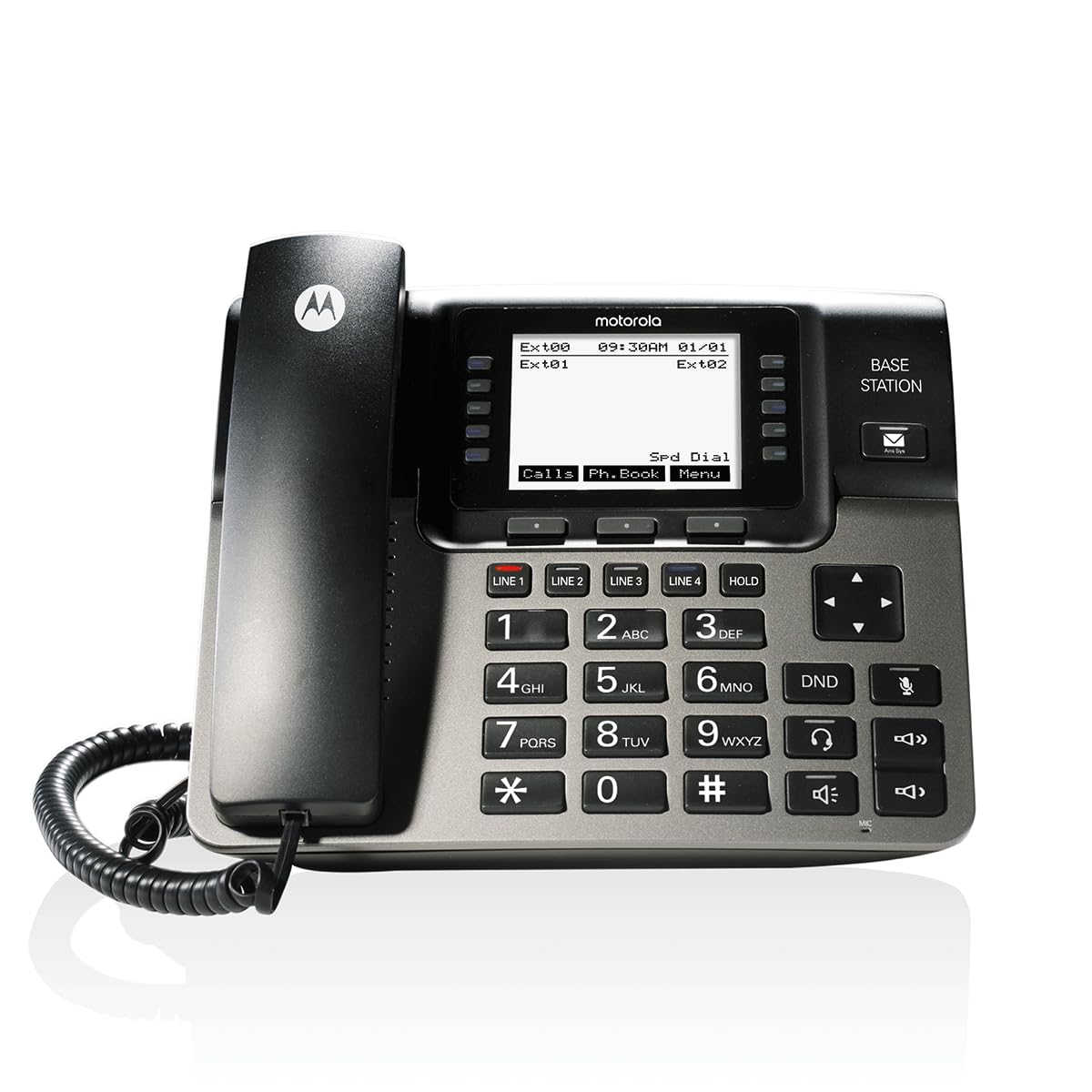
2. Motorola ML1000 4-Line Corded Base Station
A four-line office base that grows by wireless extension instead of wiring
This is the pick for someone with more phone numbers than a two-line desk can hold. The ML1000 is a base station that takes up to four lines and supports up to 10 wireless extensions in the ML1100 and ML1200 family, so you add desks without running cable to them. One phone jack gets the whole thing started, which is the part that saves a weekend of drilling. At 8.7 x 3.16 x 5.9 inches it takes real desk space, but it also looks like the office phone it is meant to be.
The digital receptionist is the standout for a business: it answers incoming calls and routes them to the right department automatically, so no caller sits in silence waiting for a person. The 200-minute digital answering system stores messages across up to 10 mailboxes with time and date stamps, and you can retrieve messages remotely when you are out of the office. Headset-ready and hearing-aid compatible, it also wall-mounts if your desk is already crowded.
Setup is quick: reviewers describe getting the system running in about three minutes, with an easy menu and readable buttons and display. The speakerphone picks up voices from 10 to 15 feet away, so several people in the room can join a call. If you are expanding the way the system is designed for, it holds up well over months of use.
Worth knowing before you buy: The base and desk set run large, and one owner wanted something about 3 inches narrower. Buttons are oversized and there is no color screen, and unused lines keep showing a “no line” message. A few units have shipped with a dead handset or a base that reports low batteries even on fresh cells — worth testing the moment it arrives while the return window is open.
Reach for this if: You need four lines and wireless extensions without running new cabling through the office.
Think twice if: You want a compact desk phone or a color screen — this base is meant to be the hub, not tucked away.
3. VTech DS6151-2 2 Handset 2-Line Cordless Phone System

Two lines and two handsets for the price of a mid-range home phone
For a home or small shop that wants two lines covered without spending office money, this is the practical pick. You get two cordless handsets and a base, with two-line operation and a 3-way conference that pulls in an outside line plus two handsets. Each line gets its own mailbox on the digital answering system, so a business number and a family number never trip over each other’s messages. Recording time runs up to 13 minutes, and caller ID history holds 50 names and numbers.
Expansion is where the value sits. The system grows up to 12 handsets, so you can add a cordless handset to the kitchen or the back office and they will all ring on the correct line. Intercom between handsets and the base means you can call across the building without picking up a line at all. Prompts run in English, Spanish, or French, which is a small touch that makes setup easier for more households. At 1.9 pounds it is light enough to move between rooms when you rearrange the space.
Buyer reviews are split, and that is worth knowing: some owners find the setup friendly and the sound good, while others report a handset that did not work from the start or calls that drop. Buyers who use it daily treat it as a straightforward two-line phone with voicemail and call history. Coverage impresses — one account uses it in a concrete-block school with the base in a hallway reaching every classroom. Expect it to do the basic job well and not much beyond.
The catch to size: The sound quality is the main split — a handful of buyers report muffled speakerphone or dropped calls, which is the risk at this tier. There is no cell linking, no Bluetooth, and no corded handset backup, so a power cut takes the phones down with it. If you need any of those, budget-tier is not the right shelf.
The value call: Ideal for a home or small shop that needs two lines, two handsets, and a per-line mailbox without paying office-system money.
skip it if: You want cell calls to ring through the landline or a corded handset that works during an outage.
4. AT&T TL86103 2-Line Corded/Cordless Phone System

Runs two landlines and two mobiles off one corded desk base
If your home office is really a small office, this is the system built for that mess. The corded base keeps working in line-power mode during an outage, and the base carries a large backlit display, speakerphone, and big-button keypad. The cordless handset can reach any of the connected lines, and the system expands to a large number of cordless handsets if you want coverage across the house.
Range reaches up to 1,000 feet, enough for a home office that spills into a workshop or a detached space. Two separate mailboxes each hold up to 22 minutes of recording, so business messages and family messages stay apart without you sifting through one inbox. Up to 6,000 cell phonebook entries download to the handsets, and two USB ports on the base charge your mobiles while you work.
What wins people over is quality, and ease of use lands right behind it. Owners praise the feature set for a work-at-home or small office desk — a second line on a Magic Jack, an iPhone over Bluetooth, a spare cell or wireless headset all coexisting. There is no call blocker, but a QUIET button silences the ringer for a stretch of hours when you need to focus. A data port on the base handles a fax modem, which is the detail that makes it a real office phone rather than a house phone with more buttons.
What to plan for: The 2.5mm wired headset jack needs a firm push to seat fully, and the cordless base can feel wobbly on a polished desk. One owner ran into a discontinued companion app that no longer plays nicely with current messaging apps, so do not count on the phone-side app features. Bluetooth range holds up well but can thin out in a split-level home with a strong router nearby.
The one to reach for: A work-from-home or small office desk juggling two landlines and two mobiles at once.
pass on it if: You want a simple two-line house phone — the feature count here is more than a home setup needs.
5. AT&T TL86109 2-Line Corded/Cordless Phone with Bluetooth

The two-line desk phone that treats a Bluetooth headset as a real line
Here is the unusual part: this system connects up to two Bluetooth cell phones at once, or one cell phone plus a Bluetooth headset you use for your landline calls. That second option is rare, and it is the reason someone who lives on a headset should look here. The package includes a corded handset and a cordless handset, the base carries a speakerphone and a dual keypad, and DECT 6.0 handles the wireless side. Intercom and call transfer between handset and base are built in, and the digital answering system holds up to 14 minutes of recording.
Functionality is what owners single out, with Bluetooth connectivity a close second. The clearest real-world win is hearing-aid pairing: one owner reports this is the only Bluetooth landline phone that pairs with their Phonak hearing aids as a Bluetooth headset, after trying several models. The tilting backlit display is easy to angle, the centralized directory keeps everyone’s contacts in one place, and the whole thing reads like a proper office phone. Call transfer between lines is smooth, and pairing an iPhone has proven stable over years of use.
The Bluetooth integration gives you three lines in practice — two landlines plus your cell — with conference, hold, and mute working across all of them. Range through walls is solid enough for a typical two-storey house. It is ENERGY STAR qualified, which is a small running-cost consideration in a phone that stays plugged in all day.
Where the friction sits: Ease of use divides opinion sharply — some find it intuitive and smooth, others hit a lunch-menu learning curve. The directory search can take a few seconds to land, only one Bluetooth device is active at a time, and non-recessed buttons invite accidental presses. The bright blue charging light on the handset is a common complaint for anyone with a handset near the bedroom.
Made for: Anyone who takes landline calls on a Bluetooth headset or uses hearing aids that pair over Bluetooth.
Not for: Someone who wants a button-light phone — the menus here reward a little setup patience.
6. Panasonic KX-TGW420B 4-Line Corded Base Phone System

A four-line desk phone that expands by adding desk units, not cables
This is the Panasonic office base for a business line count that has outgrown two. It handles four lines, and it wirelessly connects up to 9 additional corded desk units or cordless handsets in the KX-TGWA40B and KX-TGWA41B families, so the whole office grows without a wiring job. The feature list runs long: 30 speed dial numbers, 6-way conferencing, 2-way recording, intercom, music on hold, and a digital answering system with up to 200 minutes of storage. DECT 6.0 keeps the signal strong across separate rooms or even outside.
The digital receptionist is the productivity piece — it answers incoming calls and routes them where they belong, which saves a receptionist’s time in a small shop. Setting it up is straightforward, and the handset sound and menu are clear enough that a home-office user can run it without a manual. The corded base means the desk phone keeps working if the power dips. If your growth plan is adding desks one at a time, this is the base built for that path.
An honest fit note: Owner feedback here is genuinely mixed, not a rave or a bust. Some users get easy setup, intuitive menus, and good handset sound; others report buttons stopping over time, subpar speakerphone audio, and difficulty with features like redial and conference calling. One owner did not realize a handful of these had to be one base plus extensions rather than several bases working together — that is a setup detail worth confirming with the maker before you order multiples.
One small gripe: The ringtone cannot be changed and the ringer volume has no adjustment, which is the specific limitation worth knowing if the desk sits away from where you work. If your office is quiet and the phone is on the desk, it is a non-issue.
7. VTech DS6251-3 2-Line Cordless Phone System with 3 Handsets

Three handsets covering two lines for the price of two
For a house that wants both lines answered in any room, this kit gives you three cordless handsets right from the start, and it expands up to 12 if you need more. Two-line operation with 3-way conferencing covers the basics, DECT 6.0 keeps the signal clear with interference-free communication and enhanced security, and the large backlit display plus adjustable handset volume make it usable for older users. Trilingual menus cover English, Spanish, and French. Four AA batteries power the setup, and the phone runs on the DECT 6.0 wireless standard.
The reason this earns its place: handset coverage per dollar. Two-line systems often include only one or two handsets, so three in the box at this price is the value story. Owners describe it as easy to set up with a great price and a clean design, and the ringtone is loud enough to reach you from another room. One buyer took it to a concrete-block school and reports the base in the hallway reaching all the classrooms, which tells you what DECT 6.0 can do when the base is centered. Another notes a line splitter was needed to bring both lines in, and honestly that is a home-wiring fact rather than a phone limitation.
The honest reality: Reliability and quality both read as mixed in the owner feedback, and value-for-money reads negative — which is worth parsing carefully. Some owners run it clean for months; others hit a dead second line or handsets that need an unplug-and-replug reset to recover. A couple of buyers find it harder for callers to hear them, which is the sound-quality weakness at this end of the range. If you buy it, test both lines the first week.
Who it suits: A multi-room home that wants three handsets covering two lines without paying a premium.
Who should pass: Anyone who needs rock-solid reliability for critical calls — the consistent feedback is mixed at this tier.
Know the Specs
Number of lines and handset expansion
A two-line system answers two separate phone numbers from one base, while a four-line system like the Motorola ML1000 or the Panasonic KX-TGW420B handles more. The expansion number tells you how many handsets the base can carry — the AT&T TL86103 and the VTech DS6151-2 and DS6251-3 all expand up to 12 handsets, while the Motorola ML1000 supports up to 10 wireless extensions in the ML1100 and ML1200 family and the Panasonic KX-TGW420B supports up to 9 additional desk units or cordless handsets. Pick a system whose expansion covers the rooms you actually want a phone in, so you are not adding handsets later that the base cannot carry.
Answering-system minutes and mailboxes
Recording time is the easiest spec to gloss over and the easiest to regret. The AT&T TL86103 gives two mailboxes with up to 22 minutes each, so a business and a family line can keep messages separate. The Motorola ML1000 and the Panasonic KX-TGW420B both store up to 200 minutes across multiple mailboxes, which is what you want if you get long messages or business voicemail. Smaller systems like the VTech DS6151-2 (13 minutes) and the AT&T TL86109 (14 minutes) suit light use where you clear messages regularly. More mailboxes mean fewer mixed-up messages when two lines are running at once.
Common Questions
How does a two-line phone system work with two separate phone numbers?
Does a 2-line phone system need a corded handset?
What is Link2Cell or Connect-to-Cell and how many cell phones can I link?
How many handsets can I add to a 2-line phone system?
Do I need a separate line splitter for two lines to reach one wall jack?
Will a 2-line phone system work during a power outage?
How much answering-machine recording time do I actually need?
What does DECT 6.0 mean and does it matter for my range?
Can I pair a Bluetooth headset to a 2-line phone system?
Is a 4-line base worth it over a 2-line system for a small office?
The Bottom Line
The best 2-Line Phone System for most buyers is the Panasonic KX-TG9582B: it pairs a corded base handset with a cordless one, links up to four cell phones over Bluetooth, and runs 15 hours of talk time on replaceable NiMH AAA batteries. If you want the maximum versatility for a home office juggling two landlines and two mobiles, the AT&T TL86103 is the one with two 22-minute mailboxes, two USB charging ports, and up to 1,000 feet of range. And if your business is running more lines than two, the Motorola ML1000 gives you a four-line base with a digital receptionist and up to 10 wireless extensions. One nudge before you commit: the Panasonic KX-TG9582B carries a 4.2-star score across 1,500-plus ratings, the highest-rated pick here, so if you only want to solve two lines once and be done, start there.
How we choose
We do not accept paid placement. Every pick is matched to a real buyer and a real use-case; we do not hands-on test units.
Sources
Specifications: manufacturer listings and product documentation. Review insights: verified customer reviews, as of October 2026. Pricing: not shown on this page (it changes often); check the current price via the retailer link.
As an Amazon Associate, Aappliancez earns from qualifying purchases. This does not affect which products we feature.