Disclosure: Some links in this post are affiliate links. As an Amazon Associate I earn from qualifying purchases, at no extra cost to you. Learn more
Specs are compiled from manufacturer listings and verified buyer reviews and can change over time — please confirm the key details on the product page before buying.
If you and one other person keep pulling a four-player box off the shelf and staring at it, the fix is a game built for exactly two players — no dummy hands, no watered-down rules, no waiting for a group to show up. A real 1v1 game is designed around the tension between two minds, which is why the best of them play tight, quick, and personal. This guide sorts the current standouts by what actually matters: how long a round runs, how much pure strategy it delivers, and how quickly a newcomer can sit down and play.
This guide is built by comparing the manufacturers’ published specifications and the patterns across verified customer reviews, so you get each pick’s real strengths and trade-offs instead of marketing spin.
Some of these games reward planning across a whole session, while others are quick enough to run three in a row on a rainy evening. Below you will find the strongest 1v1 board games for couples, roommates, and anyone who wants a real fight at the table.
Top Picks


How To Choose The Best 1v1 Board Games
A two-player game lives or dies on what happens inside those thirty minutes. Four-player games can hide a weak player behind the crowd; a duel exposes everything, so you want a design where both people stay busy until the last turn. Here is what to weigh before you pick a box.
Match the playtime to your real evening
Estimated playing time is the number printed on the box for a typical round, and it tells you whether a game fits a quick coffee-table match or a full evening sitting. A 20-minute game means you can play a best-of-five without checking the clock. A 30-minute game is still a single-evening commitment, but it asks for a bit more focus per session.
Look for more than one way to win
Games with three separate victory routes keep both players honest, because you cannot ignore one threat and coast to the end. When the rules offer a military win, a science win, and a points win, your opponent has to split attention across all of them. That tension keeps both players defending all three paths until the final turn.
Decide between competitive and cooperative
Most 1v1 games are head-to-head duels, but some are built for both people to win or lose together. Cooperative versions often limit how much you can talk mid-round, which is what makes two players feel the pressure as a team instead of one person solving the whole puzzle.
Side-by-Side Comparison
| Model | Best For | Playtime | Players | Win Conditions | Amazon |
|---|---|---|---|---|---|
| Asmodee 7 Wonders Duel★ Best Overall | Couples who play nightly | 30 minutes | 2 players | Military, science, or points | Amazon |
| Patchwork Americana EditionFamily Favorite | Relaxed puzzle fans | 30 minutes | 2 players | Points | Amazon |
| Smirk and Dagger BOOPBest for Kids | Families and new players | 20 minutes | 2 players | Three in a row | Amazon |
| Sky Team | Co-op couples | 20 minutes | 2 players | Complete the landing | Amazon |
| Splendor Duel | Travel and quick matches | 30 minutes | 2 players | Points, single color, or crowns | Amazon |
| Star Wars The DeckBuilding Game | Star Wars fans | 30 minutes | 2 players | Destroy three bases | Amazon |
| Everdell Duo | Slow-building city fans | 30 minutes | 1-2 players | Competitive or co-op | Amazon |
Detailed Reviews
1. Asmodee 7 Wonders Duel Board Game
Our pick — 4.5+★ from 9,500+ verified ratings; the strongest balance of quality and price.
Three separate ways to win, one tense civilization to defend
If you want a duel that keeps both players leaning forward the whole round, this is the one the crowd has crowned. It is a 30-minute, 2-player strategy game where each of you builds an ancient city by drafting cards, and every choice either strengthens your hand or hands your opponent an opening. The card drafting is the engine here: you pick from the cards laid out in a pyramid, and what you leave behind becomes available to your rival.
What seals it as the best overall pick is the three-way race. You can win by invading your opponent’s capital through military supremacy, by ruling scientific advancement, or by simply scoring the most points across your finished city — and the tension is that your opponent is tracking all three threat tracks at once. The base game is 30 minutes, and that compression matters at the table: it means you can finish a full match and immediately deal the next one.
Something to know heading in: the rulebook takes a session or two to settle into for new players, and the card layout creates genuine risk-and-reward decisions you will feel by your second round. Only seven of the eight wonders in play can ever be built, which means the literal last wonder is always a real fight. The card illustrations are gorgeous and the components hold up over dozens of plays.
Why the table keeps coming back
- Three win conditions keep every single round tense
- Estimated playing time of 30 minutes means one more game is always an option
- The card pyramid forces you to actually leave good cards for your opponent
- Base game runs clean without expansions
Where new players feel it
- Rulebook has a learning curve on the first session
- Card drafting style can feel like luck on your very first game
Grab it if: you play two-player games often enough that a slightly steeper first-session setup is worth years of deep, repeatable matches.
Keep walking if: you need something a newcomer can understand in five minutes flat.
2. Patchwork Americana Edition Board Game
A quiet puzzle duel where the clock is the real opponent
Here is the pick for two people who want a duel with no combat and no bluffing — just you, your opponent, and a 9×9 board waiting to be filled with patches. You are both quilters racing to cover your board completely with the pieces you buy. Every patch costs buttons and time, and the time track is what quietly ends the match sooner than you expect.
Patchwork Americana lands at a 30-minute estimated playtime, which lands it right next to 7 Wonders Duel on the clock but on a completely different emotional register. Where the Duel is loud and stressful, this one is meditative, and that is exactly why families reach for it on a slow Sunday instead of a party night. The Americana edition brings new art and components tied to American quilting traditions, crafted by designer Uwe Rosenberg.
The nine-by-nine board is small enough that every empty square at the end stings, so the push to leave no gaps becomes the whole game. It is an exclusive US edition, so if you are hunting for this specific art style, buy the Americana box rather than a general Patchwork copy. Both new players and veterans can find their footing in a round without a heavy rules read.
Spatial tension, no downtime: with just 33 patches and 5 special patches plus 50 button tiles in the box, every round depends on whether you planned your layout two moves ahead.
Slice it into your shelf: at a 30-minute round, this is the one to grab when you want a duel that feels productive rather than aggressive.
Reach for it when you want a two-player game that plays like a shared craft project rather than a fight.
Think twice if you thrive on direct conflict and bluffing — this one is quietly competitive, not loudly so.
3. Smirk and Dagger BOOP 2-Player Cat Strategy Board Game
A quilting-bee battlefield where every kitten you drop shoves a neighbor
Twenty minutes is the headline number here, and it is the shortest round on this list by a real margin. BOOP is a 2-player cat strategy game with an estimated playtime of 20 minutes, played on a soft quilted bed board with 32 beautifully crafted wooden kittens and cats. You place a kitten, and every adjacent piece gets “booped” one space away from the new arrival.
That shove mechanic is what turns this from a cute placement game into a genuine duel. You are trying to line up three in a row, but the board keeps shifting under you because your opponent’s placements displace your pieces too. It is the kind of game where you can be one move from winning and then watch it unravel. Playing time lands well under the 30-minute mark that 7 Wonders Duel runs, and that extra ten minutes back means you can run four or five BOOP rounds in the time a 30-minute duel takes to finish one.
The 32 wooden cats and soft quilted bed board are what sell this one. Wooden pieces with a soft quilted board, a rule set that can be explained in a few minutes, and a straightforward younger-kid variant printed in the book all make it approachable at the table with mixed ages. The game plays best at exactly two seats, which is the entire point of this shelf.
What sells it
- Shortest round in this lineup at a 20-minute estimated playtime
- The boop mechanic makes every move feel consequential
- 32 wooden cat pieces are genuinely nice to handle
- Simple enough for a brand-new player to learn on their first sit
Things worth knowing
- The box and board are a touch large for an airplane tray
- Depth tops out for very experienced strategy players
Best for: a household where at least one player is under twelve and you want the strategy to feel real anyway.
Not the right pick if: you are chasing the deeply layered decisions of a Feld or a Rosenberg at every turn.
4. Sky Team | Work Together to Land the Plane

Two people, one cockpit, and a hard rule: no talking once the dice roll
Here is the twist that makes this one different from every other duel on the list. You and your co-pilot are landing a plane together, and once the dice are rolled you are not allowed to talk. You both have to trust that the other person is handling their instruments while you handle yours. It is a 2-player cooperative dice placement game with an estimated playtime of 20 minutes.
The silence rule is what stops one player from running the whole table. In most co-op games, one person with the loudest voice takes over; here, that person is muted the second the dice hit the tray. You feel the teamwork in your stomach. The box also ships with 20 real-world airport scenarios, each with its own layout and special rules, so the same game can play easy one night and brutal the next.
The components are decent for the money — a control panel, an airplane axis disc, 8 dice, 2 player aid screens, and an altitude track. A few optional modules like kerosene leaks and ice on the tarmac are included for pushing the difficulty higher when you have beaten the standard scenarios. At 0.56 kg the box is light enough to travel with, which is a nice surprise for a game with this much table presence.
A two-person cockpit: the silent dice placement sidesteps the alpha-player problem entirely, and the 20-minute rounds let you run a full evening of landings without a time commitment.
The honest catch: the number of small tokens in the box is the recurring gripe — treat the pieces carefully and keep a bag handy for storage.
The pick for: couples and friends who would rather win together than fight each other.
Skip if: you genuinely want to beat your opponent, because that is not what this box is built for.
5. Splendor Duel Board Game
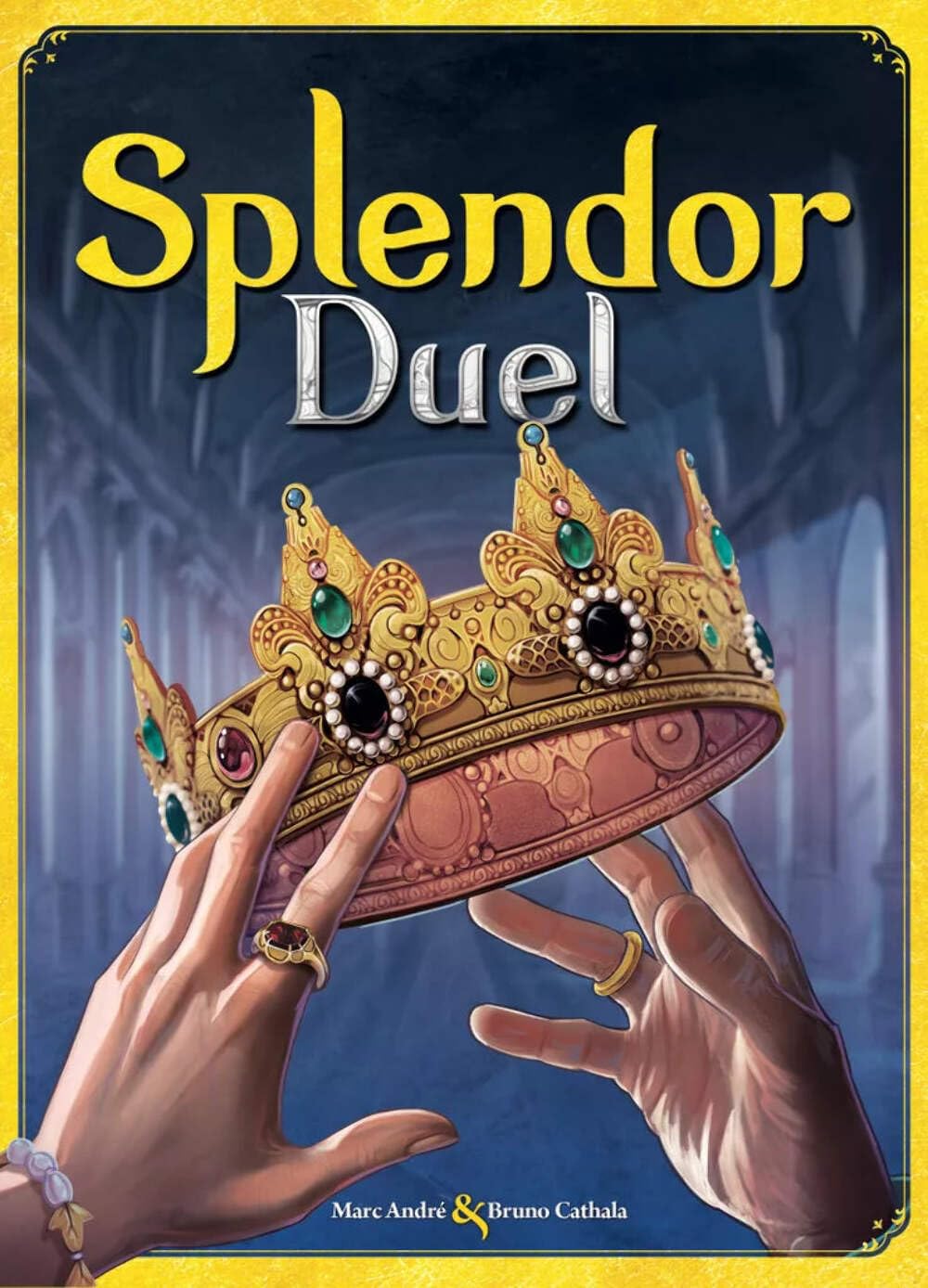
A full gemstone duel that squeezes into a bag without losing its bite
Splendor Duel is the two-player version of a game you have probably already seen on a shelf, rebuilt from the ground up for exactly two seats. The core race is gemstones: you collect them, buy development cards, build powerful combinations, and race to claim prestige points before your opponent does. The estimated playtime sits at 30 minutes.
Three win conditions give this one its three-ring battle feel. You can win on points, on collecting 10 cards of the same color, or on collecting 10 crowns — so your opponent cannot focus on stopping just one path. The Duel version adds gems that are not in the base game, including a pearl gem and a scroll mechanic that lets you claim a gem before your turn. Once you have played both, you will likely keep this one as the tighter fight.
The included components are honestly impressive for a box this size: 67 jewel cards, 25 plastic gem tokens, 4 royal cards, 3 privilege scrolls, and 1 common board, all in a package you can toss in a backpack. The main honest gripe is the card size — several owners say the cards are on the small side, and that is the trade-off for the compact build. If you are playing in low light or with readers on, expect to crane a little closer at the table.
What makes it the travel pick
- Three win conditions keep both players watching multiple threats
- Compact package — easy to bring to a cafe or a weekend suitcase
- Clean, elegant rules that click after one read
- 67 jewel cards and 25 gem tokens fit in the base box
Where it stumbles
- Cards are small, which some owners find hard to read
- Feels different enough from original Splendor that fans of the big-box version may want both
Choose it when: you want a two-player duel you can carry anywhere without dealing with a full-size game box.
Consider something else if: large, chunky cards matter more to you than portability.
6. Fantasy Flight Games Star Wars The DeckBuilding Game
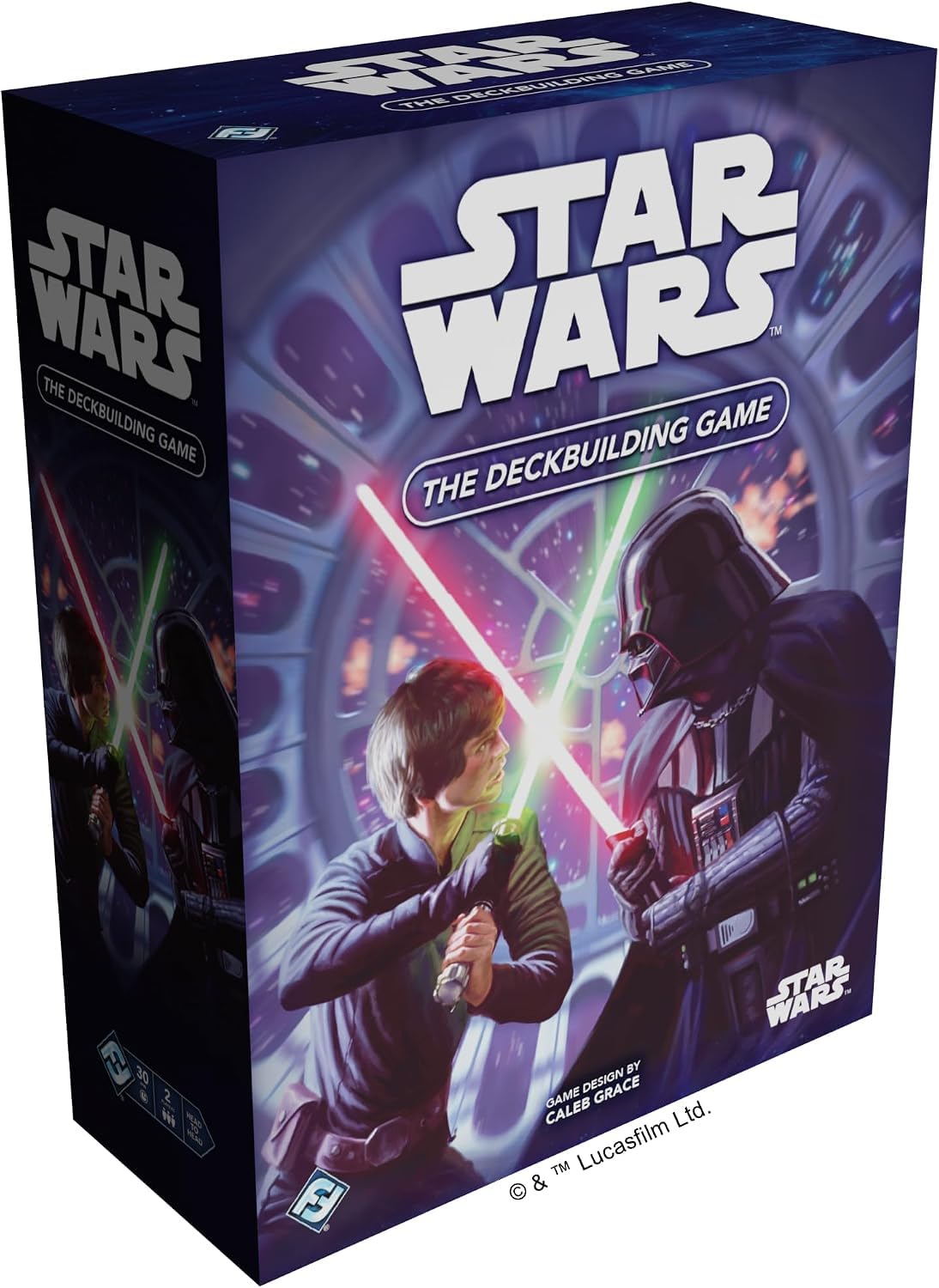
Pick a side of the Force, build your deck, and storm three bases
If the theme matters as much as the mechanics, this is where you start. You play as either the Empire or the Rebel Alliance, and the two sides actually play differently instead of just looking different. It is a head-to-head deck-building game with an estimated playtime of 30 minutes, and the win condition is simple: destroy three of your opponent’s bases.
The deck-building twist here is the shop hook. Every turn you can attack your opponent or buy cards they wanted, and in some cases removing a card from the shop is its own reward. There is a lot of shuffling involved because you are constantly cycling through a growing deck, but that is exactly what dedicated deck-building fans expect. 142 cards, 70 counters, and 1 balance of the force track all come in the box, which is a lot of game at this tier.
Where it earns its score is in the replay factor. You can run Empire one night and Rebels the next and the game feels different, because there are over 50 different cards to command and iconic bases like the Death Star and Hoth in the mix. The artwork is fan-favorite quality and the card stock holds up over repeated shuffles. Just be ready for the shuffle rhythm — it is real and non-negotiable.
Asymmetric dueling done right: playing Empire and playing Rebels each opens a different tactical language, so you get two games in one box without any expansion.
The known trade-off: the shop’s effects can feel stale after several sessions, which is the recurring note in owner reviews — plan to rotate it with another duel rather than play it nightly.
Worth owning if: you want a deck builder with a theme you will not get bored of and a two-player fight that lasts 30 minutes a round.
Maybe not your pick if: you dislike constant shuffling or prefer games with minimal card-management overhead.
7. Everdell Duo Standalone Board Game for 2 Players
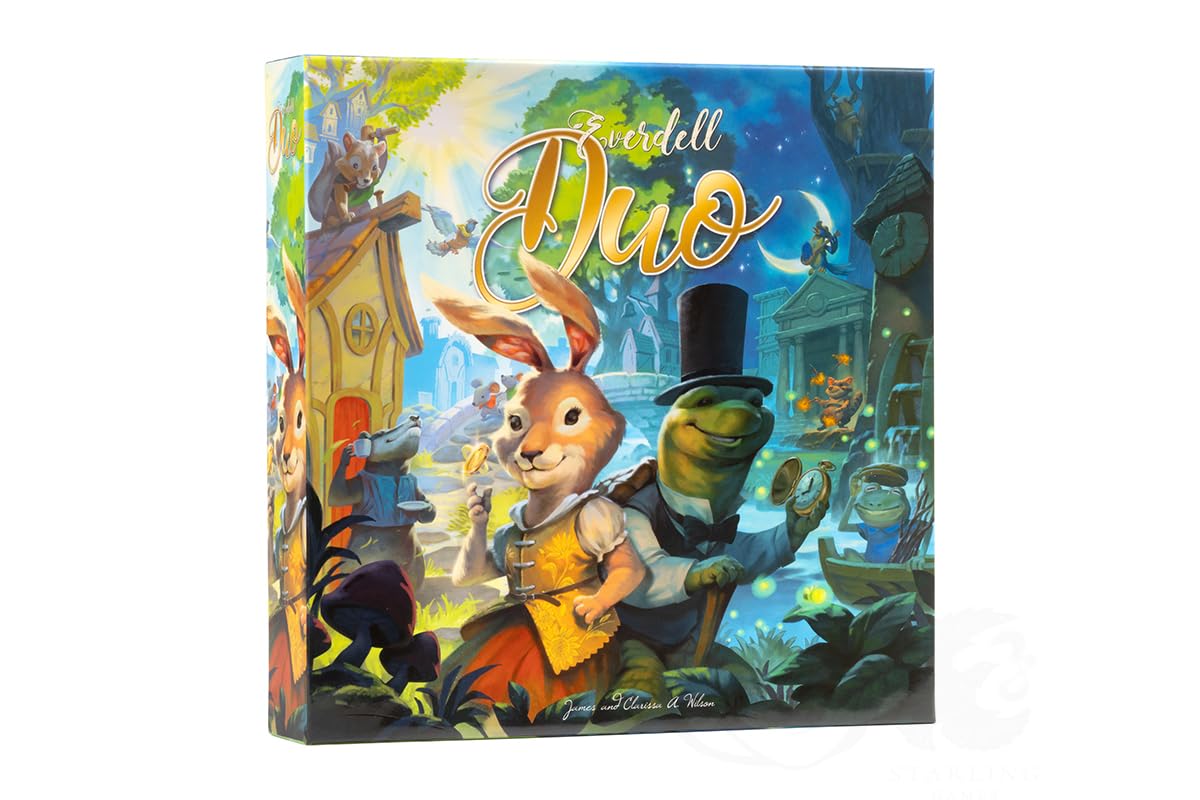
Build a woodland city together or tear each other’s down
Most duels force you to choose: compete or cooperate. Everdell Duo does not. It is a complete game built specifically for 1-2 players, and it can be played either as a head-to-head competition or as a full cooperative campaign with 15 chapters of story to work through. Estimated playtime is 30 minutes.
The engine-building core here is familiar territory if you have ever played the larger Everdell line — you place critters, gather resources, and build a city — but it has been streamlined for the two-player table. Setup is quick enough that pulling it off the shelf on a whim is realistic, which is not always true of the bigger Everdell boxes. The woodland theme and tactile components will absolutely carry this one if you have kids at the table or a partner who loves cute critters.
The cooperative mode is where this one stands apart from every other game on this list. You and your partner build the same city together instead of your own separate ones, and beating the campaign becomes a shared project rather than a series of fights. The one place owners split is difficulty — some find it very approachable and others find the campaign genuinely challenging, so it lands best with a partner who has some patience for a rule read at the start.
Two games in one box: head-to-head or full-co-op campaign means you can play competitively on weeknights and slowly push through the story on weekends.
A quieter shelf note: the difficulty curve is the one stickler — go in expecting a real rules session before your first round.
Know this pick suits: anyone who wants one box that covers both competitive and co-op nights with the same two people.
Not the right fit if: you want something you can teach to a stranger in five minutes with zero rule-reading.
8. Asmodee The Lord of The Rings: Duel for Middle-Earth

Fellowship versus Sauron, threaded through three escalating chapters
Built on the same skeleton as the best overall pick but dressed in Middle-earth armor, this one plays over three chapters that escalate the stakes as you go. You choose a side — the Fellowship trying to destroy the One Ring, or Sauron trying to conquer the land — and you expand your influence using cards and High Places. Estimated playtime is 30 minutes, and it is the premium pick on this list.
The three win conditions are what make this one so replayable. You can win by completing the Ring quest, by forming alliances with six Peoples, or by dominating Middle-earth outright. So your opponent cannot simply turtle behind one strategy, because each path requires a different kind of defense. The package includes 69 cards, 44 pawns, 18 tokens, 30 coins, 7 tiles, and 2 boards, so there is real physical weight to the table presence at 650 grams total. The plays here lead cleanly against 7 Wonders Duel, and fans of that game will recognize the bones.
The middle chapters are where this game earns its keep, because the mechanics shift enough to make the second and third acts feel like their own mini-games rather than just a longer version of the first. Asymmetric playstyles between the two sides are well balanced, so neither role feels doomed on the setup. If you have played 7 Wonders Duel and loved the tightness of its design, this is where you graduate to when you want the same sharp duel wrapped in a rich theme.
Three chapters, one duel: the quest, alliance, and conquest paths give you three distinct strategic projects inside a single match, and the escalation between chapters keeps the final act genuinely tense.
The learning ask: like its spiritual sibling, the rulebook rewards a patient first read — budget one full sitting to get comfortable before you expect a competitive match.
The one for: players who already own 7 Wonders Duel and want a thematic cousin with the same tight three-way race.
Look elsewhere if: the Lord of the Rings theme does not move you, because you can get near-identical mechanics from the base Duel at a friendlier tier.
Know the Specs
Estimated Playing Time
This is the number printed on the box for how long one typical round runs, in minutes. On a two-player game it matters more than on a party game because the two of you will usually play several rounds in one sitting. A 20-minute game lets you run best-of-five inside a single hour, while a 30-minute game still fits one relaxed evening but rewards focus. If you are choosing between a 20-minute box and a 30-minute box, ask how often you will realistically play — a 20-minute round hits the table far more often than a 30-minute one.
Victory Conditions
Victory conditions are the paths printed in the rules that let you win the game. Two-player games very often offer three, and the number matters because each extra path gives you another threat to track. A game with just one win condition can devolve into a race where the leader coasts; a game with three keeps both players honest, because ignoring one path can cost you the match. When you read a two-player rulebook, look for whether the game gives both players at least two or three realistic ways to victory.
Common Questions
What is a 1v1 board game exactly?
How long does a typical two-player board game take?
Are two-player games easier to learn than four-player games?
Can my partner and I play these cooperatively instead of competitively?
What age do kids need to be for these two-player games?
Do I need the base version of a game to play its two-player version?
Which of these games is best for couples specifically?
How much table space do these games need?
Do these games get boring after a few plays?
Is a 30-minute game too long for a quick weeknight session?
The Bottom Line
For most pairs, the 1v1 board games winner is the Asmodee 7 Wonders Duel, because it delivers three distinct win conditions inside a tight 30-minute round — the crowd favorite with 9,000+ ratings. If you want to win together instead of against each other, grab the Sky Team, whose silent dice mechanic makes your partner the only thing standing between you and the runway. And for a fast, family-friendly duel that plays in about 20 minutes, the Smirk and Dagger BOOP is the one to reach for — grab it before your next game night.
How we choose
We do not accept paid placement. Every pick is matched to a real buyer and a real use-case; we do not hands-on test units.
Sources
Specifications: manufacturer listings and product documentation. Review insights: verified customer reviews, as of October 2026. Pricing: not shown on this page (it changes often); check the current price via the retailer link.
As an Amazon Associate, Aappliancez earns from qualifying purchases. This does not affect which products we feature.