Disclosure: Some links in this post are affiliate links. As an Amazon Associate I earn from qualifying purchases, at no extra cost to you. Learn more
Specs are compiled from manufacturer listings and verified buyer reviews and can change over time — please confirm the key details on the product page before buying.
Buying a 16 inch gas chainsaw is really a decision about two things: how often you pull the starter cord, and how much saw you are willing to carry around all afternoon. Most homeowners want the same outcome — a saw that fires up on the second or third pull, keeps cutting through limbs and firewood without stalling, and does not leave your arms shaking after twenty minutes. The picks below are arranged around that reality, not around horsepower bragging rights.
This guide is built by comparing the manufacturers’ published specifications and the patterns across verified customer reviews, so you get each pick’s real strengths and trade-offs instead of marketing spin.
A saw that fires on the second or third pull and keeps its RPMs in the cut is what turns a morning of yard work into an hour. Engine displacement and saw weight shape your afternoon more than the bar length printed on the side, and the owner reviews keep returning to both. How the saw starts cold and how it behaves when you lean into a cut is the heart of any honest look at the best 16 inch gas chainsaw.
Top Picks

How To Choose The Best 16 Inch Gas Chainsaw
Match the engine to the wood you actually cut, and match the starting system to your patience on a cold morning. A 16 inch bar (the length of the cutting guide) is the homeowner balance — long enough to fell a small tree or buck a decent log, short enough to keep the saw light on your arms.
2-cycle or 4-cycle — the mixing question
A 2-cycle engine (two-stroke) burns a mix of gasoline and oil that you blend yourself before every fill. That is the classic chainsaw engine, and it is simple and light. A 4-cycle engine (four-stroke) keeps its oil separate, so you pour straight gas and never measure oil into a can. If mixing fuel is the part of saw ownership you dread, a 4-cycle saw removes it entirely.
Starting systems and how much they save you
A purge bulb primes the carburetor with a few presses before you pull. A spring-assist starter stores a little energy in the cord so the engine turns over with less yank from your shoulder. A combined choke and stop control lets you set a cold start with one lever instead of three. A purge bulb, a spring-assist starter, and a one-lever choke are what separate a second-pull saw from a fifteenth-pull saw.
Weight and how it accumulates
A 12.6-pound saw feels light in the shop and heavy after an hour of limbing with the bar off the ground. Limbing work — cutting branches off a felled tree — spends most of its time with the bar off the ground, which is where weight hurts most. Bucking firewood keeps the saw low and lets the log carry some of it. If you are limbing all morning, look for a saw that sits toward the lighter end of the range.
Side-by-Side Comparison
| Model | Best For | Engine | Power Source | Weight | Amazon |
|---|---|---|---|---|---|
| Makita XCU04PT1 36V (18V X2) LXT Brushless 16″ Chain Saw Kit★ Best Overall | Cord-free, no-mix cutting | Brushless motor equal to 32cc gas | Battery Powered | — | Amazon |
| SENIX 16″ Gas Chainsaw 46cc 4-Stroke CS4QL-L3No-Mix Engine | Homeowners tired of mixing fuel | 46 cc 4-Cycle full crank | Gas Powered | 13.4 pounds | Amazon |
| PRORUN 40.1cc 16-in. Gas-Powered 2-Cycle Chainsaw | Casual users on a tight budget | 40cc full-crank | Gas Powered | 12.6 pounds | Amazon |
| Husqvarna 130 Gas Powered Chainsaw, 16 Inch | Easy starts and low vibration | 38-cc 2-HP X-TORQUE | Gas Powered | 5.7 pounds | Amazon |
| Stihl MS 162 Chainsaw W/ 16″ Bar & Chain | Storm cleanup and firewood | 1.2 KW | MIX | 13.3 pounds | Amazon |
| Echo Commercial Gas Rear Handle Chain Saw CS-3510-16 | Lightweight limbing and pruning | 34.4cc commercial grade | Gasoline-powered | 8.2 pounds | Amazon |
| Echo CS-3410-16 30.5 cc Chainsaw | Small logs and basic homeowner work | 30.5 cc | Gas Powered | 12.6 pounds | Amazon |
Detailed Reviews
1. Makita XCU04PT1 Chain Saw Kit
Our pick — 4.5+★ from 950+ verified ratings; the strongest balance of quality and price.
No cord to yank, no can to mix — a 16 inch saw that starts with a trigger.
This is the pick for anyone who has stood over a gas saw on a cold morning, pulled until their shoulder ached, and quietly given up on the project. Two 18V LXT batteries run together to deliver what Makita describes as the power of a 32cc gas chain saw, and the brushless motor cuts in a direct-drive setup with no clutch to bog down. You press a trigger and it cuts. That single change removes the hardest part of owning a saw for a lot of people.
The chain speed runs 0 to 3,940 FPM through a variable speed trigger, so you can feather the power for a delicate limb cut or squeeze full for bucking. The tool-less chain adjustment means you can retension the bar with a twist of the cap instead of hunting for a scrench. Four 5.0Ah batteries come in the kit, and one buyer working through seasoned fir reported “1/3+ cord” in roughly an hour across three sets, with 25 to 35 cuts per set in 7 to 10 inch logs. A disabled owner who had been researching for a while cut trees of 2 to 10 inches over three hours and found the battery barely dropped.
What wins owners over is straight performance — the saw does the work it was bought to do. It handles logs up to about 6 inches in diameter comfortably and runs around 45 minutes on a pair of batteries, which is a real working window rather than a marketing figure. Durability is the part that draws mixed feelings; heavy felling is not this saw’s job, and it is honest to say so up front. Think of it as the tool that replaces a pull-start saw for limbing, pruning, and bucking small wood, not the saw you hand to a crew clearing a woodlot.
Where it earns its keep
- Brushless motor rated to match a 32cc gas saw, with no fuel mixing and no pull cord.
- Variable speed trigger with a 0-3,940 FPM chain speed range for control on small cuts.
- Tool-less chain adjustment keeps tensioning a roadside job, not a workshop one.
- Kit includes four 5.0Ah batteries plus a charger, and they also fit your other LXT tools.
- Runs quieter than gas and produces no exhaust in the cut.
Where it stops short
- Not a felling saw — it is built for bucking, pruning, and limbing.
- Battery protection circuitry cuts power before the pack is spent, so runtime ends sooner than some expect.
- You are committed to the Makita 18V platform for spare packs.
Buy this if: you have a suburban yard, cut a cord or two a season, and want a saw that fires on a trigger.
Pass if: your work is felling big hardwoods all day — you need engine displacement for that.
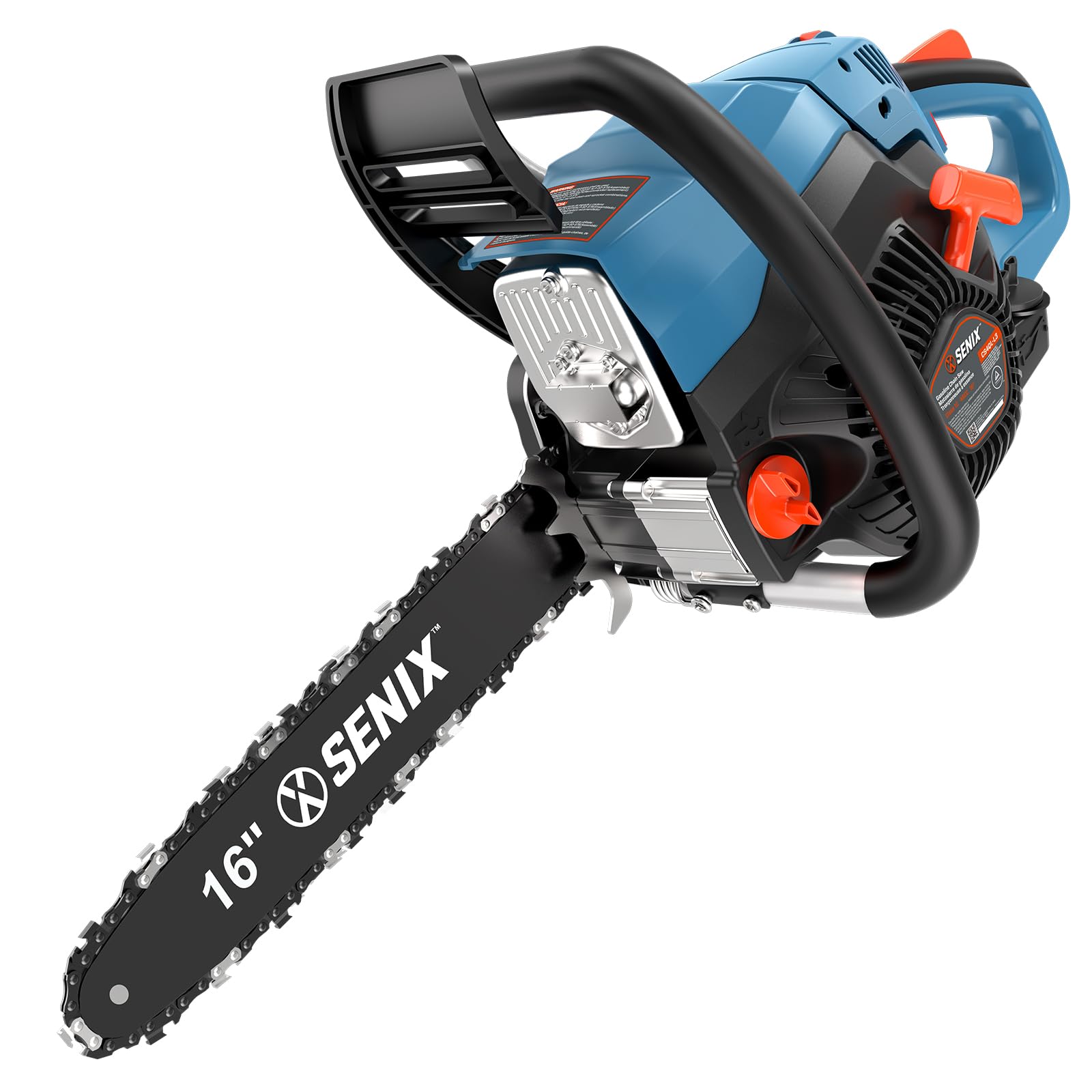
2. SENIX CS4QL-L3 Gas Chainsaw
Pour straight gas and never measure oil into a can again.
Here is the saw for the person who has ruined a fuel mix, or simply refuses to keep a measuring cup in the shed. The SENIX runs a 46 cc 4-cycle full crank engine, and 4QL technology means no blending gas and oil at all — just fill and go. It also keeps the motor lubricated at any angle, so you can roll the saw into awkward cuts without stalling or leaking oil out of the crankcase. For a homeowner who cuts on weekends and leaves the saw on a shelf between uses, that is the feature that keeps it starting.
The 16 inch bar and chain are rated to handle firewood and tree limbs up to 32 inches in diameter, which covers most of what a backyard asks for. The loop handle gives you 360° of grip so you can rotate the saw in the cut. An automatic oiler keeps the bar and chain fed. Compared with the PRORUN below, this one carries 13.4 pounds against that saw’s 12.6 pounds, so it is a little heavier in the hand — the trade you make for a four-stroke engine.
Cutting power lands where you want it: owners describe it slicing through 20 inch diameter trees and a 10 inch ash without complaint. One summed it up the way this saw wants to be judged: “I cut two cords of rounds with mine today!” The recurring gripe is not the cut but the cord — a stubborn starting routine that works for some and fights others. The bar can also loosen until you add a couple of lockwashers. Establish your own cold-start sequence and the saw settles in; skip that and you will spend more time pulling than cutting.
Why the four-stroke wins: no mixing, less smoke, quieter than a 2-stroke at full throttle, and enough low-RPM torque to build power around 70% of engine speed.
The honest trade: a cold start that rewards a set ritual, and a bar that may want a lockwasher or two before it holds tension.
Reach for this if: mixing fuel is the reason your last saw sat in the garage.
Look elsewhere if: you want a saw that fires on command with zero fuss — the starting routine here asks for patience.
3. PRORUN 40.1cc 16-in. Gas-Powered 2-Cycle Chainsaw
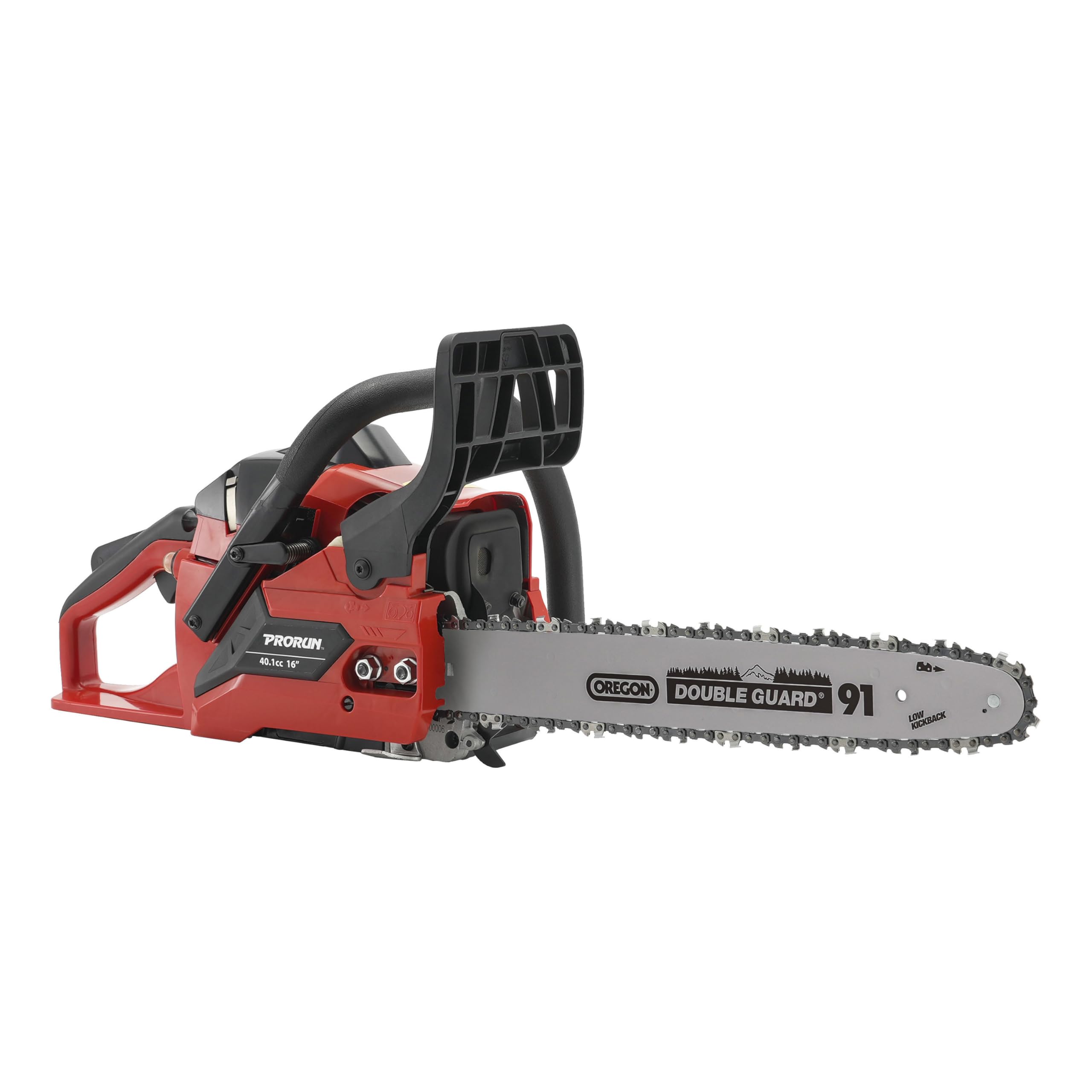
A spring-assist pull and a commercial-grade bar at the entry tier.
Where this saw makes its case is in the parts that usually get skimped on at the budget end. The 16 inch bar and chain are commercial-grade Oregon, the engine is a 40cc full-crank unit rated at 2.0 HP, and the pull handle is spring-assisted so you are not yanking a cold engine from a dead stop. At 12.6 pounds it comes in 0.8 pounds under the SENIX above, and that difference shows up when you are carrying it around the yard between cuts.
The full-crank design is the durability argument — a crank supported at both ends spreads the load better than a single-sided one, which PRORUN says means reduced maintenance over the saw’s life. An automatic oiler keeps the chain lubricated, and the package includes a scabbard, a scrench multi-tool, and a file for sharpening. For a casual user cutting storm damage and a stack of firewood, that is a sensible kit out of one box.
Performance is what owners praise most, and it holds up in the easy jobs: trimming overgrown branches before a storm rolls in, cutting small to medium trees, teaching a teenager to run a saw. One buyer put three hours on it with no trouble at all. The catch is consistency at the lower end — a few saws arrive with a chain tensioner (the screw that sets chain tightness) that fights you, or a bar that measures under the 16 inch label. The wet-wood cut can also bog where dry wood flies through. Treat it as a fair-weather homeowner saw and it delivers; expect commercial behavior and you will be disappointed.
The value case
- Commercial-grade Oregon bar and chain on an entry-tier saw.
- Spring-assisted pull handle takes strain off a cold start.
- 12.6 pounds — lighter than the SENIX by 0.8 pounds.
- Ships with scabbard, scrench multi-tool, and file.
- 40cc full-crank engine rated at 2.0 HP.
What to keep in mind
- Chain tensioner and bar measurement have drawn complaints on a few units.
- Bogs in wet or live wood where dry wood cuts cleanly.
- Chain brake feel is not up to premium standards.
Worth it for: the homeowner who wants a real gas saw without paying premium money, and cuts dry wood on weekends.
Think twice if: you routinely cut green or wet timber — the power delivery here prefers dry stock.
4. Husqvarna 130 Gas Powered Chainsaw, 16 Inch

The homeowner saw built around the cold start, not the spec sheet.
Husqvarna aimed the 130 at the part of saw ownership that ruins mornings: getting it running. A fuel pump primes the carburetor, and a combined choke and stop control sets a cold start with one lever, which the maker says cuts the risk of flooding the engine. In practice that is the difference between a saw that sits in the shed and one you actually pull out for a branch. The X-TORQUE 38-cc engine is rated at 2 HP and is tuned to hold power even at low RPMs, so it keeps pulling when the chain slows in a cut rather than stalling out.
Handling gets real attention too. LowVib technology uses dampeners to soak up the vibration that numbs your hands after a long session, and an inertia-activated chain brake is there to react to kickback. Air Injection throws the larger dust and debris out before it reaches the air filter, which keeps the engine breathing between cleanings. The saw is listed at 5.7 pounds, the lightest figure of any pick here, and it runs bars from 14 to 16 inches.
Owners describe a saw that is sharp from the start and walks through decent-sized trees without much urging. The vibration damping (soft mounts that soak up engine shake) is the sort of thing you notice only when you switch to a saw without it. One review captured the mood: “Started on the 4th pull, cuts like a lightsaber.” The honest caveat: it can start cleanly and then stall after a cut or two until the idle and mixture settle. That is a tuning issue rather than a design one, but plan a break-in period for it.
Where the design pays off: fuel pump plus combined choke lever for a repeatable cold start, and LowVib dampeners that keep the tingle out of your hands.
What to budget for: a break-in window where the idle may need adjusting before the saw runs clean cut after cut.
Best fit: a homeowner with mixed yard work who wants a light saw with a predictable start ritual.
Not the one for: someone who wants to unbox and cut without ever touching a carburetor screw.
5. Stihl MS 162 Chainsaw W/ 16″ Bar & Chain
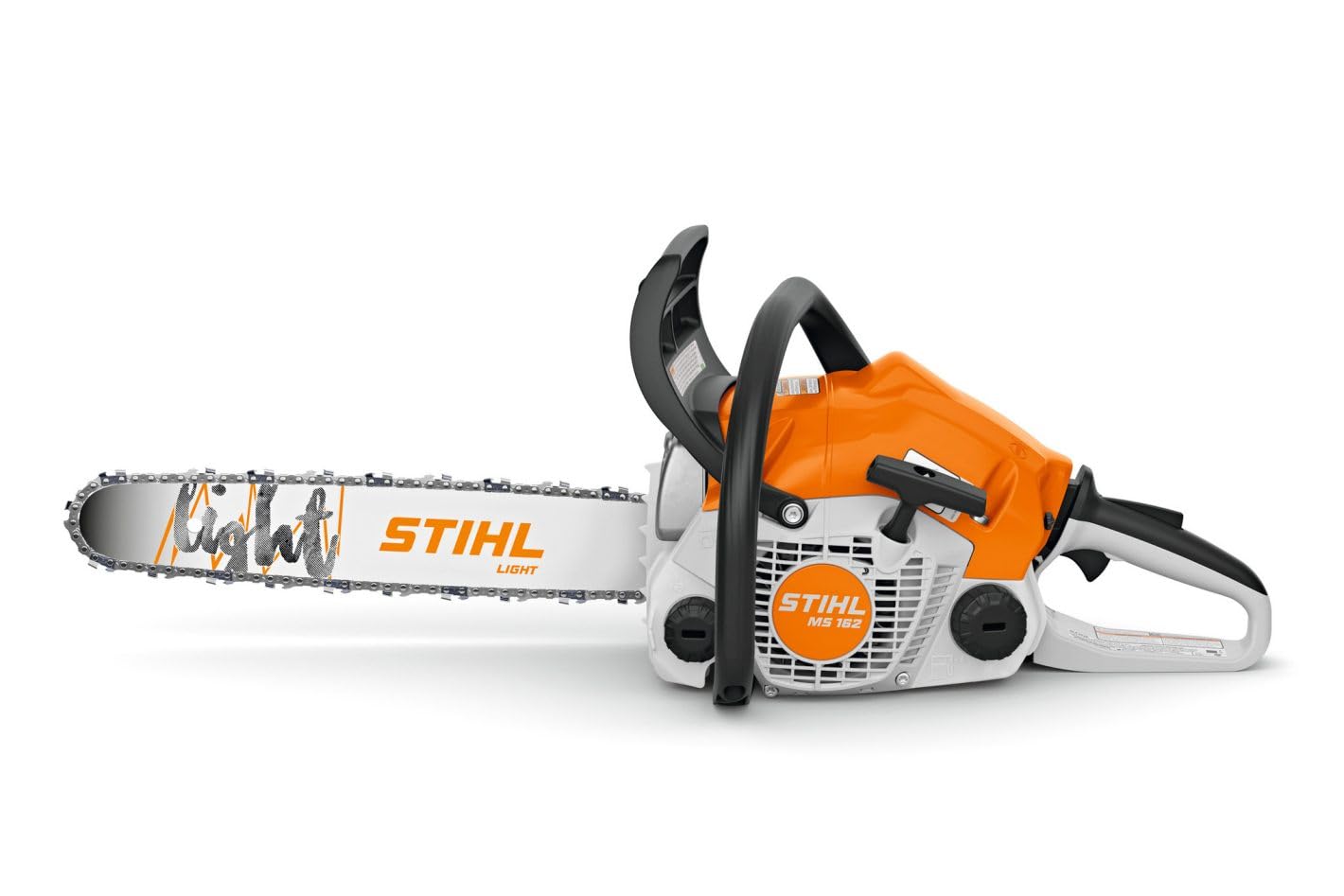
A compact bar saw that punches above its size on hardwood.
Storm cleanup is where this saw makes sense — a tree comes down across the yard and you want something that starts, cuts it into movable lengths, and does not wear you out doing it. The MS 162 runs a 16 inch bar with a 1.2 KW power rating and sits at 13.3 pounds. Owners describe it as light for a saw with this much punch, and the size keeps it maneuverable in tight brush where a longer bar would catch.
Capability is not in question when it runs. Cuts through 12 inch oak trunks come up repeatedly in owner experience, and the compact frame makes firewood gathering a manageable afternoon rather than an ordeal. It is a saw built for the occasional heavy day instead of daily commercial felling, and it does that job without drama. The 16 inch bar is also the size most home users settle on, long enough to get through a decent trunk and short enough to keep the saw balanced.
The thing to plan for is the unit itself, not the design. A share of saws arrive with a fuel or spark problem from the start, and that is the honest risk with any gas saw shipped to your door — check it fires before the return window closes. On a good sample the saw is exactly what you want: capable, light, and ready for the next storm. On a bad one you are arranging a replacement, and that is the trade-off worth knowing before you buy.
The headline: a compact 16 inch frame that cuts 12 inch oak and stays light enough to carry around a downed tree all afternoon.
The checklist item: test the fuel and spark the day it lands, so any out-of-box issue gets handled promptly.
Pick this when: you want a compact, capable bar saw for storm cleanup and firewood gathering.
Look at the Husqvarna instead if: you want the same homeowner niche with a gentler cold-start ritual.
6. Echo Gas Rear Handle Chain Saw
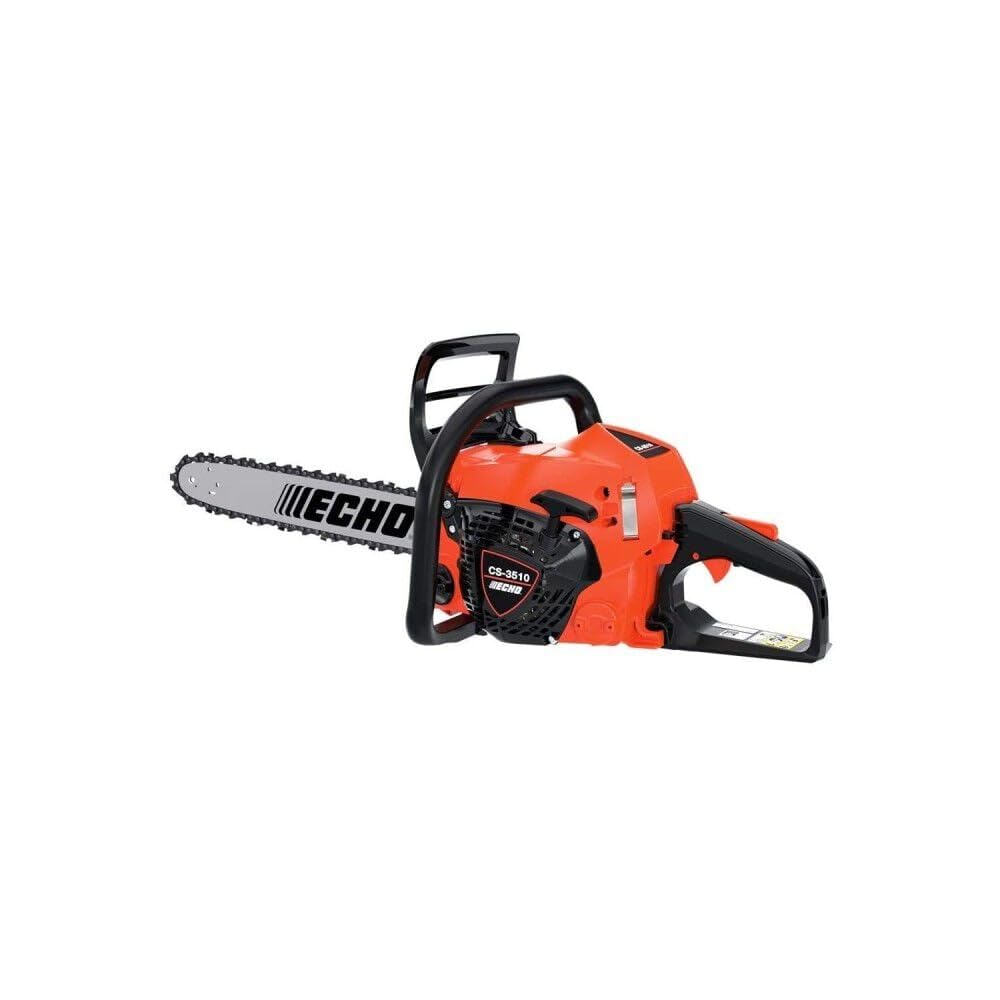
A commercial-grade 34.4cc saw that weighs 8.2 pounds on the scale.
Eight point two pounds is the number that decides this one. That is the lightest gas saw on this list by a wide margin, and if your work is limbing felled trees with the bar up in the air, that weight difference is the difference between finishing the job and quitting halfway. The 34.4cc commercial grade engine (the size of the motor that drives the chain) still delivers enough to handle tree limbs. Echo’s i-30 starter is designed to cut pull effort by 30%, per the maker. For someone who has spent decades running saws and now wants the saw to do less damage to their shoulders, this is the profile that fits.
Comfort features are where a commercial saw earns its price. A three-point spring vibration reduction system (springs that separate the handles from the engine) isolates your hands from the shake. An air injection air cleaner keeps the filter breathing and reduces maintenance, and the whole thing is built on a light frame. Start effort and cut quality both come up in owner experience: a saw that starts on the second pull and cuts tree limbs “like butter” appears more than once. The light frame lets you work longer before fatigue sets in.
The trade is build feel at the lower edge. A few commercial users find the plastic thin enough to feel toy-like, and a gas cap that spatters fuel on a fill is the kind of small annoyance that adds up. This is not the saw you buy to fell a forest; it is the saw you buy to limb, prune, and clean up. It does that better than anything else here because it never tires your arms out. Judge it on the work it does in the air, and it earns its place.
What it does beautifully
- 8.2 pounds — the lightest gas saw in this guide.
- Echo’s i-30 starter is designed to cut pull effort by 30%.
- Three-point spring system soaks up engine vibration.
- Air injection air cleaner cuts maintenance time.
- 34.4cc commercial grade engine rated to handle tree limbs.
The honest caveats
- Plastic feels thin next to premium saws in the same engine class.
- Gas cap can spatter fuel during a fill.
- Built for limbing — not for felling large trunks.
The right call for: limbing and pruning work where a light saw saves your arms over a long session.
Not the pick for: felling large trees or anyone who wants a dense, tank-like build in the hand.
7. Echo CS-3410-16 30.5 cc Chainsaw with 16 in. Bar and Chain

A small-displacement saw that gets through a hickory log and stops there.
If your cutting is small logs, downed pine, and the odd branch, this Echo does the work without asking much of you. The 30.5 cc engine sits at the modest end of the range, the bar is 16 inches, and the saw weighs 12.6 pounds. Basic controls and a straightforward layout mean you are cutting within minutes of unboxing, and the 13 inch logs that came up in owner experience went through well with the stock low-kickback chain.
What people like beyond the cut is the price-to-capability balance. Echo has a following for delivering comparable work to more expensive brands for less money, and this saw follows that pattern. One owner put it plainly: it is the kind of saw you buy once and use for years on a homeowner’s workload. Three pine trees came down without a problem on one owner’s account, and 18 inch hickory was handled without drama on another. That is a real homeowner envelope, and this saw lives comfortably inside it.
Two things to know going in. Starting is genuinely mixed — plenty of saws fire on the third pull cold and the first pull warm, but a minority will idle then die under throttle, and that is the risk with any small engine. Chain life runs shorter than you may expect, so plan to keep a spare chain on hand. Neither is a reason to avoid it; both are reasons to buy it knowing what you are getting — a small, manageable saw for small, manageable jobs.
What sells it: a 30.5 cc engine on a 16 inch bar that handles 13 inch logs and 18 inch hickory at a homeowner-friendly price.
What to know: starting is hit-or-miss on a minority of units, and the chain wears faster than a premium chain.
Good match for: small-log cutting, pine, and light yard cleanup on a tight budget.
skip it if: you need a saw that starts reliably every single morning — the starting record here is uneven.
Know the Specs
Engine Displacement (cc)
Engine size in cc — cubic centimeters — measures the volume the piston sweeps on each stroke. Bigger numbers mean more potential power per pull, but they also mean more weight and fuel burned. A 30.5 cc saw and a 46 cc saw both carry a 16 inch bar, yet the 46 cc unit cuts wet wood that stalls the smaller engine. Match displacement to the wood, not the other way around.
Bar Length vs. Cutting Capacity
Bar length is the guide bar the chain wraps around, not a promise about log diameter. A 16 inch bar handles logs several times its length because you cut from both sides, but the saw’s real limit is engine power behind that bar. A 16 inch bar on a 30.5 cc engine and a 16 inch bar on a 46 cc engine are different tools entirely — the bar is the same, the work they do is not.
2-Cycle vs. 4-Cycle
A 2-cycle engine burns a pre-mixed blend of gas and oil, and it is light, simple, and loud. A 4-cycle engine keeps oil in a separate sump, so you pour straight gas and never mix — and it typically runs quieter with less smoke. The 4-cycle SENIX is 13.4 pounds; the 2-cycle PRORUN is 12.6 pounds. That slight weight difference is the cost of skipping the mixing chore.
Starting Systems Explained
A purge bulb is a small primer you press to push fuel into the carburetor before a cold start. A spring-assist starter stores energy in the cord so the engine turns over with less yank. A combined choke and stop lever sets a cold start with one motion. These parts are not glamorous, but they are the reason one saw fires in three pulls and another takes fifteen, and they matter more to daily satisfaction than a horsepower figure.
Common Questions
Is a 16 inch bar big enough for cutting firewood?
Do I have to mix gas and oil for a 4-cycle chainsaw?
What does a spring-assist starter actually do?
Why does a chainsaw need a purge bulb and a choke?
How much does saw weight matter when I am cutting?
What is a chain brake and when does it fire?
Should I buy a battery saw instead of gas for home use?
Why do some saws bog down in wet or green wood?
How often should I sharpen or replace the chain?
What does automatic oiling do for my saw?
The Bottom Line
For most people buying a 16 inch gas chainsaw, the SENIX 46cc is the one to beat among gas saws. It takes mixing fuel off the table completely, cuts wet and dry wood with a 46 cc four-stroke, and handles firewood and limbs the way a homeowner actually uses a saw. Establish its cold-start ritual once and it becomes a reliable weekend tool. If a trigger instead of a cord appeals to you — and you cut mostly small wood — the Makita XCU04PT1 kit is the cleanest answer, with four batteries in the box and no exhaust in your face.
For sheer limbing comfort, the Echo CS-3510-16 at 8.2 pounds is hard to argue with when your arms are the limiting factor. The Husqvarna 130 is the gentlest gas cold start on the list for mixed yard work. The Makita carries 4.5+ stars across 900+ owners, but the gas saw that removes the mixing chore is the one most homeowners will reach for first.
How we choose
We do not accept paid placement. Every pick is matched to a real buyer and a real use-case; we do not hands-on test units.
Sources
Specifications: manufacturer listings and product documentation. Review insights: verified customer reviews, as of October 2026. Pricing: not shown on this page (it changes often); check the current price via the retailer link.
As an Amazon Associate, Aappliancez earns from qualifying purchases. This does not affect which products we feature.