Disclosure: Some links in this post are affiliate links. As an Amazon Associate I earn from qualifying purchases, at no extra cost to you. Learn more
Specs are compiled from manufacturer listings and verified buyer reviews and can change over time — please confirm the key details on the product page before buying.
The controller is the one part of your sprinkler system you touch every week, so getting it wrong costs you time all season. You want twelve zones that actually run when they should, an app that lets you skip a cycle from the couch, and no subscription fee quietly draining your card each month. This guide sorts the seven strongest twelve-zone-capable controllers by station count, weather logic, and app control.
This guide is built by comparing the manufacturers’ published specifications and the patterns across verified customer reviews, so you get each pick’s real strengths and trade-offs instead of marketing spin.
Some models here ship WiFi-ready and need a plug-in module, some bake the smarts into the box, and the difference changes your install day. Below you’ll find the exact station counts, program limits, and weather-skip behaviour that decide which one fits your yard — all laid out for the 12 zone sprinkler controller.
Top Picks

How To Choose The Best 12 Zone Sprinkler Controller
Twelve zones is a real residential yard — front lawn, back lawn, three or four beds, a drip line or two, and a couple of spares for the side strip. The controller has to run all of them without you standing at the wall in the rain. Start with the count and the wiring, then worry about the app.
Match the station count to your actual valve wires
Every zone valve needs its own terminal, so count your valve wires before you buy anything. A twelve-station unit covers twelve valves; a fourteen-station model leaves you a couple of spares for a future drip line. Look for numbered zone terminals — labelled zones make a controller far easier to program and far easier to troubleshoot when a valve sticks.
Decide if you want WiFi built in or added later
Some controllers here are WiFi-ready, which means the radio lives in a separate plug-in module you buy and clip in yourself. That keeps the base unit cheaper and lets you skip WiFi entirely if you only ever adjust the dial. Others, like the ImoLaza, include the connection in the box. Either works, but the add-on route means one more part to source and one more place for a connection to fail.
Check the programs, start times, and run length
A program is one saved watering plan; a start time is when that program begins. Three programs with four start times each gives you a dozen scheduling slots, and run times measured in hours suit drip zones and newly seeded lawns. If you run a lawn service or a high-frequency seed schedule, more start times matter more than a bigger screen.
Look at weather skip and water savings honestly
Weather-aware controllers pull a local forecast and either cut a cycle or shorten it when rain or cold is coming. That is the feature that actually saves water, and it only works as well as the local weather data it reads. Pair it with a rain sensor at the gutter for the days the forecast misses a passing shower.
Side-by-Side Comparison
| Model | Best For | Stations | WiFi | Programs / Start Times | Amazon |
|---|---|---|---|---|---|
| Hunter PRO-HC PHC-1200★ Best Overall | Whole-yard control with a real display | 12 | Built-in (Hydrawise) | Hydrawise web and app scheduling | Amazon |
| ImoLaza ET Master 12 ZoneSmartest Water Saver | Set-and-forget watering with no fees | 12 | Built-in | Up to 24 start times (New Grass Schedule) | Amazon |
| Orbit B-hyve XR 16-Zone | Big zone counts on a budget frame | 16 | Built-in | 4 programs (A–D) | Amazon |
| Hunter X2 14 Zone | Dial-first control, WiFi optional | 14 | Optional WAND module | 3 programs, 4 start times each | Amazon |
| Rain Bird ESP-TM2 + LNK (6 Zone) | Small yards, fastest swap-out | 6 | Included LNK module | 3 programs, 4 start times each | Amazon |
| Rain Bird ESP-TM2 12 Station | Twelve zones on a proven dial layout | 12 | Add LNK module (sold separately) | 3 programs, 4 start times each | Amazon |
| Rain Bird ESP-ME3 + 2 Modules | Expandable jobs and light commercial | Configurable to 22 | Add LNK module | Dial-based schedules per station | Amazon |
Detailed Reviews
1. Hunter PRO-HC PHC-1200 12-Station WiFi Controller
Our pick — 4.5+★ from 300+ verified ratings; the strongest balance of quality and price.
Twelve stations, a real LCD panel, and Hydrawise weather logic already inside the box.
The reason this one tops a twelve-zone list is that you get the zone count and the app in one purchase. Twelve stations cover a full residential yard with a few spares, and the built-in LCD means the controller still works exactly like a normal wall unit when the WiFi is down or a houseguest needs to run a zone. Hydrawise runs on both phone and desktop, so you can rename zones, attach photos, and start a manual run without walking to the garage.
Hydrawise’s Predictive Watering is where the water savings live. The controller can skip a cycle entirely when the forecast drops below 68F, cut 30% off a run when it is under 77F, add 30% when it climbs past 86F, skip for rain chances over 80%, and skip when wind passes 19mph. Those are fixed thresholds you can see, which means you know exactly why the lawn did or did not get watered. The 10″L x 4″W x 9″H plastic cabinet is compact compared with the Orbit B-hyve XR’s 11″L x 9″W x 4″H footprint, so it tucks neatly onto a garage wall or an outdoor pier.
Install is a genuine weekend-hour job for most owners. Buyers report “hardware install ~30 min, config/testing ~1 hr” when swapping an older Hunter Pro-C for this unit, and the only snag mentioned is that the bottom mounting holes sit roughly 3/8″ off the old Pro-C pattern — a ten-minute drill fix. The Hydrawise interface was written with professional landscapers in mind, so a first-timer benefits from a tutorial video before renaming zones. It is the priciest pick here, and that is the honest trade: you pay once for a controller that does not need a companion module.
Where it earns its keep
- Twelve stations plus built-in WiFi means no extra module to buy or plug in.
- Weather thresholds are published and predictable at 68F, 77F, 86F, 80% rain chance, and 19mph wind.
- LCD panel keeps the controller usable for anyone who does not want to open an app.
- Desktop and phone access both work, so a landscaper or a partner can adjust a schedule.
What to plan around
- Mounting holes may not line up with an older Hunter cabinet — expect a small drilling job.
- Hydrawise has a learning curve written for pro installers, not first-timers.
- It sits at the premium end of this list.
Reach for this if: you want the zone count, the display, and the weather logic in one box and you will use the desktop dashboard as much as the phone.
Have a plan for: the Hydrawise learning curve — watch a setup video before you start renaming twelve zones.
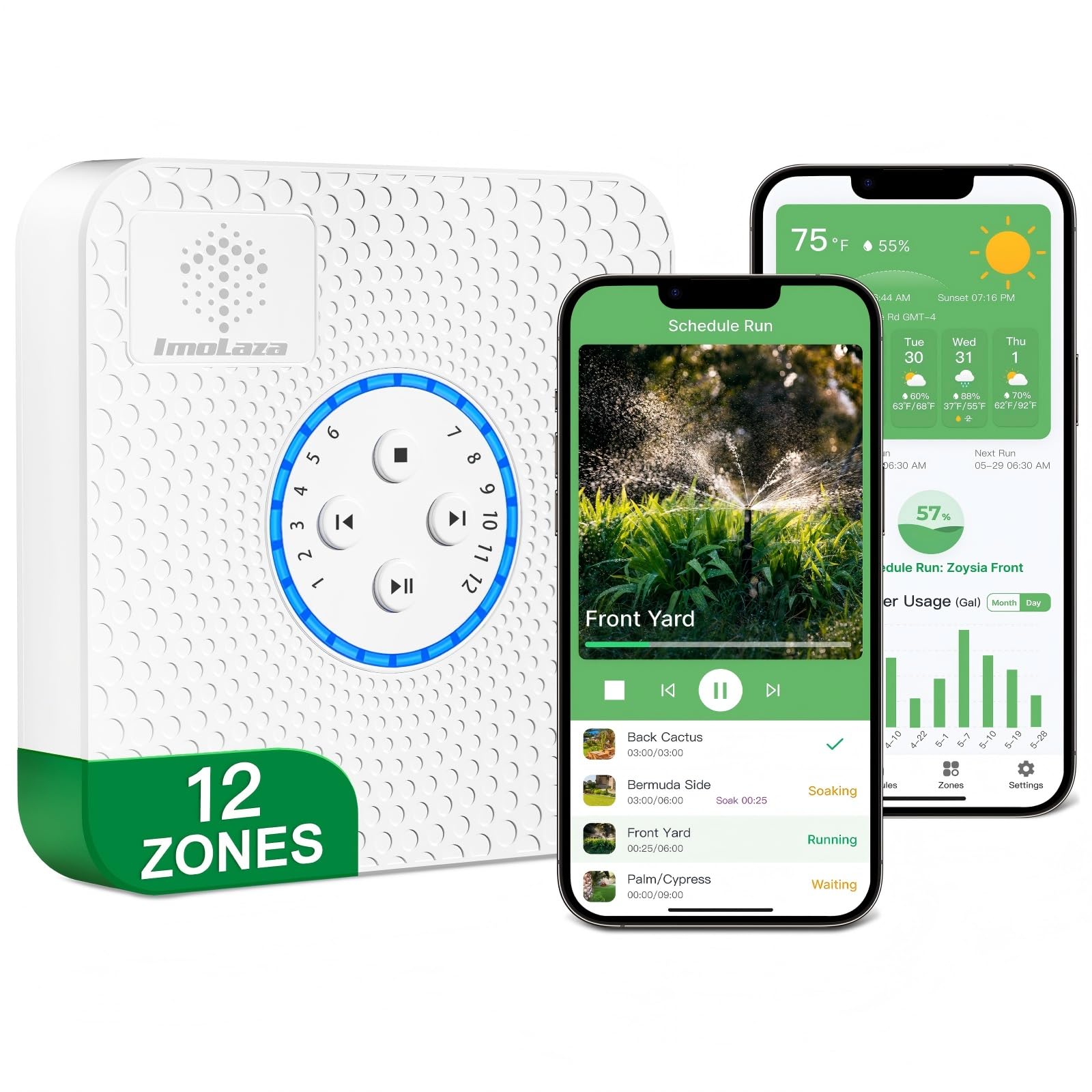
2. ImoLaza 12 Zone WiFi Smart Sprinkler Controller (ET Master)
The compact twelve-zone brain that rebuilds your schedule around live evapotranspiration every single day.
If your goal is less time at the controller and a lower water bill, this is the pick that does the most thinking for you. It runs real-time evapotranspiration (ET — a live calculation of how much water your lawn is losing to sun, wind, and heat) and regenerates watering durations daily from local weather. Rain skip, wind skip, and freeze skip handle the obvious days, and the app is free with no subscription attached to any feature.
The thing that wins people over is how little setup it takes — the install runs 15-30 minutes with no special tools, and the review pages are full of owners who finished wiring solo in about a quarter of an hour. One review sums it up plainly: “Install from control box to controller straightforward; set up solo in 15 min and it works.” The box itself is tiny at 6.3″L x 6.3″W x 1.18″H and 12.16 ounces, so it mounts almost anywhere without fighting for wall space. It works with Amazon Alexa and Google Assistant for voice control, and OTA (over-the-air) updates let the controller download revised watering algorithms after it is already on your wall.
Here is the catch worth knowing before you buy: the schedule logic leans on a solid 2.4 GHz WiFi connection, and one owner hit a rough patch getting connected on that band before the controller settled in. A rare app lag while syncing changes also shows up in the 4-star end of the reviews. Neither stops the controller from watering; they just mean the app is not always instant. For a twelve-zone yard where you want the controller to make the daily decisions, this is the deepest automation at the mid-range level.
Why it climbs: Twelve zones, an ABS cabinet, 140 °F operating temperature, and a free app with no subscription — the hardware is small but the automation is the deepest in this list.
The honest limit: The New Grass Schedule allows up to 24 start times for high-frequency watering, but that flexibility is only useful if you actually want to tune it; a set-and-forget owner never touches it.
Pick this one when: you want the controller to write your schedule around live weather and you never want to see a subscription prompt.
Look elsewhere if: your WiFi is shaky on 2.4 GHz and you would rather the app not be in the loop at all.
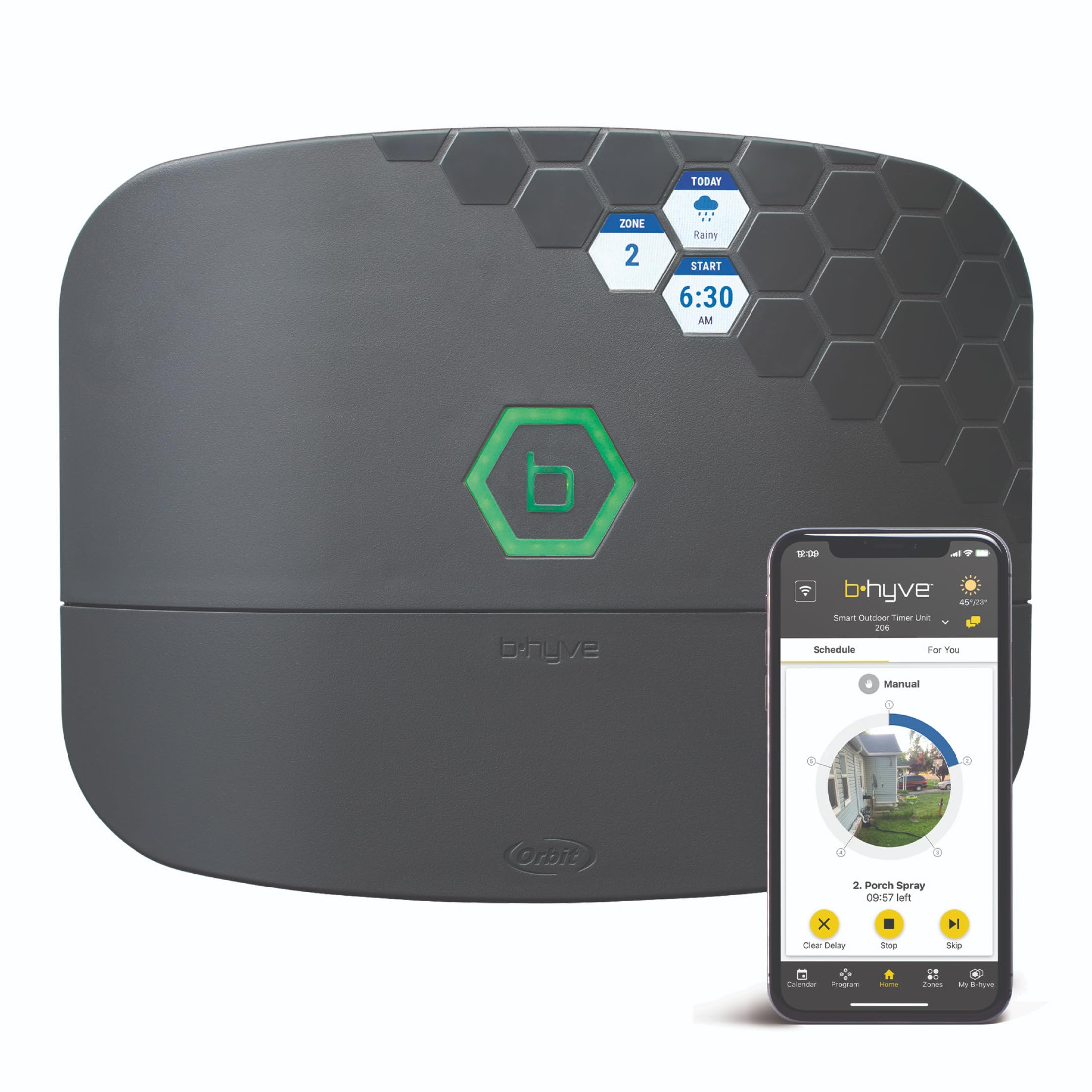
3. Orbit B-hyve XR 16-Zone Smart Sprinkler Timer
Sixteen stations in a plastic cabinet that still costs less than most twelve-zone rivals.
You get four more station terminals than a twelve-zone box for less money than the Hunter X2 fourteen-zone, which is the whole pitch here. The 11″L x 9″W x 4″H cabinet is the largest on this list — roughly 75% more footprint than the ImoLaza’s 6.3″L x 6.3″W x 1.18″H frame — so measure your wall or pier before you commit. In return you get a weatherproof indoor/outdoor housing, app control that can start manual watering in around eight seconds, and the ability to name each station and attach photos.
What owners love is the app: naming zones, pulling up a photo, and hitting a manual run from the phone is quick enough to do while standing in the yard. Set aside the spec-sheet claim that the smart side always behaves, though. The recurring gripe in long-term owner reports is the number of programs — this unit caps at four (A–D) for sixteen stations, and seasoned users keep asking for more. A second gripe is WiFi stability: the radio can stutter on a combined 2.4/5 GHz network and occasionally drops on a dedicated 2.4 GHz band even with strong signal.
Treat this as the value play for a fourteen-to-sixteen-valve yard. If you have fourteen or sixteen valves and a phone in your pocket most days, the zone headroom is worth the larger box. Two points to weigh: the weather data feeding the smart watering is not always accurate to your microclimate, and the fixed four-program ceiling will feel tight on a complex multi-zone property. For a straightforward lawn-and-beds layout at sixteen stations, it delivers the most terminals for the price.
What it does well
- Sixteen station terminals at a lower tier than most twelve-zone competitors.
- App-driven manual runs land in roughly eight seconds.
- Indoor/outdoor weatherproof housing handles a garage wall or an outdoor pier.
- Works with Alexa alongside the standard app.
Where it asks for patience
- Four programs (A–D) feels tight when you are running sixteen stations.
- WiFi stability is the common complaint — a combined 2.4/5 GHz network can confuse it.
- Weather data is not always accurate for a small, specific yard.
Your pick if: you need fourteen to sixteen valves and would rather spend the difference on a rain sensor than on the controller.
Take a pass if: your router broadcasts one merged network and you have been fighting disconnects on other smart gear.
4. Hunter X2 14 Zone Sprinkler Controller (X2-1400)

Fourteen stations, three programs, four start times each — and WiFi only if you want it.
Some yards just need a dial and a backlit screen, and this is the pick for that owner. Seasonal adjustment trims or extends every station at once without reprogramming, which is the feature you actually use twice a year. The WAND WiFi module is a separate add-on if you later want Hydrawise on your phone.
Owners swapping in an older Hunter controller find this one easy to wire and easy to program — functionality is what most praise, and the QuickCheck diagnostics flag a wiring fault on the display before you waste an afternoon chasing a dead valve. The Easy Retrieve Memory saves your schedule so a power blip does not wipe twelve zones of programming. The weather-resistant enclosure and backlit display suit a side-of-house install where you check it in the evening.
Now the honest part. The WiFi add-on is where the mixed reports live — owners who bought the WAND module describe the receiver as unreliable even on a strong mesh network, and some simply skip it and program at the cabinet. Reliability overall sits in mixed territory in owner feedback, which is worth knowing before you plan on app control. If you want phone access, pay attention to the module reviews; if you are happy with a dial, this controller is genuinely straightforward and the display is bright in any light.
The dial-first verdict: A fourteen-station panel with a backlit LCD, 2.8 pounds of plastic cabinet, and six-hour run times — built for the owner who prefers buttons to an app.
What you give up: The WiFi module is sold separately and its connection quality is the weak link, so app control is a bonus here, not a guarantee.
Go here if: you want a bright, dead-simple wall controller and will only add WiFi as a later upgrade.
Think twice if: remote control is the main reason you are buying — the optional module’s reliability is hit-or-miss.
5. Rain Bird ESP-TM2 6 Zone WiFi Controller with LNK Module

Six zones, the WiFi module in the box, and a three-step program that fits a small yard overnight.
This is the small-yard specialist: six stations, a factory-installed 6′ outdoor-rated power cord, and a schedule you can build in three steps. It will not cover a twelve-zone property, but for a compact lawn and two beds it lands the same Rain Bird logic in a package that swaps in quickly. The LNK WiFi module is included, so remote control works the day you unbox it — no separate order and no second wait.
Install speed is what owners rave about. One owner removed a fourteen-year-old four-zone Rain Bird and had the new one running in under ten minutes, with app setup right behind it. The app adjusts watering to the local forecast, and paired with a rain sensor you get hands-free cycle skipping. A delay-watering feature holds everything for up to 14 days and resumes automatically, which is a handy setting before a vacation. Contractor Default saves and restores your custom schedule if you ever need a reset.
The trade-off is the WiFi link itself. It is the most-discussed weak point in the owner feedback, and a few note the connection needs to be redone from time to time. There is also a learned quirk with the wiring: a ground wire does not belong in the “M” slot on this model, and leaving it blank is the correct move — a small detail that trips up a first install. For a six-zone yard where quick setup matters more than endless tuning, this is a dependable small-yard controller.
Strengths that show up fast
- WiFi module comes in the box — remote control on day one.
- Six-zone wiring is quick, with owners reporting under ten minutes of install.
- Delay watering up to 14 days and it resumes on its own.
- 3-step programming and a large backlit LCD keep it simple.
Watch-outs
- The WiFi connection is the frequently mentioned weak point and sometimes needs re-pairing.
- Some owners hit an app bug where a zone gets stuck after stopping watering.
- Six stations will not cover a twelve-zone yard.
Best fit for: a small lawn and a few beds, where you want WiFi working without buying a separate module.
Not your model if: you are counting twelve valves — you will run out of terminals.
6. Rain Bird ESP-TM2 12 Station WiFi Ready Controller (TM2-12)

Twelve numbered stations, a dial you already know, and a WiFi upgrade path you can take later.
If you want twelve zones without paying for WiFi you might not use, this Rain Bird is the value answer. It holds twelve stations with three programs and four start times each, uses 120 volts, and mounts in a plastic cabinet sized 7.92″L x 3.51″W x 7.86″H that fits a standard utility space. The numbered zone terminals make programming straightforward — wire zone one to terminal one and the dial does the rest. When you want phone control, clip in a LNK WiFi module (sold separately) and the same box becomes a smart controller without a full replacement.
What wins people over is quality and how fast it goes in. Owners mention swapping out a twenty-year-old controller in about fifteen minutes, and one sums it up plainly: “Installed and running within an hour.” A Rain Bird app once the LNK module is added lets you run zones from your phone, check a stuck head, and adjust based on local weather without a trip to the wall.
The catch is small but real: the WiFi module is not included. That adds a step and a cost, and it is the most common wish in the feedback — buyers want it bundled. The remote connection itself rates mixed, so the smart side is a convenience, not the reason to buy. Buy it for the twelve stations, the labelled wiring, and a dial layout that a sprinkler tech will recognize instantly.
Twelve zones, no surprises: The 3-program, 4-start-time layout and numbered terminals have been around long enough that a contractor can program it blindfolded.
The one extra step: No LNK module in the box means WiFi is a separate purchase — plan for that before install day, not after.
Buy it for: the twelve-station terminal block and the dial that any sprinkler tech can service without a manual.
Budget for: a LNK module if you want remote control; the controller itself will not talk to your phone on its own.
7. Rain Bird ESP-ME3 Controller with 2 Station Modules

A dial controller that grows to twenty-two stations without you unplugging a single wire.
For a yard with a plan bigger than today, this is the one to grow into. It arrives with two station modules fitted and configures up to 22 stations when you add more 3 or 6 station modules later — and you add them without removing or power-dosing the controller, which means an expansion is a five-minute job instead of a reinstall. The large 3″ backlit screen reads clearly in a dark garage or shed, and colour-coded dial positions with large symbols make the layout friendly. It ships with a power plug and an outdoor cabinet for indoor or outdoor use.
What stands out for a hands-on owner is the diagnostics. Electrical, programming, and — when you fit a flow sensor — high-flow faults show up as a red LED and scrolling messages, and with the LNK WiFi module plus the Rain Bird app those alerts reach your phone. Add the WR2 rain sensor and the unit becomes a smart controller. Reports from owners who wired it in describe a smooth install and a simple set-up, with a modest programming learning curve since each station gets its own run time.
The honest read: smart features are all add-on here. The LNK module and WR2 sensor are separate buys, so a base unit alone will not skip rain or talk to your phone. The dial programming is a small learning curve rather than a one-screen app, which some owners prefer and others find slow. For a property that will likely reach eighteen or twenty zones, though, no other controller on this list lets you add stations without pulling the box off the wall — and that flexibility is worth the tier.
Why it scales
- Grows from the included modules up to 22 stations without a power-down.
- 3″ backlit screen with colour-coded dial positions and large symbols.
- Electrical, programming, and flow faults show on a red LED and scroll across the display.
- Outdoor cabinet and power plug in the box.
The add-on reality
- LNK WiFi module and WR2 rain sensor are separate purchases for smart features.
- Programming per station takes a small learning curve compared with a phone app.
- Overkill for a small, fixed yard that will never exceed twelve valves.
Tailor-made for: a growing property or a light commercial site that may push past twelve zones in the next few years.
Skip the tier if: your ten-to-twelve-zone yard is final and you would rather spend the extra on a sensor instead.
Know the Specs
Station count and programs
A station is one valve terminal; twelve stations run twelve valves. A program is one saved schedule, and start times within it are when that schedule fires. Three programs with four start times gives a dozen slots, which suits most homes. If you run a high-frequency seed schedule, look at the ImoLaza’s New Grass Schedule and its up-to-24 start times instead.
Weather skip and real-time ET
Weather-aware controllers read a local forecast and either shorten or skip a run when rain or cold is coming. Real-time ET is a live calculation of how much water your lawn is losing to sun and wind, and it lets the controller rebuild durations each day instead of running a fixed clock. The Hunter PRO-HC spells out its thresholds in numbers; others leave the logic opaque.
WiFi module vs built-in WiFi
Some controllers carry the radio inside the box, and others need a clip-in module. The Hunter X2 and both Rain Bird ESP-TM2 models take an optional module, and the Rain Bird ESP-ME3 needs a LNK module plus a WR2 sensor for smart features. A module route keeps the base price down but adds a part to source and one more link in the chain.
Cabinet, voltage, and temperature
All these controllers use plastic housings, and most list 120 volts for the supply. The Hunter PRO-HC and Rain Bird ESP-TM2 12 Station specify 120 volts. Operating-temperature ratings vary: the ImoLaza lists 140 °F, the Rain Bird ESP-TM2 6 Zone lists 149 °F, and the ESP-ME3 lists 149 °F, so the whole set is built for a hot outdoor wall.
Common Questions
Do I need a twelve-zone controller if I only water eight zones now?
Does the Rain Bird ESP-TM2 12 Station include WiFi from the start?
What does evapotranspiration mean on a smart controller?
Why does my controller fail to connect to the app on a combined 2.4 and 5 GHz network?
Can I run twelve zones without a weather service subscription?
How long do these controllers typically run on a single station?
Does a rain sensor replace weather-based skipping?
What should I do with the ground wire on the Rain Bird ESP-TM2?
Can I add stations to a controller later without replacing it?
Will a smart controller actually lower my water bill?
The Bottom Line
For most twelve-zone yards, the winner is the Hunter PRO-HC PHC-1200 because it pairs twelve stations with built-in WiFi, a real LCD panel, and published weather thresholds you can read and trust. If the goal is squeezing more water savings out of a free app, grab the ImoLaza 12 Zone and let it rebuild your schedule around live ET. And for a big yard that may grow past twelve valves, the Rain Bird ESP-ME3 is the one to reach for, since it expands to 22 stations without a reinstall.
How we choose
We do not accept paid placement. Every pick is matched to a real buyer and a real use-case; we do not hands-on test units.
Sources
Specifications: manufacturer listings and product documentation. Review insights: verified customer reviews, as of October 2026. Pricing: not shown on this page (it changes often); check the current price via the retailer link.
As an Amazon Associate, Aappliancez earns from qualifying purchases. This does not affect which products we feature.