Disclosure: Some links in this post are affiliate links. As an Amazon Associate I earn from qualifying purchases, at no extra cost to you. Learn more
Specs are compiled from manufacturer listings and verified buyer reviews and can change over time — please confirm the key details on the product page before buying.
If you are wiring four ceiling speakers and two subwoofers into a living room, the receiver you pick decides whether that 7.2.4 investment pays off or fights you. An 11.2 receiver drives eleven speakers plus two subwoofers — the front left, center, right, a pair of surrounds, a pair of rear surrounds, and four height or ceiling speakers, with two subwoofer outputs. Four height channels are what put rain and helicopters overhead instead of only at ear level. This guide compares eleven 11.2-capable receivers on channels, room correction, HDMI 2.1, and pre-outs.
This guide is built by comparing the manufacturers’ published specifications and the patterns across verified customer reviews, so you get each pick’s real strengths and trade-offs instead of marketing spin.
Power ratings vary wildly between brands, room correction software changes the whole character of the sound, and HDMI handshake troubles can undo a great amplifier. Here is what to know before you spend on the best 11.2 AV receiver for your own room.
Top Picks


How To Choose The Best 11.2 AV Receiver
Buying an 11.2 receiver depends on four separate decisions: how many speakers you want to run at once, who calibrates the room, what your TV and console need over HDMI, and if you want to add amps down the road. Get those four right and the wattage figures stop being the deciding factor.
Count your speakers before you count the watts
An 11.2 receiver processes eleven channels and drives two subwoofers. A 7.2.4 layout — seven ear-level speakers, two subs, four overhead — uses every one of them. If you only plan a 5.1.2 arrangement, you are paying for channels you will never switch on, so an honest look at your ceiling first saves money. Some flagship units here, such as the Sony STR-AZ7000ES, step up further to 13.2-channel processing for an even denser layout.
Room correction is not the same across brands
Dirac Live, Audyssey MultEQ XT32, and Yamaha’s YPAO R.S.C. all measure your room with a microphone and then flatten the peaks and dips your furniture creates. Dirac Live appears from the start on the Onkyo TX-RZ30 and TX-RZ70; Audyssey MultEQ XT32 sits inside the Marantz AV7706. Which correction system you get matters more than a few watts, because a corrected room almost always sounds better than a louder uncorrected one.
HDMI 2.1 and the handshake question
HDMI 2.1 inputs carry 8K60 and 4K120 signals at 40 Gbps, which is what a modern console or high-refresh TV sends. Auto Low Latency Mode (ALLM) and Variable Refresh Rate (VRR) reduce lag and screen tearing in games. Real-world catch: eARC and HDCP handshakes between a receiver and a TV occasionally need a firmware update or a cable swap, and most brands list that somewhere in their review history.
Side-by-Side Comparison
| Model | Best For | Channels | Power | HDMI In/Out | Amazon |
|---|---|---|---|---|---|
| Yamaha RX-A4A AVENTAGE★ Best Overall | Balanced music and film sound | 7.2 | — | 7 / 3 | Amazon |
| Denon AVR-X6700HPowerhouse Pick | Big power with 13.2 processing | 11.2 | 140W x 11 | 8 / 3 | Amazon |
| Marantz SR8015Audiophile Pick | Warm audiophile character | 11.2 | 140W x 11 | — | Amazon |
| Onkyo TX-RZ30 | Dirac Live on a budget | 9.2 | 100W per channel | — | Amazon |
| Onkyo TX-RZ50 (Renewed) | Refurb value for 9.2 | 11.2 processing | — | — | Amazon |
| Sony STR-AN1000 | 360 Spatial Sound mapping | 7.2 | 165W (6 ohms) | 6 / 2 | Amazon |
| Onkyo TX-RZ70 | Flagship power and value | 11.2 | 140W per channel | — | Amazon |
| Marantz AV7706 | Pre-amp for external power | 11.2 | Pre-amp only | 8 / 3 | Amazon |
| Yamaha RX-A8A AVENTAGE | Four discrete zones | 11.2 | — | 7 / 3 | Amazon |
| Sony STR-AZ5000ES | Custom install integration | 11.2 | 130W + 130W (8 ohms) | 7 / 2 | Amazon |
| Sony STR-AZ7000ES | Densest speaker layout | 13.2 | 150W + 150W (8 ohms) | 7 / 2 | Amazon |
Detailed Reviews
1. Yamaha RX-A4A AVENTAGE 7.2-Channel AV Receiver
Our pick — 4.0+★ from 250+ verified ratings; the strongest balance of quality and price.
A 7.2 receiver tuned for two-channel music as carefully as for Atmos action.
The RX-A4A is a 7.2-channel receiver, so it drives seven speakers and two subwoofers — a 5.2.2 or a 7.2 layout with ceiling or upward-firing height speakers. It gives you three HDMI outputs (a projector plus two TVs, or two rooms) and seven HDMI inputs, all of which accept 8K60 and 4K120 at 40 Gbps. That bandwidth figure matters because a PS5 or an Xbox sends a full-speed signal the other way — low-bandwidth ports choke it, these do not.
Yamaha’s own YPAO R.S.C. room correction (an automatic setup that measures your room in 3D, samples multiple points, and applies precision EQ) does the heavy lifting on setup. Around it sit the features that make the A4A a genuinely useful everyday machine — AirPlay 2, Bluetooth, MusicCast (Yamaha’s own multi-room app), Roon Tested, and a phono input for a turntable. It also accepts a 7-in/3-out HDMI array (seven inputs and three outputs), one more input and one more output than the Denon AVR-X6700H’s 8-in/3-out in some configurations — the A4A gives you a third output for a second display that most rivals stop at two for.
from the start, the initial eARC handshake can be sticky — buyers report occasional 5-10 second audio delays or silence until a firmware update settles it. The fix is usually to switch the TV’s eARC digital output from Auto to passthrough and reboot.
Why It Wins
- All seven HDMI inputs accept 8K60 and 4K120 at 40 Gbps, with ALLM and VRR for gaming
- Three HDMI outputs — room for a projector and two screens without an HDMI splitter
- YPAO R.S.C. 3D calibration with multipoint measurement gets a decent room to sound better fast
- Surround:AI reshapes dialogue and effects in real time so speech stays clear over a soundtrack
Where It Gives Ground
- 7.2-channel only — no 11.2 processing, so a 7.2.4 layout is out of reach
- eARC handshake can need a firmware update and a TV-side setting change to lock on
- The display is small; some buyers find it hard to read from across the room
Reach for this if: you want a 5.2.2 or 7.2 room that sounds balanced for music and film without a pile of external amps.
Look elsewhere if: you are committed to a 7.2.4 ceiling layout — you need the 11-channel processing of the Denon or Onkyo flagships below.
2. Denon AVR-X6700H 8K Ultra HD 11.2 Channel AV Receiver
Thirteen-channel processing and a 140-watt amp behind every one of eleven speakers.
If you are building a Dolby Atmos room with four height speakers and two subs, the X6700H is set up for exactly that: eleven driven channels of 140 watts each, plus 13.2-channel processing so you can choose the speaker arrangement you want. It has eight HDMI inputs and three outputs, more inputs than the Yamaha RX-A4A’s seven — useful if you keep a cable box, a console, a Blu-ray player, and a streamer all plugged in at once. Dolby Atmos, DTS:X, Auro-3D, and IMAX Enhanced are all decoded here.
The gaming side is where this unit earns its keep for a modern setup: 4K/120 pass-through, Variable Refresh Rate, Quick Frame Transport (which shortens the lag between frames), and Auto Low Latency Mode. Dynamic HDR and HDR10+ keep picture quality strong, and Quick Media Switching reduces the frustrating blank screen when you jump between sources. A built-in cooling fan handles the heat of a big A/B amplifier, which matters if this sits in a closed cabinet.
The honest catch is HDMI stability with certain cable boxes. Owners mention that beautiful, powerful audio can drop out after a couple of minutes with a cable feed over one specific TV, while the same receiver ran fine with a streaming box and a Blu-ray player. Setup also is not a beginner’s job — the menus guide you well but the TV and 8K handshaking take patience.
The 13.2 argument: processing more channels than it drives lets you split the amp load however your room wants — front heights today, a second zone tomorrow — without buying another receiver.
Cabinet reality check: 15.94″D x 17.19″W x 6.56″H, and that built-in fan is doing real work. Leave clearance around it and it stays cool through a double feature.
Suits you if: you want eleven driven channels, 13.2 processing headroom, and 8K gaming features under one hood.
Think twice if: your main source is a legacy cable box over HDMI — the Denon’s handshake history with one such feed is the recurring gripe in its review pages.
3. Marantz SR8015 11.2 Channel 8K Ultra HD AV Receiver
The warm-toned Marantz that treats a two-channel album as seriously as a film.
Marantz has a sound signature — a smoother top end than most rival amps — and the SR8015 carries it through eleven channels of 140 watts each, with a 15.6 kg chassis. Its footprint is 18.11″D x 17.32″W x 7.48″H, which means the rear clearance for cables stacks up fast: the amp runs hot, so plan on a few inches behind it, not a hard wall. HEOS is Marantz’s built-in multi-room streaming platform, and voice control works with Amazon Alexa and Google Assistant.
The callouts from the review pages lean heavily on musical clarity — even buyers driving Klipsch speakers note the highs are crisp and the low end is tight rather than boomy. What is less celebrated is the software. Subs are switched off by default and have to be enabled in the menu; the auto-calibration sometimes fails and requires a manual setup pass; bi-amping skips the high-frequency crossover. If your setup is a 7.1 without much processing finesse to chase, that matters less.
One honest warning worth surfacing: the remote is a weak link aged for this price bracket — it feels cheap and can be slow to respond. Buyers have also noted units that failed shortly after arrival, which is a real but rare occurrence in a receiver this well-reviewed.
Sound you can pick out in a blind test: the Marantz’s read is musicality first — highs with detail and transients that separate individual instruments rather than smearing them into a wall of sound.
Where the polish stops: expect a remote that does not match the amp, a menu that wants a manual pass, and a chassis that clearly likes breathing room.
Fits you when: two-channel listening sits alongside film-watching, and you want the smooth Marantz tone rather than the brightest amp on the shelf.
Skip if: you want a plug-and-play experience with a premium hand-feel remote — the software and the clicker here need a little patience.
4. Onkyo TX-RZ30 9.2-Channel AV Receiver

Dirac Live comes included from the start, which is unusual at this rung.
Most receivers at this level charge extra for Dirac Live. The TX-RZ30 gives you a Dirac Live Room Correction Full Bandwidth license in the box, and you can upgrade to Bass Control later. Dirac is the calibration software that measures your room with a microphone and corrects the peaks and nulls your furniture creates — in a typical lounge with a sofa and a rug, that correction can do more for your bass than any wattage bump. It runs 9.2 channels at 100 watts per channel, more speaker outputs than most buyers actually need.
The amp section is built wide: custom low-noise power transformers push output from a rumbling 5 Hz up to 100 kHz, which is a much wider frequency window than most receivers here. Two independent subwoofer outputs appear on the review pages as a highlight, and IMAX Enhanced is on hand for object-based audio in 3D space with an algorithm that adjusts color and contrast frame by frame. Klipsch tune Mode holds exact crossover values for Reference Premiere speakers if that is your setup — select the model and the crossover sets itself.
The RZ30 runs warmer than the RZ50 and RZ70 models above it in the family, so a cooling fan in a closed cabinet is a reasonable add-on. Setup splits opinion, with more than one owner calling it not user-friendly on the first pass before Dirac’s guided walk-through smooths the path.
What Is Right About It
- Dirac Live Full Bandwidth license included — the calibration you would normally pay an upgrade fee for
- Two independent subwoofer outputs, so two subs are tuned individually, not mirrored
- 5 Hz to 100 kHz frequency range on the amp section for deep bass and detailed highs
What To Plan Around
- Runs hot enough in enclosed spaces that external cooling is a sensible purchase
- Setup leans technical; expect to spend an evening with the Dirac software
- 9.2 channels stops short of a full 7.2.4 layout without external amplification
Pick this if: Dirac Live from the start is the priority and a 9.2 layout covers your room.
Steer clear of: you need all eleven channels driven from the receiver itself — the RZ70 below handles that.
5. Onkyo TX-RZ50 AV Receiver

A refurbished nine-channel Onkyo that arrives looking and working like new.
The renewed label on this TX-RZ50 is not a compromise on the sound front — the 30.9-pound chassis and the 11.2-channel processing are the same as a boxed new unit. The one catch a renewed unit brings is trust, and most buyers find the packaging original, the accessories present, and the unit indistinguishable from new on arrival. You get Dirac Live room correction, Klipsch tune Mode, THX certification, and 4K/120 HDMI inputs that suit a current console or Blu-ray player.
The performance picture here is bright. Sound quality, features, and value all come through strongly across the review pages, and a buyer replacing a fourteen-year-old Onkyo 7.2 receiver found the RZ50 handled Atmos and TrueHD without any apparent power-limiting issue, attributing any past “limp mode” reputation to an earlier firmware version. Another noted that the management app is simple, AirPlay works reliably, and there are enough inputs to grow a home theater beyond the initial layout.
Two honest trade-offs surface on a small number of units. The remote feels cheaper than the equivalent Denon remote, and a very rare report describes an HDMI 1 input malfunctioning with color shifts under HDR — those two are the exceptions in a receiver that otherwise lands well. If you want the highest channel count with a longer parts-tracking warranty, the new-in-box flagships in this list are the safer route.
Renewed done right: original box, original manuals, all accessories present — the refurb process here has produced units that feel new to owners.
The warranty trade-off: extended coverage applies to renewed units, but a refurb brings a small chance of a unit with a flaw the previous owner found. It is a low-probability bet, not a wild one.
Reach for this if: you want Dirac Live, THX certification, and 11.2 processing on a tighter budget.
Go new instead if: you have had bad luck with refurbished electronics in the past — the savings here are real but so is the minor risk.
6. Sony STR-AN1000 7.2ch Home Theater 8K A/V Receiver

Sony’s 360 Spatial Sound Mapping fakes a dome of speakers without drilling the ceiling.
The STR-AN1000 runs 7.2 channels at 165 watts (6 ohms, 1 kHz, 1ch). The spec to write home about is 360 Spatial Sound Mapping, which produces virtual height channels from whatever speakers you own, in combination with Digital Cinema Auto Calibration IX. If your room will not take four in-ceiling speakers — a rented flat, a listed building, a partner who will not have holes in the ceiling — this mapping is the single biggest reason to consider the AN1000 over a bigger-channel rival.
HDMI is HDMI 2.1 with 6-in/2-out, carrying 8K and 4K/120, with Dolby Vision, HDR10, Hybrid Log Gamma, and IMAX Enhanced support. Streaming runs through Bluetooth, Wi-Fi, Chromecast built-in, Spotify Connect, and Apple AirPlay, and Google Assistant handles voice. Zone 2 and Zone 3 give you two extra rooms. The amp output is 165 watts per channel into 6-ohm speakers, so it drives most modern speakers comfortably.
Where the AN1000 meets reality is compatibility. Chromecast and Apple TV Dolby Vision pass-through are the frequent sticking points — audio and picture dropouts on some source-plus-TV combinations have been reported, and setup is easy but calibration can miss a subwoofer distance by many feet. The front display is small and the remote plasticky, both liveable annoyances if the 360 soundstage is what you came for.
The virtual-height story: 360 Spatial Sound Mapping is a real way to get an rich effect from a 5.1 speaker array — no ceiling holes, no upward-firing speakers.
Compatibility is the wild card: Apple TV Dolby Vision and Chromecast handshakes can trip it up. Check your exact sources before you buy.
Reach for this if: you cannot install ceiling speakers but still want the height effect, and your sources are known to play nice with Sony.
Look elsewhere if: Apple TV Dolby Vision pass-through and Chromecast are must-haves — rival brands handle those more reliably.
7. Onkyo TX-RZ70 11.2-Channel AV Receiver
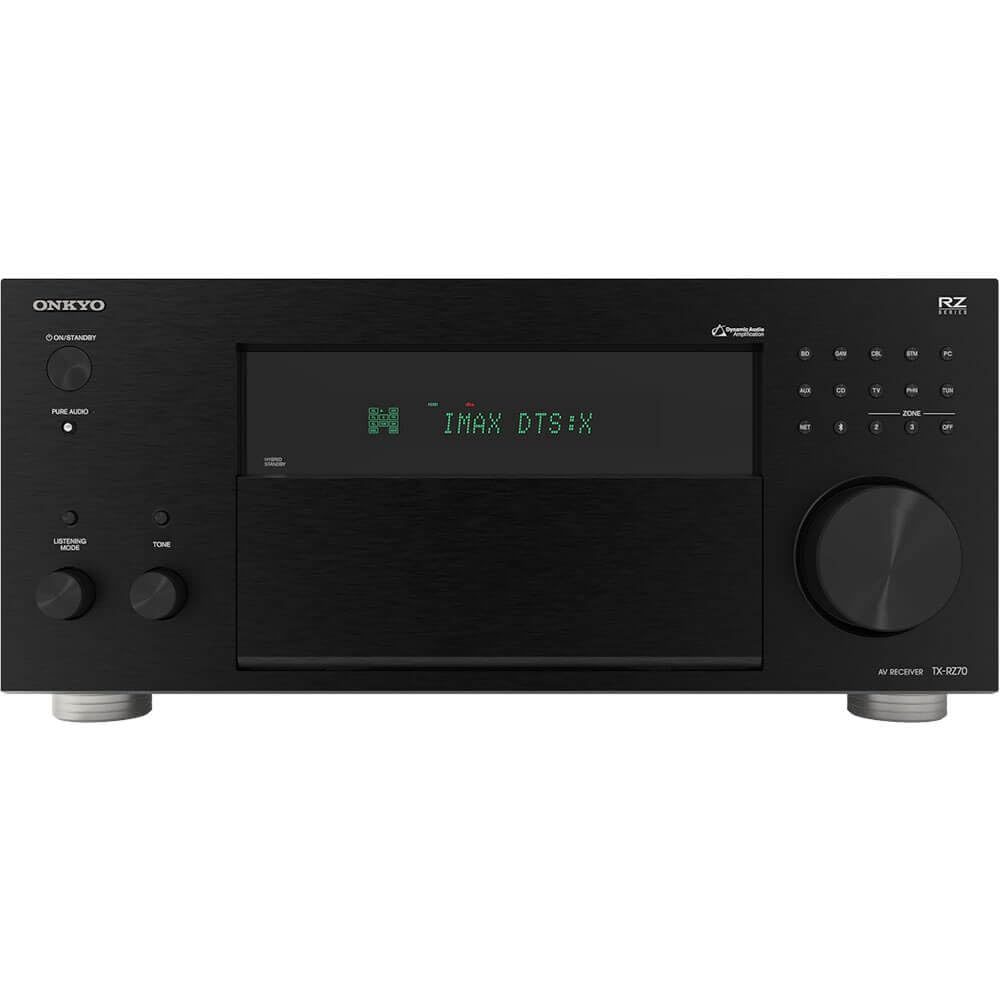
Eleven driven channels, 140 watts each, with Dirac Live inside from day one.
If you have decided on a 7.2.4 layout and want it driven by one box without adding external amps, the TX-RZ70 is the most direct answer here. It is an 11-channel unit with 140 watts per channel, running discrete zones with multiple subwoofers, and it uses ESS Sabre digital-to-analog converters — the chip that converts a digital source to the analog signal your speakers play. That converter is the same class of component found in dedicated hi-fi players, which is why the detailed audio judgments on this unit read unusually well for an AVR.
Dirac Live Room Correction Full Bandwidth is included, and a Bass Control upgrade corrects the lowest tones specifically. The amp is heavy at 57.9 pounds and built to run cool; a pre-pro switch mode lets you turn the built-in amps off when you use external amplification, cutting heat and cleaning the signal path. Four THX listening modes (cinema, gaming, music, surround EX) and IMAX Enhanced with a stretched aspect ratio round out the feature list. All HDMI inputs carry 40 Gbps for 4K/120, VRR, ALLM, Dolby Vision, and HDR10+.
One honest caveat: the TX-RZ70 runs large and heavy, so a shelf with weight limits is out. There is also a recurring report of rapid popping with one specific TV brand’s streaming apps, a handshake issue the community knows about. Neither undermines the amplifier itself, and the majority of customers note a smooth ride.
Where It Stands Out
- 140 watts to each of eleven driven channels — a true 7.2.4 without external amps
- Dirac Live Full Bandwidth included, with a Bass Control upgrade path for two subs
- ESS Sabre DACs, THX certification, and pre-pro mode for adding external amps later
- 40 Gbps HDMI 2.1 on every input with zero handshake issues reported by most owners
Where It Asks Something Of You
- 57.9 pounds — plan two people and a strong shelf for installation
- An occasional handshake issue has been reported with one TV brand’s smart apps
Buy this when: a full 7.2.4 ceiling layout is the plan and you want it driven properly by the receiver alone.
Consider another route if: you need a small footprint — 57.9 pounds is not shelf-friendly and it is not a wall-cabinet unit.
8. Marantz AV7706 11.2Ch 8K Ultra HD AV Surround Pre-Amplifier

No built-in amplification at all — this one is the brain, you supply the muscle.
Read the spec sheet carefully: the AV7706 is a pre-amplifier, not a receiver. It processes eleven channels and feeds external power amps, so if you already own a stereo amp for your front stage there is real logic in spending your budget on processing quality rather than another integrated amp. It has eight HDMI inputs and three outputs, all HDCP 2.3, with 8K/60 and 4K/120 pass-through. Cabling is generous — eight in, three out, one of which is dedicated 8K.
Audyssey MultEQ XT32 carries the room correction, with Dynamic Volume, Dynamic EQ, LFC, and Sub EQ HT to calibrate two subwoofers independently. That is the full Audyssey Platinum suite, which is among the most capable room-correction packages in this list alongside Dirac Live. Marantz’s HEOS streaming is built in, with Spotify, TuneIn, Deezer, Tidal, Netflix, and Amazon Prime supported, plus Bluetooth and AirPlay 2. The AV7706 is 28.3 pounds — noticeably lighter than an integrated amp because there are no output stages to carry.
The honest catch is that it demands as much from you as it gives. The menu is deep and the documentation is thin; reviewers point out the setup takes study and both apps. And there is no printed manual in the box, which irritates a group that prefers a paper reference. None of that undercuts a processor whose performance ceiling is high once configured.
top-tier processing: Audyssey MultEQ XT32 with Sub EQ HT on two subs is a serious calibration tool that earns its keep on a room with bad bass.
Not a beginner unit: if “pre-amplifier” is a term you had to look up, read the setup guide twice before you buy.
For you if: you already own external power amps and want the AV processing and calibration in a separate box.
Not for you if: you want to plug in speakers and go — the AV7706 will not drive a single speaker without a power amp on every channel.
9. Yamaha RX-A8A AVENTAGE 11.2-Channel AV Receiver

Four zones, eleven channels, and a backlit remote that lights up when you pick it up.
The RX-A8A is Yamaha’s top-tier AVENTAGE line, and it shows in the specs that matter for a whole-house install: 11.2 channels with Zone 2, Zone 3, and Zone 4, all driven from one box. The 47.2-pound chassis gives it the damped mass that separates a premium amp from a budget one. Dolby Atmos, DTS:X, and Auro-3D are all on board, with seven HDMI inputs and three outputs carrying 8K60 and 4K120 at 40 Gbps.
Surround:AI is the machine-learning layer that rebalances dialogue, effects, and music in real time based on what is playing. The review pages describe it pleasantly: it keeps dialogue intelligible over a loud score and makes an action scene feel bigger without cranking the volume. YPAO R.S.C. room correction has 3D and multipoint measurement, and streaming runs through MusicCast with AirPlay 2, Spotify Connect, Roon Tested, and a phono input.
Where the A8A requires a little patience is at the HDMI handshake. A firmware updating has caused HDCP 2.2 errors on some units, requiring a restart, and the full-screen on-screen display is heavier than rivals’. The MusicCast app’s input menu is cluttered, though the web login through IP address makes fine-tuning from a laptop easier. Buyers uniformly flag heat — class AB amps run warm.
The four-zone story: Zone 2, 3, and 4 make this an unusually capable whole-home brain — kitchen, patio, and bedroom from one processor.
The HDMI handshake risk: firmware has thrown HDCP 2.2 errors on some setups. A restart fixes it; a hardware swap is rarely needed.
Fits you when: you want the receiver to feed multiple rooms and a full 11.2 theater without a separate multi-zone controller.
Worth pausing on if: you want completely bulletproof HDMI switching on day one — this one occasionally needs a firmware restart.
10. Sony STRAZ5000ES Premium ES 11.2 CH 8K A/V Receiver

Sony’s installer-grade ES unit, built to be wired into a control system and forgotten.
The ES badge means Sony’s installer channel — the STR-AZ5000ES is designed for rack and custom-install environments, with IP control integration for the major control systems, a front-panel display, and a graphical UI. The amp is rated at 130W + 130W into 8 ohms (1 kHz, 2ch, 0.9% THD), and there are seven HDMI inputs and two outputs, all carrying 8K and 4K/120. It runs an 11.2-channel layout with Dolby Atmos and DTS:X decoding.
The audio and video side leans on two core Sony technologies: Digital Cinema Auto Calibration IX, which maps your room and adjusts speaker output accordingly, and 360 Spatial Sound Mapping, which pulls a full dome of sound out of speakers placed where they actually are. Works With Sonos lets you bolt it onto an existing Sonos network with a Sonos port. Streaming is broad — Bluetooth, Wi-Fi, Chromecast built-in, Spotify Connect, AirPlay — and Google Assistant handles voice.
The honest caveat is that the AZ5000ES is not a consumer-first product. Shoppers say software that failed to map a room with front ceiling speakers, requiring manual configuration, and a TV popup on power-on instead of returning to the last source. Speaker hissing has been reported on these units at the level where more than one owner returned them, so audition carefully in your own room.
The 360 pitch: Spatial Sound Mapping plus DCAC IX calibration is Sony’s answer to a room where speaker placement is imperfect.
Installer product, installer quirks: some software edges still need manual setup and the front-height mapping can misfire.
For you if: you are integrating the receiver into a control system or rack and want ES-tier build.
Not for you if: you want a plug-and-go consumer receiver — some setup paths here still need a laptop and a manual.
11. Sony STRAZ7000ES Premium ES 13.2 CH 8K A/V Receiver

Thirteen channels and two subwoofers — the biggest speaker count on this page.
If you are building past a 7.2.4 layout, the STR-AZ7000ES goes one step further: 13.2-channel processing, with 150W + 150W of amplification into 8 ohms (1 kHz, 2ch, 0.9% THD). That is the densest speaker arrangement here, and the extra channels let you add front wides or a second pair of height speakers that a 7.2.4 system does not have room for. HDMI is 7-in/2-out with 8K and 4K/120, and Dolby Atmos and DTS:X decoding are standard.
Like its 11.2 sibling, the AZ7000ES relies on Digital Cinema Auto Calibration IX and 360 Spatial Sound Mapping. Where the 11.2 model adds a channel count for a standard room, the 13.2 unit makes more sense with a properly laid out listening room where the extra speakers are actually installed. It runs 55.9 pounds, so the chassis is substantial, and it runs hot — external cooling is the practical accessory. Works With Sonos and Chromecast built-in are on hand, with Bluetooth, Spotify Connect, AirPlay, and Google Assistant rounding out streaming.
The honest part: this is a small group of buyers by design. At this channel count and price bracket, it lands in the same room as the Onkyo TX-RZ70, and it costs more. Two trade-offs show up consistently. Buyers report a hissing noise audible for a few seconds after every menu change when 360SSM is enabled, and it runs hot enough that a cooling fan is worth adding. HDR10+, QMS, and QFT are not supported, so if those matter to your source chain, it falls short. The amp is gentle on lesser speakers, though — many note it makes modest speakers sound more expensive.
Speaker-count ceiling: 13.2 channels is the highest here — front wides and a second height pair become available.
Heat and hiss: the amp needs cabinet clearance and the 360SSM mode can introduce a brief hiss on some units.
Reach for this if: your room has the ceiling real estate for more than nine overhead and ear-level speakers, and you want Sony’s ES processing on top.
Think twice if: you can only fit a 7.2.4 layout — the TX-RZ70 delivers that for a lot less, and the extra channels go unused.
Know the Specs
Channels: 11.2 vs 9.2 vs 7.2
An 11.2 receiver processes eleven main speakers plus two subwoofers. A 7.2.4 layout — seven ear-level, two subs, four overhead — uses every one. A 9.2 layout runs four height-channel speakers plus five ear-level and two subs. A 7.2 unit drives seven speakers with two subs. The number after the dot refers to subwoofer outputs, not subwoofers themselves — two outputs let you tune each sub separately, which helps on a room with an awkward null on one side.
Watts per channel, honestly measured
Power numbers are the easiest spec to overstate, because the measurement conditions matter. A receiver rated at 140W x 11 may be measured at 6 ohms or at 8 ohms, at 1kHz or full bandwidth, and with one channel or all channels driven. When comparing, read the small print on the measurement condition. If a unit lists 130W + 130W (8 ohms, 1kHz, 2ch, 0.9% THD), that is the per-channel figure under those conditions. Where you see just “140W x 11” without conditions visible, treat the power figure as a rough comparison only.
Room correction: Dirac, Audyssey, and YPAO
Dirac Live is a correction system that measures your room and applies a filter that evens out peaks and nulls. It tends to be praised for tightening bass in awkward rooms. Audyssey MultEQ XT32 is Marantz’s correction system, capable of calibrating two subwoofers independently with Sub EQ HT. Yamaha’s YPAO R.S.C. handles 3D and multipoint measurement. All three are worthwhile; which one suits you depends on the room and the speakers more than on the brand.
HDMI 2.1, eARC, and HDMI handshake
HDMI 2.1 support at 40 Gbps carries 8K60 and 4K120 signals. VRR reduces tearing, ALLM reduces lag, and eARC carries the highest audio formats back to the receiver from your TV. The catch to budget for: HDCP 2.3 and eARC handshakes between a receiver and a specific TV model can occasionally misfire, causing a blank screen or an audio delay until the two handshake again. Firmware updates and a passthrough output setting usually fix it. A premium receiver still occasionally needs a cable swap.
Common Questions
Do I really need 11.2 channels or is 9.2 enough?
Is Dirac Live better than Audyssey MultEQ XT32?
Will an 11.2 receiver drive ceiling speakers directly?
How much clearance does an AV receiver need behind and above it?
Can I add external power amps to an 11.2 receiver?
Do I need HDMI 2.1 for a PS5 or an Xbox Series X?
Why does my receiver lose sound after a cable box or TV change?
Can I use an 11.2 receiver with a Sonos system?
Is a refurbished or renewed receiver worth buying?
Will an 11.2 receiver sound better with a separate power amp on the front stage?
The Bottom Line
The strongest all-rounder here is the Yamaha RX-A4A AVENTAGE. It runs a 7.2 layout with all seven HDMI inputs at 8K60 and 4K120, three HDMI outputs, and YPAO R.S.C. calibration — a balanced music-and-film machine for a room that does not need four ceiling speakers. Its eARC quirks are a firmware fix, not a flaw. If you want eleven driven channels with Dirac Live included and a full 7.2.4 ceiling array, Onkyo’s TX-RZ70 is the value play at the flagship rung — 140 watts to every channel, ESS Sabre DACs, and THX certification.
For a denser whole-home install, the Yamaha RX-A8A adds Zone 2, 3, and 4 on top of its 11.2 processing, and the Sony STR-AZ7000ES takes you to 13.2 if the room can hold the extra speakers. The Onkyo TX-RZ50 Renewed is the honest bargain here if you want Dirac Live and THX at a lower rung and can live with a renewed label. Whichever you pick, plan the cabinet, the rear clearance, and a spare cooling fan — those are the details that decide whether a great receiver actually lasts.
How we choose
We do not accept paid placement. Every pick is matched to a real buyer and a real use-case; we do not hands-on test units.
Sources
Specifications: manufacturer listings and product documentation. Review insights: verified customer reviews, as of October 2026. Pricing: not shown on this page (it changes often); check the current price via the retailer link.
As an Amazon Associate, Aappliancez earns from qualifying purchases. This does not affect which products we feature.