Disclosure: Some links in this post are affiliate links. As an Amazon Associate I earn from qualifying purchases, at no extra cost to you. Learn more
Specs are compiled from manufacturer listings and verified buyer reviews and can change over time — please confirm the key details on the product page before buying.
You want a road bike that fits how you actually ride, and the gearing is where most buyers get lost. This guide covers eleven road-going 10 speed bikes (plus close cousins with 20-, 24- or 18-speed gearing), from full carbon race rigs down to aluminum starter bikes, so you can match one to your riding and your budget.
This guide is built by comparing the manufacturers’ published specifications and the patterns across verified customer reviews, so you get each pick’s real strengths and trade-offs instead of marketing spin.
The bikes below split into three clear groups: lightweight carbon racers, aluminum all-rounders, and one kids’ machine. Read on for how each gearing setup behaves, what the frame material actually changes, and which of the 10 Speed Bikes fits your riding week.
Top Picks


How To Choose The Best 10 Speed Bikes
The fastest way to narrow this list is to decide three things before you look at any frame: how many gears you actually need, what material you want under you, and how you plan to stop. Everything else is detail.
Gear count and the drivetrain behind it
A “10 speed” bike usually means ten cogs on the rear cassette (the cluster of gears at the back wheel). Add two chainrings up front and you get 20 gears; add a triple and you get 30. On this list you’ll see 2×12 (24 speeds), 3×8 (24 speeds), 2×10 (20 speeds) and single-ring 8- and 10-speed setups. The count only helps if the derailleur (the arm that pushes the chain between gears) moves the chain cleanly, so check the groupset name — Shimano Claris, Sora, Tiagra and 105 sit in ascending order of refinement. Buyers on the Tommaso Imola praise the integrated brake-and-shift levers for accuracy; on the Schwinn Phocus, gear quality is the most-discussed topic and reads mixed, which is the honest reason to spend a little more on the drivetrain.
Carbon versus aluminum
Carbon fiber frames and wheelsets on this list weigh in as low as 8.8kg (19.4 lb) for a full-carbon build, and SAVADECK claims its T800 carbon layup is five times harder than aluminum at equal volume. That lightness is the real payoff — hill climbs feel shorter and carrying the bike up stairs stops being a chore. Aluminum is the tougher, more forgiving material on paper; the woom Explore and the Tommaso frames are all aluminum and shrug off knocks that would worry a carbon owner. Carbon needs a torque wrench and carbon assembly paste on the seat post, and a knock is worth inspecting.
Brakes: hydraulic disc, mechanical disc, caliper
Hydraulic disc brakes push fluid through a sealed line, so they need almost no hand strength and stay consistent when the rim is wet. The SAVADECK R7120 builds use hydraulic levers and calipers; the woom kids’ bike uses hydraulic discs with 160mm front and 140mm rear rotors. Mechanical disc and caliper rim brakes are simpler to service at home but demand more lever pull. If you ride in rain or descend long hills, hydraulic is the one to hold out for.
Sizing and assembly
Fit beats spec every time. Two riders on the Tommaso Monza — one at 6’3″, one at 5’7″ — landed on different frame sizes from the same chart, and a 5’9″ rider with a 34″ inseam settled into a 56cm SAVADECK with seat adjustment. Measure your inseam, not just your height. Most bikes ship 80–90% assembled, so you fit the front wheel, handlebar, seat post and pedals — allow 20 minutes to an hour, and budget for a torque wrench (a wrench that clicks at a set tightness) if you’re on carbon.
Side-by-Side Comparison
| Model | Best For | Drivetrain / Speeds | Frame Material | Stated Weight | Amazon |
|---|---|---|---|---|---|
| SAVADECK Full Carbon R7120★ Best Overall | Serious riders wanting a race-ready carbon build | Shimano R7120 2×12 (24-speed) | Carbon fiber | 8.8kg (19.4 lb) | Amazon |
| Tommaso Imola (Claris)Best for Beginners | First road bike on a tight budget | Shimano Claris 3×8 (24-speed) | Aluminum | — | Amazon |
| Tommaso MonzaBest All-Rounder | Riders stepping up to a Tiagra drivetrain | Shimano Tiagra 2×10 (20-speed) | Aluminum with carbon fork | — | Amazon |
| Tommaso Imola (alternate listing) | Buyers who want the same Imola build in another color | Shimano Claris 3×8 (24-speed) | Aluminum | — | Amazon |
| SAVADECK Carbon Sora R3000 | Entry into carbon without a race-bike price | Shimano Sora R3000 18-speed | Carbon fiber | 9.6kg (21.1 lb) | Amazon |
| SAVADECK A7L Carbon 105 | Triathletes and fast group rides | Shimano 105 R7100 2×12 (24-speed) | Carbon fiber | 8.9kg (19.6 lb) | Amazon |
| SAVADECK Full Carbon (black) | Buyers who want the same carbon spec in black | Shimano R7120 2×12 (24-speed) | Carbon fiber | 8.8kg (19.4 lb) | Amazon |
| Model H Carbon Tiagra | Durability-focused recreational riders | Shimano Tiagra 2×10 (20-speed) | Carbon fiber | 18.7 lb | Amazon |
| Schwinn Phocus 1.6 Disc | Casual riders and starter mileage | microSHIFT 14-speed | Aluminum with alloy fork | 25.7 pounds | Amazon |
| Throne Goon Runner | Street and BMX-style cruising | Shimano Deore 10-speed | 6061-T6 aluminum | — | Amazon |
| woom Explore | Kids aged 10–14 riding road and trail | microSHIFT Acolyte 8-speed | Aluminum | 22.2 lbs | Amazon |
Detailed Reviews
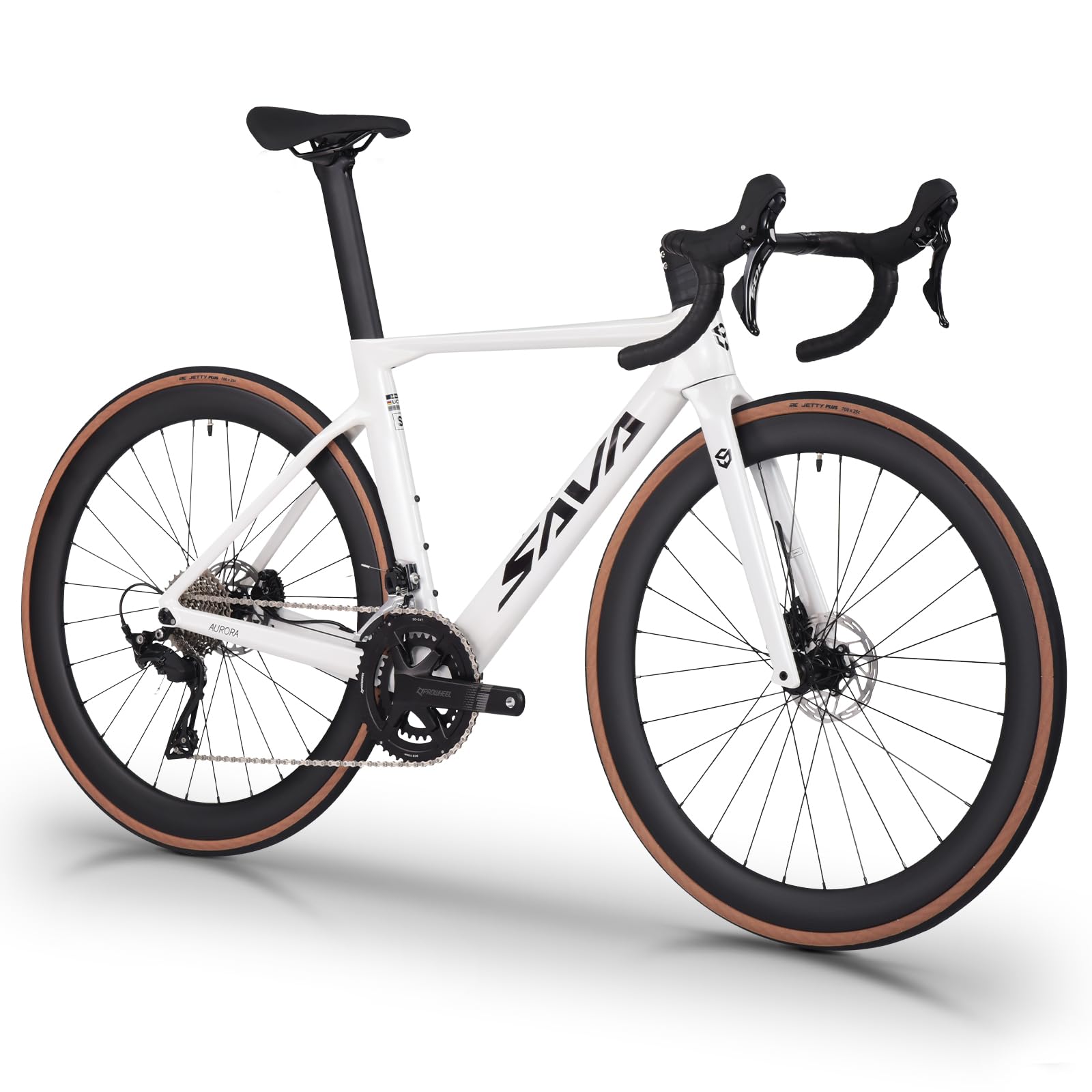
1. SAVADECK Carbon Fiber Road Bike with Shimano R7120 24S
Our pick — 4.5+★ from 70+ verified ratings; the strongest balance of quality and price.
Full carbon from fork to freehub at under 20 pounds — this is the one that turns heads on the climb.
The number that wins this pick is 8.8kg (19.4 lb) — the whole bike, frame, fork, seat post and wheelset all in T800 carbon. That’s the lightest build on the list. On a rolling road the difference is plain: acceleration comes quicker, and the bike doesn’t fight you on the uphill section of your usual loop.
Shifting is the R7120 2×12 setup — twenty-four gear combinations through Shimano’s hydraulic-lever shifters, with an R7100 front and rear derailleur. Owners say the shifts land spot-on with no chatter, and the hydraulic discs give the confident stopping power that mechanical brakes can’t match on a wet descent. Cable routing runs fully inside the frame, which keeps airflow clean and the front end tidy. The 700x25C carbon wheels come wrapped in JETTY PLUS tires with an anti-skid shoulder for grip through fast corners, and a pair of clipless pedals is in the box.
What wins people over most is the build quality itself — the finish and the solidity of a frame this light. The recurring gripe is small: fitting the handlebar and stem spacer takes patience and a torque wrench, and some find the saddle worth swapping. The freewheel can arrive loud until the grease evens out. Plan on a shop visit or a careful home setup.
What the carbon buys you
- 8.8kg (19.4 lb) total weight — the lightest build on this list
- Shimano R7120 2×12 hydraulic groupset with R7100 derailleurs
- Carbon frame, fork, seat post and wheelset all in one package
- About 90% pre-assembled from the start
Before you commit
- Handlebar and stem fitting wants a torque wrench
- The stock saddle is the first thing most owners change
- Carbon needs paste and careful torque — not a knock-about commuter
Reach for this if: you ride paved roads hard, want hydraulic braking and 24 gears, and you’re ready to treat a carbon frame with respect.
Think twice if: you want a bike you can throw in a garage without a torque wrench and carbon paste on hand.
2. Tommaso Imola Aluminum Road Bike
Twenty-four gears on an aluminum frame, aimed squarely at the rider buying their first drop-bar road bike.
Start with the gearing. The Imola runs Shimano Claris in a 3×8 layout — three chainrings and eight cogs, twenty-four combinations — with integrated brake-and-shift levers that owners describe as accurate and low-profile. On hilly ground the triple up front gives you a granny gear for the steep stuff without giving up the big ring on the flat.
You get a light, fast-feeling ride without a carbon price tag, thanks to the aluminum frame. Riders upgrading from an older single-speed or a hybrid say it feels light and fast by comparison, and build quality carries the day — it’s the most-praised thing about this bike by a wide margin, well ahead of value and ride quality. Buyers report rides between 10 and 30 miles without issue. Most arrive mostly assembled, and shipping is quick.
The catch is the saddle. It’s firm, and a couple of owners swapped it and the plastic cage pedals on day one. Shifting and performance read as mixed in the review pages — some get flawless Claris from the start, others find the front derailleur fussy to adjust. Budget a shop tune if you want gear changes as crisp as the SAVADECK above.
The honest read: a well-built aluminum starter bike whose 24-speed Claris setup gives beginners a real climbing gear, priced to leave money for a better saddle and pedals.
Where it lands short: the front derailleur can be touchy to dial in, and the saddle and pedals are the first upgrades most riders make.
Fits you if: you want your first road bike to be light, eager and forgiving on the wallet.
Hold off if: you expect a plush saddle and smooth pedals straight from the start.
3. Tommaso Monza Aluminum Road Bike
The step up from Claris to a Tiagra 2×10 drivetrain, on an aluminum frame with a carbon fork to soften the chip seal.
Twenty gears from a Shimano Tiagra 2×10 setup, and that drivetrain is the whole pitch here. Tiagra 4700 shifts smoothly and holds together under load — racers in the reviews rate the Tiagra 4700 shifts close to Dura-Ace for the price, and one owner covered roughly 800 miles in five months with only an occasional missed shift. The front end takes the sting out of rough pavement thanks to the 6061 aluminum frame paired with a carbon fork.
Ride quality is the thing this bike does best, and it shows across riders of every build. A 6’3″, 220lb rider on the XL found the shifting flawless and the bike comfortable; a 5’7″ rider fits the Small per the sizing chart. Two bottle cage mounts and external cabling make maintenance and long summer rides easier. One 30-year racer bought it to start his son in road racing and reckons it stands comparison with bikes in a much higher bracket.
Two upgrades to plan for. The stock 23c tires and tubes caused repeated flats for one owner in the first week before he switched to 25c road tires, and the saddle is unpadded — replace it early. Wheels are on the heavy side. The frame itself has been sound across long-term riders, but a couple of buyers landed on faulty shifters from the start.
Why it climbs the ranking: a Tiagra 2×10 transmission (20 gears from Shimano’s mid-tier groupset), a carbon fork and 20 usable gears make this the balance for someone who has outgrown a starter bike but isn’t ready for carbon prices.
The trade-off: the stock tires and saddle are placeholders — budget for 25c rubber and a padded saddle, and you’ll have a bike that punches well above its bracket.
Buy it if: you want reliable Tiagra shifting and a carbon fork on an aluminum frame without jumping to a carbon bike.
Pass if: you’d rather not budget for new tires and a saddle right after buying a new bike.
4. SAVADECK Carbon Disc Road Bike
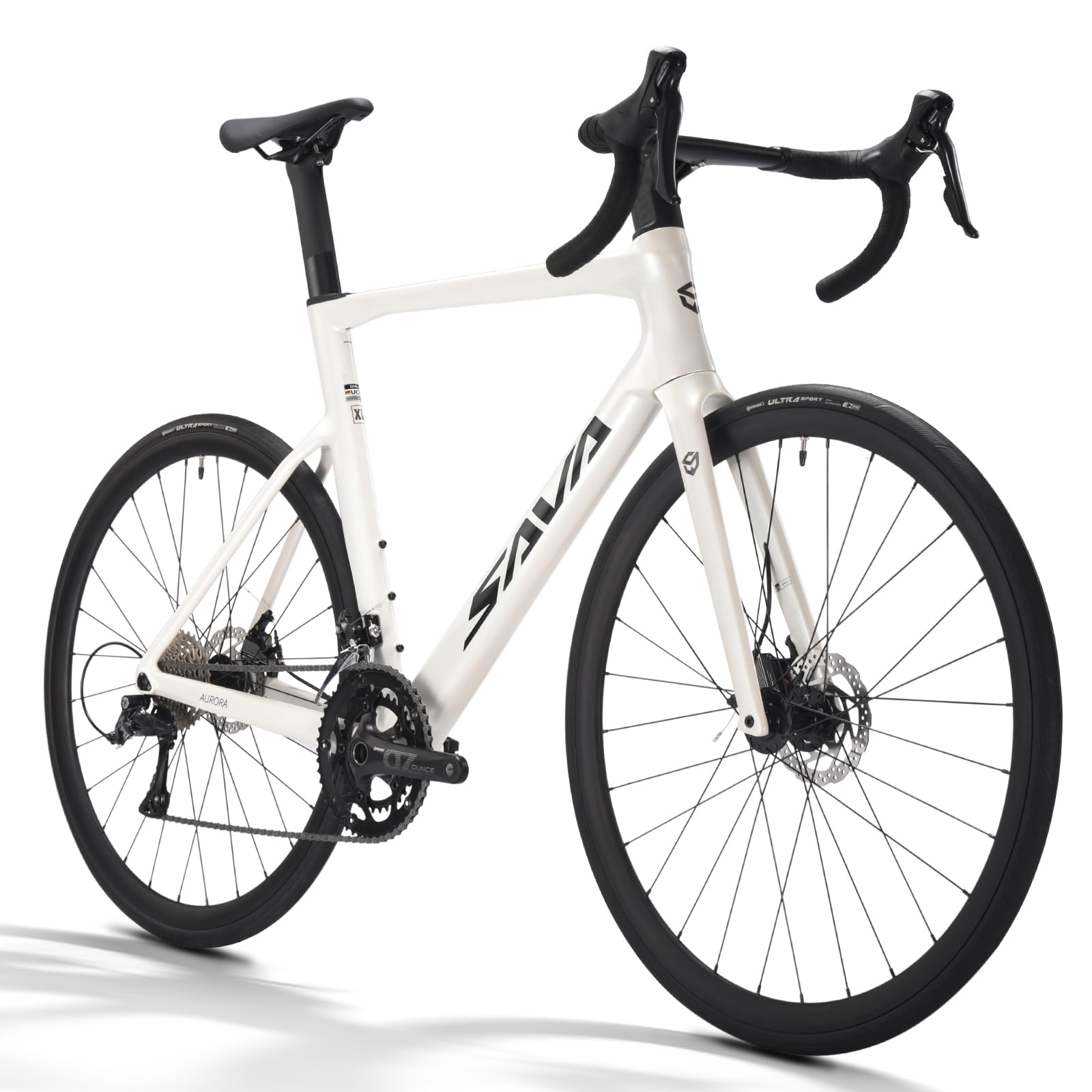
Your cheapest door into a carbon frame and wheelset, with Continental rubber and 18 Sora gears bolted on.
Nine and a half kilos of Japanese carbon — 9.6kg (21.1 lb) — with the frame, fork, rims and seat post all in Toray T800. It’s a touch heavier than the flagship SAVADECK above, but it’s still a carbon bike that you’ll notice on the climbs and when you carry it indoors. Cables run fully inside the frame for a clean profile and less wind drag, and the tapered head tube tightens up the handling.
Gearing is Shimano Sora R3000 in an 18-speed setup, running through Sora shift levers and front and rear derailleurs. The brakes are hydraulic disc with a balanced, linear pull — easy to maintain and strong in the wet. Continental 700x25C tires come fitted, which is a genuine upgrade over generic rubber, and pedals are included in the box. Over half the review page is devoted to how light the bike feels, with looks and value right behind it.
The honest friction point is setup. The integrated handlebars and in-frame cables are fiddly, and the bar sits low — a 67-year-old rider logging 100 miles a week is still dialing in his fit. There are no English assembly instructions in some boxes. If you’re handy or you’ll pay a shop to build it, that’s a one-time hurdle; if not, budget for it.
Why riders like it
- Toray T800 carbon frame, fork, rims and seat post at 9.6kg (21.1 lb)
- Shimano Sora R3000 18-speed shifting
- Continental 700x25C tires and hydraulic disc brakes
- Nearly fully pre-assembled for shipping
Where it needs care
- Integrated handlebar and in-frame cable fitting is fiddly
- The handlebar sits low — some riders need a longer stem or shorter reach
- Instructions may arrive for the wrong model
Choose this if: you want carbon frame and wheels on a first road bike without going all the way to a race-spec build.
Skip if: you’d rather your bike show up nearly dialed-in and ready to roll.
5. SAVADECK A7L Carbon Road Bike
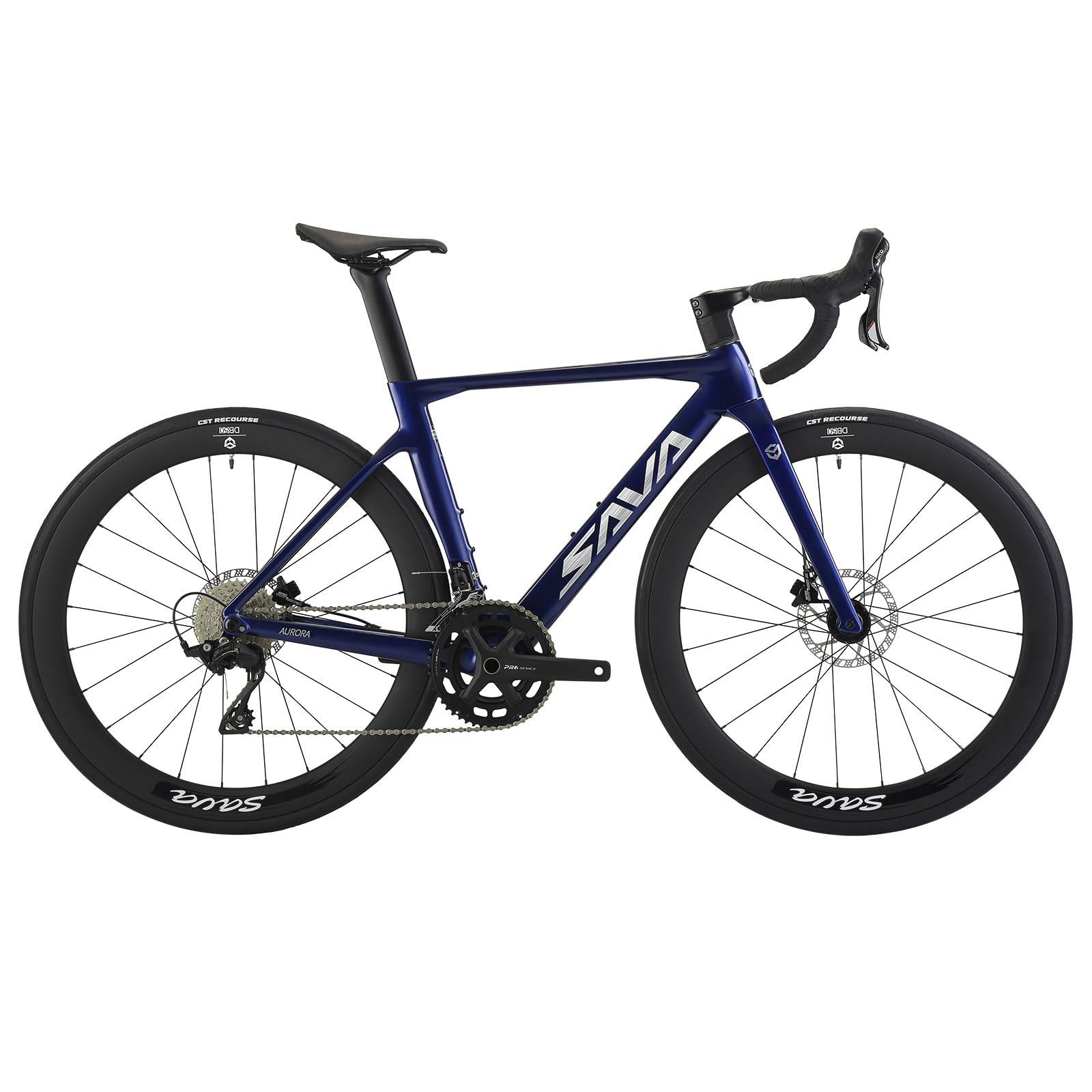
Shimano 105 and hydraulic discs on a full carbon frame that goes together in about fifteen minutes.
This is the SAVADECK built around a Shimano 105 R7100 2×12 groupset — twenty-four gears with hydraulic disc brakes, the same tier as the flagship but in a different frame package. The T800 carbon frame, fork, seat post and rims bring it to 8.9kg (19.6 lb), and the maker pays attention to aerodynamics: frame, wheelset and handlebars are shaped to cut drag. It comes 85% pre-assembled, with a 15-minute assembly in mind — handlebar, seat post, front wheel, pedals.
Durability is what earns this bike its reputation. one owner raced it in a 27-mile triathlon after a shop safety check came back clean, and the quality of the frame and components is the most-discussed strength on the review page, ahead of value and durability. The Shimano 105 drivetrain shifts precisely once the shop has a look, and clipless pedals are included as a complimentary pair. The one adjustment first-time users flag is getting used to the shifting feel.
Two things to know. Shipping from overseas can get held in customs — one buyer waited over a month, though SAVA kept him updated and refunded part of the delay. The stock seat and pedals are entry-level; most owners upgrade those before the first long ride. The freewheel is loud, which is typical for this drivetrain family.
Best for: triathletes and fast group riders who want 24 speeds of Shimano 105 on a light carbon frame without paying race-tier money.
Before you click buy: plan for customs delays, and expect to swap the seat and pedals early if you want the fit dialed in.
Go for it if: you want a 105-equipped carbon race bike that’s quick to put together and ready for your first tri.
Consider the alternative if: a 105 groupset isn’t essential and you want a more forgiving out-of-box experience.
6. Model H Carbon Fiber Road Bike with Shimano Tiagra 20 Speeds

Eighteen-point-seven pounds of carbon with rim brakes, a 20-speed Tiagra drivetrain and a limited lifetime frame warranty.
Here’s the number worth knowing: 18.7 lb, which is lighter than both SAVADECK carbon bikes above. The T800 carbon frame carries a limited lifetime warranty, and the mechanical parts are covered for a year — the only bike on this list with that warranty structure stated up front. A Shimano Tiagra 10×2 setup gives twenty gears, and the bike can be ordered with a custom club logo, which is why it appeals to riding groups.
Long-term riders are the story here. One buyer has raced it in Cape Town for two years and ridden it since 2021 without a problem; another has five enjoyable months on it and calls it the best value road bike he’s ridden. The frame takes a knock and keeps going, and its 4.5+ star average across more than three dozen ratings is the highest on this list. Assembly is about an hour and straightforward — the front wheel, bars and seat post — and it ships with a tool kit.
One recurring owner suggestion: service it every six months, because the mechanical parts have a one-year warranty rather than a lifetime one. The rim brakes aren’t as capable in wet weather as the hydraulic discs on the SAVADECK builds, so it’s best for dry-weather riding or a fair-weather club rider. Gear range is described as plenty for casual riders but not for a racing mountain stage.
Why it tops the shelf: a light carbon frame with a lifetime warranty, twenty Tiagra gears and strong long-term durability reports make this the safest carbon buy on the list.
What it lacks: rim brakes rather than discs, so if you ride in rain a hydraulic disc build serves you better.
Made for: club riders and recreational road cyclists who want a light carbon frame with real warranty backing.
Not for you if: you ride in the wet regularly and need hydraulic stopping power.
7. SAVADECK Full Carbon Road Bike
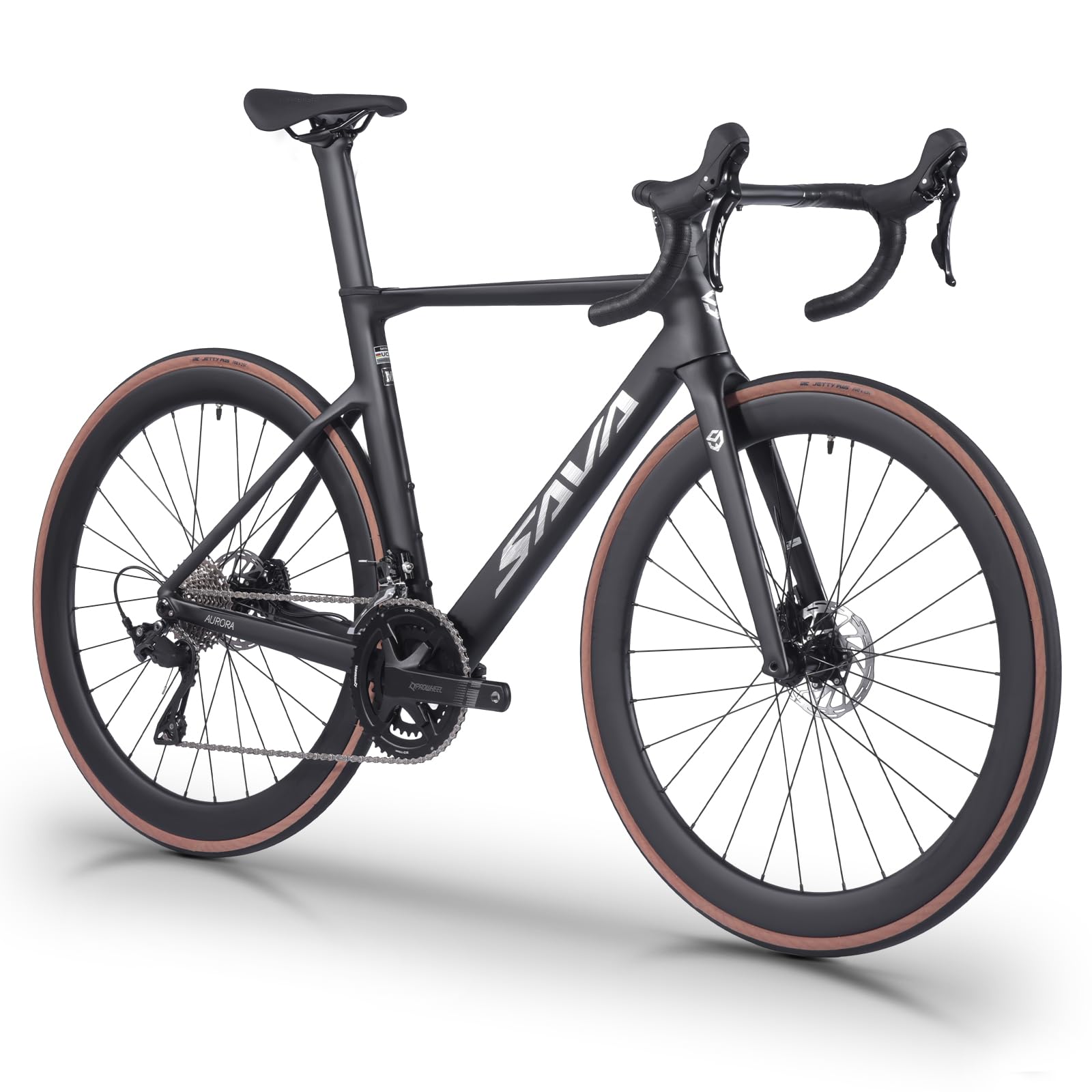
Same full-carbon, 24-speed build as the top pick — the only real difference is the black finish.
If you want the flagship SAVADECK spec in black rather than white, this is the listing. The full-carbon frame, fork, seat post and wheelset come to the same 8.8kg (19.4 lb), the Shimano R7120 2×12 groupset gives twenty-four hydraulic-braked gears, and the 700x25C carbon wheelset carries JETTY PLUS tires with anti-skid shoulders. Fully internal cabling keeps the profile clean.
Riders confirm the flagship numbers hold: a 5’9″ rider with a 34″ inseam fits the 56cm frame with seat adjustment, a 5’11” rider settles into the 54cm L comfortably, and setup took about twenty minutes for one experienced cyclist. The Shimano 105 shifts spot-on with no chatter once dialed in, and the front derailleur wants a firm double-click to shift — normal for this tier, not a defect.
A couple of small things to plan around. The included pedals are cheap and most owners swap to clipless, the saddle is worth replacing, and the seat adjustment is awkward without a torque wrench. One rider also found the front-wheel screw attached to the fork instead of a quick-release. If you want the black colorway and the spec above, this is your bike; the build is otherwise identical.
What you get
- Same 8.8kg (19.4 lb) full-carbon build as the flagship pick
- Shimano R7120 2×12 24-speed groupset with hydraulic discs
- Black colorway, carbon wheelset and JETTY PLUS tires
- About 90% pre-assembled
Worth knowing
- Included pedals and saddle are entry-level — most owners swap them
- Seat adjustment needs a torque wrench for carbon-safe tightening
- Front wheel comes with a screw rather than a quick-release
If black is your color: this is the identical flagship build — same weight, same groupset, same carbon everywhere.
If you’re chasing the clean white frame: the top pick carries the exact same hardware.
8. Tommaso Imola Aluminum Road Bike Alternate Listing

The same Claris-equipped aluminum Imola as the beginner pick above, offered in a different listing and colorway.
Everything that made the Imola worth a look applies here: twenty-four gears from a Shimano Claris 3×8 setup, integrated shift-and-brake levers that owners describe as accurate and simple, and a light aluminum frame that riders say climbs noticeably easier than a heavier hybrid. This listing is simply another finish of the same bike.
You get real road geometry for a low buy-in, and assembly is friendly — riders report a local shop wanted to sell one after sizing it up, and many get it rolling with just the front wheel, bars and pedals to fit. A 5’9″ rider fits a medium comfortably. The saddle and cage pedals are the first parts most people replace, and buyers on the sibling listing say the front derailleur can be fussy to adjust — plan on a shop tune if that’s not your skill set.
If the main listing for the Imola is out of stock or you prefer this color, snap this one up. It’s the same aluminum first road bike with the same 3×8 drivetrain.
The short version: a duplicate of the beginner-favorite Imola in another finish — twenty-four Claris gears on a light aluminum frame.
Be ready for: swapping the saddle and pedals, and dialing in the front derailleur to keep shifts quiet.
Pick this listing when: the primary Imola listing is unavailable and you want the identical beginner bike.
Look at the main listing when: you want the most-reviewed version of the same frame and drivetrain.
9. Schwinn Phocus 1.6 Disc Road Bike

A 700c disc-brake road bike at the lowest point on this list, sized for riders from 5’6″ to 6’0″.
Schwinn’s entry point runs a 14-speed microSHIFT integrated shifter-and-brake lever setup, 700c x 28c tires on high-profile alloy wheels, and a mix of an aluminum frame with an alloy fork. Disc brakes replace the caliper rim setup common at this price, and the drop-bar geometry gives you the aerodynamic riding position. Weight is 25.7 pounds — heavier than the aluminum Tommaso builds and far off the carbon bikes, but steady on the flat.
Looks are what buyers remark on most — the bike photographs well and, for a first road bike, it gets you out on the pavement. Bearings can feel loud after the first few miles, and the front and rear dérailleur gear changes are the most-discussed topic and read as mixed. Some owners found the gears noisy unless set in a specific combination. It’s a budget bike and should be judged as one: the frame, looks and disc brakes are the wins, and the drivetrain refinement is where the money went missing.
Two more honest notes. Watch the assembly — a few owners received bikes with missing hardware or an inner tube that wouldn’t inflate. And the older version of this same model is remembered as a better ride by some long-term Schwinn owners. If you’re set on a lower-cost entry into road cycling, buy with care and inspect on arrival.
Where it fits: a low-cost disc-brake 700c road bike for casual riders who want to start turning miles on pavement.
Where it stumbles: the gear changes aren’t the smooth kind, and assembly needs a careful inspection on delivery.
For the casual rider: a good-looking starter road bike with disc brakes when the price tag matters most.
Consider spending more if: smooth gearing is important to you — the Tommaso Imola does it better.
10. Throne Goon Runner 10-Speed Alloy BMX Bike
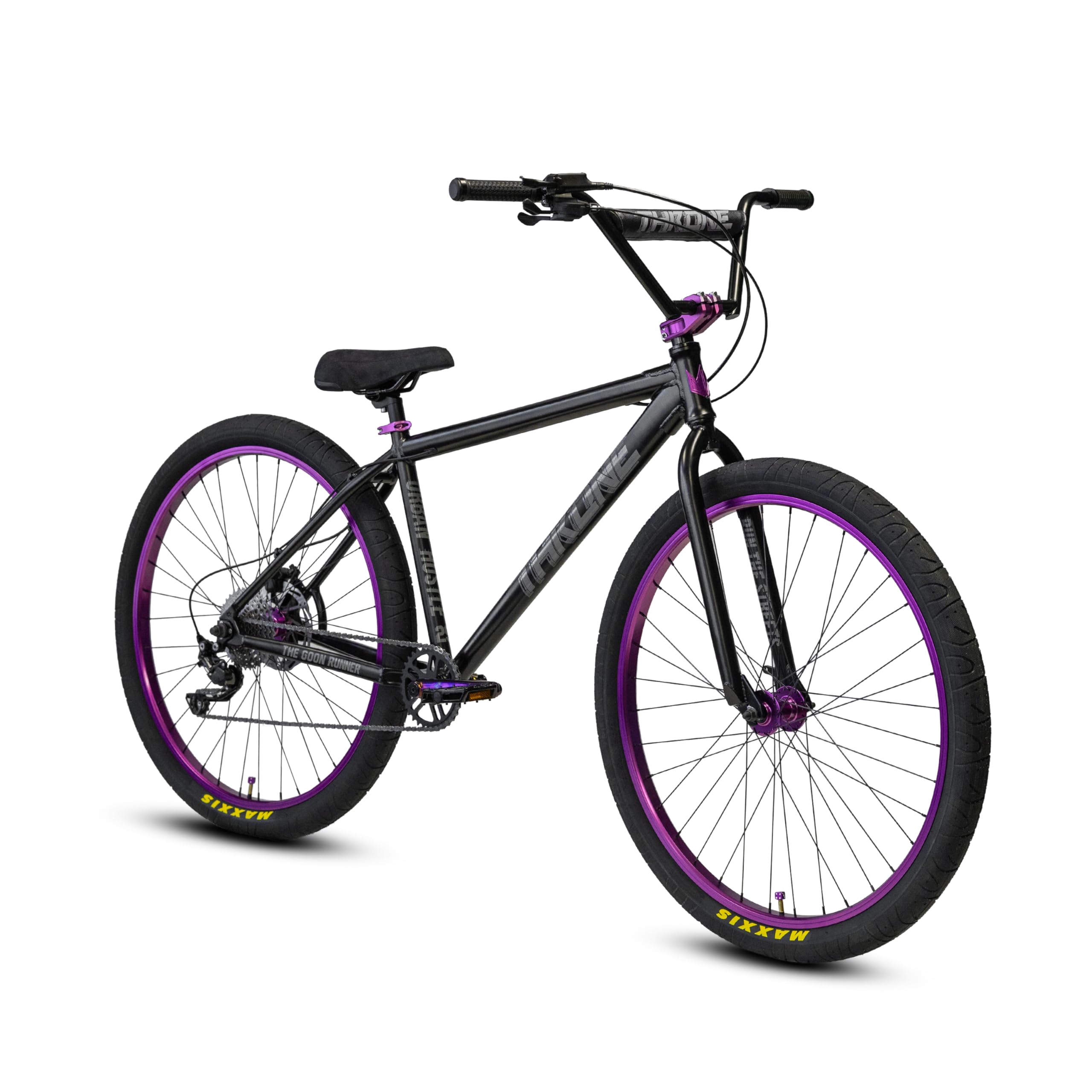
The literal ten-speed on this list — a BMX-inspired street runner with a Shimano Deore derailleur and hydraulic discs.
You get clean gear changes while you cruise, climb or thread through the streets, because the ten gears come from a Shimano Deore rear derailleur — a proper mountain-bike-grade unit, not a no-name. The frame is TIG-welded 6061-T6 aluminum (a welded aluminum alloy) with an upgraded 5-inch yoke for stability and tire clearance, and the components borrow BMX hardware: an 810mm-wide alloy BMX bar, a 1 1/8-inch chromoly fork, a sealed-bearing headset, alloy BMX pedals and a three-piece 33T crankset (a 33-tooth front chainring).
Hydraulic disc brakes with responsive, dependable stopping power are fitted, which is rare on a street-cruiser style bike. You can choose the wheel size — 27.5-inch or 29-inch — based on your height and how you want to ride. It produces a distinctive look and a ride style that’s a long way from the drop-bar road bikes above: more BMX swagger, less aero tuck.
Two known points from riders: the powder coat finish could be better, and one said the ride itself is awesome. It’s a niche pick, so make sure the BMX geometry and wide bar suit your riding before you buy.
Buy it if: you want a true 10-speed geared bike with BMX style and hydraulic brakes for street cruising.
skip it if: you want drop-bar road geometry and aero riding position.
11. woom Explore Kids Road Bike, 20/24/26 Inch, Ages 6-14

A 22.2-pound kids’ bike with eight gears and hydraulic discs, built for road and trail riders aged 10 to 14.
The number that matters here is 22.2 lbs — that aluminum frame is light enough that a kid can climb hills on the school run that used to mean walking. The 8-speed microSHIFT Acolyte trigger shifter and matching rear derailleur are sized to be worked by smaller hands, with wide aluminum riser bars and tapered ends for a kid’s grip. The 26-inch wheel model is aimed at riders aged 10–14, and the seat runs from 29.9 to 38 inches.
Hydraulic disc brakes with 160mm front and 140mm rear rotors, plus adjustable levers, are the standout for parents — the controlled braking power keeps kids from grabbing too much and going over the bars. Fit matters: this bike suits kids 55 to 65 inches tall, with 29.5 to 37.4-inch inseams, and holds up to 175 lbs. It ships about 80% assembled, with assembly taking around 30–40 minutes.
The price is the sticking point — this is a premium kids’ bike, and parents pay it for the durability. one 24-inch woom was handed down through three boys, and one upgrade from a Trek where the kid can now climb all the hills on the school run. The matte finish and confident brakes are the recurring notes. If you’re passing it down through siblings, it makes sense; as a one-child starter bike, weigh it against your budget.
What makes it worth the money
- 22.2 lbs aluminum frame, light enough for a kid to climb easily
- Hydraulic disc brakes with 160mm/140mm rotors and adjustable levers
- 8-speed microSHIFT Acolyte trigger shifter sized for small hands
- Ships about 80% assembled
Where it costs you
- Premium price for a kids’ bike
- Riders need to be 55–65″ tall — it’s a big investment that gets outgrown
- Assembly still takes 30–40 minutes
Choose it if: your kid is 55 to 65 inches tall, riding to school or trails, and durability plus confident brakes matter more than the sticker.
Hold off if: your child is still growing fast enough that the fit window will close within a year.
Know the Specs
Gearing and Drivetrain
On a “10 speed” bike, ten refers to the cassette — the stack of cogs at the rear wheel. Pair that rear block with the chainrings up front and you get the total: a 2×10 gives twenty gears, a 3×8 gives twenty-four. More gears isn’t always better; a group with precise, clean shifts matters more than a big number. Shimano Claris, Sora, Tiagra and 105 sit in ascending refinement order, and a Shimano Deore derailleur on a BMX-style bike is a mountain-bike part, so the shifts are durable even if the riding is flat.
Frame Material and Weight
Carbon fiber frames pack in light — the SAVADECK builds land at 8.8–9.6kg (19.4–21.1 lb). Aluminum frames on the Imola, Monza and woom are heavier but handle knocks without a care, and the woom comes in at 22.2 pounds. Weights can help you gauge climbing ease,but a slightly lighter bike with a well-tuned drivetrain beats a marginally lighter bike with a fussy shifter every time.
Brake Types and Wet Weather
Hydraulic disc brakes move fluid through a sealed line, so they give the same firm feel in the rain as on a dry day — the SAVADECK R7120 builds and the woom kids’ bike both use them. Mechanical disc brakes are on the Schwinn and Throne and need more hand effort but are simpler to fix. Caliper rim brakes on the Model H and the Sora SAVADECK are light and simple but lose bite when the rim gets wet.
Sizing and Inseam
Height alone can steer you to the wrong frame. Measure your inseam from the floor to your crotch with your shoes on, and compare that against the maker’s size chart. A 5’9″ rider with a 34″ inseam fits a 56cm SAVADECK, while a 6’3″ rider on the Tommaso Monza lands on the XL. The woom states its fit window plainly: 55 to 65 inches tall, with 29.5 to 37.4-inch inseams.
Tire Width and Grip
Tire width changes ride feel and grip. A 700x25C tire is the narrow road standard on most of the bikes here — fast on smooth pavement but less forgiving on rough surfaces. The Schwinn runs 700x28c for a slightly cushier ride. Wider rubber usually means more grip at the cost of a little speed. If you want more comfort on chip seal, a 28c swap is a common upgrade, and several riders on the Tommaso Monza made exactly that move after early flats.
Assembly and Pre-Tune
Most road bikes ship 80 to 90% assembled. That leaves the front wheel, handlebar, seat post and pedals for you, plus the derailleur and brake tuning. Some bikes arrive dialed in — the Imola and the SAVADECK flagship have owners reporting the gears and brakes were set correctly from the start. Others need a shop visit to smooth the shifting. Budget an hour if you’re doing it yourself, or factor in a shop build.
Common Questions
What does “10 speed” actually mean on a road bike?
Is a carbon frame worth the extra over aluminum?
How do I know which frame size to order online?
Can I ride a road bike with 25c tires on gravel or rough pavement?
Are hydraulic disc brakes really better than rim brakes?
How much assembly is needed when a road bike arrives?
Do I need a torque wrench for a carbon frame bike?
Is a kids’ road bike like the woom Explore worth the price?
Can I upgrade the groupset later instead of buying a more expensive bike?
Will a road bike work for commuting and fitness riding, or is it a race-only machine?
The Bottom Line
For most riders, the 10 speed bikes winner is the SAVADECK Carbon Fiber R7120 because it packs a full carbon frame, fork, seat post and wheelset into 8.8kg (19.4 lb), with 24 gears of Shimano hydraulic disc braking — the lightest, most race-ready build on this list. If you want the same carbon spec in black, the SAVADECK full carbon in black is the identical bike in a different finish. For first-time buyers who want reliable Shimano gearing without jumping straight to carbon, the Tommaso Imola is the beginner pick: 24 gears of Shimano Claris, a light aluminum frame and strong build-quality reports make it the sensible starting point. And if you want Tiagra with a carbon fork on the same aluminum frame, the Tommaso Monza is the step up — just budget for tires and a saddle. One honest nudge: the Model H tops the ratings at 4.5+ stars, but the SAVADECK flagship’s combination of full carbon, hydraulic discs and 24 speeds is what most riders looking at this list are actually chasing.
How we choose
We do not accept paid placement. Every pick is matched to a real buyer and a real use-case; we do not hands-on test units.
Sources
Specifications: manufacturer listings and product documentation. Review insights: verified customer reviews, as of October 2026. Pricing: not shown on this page (it changes often); check the current price via the retailer link.
As an Amazon Associate, Aappliancez earns from qualifying purchases. This does not affect which products we feature.