Disclosure: Some links in this post are affiliate links. As an Amazon Associate I earn from qualifying purchases, at no extra cost to you. Learn more
Specs are compiled from manufacturer listings and verified buyer reviews and can change over time — please confirm the key details on the product page before buying.
A flooded basement or a low-yield well stops being a headache when you pick the right 1 HP submersible pump. The wrong one burns out, clogs, or cannot lift water high enough. Match three numbers to your job: flow rate in gallons per minute (how fast it moves water), feet of head (how high it pushes water), and where it sits — a sump basin, a pool cover, or a well casing.
This guide is built by comparing the manufacturers’ published specifications and the patterns across verified customer reviews, so you get each pick’s real strengths and trade-offs instead of marketing spin.
Some of these pumps shred solids and empty a basement fast, a few run quietly under a pool cover season after season, and one pulls drinking water from a deep well. This breakdown covers what actually matters in a 1 hp submersible pump.
Top Picks


How To Choose The Best 1 HP Submersible Pump
Before you compare models, decide what your pump actually has to do. Emptying a basement sump pit is a very different job from lifting water out of a deep well, and the same 1 HP rating can hide wildly different flow and lift numbers. Here is what to check in order.
Start With Maximum Head, Not Horsepower
Maximum head is the tallest vertical distance a pump can push water, measured in feet. If your well is deep or your discharge has to climb a hill, head matters more than the horsepower badge. A pump rated for a tall lift will still deliver usable pressure at the top of that run, while a short-lift model will simply stall out.
Then Match Flow Rate To Your Job
Flow rate is how many gallons per minute the pump moves, written as GPM or sometimes GPH (gallons per hour). For emergency flood removal you want high flow so the water disappears in a hurry. For topping up a tank or feeding irrigation, a lower flow with steadier pressure is often the better fit.
Float Switch, Manual, Or Both
An automatic float switch turns the pump on when water rises and off when it drops, so you can leave it unattended. A manual pump runs whenever it has power, which suits supervised draining jobs and lets you control exactly when it stops. Some pumps offer both modes so you can switch depending on the situation.
Solids Handling And Discharge Size
If the water carries debris, look at how big a particle the pump can pass. A wider discharge opening and a larger solids rating mean fewer clogs. Clean water in a well casing does not need that, so you can choose a narrower fitting and quieter operation instead.
Side-by-Side Comparison
| Model | Best For | Flow Rate | Max Head | Power | Amazon |
|---|---|---|---|---|---|
| VEVOR Deep Well Submersible Pump★ Best Overall | Deep wells and irrigation | 37 GPM | 207 feet | 115V | Amazon |
| AgiiMan Automatic Pool Cover PumpSmartest Automatic | Pool covers and light flooding | 3500 GPH | 36 feet | 300W motor | Amazon |
| FOTING 304 Stainless Steel Sump PumpFastest Draining | Sump basins and flooded rooms | 4600 GPH | 32 feet | 1 HP | Amazon |
| Green Expert 1HP Sump Pump | Supervised draining jobs | 4000 GPH | 32 feet | 1 HP | Amazon |
| LANCHEZ Sewage Pump | Basement sewage and effluent | 6600 GPH | 27 feet | 1 HP | Amazon |
| WASSERMANN Aerobic Septic Effluent Pump | Septic systems and cisterns | 32 GPM | 207 feet | 115V | Amazon |
| Aquastrong Sewage Grinder Pump | Clog-prone sewage lines | 4200 GPH | 40 feet | 115V | Amazon |
| Multiquip ST2040T Trash Pump | Muddy job sites and big floods | 79 GPM | 40 feet | 115V | Amazon |
| Red Lion RL22G10-3W2V Well Pump | Deep potable-water wells | 22 GPM | 260-ft shut-off | 230V | Amazon |
Detailed Reviews
1. VEVOR Deep Well Submersible Pump 1 HP
Our pick — 4.5+★ from 500+ verified ratings; the strongest balance of quality and price.
The deep-well workhorse that lifts water up a steep hill without losing pressure.
If your water has to climb — up a slope, into a storage tank, or out of a well casing — this is the pick that gives you room to spare. Its maximum lifting height is 276 feet, while the FOTING sump pump above tops out at 32 feet. That head rating is what lets it keep pushing water even when the ground level rises between the source and where you need it to land.
The practical setup is simple: a 4-inch body that drops into a 4-inch or larger well casing, a 1-1/4 inch NPT discharge, and a 33 ft electric cord included so you are not splicing cable on day one. Water moves at up to 37 GPM, and the six-stage thermoplastic impellers are what generate that steady stream. It is a genuinely heavy piece of gear at 25 pounds, which tells you there is real metal — a stainless steel frame including the outlet and connecting parts — inside the housing. The IP68 waterproof grade means it is built to live underwater, and the copper motor carries built-in overheat protection that shuts the pump down automatically if it gets stuck or hits an abnormal condition.
What wins people over is the reliability and the sheer quality of the build, with the stainless construction and easy installation close behind. Buyers report lifting water “up a steep hill probably 75 to 100 feet vertical height” and still having enough pressure left to run garden watering. Another owner filled a 1-1/4 inch pipe from 30 feet deep, and the pressure held up. Value comes up again and again too — you are getting deep-well capability without moving into the premium tier.
Here is the honest catch: durability feedback is split, with some long-term owners still going strong and others noting a pump that did not make it a full year. The other thing the manual is loud about — never run it dry or at a low water level. Idle running is the fastest way to end one of these. Treat it as a fit question: a deep well with steady water is exactly its job, and a shallow, often-dry pit is not.
Where it earns its keep
- 276 feet of maximum lift clears slopes and long uphill runs that short-head pumps cannot reach
- 37 GPM from six-stage thermoplastic impellers keeps a real stream moving, not a trickle
- IP68 waterproof housing with a stainless steel frame resists rust and corrosion underwater
- 33 ft cord plus a 1-1/4 inch NPT discharge means fewer adapters on install day
What to watch
- Durability stays mixed — some units power down for good inside the first year
- Never let it run dry or at a low water level, or the motor is done
- 25 pounds is real weight to lower into a well casing by hand
Reach for it when: you are pulling from a deep well or pushing water uphill and need head to spare.
Look elsewhere if: your pit or basin routinely empties to nearly dry, because dry running is the one thing this motor cannot survive.
2. AgiiMan 1HP Automatic Pool Cover Pump
Set it on the cover in autumn and let it decide when to run.
This one is built for the job nobody wants to babysit: keeping a pool cover or a flooded floor dry without you standing over it. It activates at a 5/8 inch water level and shuts off after draining down to 1/3 inch, running an extra 20 seconds to finish the job. The bottom suction pulls water down to 1mm on flat surfaces, which is why it works so well on a taut cover or a level slab. Its maximum lifting height is 36 feet, and at 8 pounds you can carry it in one hand to wherever the water is.
Compare that to the VEVOR deep-well pump above, a 25-pound unit sized for a well casing. This one is a different tool entirely: 3500 GPH of flow, a 300W motor, and the ability to pass solids up to 1/6 inch so slightly dirty water does not stop it. The smart temperature controller shuts the pump down at 221°F to avoid overheating, and it restarts on its own once it cools. That combination is what makes it safe to leave in a basement or under a cover through the winter.
Buyers are surprised by how much work this pump quietly handles — pool draining, hot tubs, and flooded areas come up most in reviews. Fast water movement and light weight are right behind. One buyer summed it up: “sometimes you get a lemon, don’t be afraid to buy it though it’s a great buy.” An early motor failure can happen, but the replacement arrived the next day and the second unit has run fine since. If you want a backup for an unattended basement, that quick turnaround is the reassurance that matters.
The real limitation is that this is a surface-cleanup pump, not a debris pump. Twigs, thick sludge, and anything bigger than 1/6 inch are not its job. And the kind of owner who wants to drain a deep, dirty sump pit with heavy solids should look at the cast-iron or grinder options lower down this list.
what separates it: true unattended operation — it wakes at 5/8 inch of water, stops at 1/3 inch, and cools itself back down after a thermal trip (a safety shutoff when the motor gets too hot).
Who should pick it: pool owners, hot tub owners, and anyone whose basement tends to take on a shallow layer of water they would rather not watch.
The smart buy for: anyone who wants a pump that decides when to run and does not need a hand on the switch.
The trade-off: it handles only 1/6 inch solids, so heavy debris and deep sludge are off the table.
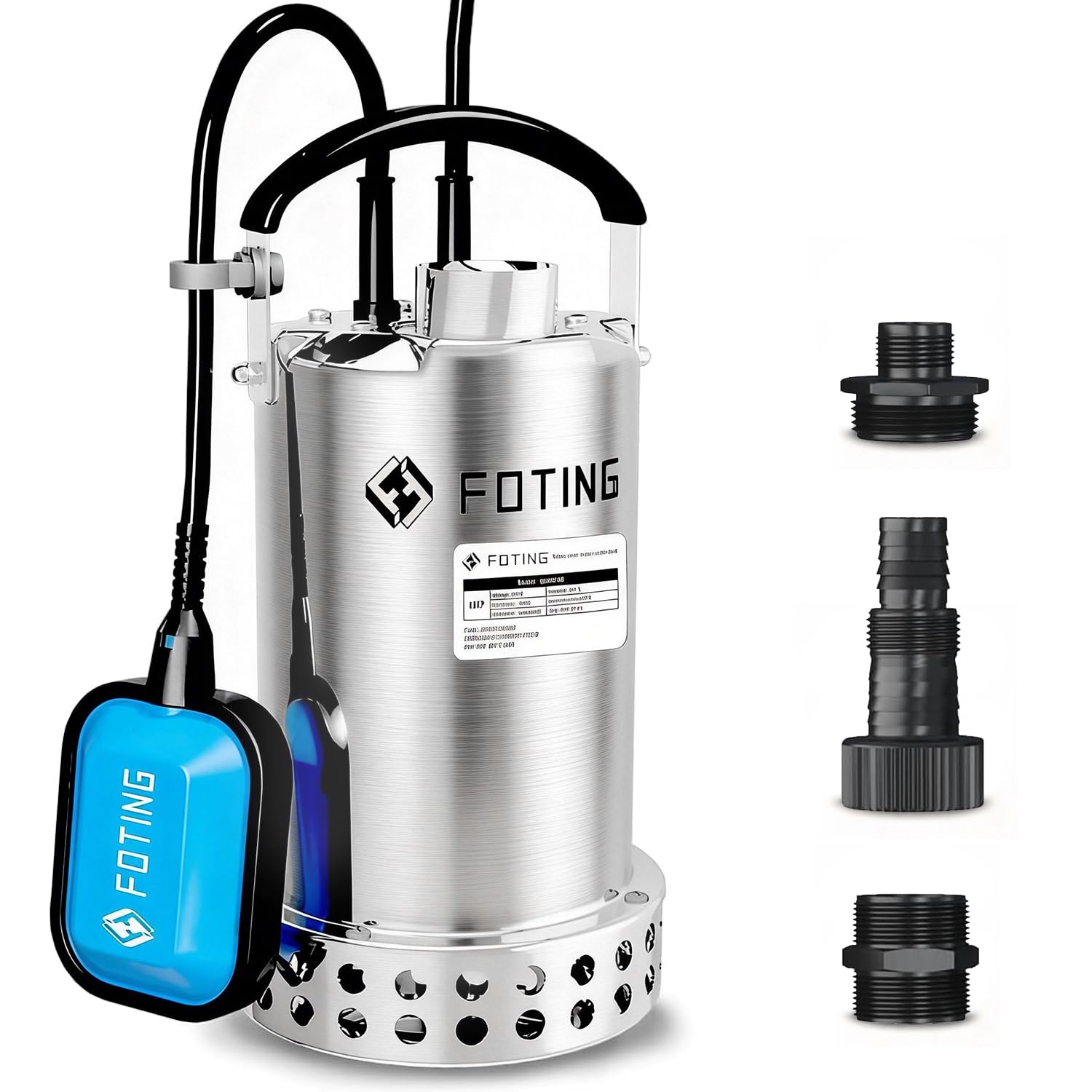
3. FOTING Full 304 Stainless Steel Sump Pump
High volume, low water line — it grabs water almost down to the floor.
The number that does the heavy lifting here is 4600 GPH, roughly 76 GPM of water leaving the room, combined with a suction floor of 0.43 inches. That means when the basin or the low corner of a flooded room drains, it drains nearly to the concrete. The full 304 stainless steel housing and pump base help shed motor heat during long jobs, and a thermal overload cutout protects the motor if it gets pushed too far.
The automatic float switch starts the pump once water rises above 7 inches and stops it below 1-1/2 inches, so it can sit in a sump pit and handle the job on its own. There is also a manual mode — lock the float in its bracket and the unit runs continuously, which is useful when you need it to keep pulling or when you want to avoid dry running. The top discharge design lets it slide into a narrow pit, and the double-deck suction holes on the base let it pass solids up to 2/5 inch.
Raw performance is where this pump shines — emptying a 275-gallon hot tub in 15 minutes is the job buyers bring up. It moves more water than the manual Green Expert below, which pushes 4000 GPH (gallons per hour) with no float switch at all. Reliability is the most-discussed topic and it cuts both ways: plenty of buyers keep one running perfectly for months and buy a second as a backup, while a few report a unit that tripped a breaker or quit early.
One thing to plan for: the float mechanism is a little finicky to get positioned right on first setup, so allow a few minutes to dial it in. Once set, it does the rest.
The case for it
- 4600 GPH moves serious volume fast, so a big basin or a flooded room clears quickly
- Drains down to 0.43 inches, leaving almost no standing water behind
- Automatic float plus a lockable manual mode covers both unattended and supervised jobs
- Full 304 stainless housing with thermal overload protection takes long duty without overheating
Know before you buy
- Reliability is genuinely mixed — quality control on these can vary
- The float switch takes patience to position correctly at first
- It needs water around it; dry running is what kills it
Best for: sump basins, flooded rooms, and hot tubs where you want the fastest possible drain and automatic control.
Worth knowing: if you want zero fiddling and rock-solid consistency, weigh that against the mixed durability reports.
4. Green Expert 1HP Submersible Sump Pump
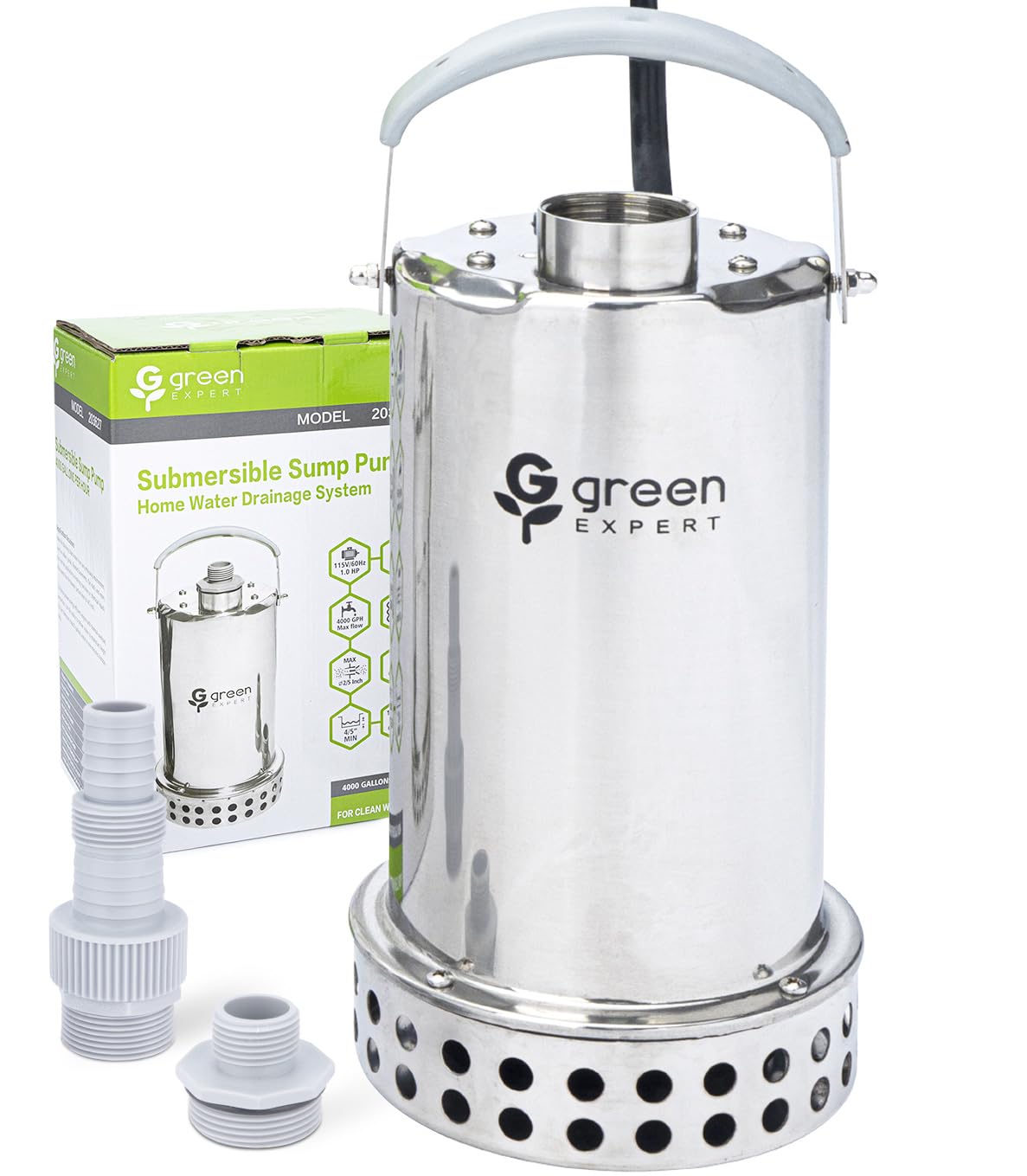
You flip the switch, it does the work — no float to argue with.
This is the pump for people who want to be standing there when it runs. There is no float switch, so it starts the instant it has power and keeps going until you cut it. That makes it ideal for supervised draining — an in-ground pool, a water tank, a flooded pit you are watching. At 4000 GPH and a maximum lift of 32 feet, it has the volume to clear a real pool, and the 6-inch cylindrical body with top discharge slips into tight wells and pits.
The build is the part people linger on. A full 304 stainless steel body and base resist rust and help move motor heat away during long drainage sessions. The rated 1 HP oil-free motor avoids pump-oil contamination, and thermal overload protection keeps it from cooking itself if the load gets heavy. A 16.5 ft black lifting rope is included, which is a thoughtful touch given the unit weighs 5.1 kg — you lower it by the rope, not by the cord. Double-layer multi-hole intake lets it handle leaves and pebbles, and it will run down to about 1 inch of water, or 0.8 inch in ideal conditions.
What sells the design is quiet, smooth operation — it moves water quickly and does it without a racket. The stainless construction gets the most praise by far, turning up in buyer after buyer. The honest trade-off is durability and that is reflected in the mix of feedback: some owners drain pools and basements for months without trouble, while a small number see one fail early. There is also no float, so it will not protect itself from dry running — that is on you. And one practical note: the base measures closer to 7 inches than the stated 6, so measure your pit or tank opening before you commit.
Why it appeals: precise, hands-on control plus a genuine all-stainless build at a mid-range tier — no float to fail, no oil to suspect.
The catch to weigh: without a float switch, the pump offers no protection from dry running, and durability feedback is mixed.
Pick it if: you want manual control, a durable stainless body, and a rope to haul it in and out of a narrow pit.
Pass if: you need a pump that turns itself on and off without you in the room.
5. LANCHEZ 1HP 6600 GPH Submersible Sewage Pump
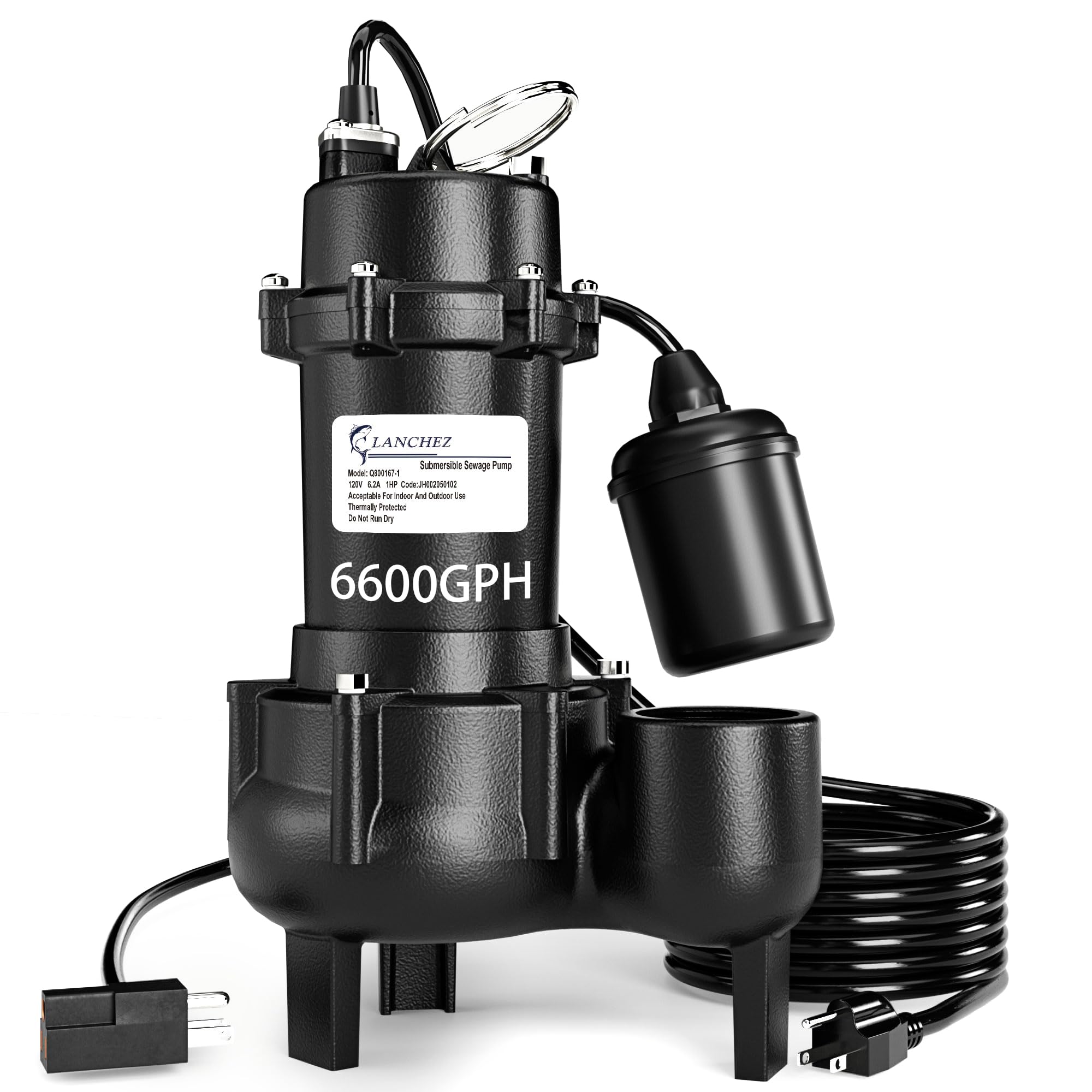
Cast iron and 6600 GPH — this one is built for volume and for staying put.
When the job is a basement filling with ground water or a sump basin that has to empty fast, flow is everything, and this pump delivers 6600 GPH at zero feet of height. Even at 5 feet of lift it still pushes 5,644 gallons per hour. The ceiling on how high it can throw water is 27 feet, driven by a 1 HP PSC copper motor that runs efficiently and quietly. A piggyback tethered float switch turns it on and off as the water level in the basin changes, and the float length is adjustable to your setup.
The body is cast iron, which is why this pump has a heavy, planted feel — the reinforced casing resists corrosion and helps dissipate motor heat. Thermal overload protection cuts the motor if it starts running dry. It carries a 2 inch NPT discharge for high-capacity pumping, a 10ft grounded waterproof cord, and a portable handle for lowering it into place. The manufacturer backs it with 3 years of technical support, longer than most pumps in this price tier.
Owners keep coming back to quality and quiet operation — heavy-duty construction that sits still in the water and a motor that does not announce itself. Performance is the most-discussed topic overall, and it goes both ways: some report a pump that clears a sump hole fast and keeps going for a year, while a few see one quit after a few minutes of running. The heavy cast-iron frame tips and settles like a substantial object, and the small key-ring style handle digs into your hand if you carry it by hand. Set it by the handle only for short moves, and lower it with the cord kept clear.
One more practical note: on some units the automatic start relies on the float buoy sitting fully vertical, so make sure nothing in the basin leans against the float. That single setup detail accounts for a lot of the “it won’t start” frustration.
Strong points
- 6600 GPH at 0 feet and 5,644 GPH at 5 feet of lift — real high-volume capability
- Cast iron casing with thermal overload protection handles tough sump duty
- 2 inch NPT discharge and a 10ft grounded cord make for a clean install
- Adjustable tethered float switch lets you set the on/off water levels
Real-world gripes
- Performance reports are mixed — a few units have quit early
- Heavy enough that lifting it out of a basin is a two-hand job
- The float has to sit fully vertical or the pump will not auto-start
The one for you if: you need maximum gallons per hour and want cast-iron durability doing the heavy lifting in a basement or sump basin.
Second thoughts if: you have a shallow, occasionally dry basin — repeated dry running is the one thing that will end this pump early.
6. WASSERMANN 1HP 4″ Aerobic Septic Effluent Pump

Purpose-built for pulling clarified effluent out of a septic tank and uphill to the drain field.
Not every 1 HP pump is meant to move dirty floodwater, and this one is deliberately not. It is designed as a submersible septic pump, moving clarified effluent from aerobic treatment systems to the final discharge point, including septic sprinkler setups. Its maximum lifting height is 207 feet with 115V power, and the 32 GPM flow rate is steady and pressure-friendly rather than gushing. For an aerobic system that has to push effluent up a slope to a sprinkler head, that head number is the whole reason to buy it.
The 4-inch submersible design fits 4-inch well casings and larger openings while keeping a long, narrow profile for submerged installation. The 1-1/4 inch FNPT discharge gives you a standard threaded outlet. A bottom suction configuration draws from lower tank levels, while a stainless steel intake screen keeps larger debris out of the pump. The hermetically sealed motor includes thermal overload protection and a built-in capacitor start, which help it start reliably and run for the long haul. A 33 ft cable is part of the package.
Easy installation is the recurring theme in the feedback, and the performance is described as genuinely capable — handling three large irrigation stations is the kind of load people mention. The value side is real too: a buyer replacing a failed septic pump noted it was far less expensive than paying a service to swap one out, and that the job was not hard to do. The honest wrinkle is that reliability is not guaranteed forever — a small number of owners have had one fail early, in one case with water finding its way into the motor through the cable seal. Worth adding an extra bead of sealant or checking that fitting during install, and it is note the company was quick to send replacements in those cases. Given how specific this pump’s job is, if you do not own an aerobic septic system, this is simply the wrong tool — a sump or grinder is what you want instead.
What it does best: delivers effluent pumping where a standard sump pump cannot, thanks to 207 feet of head and a bottom suction that drains the tank down.
One caution: a rare unit has taken on water through the cable seal, so it is worth checking that connection on install.
Right for: aerobic septic system owners who need to move clarified effluent uphill to a drain field or sprinkler zone.
Wrong for: anyone trying to clear muddy floodwater or heavy solids — that is a sump or grinder job.
7. Aquastrong 1 HP Sewage Grinder Pump

The one that shreds the stuff that clogs everything else.
Most pumps choke on wipes and twigs. This one is built to eat them. Stainless steel blades cut through soft and semi-rigid debris — wipes, twigs, zip ties — before it can jam the flow, and a 2 inch discharge lets it pass solids up to 2 inches straight through. That is the difference between a pump you have to unclog and a pump you forget about. Flow is 4200 GPH with a maximum lift of 40 feet, powered by 115V single-phase electricity.
The adjustable float switch gives it automatic or manual operation, so you can let it cycle with the water level or run it continuously. It is rated for basement sump basins and sewage ejector systems, with a two-year warranty. One important rule from the manufacturer: always fully immerse the pump before starting, and always lift it by the handle rather than the power cord. In cold weather, shorten the float cable to keep it from freezing.
How well it handles a dirty, thankless job is what gets people talking. Build quality feels solid, and owners say it far outperforms what they expected — one is used in a tank serving a 13-unit mobile home park with 13 units feeding it, which is a lot of volume for one pump. The reliability picture is split, and that is worth naming honestly: most owners keep it running for years, while a few have had one stop working or a float switch that would not trigger on first install. For a sewage pump the float is what makes it automatic, so make sure it can swing freely and is not sitting against the tank wall.
One constraint to respect: never use it in gasoline, alcohol, or biogas tanks, and avoid feeding it rubber items or thick towels — the blades are for soft and semi-rigid debris, not everything.
What it handles
- Stainless steel blades shred wipes, twigs, and zip ties to prevent clogs
- 2 inch discharge passes solids up to 2 inches for smooth drainage
- Adjustable float switch enables automatic or manual operation
- 40-foot maximum lift handles the ejector pump layout of a basement
Worth knowing
- It needs to be fully immersed before every start
- The float must swing freely or the pump will not kick on automatically
- Not for gasoline, alcohol, or biogas tanks, and not for rubber or thick towels
Pick it if: you want a grinder pump that turns wipe-and-debris clogs into a non-event in a basement ejector or sump setup.
Skip if: your pit regularly empties to dry or your debris includes rubber or heavy cloth the blades are not designed to cut.
8. Multiquip ST2040T Electric Submersible Trash Pump

A job-site trash pump that went into a flooded basement and came out a neighborhood hero.
This is the heavy one — 36.3 pounds of cast iron on a 10.3-inch by 16.8-inch frame. If the picture forming in your head is a construction site, you are close. It moves 79 GPM with a 40-foot maximum lift on 115V, and it has a 2 inch suction and discharge so mud, sediment, and debris pass through without choking it. It is built to run long stretches without overheating, which is exactly what a trash pump needs to do.
Nowhere is that more useful than a fresh flood. Owners mention clearing a full foot of water out of a neighbor’s large farmhouse basement in under 1.5 hours, and one owner noted 14 days of straight pumping around the clock — never missed a beat. That is not a one-off; the performance and raw pumping power of this unit come up more than anything else, with its speed and heavy-duty build close behind. When you are staring at a flooded foundation and a furnace you would like to save, 79 GPM of cast-iron reliability is worth the haul.
The trade-off is straightforward and totally predictable. It is heavier and pricier than the plastic-bodied pumps, and there are no casters — you carry it where it needs to go. It also lacks a built-in float switch, so you supply your own if you want unattended operation. But if your work involves mud, muck, and moss, this pump earns its keep; one owner reported pulling water for two weeks straight without a hiccup. The setup is simple — two-inch discharge, single-phase power — with a tight NPT adapter fit that occasionally needs a little coaxing.
What makes it worth the weight: 79 GPM of cast-iron trash pumping that can move mud and debris without clogging, for hours on end.
The honest downside: heavier and costlier than basic pumps, and it has no float switch, so unattended operation needs an add-on.
Best suited to: job-site drainage, flooded foundations, and any muddy water situation where clogging is the enemy.
Think twice if: you are looking for a light, low-cost pump for a clean sump basin — the weight and price are the price of durability here.
9. Red Lion RL22G10-3W2V Submersible Well Pump
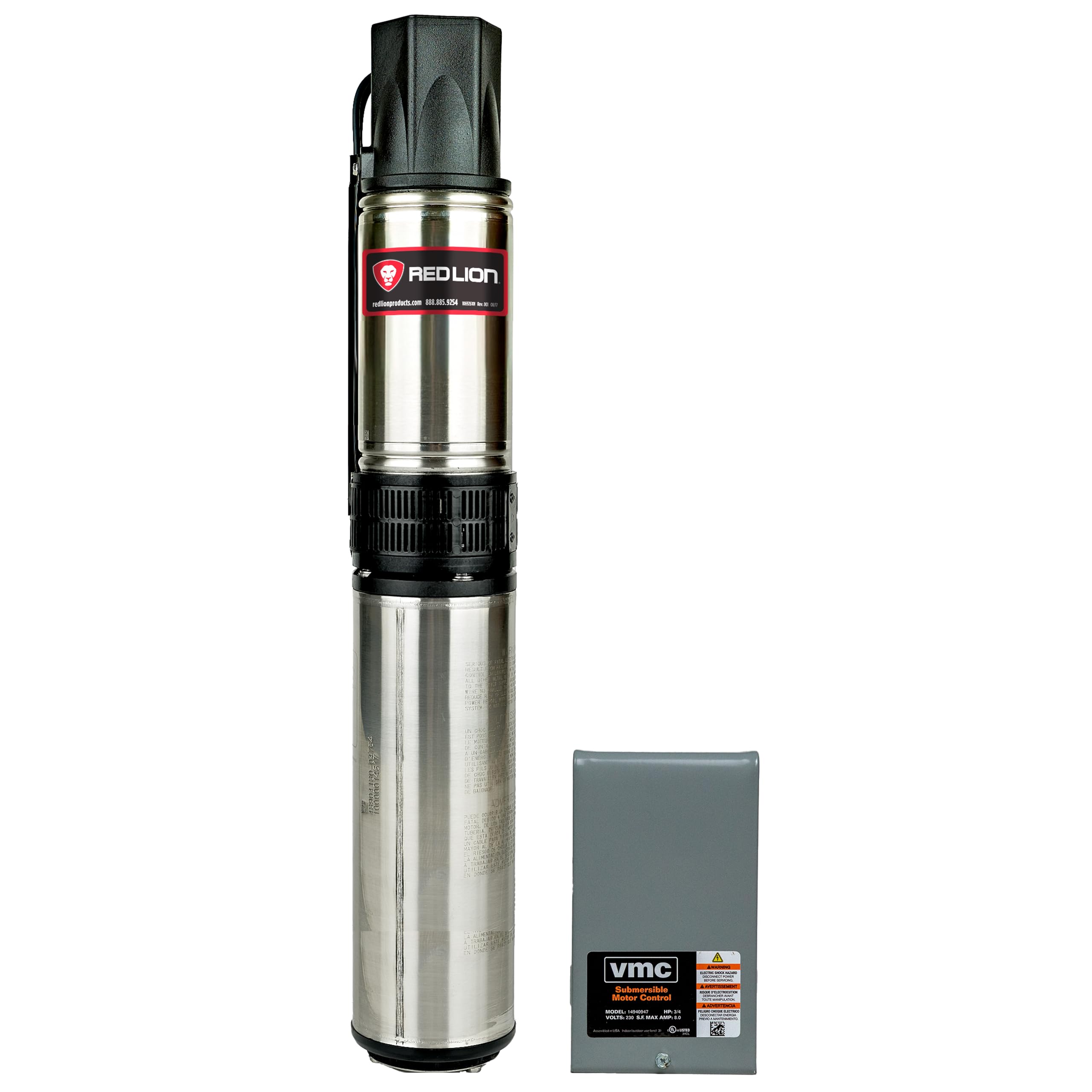
A well pump you drop for good, not one you swap by the season.
This is the deep-well specialist, and it targets a specific buyer: someone pulling drinking water from a 4-inch driven well and needs NSF/ANSI 372 certification for potable water. The pump body is 3.9 inches in diameter to slide into that casing, and it runs on 230V three-wire power with 10.4 running amps. Rated output is 22 GPM at 30 PSI at a depth of 80 feet, with a 260-foot shut-off, so shallow-to-mid-depth wells with real pumping demand are squarely in its lane. At 30 pounds it is not a light piece of equipment, and that weight reflects the stainless housing and motor internals that are meant to stay submerged for years.
The built-ins make it a complete package: a check valve to stop rapid cycling (the pump turning on and off quickly), a suction screen to keep debris out of the impellers (the spinning parts that move water), and an included control box — a branded 1 HP, 0.75 KW, 230V, enclosure 3-rated unit UL listed in both Canada and the USA. The 48-inch lead wires are already attached, and a wire splice kit is in the box, so you are not hunting for parts mid-install. A 1-1/4 inch FNPT discharge gives you a standard threaded outlet.
Longevity is the real story here. One buyer updated after a decade of service running roughly 12 hours a week with no problems. Customers note strong, steady pressure, with one setup filling a 2,000-gallon tank 340 feet uphill. The honest catch is durability: a small number report a pump failing early, and in those cases pull-out and reinstall is difficult and costly. That is why getting this right the first time matters — the working assumption is a 3-wire, 230V setup, so your existing wiring needs to match, and the low-pressure, high-volume nature of this model means it works best in shallower wells, not very deep ones. One owner’s note is worth keeping in mind: it performed flawlessly for a year before shutting off intermittently, so the coverage of the included 3-year warranty matters.
Built-in advantages
- NSF/ANSI 372 certified for potable water, which most deep-well pumps skip
- Built-in check valve prevents rapid cycling and extends motor life
- Control box included with the pump, plus a wire splice kit and manual
- 1-1/4 inch FNPT discharge matches standard well plumbing
Plan for these
- Requires 230V 3-wire wiring, so your current setup may need changes
- Designed for shallow-to-mid wells, not the deepest ones
- Durability is mixed, and pulling a failed pump is a real job
Best for: deep well owners who want certified potable-water pumping with the control box and valve work already handled.
Reconsider if: your well is very deep or your electrical setup is 115V, because this pump is built for 230V three-wire systems.
Know the Specs
Maximum Head (Feet)
Maximum head is how high a pump can lift water, written in feet, and it is the most important number for any well or uphill job. A pump with a short head rating cannot push water up a long vertical run no matter how strong its motor is. Match the head rating to your tallest lift with some room to spare.
Flow Rate (GPM or GPH)
Flow rate is how much water moves per minute or per hour. High flow clears a flooded floor fast, while a lower, steadier flow suits filling a tank or feeding sprinklers. Horsepower sets the ceiling on what a pump can do, but flow rate and head tell you what it will actually deliver at your job.
Float Switch vs. Manual
A float switch turns the pump on when water rises and off when it drops, so you can walk away. A manual pump runs on power alone, so you decide when it starts and stops. Some pumps offer both — an adjustable float for hands-off duty and a lockable manual mode for supervised draining.
Solids Handling
Solids handling is the largest particle a pump can pass without clogging, given in fractions of an inch. Pumps with wider discharge ports and bigger solids gaps handle dirtier water, while clean-water pumps move water with less internal wear. Match the solids rating to your water’s debris.
Voltage and Wiring
Voltage determines the wiring you need. Some pumps run on standard 115V household power, while others require 230V. A 3-wire pump uses an external control box for starting, while 2-wire pumps typically start on their own. Check your circuit before you buy.
Cord Length and Discharge Size
Cord length tells you how far the plug can reach from the water, and discharge size determines which hose or pipe fits without adapters. A longer cord and standard threaded discharge save a trip to the hardware store on install day.
Common Questions
What size discharge do I need for a 1 HP submersible pump?
Can I leave a 1 HP submersible pump running unattended?
What happens if a submersible pump runs dry?
Will a 1 HP pump fit my well casing?
Can I run these pumps on a generator or inverter?
What is the difference between a sump pump and a well pump?
How much head do I need for my job?
Do these pumps handle debris and solids?
How long does a 1 HP submersible pump typically last?
Which pump is best for a flooded basement?
The Bottom Line
For most people, the 1 hp submersible pump winner is the VEVOR Deep Well Submersible Pump because it pairs 207 feet of maximum head with 37 GPM of flow from a stainless steel, IP68-rated body (sealed against dust and water) — the lift needed for deep wells, hillside irrigation, and long uphill runs. If you want unattended operation under a pool cover or on a wet basement floor, grab the AgiiMan Automatic Pool Cover Pump, which wakes at 5/8 inch of water and shuts itself off. And for clearing a flooded basement or sump basin as fast as possible, the LANCHEZ Sewage Pump at 6600 GPH is the one to reach for. The VEVOR earns the top spot on 4.5+ stars across 500+ ratings, the strongest signal here that the design holds up in real wells.
How we choose
We do not accept paid placement. Every pick is matched to a real buyer and a real use-case; we do not hands-on test units.
Sources
Specifications: manufacturer listings and product documentation. Review insights: verified customer reviews, as of October 2026. Pricing: not shown on this page (it changes often); check the current price via the retailer link.
As an Amazon Associate, Aappliancez earns from qualifying purchases. This does not affect which products we feature.