Disclosure: Some links in this post are affiliate links. As an Amazon Associate I earn from qualifying purchases, at no extra cost to you. Learn more
Specs are compiled from manufacturer listings and verified buyer reviews and can change over time — please confirm the key details on the product page before buying.
If your campground water smells like a pool and tastes faintly of minerals, the fix is not a bigger carbon cartridge — it is a tighter pore size. A 0.2 micron water filter screens out particles down to two-tenths of a micrometer, which is the size range where cysts, sediment fines, and the gunk that ruins taste actually live. The picks below cover every budget and every rig, from a twin-pack of drop-in cartridges to full stainless three-stage systems.
This guide is built by comparing the manufacturers’ published specifications and the patterns across verified customer reviews, so you get each pick’s real strengths and trade-offs instead of marketing spin.
You will see which housings fit standard plumbing, which cartridges clog fast on iron-heavy well water, and where a thread leak is likely to show up first. Here is the honest shortlist of the best 0.2 Micron Water Filter options for RV, van, and whole-house use.
Top Picks


How To Choose The Best 0.2 Micron Water Filter
Pore size gets all the attention, but the number you will actually feel every day is flow rate. A cartridge that screens down to 0.2 microns but chokes your shower to a trickle is a filter you will stop using. The trick is matching the micron rating to the housing and to how much water you move.
Absolute versus nominal ratings
An absolute rating means the filter stops essentially everything larger than the stated pore size. A nominal rating is looser — it describes an average, so some particles slip past. The Clearsource cartridge states an absolute 0.2 micron rating, which is why it is described as hospital grade. When you compare filters, ask which type of rating the maker is quoting, because the same “0.2 micron” label can mean very different real-world protection.
Match the cartridge to your canister
Cartridges come in two common footprints. A 2.5-inch by 5-inch cartridge drops into compact RV canisters and small systems. A 2.5-inch by 10-inch cartridge is the standard whole-house sediment size, so it slots into bigger housings and under-sink units. Measure your existing housing before you buy a replacement, because a five-inch cartridge will not seal in a ten-inch canister.
Flow rate and pressure drop
Tighter pores restrict water more, so makers fight back with pleated media and evenly distributed pores. The Blu Tech cartridges use a pleated polypropylene membrane designed to let water pass with no big pressure drop. Systems with a stated maximum flow rate — like the WLSINJL at 20 GPM — are built to keep up with filling a fresh tank fast. A system rated at 4 GPM will fill more slowly but still serve a faucet fine.
Sediment first, carbon second
A sediment pre-filter catches dirt, sand, and rust before they reach the finer stages. That extends the life of the expensive cartridges behind it. Read the stage order carefully, because some systems stack a coarse sediment filter in front and a tight 0.2 micron cartridge behind, while a single composite cartridge does both jobs in one body. The composite route saves space; the staged route saves cartridges.
Side-by-Side Comparison
| Model | Best For | Micron Rating | Filter Life | Stages | Amazon |
|---|---|---|---|---|---|
| Clearsource Replacement Filter Twin Pack★ Best Overall | Stationary campers and long-stay rigs | 0.2 micron absolute | Annual replacement | 2-stage carbon block | Amazon |
| Glacier Fresh GFRVWP03 3-Stage SystemTop Performer | Full-time RVers who want best taste | 0.2 micron | 3-4 months per set | 3-stage | Amazon |
| WLSINJL 5-Stage RV Filtration SystemBiggest Capacity | Fast tank fills and hard water | 0.01 micron | 6 months | 5-stage | Amazon |
| Virus Hero 3 Stage RV System | Questionable water sources and boil notices | 0.2 micron | Up to 6000 gallons | 3-stage | Amazon |
| GoBluTech AR3 | Compact setups and tight wet bays | 0.2 micron | 12 weeks | 3-stage | Amazon |
| Glacier Fresh Replacement Filter Set | Owners already running a GFRVWP03 | 0.2 micron | 7+ months observed | 3-stage cartridge set | Amazon |
| Blu Tech 10 Inch High Flow 2 Pack | Standard 10-inch housings | 0.2 micron | 2-4 months | Pleated membrane | Amazon |
| Blu Tech 5-Inch High Flow 2 Pack | Compact RV canisters | 0.2 micron | 2-4 months | Pleated membrane | Amazon |
| GoBluTech Trio | Permanent stainless installs | 0.2 micron | — | 3-stage | Amazon |
| HHB10 RV Water Filter System | Van storage and portable setups | 0.2 micron composite | Cartridge swap | 2-in-1 composite | Amazon |
| Glacier Source 3-Stage Premium | Portable RV and boat use | 0.2 micron | 4 months | 3-stage | Amazon |
Detailed Reviews
1. Clearsource Replacement Filter Twin Pack
Our pick — 4.5+★ from 250+ verified ratings; the strongest balance of quality and price.
Two fat carbon blocks that strip a creek down to drinking water.
This is the pick for the camper that stays put. Each cartridge is a 5 micron coconut shell carbon block wrapped around a 0.2 micron absolute membrane, and the set is built to handle real sediment rather than just polish clear city water. The housing footprint is genuinely large — 3 inches deep, 6 inches wide, and 11 inches tall — so plan shelf or bay space before it arrives.
The 0.2 micron absolute stage is rated to remove bacteria such as E. coli and Legionella, cysts like Giardia, viruses, heavy metals including lead and mercury, petrochemicals, and trace pharmaceuticals. That is a very different job than a basic inline filter, which mostly just takes the chlorine edge off. If you draw from a well, a creek, or a suspect spigot, the extra stage is the whole point.
What wins owners over is build quality, and the field reports back it up — campers running sand-filtered well water describe filtration well beyond ordinary in-line cartridges, with sediment and clog-causing debris handled season after season. As buyers put it: “Good tasting water!
Where it pulls ahead
- Absolute 0.2 micron rating — the tighter, more meaningful standard
- Handles sediment-heavy well and creek water without choking
- NSF external testing certification listed on the spec sheet
- Season-long service in low-use stationary setups
What to weigh first
- Big 3″D x 6″W x 11″H body needs dedicated space
- Fresh cartridges may carry a faint chlorine note for the first couple of days
- Priced above simple carbon replacements
Made for: campers hooked to well or surface water who want the finest pore size available.
Think twice if: you break camp weekly — the bulk is meant for a stationary install, not daily hauling.
2. Glacier Fresh GFRVWP03 3-Stage RV Water Filtration System
The three-stage veteran that full-timers keep coming back to.
Three cartridges do three jobs here. A sediment filter catches the big debris, a charcoal and coconut shell carbon filter fixes flavour, and a 0.2 micron high-flow cartridge takes the sub-micron particles out. Stainless steel garden hose quick connects thread onto city or well water at any campground, and the compact 5-inch filters ride in an ultra-lightweight polycarbonate carbon-fiber frame. Working range is 40°F to 125°F.
Against the Clearsource twin pack, this system carries a full stage count rather than two absolute 0.2 micron blocks. That makes it more flexible for campground variability but slightly less targeted on the absolute pore size. The maker recommends inlet pressure between 0.4 MPa and 0.8 MPa, and specifically advises filling your fresh tank rather than hard-plumbing the unit inline with your interior water lines.
Full-timers report the taste edges out several other systems, with a set of filters lasting seven months in one four-year RVer’s log — notably longer than the three to four months the maker suggests. The recurring gripe is the connectors: the inlet and outlet can weep, and the weeping gets worse above 80 psi. The fix owners find is extra thread tape and finger-tight only, since over-tightening distorts the rubber seal. A hard-plumbed owner also notes tank fills run much slower through it, and heavy-iron park water clogged the filters inside two days.
Why it keeps winning: three stages give you a sediment buffer before the fine cartridge, so a muddy campground source does not instantly ruin the pricey stage.
Where it asks patience: budget for a roll of thread tape and expect a slower tank fill — the fine pores are earned, and that cost shows up in flow.
Reach for this if: you want proven campground flavour and can live with a careful hand on the fittings.
Look elsewhere if: you run high-pressure parks — above 80 psi the seals want more attention than some owners want to give.
3. WLSINJL 5-Stage RV Water Filtration System
Five stages and a 3000-gallon capacity that keeps up with hard water.
Here is the spec that matters on this build: 3000 gallons of capacity before the flow chokes, plus a tested flow rate of 20 GPM (gallons per minute — how fast water moves through the system). That means a fresh tank fills in a hurry instead of dribbling through the fine stages. It is rated down to 40°F, pressure-tested to 125 psi, and built around a food-grade housing with a detachable handle for carrying.
Five stages go after sediment, chlorine, VOCs (volatile organic compounds — the solvents and chemical smells that can ride along in tap water), heavy metals, and odours, and the finest stage reaches down to 0.01 microns. That is tighter than the 0.2 micron cartridges on this list, which catches smaller particles but also fills up faster on dirty water. Cartridges here are meant to last a full camping season, which is a far longer service window than the four months some systems settle for.
What owners notice first is water quality — dishes come out without hard-water spots and the drinking water runs clear. Filtration performance and easy installation are the next things that come up most, and a reviewer on well water reports the bad taste and smell vanish. The real trade-off is size and setup: the housing measures 17 inches long by 7 inches wide by 16 inches tall, so it wants a bay or a mounting spot, and it ships with the wrench, O-ring, tape, brass threads, and adapters you need for 1-inch or 3/4-inch plumbing.
Arguments for this one
- 3000-gallon capacity before clogging
- 20 GPM tested flow rate keeps tank fills quick
- Six-month filter life cycle, one season of camping per set
- Pressure-tested to 125 psi with food-grade housing
Honest counterweights
- Large 17″L x 7″W x 16″H housing needs dedicated space
- 0.01 micron stage clogs faster on very dirty sources
- Cost lands near the top of the mid range
Best for: high-volume rigs that pour tank fills fast and want a full season between cartridge swaps.
Skip if: you want something you can toss in a tote — this housing is a mount-it-and-leave-it piece.
4. Virus Hero 3 Stage RV Water Filter System

Built for the “is this water even safe?” stop on the map.
Three 10-inch housings stack a 1 micron sediment filter, the 0.2 micron Virus Hero cartridge, and a 0.5 micron carbon block. The middle filter is NSF certified and rated to reduce or remove viruses, bacteria, and other waterborne pathogens, which is why it beats a taste-only carbon stage at an unknown spigot. The metal trap stage reduces iron, sulfur, lead, and magnesium for up to 6000 gallons; the carbon block handles chlorine, PFAS, VOCs, and pesticides.
Where the Glacier Fresh system above is tuned for flavour and daily campground water, this one is tuned for worry. Its 6000-gallon metal-reduction capacity is the longest on this list, and the 4 GPM maximum flow rate is the trade: safer water arrives more slowly. The kit ships with three housings, a mounting bracket, the cartridge set, and a canister wrench, and it carries a limited lifetime warranty.
Owners use it across campers and hot tubs alike, and one practical heads-up comes through clearly: the unit ships with two filters installed and three replacements in the box, so check inside the housing before your first use. The setup is portable rather than plumbed, and the universal hose fittings make it a quick connection at camp. It is the pick for a boondocker who would rather carry a little less water and trust the tap.
The standout number: 6000 gallons of metal-reduction capacity, the longest of any metal-rated system here.
What you give up: 4 GPM is the slowest stated flow on this list, so plan your fills around it and check that a filter is seated in each housing before you connect.
Pick it when: water quality at your stops is a genuine question mark and pathogen reduction matters more than fill speed.
Pass if: you mostly hook to clean municipal water and want maximum flow — the fine stages here slow you down on purpose.
5. GoBluTech AR3 RV Water Filter System
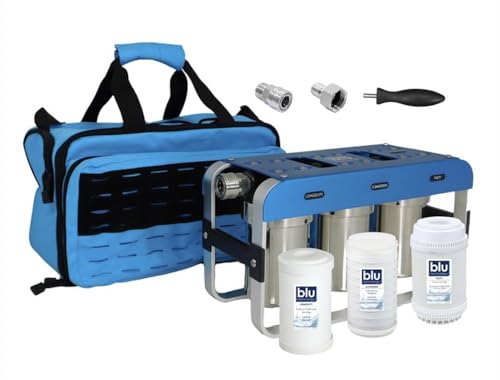
Compact 5-inch filters and a 9.6 lb frame that stows in a wet bay.
The AR3 puts the 0.2 micron high-flow filter to work alongside a charcoal and coconut shell carbon stage and a sediment pre-filter. Stainless steel garden hose quick connects thread straight onto city or well water, and the maker states there is no significant pressure drop with the high-flow cartridges. The frame is polycarbonate carbon fiber, it weighs 9.6 pounds, and it runs from 40°F to 125°F.
Here is the direct comparison you came for: the AR3 and the Glacier Fresh GFRVWP03 are near twins on paper — same three-stage layout, same compact 5-inch filters, same quick connects. The AR3 lists a 12-week filter life cycle, where Glacier Fresh suggests three to four months per set, so the Glacier Fresh stretches slightly longer between swaps. The AR3 earns its keep on portability and build: the carbon-fiber frame and stainless fittings feel more permanent than plain plastic.
Water quality is what owners talk about most, with ease of installation close behind. One full-timer removed a clunky tank-and-pump arrangement from an older Class C motorhome and reports the AR3 delivered excellent water in its place. Another pairs it with a water softener and describes a night-and-day jump over poor park water, noting the system is built in America and priced accordingly. The catch worth stating plainly: it lives outside, hangs on a bracket, and it is not the cheap option in this lineup.
What earns the bracket
- High-flow 0.2 micron cartridges with no stated pressure drop
- Compact carbon-fiber frame at 9.6 lb
- Stainless quick connects for fast hookups
- External mount keeps it out of tight interior space
What stays on your list
- 12-week filter life means more frequent swaps than some systems
- Priced in the premium tier with no domestic budget alternative
- Requires mounting hardware and an exterior spot
Fits best in: vans and Class C rigs where a wet-bay bracket beats a floor-standing tower.
Count the cost if: you want long service intervals — a 12-week life cycle keeps you buying cartridges more often.
6. Glacier Fresh Replacement Filter Set for GFRVWP03

The refresh kit for anyone already running the Glacier Fresh housing.
This is a cartridge set, not a new system. If you already own the GFRVWP03 three-stage housing, this is the swap that brings it back to life: a 0.2 micron high-flow cartridge, a charcoal and coconut shell carbon filter for taste, and a sediment filter to extend the life of the fine stage. The three-piece set ships with the GFRVWPR04 components and keeps your existing stainless quick-connect plumbing in place.
Because it drops into a system you own, the buying decision is simpler than picking a whole rig. You are replacing three parts, not rebuilding your water line, and the maker suggests three to four months per set. Two buyers report stretching well past that — a four-year RVer says a set lasted more than seven months of steady use, and finds the replacements cost less than competitor cartridges.
The connector caveat carries over from the parent system, so treat it as a handling note: extra thread tape and hand-tight-only connections keep the inlet and outlet seals happy, especially above 80 psi. A rare loose part on arrival shows up in the reviews too, worth a quick check before you install. Otherwise this is the low-drama way to keep a Glacier Fresh system running for another season.
Why owners stay loyal: taste holds up season after season and the per-cartridge cost lands below the competition.
Fitting note: these cartridges are cut for the GFRVWP03 housing — check your model number before ordering, because the same brand sells different footprints.
Best used by: current GFRVWP03 owners who want the exact replacement set the housing was designed around.
Don’t buy if: you do not already own a Glacier Fresh system — this is cartridges only, not a housing.
7. Blu Tech 10 Inch High Flow RV Water Filter, 2 Pack

Ten-inch pleats that slide into the housing you already own.
Two 10-inch cartridges, 2.5 inches across, designed to drop into any standard 10-inch canister built for the 2.5-inch by 10-inch footprint — RV housings, under-sink units, and whole-house sediment slots all take them. Each cartridge is a pleated polypropylene membrane with uniformly distributed pores, so the 0.2 micron rating comes without a big pressure drop. The maker rates life at two to four months.
The footprint is the differentiator. The 5-inch Blu Tech set below and this 10-inch set carry the same pleated membrane, but this one adds the extra pleat length of a full 10-inch body. That means more surface area before the pores load up, so a muddy, high-iron source has more room to clog before flow drops. Against the Glacier Fresh 3-pack, which ships three complete filter cartridges, this is a simpler two-pack of identical fine-membrane cartridges.
Owners consistently credit the pleated element for visible proof of work — the filter body lets you see the element so the dirt is right there when you pull it. The light-and-flimsy critique does appear, and it is fair to note: the cartridge weighs 16 ounces and feels lighter than a dense carbon block. Treat it as a fit-and-flow cartridge rather than a heavy-duty taste block, and the two-to-four-month swap schedule keeps it honest.
Where it shines
- Standard 2.5″ x 10″ size slots into most existing housings
- Pleated membrane keeps pressure steady
- Visible element shows how dirty the cartridge has become
- FDA listing on the spec sheet
Where it disappoints
- 16-ounce cartridge feels light compared with denser carbon blocks
- Two-to-four-month life means stocking spares
- No sediment pre-stage built into the cartridge itself
Right for: owners with a standard 10-inch housing who want a tight micron rating without adding a second canister.
Wrong for: anyone expecting a heavy carbon taste block — this is a pleated sediment-and-particulate cartridge.
8. Blu Tech 5-Inch High Flow RV Water Filter, 2 Pack

Five inches of pleated 0.2 micron media for tight canisters.
Compact systems have a cartridge problem: the small housings often take larger-pore media because a tight pleat would choke flow. Blu Tech answers that with a 2.5-inch by 5-inch pleated polypropylene cartridge rated to 0.2 microns. The maker points out that similar RV filters on the market use 0.5 micron or larger pores, so this half-size cartridge delivers a tighter screen in a small body.
Fit is where this set earns its keep. The cartridges are compatible with all Blu Technology 5-inch canisters and any standard 2.5-inch by 5-inch filter housing. If you run a compact RV canister or a whole-house-style smaller housing, these drop right in. The same pleated-membrane construction as the 10-inch version arrives here, and the life rating is the same two to four months.
Owners who have run them for a couple of years describe a reliable product they keep reordering. The visible element is a recurring plus — you can see the dirt and know when to swap. That same light-and-flimsy critique shows up on this set too, so set expectations: it is a pleated membrane, not a dense carbon block. One owner notes these filters hold up better than the originals that shipped with an RV filtration system, and calls the customer service excellent.
Best proof of value: a 0.2 micron rating in a 2.5″ x 5″ body, where competitors use 0.5 micron or larger.
Worth knowing: 16 ounces and pleated means it will feel light in the hand — check the housing seal and cartridge seating, not the heft.
Choose it for: a compact RV canister that needs a genuine sub-micron pleat without losing flow.
Not the one if: you run a full 10-inch housing — the 10-inch Blu Tech pack is the correct size.
9. GoBluTech Trio RV Water Filter System
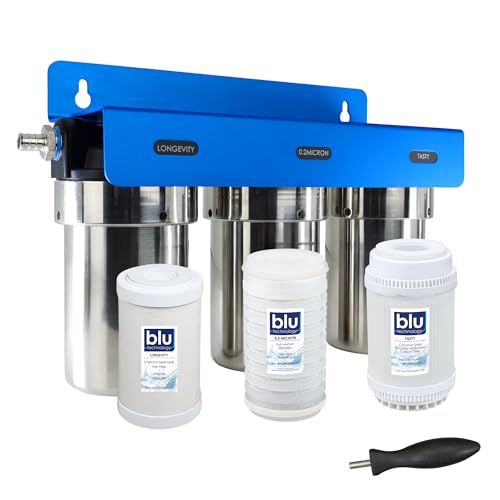
A stainless three-stage tower that lives outside without complaint.
Three-stage sedimentation filtration in stainless steel housings, with the filters already installed and a filter housing key in the box. The Trio is built for mounted installation at the city water inlet, so you plumb it once and every fixture downstream draws filtered water. Dimensions run 13 inches long by 4.5 inches wide by 9.5 inches tall, it is rated down to 40°F, and the maker lists a capacity of 1000 gallons per day alongside a 1000 liters-per-day maximum flow rate.
The stainless build is the story. Unlike the plastic-framed Glacier Fresh and Glacier Source towers, this one is meant to sit outside or in a wet bay without rust or UV worry, and owners say it feels built rather than cheaply molded. That is also why it costs more, and why it suits a rig that stays connected rather than a weekend camper who unpacks the gear each trip.
The biggest practical caution in the reviews is packaging: at this tier, a beat-up box on arrival is frustrating, and it is worth checking the unit carefully the day it lands. On the water side, installs are reported as straightforward with screws and PEX plumbing, and the taste is largely well received. One household has a dissenting palate — a spouse who dislikes some bottled brands just does not care for the output either. Replacement cartridges are bought from the vendor or its affiliates rather than from the general listing.
The case for going stainless
- Stainless steel housings survive exterior and wet-bay mounting
- Filters arrive pre-installed with the housing key included
- Plumbs in at the city inlet and feeds every fixture
- Mounted install, not a floor tower in your storage bay
The follow-up questions
- Replacement cartridges come from the vendor, not general retail
- One household reports the taste did not suit everyone at home
- Premium-tier cost for the stainless build
Worth it for: a full-timer who wants a permanent, stainless, plumbed-in filtration spot at the inlet.
Second-guess it if: you move rigs often or want to buy refills from the same place you bought the system.
10. HHB10 RV Water Filter System

Dual-layer cartridge and a 10″x4.5″ housing you can carry by the handle.
Two layers do the work of a multi-stage rig. The outer pleated polyester layer screens down to 0.2 microns, and the inner activated carbon layer handles 5 micron filtration for sand, rust, chlorine, VOCs, certain heavy metals, and odours. The blue housing is reinforced polypropylene, measuring 10 inches by 4.5 inches, rated for outdoor use and built food-grade, lead-free, and BPA-free. A detachable handle makes it carriable from the van to the spigot.
The composite cartridge is the smartest bit of engineering in this budget tier — you do not need a second canister because the sediment and carbon jobs share one cartridge body. Plumbing is simple: it attaches to 3/4-inch standard garden hose fittings with no pro tools required, and the kit includes the housing, handle, 1-inch NPT to 3/4-inch GHT adapter, thread tape, wrench, and manual.
Owners stretch the limits and report back. One van owner says it cleared a brown, high-iron well water where small inline RV filters failed. Another notes that the 0.2 micron pleat catches sediment and many bacteria, but is not a virus purifier — an honest read worth repeating. The kit’s only real wish-list item is a silicone O-ring lube, which is not included. Storage-wise it runs large for a van but still fits with planning.
Standout spec: 0.2 micron pleated polyester outside, 5 micron carbon inside — two filter stages in one 10″ x 4.5″ housing.
Honest limit: this is a bacteria and sediment filter, not a virus-certified purifier, so do not treat it as a substitute for the Virus Hero above.
Good fit for: van and camper builds that want one compact canister instead of three housings.
Look elsewhere if: you need certified virus reduction — the composite pleat handles bacteria, not full pathogen removal.
11. Glacier Source 3-Stage RV Water Filter System

The lowest-cost way into a full three-stage stainless frame.
This one starts low and stays honest. A 5 micron sediment filter takes rust and debris first, then a coconut shell carbon stage improves taste and cuts chlorine, then a 0.2 micron cartridge deals with sub-micron particles. Stainless steel garden hose connects handle campground hookups, and the frame is stainless for durability. Working range is 40°F to 125°F, it lists NSF certification, and filter life runs four months.
Against the Glacier Fresh three-stage system above, this one saves money up front but carries a lower rating and a shorter four-month filter life than the seven months some Glacier Fresh owners mention. The compact 5-inch filters and stainless frame keep it portable, and the maker pitches it at RV, boat, and camper-van duty. Owners note the metal cage makes it easy to move and secure.
Where it needs care is the fittings. The inlet and outlet connections are machined, and one owner reported the first filter change cracked the inlet fitting — with a harder time reaching anyone for a replacement part. That is the single most-cited frustration at this tier, and the workaround is the same one that saves the Glacier Fresh: pad the threads, do not overtighten. Buyers also flag stripped screws on the cage as a packaging-era annoyance, and some rate the water quality as good but not perfect against their tap. Treat it as the value entry into three-stage filtration and keep a spare fitting in the toolbox.
What you gain at this tier
- Full three-stage layout at the lowest price here
- Stainless steel frame and hose connects
- NSF certified listing
- Runs 40°F to 125°F with compact 5-inch cartridges
What you should plan for
- Machined inlet/outlet fittings can crack under heavy hand pressure
- Four-month filter life means frequent swaps
- Occasional stripped cage screws on arrival
Suits you if: you want three stages and a stainless frame on a tight budget and you handle fittings gently.
Better to skip if: you expect to change filters without fuss or want a long service window between swaps.
Know the Specs
Micron rating
The micron number is the pore size a filter screens down to, and smaller means finer protection. A 0.2 micron filter is very tight — tight enough to catch sub-micron particles that a 5 micron cartridge passes straight through. Tighter pores also fill faster on dirty water, so pair a fine cartridge with a sediment stage in front of it. Absolute ratings are stricter than nominal ones and describe the largest particle that can slip through.
Flow rate (GPM)
GPM stands for gallons per minute — how fast water travels through the system. A high-flow rated system like the 20 GPM WLSINJL fills a tank quickly, while a 4 GPM Virus Hero fills more slowly. Flow and filtration pull against each other: the tighter the pore, the more restriction. Pleatedmedia and evenly distributed pores let makers keep pressure steady despite fine ratings. When you compare systems, treat GPM and micron rating as a pair — one number alone tells you half the story.
Cartridge footprint
Footprint is the physical size of a cartridge, usually written as a diameter and a length. Blu Tech uses 2.5-inch by 5-inch and 2.5-inch by 10-inch sizes. The 5-inch fits compact RV canisters; the 10-inch fits standard housings, under-sink units, and whole-house sediment slots. Measure your housing before ordering, because a shorter cartridge cannot seal in a longer canister. The HHB10 housing measures 10 inches by 4.5 inches, a wider body than the pleated cartridges.
Capacity and filter life
Capacity is the volume of water a cartridge processes before it needs replacing — measured in gallons or months, depending on the maker. The Virus Hero is rated for up to 6000 gallons of metal reduction; the WLSINJL is rated for 3000 gallons with a six-month life cycle. A short life rating like the Blu Tech two to four months is a schedule to plan for, not a fault; buy a spare set so a clogged cartridge never strands you mid-trip.
Common Questions
Is a 0.2 micron filter better than a 5 micron filter?
Does a 0.2 micron water filter remove viruses and bacteria?
Will a 5-inch cartridge fit in a 10-inch housing?
How often do I need to change a 0.2 micron filter cartridge?
Why does my 0.2 micron system slow my tank fill so much?
Do I still need a sediment filter if I already use a 0.2 micron cartridge?
Can I install a 0.2 micron filter system myself?
What is the difference between absolute and nominal micron ratings?
Why do my filter fittings leak, and how do I stop it?
Can I use a 0.2 micron system with well water?
The Bottom Line
For most campers chasing the best 0.2 Micron Water Filter, the Clearsource Replacement Filter Twin Pack is the one to reach for because an absolute 0.2 micron rating with real sediment-handling capacity is a combination nothing else here matches for a stationary rig. If you want a full three-stage tower with proven campground flavour, the Glacier Fresh GFRVWP03 is the veteran that keeps earning repeat owners. And for a plumbed-in stainless staple at the city inlet, the GoBluTech Trio is the one to reach for.
One last nudge worth acting on: filtration gaps bite hardest on unknown water, so if a suspect spigot is on your route, the Virus Hero 3 Stage is the only system here with an NSF certified pathogen-reduction stage — worth the slower fill when the water source is a question mark.
How we choose
We do not accept paid placement. Every pick is matched to a real buyer and a real use-case; we do not hands-on test units.
Sources
Specifications: manufacturer listings and product documentation. Review insights: verified customer reviews, as of October 2026. Pricing: not shown on this page (it changes often); check the current price via the retailer link.
As an Amazon Associate, Aappliancez earns from qualifying purchases. This does not affect which products we feature.