Disclosure: Some links in this post are affiliate links. As an Amazon Associate I earn from qualifying purchases, at no extra cost to you. Learn more
Specs are compiled from manufacturer listings and verified buyer reviews and can change over time — please confirm the key details on the product page before buying.
Ceramic tile hides everything. A tile wall is a sandwich of porcelain or ceramic, thinset mortar, and a backer board, and most electronic scanners simply give up on that stack. The picks below all earn their place by physically reaching the fasteners behind that sandwich — mostly with magnets rather than electronics. If you want the shortest answer: a strong magnet that can pull through tile beats a fancy scanner almost every time.
This guide is built by comparing the manufacturers’ published specifications and the patterns across verified customer reviews, so you get each pick’s real strengths and trade-offs instead of marketing spin.
A magnet only finds the screws, never the wood, so you need one that pulls hard and tells you clearly when it has latched. Here is what actually works on tiled walls.
Top Picks


How To Choose The Best Stud Finder for Ceramic Tile
Tile changes the job completely. On bare drywall a cheap electronic scanner can often find a stud edge. Add a porcelain layer, a bed of thinset mortar, and cement backer board, and that same scanner tends to read the tile as one solid mass. Magnetic finders sidestep the problem because they are looking for the steel screws holding everything up, not for a density change.
Pull force beats features on a tiled wall
Every extra layer between your tool and the screw eats magnetic strength. A magnet rated at 27 pounds of pull (the force it takes to detach it from steel) is the working number that shows up on tile-rated models. Weaker magnets can still work through drywall, but the pull fades to a whisper through porcelain.
Feel versus tell
Most magnetic finders expect you to feel a tug through the plastic. A few use an internal mechanism that pops or clicks when it locks onto a fastener — that matters enormously on thick tile, where the tug is too faint to trust in your fingertips.
Know what a magnet can and cannot do
A magnet finds screws and nails, never the stud itself. If a screw sits off-center in the stud, your mark sits off-center too. That is fine for a grab bar with a wide flange, and riskier for a TV bracket that needs the exact middle. Plan for a small pilot hole to confirm before you commit.
Batteries, calibration, and tile dust
Electronic scanners need a battery and, on most models, a calibration step against a blank patch of wall before every scan. Tile walls rarely offer a blank patch. A battery-free magnet avoids both problems, which is why the tile-friendly end of this list leans heavily mechanical.
Side-by-Side Comparison
| Model | Best For | Detection Type | Power | Tile Capability | Amazon |
|---|---|---|---|---|---|
| CH Hanson Magnetic Stud Finder★ Best Overall | All-round tile and drywall pick | Rare earth magnets | Battery-free | — | Amazon |
| The Original StudBuddySimplest Start | Cheapest reliable entry | Neodymium magnets | Battery-free | Not stated for lath and plaster | Amazon |
| Original StudPoPThick-Wall Specialist | Thick plaster and tile walls | Moving magnet with click and pop | Battery-free | Listed for tile | Amazon |
| MagnetPAL Magnetic Stud Finder | Tiny pocket carry | Permanent magnet | Battery-free | Listed for tile | Amazon |
| JOTOVO Studball 52300 | Tile shower and grab bar work | Rare earth magnet, 27 lb pull | Battery-free | Up to 3/4″ ceramic tiling and plywood paneling | Amazon |
| Franklin Sensors ProSensor M70 | Full stud width on drywall | 7-sensor electronic | 2 AAA batteries | Deep detection up to 1.5 in | Amazon |
| Povlen TH570 Wall Scanner | Wire detection in one pass | 5-mode electronic | 1 9V battery (included) | Stud modes up to 1.5 inches | Amazon |
| Kreg KMM1000LZ | Laser marking for installs | Rare earth magnets plus Class 2 laser | Battery-free magnet | — | Amazon |
| PREXISO 2-in-1 Stud Finder | Stud finder and cross-line laser | Electronic with vertical laser marking | Rechargeable | Not for lath and plaster | Amazon |
| Zircon MultiScanner A200 | Metal pipe and wire scanning | 3-mode electronic with SpotLite pointer | 1 9V battery | DeepScan up to 1-1/2 in | Amazon |
| Franklin Sensors ProSensor M210 | Accuracy-first deep scanning | 13-sensor electronic plus live wire | 2 AA batteries | Deep detection up to 1.7 in | Amazon |
| Klein Tools ESF150LL | Cross-line lasers plus stud scan | Electronic with 3R lasers | 2 AA batteries (included) | Deep scan to 1-1/2 in | Amazon |
| BOSCH GMS120-27 | Jobsite durability | Multi-function electronic | 2 AA or Bosch 3.7V Li-Ion | IP54-rated body | Amazon |
| Franklin Sensors ProSensor MAX | Scanning through large tile | 13 large-sensor electronic | Battery powered (3V) | Max detection depth 2.5 in | Amazon |
| LifeBasis MK2301 | Multi-tool measuring kit | 4-sensor electronic with thermal module | Rechargeable lithium, Type-C | Wood beam scan 20mm/38mm | Amazon |
Detailed Reviews
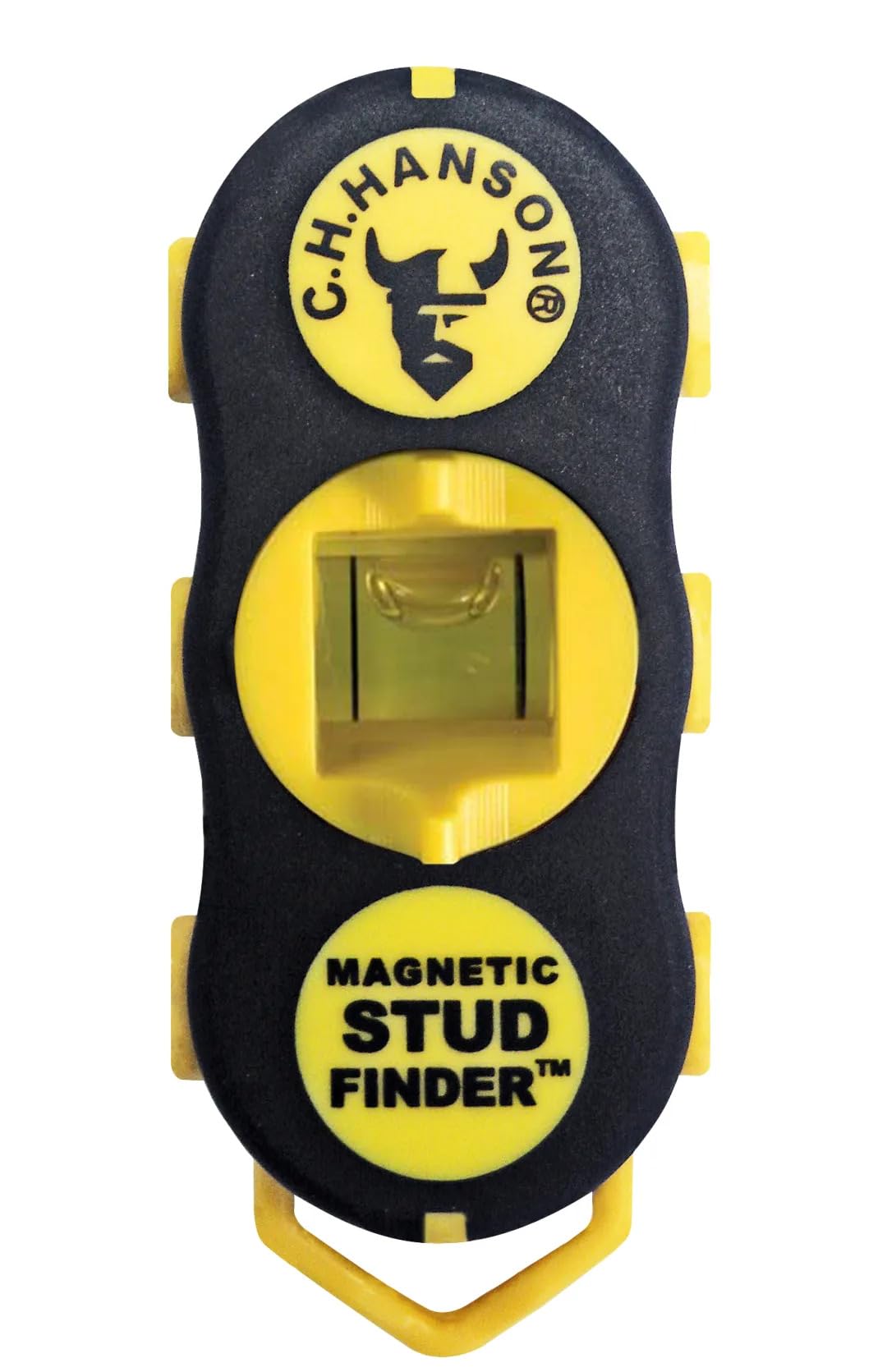
1. CH Hanson Magnetic Stud Finder
Our pick — 4.5+★ from 550+ verified ratings; the strongest balance of quality and price.
The rare-earth magnet that hangs on the wall while you line up your pilot hole.
What earns this the top slot is the combination: rare earth magnets strong enough to go grabby on the wall, plus a bubble level built into the body. The level rotates, so you can mark both horizontal and vertical lines in one pass — no fumbling for a second tool while the magnet is stuck to a screw. It weighs 0.15 lbs and lives in a pocket or tool belt.
There are no batteries, no calibration, and no setup. That matters most on tile, where an electronic scanner needs a blank calibration patch the wall cannot provide. The magnet only reacts to steel fasteners, so pipes and ductwork cannot fool it the way they fool density-based scanners. Materials listed are drywall, plaster, and paneling, with residential walls holding nails.
The honest catch is the one every magnet shares: it finds screws and nails, not wood. If the installer drove screws off-center in the stud, your mark is off-center too. Sweep vertically if the screws look widely spaced. Also note the level is a bubble vial, not a laser — you line it up by eye.
Why it takes the top spot
- Rare earth magnets with a rotating bubble level built in for horizontal and vertical marking.
- Battery-free and calibration-free — place it and start, even on tiled walls.
- Weighs 0.15 lbs, so it drops into a pocket without a bulge.
- Backed by a limited lifetime warranty from C.H. Hanson.
What you give up
- Finds metal fasteners only, never the full stud width.
- Widely spaced screws can mean a few vertical sweeps before you catch one.
- Bubble level, not a laser line.
Reach for this if: you want one battery-free tool for tile, drywall, and shelving work, with a level already on the body.
Look elsewhere if: you need the full width of a stud or a laser line across a whole wall.
2. The Original StudBuddy Magnetic Stud Finder
The tiny orange tool that made magnetic stud finding mainstream, at 1.6 ounces.
This is the crowd favorite of the whole list, and there is an enormous base of owners behind it. The method is almost embarrassingly simple: neodymium magnets (very strong permanent magnets) grab the screw heads that hold drywall to studs, and the tool stays stuck to the wall while you mark. No batteries, no calibration, no moving parts.
Being 1.6 ounces versus the StudPoP’s 1.12 ounces, it carries a bit more heft in the hand, but the plastic-encapsulated magnets are the reason it grabs so decisively. Sweep it in an S-pattern and you will usually catch a fastener within a few seconds. The maker states it is built for drywall and wood — it is specifically flagged as not intended for lath and plaster walls, which is worth knowing before you take it to an old tiled bathroom.
The single gripe that recurs is that a screw is not always centered in the stud, so your mark can sit a fraction off. Owners who need level marks tend to point toward the V2 version with the bubble level. As one contractor-watching buyer put it: “I saw my contractors using this so I had to buy a pair.”
The draw: dead simple, no battery, and it hangs itself on the wall so both hands are free to mark.
The trade-off: read the label on plaster and lath — this one is meant for drywall and wood.
Pick this one if: you want the least complicated tool to throw in a kitchen drawer and use the moment you need it.
Keep looking if: your tiled wall sits over lath and plaster rather than drywall.
3. Original StudPoP Moving Magnet Stud Finder
A magnet that tells you when it has found metal instead of making you feel for it.
Here is the design difference that matters on thick walls. Ordinary magnetic finders expect you to detect a faint tug through the casing — on a tile-and-mortar sandwich, that tug is often too weak to trust. The StudPoP’s internal mechanism does the sensing for you and pops up with a click when it has locked onto a fastener. No guessing, and no false readings from pipes or ductwork.
The maker spells it out: the popular oval magnetic finders are not built for older homes, and the disclaimer is on their packaging. The StudPoP is listed for new build and old — wood studs, metal studs, plaster, tile, and double-layer sheetrock. At 1.12 ounces it is lighter than the 1.6-ounce StudBuddy, and the 1.5-inch cube body slips into a pocket.
You get both a light and a sound when the tool finds metal, so you don’t have to rely on feel alone. One reviewer facing heavy tile put it this way: “The StudPoP lights up and clicks when it finds metal, so you don’t have to feel for a tug.” The catch is the same magnet limit in a different form: it locks onto fasteners (screws and nails), not onto the wood stud itself. A 4-star owner in the reviews called that a bit misleading in the listing.
Best at: thick plaster and tile stacks where the magnetic pull is too faint to feel.
Also worth knowing: ABS body, battery-free, no calibration step before each sweep.
Go with this: if your walls are old, thick, or covered in tile and you want a machine to make the call, not your fingertips.
Skip the extra: if plain drywall is all you have — the StudBuddy handles that for less.
4. MagnetPAL Magnetic Wall Stud Finder

A 9.07-gram cylinder that pulls itself out of your hand onto the nearest screw.
The method here is almost playful: wave it about an inch off the wall and wait for the wall to pull it out of your grip. Once the permanent magnet latches, it sticks to the wall and guides you to the fastener. It is listed for plaster, drywall, sheetrock, wood, tile, and plastic, so tiled walls are on the manufacturer’s list.
At 9.07 g and shaped like a small cylinder, it is the most pocketable pick on the list. The maker notes the magnet never rusts and works wet or dry, hot or cold — handy in a bathroom or a garage. Strength is the part owners bring up most, and the manufacturer calls it fail-safe for installers who cannot afford to put holes in a client’s wall.
Size and accuracy are the two places opinions split. Some find it ideal; others find it struggles on thicker drywall. Treat it as a fastener-pointer for standard walls rather than a heavy tile workhorse. It is also the sort of magnet that collects every stray nail in your toolbag if you drop it in.
Material note: permanent magnet in a black cylindrical body, listed as never rusting or falling off.
Size reality: it is extremely small — which makes it great to carry and modest against very thick layers.
Slip this in a pocket: if you want a light everyday magnet for hanging frames and finding screws behind standard walls and tile.
Look to the Studball instead: if a porcelain tile over cement backer board is the job.
5. JOTOVO Studball 52300 Magnetic Stud Finder

A round rare-earth magnet with 27 pounds of pull and tile in its spec sheet.
This is the pick written for your exact problem. The spec sheet lists detection through up to 5/8″ drywall, wood frame, and — the line that matters — up to 3/4″ ceramic tiling and plywood paneling. The rare earth magnet is rated at 27 pounds of pull force (the force needed to detach it from steel), which is the number that lets it reach through porcelain and thinset.
The maker also claims it can find 40 or more steel studs on 5/8″ drywall in under a minute. There is no marking and no data readout to interpret — when it catches a screw head, it fixes itself to the exact spot so you can drill. That same 27-pound pull lets it hang metal tools and fish dropped screws out of gaps.
What seals it for tiled rooms is how it handles the real sandwich. The review pages describe a magnet powerful enough to react through porcelain tile over thinset mortar over 1/2-inch cement backer board, used to place a grab bar in a tiled shower. Plan for the magnet limitation: fasteners only, and an off-center screw means an off-center mark.
The tile argument: a 27-pound-pull rare earth magnet rated through 3/4″ ceramic tiling, which almost nothing else on this list states.
Second life: it hangs metal tools and retrieves dropped hardware from gaps — tie a rope through the rubber ring.
The one for a tiled shower or kitchen: grab it if your mount has to go through real ceramic and backer board.
Not the tool for: anyone who needs to know a stud’s full width rather than just where the screws sit.
6. Franklin Sensors ProSensor M70 7-Sensor Stud Finder
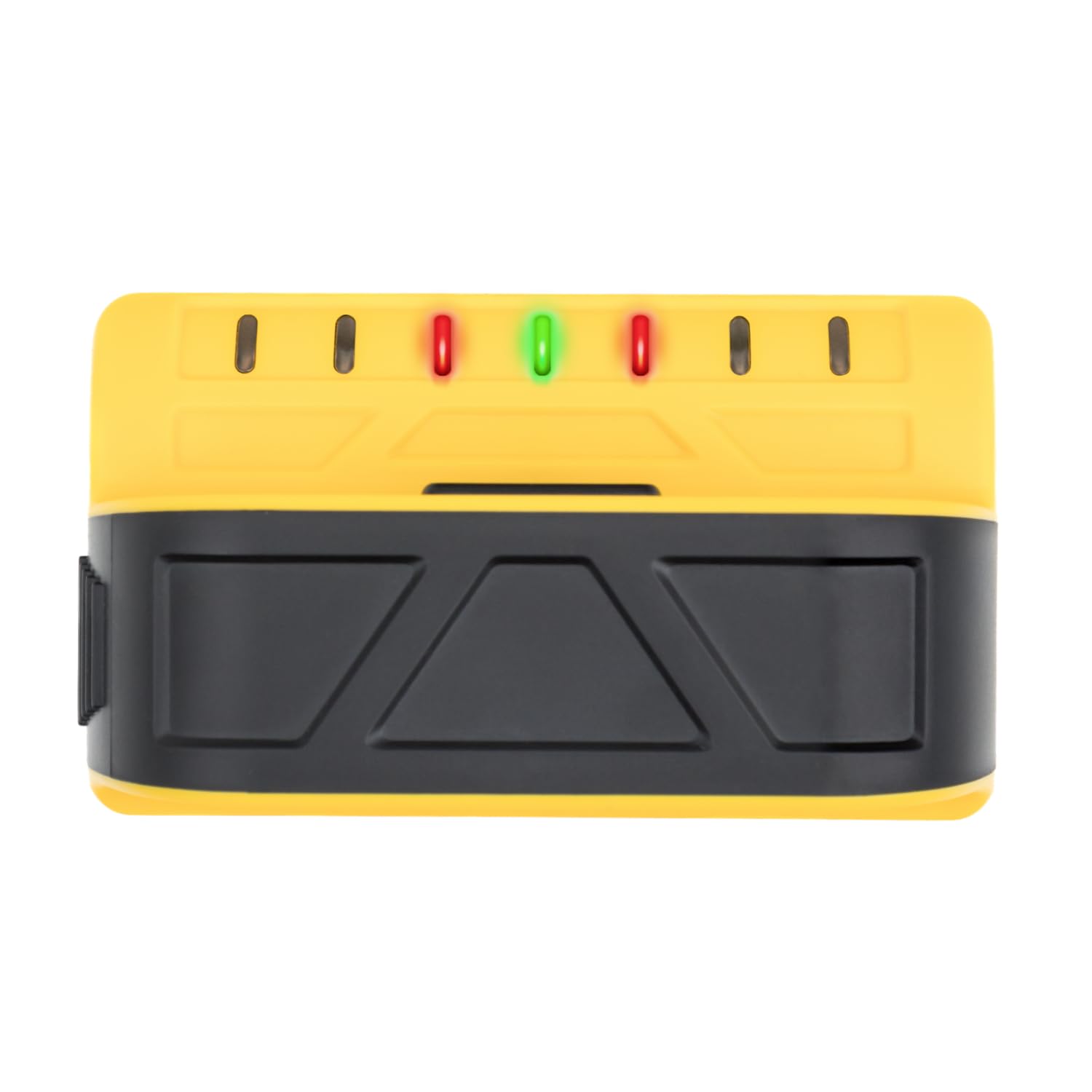
Seven sensors in a row so you see the whole stud, not just its edge.
Most electronic finders pack one or two sensors and make you creep along until a beep fires. The M70 lines up seven of them, so a scan lights the full width of the stud at once and the middle LED turns green over the center. It reaches up to 1.5 inches deep and finds both wood and metal studs — one mode does the whole job, with no calibration step.
That full-width read is the thing a magnet cannot give you, and it is why scanners still earn a place on drywall and simple tile-over-board walls. You press and hold one button and slide; the tool tolerates starting the scan even over a stud, which is where a lot of older finders produce false readings.
Weighing 4.96 ounces and running on two AAA batteries that are not included, it is a small handheld unit. The known limit: the maker specifically advises against rechargeable batteries in this model. Center-light behavior is where feedback divides — most find it clear, a few find the light logic fussy on thinner walls.
Why seven matters: a multi-sensor array shows width and center together, cutting the guesswork a single-sensor beep leaves you with.
Heads-up: no rechargeables — stock two AAA alkalines before you start.
Choose this: if your tile sits over a simple board and you want to see the full stud under it in one sweep.
Not for you: if the wall is an old lath-and-plaster build where a magnet pops instead.
7. Povlen TH570 Stud Finder Wall Scanner

Five scan modes and a wire alert that keeps your drill out of live cable.
If you are drilling into a tiled bathroom wall, knowing where the stud is only half the job — you also want to know where the live wire runs. The TH570 covers both: three stud modes up to 1.5 inches, a metal mode up to 2.36 inches, and an AC mode up to 2 inches, plus continuous wire alerts in every mode. A backlit LCD shows stud center and edge with an audio tone.
It runs on a single 9V alkaline battery that comes in the box, with a shock-resistant, dust-resistant body. Sweep a tiled bathroom with the stud mode to map framing, then switch to AC mode before you drill near an outlet.
Feedback splits on accuracy, and that is worth understanding before you buy. Some owners find it solid and some get false readings on certain walls, so treat it as a locating aid that pairs with a pilot hole rather than an oracle. Accuracy also depends on keeping the tool flat and the sweep slow. It is a reasonable first scanner if you want wire detection without paying premium prices.
The edge here: live AC detection in every mode, so wire safety is not a separate step.
Set expectations: this is a locate-then-verify tool — combine it with a small test hole on critical mounts.
Worth grabbing if: you are drilling into a tiled wall near outlets and want a wire alert on top of stud finding.
Better look elsewhere if: you need dead-nuts repeatability on thick tile — a magnet pops then.
8. Kreg KMM1000LZ Magnetic Stud Finder
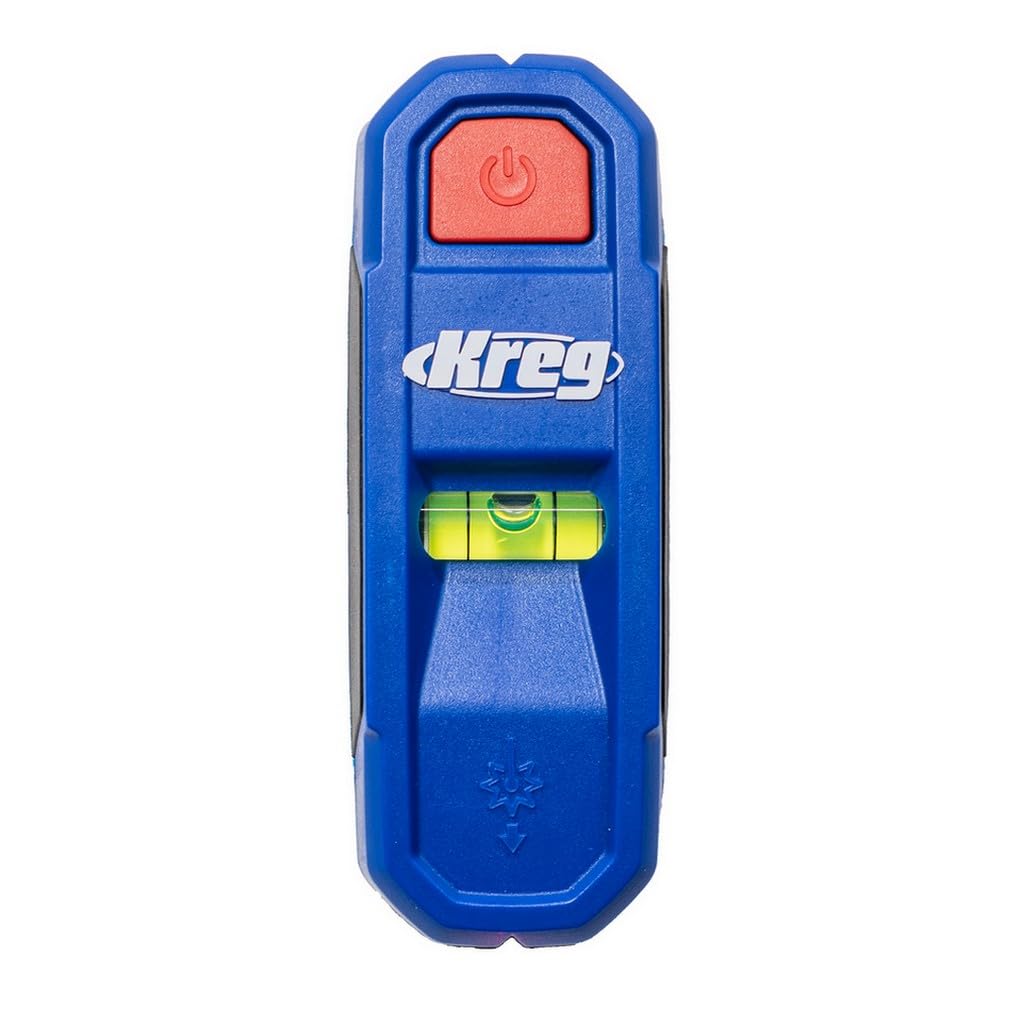
Two rare earth magnets hold the tool on the wall while a laser shows the line.
Kreg built this around two rare-earth magnets, so the body hangs itself on a nail or screw the instant it finds one. That leaves both hands free to mark the line. Then the Laser-Mark feature — a Class 2 laser at 1 mW or less — throws a line along the stud, with precision-centered notches and a high-visibility bubble level to finish the alignment.
On tile, the magnets do the finding, and the laser does the marking. For a cabinet or a mirror where you want the line drawn across several fasteners, that saves a lot of re-measuring. It lives in a pocket and is aimed squarely at carpenters and installers doing repeat work.
The trade-off is inherent to any magnet design: a screw that is not centered in the stud will pull the laser line slightly off the true middle. One buyer found the magnet could stand to be stronger, which is note if your tile stack is on the thick side.
Where it shines: the laser and level turn a found screw into a marked, level drilling line in one motion.
Magnet reality: off-center screws shift the line a touch — pilot holes protect you here.
The pick for frames and cabinets: take it if you are hanging items square and want laser alignment without a separate level.
Pass on this one: if you only need to find the stud and don’t need the laser line.
9. PREXISO 2-in-1 Stud Finder with Laser Level

A stud finder that projects a vertical laser on the edge the moment it finds one.
You get two tools in one: an edge-detect stud finder (it finds the side of a stud) that locates wood and metal studs up to 3/4 inch deep through drywall and AC wires up to 1-1/2 inch, plus a cross-line laser level (it projects straight lines on the wall). The clever part: when it finds a stud edge, it fires a vertical laser line up the wall and turns the top LEDs red with an audio alert, so you mark the edge with light instead of a pencil tap.
Charging is over Type-C and the body is aluminum and plastic, which keeps it from feeling disposable. Three fixing methods — two pins for rough surfaces, six self-adhesive strips for smooth ones, and a top pin hole — plus a 360° wall mount make it flexible around a bathroom or kitchen. The laser projects up to 30 ft indoors.
Two limits you must know. Calibration is required before every stud scan, and the laser level is manual-leveling — you align the two bubble vials yourself, and they only light up in laser mode. The maker also flags it as not designed for lath and plaster walls. Accuracy and battery feedback both split in reviews, so treat the finder as an aid and confirm critical mounts.
The clever feature: auto-projected vertical laser on edge detection — visual marking without a pencil.
Read the manual twice: calibrate, use the vials manually, and stay off lath and plaster.
Get this to combine jobs: if you want stud detection and a laser level in one rechargeable tool for indoor projects.
Skip the combo: if manual leveling and a pre-scan calibration will bug you — a magnet is simpler.
10. Zircon MultiScanner A200
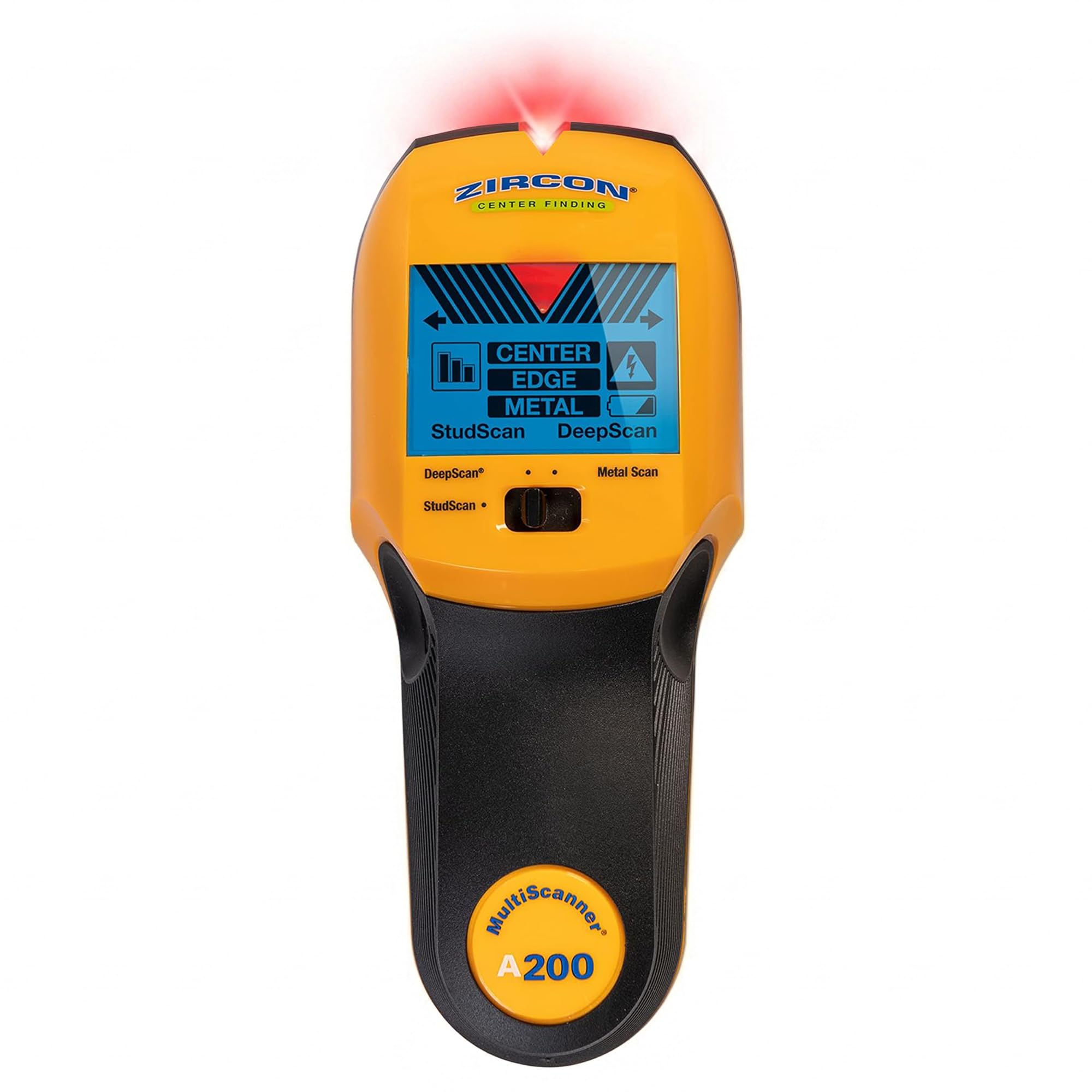
A three-mode scanner with a pointing light for marking off stud edges and centers.
Zircon’s A200 is built for the “before I drill” moment. StudScan finds wood or metal stud edges and centers up to 3/4 inch deep, DeepScan pushes to 1-1/2 inch for thicker or layered walls, and Metal Scan hunts metal behind the surface. WireWarning adds an alert for hot wires, and the SpotLite pointer marks the edge with a spot of light.
An IP54 rating means dust and splash resistance — useful in a bathroom where tile and moisture are the norm. The low-battery indicator is a real help here, because a scanner working on weak power tends to throw bad reads. On tile over thick backer board, use DeepScan and let it settle before trusting a result.
Accuracy is where the reviews divide. Some owners get precise, consistent edges; others hit false readings and need several passes. One consistent tip: calibrate against a blank wall away from studs, and recalibrate after every find. It is a serious tool for serious jobs, but confirm before you commit a hole.
Strong build: an IP54-rated body with a readable display and an audio tone for dim rooms.
The honest limit: mixed accuracy reports mean you should sweep twice and verify the mark.
Go for it if: you want a multi-scan tool that flags wires and metal as well as studs before drilling.
Try a magnet instead if: the tile stack is thick — magnetic pull is more predictable there.
11. Franklin Sensors ProSensor M210 13-Sensor Stud Finder
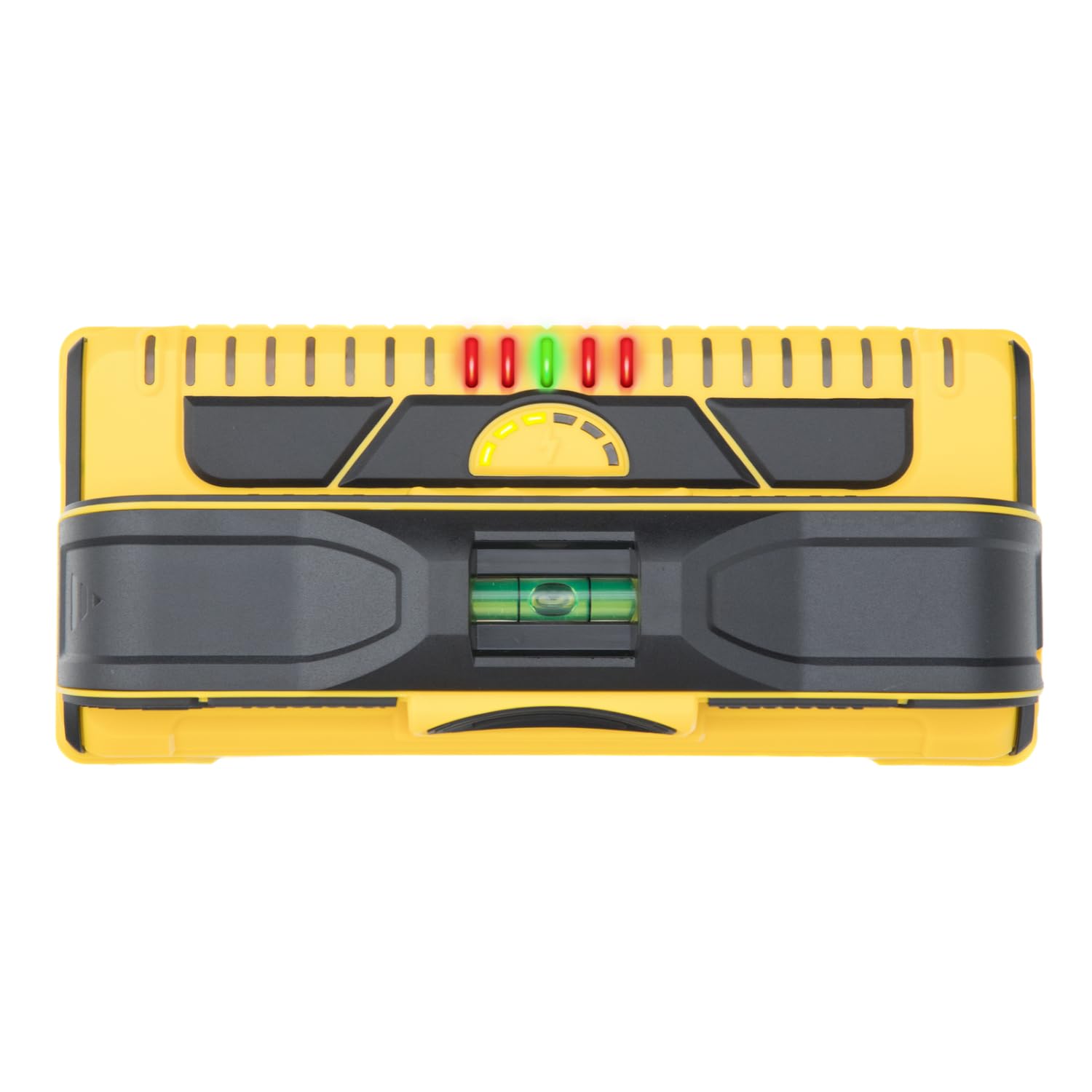
Thirteen sensors across the face, so a single press maps the whole stud.
More sensors really does mean more info. Where the M70 runs seven, the M210 runs thirteen across its face, and the LED display shows the full width of the stud and even double studs, with the middle light going green over the center. Detection reaches up to 1.7 inches deep, and it finds both wood and metal studs.
It also adds live wire detection and a pencil caddy, which matter on a tiled wall where you want to both find framing and avoid cable before you drill. No calibration — press and hold the button and scan anywhere, even starting over a stud. Two AA batteries are required and not included, but this model does accept rechargeables.
The recurring note is durability; a dropped unit can disappoint, so a protective case is worth adding. Weight is 11.36 ounces, which is heavier than a pocket magnet but a fair price for a full-width read. For tile over a simple board, this is the accuracy pinnacle of the electronic picks.
What you gain: 13 sensors plus a full-width LED display and live wire detection on one tool.
What to budget for: two AA batteries and a case, since a drop is where these tend to go wrong.
The deepest-reading choice for drywall under tile: grab it if seeing the whole stud width and live wires in one scan is worth the size.
Think twice if: you want something that lives in a pocket — this is a two-handed tool.
12. Klein Tools ESF150LL Laser Level Stud Finder
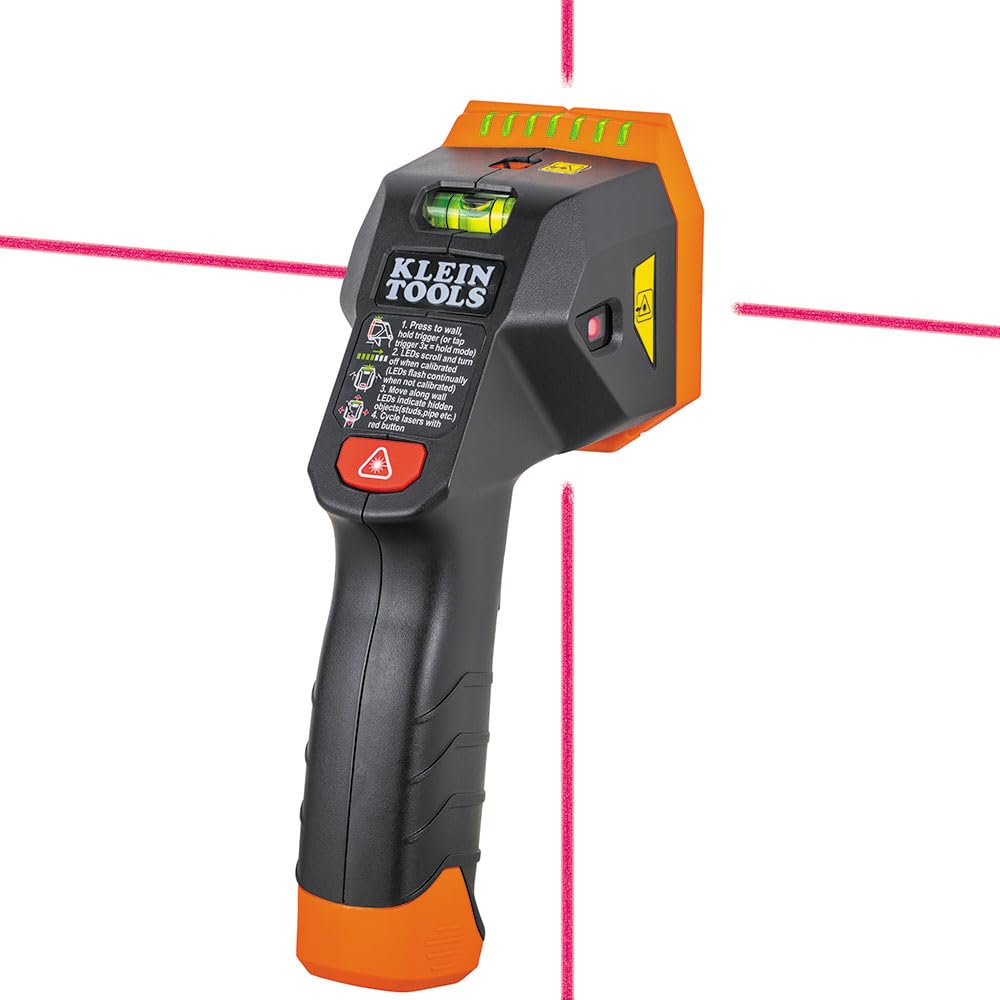
A handheld grip with cross-line lasers and a HOLD mode for continuous scanning.
Klein’s pitch is a stud finder that also lays horizontal and vertical laser lines, usable together or separately, projecting 15 feet in all directions. Stud detection reaches 1-1/2 inches deep with an auto deep scan, and it shows stud width with bright LEDs and adjustable sound. The ergonomic grip has wall-protecting felt pads and a HOLD mode, so you do not have to keep the trigger depressed through a whole sweep.
Durability is a genuine selling point here: a PC and PC-ABS housing with electronics that survives 6.6-foot drops, and two AA batteries are included. Weighing 9.44 ounces, it is an easy one-hander with a built-in bubble level for quick alignment.
Calibration is the weak point, and it is a real one. Many owners describe the calibration step as fussy and unreliable, and some readings drift. It is best as a laser-marking tool with stud finding attached, not as your sole framing finder. If you need guaranteed stud centers in tile, pair it with a magnet.
Built to take a hit: a 6.6-foot drop rating, felt pads, and a HOLD mode for long scans.
The catch: calibration splits most owners — practice it on a known wall first.
Reach for it: if you want a rugged cross-line laser that also finds studs for the occasional mount.
Lean on another pick: if you only need simple to use stud detection and nothing else.
13. BOSCH GMS120-27 Professional Wall Scanner

A pro-grade scanner with a color-coded ring that goes green for safe and red for live.
Bosch built this for the jobsite. The IP54-rated body is dustproof and water-resistant, wrapped in shock-absorbing rubber so it survives daily abuse. It locates wood studs, metal framing, copper pipes, and live AC wiring, and the color-coded marking ring turns green for safe and red for live wire, with a graphical display to show the center of a stud.
Power flexibility is a plus: two AA batteries included for immediate use, or a Bosch 3.7V Li-Ion battery sold separately for rechargeable runs. It weighs 13.76 ounces — the heaviest of the electronic picks — with a 0.06 measurement accuracy spec and an industrial style that suits a contractor’s bag.
Here is the honest read. Reviews split sharply on stud accuracy: it detects metal reliably, but owners commonly say it struggles to separate wood studs and complains of confusing indicators. For a tiled bathroom where you need a stud center, it is not the surest finder. It makes more sense for electricians and plumbers who mainly want wire and pipe detection.
Best when the job is messy: IP54 protection and a shock-absorber body for a working construction site.
Not the stud specialist: metal detection is its strength — wood stud centers less so.
Buy it for: jobsite durability plus live wire and pipe detection, where the wire warning is worth as much as the stud scan.
Reach for a magnet instead: if planting a mount in ceramic tile is your primary goal.
14. Franklin Sensors ProSensor MAX 13-Sensor Stud Finder
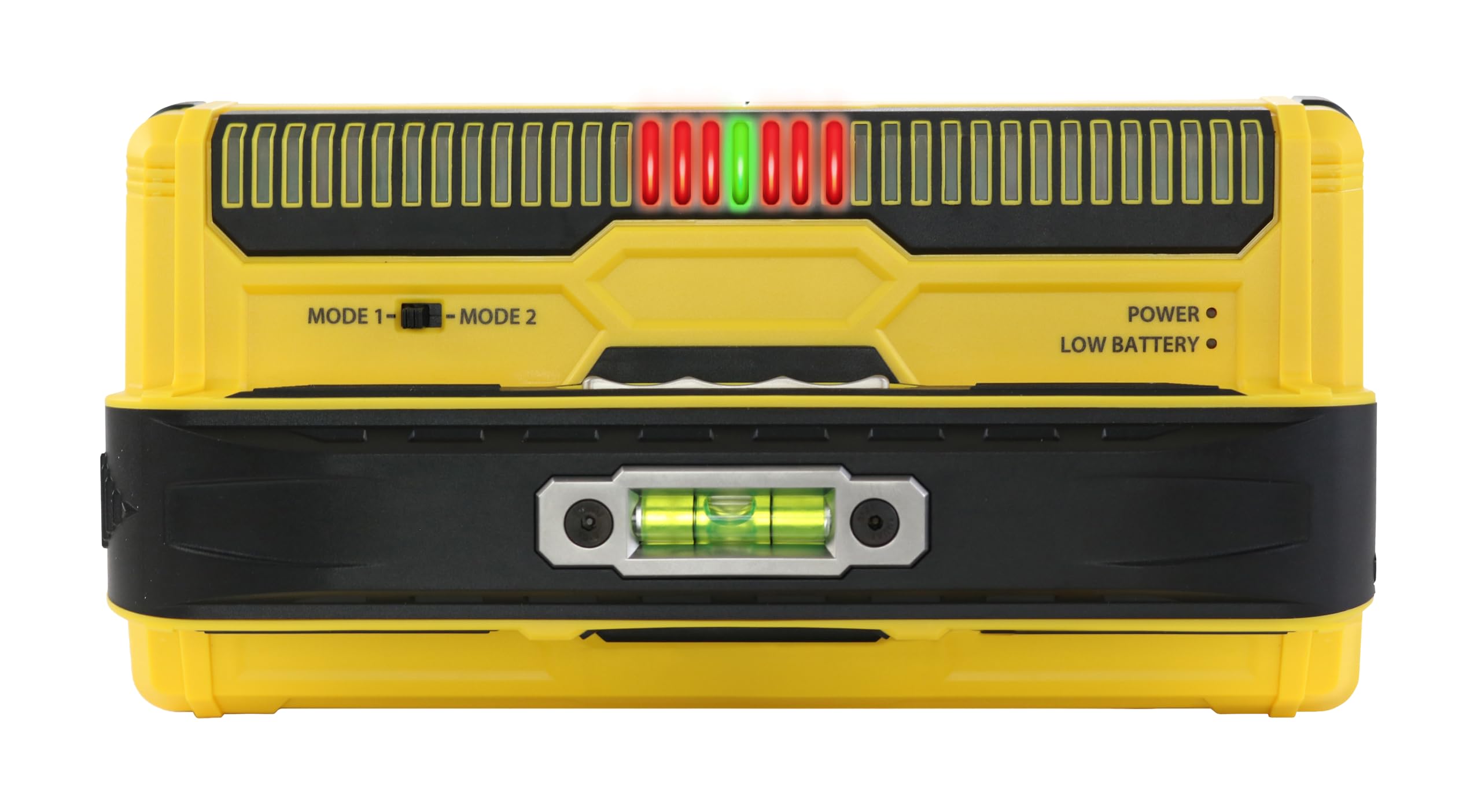
The scanner built for the exact stack a tiled wall throws at you — up to 2.5 inches.
Most electronic finders top out around an inch and a half. The ProSensor MAX uses 13 larger sensors to reach a max detection depth of 2.5 inches, and it is explicitly rated to scan through two or more layers of drywall, plaster, OSB, plywood, MDF, and large tile. That is the spec that matters when your wall is ceramic over backer board over framing.
Two detection modes split the work: mode 1 is a normal stud scan for drywall, and mode 2 is the deep scan for thick or tough walls. Switching between them gives you a choice rather than forcing one compromise. The LED display shows single or double studs, with the middle LED turning green over the center, and there is no calibration — press and hold and start anywhere. Weighing 1.1 pounds and sized extra large, it is a two-hand tool, not a pocket carry.
The honest limit is bulk. It is heavier than any magnet on this list, and switching modes can occasionally give you two different reads on the same wall. Treat the deeper mode as your tile scan and confirm the center with a pilot hole before a heavy mount.
The deep-scan argument: a listed 2.5-inch detection depth and a rating for large tile — top of this list for sheer reach.
The size reality: 1.1 pounds and a large body mean it is a bag tool, not a coat-pocket one.
The pick for thick tiled walls: take it when the tile sits over backer board and a magnet can’t reach the screws.
Don’t bother if: you want something you can carry without thinking about it.
15. LifeBasis MK2301 Stud Finder Wall Scanner

A stud finder that doubles as a thermal camera, moisture meter, and laser measure.
Four high-precision sensors power wood beam scan (20mm/38mm), metal scan up to 100mm, AC wire scan, moisture scan, a distance area mode from 0.05 to 40m, and a thermal imaging module (it reads heat) with 32×32 resolution over a temperature range of -20°C to +1000°C. A 2.4-inch LCD, touch buttons, and voice broadcast round it out.
It charges over Type-C from a 5V 2A adapter with roughly 6 hours of runtime, and a full charge takes about 3-4 hours. The maker stresses one discipline: calibrate before every detection by holding it in the air away from metal, then keep an even force and steady speed as you move.
That last instruction is the tell. Stud detection here is fussy, and it is where reviews are least kind — the laser measurement and thermal module get praise, but stud accuracy draws real complaints. For a tile wall, a magnet is still the more reliable route. This one earns its place as a multi-purpose gadget for a workshop, not as your go-to tile finder.
Wide toolkit: thermal imaging, moisture, laser distance, and wire detection packed into one rechargeable body.
Keep expectations on studs: calibrate before every scan and confirm the mark with a hole.
Buy it as a gadget: if you want thermal imaging and a distance measure alongside a stud scan in one kit.
Buy a magnet instead: if the only job is hanging something through ceramic tile.
Know the Specs
Pull force (the tile number to watch)
Pull force is the force it takes to detach a magnet from a steel plate, and on a tiled wall it is the best predictor of whether you will feel anything. The JOTOVO Studball is rated at 27 pounds of pull. A lower-rated magnet will find drywall screws on a bare wall and then go quiet under porcelain. If your wall is ceramic over backer board, start with the highest pull force on your shortlist.
Detection depth versus fastener reach
Electronic scanners quote a detection depth — how deep the sensors can sense through material. The ProSensor MAX lists 2.5 inches and the M210 lists 1.7 inches, both of which can span a typical tile-and-board stack. But depth is not the same as certainty: density scanners must distinguish a stud from a wire or a pipe at that depth, and that is where false readings creep in on tiled walls.
Calibration and its cost on tile
Most electronic finders require calibration against a blank patch of wall before a scan. Tile walls seldom have a blank patch, which makes calibration awkward. Magnet models need no calibration and no battery, which is why they hold up better on ceramic. When a scanner’s manual says recalibrate after each find, take that seriously — skipped recalibration is the most common cause of a bad read.
Center, edge, and off-center screws
Electronic scanners show the whole width and mark the center with a green LED. Magnets find only the fastener, which can sit off the true stud center. If your mount needs the exact center — a heavy TV bracket or a cabinet — verify with a small pilot hole. If the mount has a wide flange — a grab bar or a floating shelf — an off-center mark is usually fine.
Common Questions
Will a magnetic stud finder work through ceramic tile?
Why do electronic stud finders struggle with tiled walls?
Do I need a stud finder with a laser to hang a mirror on tile?
What is the difference between a stud finder that finds studs and one that finds screws?
Can a magnet stud finder locate pipes and wiring behind tile?
Should I pick the deep scan mode on my scanner for a tiled wall?
How accurate is a magnetic finder if the screw is not centered on the stud?
Do magnetic stud finders need batteries or calibration?
Which finder is best for a tiled shower where I am mounting a grab bar?
Is a magnetic finder enough on its own, or do I still need a scanner for thick tile?
The Bottom Line
For most tiled walls, the stud finder for ceramic tile winner is the CH Hanson Magnetic Stud Finder because it pairs rare earth magnets (strong magnets that grab screws) with a rotating bubble level and needs no battery or calibration. If your wall is old, thick, or heavily tiled, the Original StudPoP clicks and pops so you don’t have to feel the pull, and for porcelain over backer board the JOTOVO Studball with its 27-pound pull force is the one rated through 3/4″ ceramic. When you also need live wire detection, the Franklin Sensors ProSensor M210 brings thirteen sensors and a full-width read to the job.
Know this before you buy: a magnet’s job is small and specific — it finds fasteners (screws and nails), not the stud itself — and that narrow purpose is exactly why it holds up where a scanner stalls on tile. That narrow job is why a plain magnet often beats a scanner on tile.
How we choose
We do not accept paid placement. Every pick is matched to a real buyer and a real use-case; we do not hands-on test units.
Sources
Specifications: manufacturer listings and product documentation. Review insights: verified customer reviews, as of October 2026. Pricing: not shown on this page (it changes often); check the current price via the retailer link.
As an Amazon Associate, Aappliancez earns from qualifying purchases. This does not affect which products we feature.