Disclosure: Some links in this post are affiliate links. As an Amazon Associate I earn from qualifying purchases, at no extra cost to you. Learn more
Specs are compiled from manufacturer listings and verified buyer reviews and can change over time — please confirm the key details on the product page before buying.
The right home meat grinder turns cheap chuck and discounted pork shoulder into burgers and sausage you control completely — no mystery filler, no grey paste. The wrong one jams on the first cold cube and leaves sinew wrapped around the auger. The difference is almost always the motor, the grinding head size, and whether it can chew through partly frozen meat without stalling. This guide separates the machines built for real kitchen work from the ones that only look like it.
This guide is built by comparing the manufacturers’ published specifications and the patterns across verified customer reviews, so you get each pick’s real strengths and trade-offs instead of marketing spin.
You will see the head size, the motor rating, and the pounds-per-minute figure explained in plain terms for every machine below. What follows is a grounded walk through the best meat grinders for home kitchens, matched to the batch sizes and budgets real households work with.
Top Picks

How To Choose The Best Meat Grinders for Home
Start with batch size. A household grinding five pounds of chuck for a week of burgers has different needs than a hunter processing a whole deer. Motor, head size and accessories all follow from how much meat hits the tray in one sitting.
Start With The Grinding Head Number
The head is the metal housing that holds the auger and plates, and the number tells you its physical size. A #5 head is the smallest and struggles with volume. A #8 handles most home jobs and is where most solid machines land. A #12 head has a wider throat, so larger cubes of meat feed in without you pre-cutting everything into tiny pieces.
Understand What The Wattage Actually Means
Many listings quote a “locked” or “max” wattage that the motor only touches in a burst. The motor runs on far less under normal load. Look for both figures where they are published — the sustained rating is what determines whether the machine powers through a cold roast or stalls halfway.
Decide if you need Bone Capability
Most home grinders explicitly refuse bones and tendons. If you make pet food or want to grind whole chicken, you need a machine whose listing says it handles soft bones. Otherwise, stick to trimmed, cubed meat and the machine will last far longer.
Plan For Sausage And Kubbe Attachments
A sausage stuffing tube turns the grinder into a stuffer, which saves buying a second appliance. Check the tube sizes included, because small tubes suit snack sticks while wide tubes handle kielbasa. Kubbe attachments are a bonus that most machines now include.
Side-by-Side Comparison
| Model | Best For | Grind Head | Motor | Output Rate | Amazon |
|---|---|---|---|---|---|
| LEM BigBite #8★ Best Overall | Serious home grinding, year-round | #8 | 0.5 HP | 7 lbs/min | Amazon |
| STX Turboforce 3000Most Complete Kit | Big batches with foot control | #12 | 3000W max (800–1200W under load) | 180–240 lbs/hr | Amazon |
| STX Turboforce II 4000Bone Grinder | Soft bones and heavy volume | #12 | 2000W max | 220–260 lbs/hr | Amazon |
| Weston Pro Series #12 | Continuous bulk grinding | #12 | 1 HP, 750W | 6–9 lbs/min | Amazon |
| LEM MightyBite #8 | Weekend hunters and game | #8 | 500W | 4–5 lbs/min | Amazon |
| Cuisinart Electric Grinder | Everyday kitchen grinding | — | 300W | 3 lbs/min | Amazon |
| STX Turboforce Cadet 2000 | Mid-size home batches | #8 | 1200W max (550W grinding) | 80–120 lbs/hr | Amazon |
| LEM #8 Countertop | Occasional small-batch grinding | #8 | 575W | 2–3 lbs/min | Amazon |
| Gourmia Electric Grinder | Budget entry into grinding | — | 500W | — | Amazon |
| CHEFFANO Meat Grinder | Venison and high-volume home use | — | 350W rated, 2800W peak | 3 lbs/min | Amazon |
| VEVOR Electric Grinder | Dishwasher-friendly convenience | #8 | 700W / 0.77 HP (1800W max) | 5 lbs/min | Amazon |
| AAOBOSI 3-in-1 | Compact kitchens and beginners | — | 300W | 3.3 lbs/min | Amazon |
| Sunmile Electric Grinder | Budget deer processing | — | 250W rated, 1000W max | 150 lbs/hr | Amazon |
| KitchenAid Metal Attachment | Stand mixer owners | — | Mixer-driven | — | Amazon |
| Manual Hand Crank Grinder | No-power backup and baby food | — | Hand crank | — | Amazon |
Detailed Reviews
1. LEM Products BigBite #8 Meat Grinder
Our pick — 4.5+★ from 3,000+ verified ratings; the strongest balance of quality and price.
The stainless-steel workhorse that turns bulk chuck into burgers before your pan is hot.
Start with the number that ends the argument: 7 pounds of meat per minute. That is the BigBite #8’s throughput, and it changes what a grind session feels like — a ten-pound batch of chuck disappears in under two minutes, so you are stuffing sausage instead of babysitting a tray. The 0.5 HP motor drives it, and the whole head is stainless steel rather than coated aluminum, which is why the machine weighs 32.6 pounds. That heft is the trade-off you pay for the build.
Buyers report this grinder handles a whole chicken in about 60 seconds and works through 100 lbs of meat without complaint. Review pages are thick with sausage-making sessions measured in 25-pound runs. The stainless head and permanently lubricated motor are built for repeat use, so you can grind batch after batch. The noise-dampening design keeps it from roaring like a shop tool. As buyers put it, the grinder “performs exceptionally well.”
The head-to-head against the Weston Pro Series is telling: the LEM is 32.6 pounds versus 42 pounds on the Weston, so it is meaningfully the lighter of the two heavyweights to lift onto the counter. Compare it to the KitchenAid attachment at 2.5 pounds and the gap is 13.0x — but the KitchenAid is riding on a stand mixer’s motor while this one has its own. You get three plates, a knife, a stomper, and stuffing tubes in the box, plus a five-year factory warranty that outlasts almost everything else here.
Where it earns its keep
- 7 lbs per minute clears a week’s meat in one short session
- Full stainless steel head and permanently lubricated 0.5 HP motor
- Five-year factory warranty backed by lifetime customer support
- Noise-dampening build keeps it quieter than its power suggests
The honest catch
- 32.6 pounds — this is a stored appliance, not a cabinet afterthought
- It will not grind bones, so whole-chicken pet food is off the table
- Premium-tier spend for a machine most households use a few times a month
Best for: Anyone who grinds in real volume — hunters, bulk-buyers, sausage makers — and wants one machine to last.
Look elsewhere if: You only grind a pound at a time; the heft and the spend are more machine than that needs.
2. STX International Turboforce 3000 Series 6-in-1
A #12 head with a foot pedal, so both hands stay free while the meat feeds.
Here is the number that reframes the whole machine: the 3000 watts on the box is a locked figure, and under load while actually grinding it pulls between 800 and 1200 watts. That is normal — every grinder in this category quotes a peak — and the honest figure is the one that matters. With that motor it grinds 180 to 240 pounds per hour when the meat is properly stripped or cubed. The 9.75″ x 7.25″ hopper holds roughly 3 lbs of prepped meat, so you are not stopping to reload every handful.
The foot pedal is the detail that sells. You load the tray, tap the pedal with a toe, and both hands handle the stomper and the casings. The #12 grinding head is the widest throat here alongside the Turboforce II, so larger cubes feed without protest. In the box you get three 304-grade stainless blades, five grinding plates including one sausage plate, three stuffing tubes at 1/2″, 5/8″ and 3/4″, a kubbe attachment, plus meat claws and a burger press.
The machine ships in a 3-year warranty package with a 30-day money-back window, and at 12.5 pounds it lifts off the shelf far more readily than the LEM BigBite at 32.6 pounds. Where the KitchenAid attachment asks your stand mixer to do the work, this one brings its own motor and its own pedal. Read the fine print though: no tendons, no vegetables, no nuts, no fruit — and it will not grind bones.
What the kit buys you: A complete sausage station in one box — five plates, three blades, three stuffing tubes, a kubbe maker, claws and a press. You will not be hunting down a missing accessory on a Sunday morning.
The pedal is the point: Optional-use foot control is the feature that separates this from every other grinder at this tier, and it is why the model number carries a PD at the end.
Reach for this if: You want sausage making to feel like a station rather than a juggling act.
Think twice if: You were hoping to grind bones or push vegetables through — the manual is explicit that this is a meat-only machine.
3. STX International Turboforce II 4000 Electric Meat Grinder
The grinder in this lineup that will actually take a chicken bone and keep running.
Soft bones are the dividing line in this category, and this is one of the rare machines that crosses it. It handles chicken, rabbit, squirrel and quail bones, which turns a whole bird into pet food in one pass instead of a trimming project. Everything else here says no to bones — the Turboforce 3000, the LEM BigBite, the Weston — so if bone grinding is your job, this is the machine.
The patented Quad Air Induction Cooling System with a circuit breaker drives a locked 2000 watts, and it feeds 220 to 260 pounds per hour depending on the plate and the meat. That is the top end of the group alongside the Turboforce 3000’s 240. It is a Size No.12 grinder with a 2-1/2 inch output and a 2-inch feed tube — not a #5 or a #8 — so the throat takes bigger cuts. Six grinding plates, three 304 stainless blades, three stuffing tubes, a kubbe maker, a palm pusher, meat claws and a burger press all come in the box.
At 13 pounds it is manageable to haul out of a cabinet, and the 3-year guarantee runs through the 48 states — check that clause before ordering if you are outside the continental US. The recurring consideration is that the 30-day window covers replacement, and any buyer’s-remorse return needs the box unopened. Fine as long as you know it going in.
The bone capability is the whole story: 220 to 260 lbs per hour is impressive, but the reason to pick this over the Turboforce 3000 is that this one will grind a chicken skeleton.
Cleanup reality: A #12 head with six plates and multiple tubes means more parts to wash than a simple #8 — budget a few extra minutes after a big run.
Built for: Pet-food makers and anyone who wants to use the whole animal rather than trim it away.
Not the one if: You never plan to grind bone — the Turboforce 3000 does the same volume with a foot pedal for your trouble.
4. Weston Pro Series Electric Meat Grinder

Built to run without stopping — the grinder you buy when the meat does not.
Air-cooled and permanently lubricated, the 1 HP, 750-watt motor is rated for continuous grinding of bulk loads rather than burst sessions. That is what “commercial grade” means in practice here: the machine does not need a cooldown between batches. It grinds 6 to 9 lbs of meat per minute, with a rifled-head design and offset throat pushing the meat in faster. Compare that with the LEM BigBite’s 7 lbs per minute and you can see they run in the same lane on speed — the Weston’s edge is endurance, not pace.
Quality is the thing that draws praise — the review pages describe a machine that processes hundreds of pounds, and the phrase “built like a tank” shows up more than once. Speed and durability get their share of attention too. The accessories are thoughtful: a patented auger-grabbing stomper that pulls the meat down, a storage tray with cover, coarse (7 mm) and fine (4.5 mm) stainless plates, a grinder knife, and four sausage funnels at 10 mm, 20 mm, 30 mm and 40 mm.
At 42 pounds this is the heaviest machine in the group, and it is not a cabinet-hopper. It wants a permanent spot on a sturdy counter. Durability feedback is mixed, and a limited five-year manufacturer’s warranty is the backstop. If you process a deer or a side of pork in one long session, the continuous rating is exactly what you are paying for.
Why the pros pick it
- 1 HP air-cooled motor runs continuously without a cooldown break
- 6–9 lbs per minute with a rifled head and offset throat
- Four funnel sizes cover snack sticks through kielbasa
- Patented auger-grabbing stomper feeds meat down hands-free
Before you commit
- 42 pounds — it lives on the counter, not in a cupboard
- Durability feedback is genuinely mixed in the review pages
- Stainless build and continuous motor put it in the premium tier
The right call for: Hunters and bulk processors who run one long session and need the motor to keep pace.
Wrong call for: A small kitchen grinding five pounds a month; the heft and the premium tier are wasted there.
5. LEM Products MightyBite #8 Meat Grinder

The LEM that deer hunters reach for — 4 to 5 pounds a minute, no drama.
Wild game is the reason this machine exists, and the numbers line up for it. At 4 to 5 lbs per minute it is roughly half the pace of its bigger sibling, the BigBite #8 at 7 lbs per minute — but for a single deer that difference is minutes, not hours. Buyers put 20 pounds of beef cubes through in under 20 minutes, and the review pages call out wild game processing as quick and easy. The 500-watt motor with a permanently lubricated build and circuit breaker backs that up.
The aluminum construction with long-lasting gears keeps the weight at 16.5 pounds, which is roughly half the BigBite’s 32.6. That matters if the grinder lives in a cupboard and comes out for the season. You get stainless steel plates, a knife, a stomper, and three stuffing tubes for sausage work, and everything cleans with warm soapy water. Value is the second thing the reviews praise — the price-to-output math on this machine is easy to justify.
No bones, same as the rest of the LEM line, so trimmed game meat is the expectation. A two-year factory warranty covers it with lifetime support behind it. If you want the LEM name and build without the BigBite’s weight and premium tier, this is the sensible middle path.
The hunter’s arithmetic: 16.5 pounds of machine against 4 to 5 pounds per minute is a ratio that works when the harvest is one deer a year.
Where it sits: Half the weight and half the speed of the BigBite, with a two-year warranty instead of five.
Pick this if: Your grinder is a seasonal tool for game and the occasional sausage weekend.
Keep shopping if: You grind weekly year-round and want the extra throughput and longer warranty of the BigBite.
6. Cuisinart Electric Meat Grinder

A tidy 300-watt grinder that handles beef, chicken, turkey and venison at three pounds a minute.
Three pounds per minute from a 300-watt motor is the honest summary — this is a home grinder for ordinary kitchen jobs like burgers, meatballs and breakfast sausage. It takes beef, chicken, turkey and venison, and it handles semi-defrosted meat without complaint, which is more than some machines twice its rating can say. The stainless housing wipes down easily and looks like it belongs on a counter.
Just two metal cutting plates, medium and coarse, plus two sausage attachments for breakfast links and regular sausage. That is a leaner accessory set than the STX machines and a fair trade — fewer parts to store and fewer to wash. The reverse function clears a clog without disassembly. The cord runs 34 inches, which is long enough to reach most counter outlets without an extension. At 8.5 pounds it moves freely.
Few parts means quick cleanup, and the review pages point to that repeatedly. The limited three-year warranty is real backing for a mainstream kitchen brand. What it will not do is grind in volume — this is a machine for a pound or two at a time, not a side of pork.
The everyday case: Two plates, two sausage attachments, a reverse button and a stainless body — nothing extra to store, nothing extra to clean.
Where it ends: 300 watts and 3 lbs per minute means it is a household grinder, not a harvest-day machine.
Suits you if: You grind a pound or two for dinner and want a name-brand machine that tucks away.
Skip if: You are processing game or grinding in bulk — you need the throughput this one does not have.
7. STX International Turboforce Cadet 2000 Series

The STX family’s mid-size option — 1200 locked watts, a #8 head and 80 to 120 pounds an hour.
This is a genuinely different animal from the two big STX machines. The Cadet 2000 locks 1200 watts but uses only 550 while grinding under typical conditions, and it moves 80 to 120 lbs of meat per hour — roughly half the Turboforce 3000’s 180 to 240. The #8 head means 2-7/16″ plates with 4mm, 5mm and 8mm holes, so you get a coarse grind for summer sausage or a fine one for burgers. For a household batch, that is enough.
What the kit includes is the surprise: three 304-grade quad-beveled stainless blades, four grinding plates with one sausage plate, three stuffing tubes, a kubbe attachment, a meat pusher, two meat claws and a burger-slider press. That is more blade redundancy than most machines at this size — three so you are not stopped by a dull edge. A 3-year warranty covers it, and the compact body slides onto a crowded counter more easily than the #12 machines.
One caution in the manual worth reading before you buy: no animal tendons, no vegetables, no nuts, no fruit, and no bones. Same restriction as the Turboforce 3000 and 4000, just worth saying plainly. It is a household meat grinder, not a commercial one.
The kit detail: Three blades for a #8 machine is generous, and it means a dull one does not end your session.
The size logic: 80 to 120 lbs per hour fits a home kitchen; it is half the volume of the big STXs and priced to reflect that.
Best for: A kitchen where the grinder shares counter space and the batch is measured in pounds, not pounds per hour.
Not ideal if: You need the 220-plus-pounds-per-hour pace of the Turboforce II — this one runs at half that.
8. LEM Products #8 Countertop Meat Grinder

The occasional-use LEM — 575 watts, 2 to 3 pounds a minute, and quieter than you expect.
Built for people who grind occasionally, this one pushes 2 to 3 lbs per minute through a heavy-duty aluminum head that locks with a quarter turn and comes apart easily. That is one third of the BigBite’s 7 lbs per minute — and that is fine if your grind is a few pounds of chuck for burgers once a week. The push-button forward and pulse reverse functions clear jams without a wrestling match.
Noise is the quiet surprise. The listing claims the motor runs quieter than expected, and the review pages back that up while some find it a little noisy — a mixed response, and honest to say so. Quality and performance are the aspects that get praised most, with easy cleanup and grind speed following. At 11.3 pounds it is a reasonable lift, and the aluminum head with stainless plates and knife cleans with warm soapy water.
Durability feedback is mixed here too, which is worth weighing against the one-year warranty. It includes a stuffing tube and plate for sausage work, so a whole session is covered. For a household grinding a couple of pounds at a time, the price-to-capability math is solid.
The quiet card: A 575-watt motor that runs more softly than its size suggests — a small mercy if you grind while others sleep.
The reality check: 2 to 3 lbs per minute is occasional-use speed, and the one-year warranty is the shortest in the LEM line.
Choose it if: You grind a few pounds at a time and want LEM build without the BigBite’s weight or cost.
Pass if: You grind in volume — the speed and warranty here are sized for occasional use.
9. Gourmia Electric Meat Grinder

A 500-watt grinder that clears ten pounds of meat in under five minutes.
The Gourmia is the proof that you do not need a #12 head to grind well. A 500-watt motor drives three stainless plates — fine, medium and coarse — so you can go from tartare to sausage filling with the same machine. It handles beef, chicken and pork with a 3-way on/off/reverse switch that clears minor jams without disassembly. Eight and a third pounds is light enough to lift with one hand.
The real testimonial is the time: buyers describe processing 10 lbs of meat in under five minutes, and the review pages note the cost math — grinding your own beats buying pre-ground. Taking it apart for cleaning is straightforward, which is often the part people dread. Sausage and kebbe attachments with a food pusher come included, so a whole session is covered in the box.
This is an entry point into grinding, and it should be treated that way. A one-year manufacturer warranty covers it. If you grind a few pounds a week for burgers and meatloaf, that is plenty of machine.
Where the value sits
- 500 watts and 10 lbs in under five minutes — genuinely quick
- Three plates plus sausage and kebbe attachments in the box
- 8.3 pounds and easy to disassemble for cleaning
What it is not
- One-year warranty is the shortest coverage here
- No bone capability, so whole-chicken pet food is out
- Volume work is not its brief — it is a household machine
Right sized for: First-time grinders who want speed and value in a budget-friendly machine.
A mismatch if: You need continuous bulk grinding or bone handling — neither is in this machine’s spec sheet.
10. CHEFFANO Meat Grinder 2800W Max

A pure-copper motor rated 350 watts, peaking at 2800, built for venison and volume.
The wattage here needs unpacking. The pure copper motor is rated up to 350 watts normally, and the peak can reach 2800. That is the same locked-versus-sustained gap you see across this category, and the rated figure is what you will actually be using. With it the machine grinds roughly 3 lbs of meat per minute, and the 3-layer auger is designed to pull meat with less heat, which keeps the texture from turning grey and stringy.
Venison is the standout. The review pages have people putting 40 pounds of chicken meat through in 45 minutes, and the grinder is repeatedly called out as good for venison, burgers, meatloaf and sausage. It is ETL approved with 3 grinding plates at 2mm, 5mm and 7mm, 2 blades, a food pusher, and kubbe and sausage accessories. A reverse button clears a jam without a teardown.
Cleanup is the catch worth knowing: the parts are explicitly not dishwasher safe. Wash them by hand under water no hotter than 122°F with a neutral detergent, and dry them quickly with a towel. Do that and the machine holds up; skip it and oxidation of the alloy parts becomes your problem.
The auger earns its keep: The 3-layer design reduces grinding heat, which is why the meat comes out with a better texture and fewer grey streaks.
Cleanup discipline required: Hand-wash only, under 122°F, and dry immediately — this is not a machine you can throw in the dishwasher after a long grind.
The one for: Hunters and burger-makers who process venison and want a fast grind with a clean result.
Know before buying: Dishwasher use will damage the alloy parts — plan for hand washing every time.
11. VEVOR Electric Meat Grinder #8
A copper-motor #8 that goes straight into the dishwasher — blades and plates, at least.
Most grinders in this group ask you to hand wash every part. The VEVOR does something different: the stainless blade, grinding plates and plastic parts are dishwasher safe. Only the aluminum alloy components need hand washing. If cleanup is the reason you have been putting off grinding your own meat, this is the one that removes that argument. The 700W / 0.77HP pure copper motor (max 1800W) pushes 5 lbs of meat per minute through a 3-stage spiral auger and a sharp stainless blade.
The accessory set is thorough: three plates at 3mm fine, 5mm medium and 8mm coarse, a kibbe kit, and three sausage stuffing tubes at 0.3″, 0.4″ and 0.78″. The locking knob holds the grinding head tight so it does not work loose mid-session, and there is a reverse button for clogs. It is ETL approved, and it handles chicken, pork, beef, fish, vegetables and chili peppers — though the manual restricts it from bones and frozen meat.
At 12.1 pounds the machine is manageable, and the metal housing wipes down easily. The one habit worth forming: dry the parts with a soft cloth after washing, because the alloy parts do not like sitting wet. Do that and the dishwasher convenience is a genuine advantage over every hand-wash machine here.
The cleanup advantage: Dishwasher-safe blades, plates and plastic parts set this apart from the hand-wash-only grinders that dominate the category.
The 5 lbs per minute pace: That is a home-scale throughput — faster than a Cuisinart at 3 lbs per minute, slower than the LEM BigBite at 7.
The fit: Households where washing up has been the blocker to grinding their own meat.
Not for: Bones or frozen meat — the manual is clear on both, so prep your meat fresh or thawed.
12. AAOBOSI 3-in-1 Meat Grinder 2800W Max

Three appliances in one footprint — grind, stuff sausage and make kubbe from a compact body.
Kitchen space is the honest constraint here, and the AAOBOSI answers it: meat grinding, sausage stuffing and kubbe making in one unit. The 300-watt motor grinds 1.5kg (3.3 lb) per minute through a 7mm plate, which is fast enough for a home batch. The 18/8 stainless casing and ABS body are food-grade, and the heat dissipation holes — 20 at the bottom and 14 on the side — are there to keep the motor from overheating on a long session.
A reverse button clears a clog. The parts include 3 stainless plates, 2 blades, a sausage stuffer and a kubbe maker, and the blades and plates are dishwasher safe while the rest hand washes. Quality is the thing that gets praised most, with value and grinding performance close behind.
Durability feedback is genuinely mixed — some find it solid, others describe it as flimssturdier than expected. The manual warns against bones, tendons and skin, so keep those out of the tray. At 9.8″ by 6.6″ by 15″, the compact footprint is the reason to choose it over a full-size #12.
The space math: Three functions in one 9.8″ x 6.6″ x 15″ body — grill season in a small kitchen benefits most.
Durability is the open question: Mixed feedback in the review pages sits behind the low price point, so treat it as a light-duty machine.
Worth it for: Beginners and small kitchens that want sausage stuffing and kubbe without three appliances.
Not the pick if: You grind heavy volume weekly — the 300-watt motor and mixed durability reports point to lighter use.
13. Sunmile Electric Meat Grinder and Sausage Maker
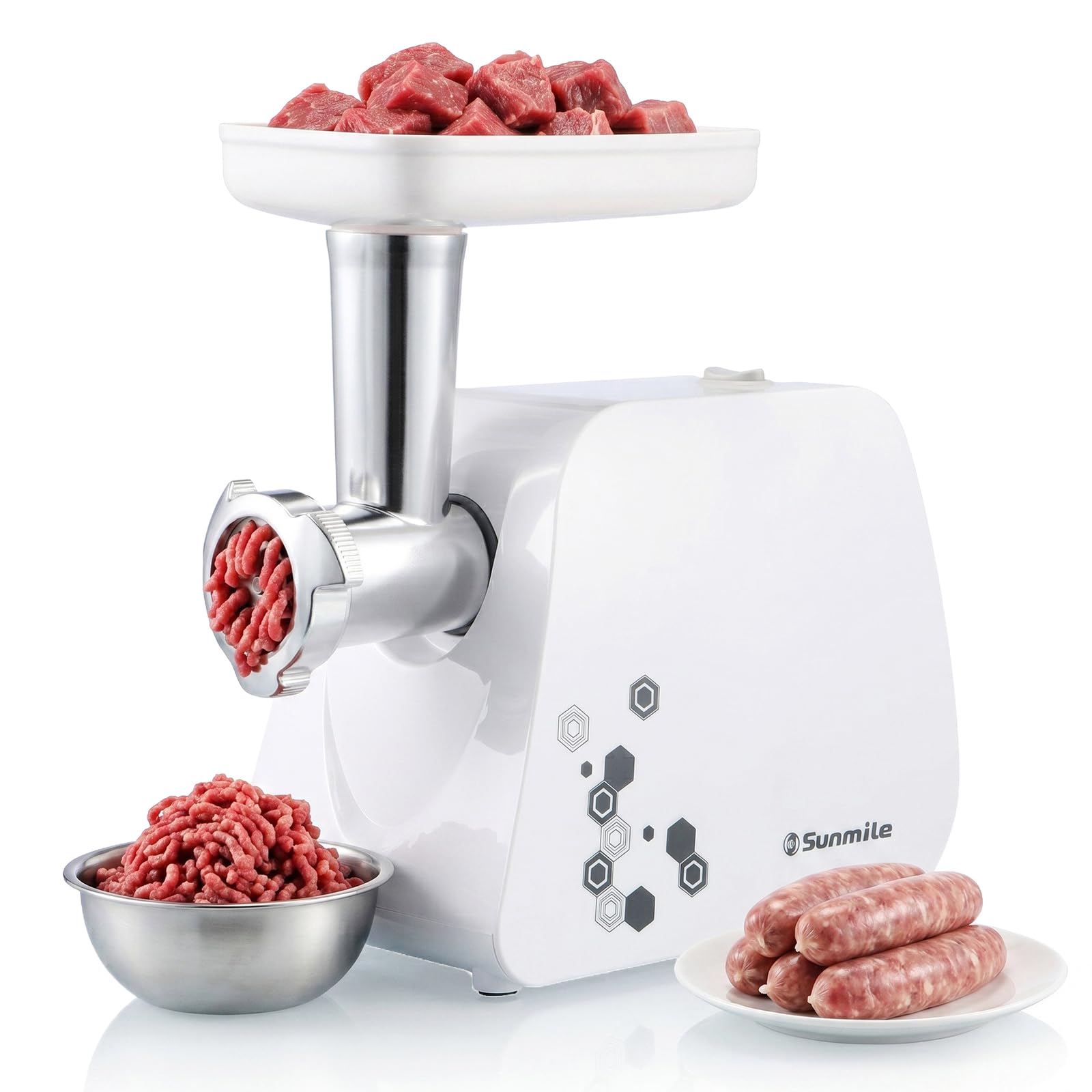
A whole deer goes through this one, and it will not flinch at the price tag either.
Read the wattage twice, because it matters. The Sunmile carries a 250W rated power figure and a 1000W max locked power figure, and the sustained 250W is what does the work. Buy it knowing that and it is a capable machine — 150 pounds per hour through three stainless plates for coarse, medium and fine grinds. The review pages have people putting an entire deer through it with ease and grinding 50lbs of pork in about seven minutes.
Cleanup is a genuine strength. The grinder breaks down easily, the plates and blade are dishwasher safe, and the big wrapped plastic body wipes down in seconds. Reliability is the thing it is known for, and value-for-money sits right behind that in the impressions buyers leave. The big on/off/reverse button is easy to hit and the circuit breaker guards the motor. It weighs 7.9 pounds, which makes it the lightest electric machine here — it stores in a cupboard easily.
Two honest notes: durability draws some negative feedback in the review pages, and the motor wattage question is a common complaint — the advertised 800-watt motor is actually 250 watts. Treat that as marketing, not fraud, and judge it on the rated figure.
What makes it worth the money
- A deer goes through it, and 50lbs of pork grinds in about seven minutes
- 7.9 pounds — the lightest electric grinder here
- Dishwasher-safe plates and blade with easy breakdown
Read this before buying
- The advertised 800-watt motor is actually 250 watts
- Durability feedback is negative in the review pages
- Plastic body will not take the knocks a stainless one would
The budget answer: Deer processing and pork prep on a modest outlay, provided you read the wattage correctly.
Go elsewhere if: You need a machine that survives years of heavy use — the durability feedback points to a shorter service life.
14. KitchenAid KSMMGA Food Grinder Attachment
The grinder for the stand mixer you already own — no second motor on the counter.
If a KitchenAid stand mixer is already on your counter, this attachment turns its motor into a meat grinder and saves you buying a whole separate machine. It clicks into any household KitchenAid stand mixer power hub, and at 2.5 pounds it is the lightest grinder here by a long way — the LEM BigBite weighs 32.6 pounds, a 13.0x gap. It stows in its own storage case, which is more than you can say for most of the machines on this list.
The box carries 10 items: fine, medium and coarse grinding plates, two sausage stuffer tubes, and the metal grinding head. The larger food tray compared to the older FGA model means fewer reloads for the same batch. One trick worth knowing — pre-chill the grinder head in the fridge or freezer before you grind, and the meat runs through cleaner and neater.
The honest limitation is the motor. It does not have its own; it borrows your mixer’s, so throughput depends on which mixer you own and how hard you push it. This is for small batches and the occasional sausage run, not a deer. But for a KitchenAid owner with 11 kg of capacity on the spec sheet, it turns an appliance you own into a grinder you did not have to buy.
The footprint argument: 2.5 pounds and its own storage case is a genuine win over a 32.6-pound dedicated machine in a small kitchen.
The dependency: Throughput is limited by your stand mixer’s motor, so batch size needs to stay modest.
Reach for this if: A KitchenAid stand mixer is already in your kitchen and you grind small batches.
Wrong tool if: You have no stand mixer, or you process game in volume — this attachment cannot carry that load.
15. Manual Meat Grinder with Stainless Steel Blades

A crank you turn by hand — no outlet, no motor to burn out, baby food and meatballs in reach.
No electricity is the whole appeal here. You drop the meat into the hopper, turn the crank, and grind — meatballs, egg salad, chicken burgers, and baby food are all named in the listing. Empty the fridge without finding an outlet. The heavy-duty plastic body is paired with stainless steel blades, and blades, sausage stuffing tubes and handle replacements are all available as spares, which is unusual for a budget manual unit.
The suction base is the design detail that decides whether a manual grinder works or fights you. Press it onto a smooth, dry counter edge, expel the air, and turn the knob down — the suction cup holds it steady, and the ergonomic handle with non-slip rubber base keeps your grind smooth. The blades are fully enclosed, so the safety question is settled. Cleanup is the aspect that gets praised most: assembly, breakdown and washing are all straightforward.
The honest catch is effort. Feedback on functionality, ease of use and quality is genuinely mixed — some find it does the job, others find it difficult to use — and it runs on arm power, not a motor. At 1.7 pounds it stores on a shelf and travels easily. It is the backup grinder, the camping grinder, and the small-batch grinder rolled into one.
Where it wins: No outlet, no motor, 1.7 pounds, and a suction base that holds it steady once you set it up correctly.
The effort cost: Arm power and mixed feedback on ease of use mean this is a small-batch tool, not a deer processor.
The niche it fills: Small batches, baby food, and anywhere without a spare outlet — a backup that never needs power.
Not a substitute for: An electric machine — if you grind pounds at a time, your arm will tell you.
Know the Specs
Grinding Head Size (#5, #8, #12)
The head is the metal housing that holds the auger and the grinding plates, and its number tells you the physical size of the throat. A #8 head is the common home size and takes 2-7/16″ plates. A #12 head is wider, so larger pieces of meat feed in without pre-cutting into tiny cubes. Wider heads also mean more metal to wash. Match the head to how big your meat pieces are — not to the wattage.
Locked Wattage vs. Rated Wattage
Nearly every listing quotes a “locked” or “max” wattage — the burst the motor can hit for a moment. Under load, while actually grinding, the motor uses far less. The Turboforce 3000 locks 3000 watts but uses 800 to 1200 under load. The Sunmile locks 1000 but is rated at 250. Look for both numbers where they exist, and trust the rated figure for day-to-day performance.
Pounds Per Minute vs. Pounds Per Hour
Some brands quote a per-minute figure and others a per-hour figure. To compare apples to apples, the per-minute number is easier to picture: 7 lbs per minute clears a ten-pound batch in under two minutes. A per-hour rate of 180 to 240 translates to a big session. When both appear on a listing, read the per-minute figure if you can — it is what a home batch actually experiences.
Bone Capability and What It Costs
Most home grinders explicitly refuse bones, and the manual warnings are not optional. Soft-bone capability — chicken, rabbit, squirrel, quail — shows up on only one machine here, the Turboforce II 4000. If you want to make pet food from a whole bird, that capability is the deciding spec. If you do not, ignore the bone question and focus on throughput and cleanup.
Common Questions
Can a home meat grinder grind bones?
What does the locked wattage on the box actually mean?
Will a #8 grinder handle a whole deer?
Do I need to pre-freeze meat before grinding?
Is a manual grinder worth buying over an electric one?
Can I use my KitchenAid mixer as a meat grinder?
Which grinder parts can go in the dishwasher?
How fast should a home grinder process a batch?
Why does my grinder leave grey streaks in the meat?
Do sausage stuffing tubes come with most home meat grinders?
The Bottom Line
The safest pick for most homes is the LEM BigBite #8, and the reason is the 7 lbs per minute combined with a stainless head and a five-year factory warranty. It costs more than the budget machines, but the price-to-output math holds for anyone who grinds regularly. If you want the full sausage station with a foot pedal, the STX Turboforce 3000 is the pick. And for bone grinding, the STX Turboforce II 4000 is the only machine here that will take a chicken skeleton and keep going. It earns its place with 4.5+ stars across 3,000+ owners, and the reviews back that up with 25-pound sausage runs, whole chickens and 100-pound grinding sessions. Grind your own once and the store’s pre-ground case stops making sense.
How we choose
We do not accept paid placement. Every pick is matched to a real buyer and a real use-case; we do not hands-on test units.
Sources
Specifications: manufacturer listings and product documentation. Review insights: verified customer reviews, as of October 2026. Pricing: not shown on this page (it changes often); check the current price via the retailer link.
As an Amazon Associate, Aappliancez earns from qualifying purchases. This does not affect which products we feature.