Disclosure: Some links in this post are affiliate links. As an Amazon Associate I earn from qualifying purchases, at no extra cost to you. Learn more
Specs are compiled from manufacturer listings and verified buyer reviews and can change over time — please confirm the key details on the product page before buying.
That swirling pattern on most “Damascus” knives sold online is often laser-printed, and it fades the first time the blade meets hot water. A real Damascus blade shows its pattern in the metal itself: a hard steel core wrapped in many folded layers, listed on the spec sheet as HRC hardness (a scale for how hard the steel is) and layer count. Below, each pick is matched to how you actually cook — heavy meal prep, delicate vegetable work, or one do-everything knife you reach for all evening.
This guide is built by comparing the manufacturers’ published specifications and the patterns across verified customer reviews, so you get each pick’s real strengths and trade-offs instead of marketing spin.
You will learn why a 67-layer blade with a hard core stays sharp through weeknight dinner duty, and how handle material changes the way a knife feels after twenty minutes of chopping. By the end, you will know which of these Damascus kitchen knives belongs on your own board.
Top Picks

How To Choose The Best Damascus Kitchen Knives
Judge a Damascus knife on three specs listed on the product page: the steel core, the layer count around it, and the HRC hardness the core is heat-treated to. Get those three right and the edge holds through years of weeknight chopping. Get them wrong and you are paying for a printed pattern on steel that dulls in weeks.
Real folded steel versus a printed pattern
Genuine Damascus is made by forge-welding many layers of steel together, folding, and hammering until the wavy grain runs through the metal itself. That pattern cannot wear off because it runs through the whole blade. A laser-etched or printed design sits on the surface only. If a listing says genuine Damascus and states a layer count in the same breath, you are on the right track.
Why the HRC number matters more than the swirl
HRC is a hardness score: the higher the number, the longer the edge holds but the more brittle the steel becomes. The picks here sit in a narrow band, from 58 to 62+ HRC, which is the range that keeps a sharp edge without turning the blade fragile. A very hard blade cuts longer between sharpenings; a slightly softer one is more forgiving if it meets a bone or a careless board tap.
Blade length and shape for your actual kitchen work
An 8-inch chef knife is the all-rounder — long enough to slice a whole cabbage, short enough to control a fine dice. A nakiri or santoku shape is flatter along the edge and suits vegetable work where you push straight down. If you mostly trim and mince, a smaller 5.5-inch utility blade does the job and takes up less drawer room.
Handle material and how the knife feels after minutes of use
G-10 fiberglass and Pakkawood both resist moisture and stay steady in a wet hand. Olive wood feels warmer and shows more natural grain. Whichever you pick, the balance point matters as much as the material: a knife that tips forward at the blade does the cutting work for you and eases wrist strain during a long prep session.
Side-by-Side Comparison
| Model | Best For | Blade Length | Steel / Layers | Hardness | Amazon |
|---|---|---|---|---|---|
| Dalstrong 8″ Japanese Chef Knife Gyuto★ Best Overall | All-purpose everyday prep | 8 inches | AUS-10V, 66-layer | 62+ HRC | Amazon |
| VEROXIS Damascus Chef Knife 8 InchPremium Pick | Gift-ready single chef knife | 8 inches | VG-10 core, 67-layer | 62 HRC | Amazon |
| Emojoy 8-Inch Damascus Chef KnifeBest Value | Value full-size chef blade | 8 inches | Damascus, 67-layer | 58 HRC | Amazon |
| TIVOLI Damascus Nakiri Knife 6.5 Inch | Vegetable-first prep | 7 inches | VG10, Damascus clad | 60-62 HRC | Amazon |
| WeKit 8 Inch Damascus Chef Knife | Budget three-knife starter | 8 inches | VG10 core, 66-layer | 62+ HRC | Amazon |
| KYOKU Shogun Series Chef Knife | Heavy daily chopping | 8 inches | VG-10, 67-layer | 58-60 HRC | Amazon |
| NANFANG BROTHERS 9-Piece VG10 Set | Complete block for a family kitchen | 8 inches (chef) | VG10, 67-layer | 60±2 HRC | Amazon |
| HENCKELS Compass Damascus Santoku | Brand-name vegetable blade | 7 inches | High carbon, 23-layer | — | Amazon |
| Wakoli EDIS 4-Piece Damascus Set | Curated gift set | 6.7 inches | VG10 core, 67-layer | 60±2 HRC | Amazon |
| Yatoshi 6-Piece Magnetic Block Set | Countertop display set | 8 inches | VG-10 core, 67-layer | 60-61 HRC | Amazon |
| Topfeel Damascus 3-Piece Set | Entry-level multi-knife set | 8 inches (chef) | VG-10 core, 67-layer | 60±2 HRC | Amazon |
Detailed Reviews
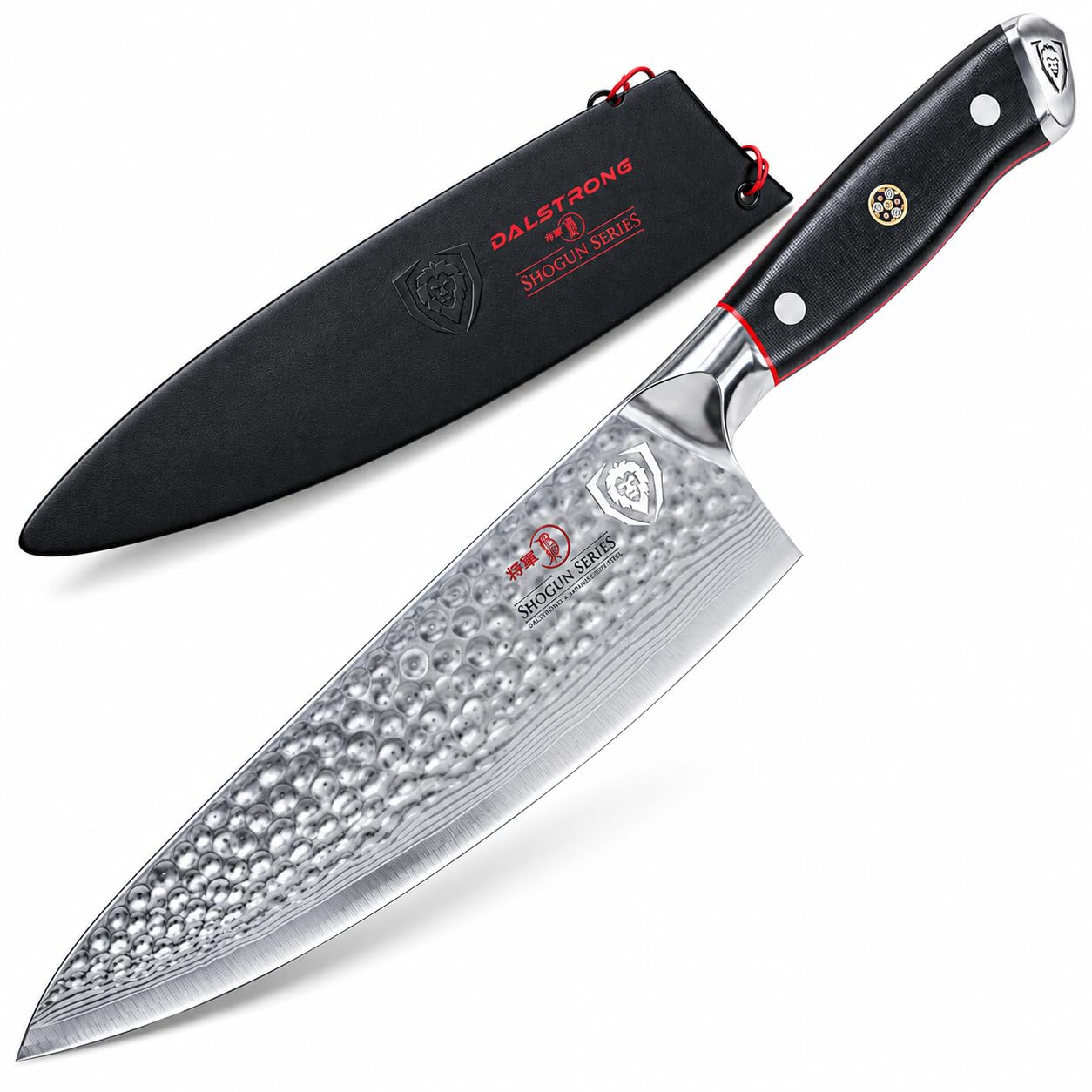
1. Dalstrong 8″ Japanese Chef Knife Gyuto
Our pick — 4.5+★ from 2,500+ verified ratings; the strongest balance of quality and price.
The one knife that does the onion, the herbs, and the chicken without blinking.
If you only buy one blade for the rest of your cooking life, this is the one. Its AUS-10V Japanese steel core sits at a 62+ Rockwell hardness (a hardness score — the higher it is, the longer the edge resists rolling over), and that core is wrapped in 66 layers of Damascus steel. In practice, that hardness keeps the edge biting through a full Sunday prep session of chopping and slicing instead of going soft halfway.
A hand-sharpened 8–12° edge per side (a very fine angle) lets this blade glide through boneless meat and thin vegetable slices instead of tearing them. The hammered dimpling on the blade face helps food release, so diced onion falls off onto the board instead of clinging. It runs 14 inches overall and 9.6 ounces — longer and a touch heavier than the VEROXIS at 8 inches and 8.8 ounces. That suits you if you like a big forward-cutting blade; if your hands are smaller, the VEROXIS size will feel easier to control.
The contoured G-10 handle (a fiberglass laminate that shrugs off moisture) and smooth spine let you choke up into a pinch grip comfortably. Owners single out the fit and finish — the tight handle-to-tang join and even grind — as the knife’s standout quality. A sheath and presentation box come in the box for covered storage or gifting. The honest catch is around long-term durability if the blade gets abused on glass boards or dropped; treat the hard edge with care and it rewards you for years.
Why it earns the top spot
- 62+ HRC AUS-10V core holds a fine 8–12° edge through heavy chopping
- 66-layer Damascus grain runs through the metal, so it can’t wear off
- Hammered finish reduces food sticking to the blade
- Full-tang G-10 handle gives secure control in a pinch grip
- Ships with a PerfectFit sheath and gift box
Worth knowing before you buy
- At 14 inches overall it is a big blade for compact kitchens
- A hard, fine edge needs careful handling — not a beater knife
- Durability feedback is mixed, so avoid glass boards and drops
Reach for this if: you cook most nights and want one versatile 8-inch chef knife that keeps its edge.
Think twice if: you have small hands and prefer a lighter, shorter blade.
2. VEROXIS Damascus Chef Knife 8 Inch
A VG-10 core wrapped in 67 folded layers, dressed in glossy pakkawood.
Here is a chef knife built to be held for a while. The core is VG-10 high-carbon steel, heat-treated to 62 HRC, which is the same hard band that keeps an edge crisp through repeated slicing. Around it, 67 layers of Damascus steel are repeatedly folded and forged until the water-ripple grain forms inside the blade — not printed on top, so it cannot rub off in the sink.
It slices through meat and vegetables with very little effort, and the glossy pakkawood handle (a dense resin-impregnated wood that resists water and wear) with its full tang keeps the weight balanced over your fingers. The whole thing weighs 8.8 ounces and runs 8 inches, making it the shorter, lighter sibling to the Dalstrong at 14 inches and 9.6 ounces — an easier fit if you have a smaller grip. A 12-month warranty backs it, and it arrives in gift-box packaging.
What people praise most is the sheer sharpness straight from the start, with quality a close second. The trade-off is hand-feel: this is a trim, light blade rather than a hefty forward-weighted chopper, so if you like a knife that does the work for you in a long dice, it may feel thin by comparison.
Where it wins: a genuine 67-layer forged blade with a hard VG-10 core and a moisture-resistant pakkawood handle, all in a gift-ready box.
What to weigh: the light 8.8-ounce build suits quick, precise cuts more than heavy cleaver-style work.
Pick this one if: you want a beautifully finished single chef knife to give as a gift or start a real collection.
Pass if: you prefer a long, heavy blade for big-batch chopping.
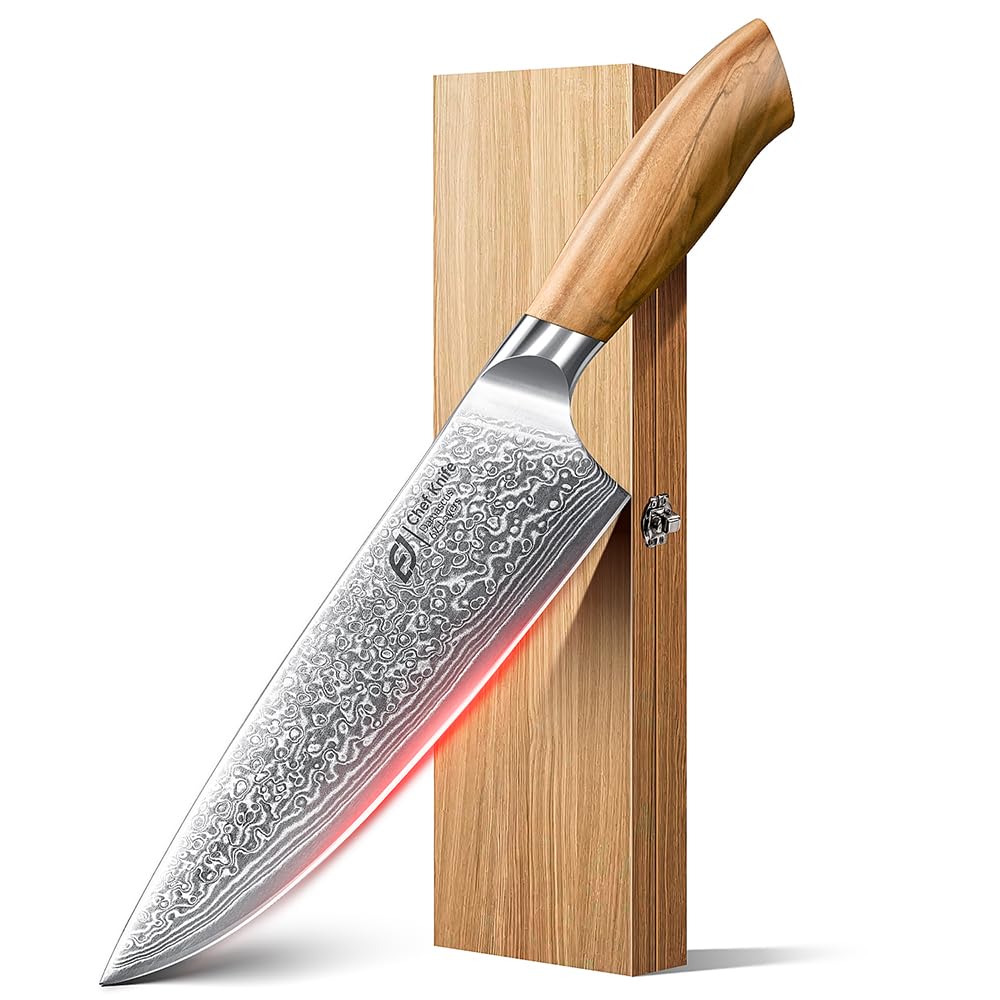
3. Emojoy 8-Inch Damascus Chef Knife
Real 67-layer steel and olive wood, at the price of a plain stamped knife.
What defines this knife is 67 layers of Damascus steel at 58 HRC (a hardness scale for steel) — slightly softer than the top picks, so the edge is a little more forgiving if it meets a bone or a board tap. The blade is hand-sharpened to a 15° edge and carries a genuine rust-proof folded pattern rather than a print, so it keeps its looks over time.
The CALABRIAN olive wood handle is the part you will notice daily: its organic shape fits a range of hand sizes, and the half-bolster design lets you slide your hand right up to the edge for easy control. That comfort is a big part of why the ergonomics draw so much affection from owners. It slices meat, fish, and vegetables with ease and even handles partially frozen poultry, and it comes in a wooden box that makes it a ready-made gift.
Where it stands apart from the pricier picks is edge longevity: the softer 58 HRC steel will want a touch-up sooner than a 62+ blade. It is the easiest entry into genuine Damascus, and the build is honest for the tier.
Best for: a first real Damascus knife or a gift that looks far more expensive than it is.
Know going in: the softer 58 HRC edge trades a little retention for toughness, so plan on regular honing.
4. TIVOLI Damascus Nakiri Knife 6.5 Inch

A flat-edged vegetable specialist with a traditional Japanese sharpening finish.
Nakiri shapes are built for one job — coming straight down through vegetables, herbs, and anything you want in clean slices. This one is forged from VG10 steel with a Rockwell hardness of 60–62 HRC, oil-quenched and hand-finished with the Honbazuke sharpening method, a traditional three-stage process that produces a keen, even 15° edge. The Damascus cladding adds durability and rust resistance, so the blade holds up to daily cooking.
The sloped bolster and natural olive wood handle support a secure pinch grip and stay comfortable through a long prep session. What you feel most is the control — chopping and dicing feel balanced rather than top-heavy. The blade runs 7 inches, so it is shorter than the 8-inch chef knives here, which makes it easier to steer in tight board space.
Plan on upkeep: a few cooks mention needing to resharpen every 2-3 weeks, and durability feedback is mixed. This one rewards someone happy to maintain a fine edge, not a knife that sits in a drawer forgotten. The gift-box packaging and lifetime warranty round it out.
The case for the nakiri: a VG10 core at 60–62 HRC with a true Honbazuke 15° edge, tuned for flat-down vegetable work.
Fair caution: the fine edge benefits from regular maintenance — treat resharpening as part of ownership, not a flaw.
Right for you if: vegetables are the center of your cooking and you want a dedicated flat-edge blade.
Look elsewhere if: you want one knife to break down whole chickens and carve roasts too.
5. Damascus Kitchen Knife Set 3 PCS, Ultra Sharp Chef Knife Set

Three real forged blades — chef, santoku, and utility — in one gift box.
For someone starting a kitchen from scratch, a single chef knife leaves gaps. This Topfeel set covers the three most useful shapes at once: an 8-inch chef’s knife, a 7-inch santoku, and a 5.5-inch utility knife. Each blade is forge-welded from 33 layers, folded and beaten to a total of 67 layers around a VG-10 steel core, reaching 60±2 HRC for lasting sharpness and rust resistance.
Wooden handles balanced in length and weight keep the knives steady in your hand rather than tip-heavy. The set arrives in a gift box that suits a housewarming or wedding present. The knives are genuinely Damascus, with the wavy pattern running through the metal. The catch is the track record: the set carries a 60-day money-back and lifetime replacement warranty, but there is little independent feedback to lean on yet. Choose it for the shape variety and the honest layer count, not for proven reviews.
If you already own a good chef knife, a single premium blade will serve you better; if you are outfitting a first kitchen, this covers more ground.
Choose this if: you want three forged Damascus shapes and a gift-ready presentation in one go.
Consider a single knife instead if: you already have a chef blade and only want to upgrade that one slot.
6. WeKit Chef Knife 8 Inch

A hard 62+ HRC VG10 blade that slices meat like it is softening butter.
This WeKit chef knife leads with the same high-end formula as the top picks: a VG10 vacuum heat-treated core at 62+ Rockwell hardness, wrapped in 66 layers of high-carbon stainless steel. That means strong edge retention and stain resistance without a hefty price jump. The forged edge is sharpened to 10-15° per side and is built to stay that way through slicing meat, chicken, steak, and sushi.
The G-10 handle is treated to resist heat, moisture, and cold, and it stays comfortable even during long sessions. Owners describe the blade as a true Damascus knife that holds its edge and feels balanced in the hand, and the fish-bone surface pattern gives it real visual character. A sheath is included for safe storage.
The honest caveat is durability: a few cooks report rust showing within 30 days when the blade is left wet, so dry it promptly after washing. Kept clean and dry, it is a sharp, well-balanced performer for the money.
Why it stands out: a 62+ HRC VG10 core with 66 high-carbon layers, G-10 handle, and a coming-in sheath at a friendly tier.
The maintenance note: dry the high-carbon blade right after washing — durability feedback flags rust if it stays damp.
Great match for: a cook who wants a hard, sharp VG10 chef knife and does not mind wiping it dry.
Think again if: you tend to leave knives soaking in the sink.
7. KYOKU Chef Knife 8″ Shogun Series

A Japanese-made 67-layer blade with a fiberglass handle built for long shifts.
A made-in-Japan 67-layer VG-10 Damascus blade (VG-10 is a hard stainless steel) gives the Kyoku Shogun its edge. It is cryogenically treated (cooled to very low temperatures to relieve stress in the steel) and sharpened to an 8 to 12 degree edge with the traditional three-step Honbazuke method. The 58-60 HRC steel resists corrosion and holds its edge, and the hammered Damascus face is genuinely striking.
The fiberglass handle with its signature mosaic pin shrugs off cold, heat, corrosion, and moisture, and the sheath and case keep the blade protected between uses. It is easy to handle and clean, cuts an onion with almost no push, and holds its balance in the hand. The blade quality is the thing people come back to again and again — it is the reason this is the most-reviewed knife on the list.
At 13.2 inches overall it is a full-size chef knife, so it needs a little drawer or block space. Otherwise it is a dependable daily driver for anyone who cooks hard.
What it brings: a made-in-Japan 67-layer VG-10 blade at 58-60 HRC, cryogenic treatment, and a sheath-plus-case package.
Space to plan for: 13.2 inches overall means it wants a proper home on the counter or in a block.
Pick it up if: you want a Japanese-made chef knife that handles daily chopping and slicing with a weighted, comfortable handle.
Skip if: you are short on storage space for a 13.2-inch knife.
8. NANFANG BROTHERS 9-Piece VG10 Damascus Knife Set, ABS Handle

Nine pieces that outfit an entire kitchen, from paring knife to shears.
This set is about coverage. You get an 8-inch chef knife, 8-inch slicing knife, 8-inch bread knife, 7-inch santoku, 5.5-inch utility knife, 3.5-inch paring knife, kitchen shears, a honing rod, and a wooden storage block. Every blade uses a genuine Japanese VG10 steel core (10Cr15CoMoV) surrounded by 67 layers of high-carbon steel, precision heat-treated to 60±2 HRC for sharpness, edge retention, and corrosion resistance.
The Damascus pattern is forge-welded into the core through repeated folding, so unlike laser-printed fakes it will not fade or wear off. The ABS handles provide a secure grip and good balance to cut hand fatigue, and the included honing rod makes keeping the edge easy. It slices cleanly through meat and vegetables, and the forge-welded pattern looks sharp on a counter.
The honest notes: a few cooks flag material inconsistency and some report chips or rust, so keep the blades dry and honed. For the range of tasks covered, it is a great value for someone equipping a whole kitchen at once.
What you get in the box
- Nine pieces covering chef, bread, santoku, utility, paring, shears, and honing
- Genuine forge-welded VG10 core with 67 folded layers, not printed
- Heat-treated to 60±2 HRC for lasting sharpness
- Wooden storage block keeps everything organized
Keep these in mind
- Material feedback is mixed — the pattern is real, but some cooks want more consistency
- A few note chips and rust, so dry and hone regularly
Best for: a family kitchen that needs every blade covered in one purchase, with a block to hold it all.
Not for you if: you’d rather invest in one exceptional chef knife than six good ones.
9. HENCKELS Compass Damascus 7-inch Damascus Santoku Knife

A 7-inch santoku with a 23-layer pattern and a well-known kitchen name.
This is a santoku through and through — flat-edged, 7 inches long, and built for the three moves detailed vegetable work needs: mincing garlic, slicing cucumber, and dicing onions. It uses a 23-layer Damascus construction, folded, heated, and forged into a wavy pattern that is then darkened with an acid wash to bring out the texture. The handle is POM plastic, a durable resin that resists water and everyday wear.
At 8 ounces and 11.5 inches overall, this compact santoku (a wide, flat-edged vegetable knife) is a manageable size for most boards, and the striking finish is the draw. Weigh the feedback first: quality and sharpness both come back mixed overall, so this is a fit-based choice rather than a proven performer. It suits owners who want a specific santoku shape from a recognized brand like Henckels. If you want the most consistent edge across a whole set, the VG10-heavy picks here tell a steadier story.
Where it fits: a name-brand 7-inch santoku with a 23-layer pattern and an acid-washed finish for detailed prep.
The honest read: quality and sharpness feedback are mixed, so choose this for the shape and brand more than for a long track record.
Consider it if: you want a compact santoku from a brand you recognize for garlic, cucumber, and onions.
Look to the VG10 picks if: a consistent, hard edge is your priority over brand name.
10. Wakoli EDIS Damascus Kitchen Knife Set 4-Piece

Four well-chosen blades in a luxury wooden box, honed for fine slices.
Four shapes that earn their place, not a block full of rarely used ones: a santoku (11.8″ overall, 6.7″ blade), a carving knife (12.2″ overall, 7″ blade), a small santoku (9″ overall, 4.7″ blade), and a paring knife (7.5″ overall, 3.4″ blade). Each blade wraps 67 layers of Damascus steel around a VG10 core (a hard stainless steel), and each is manually honed to a 12-14° cutting angle for smooth, controlled slices.
The hardened VG10 core holds around 60±2 HRC, which means the edge stays sharp with less frequent sharpening. The contoured Pakkawood handles stay secure and comfortable and reduce hand fatigue, so even the small santoku feels steady during detailed trimming. The set is beautifully arranged in a wooden gift box, making it a strong anniversary or holiday present for someone who cooks seriously.
The value call takes a little faith: opinions on whether the set is worth the spend are mixed, so it rewards buyers who want a curated, gift-worthy set over the widest possible range. On sharpness, the knives arrive ready to cut right from the start.
A smart buy if: you want four genuinely useful shapes with hard VG10 cores, presented in a luxury box.
Second-guess it if: you would rather spend the same on one top-tier chef knife.
11. Magnetic Kitchen Knife Block Set 6 pieces
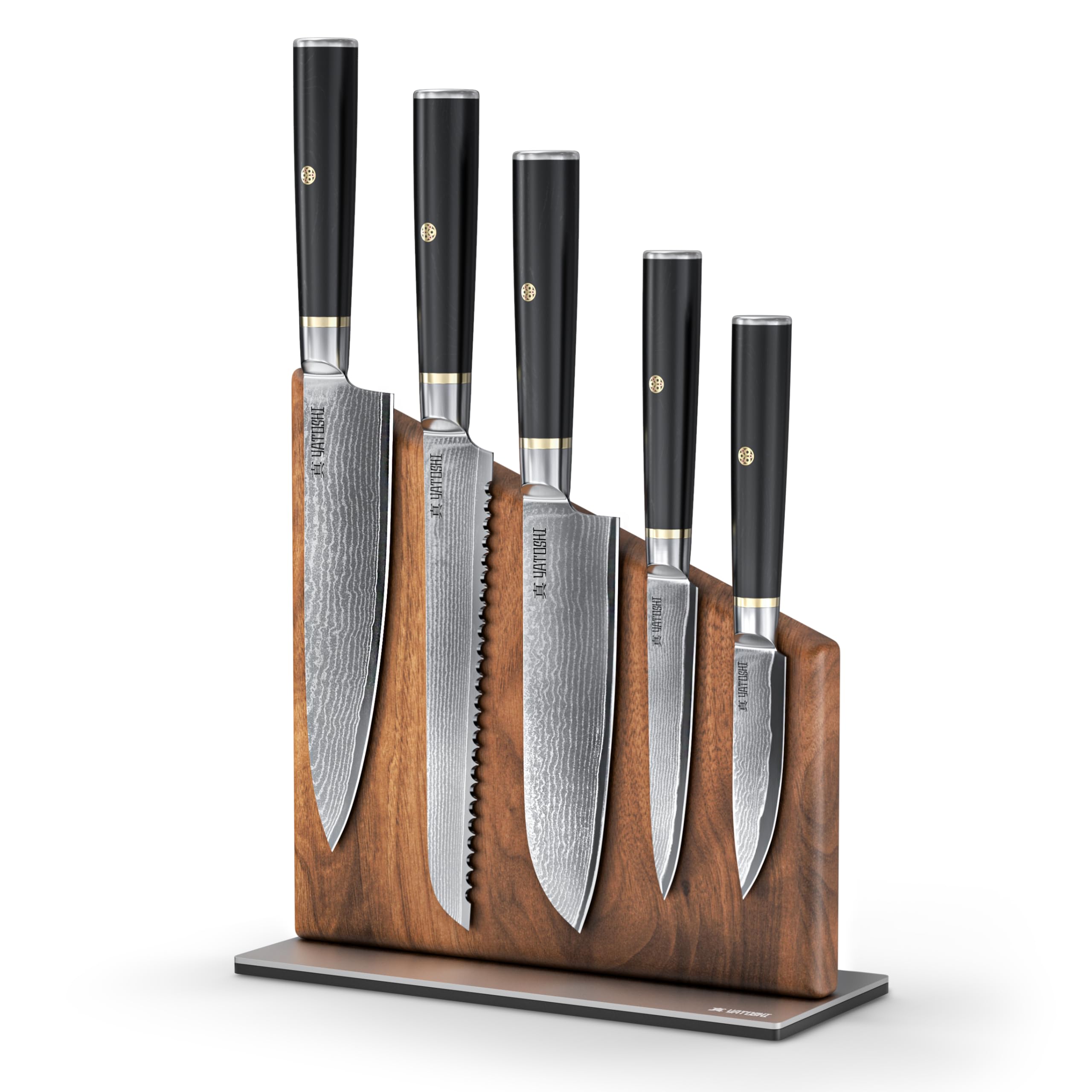
Five VG-10 blades on a double-sided magnetic walnut block with anti-skid feet.
This Yatoshi set puts the display front and center. A double-sided walnut magnetic block holds five knives — 8″ chef, 8″ bread, 7″ santoku, 5″ utility, and 3.5″ paring — with anti-skid pads to keep the whole thing steady on the counter. Each blade uses a VG-10 cutting core wrapped in 67 layers of stainless Damascus cladding, at a 60-61 Rockwell hardness and a hand-shaped 16° double-bevel edge.
The textured G10 handle and concealed-tang design keep the grip secure and the weight balanced, and the blades hold a good edge. The double-sided walnut block and black Damascus blades make it a display piece on the counter. What makes this one a fit-based call rather than a sure thing is long-term durability: some buyers report the block cracking within the first week and handles turning yellow after three months, alongside rust resistance concerns. The blades themselves are the strong part; the block and handles are where you want to inspect on arrival and treat with care. Keep the blades dry and the set clean to get the most from it.
What’s genuinely strong
- Five VG-10 core blades at 60-61 HRC with 67-layer cladding
- Double-sided walnut magnetic block with anti-skid feet
- G10 concealed-tang handles for a secure, balanced grip
- Sharp blades that hold a good edge
Where buyers hit friction
- Durability and rust resistance feedback is negative overall
- Some report the block cracking early and handles discoloring over time
- Wants careful drying and a close look on unboxing
Matches well with: a cook who loves a magnetic display block and will keep the blades wiped dry.
Not ideal if: you want a low-maintenance set you can leave damp on the counter.
Know the Specs
Layer Count: What 67 Layers Really Means
Layer count is the number of steel sheets forge-welded, folded, and hammered into the blade. A higher count, like the 66 or 67 layers on the top picks, makes the pattern run through the whole blade rather than sit on the surface. That means the wavy grain will not fade or rub off in the sink — the practical benefit is a knife that still looks and performs the same in year three as it did on day one. A low layer count with a printed or etched design is the cosmetic version, and the pattern disappears with use.
HRC Hardness: Edge Retention Versus Toughness
HRC is a hardness score for the steel, and it decides how a knife behaves. A higher number — a 62+ HRC blade, for example — holds a sharp edge longer between sharpenings but is more brittle if it meets a bone or a careless board tap. A slightly lower 58-60 HRC blade is a little tougher and easier to straighten, but wants honing sooner. For most home cooks the 58-62 range is the practical zone: sharp enough to glide through vegetables and forgiving enough to survive real-world handling.
Common Questions
How can I tell a real Damascus blade from a printed one?
Does a higher HRC number mean a better knife?
Will an 8-inch chef knife work for a smaller hand?
Will Damascus kitchen knives rust if I leave them wet?
How often will I need to resharpen a Damascus chef knife?
Is a nakiri or santoku better than a chef knife for vegetables?
What is the difference between G-10, Pakkawood, and olive wood handles?
Do Damascus knife sets need special care compared to a single knife?
Can a Damascus chef knife go in the dishwasher?
Which blade length should I start with if I only want one knife?
The Bottom Line
For most cooks, the damascus kitchen knives winner is the Dalstrong 8″ Japanese Chef Knife Gyuto. Its 62+ HRC AUS-10V core (a hard stainless steel) inside 66 Damascus layers holds a fine 8-12° edge through onion dicing and portioning chicken. It also carries the largest review base here: 4.5+ stars across 2,700+ owners. Want a lighter, gift-ready single blade for smaller hands? The VEROXIS 8 Inch Chef Knife at 8.8 ounces is the one. For a vegetable-first cook, reach for the TIVOLI Nakiri. Outfitting a whole kitchen in one move? The NANFANG BROTHERS 9-Piece Set covers every blade with a genuine 67-layer VG10 core, plus a honing rod, shears, and block. One honest nudge: hold out for a genuine 67-layer blade with a hard VG10 core. The cosmetic etched imitations cost you an edge that will not last, and the picks with a real core are the ones worth bringing home.
How we choose
We do not accept paid placement. Every pick is matched to a real buyer and a real use-case; we do not hands-on test units.
Sources
Specifications: manufacturer listings and product documentation. Review insights: verified customer reviews, as of October 2026. Pricing: not shown on this page (it changes often); check the current price via the retailer link.
As an Amazon Associate, Aappliancez earns from qualifying purchases. This does not affect which products we feature.