Disclosure: Some links in this post are affiliate links. As an Amazon Associate I earn from qualifying purchases, at no extra cost to you. Learn more
Specs are compiled from manufacturer listings and verified buyer reviews and can change over time — please confirm the key details on the product page before buying.
Poaching eggs in a swirling pot of water is the step most people give up on by the second Sunday. The fix is a pan with cups: you drop eggs into shallow simmering water, clamp on the lid, and pull out neat rounds that hold their shape. A pan with thin cups and a loose lid gives you rubbery whites and stuck eggs; a pan with deep cups and a tight tempered-glass lid gives you Eggs Benedict without the panic.
This guide is built by comparing the manufacturers’ published specifications and the patterns across verified customer reviews, so you get each pick’s real strengths and trade-offs instead of marketing spin.
Every pick below is here for a different reason, from cup depth to stove compatibility to how the insert lifts out of boiling water. Read on for the real differences that decide which pan for poaching eggs earns a spot on your hob.
Top Picks


How To Choose The Best Pan for Poaching Eggs
You can poach eggs two ways, and buying the wrong one is the most common mistake. A dedicated poacher is a full pan with a lid and a tray of cups that sits in shallow water. An insert is just a tray that drops into a skillet you already own. Both work. Your choice depends on counter space, how many eggs you cook at once, and if you want the pan to do a second job.
Dedicated poacher or skillet insert
A dedicated poacher gives you the steadiest result because the cups, lid, and water level are all designed together. An insert costs less and stores flat, but you must match its diameter to your skillet. HIC’s 3-egg insert needs an 8-inch pan or larger; Nordic Ware’s 4-egg insert needs a 10- to 12-inch skillet. Measure the flat cooking surface, not the rim, before you buy.
Cup depth and cup material
Eggs need room to set into a round instead of spreading flat. Cups around 75 ml hold an extra-large egg comfortably; shallow cups crowd a large yolk and force the white up over the rim. Cups come in nonstick-coated steel, plain stainless, and silicone. Coated steel releases cleanly when new but can flake with hard scrubbing. Plain stainless lasts but needs butter or oil every time. Silicone releases well and stores small, yet can float if the water runs deep.
How the water behaves under the lid
Steam does most of the cooking once the lid goes on, so lid fit is not a detail. A tight tempered-glass lid with a vent hole traps the right moisture and lets you watch the whites set. Lids that sit loose let steam escape and stretch the cooking time. Most poachers here want roughly half an inch to one inch of simmering water in the base — enough to steam, not enough to boil over.
Stove compatibility
If you cook on induction, the base must contain magnetic metal or carry a magnetized plate. Several stainless poachers here state induction compatibility in the listing; the Farberware Glide, EXCELSTEEL 6-cup, CozyKit 2-cup, and Eggssentials pans all name it. On gas or electric coil, almost any base works, so you can choose purely on cup design.
Side-by-Side Comparison
Every row below compares the same three things: how many eggs fit at once, what the cups are made of, and whether the pan works on an induction hob (a flat magnetic cooktop). Scan straight across to spot the trade-off. If a spec isn’t stated in the listing, it reads as a dash.
| Model | Best For | Egg Capacity | Cup / Body Material | Induction | Amazon |
|---|---|---|---|---|---|
| Eggssentials 2-Cup Poacher★ Best Overall | Two perfect eggs, solo breakfasts | 2 XL cups (75 ml) | Nonstick cups, stainless body | Stated compatible | Amazon |
| Demeyere Resto 4-Cup SetPremium Pick | Cooking for one in style | 4 cups (1.5 qt pan) | Nonstick cups, 18/10 stainless | Stated compatible | Amazon |
| Modern Innovations Poacher PanTop Performer | Big family brunches | 4 cups (45 ml each) | Teflon-coated cups, 18/8 stainless pan | — | Amazon |
| Eggssentials 2-in-1 Poacher & Fry Pan | One pan that does everything | 4 cups | Nonstick cups, granite nonstick pan | Magnetized base stated | Amazon |
| OXO Good Grips Silicone Set | Collapsible storage in small kitchens | 2 silicone pods | Silicone, BPA free | — | Amazon |
| EXCELSTEEL 6-Cup Poacher | Batch cooking for a crowd | 6 cups | Nonstick cups, stainless body | Stated in listing name | Amazon |
| RUNZI 6-Cup Poacher | Large batches with a spatula included | 6 XL cups (75 ml) | Nonstick cups, stainless body | Stated compatible | Amazon |
| Farberware Glide Copper Ceramic | Nonstick release in a compact pan | 4 nylon cups (1.22 qt) | Nylon cups, aluminum pan | — | Amazon |
| Norpro Stainless Steel Skillet Set | Stainless cups that won’t flake | 5 cups (1 L pan) | Stainless cups, tri-ply base | — | Amazon |
| EXCELSTEEL Tri-Ply 4-Cup | Copper-accented cookware | 4 cups | Nonstick cups, copper/stainless tri-ply | — | Amazon |
| CozyKit 2-Cup Poacher | Compact induction setup | 2 XL cups (75 ml) | Nonstick cups, stainless body | Stated compatible | Amazon |
| Norpro 992 4-Egg Insert | Using a skillet you already own | 4 cups (8.5 in) | Nonstick, alloy steel | — | Amazon |
| Nordic Ware Insert | 10- to 12-inch skillets | 4 eggs (12 in) | Nonstick, thick aluminum base | — | Amazon |
| HIC 3-Egg Insert | Small pans and small batches | 3 cups (6.3 in) | Nonstick carbon steel | — | Amazon |
| YomiFamily Silicone Cups | No extra pan at all | 4 silicone cups (3.93 in) | Thickened silicone, BPA free | — | Amazon |
Detailed Reviews
1. Egg Poacher Pan Nonstick Coating by Eggssentials
Our pick — 4.5+★ from 12,500+ verified ratings; the strongest balance of quality and price.
The two-egg poacher that made oversized cups and a clean slide-out the standard.
This is the pick for the person who eats two poached eggs most mornings and wants them identical every single time. The cups hold 75 ml, which is roomy enough for an extra-large egg to set into a proper round instead of a flat puddle. The base is stainless steel with a 3-ply aluminum encapsulated bottom — three bonded layers, with aluminum in the middle so heat spreads across the pan instead of pooling under one spot. The result is even cooking without the hot patch that browns one white while the other stays raw.
The cup design is where this earns its place. Each cup is polished stainless with a PFOA-free nonstick coating, and the knob on top is Bakelite, a hard heat-resistant plastic that stays cool enough to lift without a towel. The lid is extra-thick tempered glass with a steam vent, so you can watch the whites firm up through the glass without lifting the lid and dumping your steam. What owners talk about most is how little scrubbing the cups need — eggs turn out of them clean, and the cups go straight into the dishwasher.
The two-cup size is the honest limit here. Cooking for four means two rounds of poaching, and the pan itself is compact, so plan on it for solo breakfasts or couples rather than a full brunch table. The other thing to know is that a nonstick coating rewards gentle handling — no metal utensils in the cups, and hand-washing if you want the release to last.
What the cups get right
- 75 ml cups take an extra-large egg without the white spilling over
- 3-ply aluminum encapsulated base spreads heat evenly across the pan
- Tempered glass lid with vent holds steam and lets you watch the set
- Nonstick cups release clean and go in the dishwasher
- Stainless body works on all stove types, induction included
Where it stops short
- Two cups means batches for a family, not a single round
- Nonstick coating needs soft utensils and gentle washing to last
Reach for this if: you want two XL poached eggs with almost no cleanup and a lid you can see through.
Look elsewhere if: four or more eggs at once is your normal weekend, where the six-cup RUNZI below saves a second round.
2. Demeyere Resto Egg Poacher Set
A 1.5-quart stainless set built like real cookware, sized for cooking for one.
You get four nonstick cups and a 1.5-quart stainless pan, which is more poacher than one serving needs — and that is exactly how people use it: poach one perfect egg, then use the round pan for something else. The body is 18/10 stainless steel (an alloy with 18 percent chromium and 10 percent nickel), so it resists staining and holds up to daily heat. It works on all cooking surfaces, induction included, and both the pan and the PFOA-free cups (made without the nonstick chemical PFOA) are dishwasher safe.
Here is a real head-to-head. The Demeyere measures 14 x 8 x 5.5 inches, while HIC’s 3-egg insert runs 6 x 6.38 x 1 inches. The Demeyere is the full-pan experience; the HIC is a tray that drops into your existing skillet. That size gap is the whole argument: the Demeyere gives you a lid, a deep water base, and four cups working together, while the insert gives you flat storage and a smaller footprint.
What wins people over is the solidity. It reads as a piece of cookware rather than a gadget, and the tempered glass lid seals to steam the eggs while you watch. The trade-off is that a 1.5-quart pan is short on working room if you want to poach four eggs and then fry something alongside — it is not a batch pan. It is the quiet, long-term buy for someone who cooks for one and wants the pan to outlast the trend.
The build payoff: 18/10 stainless resists staining, the glass lid shows the set, and the whole set goes in the dishwasher — no special care routine to remember.
Room to consider: 1.5 quarts of water base means small batches; if four eggs at once is the goal, the capacity is tighter than a six-cup poacher.
Best matched to: a single-egg cook who wants one handsome stainless pan rather than three plastic gadgets.
Not your pan if: weekend brunch for four lives in your house — the cup count stays at four with no second tray.
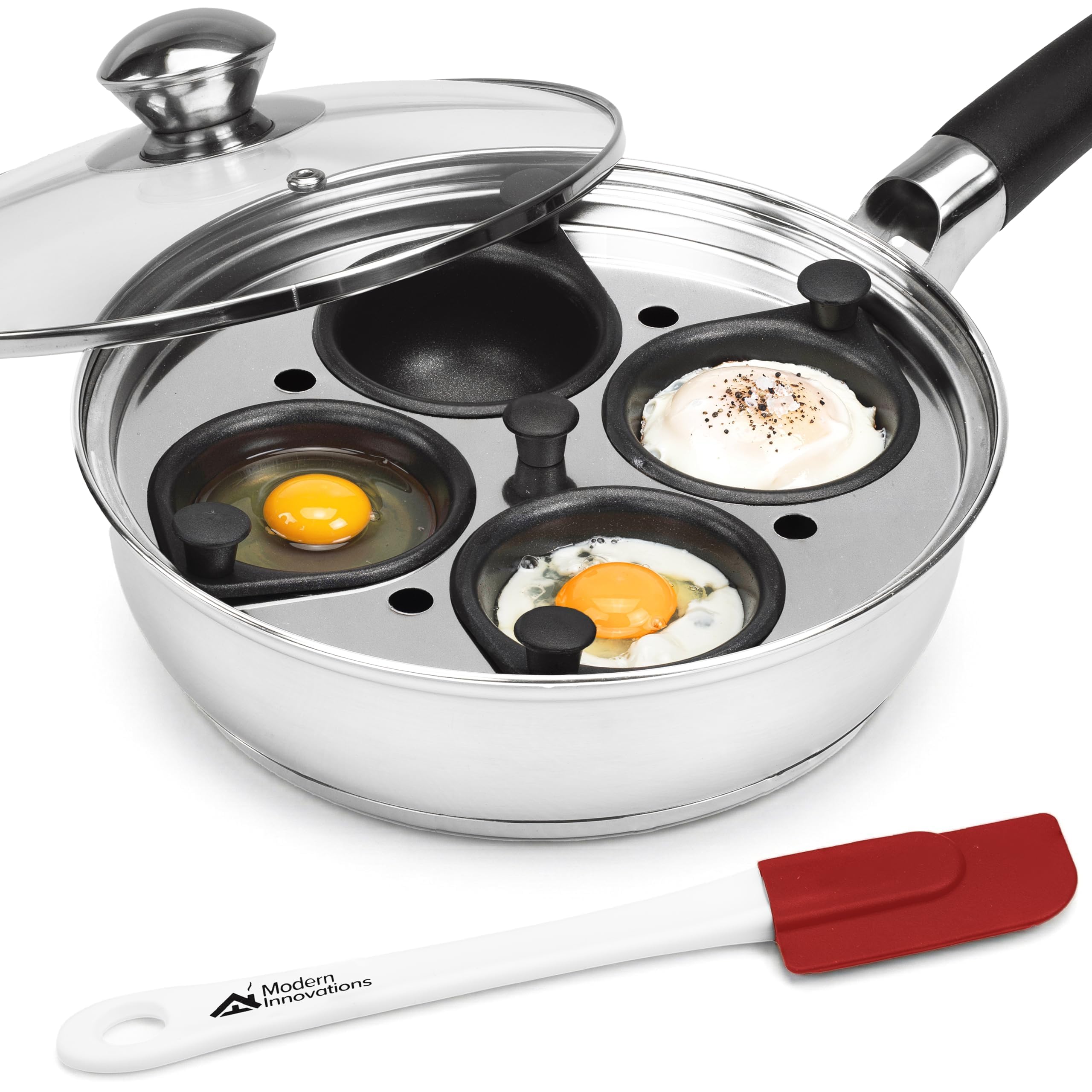
3. Modern Innovations Egg Poacher Pan
Dishes, appearances and everyday poaching in one 8-inch pan that cleans up fast.
An 8-inch 18/8 stainless pan with a tempered glass lid, a removable tray, four nonstick cups, and a silicone spatula is the full kit in one box. The stainless steel pan lets the eggs cook over 2 cups of water with steam passing through the small holes in the insert, so you are steaming the eggs rather than boiling them. The glass cover tracks the whites setting so you know when to lift the tray.
The cups are the detail that makes this a small-sauté pan for eggs alone. They are deep enough to hold one large egg with room to spare, which means you can season a yolk before it sets or drop in a little cheese without it spilling over the edge. The silicone spatula that comes with it is designed to get under the egg and lift it clean, and the pan and insert are dishwasher safe. The listed dimensions land around 4 inches tall with the lid on, so it tucks under most wall cabinets.
Buyers praise the ease of use most: the tray lifts with a stay-cool handle, the eggs come out clean, and the set looks good enough to sit on the stove instead of in a cupboard. The recurring gripe is release consistency — the nonstick does most of the work, but a little oil in the cups closes the gap. That is a small extra step, not a flaw that changes the recommendation.
The case for grabbing it
- Full kit: 8-inch stainless pan, glass lid, tray, four cups, silicone spatula
- Deep cups hold one large egg and let you season before the set
- Dishwasher safe with a stay-cool pan handle
- Compact 4-inch height with the lid on
The fine print
- Some eggs hold firm in the cups unless you add oil first
- The Teflon-coated cups need soft tools to avoid scratching
Worth your counter space if: you want a complete poacher that also looks tidy on the hob.
Pause first if: you insist on a no-oil release — coat the cups lightly and the eggs slide out as expected.
4. Eggssentials 2-in-1 Egg Poacher and Fry Pan
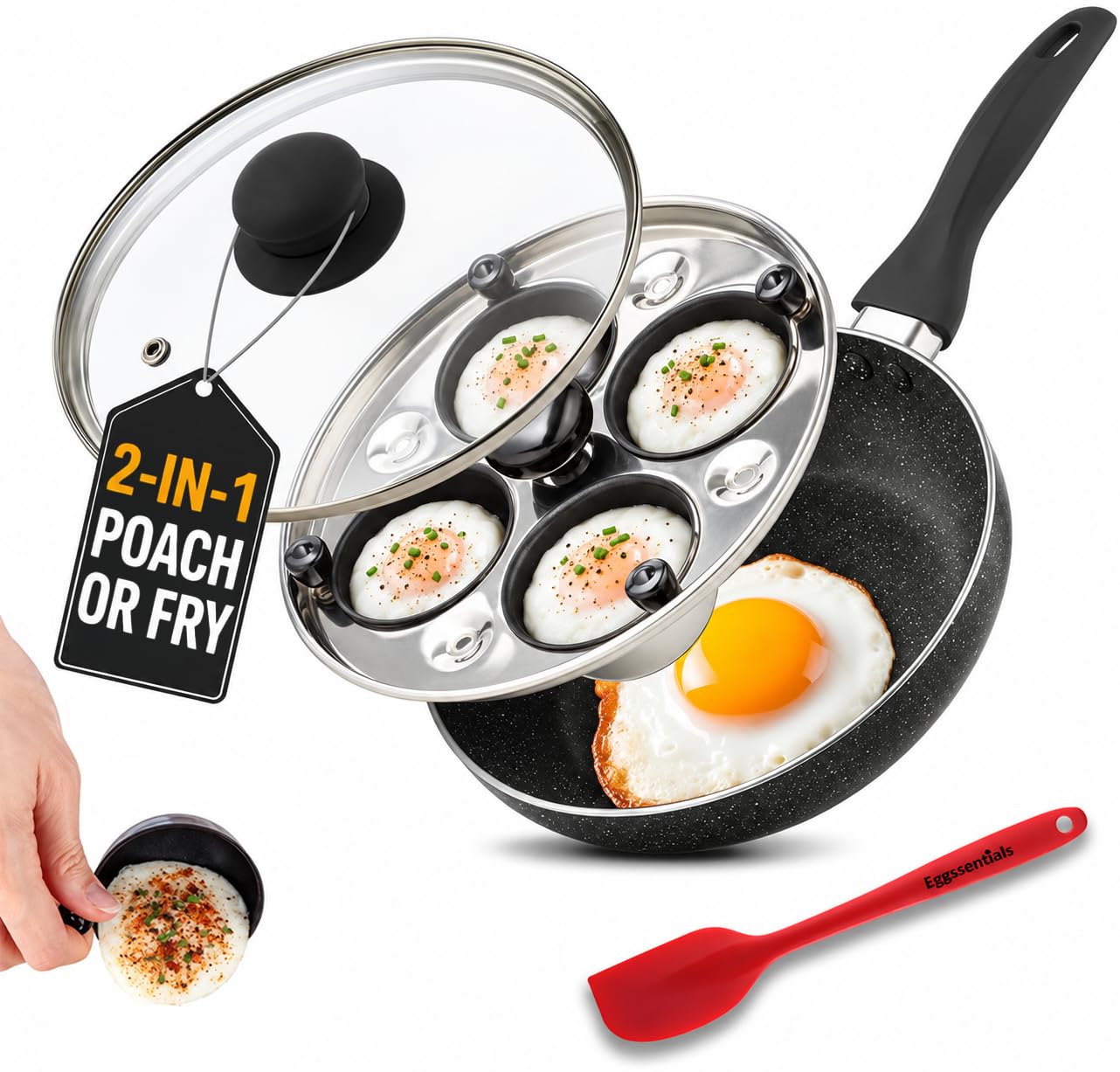
Poach four eggs, then fry the bacon in the same granite pan.
This is the one for the cook who wants a poacher and a skillet but only has one burner worth of cabinet room to spare. The base is an 8-inch stone-granite nonstick pan with a hardened scratch-resistant coating, quoted at 2 inches deep with a triple coating. The cups are double-coated nonstick and built to hold extra-large and jumbo eggs. Pull the tray out and the same pan fries eggs and omelets.
The base carries a magnetized plate so it works on induction stoves, and the quick-cool Bakelite knobs on the cups make the tray liftable without a cloth. The extra-thick tempered glass lid vents steam so the whites set without a watery film, while the soft-touch Bakelite handle stays cool while you cook. The listing names seven ways to use it — from poached eggs to omelets to hard-boiled eggs without a shell — and every one starts with the same four-cup tray or the bare pan.
Here is the real-world evidence: eggs come out of this tray in about four minutes, and the nonstick is strong enough that most of them drop loose on their own. The granite coating also takes the wear of a frying pan, which is exactly what you are buying — the poaching tray is not the whole product, it is half of one.
Two pans, one footprint: an 8-inch granite nonstick skillet plus a four-cup poacher tray means you cover breakfast in one piece of cookware.
Worth noting: the nonstick on both the pan and the cups is the wear point, so hand-wash and soft utensils keep it working longer.
Grab it for: a small kitchen where one pan has to earn its keep as both poacher and skillet.
Think twice if: you already own a good 8-inch skillet — the poacher half is what you are really paying for.
5. OXO Good Grips 2 Piece Silicone Egg Poaching Set

The silicone pod that behaves like a mini water bath and folds flat in a drawer.
These two silicone pods replicate the classic water-bath poach without a dedicated pan. Each pod has a funnel shape that guides the cracked egg into the water so the yolk stays intact, plus a hole pattern that moves water all around the egg for even cooking. The pods are designed to sit in a pot you already own, and the marking inside shows you how much water to add.
What matters for storage is the collapse — the silicone flattens down so two pods disappear into a utensil drawer. The material is high-heat resistant, BPA free, and dishwasher safe, and the silicone tab is what you grab to lift the pods out of hot water. Buyers report the whole process runs to about three and a half minutes, and four eggs can go into one pot at once using two sets.
The catch is the water-bath dependence: the pods need a pot wide and deep enough to hold them, so they are not a shortcut for someone who owns no decent saucepan. And the silicone itself is what limits the batch — two pods per set, so a bigger breakfast means a second set. It is the right pick for storage-starved kitchens where a stainless poacher would live permanently on the counter.
Why the pods work
- Funnel shape guides the egg in and protects the yolk
- Hole pattern moves water around the egg for even setting
- Collapses flat for drawer storage
- Dishwasher safe and BPA free
What to weigh
- Needs a pot wide and deep enough to hold the pods
- Two pods per set, so batch size is fixed
The drawer-space answer: silicone pods that poach four eggs across two sets in one pot.
Rule it out if: you have no saucepan that fits them — this is a poaching insert for a pot you own.
6. EXCELSTEEL Non Stick 6 Cup Egg Poacher

Six eggs, one lift, and a glass lid that keeps an eye on all of them.
Six cups in a single stainless pan is the answer to the question every brunch cook asks: how do I serve everyone at once? The cups have a center knob that lifts all six at the same time, and the pan is stainless with a stay-cool handle. It goes in the dishwasher, and the nonstick coating on the cups lets the eggs come out in one piece once you get the timing and the oil right.
Steam does the work here rather than a deep water bath. The listed method calls for a modest amount of water in the bottom, a simmer, and steam under the glass lid. The bottom is thin rather than heavy, which heats fast on an induction ring — one of the more practical touches, because thinner steel reaches temperature quickly. The trade-off is that a thin base can warp over time with repeated high heat, so keep the burner moderate.
Poaching for a crowd is the whole point here, and the six cups are genuinely large enough to hold a full-sized egg. The eggs release cleanly if you spray the cups with vegetable spray first. As one buyer put it: “The easiest way to make poached eggs and I even use it for egg whites.” That range — from a runny-yolk breakfast to poached egg whites — is why a six-cup pan earns its cabinet space.
Built for the batch: six cups, one center knob to lift them all, and a stay-cool handle on a stainless body.
The honest limit: the thin bottom heats fast and can wear with high heat, so keep the flame or ring in the middle range.
Serve the table with: six eggs at once when friends show up and the coffee is already poured.
Skip if: you poach one or two eggs a day — six cups is a lot of tray to wash for a solo serving.
7. RUNZI 6-Cup Egg Poacher Pan with Silicone Spatula

Six oversized cups, a tempered glass lid, and a stainless body that takes induction.
Six 75 ml cups is the largest single batch in this group that still runs as a dedicated poacher. The pan is stainless steel with a 3-ply aluminum encapsulated bottom for even heat, and the cups are polished stainless with a PFOA-free nonstick coating. The lid is extra-thick tempered glass with a vent, and the cups and pan are dishwasher safe.
The comparison worth making is against the Eggssentials two-cup pan at the top of this list. Both use the same 75 ml cup size and the same 3-ply encapsulated base, so the eggs cook the same way — but the RUNZI gives you six of those cups instead of two. The trade-off is footprint: a six-cup pan takes a wide burner and a lot of cabinet room. If you have the space and you make brunch for a crowd, the size pays off.
What earns the value label is that the extra cups come with no loss in cup size or coating quality. Eggs release cleanly when the cups are lightly oiled, and the included silicone spatula gets under an egg without scratching the finish. The catch to know about is release consistency across all six cups — a little oil in each one keeps the set working evenly.
Why six cups wins
- Six 75 ml cups hold extra-large eggs with room to set
- 3-ply aluminum encapsulated base spreads heat evenly
- Tempered glass lid with vent and dishwasher-safe parts
- Works on all stove types, induction included
- Silicone spatula included for clean lifts
What you live with
- A six-cup pan takes wide burner and cabinet space
- Egg release depends on oiling each cup first
Right for the brunch host: six oversized cups in a stainless body that handles induction and the dishwasher.
Not for the solo cook: a six-cup tray is more pan than one breakfast needs to wash.
8. Farberware Glide Copper Ceramic Egg Poacher Pan

A ceramic-coated pan that promises a copper-slick release and a bright accent on the hob.
Farberware coats this pan in CopperSlide, a copper ceramic nonstick the maker claims releases food 90 percent better than major ceramic competitors — a manufacturer figure, not an independent test. The pan is 1.22 quarts of dishwasher-safe aluminum, 8 inches across, with a shatter-resistant glass lid that traps heat and moisture. Four nylon cups are meant to set the eggs into clean rounds.
The copper ceramic finish is what you are actually shopping for here. Claimed release matters most with eggs because a torn white is the whole failure mode of poaching. A shatter-resistant lid is a practical touch as well: glass lids fail at the rim when knocked, and a shatter-resistant one takes a bump better. The comfortable easy-hold handle with the copper accent is a small style point, but it works on a stovetop people look at.
The cups are the part to think through. The four poaching cups are nylon, and nylon has a lower melting point than the ceramic-coated pan, so they need to stay above the water line and off a bare flame. Nylon is not flimsy in a water bath, but it is the wear point on this design compared with stainless or Teflon-coated cups. The oven-safe rating applies to the pan and lid, not the cups, so keep the cups on the stovetop.
The release story: a copper ceramic nonstick coating with a claimed 90 percent better release than major ceramic competitors, plus a shatter-resistant glass lid.
The part to watch: nylon cups — they work above the water line but need gentle handling to last.
A style-forward pick if: you want a ceramic-release pan with a copper accent that looks sharp left on the stove.
Look elsewhere if: you want metal cups that shrug off years of heat — stainless cups hold up longer than nylon.
9. Norpro Stainless Steel Egg Poacher and Skillet Set, 10-Inch

Five plain stainless cups for cooks tired of coatings that flake.
If you have watched a nonstick poacher cup flake into an egg, this is the alternative. The five cups are plain stainless steel, so there is no coating to wear off — only metal that takes a butter or oil film and lets the egg release. The 1-liter pan beneath them is tri-ply: two layers of stainless with an aluminum core between, which spreads heat across the whole base and reduces hotspots that set the whites unevenly.
Pull the cup tray and the pan is a 10-inch stainless skillet, and that second life is why people tolerate the cost. One buyer calls it “the best stainless steel frying pan I’ve ever used.” The tempered glass vented lid has a stay-cool handle, and the cups sit in a frame with their own lift. The pan works on a gas hob as its listed compatible surface.
The honest catch is heat at the handle. The listing promises stay-cool, but the cup frame and handle still get hot during a long steam, so a dry towel is worth keeping close. There is also a spot-welded joint at the handle that is the weak point on the build. Those are maintenance notes, not reasons to write the pan off — the stainless cups are the reason it is here.
Why stainless cups matter
- Five plain stainless cups with nothing to flake or wear off
- Tri-ply encapsulated base, two stainless layers with an aluminum core
- Tempered glass vented lid and stay-cool handle
- The pan works on its own as a 10-inch skillet
Handle with care
- Handle and cup frame get hot — keep a towel close
- Coated cups release more easily; stainless needs butter or oil each time
Right for the coating-wary: five stainless cups and a tri-ply pan that doubles as a skillet.
Know going in: you grease the cups every time; that is the price of a coating that never wears.
10. EXCELSTEEL 4-Cup Tri-Ply Professional Egg Poacher

A copper-toned tri-ply poacher that looks like it belongs on a cookware shelf.
Tri-ply construction — copper, aluminum, and stainless bonded together — is what makes this poacher heat faster and more evenly than a basic steel pan. The four cups are nonstick for a clean slide-out, the handle and knob stay cool by design, and the glass lid lets you watch the whites set. Dishwasher safe on top of it, which is unusual for anything copper-finished.
The copper look is the actual draw here. Copper finishes tarnish naturally as they age, so this pan develops a patina over time — some people love that lived-in look, and some want it shiny forever. The craftsmanship gets praised for being better than expected at this level, with the metal rings around each cup sitting in a frame with a lift handle. Those rings are how the tray lifts out of the water in one motion.
One practical thing to note: the rivets that hold the fittings can leak if the water rises above them, so keep the water level below the rivet line. It cooks four soft eggs in about four minutes and releases them cleanly when the cups are sprayed with oil first. For someone who wants a poacher with a little copper character, this is the one.
The copper appeal: tri-ply construction, four nonstick cups and a glass lid, with a professional look on the stove.
The care note: copper tarnishes naturally and the rivets need to stay above the water line.
Pick it for: copper character and a four-cup set that cooks in about four minutes.
Consider the stainless picks if: you want a finish that never needs polishing — copper darkens with age.
11. CozyKit 2-Cup Stainless Steel Egg Poacher Pan

A two-cup stainless pan built for induction rings and small kitchens.
A stainless steel body with a 3-ply aluminum encapsulated bottom is the base here, so the heat spreads evenly and the pan works on all stove types, induction included. The two cups hold 75 ml of PFOA-free nonstick coating each, with a quick-cool wire handle on the cup frame for lifting. The lid is extra-thick tempered glass with a vent. The pan handle is non-slip Bakelite designed to stay cool, and it screws on by hand in about ten seconds without a tool.
What separates this from the six-cup pans is the footprint. Two cups means this comes off the stove and into the cabinet easily, and the round shape fits neatly on a small induction ring. Owners find it especially good for poached-egg breakfasts where two eggs are the whole meal, and the nonstick cups slide the eggs out clean when they are oiled first. It goes in the dishwasher as well.
The caveats are the small batch size and the cup handles. Two cups maxes out a solo or couple breakfast, and the wire handles on the cups get hot during a long steam, so use the pan handle to move the whole tray. There is also a durability question at the pan handle, which has been known to deteriorate over years of heat. For a compact induction setup, the trade-offs stay within reason.
Why the compact shape works
- 2 × 75 ml nonstick cups for extra-large eggs
- 3-ply aluminum encapsulated base heats evenly
- Works on induction and every other stove type
- Bakelite handle screws on by hand in seconds
The honest caveats
- Two-cup batch only — no bigger breakfasts in one round
- Cup wire handles run hot; use the pan handle to lift
A tidy fit for induction: two large cups and an encapsulated base that saves cabinet room.
Pair it with a second set if: you consistently need more than two eggs per morning.
12. Norpro 992 Nonstick 4-Egg Poacher, 8.5-Inch Insert

A four-egg insert for the skillet you already own, with a knob that keeps your fingers clear.
At 8.5 inches across and 8.8 ounces, this tray drops into any standard 9-inch or larger frying pan or sauté pan that has a lid. That is the whole pitch: no second pan, no extra cabinet space. Four cups set the eggs into rounds, and an upright heat-resistant knob in the center lets you lower the tray into simmering water and lift it back out without reaching into steam.
The nonstick finish is the part that divides experience. Butter smeared in with a fingertip releases eggs cleanly; oil alone beads up and leaves the whites grabbing at the surface. That is a technique note rather than a defect, but it matters because a tray that needs the right fat every time is a tray you have to learn. The cups are big enough for large and extra-large eggs, and the tray doubles as a hard-boiled egg holder for shell-off cooking.
Wear is the honest limit. The coating softens with heavy scrubbing and the center knob can loosen over a long run, so treat it as a tray you replace rather than an heirloom. Hand washing protects the finish. For the money, a four-cup insert that fits the pan already hanging on your rack is a low-risk way to try cup poaching before committing to a dedicated pan.
Why it earns the budget slot: four cups, a stay-clear center knob, and a 9-inch-pan fit with no new cookware to buy.
The upkeep to expect: the nonstick degrades with hard scrubbing, so hand-wash and skip metal tools.
Buy this when: you already own a lidded 9-inch skillet and want to poach four eggs without adding a pan.
Pass if: you want a coating that holds up for years — a stainless-cup set wears longer.
13. Nordic Ware Egg Poacher Insert

Four eggs in less than four minutes, using half a cup of water in a skillet you own.
Nordic Ware’s insert is a 12-inch round that sits inside any 10- to 12-inch skillet, so it covers the widest range of existing pans in this group. Four eggs poach at once, and the listing method calls for just half a cup of water — enough to steam, not enough to splash. The base is thick aluminum with a nonstick surface, which is why the tray heats through quickly and the eggs set in under four minutes.
Cup size is the detail that stands out. The cups are deliberately generous rather than the shallow dimples on cheaper trays, so a large egg sits down in the cup with room to round out. That extra depth is what stops the white from spreading thin and cooking rubbery at the edges.
The nonstick claim is where expectations need calibrating. The surface is coated, but eggs will grab unless you butter the cups — oil spray alone does not always hold. Following the listed steps helps: butter the cups, add the half cup of water, bring it to a rolling boil, then drop in the eggs and cover. Silicone utensils only, because scratches are what turn a nonstick tray into a sticking tray.
What you get: a 12-inch insert that fits 10- to 12-inch skillets, four generous cups, and a thick aluminum base for fast, even heat.
What to expect: the nonstick needs butter in the cups, and the center handle gets hot enough to want a towel.
A natural fit for: anyone with a 10- or 12-inch skillet who wants four eggs in under four minutes with minimal water.
Reconsider if: your pans are smaller than 10 inches — this insert needs the width.
14. HIC Kitchen Non-Stick 3-Egg Poacher Insert

Three eggs in a carbon-steel tray that drops into the smallest skillet on your rack.
This is the compact option: a 6.3-inch round tray, 5.28 ounces, that fits any 8-inch pan or larger. Three carbon-steel cups with a PFOA and BPA free nonstick coating, heat safe to 430 degrees Fahrenheit. The listed method uses just three-quarters of an inch of simmering water and two to four minutes under a lid. Built-in slots take the tip of a knife or fork so you can lift the hot tray out without touching it.
Compare it directly with the Demeyere set earlier in this list and the size gap is plain. The Demeyere runs 14 x 8 x 5.5 inches; this HIC tray runs 6 x 6.38 x 1 inches. That is the difference between a full poaching pan with its own lid and water base, and a slim insert that borrows your skillet. For a one-person kitchen with a small pan and no cabinet room, the slim one is the smarter buy.
The sticking question is the honest one. Some buyers get a clean release with a light oil coat and a small spatula; others find the surface grabs and the cleanup is a fight, and large eggs can crowd the cups. Rust is the other long-term note — keep it out of the dishwasher and dry it thoroughly. Carbon steel with a coating is not the most forgiving material, but at this size it fills a gap nothing else here covers.
Where it fits in
- 6.3-inch tray fits any 8-inch pan or larger
- Built-in slots let a knife tip lift it safely from hot water
- PFOA and BPA free, heat safe to 430 degrees Fahrenheit
- Only three-quarters of an inch of water needed
What to plan around
- Large eggs can crowd the three cups
- Coating needs oil and hand washing; rust follows dishwasher cycles
Made for: a small pan and a one- or two-egg breakfast, with no extra cookware to store.
Better elsewhere if: you cook large eggs regularly — the cups here are tight for them.
15. YomiFamily 4 Pack Silicone Egg Poacher Cups with Oil Brush

Four silicone cups that poach, bake, and store in a utensil drawer.
No pan required at all. These are four thickened silicone cups, BPA free, rated from -40 to 405 degrees Fahrenheit, which covers a stovetop water bath, a microwave, an air fryer, and a baking oven. Each cup is 3.93 inches across and weighs 0.16 kg for the set. A ringed base keeps each cup steady on a counter, and they stack for storage. An oil brush ships in the box.
Compared with the HIC insert, the footprint story flips. HIC’s tray is a 6.3-inch disc that needs its own drawer slot; a 3.93-inch cup stacks inside a mug. The listed stovetop method is one inch of boiling water, lid on, five minutes on the timer — and owners mention five to six minutes on the stovetop or around two minutes in the microwave. The best trick is the washing: a quick hand wash takes under two minutes, and they air-dry before stacking so the silicone does not absorb soap.
The sticking question is the split verdict on this one. Some eggs drop straight out, and others cling a little, so spray oil before you crack the egg in — that is exactly why the brush is included. The cups also float if the water sits too deep, so keep the level to about an inch and the bases stay put. As one buyer summed it up: “I couldn’t pouch an egg to save my life!” Then these arrived and the eggs came out right.
What makes them handy
- Four stacked cups that tuck into a utensil drawer
- Rated from -40 to 405 degrees Fahrenheit, so stovetop, oven, air fryer and microwave all work
- Oil brush included for the non-stick step
- Rinse clean in under two minutes and air-dry to stack
Where they need watching
- Silicone can let eggs cling unless you oil the cup first
- Cups float if the water runs deeper than about an inch
The no-cookware route: four flexible cups that poach on the stove or in the microwave and stack away after.
Not the pick for: a cook who wants a set-and-watch glass lid — there is no tray or lid here, just cups and a pot.
Know the Specs
Three specs do most of the deciding when you buy a poacher. Here is what each one means in plain terms and how it changes your breakfast.
Cup Capacity in Millilitres
A poaching cup is a small bowl that holds one egg while it sets. Around 75 ml is the roomy size — enough for an extra-large egg to sit down inside the cup and round out rather than spill over. Shallow cups crowd a large yolk and push the white up the sides, which cooks thin and rubbery at the edge. When you see 75 ml on a listing, that is the size to look for if you buy large or extra-large eggs.
Cup Material: Coated Steel vs Stainless vs Silicone
Nonstick-coated steel releases eggs cleanly when new, but the coating softens with hard scrubbing and metal tools. Plain stainless has no coating to wear, so it lasts, but it needs a film of butter or oil every single time. Silicone flexes so eggs peel away, stores flat, and can float if the water runs deep. None of the three is wrong; pick based on how much upkeep you will actually do.
Base Construction: Encapsulated and Tri-Ply
An encapsulated or tri-ply base bonds two layers of stainless around an aluminum core. Aluminum moves heat quickly and stainless holds up, so the bonded base spreads heat across the whole bottom instead of pooling it under one spot. In practice, that means the egg in the front cup sets at the same rate as the egg in the back — no raw yolk while its neighbour goes hard.
Lid Type and Steam Vent
Once the lid goes on, steam — not boiling water — does most of the cooking. A tempered glass lid lets you watch the whites firm up without lifting the lid and dumping the steam. A vent hole releases just enough moisture to stop condensation dripping back onto the eggs. A loose or missing lid stretches the cooking time and leaves the whites watery on top.
Common Questions
How much water goes in the bottom of a poaching pan?
Do I need to oil the cups before cracking an egg in?
Will an insert fit the skillet I already own?
How long does a poached egg take in a cup poacher?
Does a stainless steel poacher work on an induction hob?
Is a cup poacher better than the whirlpool vinegar method?
Can I put the poacher cups in the dishwasher?
Why do my eggs stick even though the cups say nonstick?
How many eggs should I plan per person?
Do I have to grease the cups if I use a silicone insert?
The Bottom Line
For the least fuss from a single pan, the Eggssentials nonstick poacher is the pick — 75 ml cups, a 3-ply encapsulated base (three metal layers bonded together for even heat), and a tempered glass lid that lets you watch the eggs set. Its limit is two cups, so if your mornings feed more than two, the RUNZI six-cup pan gives you the same cup size and base design across six eggs. For cooking for one in stainless that will outlast the trend, reach for the Demeyere Resto set. And if you already own a 10- to 12-inch skillet and just want to steam four eggs in it, the Nordic Ware insert needs no other purchase.
One nudge: the top pick has the strongest owner record in this group, so if two-egg mornings are your routine, start there. The only real reason to go bigger is batch size, not quality.
How we choose
We do not accept paid placement. Every pick is matched to a real buyer and a real use-case; we do not hands-on test units.
Sources
Specifications: manufacturer listings and product documentation. Review insights: verified customer reviews, as of October 2026. Pricing: not shown on this page (it changes often); check the current price via the retailer link.
As an Amazon Associate, Aappliancez earns from qualifying purchases. This does not affect which products we feature.