Disclosure: Some links in this post are affiliate links. As an Amazon Associate I earn from qualifying purchases, at no extra cost to you. Learn more
Specs are compiled from manufacturer listings and verified buyer reviews and can change over time — please confirm the key details on the product page before buying.
You want a starter that sets firm in your jar, not one that leaves you with a drinkable puddle. The quick answer: buy a starter that names its live bacteria on the label, matches the milk you actually use, and gives you a sachet size that fits your jar. Every pick below names its actual strains on the label, so you can check what you’re buying before it hits the milk.
This guide is built by comparing the manufacturers’ published specifications and the patterns across verified customer reviews, so you get each pick’s real strengths and trade-offs instead of marketing spin.
You will see how each culture behaves in dairy and plant milk, and which one rewards reuse. By the end you will know which probiotic for yogurt making fits your jar size, your milk, and your incubator.
Top Picks
How To Choose The Best Probiotic for Yogurt Making
Most failed batches are not the culture’s fault. They come from milk that was too hot when the powder went in, or from a jar that never stayed warm enough overnight. Choose a starter rated for the milk you actually buy and the incubator you already own, and most batches will set.
Match the culture to your milk
Dairy sets differently from soy, and soy sets differently from cashew. Some starters are built for cow’s milk and thin out on plant bases. Others handle soy well because the bacteria blend is chosen for it. Read the listing for the words “dairy and non-dairy” before you commit to a box of sachets.
Decide between a one-shot sachet and a reusable culture
A sachet is powder you add once, then you can usually re-culture from the finished yogurt. An heirloom culture is the same idea but designed for endless reuse, so you only go back to the packet when you want a fresh start. At one batch a week, a reusable heirloom culture costs less per quart than buying sachets all year.
Check the live bacteria count and named strains
Look for a stated CFU figure and the actual strain names on the label. A starter that lists Lactobacillus bulgaricus and Streptococcus thermophilus is a classic thermophilic (warm-loving) blend — it wants heat, roughly body temperature and above, to set. A label that just says “probiotic blend” gives you no way to predict set time, tartness, or whether it works in soy.
Side-by-Side Comparison
| Model | Best For | Format | Yield Per Unit | Reusable | Amazon |
|---|---|---|---|---|---|
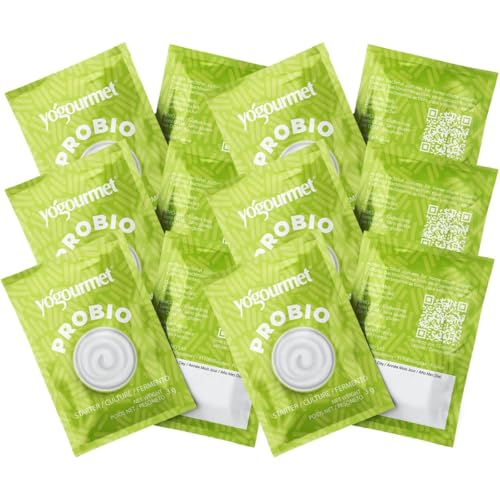
| Yogourmet Yogurt Starter With Probiotics★ Best Overall | First-time makers who want a proven sachet | 12 sachets of 3 g | 1 liter (1 quart) per sachet | Yes, from finished yogurt | Amazon |
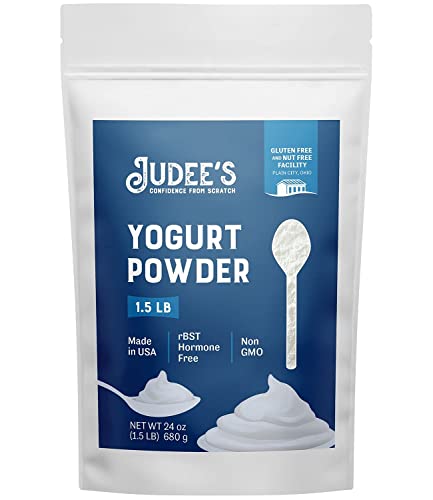
| Judee’s Gluten Free Nonfat Yogurt PowderTravel Pick | Travel and no-fuss mixing | Resealable pouch, 1.5 lb | — | — | Amazon |
| Bulgarian Yogurt Starter | Heirloom reuse in dairy or soy | 1 packet of freeze-dried culture | 8 gal / 30 L total | Yes, indefinitely | Amazon |
| Yogurt Starter Cultures Pack of 12 | Mild bifido-style yogurt | 12 sachets | 1 quart per sachet | Yes, re-cultured | Amazon |
| Starter Cultures for L. Salivarius and L. Reuteri | Targeted strain blends | 12 sachets | 1 quart per sachet | Yes, re-cultured | Amazon |
Detailed Reviews
1. Yogourmet Yogurt Starter 12 Pack
Our pick — 4.5+★ from 650+ verified ratings; the strongest balance of quality and price.
Twelve sachets, a liter of yogurt each, and a tart, creamy set that keeps people coming back.
Each 3 g sachet makes 1 liter — that is about a quart — of finished yogurt, so a dozen sachets is a dozen batches before you ever think about re-culturing. Each box is certified Halal, Kosher, gluten free and Non GMO, which matters if you keep a strict kitchen. The bacteria line-up includes four added probiotic strains on top of the classic yogurt culture. The maker states a 24-month shelf life from the production date.
Reviewers keep coming back for the flavor: smooth, creamy, and properly tart. Reviewers describe European-style results — smooth, creamy and properly tart — and tartness is what most homemade starters miss. One buyer cuts the powder loose at half a packet per half gallon, then reuses the finished yogurt as starter for a second round, calling it a “more powerful starter compared to other brands on Amazon.” That suggests the powder is potent enough to dose below the printed ratio and still culture a full batch.
The honest catch is consistency. Some makers get excellent thick yogurt, others get a thin, runny bowl that strains straight through. The most common fix is time — let it sit longer in the maker before you judge it. Follow the temperature instructions closely and this is one of the easiest starters to live with; this is the crowd favorite at 4.5+ stars across 600+ ratings.
What makes it easy to start with
- Twelve 3 g sachets, one liter of yogurt per sachet — a full season of batches per box
- Certified Halal, Kosher, gluten free and Non GMO, so it fits a restricted kitchen
- Four extra probiotic strains blended in alongside the standard yogurt culture
- Stated 24-month shelf life, so a box does not go to waste if you make yogurt in waves
Where it can let you down
- Some batches come out thin and runny rather than set — usually a time and temperature issue
- Instructions are the least-loved part of the package, so read the label carefully before you start
Best for: anyone making their first quart of homemade yogurt who wants a sachet they can trust and a tart European flavor.
Look elsewhere if: you want zero guesswork on timing — this one rewards a maker who will let a slow batch run longer.
2. Judee’s Gluten Free Nonfat Yogurt Powder
Not a sachet at all — a shelf-stable powder that gives you yogurt in a hotel room with cold water.
This is the odd one out on the list, and that is why it earns a spot. Judee’s is a 1.5 lb resealable pouch of freeze-dried nonfat yogurt powder made from nonfat milk solids, not a measured culture sachet. It stores at ambient temperature, so it lives in a cupboard or a carry-on rather than the fridge. That 1.5 lb pouch is a big, heavy bag next to the tiny Bulgarian packet, and it is built for scooping, not for single-batch precision.
Where it shines is convenience. Buyers report mixing it with cold water in a hotel room after a late flight, when there is no time to get to a store. The texture is “surprisingly creamy” and it takes an overnight rest in the refrigerator to come together. Others stir it into macaron fillings and dips rather than making a standalone jar of yogurt — it is a culinary powder as much as a starter.
Set your expectations on flavor. The taste draws split opinions, with a few finding an odd back flavor; some sweetening or fruit powder does not always cover it. Know that this is a powder to mix into recipes, not a heirloom culture you keep alive for years. For travel and cooking, it is a genuinely useful pouch.
Shelf-life advantage: a resealable 1.5 lb pouch of nonfat milk solids that needs no fridge and travels flat in a bag.
Know before you buy: the flavor is the divider here, and it will not culture the way a live sachet does — treat it as a mixing powder.
Worth grabbing if: you travel, cook with yogurt, or want a pantry backup that does not need refrigeration.
Pass on it if: you want a classic tart set from a live culture — this pouch is a different tool entirely.
3. Bulgarian Yogurt Starter (Makes 8 Gal / 30 L)

One tiny packet, eight gallons of yogurt, and a culture you can keep alive for years.
Here is the number that decides it for heavy users: 1 gram of this starter holds more than 25 billion CFU of live and active cultures, and the whole packet is rated to make 8 gal / 30 L of yogurt. That is a 12-to-1 yield advantage over the twelve-sachet boxes, which give you one quart per sachet. It also measures just 1.97 x 0.04 x 3.15 inches — a flat envelope that fits in a drawer.
It is an heirloom culture, which is the real prize. You spoon a little of yesterday’s yogurt into today’s milk and keep going, only reaching for the packet when you want a clean start. Owners mention keeping the same line going for 6+ months of continuous reuse, with the flavor holding up. It handles dairy and non-dairy equally well, and the soy results come out thick and creamy with a flan-like set and no thickener needed.
Compared with the Judee’s pouch above, this is a fraction of the physical size but a far bigger commitment to the process — you are signing up to keep a culture alive. One honest note: leave a stored jar too long and a faint pinkish surface can appear, which is the signal to start fresh rather than keep reusing. Certified Kosher and Halal, organic, gluten free and Non GMO, and shipped in plastic-free packaging.
Yield math that sells itself: 8 gal / 30 L from one packet at 25 billion CFU per gram means the cost per quart keeps dropping with every batch.
The real trade-off: an heirloom needs feeding and attention — skip a few weeks and you may be restarting from the packet.
This is your pick if: you make yogurt every week and want to stop buying starter powder altogether.
Not for you if: you want a one-and-done sachet with no culture to babysit.
4. Yogurt Starter Cultures – Pack of 12 Freeze-dried Sachets
A mild, gently sweet yogurt with a bifido blend built into the sachet.
One sachet makes 1 quart of plain, mild yogurt, and you can re-culture from the finished batch. It works with all kinds of yogurt makers and whole milk. The sachets are made in a lab environment free of additives, maltodextrin, gluten and GMO.
If tart is not your thing, this is the one to try. The mild, sweeter profile is what draws people in, and the same packet can stretch to 10 batches — around 2.5 gal — when re-cultured, with no drop-off in the starter. Quality and flavor are the parts owners rave about. It also freezes well as a 4 oz culture for later rounds, which is handy if you make yogurt in bursts.
Some batches are velvety and thick, others stay thin and need draining. A few makers note the marketing oversells what the extra strains do once the bowl is warm — the classic yogurt bacteria dominate at standard incubation temps. Set your heat carefully and it delivers; this is a mild-flavor choice, not a guaranteed thick set.
Why mild lovers keep buying it
- Blend includes Bifidobacterium bifidum, infantis and longum alongside the standard yogurt cultures
- One sachet makes 1 quart and re-cultures up to 10 batches from the same packet
- Works with all yogurt makers and whole milk
- Free of additives, maltodextrin, gluten and GMO
The honest weak spot
- Thickness is the most variable part — some jars set firm, others stay runny and need straining
- The extra bifido strains do less than the label suggests at warm yogurt temperatures
Reach for this if: you want a milder, sweeter yogurt than a tart Bulgarian style and you like the idea of a broad bacteria blend.
Think twice if: a dependable firm set every single time is your top priority.
5. Starter Cultures L. Salivarius L. Reuteri

The sachet that names Lactobacillus reuteri and Lactobacillus salivarius right on the front.
Most starters give you the two standard yogurt bacteria and stop there. This one lists four: Lactobacillus bulgaricus, Streptococcus thermophilus, Lactobacillus salivarius and Lactobacillus reuteri. One sachet makes 1 quart of plain yogurt, and you can re-culture following generations. It works in all yogurt-making devices and is built for whole dairy, soy or cashew milk. The blend is made in a lab environment free of additives, maltodextrin, gluten and GMO.
The standout result is nonfat milk. Because these strains work harder in lean milk, you can make a firm yogurt without adding powdered milk to boost the protein — the powder does the setting on its own. Raw milk users report a first batch culturing about 16 hours. With half-and-half and a 36-hour run at 100 degrees, customers note some of the thickest, creamiest yogurt they have made.
The difference from the Yogourmet box is the milk it handles best. Where that one leans on a standard dairy set, this one is made for lean and plant bases and delivers a mild soy yogurt with what buyers call a good probiotic profile. Plan your timing, though — a half-and-half batch can stay watery if it does not get the long, warm run it wants. Give it time and it rewards you.
Strain list worth reading: Lactobacillus salivarius and Lactobacillus reuteri sit alongside the standard bulgaricus and thermophilus cultures.
Plan for patience: lean and half-and-half batches need a long warm culture — short runs tend to stay thin.
Pick this one when: you make nonfat or plant-milk yogurt and want strains named on the label without added milk powder.
Skip it when: you expect a fast, short-incubation set from rich dairy.
Know the Specs
CFU count per gram
CFU stands for colony-forming units — the count of live bacteria in a gram of powder. A starter rated at more than 25 billion CFU per gram is dense, meaning a small scoop carries a lot of active culture. More CFU does not automatically mean thicker yogurt, but it gives the bacteria a stronger start so the milk sets instead of staying liquid. It also stretches further when you re-culture.
Heirloom vs single-use sachet
An heirloom culture is a living starter you carry forward — you save a spoonful of finished yogurt and use it to culture the next batch, only going back to the packet for a fresh start. A single-use sachet is measured powder you add once, though most can also be re-cultured. Heirloom wins if you make yogurt weekly; sachets win if you want no culture to maintain.
Thermophilic cultures and incubation
Thermophilic means warm-loving — these bacteria need heat to set, roughly body temperature and above, which is why a yogurt maker or a warm spot matters. Mesophilic cultures prefer cooler room temperatures. Knowing which one you have tells you where to put the jar and how long to leave it. Warm cultures that sit too cool usually give you runny yogurt.
Yield per sachet
Yield is how much yogurt one unit makes. A 3 g sachet rated for 1 liter gives you about a quart; a single packet rated for 8 gal / 30 L gives you far more over its life. Match yield to how often you make yogurt. A heavy weekly maker gets more out of a high-yield packet, while an occasional maker is better served by small sachets that stay fresh.
Common Questions
How much starter do I add to one quart of milk?
Why did my yogurt come out thin and runny?
Can I reuse the yogurt as starter for the next batch?
Which starter works best with soy or cashew milk?
Do I need a yogurt maker or can I use an oven?
How long does a starter powder keep?
Is the extra bifido and reuteri bacteria worth choosing?
How long should I incubate for the safest set?
Which starter works without adding powdered milk?
Do these starters contain gluten or GMO ingredients?
The Bottom Line
If you want the easiest path to a good first batch, the Yogourmet Yogurt Starter is the one to start with — twelve measured sachets, a liter each, and a tart, creamy result most makers get right. For weekly makers ready to stop buying powder, the Bulgarian Yogurt Starter turns one packet into 8 gal / 30 L with an heirloom you keep alive. And if nonfat or soy milk is your base, reach for the L. Salivarius and L. Reuteri sachets and let them run long.
How we choose
We do not accept paid placement. Every pick is matched to a real buyer and a real use-case; we do not hands-on test units.
Sources
Specifications: manufacturer listings and product documentation. Review insights: verified customer reviews, as of October 2026. Pricing: not shown on this page (it changes often); check the current price via the retailer link.
As an Amazon Associate, Aappliancez earns from qualifying purchases. This does not affect which products we feature.