Disclosure: Some links in this post are affiliate links. As an Amazon Associate I earn from qualifying purchases, at no extra cost to you. Learn more
Specs are compiled from manufacturer listings and verified buyer reviews and can change over time — please confirm the key details on the product page before buying.
Wild violets are the weed that laughs at your mower. Their waxy, heart-shaped leaves shrug off mowing, their deep taproots break off and re-sprout, and most “weed and feed” products just singe the edges. The honest fix is a broadleaf herbicide with the right active chemistry, applied at the right moment. Below are seven concentrated products that actually have a reputation for knocking violets back, sorted by what each one is genuinely good at. The best overall for most lawns is the Alligare Agri Star Triclopyr 4E, a triclopyr concentrate that lawn pros reach for when violets and other tough broadleaves refuse to die.
This guide is built by comparing the manufacturers’ published specifications and the patterns across verified customer reviews, so you get each pick’s real strengths and trade-offs instead of marketing spin.
Start by understanding which active ingredient you need, then use the quick table to narrow your finalists. Read on for the best herbicide to kill wild violets in your lawn, ditch, or shoreline.
Top Picks

How To Choose The Best Herbicide to Kill Wild Violets
Wild violets are a perennial broadleaf, not a grass. That single fact drives every buying decision below. You need a product labeled for broadleaf weeds that your turfgrass can tolerate, and you need enough concentrate to treat the same patch more than once, because violets rarely die from a single pass.
Match the active ingredient to the weed
Triclopyr is the standout for violets and other hard-to-kill broadleaves. It is the active ingredient in both the Alligare Agri Star and the Crossbow gallon, and it moves through the leaf down into the root. 2,4-D is a common companion and appears in the Southern Ag Crossbow blend. Dicamba shows up in the Ferti-lome Weed Free Zone and is effective on creeping charlie and clover. Read the label’s active ingredient list before you buy, because a product can be strong and still miss your specific weed.
Check that your grass is on the safe list
A herbicide that kills violets but also thins your lawn is a bad trade. The Ferti-lome label names Kentucky Bluegrass, Bermudagrass, Bahiagrass, and Zoysiagrass as safe. Products labeled “do not use on lawns,” like the Hi-Yield Killzall 365, are for bare ground, driveways, and fence lines only. Know your grass type first.
Do the math on coverage before you commit
Concentrates vary wildly in how far they stretch. The Southern Ag Crossbow gallon makes up to 96 gallons of spray solution and covers 2.23 acres. The Hi-Yield 32 oz bottle treats up to 4,300 square feet. The Airmax gallon covers 10,000 square feet. Match the numbers to the size of your problem, and remember violets need repeat treatments.
Watch for temperature and rain windows
Cool-weather products like the SpeedZone EW stay effective when violets are actively growing in spring and fall. Rain within days of application reduces how well the chemical works. Spray early on a warm, dry day and give the product time to move into the root before you water or mow.
Side-by-Side Comparison
The three spec columns below are the same dimension for every product, so you can scan the trade-offs at a glance.
| Model | Best For | Active Ingredient | Volume | Coverage | Amazon |
|---|---|---|---|---|---|
| Southern Ag Crossbow★ Best Overall | Large acreage and brush | Garlon, 2,4-D | 128 fl oz | 2.23 acres | Amazon |
| Alligare Agri Star Triclopyr 4EAlso Great | Tough broadleaves and violets | Triclopyr | 1 gallon | Broad-spectrum | Amazon |
| Hi-Yield Killzall 365 | Bare ground and driveways | Glyphosate + imazapic | 32 fl oz | Up to 4,300 sq ft | Amazon |
| Ferti-lome Weed Free Zone | Lawns with clover and charlie | Triclopyr + Clopyralid | 32 fl oz | Full lawn | Amazon |
| Tenkoz Crossbow Gallon | Brush and small trees | Herbicide concentrate | 1 gallon | Approx. 1 acre | Amazon |
| PBI Gordon SpeedZone EW | Cool-weather lawn control | Broadleaf ester | 1 gallon | Broad-spectrum | Amazon |
| Airmax Shoreline Defense | Ponds and shorelines | Glyphosate | 1 gallon | 10,000 sq ft | Amazon |
Detailed Reviews
1. Southern Ag Crossbow Specialty Herbicide, 128oz
Our pick — 4.5+★ from 800+ verified ratings; the strongest balance of quality and price.
A gallon that mixes into up to 96 gallons of spray — enough to treat a whole acreage in one season.
Two active ingredients, Garlon and 2,4-D, team up here to hit broadleaf weeds and woody brush together. The volume is the headline: 128 fluid ounces, or one full gallon, which the label says makes up to 96 gallons of spray solution and covers 2.23 acres. For a big rural property with violets scattered across fencerows and rough grass, that is a lot of treatments from one jug. Compare that with a 32 oz bottle — this holds four times the liquid.
Southern Ag built its reputation on control of unwanted trees, brush, and both annual and perennial broadleaf weeds. The 2,4-D component goes after the leafy broadleaves while the Garlon side handles the woody material. Buyers report it does a real number on jewelweed and pokeweed, killing them overnight — though the same buyers are honest that wild violets and poison hemlock are a tougher ask for this blend. On violets specifically, expect to be patient and to treat more than once.
You can spray near garden beds with less worry, because this is a low-volatile formulation (a mix that turns to vapor slowly, so it is less likely to drift onto plants you want to keep). The trade-off is a strong odor, so wear gloves and spray on a calm day. Given the coverage, the price per treatment is tough to top — this is the value play if your violet problem covers serious ground.
The acreage angle: a full gallon stretching to 2.23 acres is the reason this sits near the top for large properties — you are buying volume, not a single spot-treatment bottle.
Honest limitation: owners mention it is not a violet specialist — it shines on jewelweed and pokeweed but wild violets may need repeat passes.
Best fit: acreage owners with mixed broadleaf and brush problems who want the most spray per dollar.
Skip if: wild violets are your only target and you want a formula dialed in for them specifically.
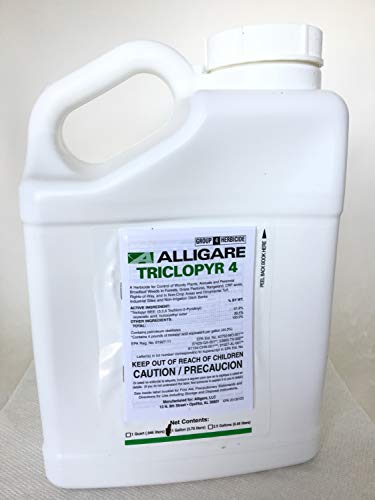
2. ALLIGARE Agri Star Triclopyr 4E Herbicide, 1 Gallon
One active ingredient, mixed at the label rate, that goes after violets where they live — in the root.
This is a straight triclopyr concentrate, the same chemistry sold under far pricier brand names for brush and broadleaf control. Triclopyr is a systemic herbicide: it is absorbed through the waxy violet leaf and travels down into the taproot. That is exactly what you need for wild violets, whose waxy leaves and deep taproots laugh off contact-only sprays. One gallon of concentrate goes a long way because you dilute it before spraying.
The label carries no coverage figure in acres or square feet, so measure your patch and mix to the label rate rather than guessing. It lists as a broad-spectrum, non-selective formula, and it is easy to apply — most buyers mix it in a tank sprayer for spot treatment. What wins people over here is simple effectiveness on the tough stuff: poison ivy, Asian bittersweet, yellow archangel, and woody brush all show real die-back. The triclopyr concentration is strong enough that many users report far fewer re-sprouts than ready-mix products manage.
The catch is that this is a concentrate you mix yourself, so you need to read the label and follow the ratio carefully — never spray it straight. There is no ready-to-use convenience here, and no built-in surfactant in the bottle, so adding one helps the chemical cling to waxy violet leaves. For someone treating a lawn or shrub bed rather than a driveway, that small extra step is the trade-off for real killing power.
What it gets right
- Triclopyr moves through the waxy violet leaf into the taproot, which is how violets actually die
- One gallon of concentrate stretches across many tank loads when diluted
- Broad-spectrum control handles brush, ivy, and tough broadleaves alongside violets
- Easy to mix and apply in a standard tank sprayer
Where it asks more of you
- Concentrate only — you mix it, so read the label and never spray straight
- No surfactant in the bottle, so add one for waxy violet leaves
- No listed acreage figure, so measure your patch before you buy
Reach for this if: you want one concentrate that handles violets, brush, and ivy without paying brand-name prices.
Look elsewhere if: you want a dial-and-spray bottle with no mixing, or your target is a pond edge rather than a lawn.
3. Fertilome 10525 Weed Free Zone Concentrate
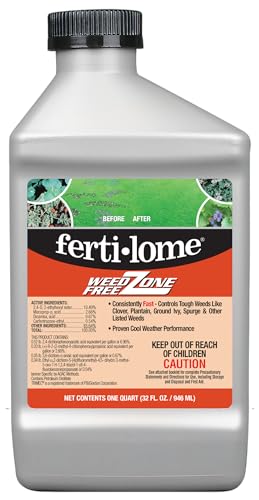
The one built around not wrecking your grass while it hunts broadleaf weeds.
Your grass can stay put while the violets go, because this Ferti-lome concentrate is labeled safe on Kentucky Bluegrass, Bermudagrass, Bahiagrass, and Zoysiagrass — a different league from the bare-ground products. The active ingredients are triclopyr and clopyralid (two weedkillers that target broadleaf plants), a combo that controls over 80 broadleaf weeds. The label says you will see evidence of injury within hours of application, so you know quickly whether your mix is working.
Where it earns its keep is on the weeds that torment lawns most: creeping charlie and white clover draw the most praise, and the grass keeps looking healthy afterward. The triclopyr-and-clopyralid pairing gives you a shot at violets too, since triclopyr is the violet-relevant half. Spray when broadleaf weeds are young and actively growing, in spring, summer, or fall, and mix at the label rate. Temporary yellowing around treated spots usually recovers within days.
Now the honest part. Customers note this broadleaf killer does knock down several weeds, but wild violet specifically remains stubborn for some users, sometimes needing two or three treatments. The concentrate is also on the pricier side for a 32 oz bottle. If violets are your only target and you demand a one-and-done, temper your expectations — this is a lawn tool, and lawns often need repeat passes.
Turf-safe and fast-acting
- Labeled safe on Kentucky Bluegrass, Bermudagrass, Bahiagrass, and Zoysiagrass
- Controls over 80 broadleaf weeds including clover and creeping charlie
- Visible injury reported within hours of application
- Works in spring, summer, or fall when weeds are growing
The violet caveat
- Wild violet can be stubborn — some buyers need two or three treatments
- Concentrate is on the pricier side for a 32 oz bottle
- Temporary yellowing around treated spots before the lawn recovers
Pick this when: your violets and clover are sitting inside a lawn you actually want to keep green.
Think twice if: you want a one-pass violet killer or your target area is bare ground with no turf to protect.
4. PBI Gordon SpeedZone EW Broadleaf Herbicide for Turf, 128oz

A gallon of cool-weather lawn herbicide that shows activity in hours — fast enough to outrun a violet’s re-sprout.
Violets often grow when the weather is still cool in spring or already cooling in fall, and many herbicides slow down in that window. SpeedZone EW is built for exactly that: the label calls it an effective, fast-acting cool-weather product, with visible activity in hours and clover control in as little as one week. It is a gallon bottle, so you have plenty to mix for a large lawn. The ester formulation is what makes it aggressive on tiny-leafed broadleaves.
For lawn owners dealing with tough, mixed broadleaf weeds, this draws consistent praise as the go-to liquid. It knocks them out without killing the grass when mixed at the label rate — buyers describe mixing it a little weak for the lawn to stretch their money’s worth. “Simply the best,” in the words of the review pages, with neighbors asking what they are using so they can buy it too. If your violets sit in a cool-season lawn and you have tried slower products without luck, this is a strong upgrade.
One real caution before you buy: this product is not for sale in a long list of states, including CA, TX, IL, and several others. Check the label restriction against your address first, because ordering from a state on that list will not work. The other honest note is cost — the gallon is a bigger outlay, and some find it expensive, though the coverage spreads the cost over many treatments.
Speed angle: visible activity in hours and clover control in as little as one week makes it the fastest-acting option for a cool-temperature window.
State restriction: a long list of states cannot buy this — verify your address against the not-for-sale list before you commit.
Best for: cool-season lawns where violets pop up in spring or fall and slower products stall.
Not for you if: your state is on the restriction list, or you want a small spot-treatment bottle rather than a gallon.
5. Crossbow Herbicide Brush Killer 1 Gallon
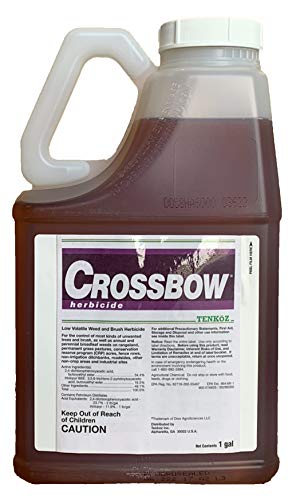
Built for the fencerow where violets and brushy weeds share the same ground.
Crossbow’s job is brush and small trees, and it does that job with force. The gallon covers approximately 1 acre or less and is a liquid concentrate. Strength is part of the draw: reviewers point out tree and brush shoots beginning to die after application, and tough, brushy bushes that laugh off weaker sprays get handled. If your violet patches sit in rough ground alongside poison ivy and shoots, this covers more than one problem at once.
The killing speed is what surprises people coming off gentler products. Sprayed plants can die same-day here, and the effect holds down regrowth for months rather than a few days. It also does a number on creeping charlie, a broadleaf in the same stubborn family as wild violet. Users spray it on driveways and under bushes, and the rule is simple: anything sprayed dies. That same caution is the reason to keep it away from plants you want to keep.
The trade-off is real and worth stating plainly. This is a blunt instrument, not a lawn-friendly violet treatment, so it belongs on brush, fence lines, and rough ground — not mixed into a fine turf program. There is also a strong chemical smell after spraying. Value is mixed depending on what you compare it against, but if you have brush to clear, the strength earns its place.
Where the power shows
- Kills small unwanted trees and brushy vegetation, not just tender weeds
- Sprayed plants can die same-day
- Knocks down creeping charlie, a similarly stubborn broadleaf
- Approximately 1 acre of coverage from the gallon
Keep it in its lane
- A blunt brush killer — not for fine turf or near plants you want to keep
- Strong chemical smell after application
- Value reviews are mixed versus name brands
Choose it for: fencerows, driveways, and rough ground where violets share space with brush and ivy.
Keep it away from: delicate garden beds and fine lawns, where a targeted product is the safer tool.
6. Hi-Yield (32170) Killzall 365, 32 oz

Extended-control herbicide for bare ground — kills weeds and holds the ground for the season.
Killzall 365 pairs glyphosate with imazapic, a combination built to kill weeds and prevent regrowth for up to one year. The 32 oz bottle treats up to 4,300 square feet. That makes it the wrong tool for a lawn you want to keep, and the label says so plainly: do not use on lawns. Where it belongs is driveways, fence lines, gravel, and bare ground where you want nothing growing back.
The extended control is the standout. Shoppers say spraying once and seeing the treated area stay dead for months, and one review of an empty lot says the grass simply did not come back four months later. Within two or three days you can see it starting to work, and it is done a few days after that. The exact length of control depends on soil — sandy ground shortens it, heavier soil holds it longer.
Two honest limits. This will not respect violets hiding in grass you want to keep, because it is a total-vegetation product, not a selective lawn herbicide. And on sandy soil the control period shrinks, as the label itself notes, so plan to reapply if your ground is loose. For clearing a hard surface or a bare zone, though, it is efficient and stretches well.
Why it stretches: 4,300 square feet from a 32 oz bottle is a lot of bare-ground coverage, and the imazapic keeps it clear after the kill.
Where it stops: labeled do not use on lawns, and sandy soil shortens how long the control lasts.
Right tool for: driveways, gravel, and bare ground where you want weeds gone and staying gone.
Wrong tool for: a lawn with violets, since this product is not labeled for turfgrass.
7. Airmax Shoreline Defense Emergent Weed Control, 1 Gallon
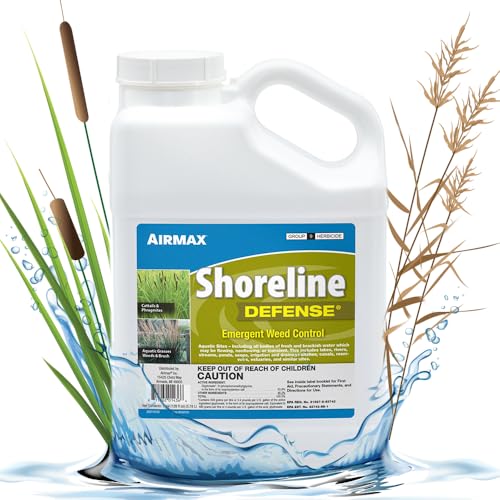
For the violets that creep up to a pond bank where a lawn product has no business being.
Around water, the rules change. Airmax Shoreline Defense is a broad-spectrum liquid aquatic herbicide built to control cattails, phragmites, grasses, weeds, and brush at the water’s edge. It is labeled for use in fresh and brackish water and covers 10,000 square feet from the gallon. The glyphosate concentrate kills cattails and shoreline grasses down to the root, so they do not just brown and bounce back.
You can treat right up to the water’s edge, because this product carries an aquatic label (it is approved for use near water). Per the label, it will not harm fish, birds, pets, livestock, wildlife, or other aquatic animals, and it carries no water-use restrictions. For a pond owner who has watched cattails march into the water, that is the difference between a safe tool and a risky one. Buyers report cattails showing signs of dying within days, and pond grass staying dead after a single spray.
The honest catch is cost — this is the priciest pick here, and some find it not worth the expense unless their shoreline problem is serious. It is also slow to show: one buyer notes it took three days to see the brown in a front-yard ditch. For a true shoreline or ditch job, though, the aquatic safety and root-level kill make it the right choice.
Why it fits the water edge
- Labeled for fresh and brackish water use
- Kills cattails and shoreline grasses down to the root for long-term control
- Labeled not to harm fish, birds, pets, or aquatic life when used as directed
- No water-use restrictions after application
What to expect
- The priciest option here, with mixed feelings on value
- Slow to show — can take several days to see browning
- Best results need a surfactant added at mixing
For pond and ditch owners: when the violets and cattails reach the water, this is the labeled, root-killing answer.
Overkill for: a dry front lawn, where a cheaper lawn product does the same job without the aquatic premium.
Know the Specs
Active ingredients: triclopyr, 2,4-D, dicamba, glyphosate
Triclopyr is a systemic broadleaf herbicide that moves into the root — the key property for violets. 2,4-D is a widely used broadleaf active that pairs with triclopyr in blends like the Southern Ag Crossbow. Dicamba and clopyralid are lawn-oriented broadleaf actives. Glyphosate is a non-selective killer that takes down whatever it touches, which is why products containing it are labeled for bare ground or aquatic edges rather than turfgrass.
Concentrate vs. ready-to-use
A concentrate is a bottle of active ingredient you dilute with water to the ratio on the label before spraying. It gives you far more spray per bottle, so it is the economical choice for larger areas — the Southern Ag gallon makes up to 96 gallons of spray solution. Ready-mix costs more per treatment but needs no mixing. All seven products here are concentrates.
Coverage in acres and square feet
Coverage tells you how much ground one bottle treats at the label rate. Watch the units: the Southern Ag Crossbow lists 2.23 acres, the Hi-Yield bottle lists 4,300 square feet, and the Airmax gallon lists 10,000 square feet. An acre is far larger than either square-foot figure, so compare in the same unit before you buy.
Turf safety and state restrictions
Turf-safe means the label lists your grass as unharmed — the Ferti-lome names Kentucky Bluegrass, Bermudagrass, Bahiagrass, and Zoysiagrass as safe. Products labeled do not use on lawns, like Hi-Yield Killzall 365, are for bare ground only. Some products, including the SpeedZone EW, are restricted from sale in certain states, so check the label against your address.
Common Questions
Will wild violets come back after I spray them once?
Which active ingredient kills wild violets best?
Can I use a brush killer on my lawn to kill violets?
How much area does a gallon of herbicide cover?
How long does a herbicide take to show results on violets?
Will a herbicide for violets also hurt my fish or pets?
Can I mix herbicide with water, or spray it straight?
Why do some violets survive when nearby weeds die?
Is a cool-weather herbicide better for violets in fall?
Do I need a surfactant when I spray violets?
The Bottom Line
For most lawns and shrub beds, the herbicide to kill wild violets worth reaching for is the Alligare Agri Star Triclopyr 4E, because triclopyr moves into the root where violets actually live. If you are protecting a real lawn and want a turf-safe formula, grab the Ferti-lome Weed Free Zone and plan on a second pass. And for cattails and weeds at a pond edge, the aquatic-labeled Airmax Shoreline Defense is the one to reach for. Whatever you pick, spray when violets are growing, add a surfactant, and treat twice — patience beats a stronger bottle.
How we choose
We do not accept paid placement. Every pick is matched to a real buyer and a real use-case; we do not hands-on test units.
Sources
Specifications: manufacturer listings and product documentation. Review insights: verified customer reviews, as of October 2026. Pricing: not shown on this page (it changes often); check the current price via the retailer link.
As an Amazon Associate, Aappliancez earns from qualifying purchases. This does not affect which products we feature.