Disclosure: Some links in this post are affiliate links. As an Amazon Associate I earn from qualifying purchases, at no extra cost to you. Learn more
Specs are compiled from manufacturer listings and verified buyer reviews and can change over time — please confirm the key details on the product page before buying.
If you want the short answer: the Makita XRU23Z is the battery powered weed eater most people should buy, because it delivers real brush-clearing power while staying light enough to carry around the yard for an hour. Every other pick on this list solves a specific problem — a bigger cutting swath, a tool-only option if you already own the batteries, or a budget entry point. So decide what your yard actually demands, then match it to one of these eight.
This guide is built by comparing the manufacturers’ published specifications and the patterns across verified customer reviews, so you get each pick’s real strengths and trade-offs instead of marketing spin.
Most trimmer shoppers obsess over volts when they should be checking cutting width, weight, and run time per battery. Volts tell you little on their own; what matters is whether the motor delivers that power for long enough to finish your fence line without a recharge break. Get that balance wrong and the trimmer stays in the shed. This breakdown covers the eight strongest options to help you pick the best battery powered weed eater for your specific yard.
Top Picks


How To Choose The Best Battery Powered Weed Eater
Picking a cordless trimmer is really three decisions stacked on top of each other: how wide a swath you need, how much the tool weighs in your hands for twenty minutes, and whether the battery platform makes sense for the rest of your garage. Nail those three and the rest of the spec sheet matters far less. Miss on any one of them and you feel it every time you pull the trigger.
Cutting width and what it actually clears
Cutting width — the swath, measured in inches — tells you how much grass the head sweeps per pass. A 15-inch or 16-inch swath eats a fence line quickly because every step covers more ground. An 8-inch or 12-inch swath means more passes, but the head fits into tighter spots between shrubs and fence posts. Wider is not automatically better; it is faster on open lawn and clumsier in a crowded garden bed. Pick the width that fits your fence lines and beds, not the widest head on the shelf.
Motor speed and torque in plain terms
RPM — revolutions per minute — is how fast the cutting head spins. Higher RPM generally means the line slices rather than tears, which matters when you hit thick stems. Torque is the twisting force behind that spin, and it is the reason a slower motor can sometimes cut better than a faster one. A trimmer rated at 6,000 RPM with a brushless motor often handles dense growth more smoothly than a higher-RPM motor that bogs down under load.
Battery volts versus amp-hours
Volts are the electrical push; amp-hours (Ah) are the size of the fuel tank. A 20V 2.0Ah pack and a 56V 4.0Ah pack are not in the same league for run time. Two batteries included is a genuine convenience because you can swap mid-job instead of stopping, and a fast charger keeps the downtime short. Check whether the battery is shared across other tools in the same family — that ecosystem decides whether your next purchase is a bare tool or a full kit.
Weight and balance in your hands
Weight in pounds is the number you feel first. A 5.5-pound trimmer tires you far less than a 9-pound one over a long session, especially reaching overhead or along a slope. Balance matters as much as raw weight: a slightly heavier tool with the battery positioned well can feel lighter than a nose-heavy one. If you have shoulder or back limits, weight is the spec to check before anything else.
Side-by-Side Comparison
| Model | Best For | Cutting Width | Speed | Weight | Amazon |
|---|---|---|---|---|---|
| Makita XRU23Z★ Best Overall | Brush and thick grass | 13 inches | 6,000 RPM | 9.2 lb | Amazon |
| EGO POWER+ ST1523SBest for Big Yards | Big lots, one charge | 15 inches | — | 7.3 lb | Amazon |
| SMILOVII 21V 4-in-1Most Attachments | Attachments and versatility | 8 inches | 24,000 RPM | — | Amazon |
| SUNCHERS 20V | Small yards, light trimming | 12 inches | 8,000 RPM | — | Amazon |
| VARSK 12 Inch | Budget first trimmer | 12 inches | 8,700 RPM | 7.7 lb | Amazon |
| JAGROM 20V 2-in-1 | Spools and starter value | 12 inches | 9,500 RPM | 7 lb | Amazon |
| WORX WG163 | Trim and edge in one tool | 12 inches | 7,600 RPM | 5.5 lb | Amazon |
| Greenworks 60V ST60L254 | Wide swath on big lots | 16 inches | 6,000 RPM | 11.2 lb | Amazon |
Detailed Reviews
1. Makita XRU23Z 18V LXT Brushless 13″ String Trimmer
Our pick — 4.5+★ from 1,000+ verified ratings; the strongest balance of quality and price.
A cordless trimmer that has the backbone to eat thick brush without the gas-can baggage.
What earns this Makita the top slot is the balance of motor grunt and hand-feel. The brushless motor spins up to 6,000 RPM, and the whole tool comes in at 9.2 pounds — substantial enough to stay planted in tall growth, still light enough that one hand steers it down a fence line. A high/low button lets you drop to low power for light trimming and stretch the battery, while a variable speed trigger gives you fine control as the line meets the grass. Owners of established yards keep circling back to how readily it handles the hard stuff, with the trimmer described as cutting through thick grass like a knife through butter.
Here is the number that stings a little: this is a tool-only listing, so the 18V LXT 4.0Ah battery is sold separately. That one-hour run time figure assumes you already own the pack. If you are already inside Makita’s 18V LXT world — drills, impacts, the usual garage lineup — that is a feature, not a cost, because one battery family powers everything. If you are starting from zero, factor the pack into your plan before you commit.
Where it earns the crown
- 6,000 RPM brushless motor delivers corded-level cutting force on high
- High/low power button plus variable speed trigger for run-time management
- 9.2 pounds with metal construction and bolted parts that feel planted, not plasticky
- Smooth trigger with no violent kickback, per owner feedback
The honest trade-offs
- Tool-only — the 18V LXT 4.0Ah battery and charger are not in the box
- Durability of the housing draws mixed long-term feedback; treat it as light-yard tooling, not a brush hog
- 13-inch swath is narrower than the 15-inch and 16-inch options here
Made for: homeowners already on the 18V LXT platform who want one trimmer that clears standard yard work and occasional thick growth.
Think twice if: you have no Makita batteries yet and want a ready-to-run kit from the start.
2. EGO POWER+ 15″ String Trimmer with POWERLOAD (ST1523S)
Two acres and one charge — that is the pitch, and owners say it holds up.
The headline here is the swath: a 15-inch cutting path fed by 0.095-inch dual-line string, versus the 8-inch head on the SMILOVII kit below. Wider swath plus a high-efficiency brushless motor means fewer passes over open ground. The POWERLOAD head takes the worst chore out of trimming — you feed the line in and press a button, and the head winds it for you. That alone saves the ten-minute spool fight that sends most people back to gas. Owners with real acreage back the run-time claim in plain terms: as one put it, “We have 2 acres and only charge once.”
The 56V 4.0Ah battery and charger both come in the box, and the 80-minute charge from zero keeps you moving. The catch worth knowing: reviews call the weight slightly heavy but well balanced, and the vibration is enough that a strap helps on long sessions. The line cutter and bump-feed head get praise, yet some find the string tangles during refill if you rush it.
Swath and stamina: a 15-inch cut on a 56V platform is a serious combination for fence lines and ditch weeds, and the included 4.0Ah pack means the tool works the day it arrives.
Before you buy: this is a full kit at a full-kit commitment. If you only have a small patch of grass to knock down, its capability is more than you need — but on a long fence line, the 15-inch swath cuts your pass count.
Reach for this if: your trimming runs along long fence lines or acreage and you want a battery that finishes the job.
Look elsewhere if: you want the lightest possible tool for a small suburban lot.
3. SMILOVII 21V Cordless Weed Wacker, Edger & Brush Cutter
One box that tries to be a trimmer, an edger, a brush cutter, and a patio scrubber.
Nobody else on this list ships with 15 cutting attachments. You get 6 dual-line string heads for soft grass, 4 flat 8-inch metal blades for thick weeds, 3 circular saw blades for pruning branches, and 2 wire brushes for scouring moss and rust off a patio. The 850W peak motor spins at 24,000 RPM no-load — a dramatic figure next to the Makita’s 6,000 RPM, though those two numbers describe different motor designs and are not a straight head-to-head. The point is this thing has range: it can swap from grass to vines to a scrub brush in the same afternoon.
Two batteries with an LCD percentage readout are genuinely useful, because you can see exactly how much juice is left rather than guessing from a blinking light. The 90-degree rotating head with a guide wheel rolls along a sidewalk for straight edging, and the aluminum shaft folds 180 degrees to store at half length. Buyers report the flat blade slicing bittersweet vines over 1 inch in diameter, and one noted an hour of use only dropped the battery to 20 percent — so the good days are real.
The catch is consistency. The motor bogs down in dense growth, and the nylon string can snap after light use, so it rewards a light touch in heavy weeds. Battery life draws the most mixed feedback here, with short runs reported on the 2.0Ah packs. Think of it as a flexible small-yard tool with a big attachment bag, not a replacement for a dedicated brush cutter.
Best fit: renters or small-lot owners who want blades, brushes, and string in one purchase.
Keep in mind: the 8-inch cutting width means more passes, so it suits detail work more than open field clearing.
4. SUNCHERS 20V 12-Inch Electric Weed Wacker
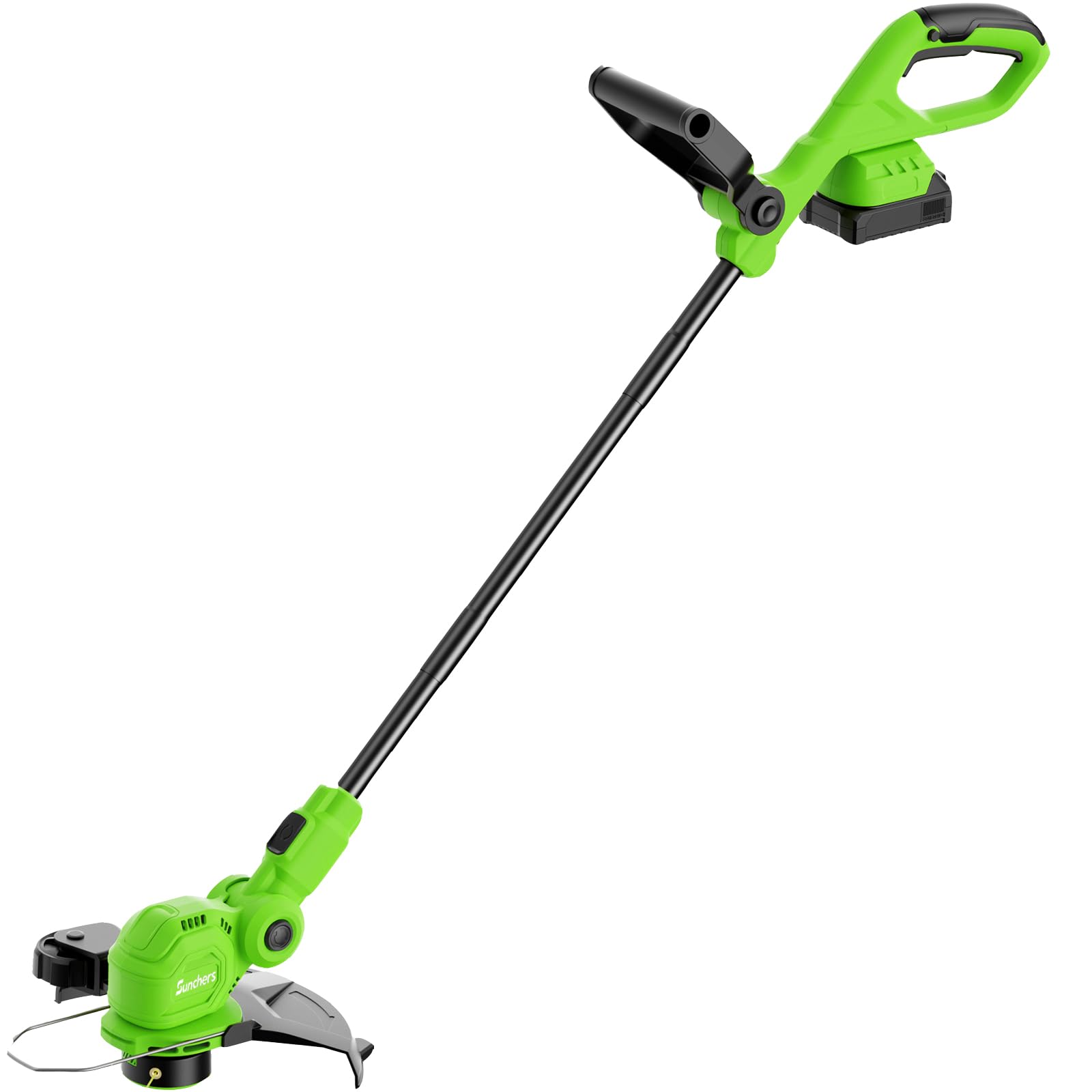
The 12-inch trimmer for the front-yard jobs that never seem worth dragging out the gas can.
SUNCHERS keeps the spec list short and the price-friendly reality clear: a 12-inch cutting head on a 20V platform, spinning at 8,000 RPM, with an auxiliary wheel to steady your line along a sidewalk edge. It weighs just over 5 pounds in owner reports, which is why it gets picked up for quick cleanups instead of staying in the shed. Assembly takes minutes, the manual includes tips for winding your own spool, and the battery charges in under an hour.
On small and medium yards, the trade-off math works. Owners trim a front lawn on a single battery before it drops below 50 percent, and the tool handles grass easily with a little more effort required for thick stems. The adjustable head and comfortable grip make it approachable for someone who has never run a trimmer. What it is not built for is long sessions or dense growth, where the power starts to feel thin and the battery runs out sooner than you would like.
What it does well: light weight, quick assembly, and a 12-inch cut that covers normal lawn edges without wearing out your arms.
The reality check: the battery life and cutting performance both split opinion across owners, and you should plan on swapping packs mid-job if your property is larger than a typical suburban lot.
Pick this for: small yards and quick edge touch-ups where a 5-pound tool and simple setup matter more than raw cutting force.
Pass if: your trimming includes tall weeds and long stretches that need sustained power.
5. VARSK 12-Inch Cordless Weed Wacker with 6 Spools
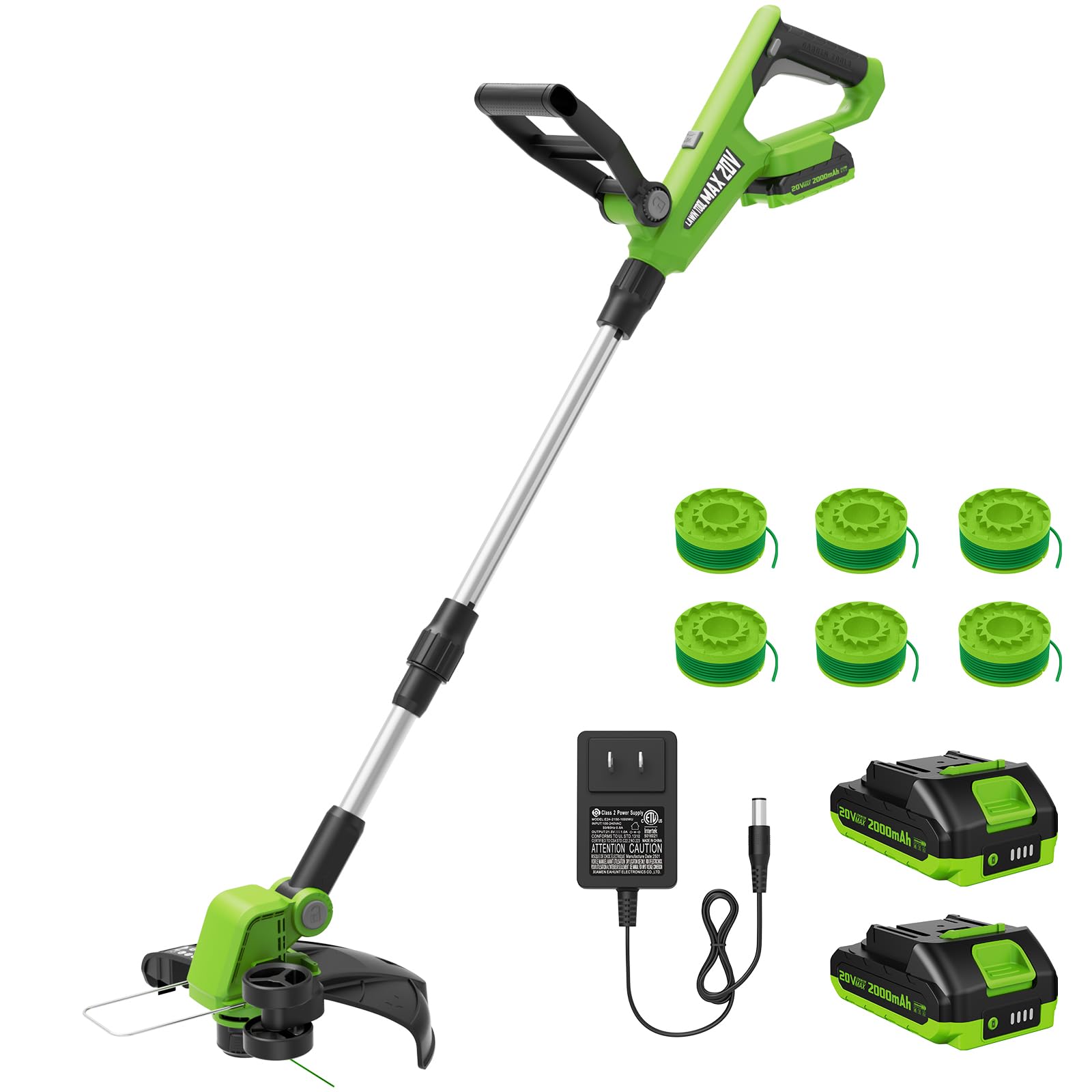
An entry-level trimmer that swaps between string and edger and arrives with spares to spare.
The value story here is in the box: two 2.0Ah batteries, a charger, and 6 replacement spools. For a first trimmer, that is the right kit — spare line means you are not stuck mid-job, and a second battery keeps you moving. The 2-in-1 design converts from trimming to edging with a press of the 90-degree rotation button and a twist of the aluminum tube. An 8,700 RPM motor sits inside a 12-inch cutting head, paired with an 80-degree pivoting head and a 180-degree adjustable handle so you can work around obstacles without contorting.
Light weight is the other draw. At 5.3 pounds it is easy to carry and easy for a shorter or older user to handle. Owners say assembly is straightforward and the result is comfortable for a normal suburban yard. The honest limits show up on bigger jobs: this is a small-yard tool, and the 30-plus-minute runtime from two packs reflects that. It is also not meant to replace a heavy brush cutter when the growth gets serious.
The value read: two batteries, six spools, and a 2-in-1 head at an entry-level commitment is a lot of kit for the money, and the stabilizer wheel helps keep edging lines straight.
One caution: treat the length and weight specs as the real guide — 5.3 pounds and a 12-inch cut is a light-duty package, so match it to your yard honestly.
Good call for: a first cordless trimmer on a small property where the included batteries and spools get you running immediately.
Look at the bigger tools instead if: your property has thick, tall growth that needs sustained cutting force.
6. JAGROM 20V 2-in-1 Cordless String Trimmer & Edger

A 2-in-1 with the highest no-load speed on this list and enough spare line to last a season.
The motor is the bragging point: a 9,500 RPM no-load speed, the fastest figure in this group, pushing a 12-inch cutting head. On top of that, JAGROM throws in 8 spools and a spindle cover, so you spend your time trimming rather than hunting for replacement line. The 2-in-1 design adjusts from trimmer to edger by changing the head angle or rotating the shaft. The shaft folds 180 degrees in three directions for storage, and the handle adjusts through 180 degrees so you can position the grip where your hands want it.
Two 2.0Ah batteries and a charger are included, and the folding shaft makes the whole thing compact to store. Owners who use it for moderate yard work call it easy to control and note the on-the-fly adjustments are genuinely handy around trees and signs. The auto line feed system takes some figuring out — when the line breaks, you release the switch and restart — but the spare spools mean you are not dependent on it during a job.
The thing to know before you buy: durability is the weak link. Some owners mention parts working loose during use, and the folding shaft needs the clamps snugged properly or it will not stay rigid. Assembly is simple, though getting the handle on takes some muscle. For light-to-moderate yard work, it functions well. For hard use around heavy growth, expect it to feel like a budget tool.
Worth considering for: a first 2-in-1 for a modest yard, especially if the included 8 spools save you a mid-season supply run.
Weigh the risk if: you plan to lean on the folding shaft and high RPMs for heavy clearing on a larger property.
7. WORX WG163 20V 12″ 2-in-1 Trimmer & Edger
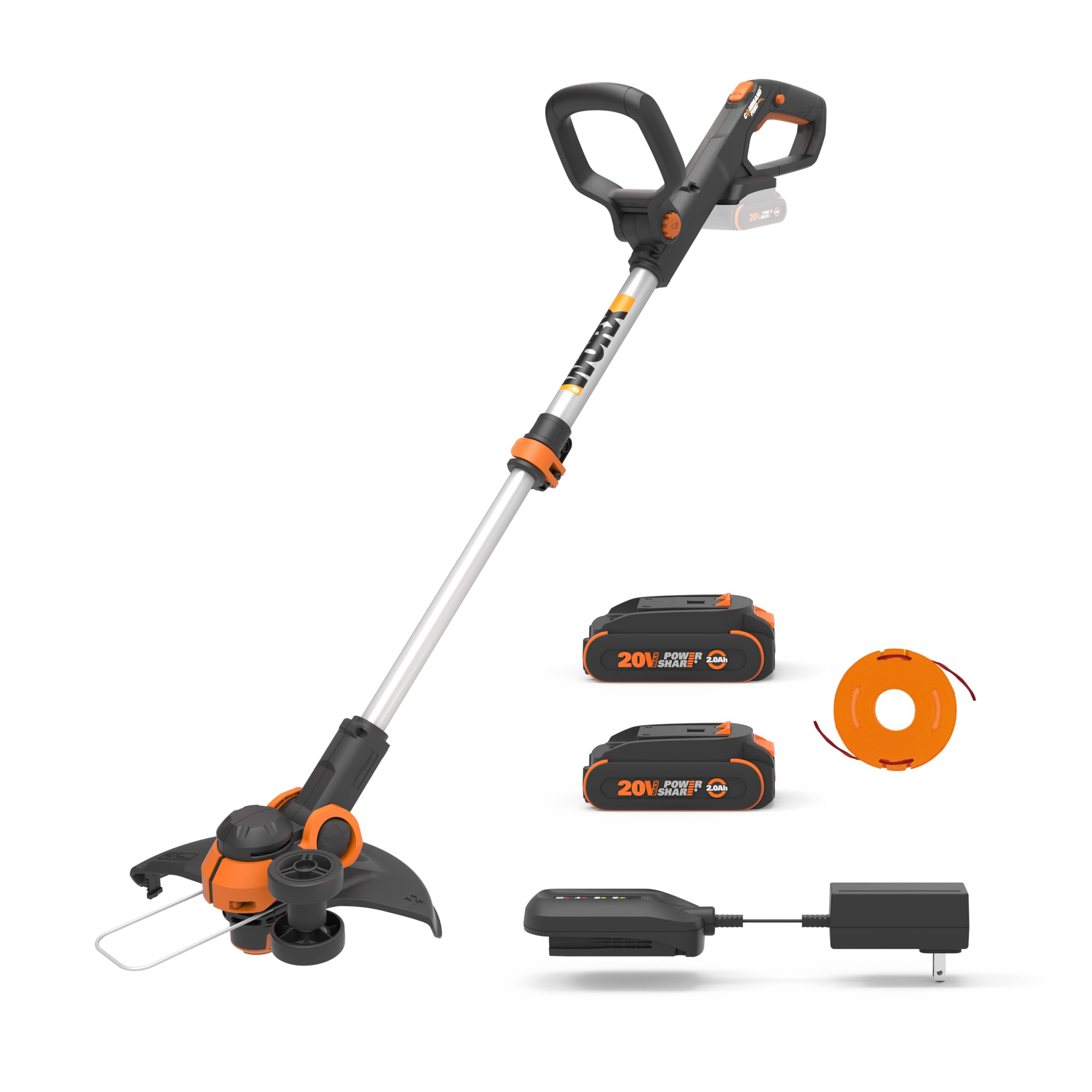
The 5.5-pound trimmer that finally made a gas-hater pick up a weed eater again.
If your yard work gets stopped by shoulder or back limits, this is the number to look at: 5.5 pounds, the lightest machine in this lineup. That matters more than rpm for a lot of people. A 7,600 RPM motor with a 12-inch cutting diameter covers normal residential trimming, and the head tilts 90 degrees so you can shape edges without stooping. The 2-in-1 conversion to an edger takes seconds, and the rubberized wheels help you steer a straighter line along a driveway. Owners who switched from gas trimmer after decade-long use describe the change as relief — lighter, no cord, no load at all.
Two 20V Power Share batteries come in the box, and both handle a typical quarter-acre of front and back trimming and edging on one charge. The Command Feed instant line feed means a quick push feeds fresh string without stopping to open the head. The manufacturer also claims free spools for life, which cuts long-term line costs. The spacer guard adjusts to protect plants and lawn ornaments while you work.
Where it falls short is thick growth. Both batteries can bog down and slow in heavy overgrowth, and prolonged use in one position will remind you the tool is still a machine hanging in your hands. The step-on head switch to change from trim to edge is convenient but can wear over time, so treat it gently. The factory charger is basic; a faster charger if you have one is a comfort.
A comfort-first trimmer: the lightest tool here by a wide margin, with a head that tilts and commands feed that keep long edging sessions manageable.
One adjustment to plan for: rewind and feed the line by hand if the factory winding is tight, and you will avoid the feed hiccups that frustrate first runs.
Choose this if: you want the lightest possible trimmer and the trim-to-edge switch without hauling a heavy power tool around.
Not the pick for: heavy overgrowth where the motor bogs and runtime gets stretched.
8. Greenworks 60V 16-Inch Cordless String Trimmer

Sixteen inches of cutting path that chews ditch weeds like a gas trimmer twice its weight.
The defining spec is the 16-inch dual-line swath. That is 1 inch wider than the EGO above and twice the SMILOVII’s 8-inch head, and every extra inch is one less pass along a fence. The 60V brushless motor delivers 6,000 RPM and the maker rates it equivalent to a 26cc gas trimmer — enough to handle blackberry vines and stubborn kudzu, tested on Georgia overgrowth. The Spin-to-Load head reloads 0.095-inch line in 10 seconds with no manual winding, which after a season of spool fights is a genuine upgrade.
Runtime suits long properties: up to 1.5 acres per charge on the 2.5Ah battery, which recharges in 45 minutes. The battery average life is listed at 65 minutes. A 360-degree rotating handle reduces wrist strain, and at 11.2 pounds the tool is heavier than the gas trimmer some owners came from — one report notes it demands a bit of upper-body strength. That same weight distribution is what keeps a wide 16-inch head stable over tall grass.
Owners consistently praise the cut quality and the relative value, though the weight gets called both light and gas-comparable depending on what you are used to. The line deflector can block your sightline when edging beds or sidewalks, so you have to angle the head to see the edge. Charging speed is quick under an hour, and the 4-year warranty covers the tool and battery.
Point it at: large lots with long fence lines and ditch weeds where the 16-inch swath and 60V power save passes and trip count.
Reconsider if: you have shoulder or back limits — 11.2 pounds is the heaviest tool on this list.
Know the Specs
Cutting width (the swath)
The width of the cutting path in inches — how much grass the spinning line sweeps in one pass. A wider swath like 15 or 16 inches covers ground faster on open lawn, while a narrower 8 or 12 inches fits between shrubs and fence posts. Neither width is better in the abstract — open lawn favors 15 or 16 inches, tight beds favor 8 or 12.
Volts and amp-hours
Volts are the electrical push behind the motor, and amp-hours measure the battery’s fuel capacity. A 20V 2.0Ah pack and a 60V 2.5Ah pack differ in both push and capacity, so two numbers on a box do not tell the whole story. Runtime depends on how hard the motor works, not on voltage alone — which is why run-time figures from actual owners matter most.
RPM and motor type
RPM is revolutions per minute, the speed at which the cutting head turns. A brushless motor uses electronics instead of brushes to spin the shaft, which tends to mean smoother running, less vibration, and longer motor life. High RPMs with a brushless motor usually translate into a cleaner cut through wet grass and thick stems than a brushed motor of similar rating.
Line feed systems
String trimmers dispense line in a few ways: bump feed (tap the head on the ground to advance line), automatic feed (the trimmer ejects line when needed), and manual winding (you open the head and rewind). The feed system decides how much of your session is spent trimming and how much is spent fiddling with the spool.
Common Questions
Is a battery powered weed eater as powerful as a gas trimmer?
How long does a battery last on one charge?
Do I need to buy a battery separately?
Can I use one battery across different yard tools?
What cutting width is best for a small yard?
How heavy is too heavy for a string trimmer?
Do I need a brushless motor?
Can I trim wet grass with a cordless trimmer?
What kind of string should I use in a trimmer?
The Bottom Line
For most yards, the battery powered weed eater that makes the most sense is the Makita XRU23Z, because it pairs a 6,000 RPM brushless motor with a 9.2-pound frame and real high/low power management. If your property runs long, the EGO POWER+ ST1523S gives you a wider 15-inch cut and a battery that owners say covers an acre plus. And if you are trimming a compact lot and want the lightest tool in the lineup, the WORX WG163 at 5.5 pounds is the one to reach for. Whichever you pick, choose a battery platform that also powers the blower or mower you buy next.
How we choose
We do not accept paid placement. Every pick is matched to a real buyer and a real use-case; we do not hands-on test units.
Sources
Specifications: manufacturer listings and product documentation. Review insights: verified customer reviews, as of October 2026. Pricing: not shown on this page (it changes often); check the current price via the retailer link.
As an Amazon Associate, Aappliancez earns from qualifying purchases. This does not affect which products we feature.