Disclosure: Some links in this post are affiliate links. As an Amazon Associate I earn from qualifying purchases, at no extra cost to you. Learn more
Specs are compiled from manufacturer listings and verified buyer reviews and can change over time — please confirm the key details on the product page before buying.
Calm water should be the easy part, yet the wrong hull still turns a quiet lake into a wrestling match. A boat that suits a 114 lb paddler on a pond is not the one a 240 lb angler wants on a windy bay. So your right pick depends on your body, your water, and how you plan to move the boat. Below are eleven real boats sorted by who they actually fit, from sit-on-tops you can hop off in deep water to tandems that carry a partner and a cooler.
This guide is built by comparing the manufacturers’ published specifications and the patterns across verified customer reviews, so you get each pick’s real strengths and trade-offs instead of marketing spin.
Weight, hull shape and cockpit fit decide whether a boat glides or fights you. That is the whole game with a flat water kayak, and the picks here are grouped so you can match one to your own water and body.
Top Picks


How To Choose The Best Flat Water Kayak
A flat water kayak is a boat you paddle on lakes, ponds, slow rivers and calm coastal water — no surf zone, no whitewater. That narrows the job down fast. You want a hull (the boat’s body) that stays predictable when the wind picks up, a cockpit or deck that suits your body, and a weight you can actually move from your car to the launch. Get hull, cockpit fit and weight right and the paddling takes care of itself.
Capacity is a budget, not a target
Every boat here lists a maximum weight capacity in pounds. Treat that as a hard ceiling, not a comfortable cruising weight. Your body plus a paddle, a life jacket, a cooler and a dry bag all count against it. A boat rated at 275 lb with a 200 lb paddler and a full cooler is close to its limit, and it will sit lower and feel twitchier. Leave margin and the hull rides higher and tracks better.
Sit-in versus sit-on-top
A sit-in kayak puts you down inside a cockpit, which keeps wind and spray off your legs and tends to feel warmer on a cool morning. A sit-on-top lets you sit above the waterline with scupper holes that drain the deck, so you can slide off and climb back on in deep water without bailing. If you fish, swim, or paddle with a dog, the open deck is usually the friendlier choice.
Hull shape and tracking
Tracking means how well the boat holds a straight line between strokes. A longer waterline (the length of hull touching the water) and a keel or fin (a ridge or blade underneath) help it run true. A wide, flat hull feels rock-solid at rest but can spin when you stop paddling. Neither is wrong — it is a trade between initial steadiness and glide. Match it to if you want to cover distance or sit still and fish.
Weight you can handle alone
A 36 lb boat like the Pelican Argo lifts onto a roof rack with one person. A 76 lb hull wants a cart or a second set of hands. Check the item weight before you fall for the hull, because the nicest paddling boat in the world is no fun if you cannot get it off the car.
Side-by-Side Comparison
| Model | Best For | Weight | Seats | Capacity | Amazon |
|---|---|---|---|---|---|
| Pelican Argo 100X★ Best Overall | First-timers who want easy entry | 36 lb | 1 | 275 lb | Amazon |
| Perception JoyrideTop Comfort | Comfort on long days | 42 lb | 1 | — | Amazon |
| Goplus Tandem InflatableBest Tandem Value | Couples with tight storage | 39 lb | 2 | 507 lb | Amazon |
| Lifetime Lotus | Fishing and gear hauling | 39 lb | 1 | — | Amazon |
| TIGERXBANG Inflatable | Stand-up paddling and touring | 11.25 kg | 2 | 500 lb | Amazon |
| Perception Zip 9.5 | Simple all-around fun | 41 lb | 1 | 325 lb | Amazon |
| Emotion Spitfire | Budget-friendly sit-on-top | 45 lb | 1 | — | Amazon |
| Lifetime Kokanee | Family tandem paddling | 76 lb | 2 | — | Amazon |
| Pelican Sprint 120XR | Faster recreational distance | 41 lb | 1 | 300 lb | Amazon |
| BKC Brooklyn 12.5 Tandem | Fishing with a partner | 70 lb | 3 | 600 lb | Amazon |
| Wilderness Systems Pungo 105 | Efficient paddling and speed | 47 lb | 1 | — | Amazon |
Detailed Reviews
1. Pelican Argo 100X
Our pick — 4.5+★ from 500+ verified ratings; the strongest balance of quality and price.
The beginner’s boat that carries like a suitcase and refuses to tip.
The number that should decide this for you is 36 lb. That is the whole boat, in a material Pelican calls RAM-X, a high-impact polyethylene mix that lets them build a lighter hull. One person can lift it onto a car roof or drag it to the dock without a cart. For a first-time paddler who plans to launch solo on a quiet lake, that weight is the difference between going out and leaving the kayak in the garage.
Buyers keep coming back to the overall build quality — it dominates the feedback and shows up across the board. Stability is the second story. The twin-arched multi-chine hull (two shallow curves running along the bottom that add contact with the water) keeps the boat upright at rest, so you can step in and out easily at the launch. As buyers put it, “great kayak. light enough to easily portage. quality materials.”
Capacity is rated at 275 lb, so a 200 lb paddler with a light day bag stays comfortably inside the limit. The cockpit includes adjustable footrests, a padded ERGOFORM backrest with a seat cushion, front storage hatch, bungee cord and a cockpit table — a fair amount of gear room for a 10 ft boat. The one mild grumble across owner feedback is long-term durability, since plastic hulls pick up scuffs on rocky launches. That is a care issue, not a dealbreaker for calm water.
Where the Argo earns its keep
- 36 lb total weight lifts onto a roof rack alone
- 275 lb capacity with adjustable footrests and padded backrest
- Twin-arch hull stays flat and steady for easy entry
- Front hatch, bungee cord and cockpit table for storage
Where it wants care
- Plastic hull picks up scuffs on rough launches over time
- 10 ft length tracks best on calm lakes rather than choppy water
Grab this one if: you want a light, stable first kayak you can move and store by yourself.
Walk past if: you need a tandem or plan to carry a heavy tackle crate.
2. Perception Joyride
A sit-inside that treats a full day on the water like a lounge chair.
If you plan four or five hours of paddling, comfort becomes the spec that actually matters. The Joyride’s adjustable seat and footrests are what carries it. The cockpit is 120 inches long and the hull measures 120″L x 29.5″W x 15″H, sized to suit both smaller and larger paddlers. Sealed bulkheads (walls inside the hull that trap air) double as dry storage you can reach from the seat, and the front hatch and rear tankwell are generous.
Compared with the Pelican Argo above, this is 42 pounds versus 36 — a heavier boat that trades a bit of lift-and-carry convenience for more cockpit room and sturdier tracking. The extra weight still travels easily on a Jeep’s vertical holders. Owners who paddle upstream rivers report it holds a line, and the selfie slot at the bow is a genuine nicety for anyone who documents their trips.
The trade-off here is weight. Owners are split — some call it light, others find it heavy after a long day. At 42 lb, it lifts onto a rack with effort but rewards you with a boat that tracks straight through wind chop without a skeg, so you are not hanging on the paddle to correct course. Cap the expectations on storage: sealed as it is, the hatch handles a PFD and a dry bag easily, but pack tight for overnights.
What earned it a spot: 42 lb of sturdy polyethylene with adjustable seat, adjustable footrests and a front hatch, all pointed at making an all-day paddle comfortable rather than fast.
The honest caveat: the weight splits opinion — fine on a carrier, noticeable on a solo shoulder carry.
The Joyride fits: a paddler who values a padded seat and dry storage over saving a few pounds.
Think twice: if you plan to car-top it alone or need a hull that clears a low garage ceiling.
3. Goplus Tandem Inflatable
Rolls into a bag, seats two, and carries more than almost anything here.
Two adults and a cooler on a 12.5 ft inflatable with 507 lb of rated capacity — that is the headline. If you share a small apartment or a compact car and still want a tandem, this folds down into a carry bag and slips into a trunk. The 150″L x 37″W x 16″H footprint is a real boat when inflated, but the setup time is a pump session, not a trailer hitch.
What wins people over is how easy the thing is to live with: easy setup, easy inflation, and a manual pump that works. The reinforcement is real — reinforced laminated PVC with mesh, a drop-stitch style floor insert and a three-chamber construction with two fins for direction control. Owners who took it out on a busy wavy lake found it handled the chop. A seven-week road trip across several lakes left the hull proud of itself.
Here is where honesty matters: the seats are the weak link. Feedback splits between paddlers who find them comfortable and those who call them flat — some sit on the floor and want more back support. The paddle holders also sit close to where you grip, so plan to add a simple strap and you save your knuckles. For the money and the packability, that is a fair swap.
The size story: 507 lb maximum capacity and 150 inches of length mean real room for two. That is roughly twice the seating of the single-seat Pelican Argo 100X.
The catch: the stock seats and paddle-holder placement are the recurring gripes — both fixable, neither structural.
Best for: a couple with limited storage who want a two-person boat that disappears into a bag.
Skip if: you want a rigid hull that tracks hard lines or you refuse to fiddle with a pump.
4. Lifetime Lotus

An 8 ft sit-on-top that fits inside a hatchback and holds a fishing rod.
At 96″L x 30″W x 10″H and 39 lb, the Lotus is a short, wide, stable platform that slots into a Subaru Outback or Honda CRV without a trailer. The hull is UV-protected high-density polyethylene, and it comes with a double-sided Lite Elite paddle so you can launch the same day. If your water is a slow river or a bay and your idea of a good afternoon is casting from a seated position, this is built for exactly that.
The size wins the day — it dominates the feedback and shows up in most reviews. Self-bailing scupper holes (openings that let deck water drain out) keep the top dry, and the foam-free open deck means you can carry a gear crate, swing your legs over the side, and re-enter in deep water. Adjustable footrests and a quick-release seat back cover a range of paddler heights.
The honest limit: the seat is hard, and a gel cushion or pad makes a real difference on a long paddle. Those with long legs may feel cramped in the cockpit. It is also a slower boat than a longer sit-in hull. That is the price of 8 ft of length and the easiest car-top in this group, and for fishing and casual paddling it is worth paying.
The right buyer: a casual angler who wants a stable, short, car-friendly sit-on-top that comes with a paddle.
Look elsewhere if: you need speed for long crossings or a seat you can sit in all afternoon without a cushion.
5. TIGERXBANG Inflatable

Paddles like a kayak, stands up like a board, and carries 500 lb doing it.
The 35-inch width is the spec that shapes the ride. A boat that wide feels planted enough to stand up and cast from. Add 500 lb of load capacity and 11.25 kg of weight, and you get a two-person inflatable that a 240 lb paddler reported sitting comfortably through a seven-hour river trip. The 122.05″L x 35.04″W x 7.87″H footprint keeps it low to the water once inflated.
Build quality is what people talk about most, with durability right behind it. Twin sandwich fabric, high-density drop stitches and a reinforced layered PVC shell mean the hull bounced off rocks and downed trees on a river run without taking scratches. A removable center fin controls direction, and the paddle holder and rod holder turn it into a fishing or touring deck on demand.
The catch is the pump work. Inflating this by hand is upper-body exercise, and owners suggest an electric pump with a digital gauge to save the arm workout. The open, low design also means a wet seat on a choppy day — that is the nature of the form, not a flaw. Inflating time is the only real cost of the versatility.
The build that wins: reinforced layered PVC over drop-stitch core, 500 lb capacity, and no scratches after a rock-scraping river run.
The honest catch: hand inflation is a workout, and the low open deck leaves you sitting in water on a choppy lake.
Reach for it if: you want one boat that works as a kayak, a stand-up board and a gear hauler.
Not for you if: you dislike pumping up a boat before every paddle.
6. Perception Zip 9.5

A simple deck, a big rear cargo well, and a cup holder where you want it.
The spec that decides this boat is the 325 lb capacity in a 41 lb one-piece hull made in the USA. That is the sort of margin that lets a 190 lb paddler add a cooler and a small passenger — a 6-year-old reportedly rode along without drama. The open rear storage area with bungee lashings takes a dry bag, a fishing crate or a beach bag. Self-draining scupper holes keep the deck dry and keep you sitting high.
Quality and stability carry the reviews. It is not tippy at all, and the cockpit is wide enough for easy entry and exit. A built-in center cup holder means your drink stays put without a separate mount. A drain plug makes hose-down cleaning easy, and molded front and rear handles keep it manageable on a car roof.
The trade-off: a 9.5 ft hull with a flat bottom spins if you stop paddling. It tracks well enough between strokes but needs attention in a crosswind. The thick, sturdy plastic is reassuring at rest but makes the boat hard to roof-load solo if you are short. Neither is a dealbreaker on a pond or a slow river, and the simplicity of the one-piece design is the reason the boat feels so solid.
Why it earns its place: 325 lb capacity, bungee-lashed rear storage and a drain plug in a sturdy one-piece hull — work and play on the same deck.
The trade: a short, flat hull spins when you stop paddling, so keep the paddle in the water through a crosswind.
This suits: anglers and casual paddlers who want room to stow gear and a deck they can hose down.
Better options exist if: you want to cover long open-water distances without constant correction.
7. Emotion Spitfire
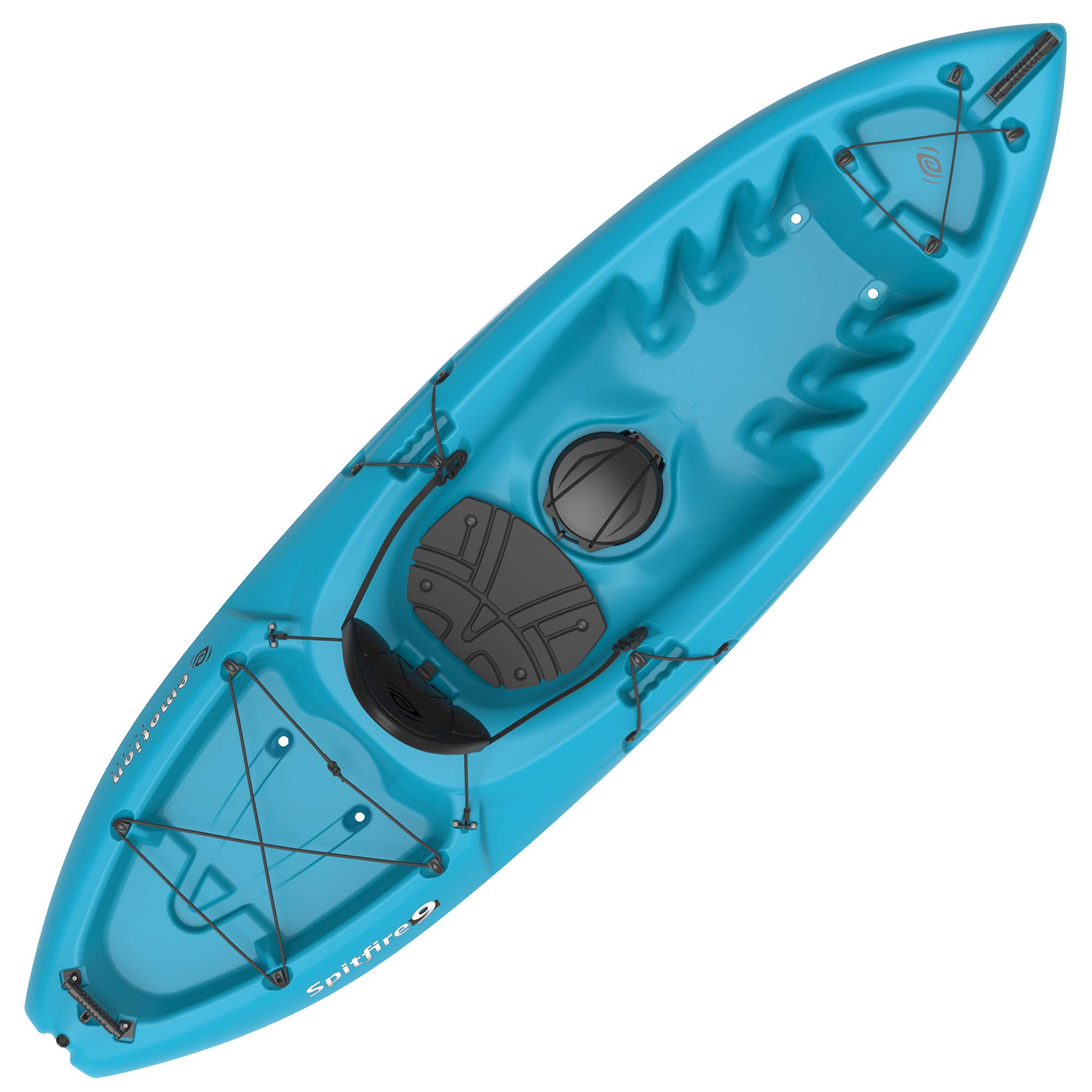
Short, light and small enough to ride home on a compact sedan roof.
The measurement that makes this boat special is 108″L x 31″W x 14″H. At 9 ft, it fits on a 2006 Honda Civic with only 1.5 to 2 ft of overhang. It also fits inside a Honda HRV and a minivan. If you drive a small car, that geometry is the whole reason to consider it. The hull is UV-protected high-density polyethylene with a padded seat, rear tankwell with cargo net lacing, a storage hatch and molded-in footwells.
What the feedback consistently confirms is build quality against price — for what it costs, buyers keep saying it is the value. It handles choppy water, tracks decently for a short sit-on-top, and stays comfortable for two-plus hours of paddling. Self-bailing scupper holes keep the cockpit and tankwell dry, and multiple footrest positions cover a range of leg lengths.
The complaints are real and worth knowing. Side-to-side stability and tracking split feedback — some find it rock-solid, others report it wobbles in a swell. The seat is fiddly to keep clipped down during transport. And a rare unit arrives with hull damage in transit. Size the boat to your water: this is a pond and slow-river kayak that loves short trips, not an open-water tourer.
Choose it if: you drive a compact car and want a light 9 ft boat you can load and unload alone.
Pass if: you need open-water stability in a swell or long-distance tracking.
8. Lifetime Kokanee

A 10 ft 6 in sit-on-top built for two, with the stability of a wide john boat.
The 76 lb weight tells you what you are getting before you even lift it: a 126″L x 36″W x 14.1″H tandem that stays planted with two adults aboard. It converts from tandem to solo in minutes, which makes it a genuinely flexible family boat. If your plan is a picnic paddle across a lake with a partner or a child, this hull is steadier than most single-seat sit-on-tops in this group. But you will want a dolly for solo transport — the weight is the price of that width.
The stability earns top billing from paddlers. It handles wind and chop without tipping, and it tracks straight at a moderate pace. Two adjustable quick-release seat backs and multiple footrest positions cover different-sized paddlers. A 6-inch storage hatch and a bungee storage system give you room for a small cooler or dry bags, and front and rear toggle handles help when two people carry it.
Two caveats worth weighing. The molded plastic seats have no padding, so a foam pad helps after the first 40 minutes or so — and the rear paddler sits cramped if you squeeze in a small child in the middle. The single 6-inch hatch is modest for a boat this big. None of that changes the value: this is a do-everything family boat, not a speed machine.
Why families pick it: tandem or solo in minutes, two quick-release seats, and 36 inches of beam that keeps two adults steady even in wind and chop.
What to plan around: 76 lb of hull needs a cart or a second pair of hands, and the hard plastic seats want a cushion.
Best suited to: a family or couple who want one sturdy boat they can paddle together or solo.
Better to skip if: you need to car-top it alone or you want a paddling workout rather than a float.
9. Pelican Sprint 120XR

A deep V-hull that cuts through chop and glides farther per stroke.
The V-chine hull is the reason to buy this and the reason to be careful. Deep V-chine means two distinct angled faces along the bottom of the boat, and they give it secondary stability — the boat firms up as it leans, so it handles chop without feeling loose. That same hull tracks straight and cuts waves. On a 10 ft sit-in with a 300 lb maximum capacity, the extra responsiveness rewards an intermediate paddler. It is a boat that turns effort into distance.
Owners who put in real miles on windy water report the Sprint holds its line without constant correction. The 41 lb weight in high-impact polyethylene keeps it car-top friendly despite the 120″L x 28″W x 14″H length. The ERGOFLEX G2 seat has extra back support and a breathable cushion. A rear quick-lock hatch, front storage platform with bungee cords, adjustable footrests, premium knee pads and a built-in bottle holder round out a surprisingly well-equipped deck.
The trade is a narrower, more performance-tuned hull. The 28-inch width feels slightly tippy getting in and out at the launch — it settles the moment you are under way and paddling. Heavier paddlers should weigh capacity against body weight carefully: 300 lb is the ceiling, and the boat’s own 41 lb eats into your usable margin. A paddler who finds it top-heavy will feel it quickly. For a mid-weight paddler who wants glide, none of this matters much.
What the hull buys you
- Deep V-chine shape cuts chop and holds a straight track
- 41 lb polyethylene hull is car-top friendly at 10 ft
- ERGOFLEX G2 seat, knee pads and quick-lock hatch included
- 300 lb capacity leaves room for a day bag
What you should know
- Narrower hull feels tippy at the launch
- Heavier paddlers get close to the 300 lb rated ceiling
It wins over: an intermediate paddler who wants tracking and glide over maximum width.
Might disappoint: a very heavy paddler or a first-timer who wants a wide, forgiving cockpit.
10. BKC Brooklyn 12.5 Tandem
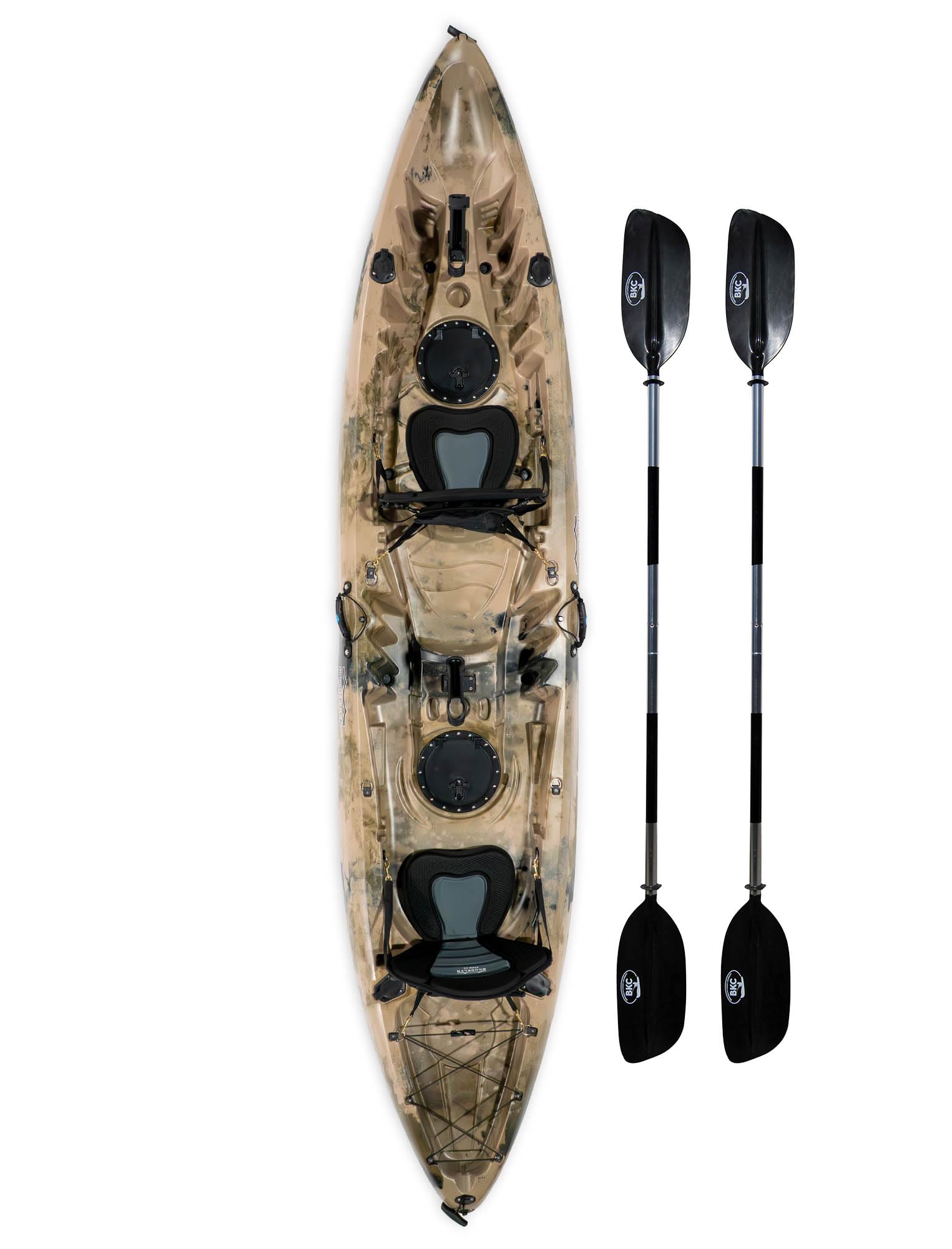
Six rod holders and 600 lb of capacity turned into a fishing platform.
Two adults plus a child with a boat that seats three, in a 12.5 ft sit-on-top with rotomolded single-piece HDPE. The rod holders tell the story: 4 flush plus 2 articulating, positioned around the deck for hands-free trolling and casting. A built-in mount area takes a trolling motor (not included) if you want range. The 148″L x 32″W x 12″H hull is stable enough to stand and cast, and the 600 lb capacity gives you room for tackle, cooler, paddles and passengers.
Quality and stability set the tone in the feedback. It survives a lot of punishment and tracks well for a tandem. The wide 34-inch beam keeps balance underfoot even in rough water, and two padded seats plus two paddles are included. It also fits two people on a car top with a helper, though the 70 lb weight means you will want a second set of hands at the launch.
Seat quality is the sour note. Reviewers lean negative — some find them flimsy and short on back support, and the front hatch has been reported to warp. The upside: better seats are easy to add, and the hull itself is solid. At 70 lb, solo loading is a two-person job. If you fish, the trade is worth it; if you want a light recreational boat, look elsewhere in this list.
The fishing setup: 6 rod holders, a trolling-motor mount, 600 lb capacity and a wide 34-inch beam for standing casts.
The honest cost: 70 lb of rotomolded hull needs a helper to load, and the included seats are reported as the weak point — budget to replace them.
The right fit: a fishing pair who want a stable, rod-ready tandem that will take a motor.
Wrong fit: a solo paddler who wants a light boat to car-top alone.
11. Wilderness Systems Pungo 105

The sit-in that makes every stroke count, with a seat built for hours.
Wilderness Systems claims this is the easiest-paddling, most efficient kayak in its class, and the 126-inch hull backs that up. That efficiency comes from a 126″L x 30″W x 14″H length paired with a hull tuned for tracking and speed. At 47 lb it is heavier than the Pelican Argo, but the payoff is glide: fewer strokes to cover the same water. It is a sit-in recreational boat for a paddler who plans to cover distance on lakes and slow rivers rather than fish from a stand.
The Phase 3 Airpro seat is the comfort anchor. It is fully adjustable with lower-back support, and the mesh-covered honeycomb-vented foam (an open cell pattern that lets air move) keeps you cooler than a plain pad. Adjustable footrests and thigh pads let you tailor the fit. The dashboard up front takes phone, bottle and small items, and owners across varied water types describe it as stable and confidence-inspiring even in moving water. It stays dry in chop that would splash over a lower sit-in.
Quality is the dominant theme in owner feedback, though sturdiness splits opinion — some report a solid hull, others mention durability issues after heavy use. The other caution is shipping: this is a big item and a rare unit has arrived damaged, so inspect it before you sign. For a paddler who values efficiency and seat comfort over a light hull, this is the one to try first.
Why the price is fair
- Efficient hull paddles farther per stroke than the cheaper sit-ins here
- Phase 3 Airpro seat adjusts fully with vented foam for airflow
- Adjustable footrests and thigh pads tune the fit
- 10.6 ft length tracks true on lakes and slow rivers
What to watch
- 47 lb is heavier than the lightest sit-ins in this group
- Sturdiness feedback is split — a rare unit reports durability issues
- Inspect for shipping damage before you accept delivery
Buy it if: efficiency and seat comfort matter more to you than dropping a few pounds.
Keep looking if: you want to lift the boat onto a roof rack without effort or you need a tandem.
Know the Specs
Maximum weight capacity
This number is the manufacturer’s ceiling for the boat plus you plus everything you bring. A 275 lb rating with a 200 lb paddler and a full cooler is close to the limit, and the boat will ride low and feel less steady. Once you exceed it, the hull sits deeper and the handling gets unpredictable. Always leave a margin — a boat rated well above your combined weight sits higher and tracks better.
Boat weight in pounds
Item weight is what you lift, carry and store. A 36 lb hull like the Pelican Argo goes on a car roof with one person. A 70 to 76 lb hull like the Lifetime Kokanee or BKC Brooklyn needs a cart, a helper or a ramp. If you paddle alone, boat weight decides whether you go out or stay home. Check it before you buy, the same as capacity or length.
Hull length and width
Longer hulls track straighter and glide farther; wider hulls feel steadier at rest and easy to enter. A 9 ft boat fits on a compact car but can spin without a paddle in the water. A 12.5 ft boat holds a line but wants a bigger roof and more storage at home. Neither is superior — match the length to how far you plan to paddle and where you store it.
Chine shape and tracking
The chine is the angle where the hull bottom meets the side. A multi-chine or V-chine shape adds secondary stability, meaning the boat firms up as it leans, and holds a straight line. A flat bottom feels stable at rest but tracks less cleanly. Fins and keels help the boat run true but add draft, so a fin-equipped boat needs a little more water under it.
Common Questions
What size flat water kayak should a beginner buy?
Is a sit-in or sit-on-top better for flat water?
How do I calculate if a kayak will hold my weight?
Can a tandem kayak be paddled solo?
Do inflatable kayaks track as well as hard shells?
What does scupper hole mean on a sit-on-top?
How much weight can I add beyond the paddler?
Will a 12.5 ft tandem fit on a car roof?
Do I need a rudder or skeg for flat water?
How long does a high-density polyethylene hull last?
The Bottom Line
For most first-timers, the flat water kayak worth buying is the Pelican Argo 100X. At 36 lb with a 275 lb capacity in a 10 ft hull, you can launch it without a cart, a trailer or a second set of hands. Its stability at rest and easy step-in and step-out make a quiet lake feel welcoming rather than risky. If you plan on long days and want a padded seat and dry storage, the Perception Joyride is the comfort step up. And for paddling a partner or a child across the lake, the Lifetime Kokanee turns a trip out into a trip for two.
One honest nudge before you decide: match the boat to the water you actually paddle. A short, wide sit-on-top on a calm pond is a pleasure; the same boat on an open windy bay will leave you correcting course all afternoon. Pick the hull for your water and your body, then let the numbers above do the rest.
How we choose
We do not accept paid placement. Every pick is matched to a real buyer and a real use-case; we do not hands-on test units.
Sources
Specifications: manufacturer listings and product documentation. Review insights: verified customer reviews, as of October 2026. Pricing: not shown on this page (it changes often); check the current price via the retailer link.
As an Amazon Associate, Aappliancez earns from qualifying purchases. This does not affect which products we feature.