Disclosure: Some links in this post are affiliate links. As an Amazon Associate I earn from qualifying purchases, at no extra cost to you. Learn more
Specs are compiled from manufacturer listings and verified buyer reviews and can change over time — please confirm the key details on the product page before buying.
If your foot slaps down or your toe catches the carpet, the fix is matching the brace to how much lift your ankle still needs. A rigid carbon AFO gives the most toe clearance, an over-the-shoe brace gives the most convenience, and a soft in-shoe strap is the lightest thing that still clears the ground. This guide sorts nine real options by that one job so you can pick the right one in a couple of minutes.
This guide is built by comparing the manufacturers’ published specifications and the patterns across verified customer reviews, so you get each pick’s real strengths and trade-offs instead of marketing spin.
The VACOped boot leads off because it locks your ankle angle and lets you dial that angle forward as you heal. Below, every pick is matched to a real walking situation, from a fresh Achilles rupture to a long-standing drop foot that needs help clearing the ground on the best foot drop boots you can buy today.
Top Picks

How To Choose The Best Foot Drop Boots
Start with the question your ankle answers first: can you lift your toes at all, or does the foot hang down when you relax? That single answer points you toward a rigid brace with a fixed frame or a flexible strap that just assists the lift. Getting this wrong is why so many people buy a brace, wear it a week, and give up.
Rigid AFO versus strap-style brace
A rigid AFO (ankle-foot orthosis, a stiff splint that runs up the back of your calf and under your foot) holds your ankle at a set angle all day. It gives the most toe clearance and the steadiest walk. The trade-off is bulk: it needs room in your shoe and a break-in period.
A strap-style brace, like the FootScientific or the PUSH, uses cords or elastic straps to pull your foot up without a solid frame. It slides into normal shoes and sandals far easier. It also flexes with your ankle, so it suits a foot that still has some movement but not enough lift.
Range of motion and the angle dial
After an Achilles injury, your doctor may want your ankle held in a specific plantar flexion angle (toes pointed down) and then moved forward in steps. Only a boot with an adjustable range-of-motion stop can do that. The VACOped runs from -15° to +30°, a real range you can tune week by week under your doctor’s direction.
Sizing by calf and shoe, not shoe size alone
Most foot drop braces are sized by calf circumference and shoe fit, not by the number on your sneaker box. A brace that is too wide pushes your shoe out to the side and makes you wobble. Measure your calf at its widest point, note your shoe width, and check the size chart before you order.
Side-by-Side Comparison
| Model | Best For | Style | Stated Weight | Fit Range | Amazon |
|---|---|---|---|---|---|
| Achilles Tendon Rupture Walking Boot (Medium)★ Best Overall | Post-rupture angle control | Rocker walking boot | 3.4 pounds | Medium | Amazon |
| FootScientific Foot Drop Brace with BOA Fit SystemAll-Day Wear | All-day wear in normal shoes | Strap brace (BOA dial) | 5.6 ounces | Small to large users | Amazon |
| TayCo RecoverX Ankle BraceBest Over-Shoe | Keeping your own shoes on | Over-the-shoe brace | 14 ounces | Large, Left | Amazon |
| PUSH ortho AFO | Flexible support, wears as a night splint | Flexible strap AFO | 154 g | Right Size 2 | Amazon |
| Carbon Fiber AFO Brace (Medium-Left, GHORTHOUD) | Trim-to-fit carbon support | Rigid carbon AFO | 11.36 ounces | Medium, Left | Amazon |
| Estinko Carbon Fiber AFO Brace | Sleek fit inside regular shoes | Rigid carbon AFO | — | X-Large, Right | Amazon |
| Carbon Fiber AFO Brace (M-Left, Tairibousy) | Budget carbon option | Rigid carbon AFO | 0.72 kg | Medium, Left | Amazon |
| Element6 Carbon AFO Foot Drop Brace | Low-profile under pants | Rigid carbon AFO | 8.1 ounces | One Size | Amazon |
| The Wright Stuff Ventopedic Offloading Boot | Heel and ankle offloading | Soft offloading boot | — | 4 sizes (S to Bariatric) | Amazon |
Detailed Reviews
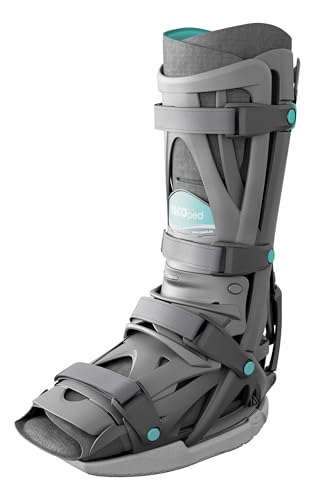
1. VACOped Achilles Tendon Rupture Walking Boot (Medium)
Our pick — 4.0+★ from 100+ verified ratings; the strongest balance of quality and price.
The boot that lets your doctor turn your ankle angle forward week by week instead of locking it flat.
The reason this one takes the top spot is the angle range. You can set the ankle anywhere from -15° (toes pointed down) to +30° (toes pulled up), then move it forward as healing allows. That is the difference between a boot that holds you and a boot that walks you through a recovery protocol. Many clinics use it as their standard boot for Achilles ruptures, and the build quality matches that role.
Comfort is the other win. A two-stage rocker sole (the curved bottom that rolls your foot forward for you) takes the strain off the injured side on every step. The liner uses XELGO bead technology, where soft beads bond at twelve contact points and let your foot sink into a stabilized pocket. The DryClaim liner breathes so heat does not build up during a long day on it. At 3.4 pounds it is a real boot, not a slipper, but the rocker does the heavy lifting for you.
Know the trade-offs before you buy. This boot is bulky at 20 inches long and weighs around 3.4 pounds, so you will feel it on every step. Fit is the most common complaint: several buyers find the medium gets tight on a smaller calf and simply add a strip of Velcro, and a size 11.5 wearer suggests stepping up to a large for toe coverage. Test one thing before a long walk outside the house. The air valve sits at the top center of the shin, so if you plan to push a knee scooter, it may meet your shin pad at that spot. It also runs on the expensive side, which is where the value-for-money view splits. One buyer put it best: “Best walking boot seen in 27+ years of fitting; used full-time 8-10 weeks for Achilles rupture.”
Where it earns the crown
- Adjustable range from -15° to +30° lets your doctor advance the angle as you heal
- Two-stage rocker sole keeps your walk smooth instead of a stiff peg-leg step
- Breathable DryClaim liner and removable soles keep the boot hygienic
- Restores a pain-free walking gait by holding the ankle at the angle your doctor sets
What to square away first
- Sizing runs snug on smaller calves; some buyers size up for toe room
- Bulky and heavy compared with a soft brace, so pants come off before the boot does
Go for this: a fresh Achilles rupture or post-surgery recovery where your doctor wants your ankle angle controlled and moved forward in steps.
Size carefully: the medium is generous in length but snug around a smaller calf — check your calf circumference against the chart before ordering.
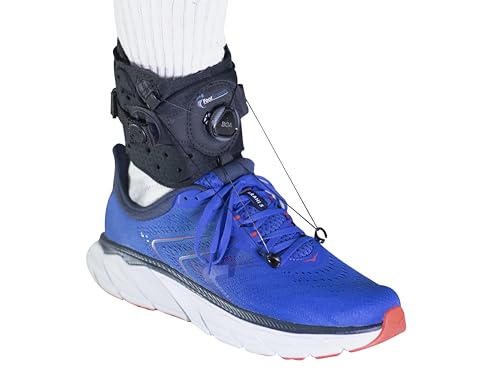
2. FootScientific Foot Drop Brace with BOA Fit System
A 5.6-ounce strap and dial that vanishes into your own sneakers and works with sandals.
If the rigid frame of an AFO is the reason you stopped wearing anything, this is the one to look at first. It weighs 5.6 ounces, wraps around your ankle, and two hooks thread through your shoe’s lace eyelets. A BOA dial (a small twist knob that tightens or releases the cord evenly, like the laces on a ski boot) sets how much lift you get. No carbon plate, no shoe stretching, no buying a bigger size.
Comfort is what wins people over here, and effectiveness runs a very close second — both are cited far more than anything else. Memory foam padding and a breathable, adjustable strap let it stay on through a full workday. It works with most shoe styles, sandals included, and it helps keep your foot clear of the ground so you are not dragging your toe on a fast walk. If your therapist has been pushing a rigid AFO and you want to keep wearing your own shoes, this is the middle ground that lets you be active in them.
Durability is the catch. Buyers report the cords fray, and one describes going through several over two years, with the latest pair that lasted four months: “The design is good and it works well, I have bought 4 of these in last 2 years they re-designed the strap and the last two I purchased lasted 4 months.” A second thing to know: setup takes a few minutes the first time to thread the hooks, and swapping the brace between shoes is not instant — a spare set of anchors helps. It is also hand-wash only, so treat the liner with a wipe rather than a soak on busy mornings.
Where the money goes: the dial-tightening system earns its keep. A rigid carbon brace runs well past this one, so if you want to stay in normal shoes and just clear the ground, you are paying for the convenience and the memory-foam comfort.
The honest caveat: moving the brace from one pair of shoes to another takes a few minutes of threading, so pick a shoe and leave it there if you can.
Reach for this if: you want to wear your own sneakers or sandals and get a consistent foot lift from a simple dial.
Look elsewhere if: you need a rock-solid frame for full ankle stability — a rigid carbon AFO does that job better.
3. TayCo RecoverX Ankle Brace
The brace that straps over the shoe you already own, so no new footwear and no uneven gait.
Where every in-shoe AFO forces you to stretch into a bigger shoe, the RecoverX straps over the outside of the one you already have. That is its whole reason for existing, and it is the pick for anyone who refuses to buy a larger shoe size for an internal brace. It hides under a pant leg, so you can keep a normal silhouette.
It relies on a progression-of-care design: three hinge options control the ankle in fixed, limited, or free motion. You start locked and dial back the restriction as you rebuild. The hinge blocks side-to-side roll while leaving front-to-back ankle motion free. Comfort is the top strength, with stability not far behind. It weighs 14 ounces in the size listed here, features breathable materials and adjustable straps for all-day wear, and it is simple to put on and take off.
The honest limit is what it is built for. TayCo is clear that it supports light exercise but is not designed or recommended for sports use — wear it with sturdy athletic, walking, or OSHA-approved work boots for the best stability. Hand wash only, and there is a real fitting learning curve, so watch the video before the first day. A buyer dealing with peroneal tendonitis found the over-the-shoe idea solves the uneven-height problem a thick-soled boot creates, since both feet stay at the same level.
The standout feature: an over-the-shoe design with three hinge settings is rare — it gives you fixed, limited, or free motion without changing the shape of your foot inside a shoe.
Choose this if: you want to keep wearing your own shoes and work boots while your ankle heals, and you need stability without the bulk of a walking boot.
Not the one for: sports or running — the maker itself says it is for light exercise only.
4. PUSH ortho Ankle Foot Orthosis

A 154-gram flexible AFO that works in your shoes by day and as a night splint by dark.
At 154 grams (about the weight of a thick pair of socks), the PUSH is the lightest full AFO in this group. It is built on a glass fiber reinforced frame, so it flexes instead of staying rigid, and you can adjust how much help it gives from maximum support down to a brace-free life. That adjustable assistance is what makes it useful at every stage, not just the early weeks.
What people praise most is comfort, with effectiveness close behind — the flexible frame lets your ankle move instead of clamping it. A soft, breathable moisture-wicking microfiber lining covers the frame, and the whole brace goes in the washing machine. It works with a wide range of shoes, sandals and slippers included, and you can also wear it as a night splint. The non-elastic straps keep it snug to your foot.
Durability is where it asks for care. The recurring gripe is the strap and the bond between the plastic base and the sole pad, which can separate after steady use. One buyer put it plainly: “I was really in love with this device. It was lite and was working great until this happened (2 days after the warranty) and I just can’t afford another.” Fit is also mixed. The support and range of motion only come right when the side straps sit exactly where they should, which can take a second pair of hands the first time.
How it fits your day: light enough to forget you are wearing it, flexible enough to bend your ankle while walking, and washable enough to keep clean over months of use.
What to expect: treat the straps and sole pad gently, and have someone help position the side straps the first time, because the fit depends on them.
Best for: a foot that still moves but needs help lifting, especially if you want to wear it in bed as a night splint.
Think twice if: you want a set-and-forget brace for heavy daily wear — the strap and sole bond need watching.
5. Carbon Fiber AFO Brace (Medium-Left, GHORTHOUD)

A carbon AFO you trim to your own foot, at a fraction of what a custom prescription brace runs.
The carbon fiber frame here is the point: it is fatigue-resistant, meaning it will not stretch or deform, and you can cut the footplate to match your foot. It fits inside most shoes and leaves room for an insole underneath. The side walls are thicker at the top than some rival carbon braces, which matters if you have a high arch and have felt the side edge dig in.
For the money, this is the value play among the rigid carbon options. One buyer compared it directly to a premium prescription-grade brace and said the side-top thickness is a real comfort difference for high arches. The frame stabilizes the ankle in a forward position, which is exactly how a drop foot gets its toe clearance. The model is built for stroke hemiplegia, foot drop, sprains, and foot varus or valgus (where the foot rolls inward or outward).
The trade-off is that “trim to fit” is not a scissors job. The manufacturer lists it as easy to trim, but one buyer found it needs a rotary tool like a Dremel to cut cleanly. It also makes a cracking sound at first before settling in, and the hook-and-loop straps are the first thing to age.
Why buyers pick the carbon
- Thicker side-top carbon is easier on high arches than some rival braces
- Fits most shoes and leaves room for your own insole underneath
- Fatigue-resistant frame will not stretch or deform over time
Know before trimming
- Needs a rotary tool to trim cleanly, not ordinary scissors
- Size up carefully — a large can be too wide for a size 10 shoe
Pick it if: you want real carbon support and are willing to trim the footplate to fit your foot and shoe.
Try another if: you have no room in your shoe — this is the one you make room for, not the one that makes room.
6. Estinko Carbon Fiber AFO Brace (Right-XLarge)

A full footplate carbon brace that slides into your regular shoes and holds the ankle at the right angle.
This one is for the person who has a bulky custom brace sitting in a closet because it only fit into shoes two sizes up. The Estinko is built around a full footplate that stabilizes the ankle joint, and it is contoured to sit low and sleek. The adjustable straps and soft EVA padding (a cushioning foam) inside the calf guard let it fit closely without rubbing. The liner is removable and washable for hygiene.
It is sized for larger feet in the X-Large Right listing, so check that against your measurement before you buy. It targets ankle instability, limb spasticity, and drop foot caused by stroke, nerve damage, multiple sclerosis, or trauma. It does exactly the job a rigid AFO is meant to do: it holds the ankle and limits that downward plantar flexion so your toe lifts and you stop dragging it.
The honest caveat is the build quality you get for a premium price. Some buyers find the carbon plate is thicker at the center post and thinner where weight lands, so it can crack under heavy use. The front plate also sits low and can make the walk feel stiff until the angle is right. On the other side, buyers with a total ankle joint replacement report it is sleek enough to sit inside ordinary shoes where their custom brace needed room. It is hand wash only.
The real draw: sleek enough for regular shoes, with a removable liner you can wash — a genuine daily-wear carbon brace rather than a bulky custom one.
Watch the fit: the X-Large Right sizing is generous, and the low front plate can feel stiff until your walking angle adjusts.
Good match for: a larger-footed wearer who wants carbon support that fits inside normal shoes.
Check first: the front plate height and the carbon thickness at the wear points — lighter-weight wearers may find it stiffer than they like.
7. Carbon Fiber AFO Brace (M-Left, Tairibousy)

The cheapest way into a carbon AFO — and the one to handle with the most care.
This is where a carbon brace starts to look affordable. It is built from carbon fiber, comes in left and right versions across large, medium, and small, and can be trimmed to your foot. It fits inside most shoes and stabilizes the ankle for drop foot, sprains, and foot varus or valgus. For a first carbon brace, it gets your foot to the right angle at a budget-friendly level.
The catch is build consistency. Owners mention that on at least some units the carbon is thin under the arch and at the padding tabs, so it can crack and dig into the foot. The padding is also minimal and compresses quickly. Those are the honest downsides for a low-cost entry into carbon, and they matter if you wear the brace all day on hard floors. Two buyers bought a pair and both had issues with the fit and comfort.
If you go this route, consider the trade-off before you buy: a slightly higher-carbon brace with thicker side walls costs more but holds up better. This is best treated as a spare or a trial brace, not a full-time daily wearer for heavy use. It is still worth a look for anyone testing whether carbon support works for their gait before spending more.
Why it is here: a genuine carbon AFO at a budget-friendly level, with cut-to-fit sizing across left and right.
The honest limit: it is the thinnest carbon here, and the padding compresses — treat it as a trial or spare rather than a long-day wearer.
Try it if: you want to test carbon support for your gait without a bigger outlay.
Step up if: you need full-day support — the carbon and padding here are the weakest points under long wear.
8. Element6 Carbon AFO Foot Drop Brace (Universal, Left)

Slim, low-profile carbon that hides under long pants — best suited to smaller feet.
At 8.1 ounces this is a very light carbon brace, and its low profile is the headline: it slips under long pants so it barely shows. It uses a moldable, trimmable footplate so you can shape it to your foot, and the adjustable hook-and-loop straps hold it in place. The carbon upright gives strong forward support to the ankle without a heavy frame.
It handles chronic and acute ankle instability plus drop foot, and the trim-to-fit footplate sits closer to your foot than a fixed-size brace. For someone with smaller feet who wants a discreet brace, this is a good contender. The universal size keeps it simple to order.
The big honest caveat is sizing — the footplate does not reach far enough forward for larger feet, and several big-footed buyers found it far too small. The rear strut can also push the shoe out to the side, so the heel does not sit flat, and the calf strap is bulky enough to show under pants. A couple of users report breakage at the ankle over time. If your foot is size 11 or larger, or you need boot-wide support, this is not the one to start with; if you are smaller, it is a slim, light option.
Who it suits: smaller-footed wearers who want light carbon support that keeps a low profile under clothes.
Who should pass: larger feet and wide shoes — the footplate and the rear strut push against the shoe instead of fitting into it.
Best for: a smaller shoe size and a discreet profile under pants.
Hold off if: you wear size 11 or up or need a roomy boot — the footplate runs short and the strut can angle your shoe.
9. The Wright Stuff Ventopedic Offloading Boot
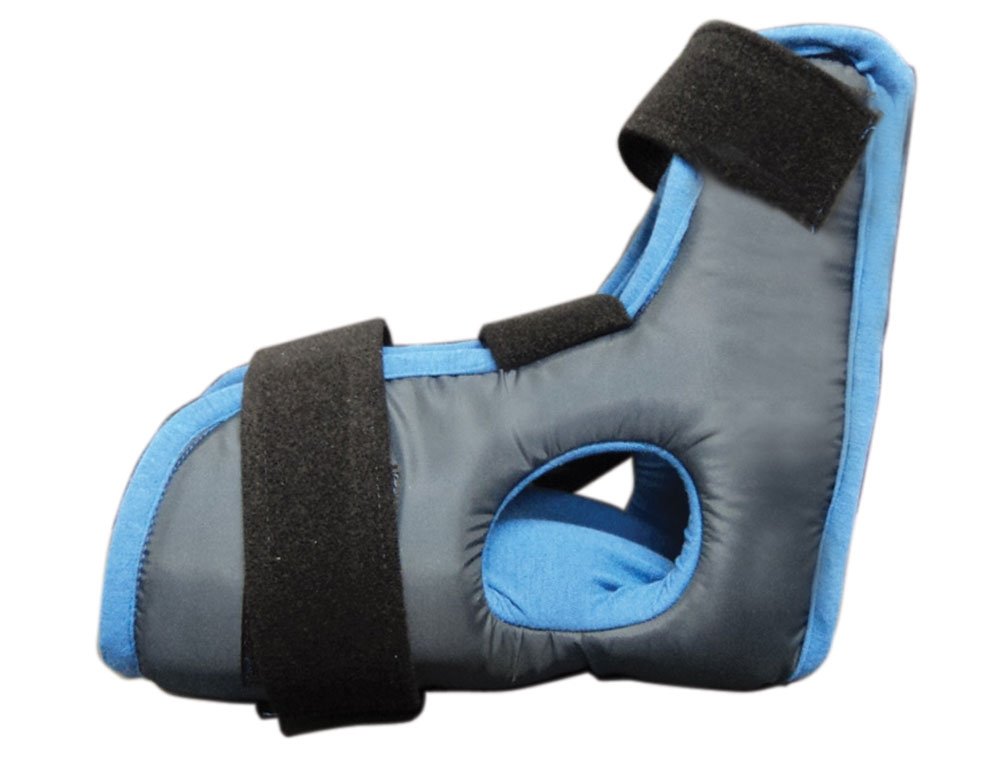
A soft fabric boot built to take weight off a sore heel — not to brace the ankle.
This is a different tool from the carbon braces. It is an offloading boot: openings on each side and at the heel let you see and protect the skin while extra fabric under the calf suspends the heel so it takes pressure off it. It is made for a sore heel or ankle that needs air, not for holding your ankle at a set angle. If your problem is a tender heel, a wound, or swelling, and you need to keep weight off it, this is the shape of boot that helps.
The fabric is the story. Ventopedic’s two-fiber fabric wicks skin moisture four times faster than regular fabric and vents air through the boot. The soft nylon outer slides over bed sheets, the sole is non-slip, and the boot works on either foot. Wide adjustable straps give a custom fit, and it is machine washable and dryable. One buyer found they could wear it day and night, including in bed: “Light weight book that still off loads wounds on lateral (outside) and inside of ankle.”
Sizing is the honest catch. The boot runs large, and a smaller size can still be too big for a narrow foot. Size by calf circumference and ankle diameter rather than shoe size. The cutout also has to line up with your sore spot or it will not offload it. It is a single boot, so check if you need a pair, and note that this listing carries a restocking fee if you return it.
Why the fabric earns its place
- Moisture-control fabric pulls sweat away fast, which keeps the skin drier through the night
- Side and heel openings let the skin breathe and take pressure off a sore spot
- Smooth nylon slips over sheets and the sole grips the floor when you stand
Getting the size right
- Runs large — measure calf and ankle, not shoe size
- Check the cutout lines up with the sore spot, or it will not offload it
Go here for: a sore heel or ankle wound that needs air and pressure off the skin, night or day.
Not for: bracing a weak ankle or clearing a drop foot — that is a job for the carbon or strap braces above.
Know the Specs
Range of Motion (ROM) and split angles
A ROM setting is the angle your ankle is allowed to bend. A negative number, like -15°, means toes pointed down; a positive number, like +30°, means toes pulled up. On a boot like the VACOped you set that range once and adjust it as your protocol moves forward. On a rigid carbon brace the angle is fixed by the frame itself, so check that the frame holds your foot in the position your clinician wants before you cut anything.
Weight in ounces and pounds
Weight tells you how long you will keep a brace on. A strap brace in the 5 to 8 ounce range (the FootScientific sits at 5.6 ounces, the Element6 at 8.1 ounces) disappears in a shoe, so you forget you have it on. A full walking boot in the 3 pound range (the VACOped is 3.4 pounds) is heavy enough that you will notice it all day. Lighter is easier to wear continuously; heavier signals a sturdier frame, and both are right for different needs.
Footplate length and shoe fit
A trimmable footplate lets you match the brace to your own foot, but its length still decides which shoe it fits. A plate that stops short of the ball of your foot puts pressure under the midfoot; a plate that is too wide pushes the shoe’s sidewall out. If your foot is size 11 or bigger, check the footplate length against your measurement before ordering, and size down a brace that is wide rather than long.
Padding, liner, and moisture fabric
The liner is what sits against your skin, and it decides whether you can wear the brace for a full day. Breathable, removable, and washable liners keep the brace hygienic over months. Fabric that pulls moisture away (the Ventopedic boot names this as its main feature) helps in bed and under a sock. Thin or compressible padding is the first thing to wear out, so plan to check the tabs and the base bond periodically.
Common Questions
Will a foot drop boot fit inside my normal sneakers?
How do I size a foot drop brace when I am between sizes?
Does a rigid AFO or a strap brace give more toe clearance?
How long does a foot drop brace usually last?
Can I wear a foot drop brace in the shower or while swimming?
Will a foot drop boot work with sandals or slippers?
What is the difference between an AFO and an over-the-shoe brace?
Can a foot drop brace replace a walking boot after an Achilles rupture?
How do I stop a carbon AFO from cutting into my foot?
Is a foot drop boot washable?
The Bottom Line
After weighing the angle control, comfort, and fit across the field, the foot drop boots winner is the VACOped Achilles Tendon Rupture Walking Boot because its -15° to +30° range lets your clinician move your ankle forward week by week instead of locking it flat. If you want to stay in your own shoes all day, grab the FootScientific Foot Drop Brace. And for an ankle that needs support without changing your shoe size, the TayCo RecoverX Brace is the one to reach for.
How we choose
We do not accept paid placement. Every pick is matched to a real buyer and a real use-case; we do not hands-on test units.
Sources
Specifications: manufacturer listings and product documentation. Review insights: verified customer reviews, as of October 2026. Pricing: not shown on this page (it changes often); check the current price via the retailer link.
As an Amazon Associate, Aappliancez earns from qualifying purchases. This does not affect which products we feature.