Disclosure: Some links in this post are affiliate links. As an Amazon Associate I earn from qualifying purchases, at no extra cost to you. Learn more
Specs are compiled from manufacturer listings and verified buyer reviews and can change over time — please confirm the key details on the product page before buying.
Most people shopping for a DIY mini split are really asking one question: can I install this myself without a technician and without wrecking the machine? In this category, “DIY” splits into two distinct install types: click-together Quick Connect kits and pre-charged systems that still need a vacuum pump. Some units arrive with pre-charged Quick Connect line sets you simply click together, while others ship pre-charged but still need a vacuum pump and manifold gauges before the first cool breeze. Get that distinction wrong and you either pay a pro anyway or void the warranty on day one.
This guide is built by comparing the manufacturers’ published specifications and the patterns across verified customer reviews, so you get each pick’s real strengths and trade-offs instead of marketing spin.
Below you’ll find thirteen ductless systems sorted by how much work you actually sign up for, from true click-together kits to high-efficiency units that want a licensed installer. Every pick lists its real BTU rating, SEER2 efficiency, and coverage so you can match one to your room before you buy the best DIY mini split.
Top Picks


How To Choose The Best DIY Mini Split
Installation style is the first decision, because it sets your tool list, your time budget, and your warranty terms. A true DIY mini split arrives with refrigerant already sealed inside pre-charged Quick Connect line sets, so you bolt up the brackets, run the lines, and torque the connections without ever opening the refrigerant circuit. A pre-charged system that still needs a vacuum pump is a different animal — the refrigerant is in the outdoor condenser, but you must pull a vacuum on the lines before releasing it.
Match the BTU rating to the room, not the brochure
Cooling capacity is measured in BTU (British thermal units — the standard unit of cooling power). A 12,000 BTU unit suits a bedroom or single garage bay, while 18,000 and 24,000 BTU systems reach into open-plan rooms and workshops. Be careful with the square-footage claims: they assume a standard ceiling and decent insulation, so a tall shop or a room with big windows will need more capacity than the number suggests.
Read SEER2 and HSPF2 as running-cost numbers
SEER2 is the efficiency rating for cooling and HSPF2 is the matching rating for heating — the higher each one is, the less electricity the unit draws to do the same job. A 24.5 SEER2 system and a 20 SEER2 system can both cool the same room, but the higher-rated one tends to cost less to run over a hot summer. This is also where cold-climate capability shows up, since a heat pump rated to operate in sub-zero outdoor temperatures needs the right compressor and defrost logic behind it.
Know your electrical supply before you order
Ductless systems run on either 115V or 208-230V, and that choice usually decides where the unit can go. A 115V unit can share a standard household circuit in some cases, while the 230V models need a dedicated breaker run by an electrician. Factor that into the plan — the unit itself may be a weekend job, but the circuit is not.
Side-by-Side Comparison
| Model | Best For | Cooling Capacity | Efficiency | Coverage | Amazon |
|---|---|---|---|---|---|
| Senville AURA 24,000 BTU★ Best Overall | Whole-floor comfort with voice control | 24,000 BTU | 21.5 SEER | 1,250 sq. ft. | Amazon |
| Hykolity 24,000 BTU WiFiBig-Room Value | Big rooms on a tighter budget | 24,000 BTU | 20 SEER2 | 1,500 sq. ft. | Amazon |
| YITAHOME 18,000 BTUBudget Performer | First-timers on a budget | 18,000 BTU | 21 SEER2 | 1,250 sq. ft. | Amazon |
| ROVSUN 18,000 BTU | Garages and workshops | 18,000 BTU | 20 SEER2 | 1,000 sq. ft. | Amazon |
| DELLA Vario 12,000 BTU | Bedrooms and small additions | 12,000 BTU | 23 SEER2 | 550 sq. ft. | Amazon |
| SereneLife 18,000 BTU | Large rooms on a value budget | 18,000 BTU | — | 1,000 sq. ft. | Amazon |
| Cooper & Hunter MIA 12,000 BTU | 115V plug-in-friendly installs | 12,000 BTU | 21.2 SEER2 | 550 sq. ft. | Amazon |
| TOSOT Aoraki 18,000 BTU | Cold climates and fresh-air fans | 18,000 BTU | 24.5 SEER2 | 1,200 sq. ft. | Amazon |
| Albott 36,000 BTU | Big shops and open spaces | 36,000 BTU | 18 SEER2 | 2,500 sq. ft. | Amazon |
| Daikin Entra 18,000 BTU | Brand-name reliability | 18,100 BTU | 18 SEER2 | 1,000 sq. ft. | Amazon |
| MRCOOL DIY 4th Gen 12,000 BTU | True no-tools DIY install | 12,000 BTU | Energy Star Certified | — | Amazon |
| MrCool Easy Pro 18,000 BTU | Quick-connect with larger coverage | 18,900 BTU | 20 SEER2 | 1,200 sq. ft. | Amazon |
| Cooper & Hunter 2-Zone 18,000 BTU | Two rooms, one condenser | 18,000 BTU | 22.5 SEER | Two heads (9K + 12K) | Amazon |
Detailed Reviews
1. Senville AURA 24000 BTU Mini Split
Our pick — 4.5+★ from 550+ verified ratings; the strongest balance of quality and price.
The one that cools a whole cabin from 84°F to 68°F while you’re still driving there.
You get 1,250 square feet of coverage from a 24,000 BTU unit (a measure of cooling power) running at 21.5 SEER (a seasonal efficiency rating — higher means lower running cost). Compare that to the Hykolity below, which spreads 24,000 BTU across 1,500 square feet. The Senville trades a little raw footprint for a higher efficiency rating, and that trade shows up on the power bill rather than in the room.
What makes the Senville notable in this lineup is the combination of Alexa voice control and a heating floor down to -22°F. Set a routine from the app, and the unit pre-cools or pre-heats before you arrive. The 208-230V DC inverter runs quietly enough that it does not cut into conversation, and the included 16-foot line set and communication wire mean fewer extras to buy. Note the manufacturer’s own warning: this is not a DIY mini split, and professional installation is required.
The catch is line-set length: the included 16-foot set can fall short on a long wall route. The lineset can run a couple of feet short of a long wall route, and one cabin owner ended up buying a 50-foot set to finish the job. If your indoor head sits far from the condenser, price that in before you commit.
Where the Senville pulls ahead
- 24,000 BTU with 21.5 SEER — strong cooling per unit of electricity, and coverage up to 1,250 sq. ft.
- Heating rated down to -22°F/-30°C, so it stays useful in a hard winter rather than switching off.
- Alexa plus app control lets you start cooling or heating long before you walk in.
- Quiet indoors and out, which matters in a bedroom wall or a shared commercial space.
What to plan around
- Not a DIY system — professional installation is required and the warranty depends on it.
- The included 16-foot line set may not reach a long indoor-to-outdoor run; extensions cost extra.
- 208-230V wiring means a dedicated circuit run by an electrician.
Reach for this if: you want one high-efficiency unit to handle an open living area or a cabin, and you have an installer lined up.
Think twice if: your whole plan hinges on doing the refrigerant work yourself — this one explicitly is not that product.
2. Hykolity 24,000 BTU Mini Split
The widest coverage in the lineup, with a mute mode that drops to 34dB.
If raw square footage is your whole criterion, the Hykolity covers up to 1,500 square feet from 24,000 BTU and a 20 SEER2 rating. That is more floor than the Senville AURA manages on the same BTU count — handy in a single open barn or a long shop where one head has to reach everything.
Setup is where it earns its keep. The kit ships with the indoor fan coil, the outdoor condenser, a 16-foot line set, vibration-absorber feet for the condenser, and a remote with holder. Reviewers describe a first-timer install as genuinely doable, with YouTube videos filling in the gaps. The 4D airflow spreads air around the room rather than blasting one spot, and the mute mode at 34dB is quiet enough for a workshop or a bedroom with the display off.
The trade-off is longer-term confidence. A few reports describe refrigerant leaks showing up early, and the Wi-Fi app carries a subscription if you want phone control rather than the remote. Treat the app fee as a known cost and keep the remote somewhere you can find it.
The install story is the pitch: the kit is complete enough that a careful first-timer can get it running in an afternoon, and the directions are praised for being straightforward.
Set expectations on the app: phone control is a paid add-on, and the unit uses a refrigerant that can be hard to source locally for a top-up.
Good match for: a shop, barn, or big open room where coverage matters more than brand pedigree.
Not for: buyers who want phone control included without another yearly fee.
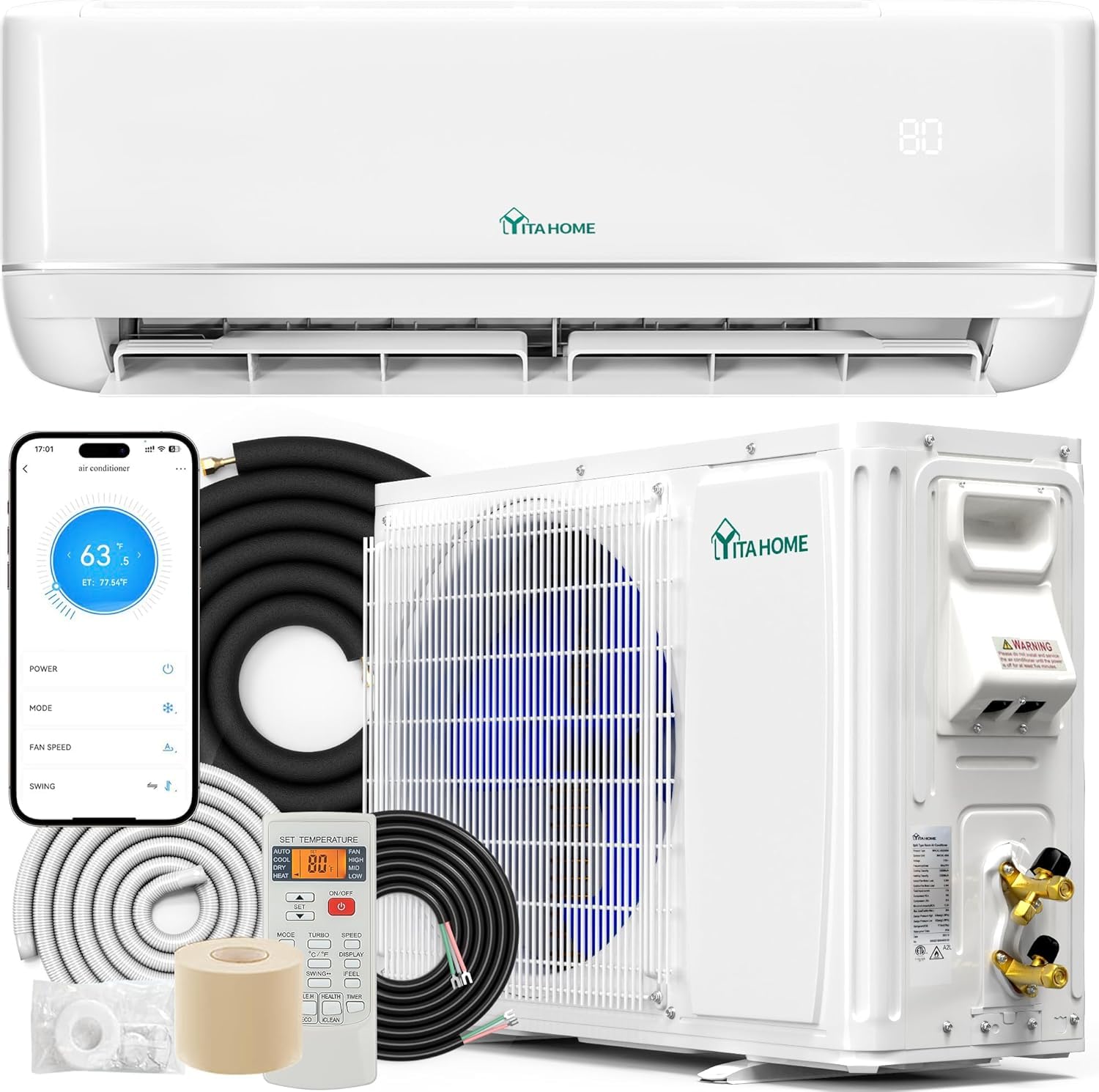
3. YITAHOME 18000 BTU Mini Split
Five modes, four fan speeds, and an iFEEL remote that chases the temperature to you.
The YITAHOME packs 18,000 BTU at 21 SEER2 into a 1.5-ton frame, and it lists a low annual energy draw of 700 kWh. For a bedroom setup that is the number that matters: a homeowner running this in ECO mode across a hot summer sees a modest addition to the bill rather than a shock.
The feature set goes further than the price would suggest. You get five modes (Auto, Cooling, Drying, Heating, Fan) with four fan speeds including Turbo, plus a 135°F self-cleaning cycle, an auto-defrost routine, and a 0-24 hour timer. The iFEEL function reads temperature at the remote rather than the wall unit, so the unit chases the reading where you actually sit. Wi-Fi and Alexa both work here, so you can set the cooling from bed without hunting for the remote.
The recurring friction is on the install side. Bending the copper lines without kinking them takes patience, and the 16mm tube size does not play nicely with every standard flaring tool, so metric adapters can show up on your shopping list. The app also takes a few attempts to pair — switching to AP mode resolves it. Budget the extra hour.
Efficiency per dollar: 21 SEER2 with a 5-star rating and 700 kWh annual use makes this one of the more economical 18,000 BTU picks to run.
The plumbing is the project: flaring and vacuuming copper is the hard part of a self-install here, not the mounting or the wiring.
Best for: a DIY-inclined buyer with a borrowed vacuum pump who wants strong features on a modest budget.
Look elsewhere if: you want a click-together line set with no flaring or vacuuming at all.
4. ROVSUN 18000 BTU Mini Split

18,000 BTU built to hammer a garage through an Arizona summer.
Garage and shop duty is the real test of a ductless system, and the ROVSUN is tuned for it. It delivers 18,000 BTU over up to 1,000 square feet, with a 20 SEER2 rating (a newer efficiency score — higher means less energy used) and a heat pump that also handles winter. The thermostat works between 61°F and 88°F, so a comfortable shop temperature is inside its range.
Quiet operation sits low on the list of priorities in a garage, but the mute mode rating of 32dB means this one will not drown out a conversation. Both the app and voice control work with Alexa and Google Assistant, so you can trigger a cooldown from the house before you walk out. The install kit includes 16.4 feet of copper line and a signal cord, and one reviewer describes a straightforward but time-consuming install in an insulated garage with no noticeable jump in the power bill.
The one real gotcha is the power cord: the kit does not include one, so buy it before the unit arrives. And it needs to stand upright for 24 hours before install, so factor in a day of waiting.
Why garage owners like it
- 18,000 BTU covers up to 1,000 sq. ft. at 20 SEER2 — enough for a two-car garage.
- 32dB in mute mode keeps it from being a nuisance in a shared building.
- Alexa and Google Assistant support lets you cool it down before you get there.
- Heat pump function keeps a workshop usable in winter as well as summer.
Plan before install day
- An extra power cord is required on top of the kit — source it in advance.
- Unit must stand upright for 24 hours before installation.
- Professional licensed installation is recommended, so check the local rules.
Suits you if: the job is a garage, workshop, or outbuilding that needs cooling in summer and heat in winter.
Skip this one if: you need a unit small enough for a bedroom — 18,000 BTU is more than a small room wants.
5. DELLA Vario Series 12000 BTU Mini Split

A bedroom unit that runs at 28 dBa and still handles -4°F heating.
For a small bedroom or a modest addition, 12,000 BTU is the balance, and the DELLA hits it at 23 SEER2 (cooling efficiency) and 9.5 HSPF (heating efficiency) — both high enough to mean low running cost. The 550 square feet of coverage suits a typical bedroom, small living room, or single-room addition.
The smart-temperature feature is unusual: in cooling mode, the system reads temperature at the remote rather than at the indoor unit, then adjusts airflow to match. That means the unit cools toward where you’re sitting, not toward the wall behind the head. At 28 dBa in quiet operation, it is quiet enough to leave on overnight without bothering anyone in the next room. The unit also handles outdoor temperatures down to -4°F in heating mode.
If you are buying this for a busy back bedroom, know the honest wear pattern: the swing fan blades and drain path need occasional attention. A few long-term buyers report some water pooling if the unit is not tilted toward the drain hose — setting it a hair off-level toward the drain resolves it. Also note the manufacturer’s instruction that professional installation is mandatory.
Bedroom-quiet at 28 dBa: this is one of the lowest indoor noise ratings in the lineup, and it pairs with a -4°F heating floor for year-round use.
Watch the drain slope: water pooling on the unit is a setup issue, not a defect — gentle tilt toward the hose fixes it.
Fits best in: a bedroom, small living room, or single-room addition where quiet running matters more than raw coverage.
skip it if: you need to cool an open plan space — 550 square feet will not stretch further than that.
6. SereneLife 18,000 BTU Mini Split AC & Heating System
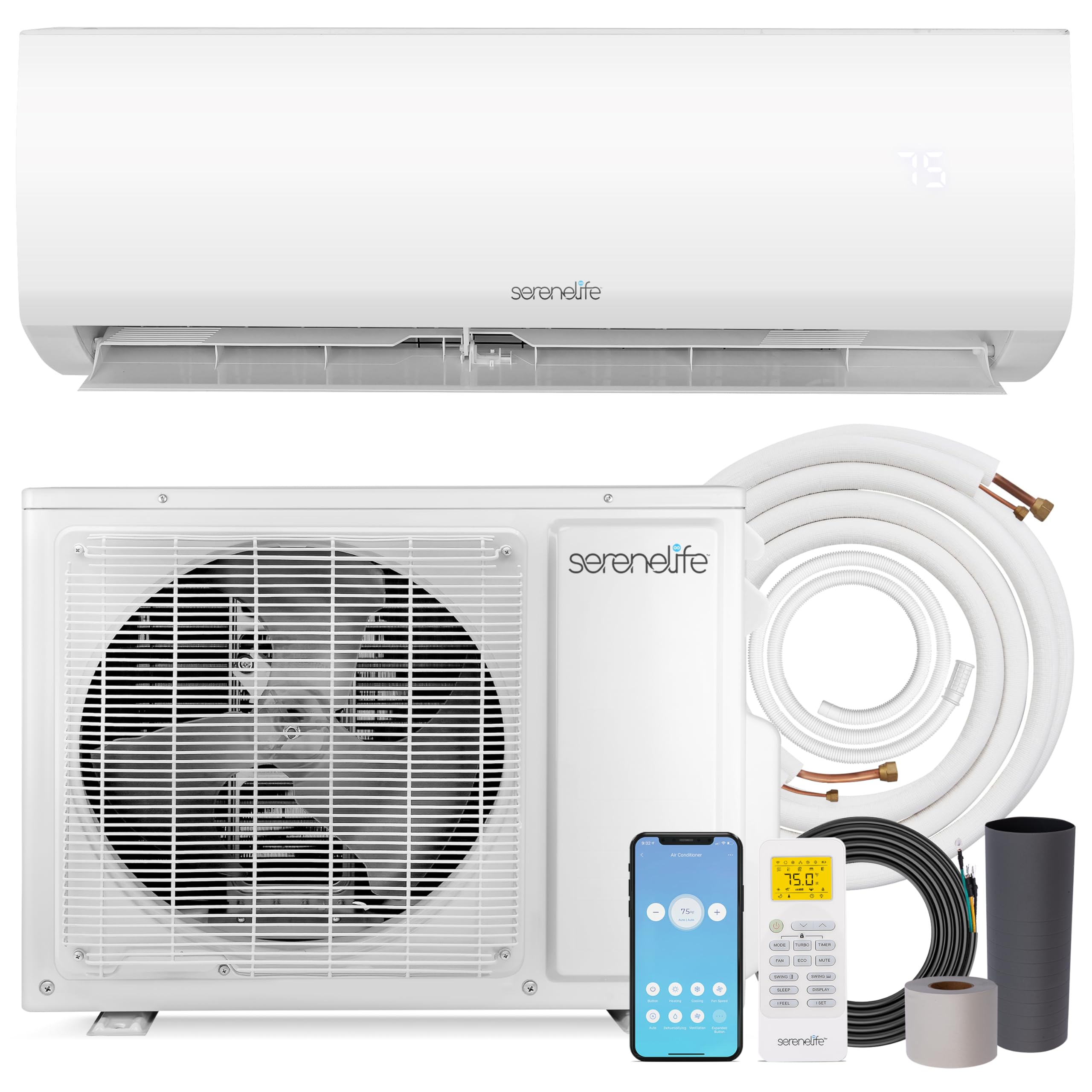
18,000 BTU across a thousand square feet, with auto-restart after a power cut.
If you want coverage without the premium price tag, the SereneLife puts 18,000 BTU over up to 1,000 square feet — a step below the Senville’s 1,250 on the same capacity band, but packaged as a simpler, more affordable option. Its 32 dB noise rating (about as loud as a quiet library) puts it in the same territory as the rest of this lineup.
There is one function here worth calling out for anyone in an area with unstable power: auto-restart. After a power cut, the unit returns to its previous settings on its own, so you do not come home to a house that has been silently baking for hours. Wi-Fi control lets you override the schedule remotely, and the kit includes a 5-meter copper pipe, remote, and AC power cord.
The main caution is an uneven reliability record, with some reports of early refrigerant leaks and louder running at high fan speeds. There are also cases where an early refrigerant leak forced a replacement. That is not the typical story — but it is worth buying from a seller with a clear return path.
Big-room value: 18,000 BTU and 1,000 sq. ft. coverage at a budget-tier position, with auto-restart that earns its keep in outage-prone areas.
Buy with a return window in mind: the long-term reliability record is the least consistent in this lineup, so protect yourself on delivery.
Right for: a large room or open living space where coverage and low upfront cost matter most.
Not the best fit if: you want the strongest possible reliability history at this size — consider the TOSOT or Daikin instead.
7. Cooper & Hunter MIA 12,000 BTU 115V Wall Mount Mini Split AC

The 115V option — the one that skips the 230V breaker conversation.
The detail that separates the Cooper & Hunter MIA from most of this lineup is its 115V supply. That means it can run on standard household voltage rather than needing a 208-230V circuit run by an electrician, which makes it the practical pick for an RV, a cabin, or an older building with limited panel room. It delivers 12,000 BTU at 21.2 SEER2 across 550 square feet.
Smart control comes in the box: the included smart kit works through the C&H Remote app to schedule and adjust the temperature remotely, and the 16-foot pre-flared line set, communication wire, and drainage extension are all supplied. Heating works down to an ambient temperature of 5°F. Owners describe whisper-quiet operation indoors and out, and a pro install is expected.
The caution is heating depth: output drops off below roughly 32°F outdoors. One basement installation in a Pennsylvania stone-walled house struggled to hold temperature on cold nights below about 32°F, with the heat output dropping as outdoor temperatures fell. In a mild climate that is a non-issue; in a hard-winter basement it matters. There are also occasional shipping-damage and controller-fault reports, so buy from a seller with a clean returns process.
What makes it different here
- 115V power supply — no 208-230V circuit required, so it suits RVs and older buildings.
- 21.2 SEER2 and 12,000 BTU in a 550 sq. ft. package.
- Smart kit and 16-foot line set included in the box.
- Quiet operation, close to recording-studio levels inside.
The honest limits
- Heating output drops below about 32°F outdoors; not a sole heat source in a harsh climate.
- Professional installation is required per the manufacturer.
- A few shipping-damage and controller-fault cases, so buy with a return path.
Choose this if: you have 115V available and want to avoid running a 230V circuit, or you’re fitting a small room in a mild climate.
Look past it if: this will be the only heat source in a cold-winter home.
8. TOSOT 18,000 BTU 24.5 SEER2 Mini Split, Aoraki Series
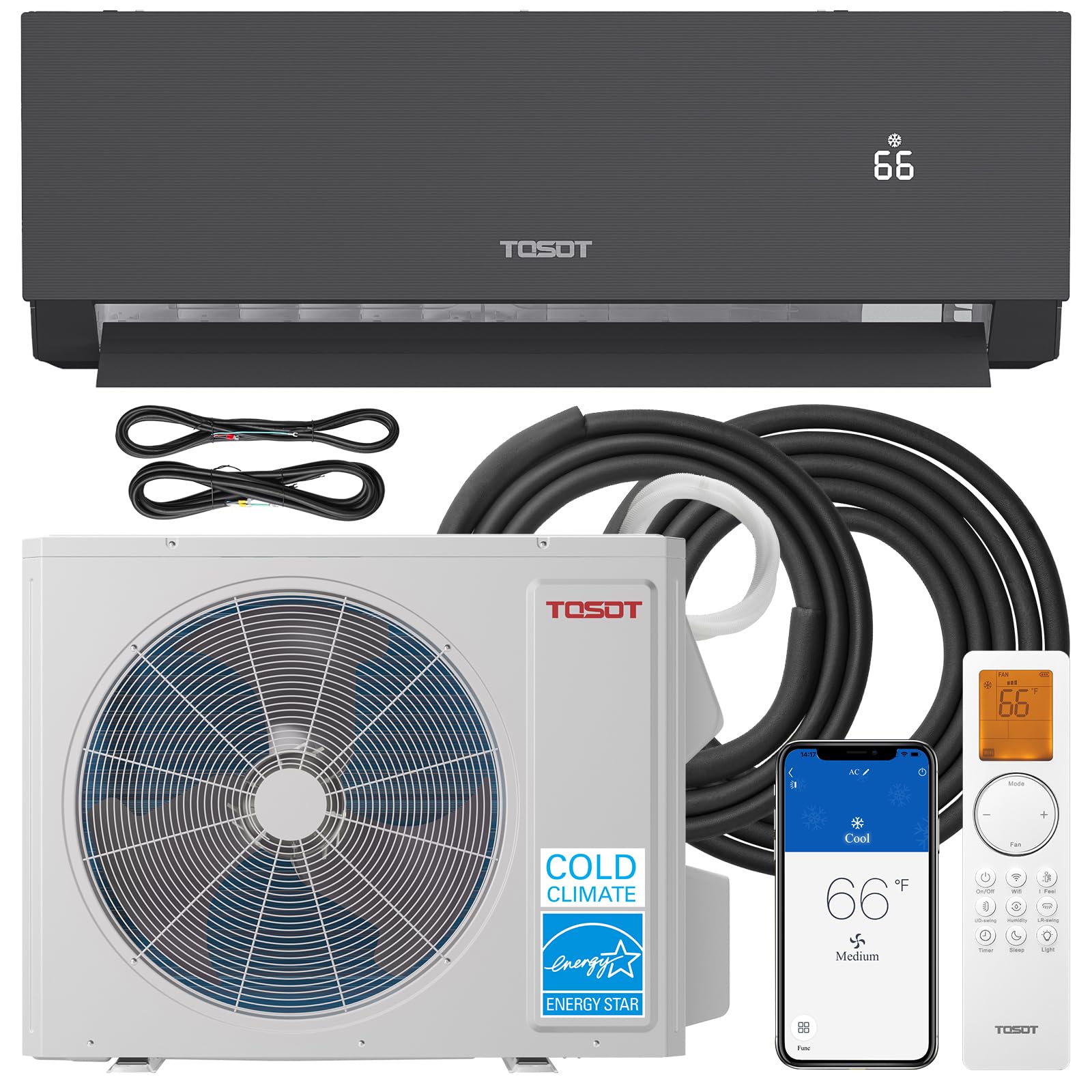
24.5 SEER2 and a -22°F operating floor, built for a hard winter.
On raw efficiency the Aoraki is the leader of this group: 24.5 SEER2 beats the Senville’s 21.5 and the ROVSUN’s 20 SEER2 on the same 18,000 BTU capacity. That gap translates into meaningfully lower running costs over a long cooling season, and the unit sits at the top of the ENERGY STAR, COLD CLIMATE, ETL, and AHRI certification ladder.
Cold weather is where it earns its keep. The system works from -22°F to 122°F, and it has a dual electric heating belt to handle extreme cold. It is also the first ductless system in the market with optional ERV integration — that means you can pair it with an energy recovery ventilator (a fresh-air accessory that recycles energy from exhaust air) to pre-condition incoming air. Indoor noise drops to 29 dB (about a whisper), and the outdoor unit runs at 59 dB in night mode.
One practical warning: the outdoor unit’s packaging is thin, and there are repeated reports of dents or damage on arrival. A few owners went through multiple condensers to get a clean one. Buy from a seller with a solid exchange policy, and inspect the outer box before you sign.
The efficiency number to beat: 24.5 SEER2 is the highest rating in this article, backed by COLD CLIMATE certification and a -22°F operating floor.
Packaging is the weak link: plan for a damaged outdoor unit and line up an exchange-friendly seller.
Best match: a home in a cold climate that wants top-tier efficiency and a fresh-air accessory path.
Pass it by if: you cannot easily return a damaged condenser — the risk is real on a heavy freight shipment.
9. Albott Mini Split Air Conditioner and Heater, 36,000 BTU
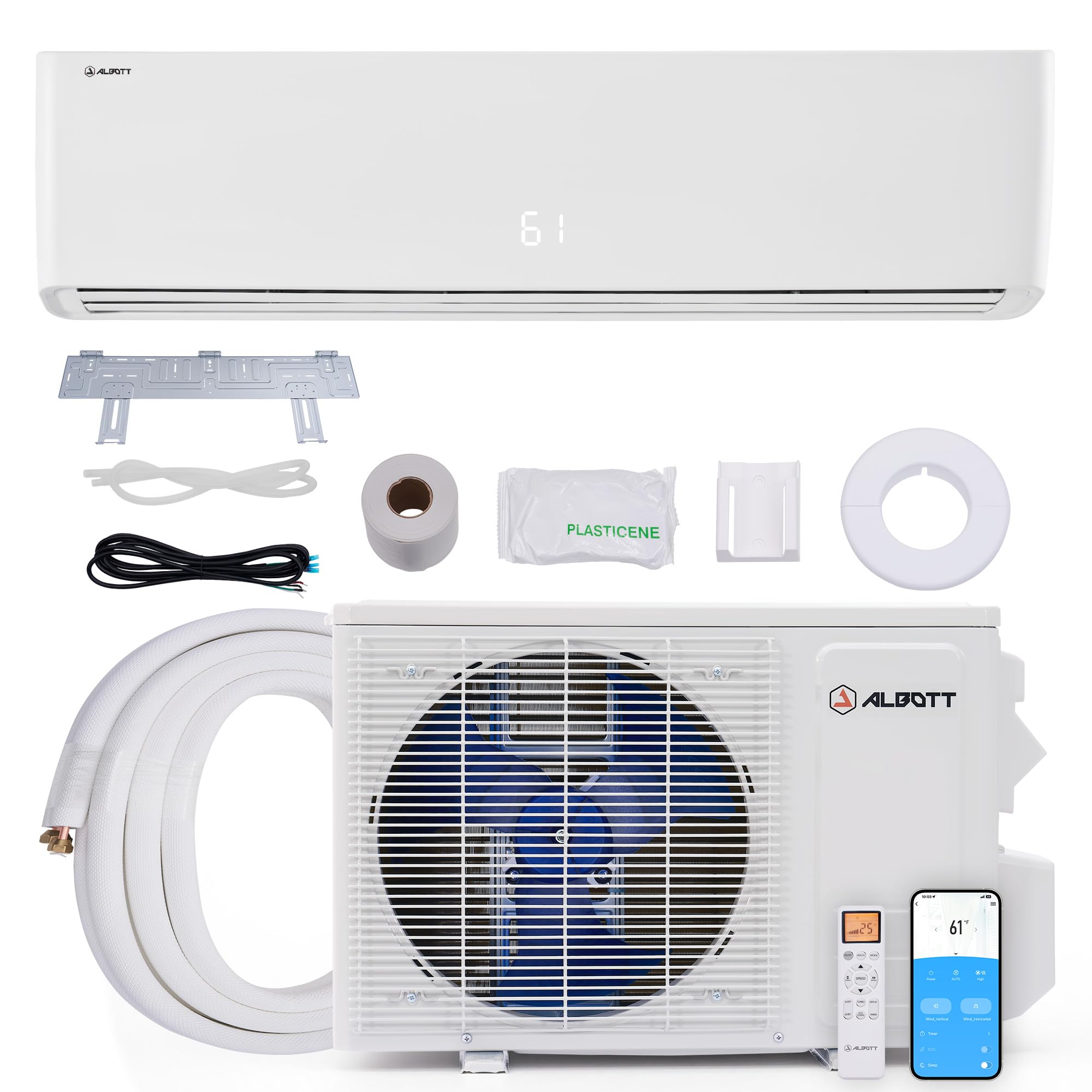
36,000 BTU for the big shop — three times the capacity of the bedroom units here.
If your space is a metal workshop or a large open floor, the Albott jumps straight to the top of the capacity list. The 36,000 BTU rating covers up to 2,500 square feet, which is roughly twice the reach of the 18,000 BTU picks in this lineup. It runs on 208-230V, and the SEER2 rating is 18 — lower than the best units here, but the added capacity is the headline.
It works across a 61°F to 90°F thermostat range, with self-cleaning and a 24-hour timer, and it runs below 29dB indoors. The compressor carries a 5-year warranty and the parts carry 7 years, which is one of the longer coverage terms in the group. One owner with a 40x40x16 insulated shop says it cools the whole thing without strain.
The most common gripe by far is packaging and arrival condition: the unit tends to show up with cosmetic damage. Buyers still describe the unit working as described once it’s up. There’s also a note that the app may not switch to Fahrenheit even though the unit and remote will.
The capacity answer: 36,000 BTU and 2,500 square feet — nothing else in this article gets you that coverage from a single head.
Fair warning on arrival: a lot of these arrive with cosmetic damage to the outer casing, so insist on a clean carton before you unwrap.
Fits the job if: you’re cooling a large metal shop, warehouse space, or very open floor plan and need the biggest single-unit capacity here.
Better to skip if: you’re working with a standard bedroom or single-room layout — you’d be buying far more capacity than the room needs.
10. Daikin Entra R32 18,000 BTU Mini Split

The one built by an HVAC brand you’d recognise on a commercial rooftop.
Daikin’s name shows up on commercial jobs more than on consumer listings, so the fact that the Entra lands at a mid-tier price makes it worth a look. The unit delivers up to 20,000 BTU at peak, rated 18 SEER2 and 9 HSPF2 — enough to cover 1,000 square feet. Operating range is 50°F to 115°F for cooling and 5°F to 65°F for heating.
What you get for the money is the refinement layer: titanium apatite photocatalytic air-purifying filtration (a filter coating designed to break down odours and airborne particles), Blue Fin coil protection, ECO+, and a self-diagnostic digital display. The kit includes a 15-foot pre-charged line set, wall bracket, and remote, and it runs on R32 refrigerant. The indoor unit is quiet enough that one owner compares it directly to the old window unit and never looks back.
The caution is registration. Some units cannot be registered for warranty when bought through Amazon, and the manufacturer support line was unhelpful in at least one case. Before you unbox, contact Daikin directly to confirm how to register, or you risk losing the warranty cover.
The case for the Daikin
- 18,000 BTU cooling with up to 20,000 BTU peak, 18 SEER2 and 9 HSPF2.
- Titanium apatite photocatalytic filter and Blue Fin coil protection.
- 15-foot pre-charged line set, wall bracket, and remote all included.
- Runs on R32 refrigerant, the current standard for new mini splits.
Watch out for
- Warranty registration is complicated when buying through Amazon — confirm before install.
- Cooling floor is 50°F and heating floor is 5°F, so colder climates need a different system.
- Professional installation is expected.
Suited to: a homeowner who prefers a well-known HVAC brand and a filter upgrade over the absolute lowest cost.
Reconsider if: Amazon-purchase warranty registration is a dealbreaker — verify it first.
11. MRCOOL DIY Star 4th Generation 12,000 BTU

This is the one where “DIY” actually means DIY — no vacuum pump needed.
Every other pick in this article expects at least a borrowed vacuum pump. The MRCOOL DIY Star is the genuine article: it arrives with pre-charged Quick Connect line sets, so no special tools, equipment, or training are required. You bolt on the brackets, click the lines together, and you’re done in a few hours rather than a weekend. The 12,000 BTU unit is energy-efficient enough to carry the ENERGY STAR certification, and the smart kit handles app and voice control.
Low-ambient cooling is a rare feature here. The unit will cool down to 5°F ambient — that is the temperature outside, not the setpoint — which makes it usable in server rooms and greenhouses where cooling is needed year-round. The low-refrigerant alarm is a sensible addition: it warns you before a small leak becomes an expensive repair. The auto-restart function picks up the previous settings after a power cut.
The catch is warranty follow-through: a few owners mention a failed controller board that was slow to resolve. A handful of customers note a failed controller board that was not resolved quickly against a filed ticket. Call it a fit question: if you value the no-vacuum install and energy efficiency, this is the standout option, but keep your paperwork and support records.
The install story is the pitch: Quick Connect line sets remove the vacuum pump from the job entirely, which saves both tool cost and time.
Budget for the electrical run: you still need a dedicated 30A circuit from an electrician, and the line-set cover is an extra worth buying.
Go for it if: a real DIY install with no vacuum pump is the whole point for you, and 12,000 BTU fits your room.
Better to skip if: warranty speed is your top concern — you’ll want a simpler path back to the brand.
12. MrCool Easy Pro 18k BTU Split System
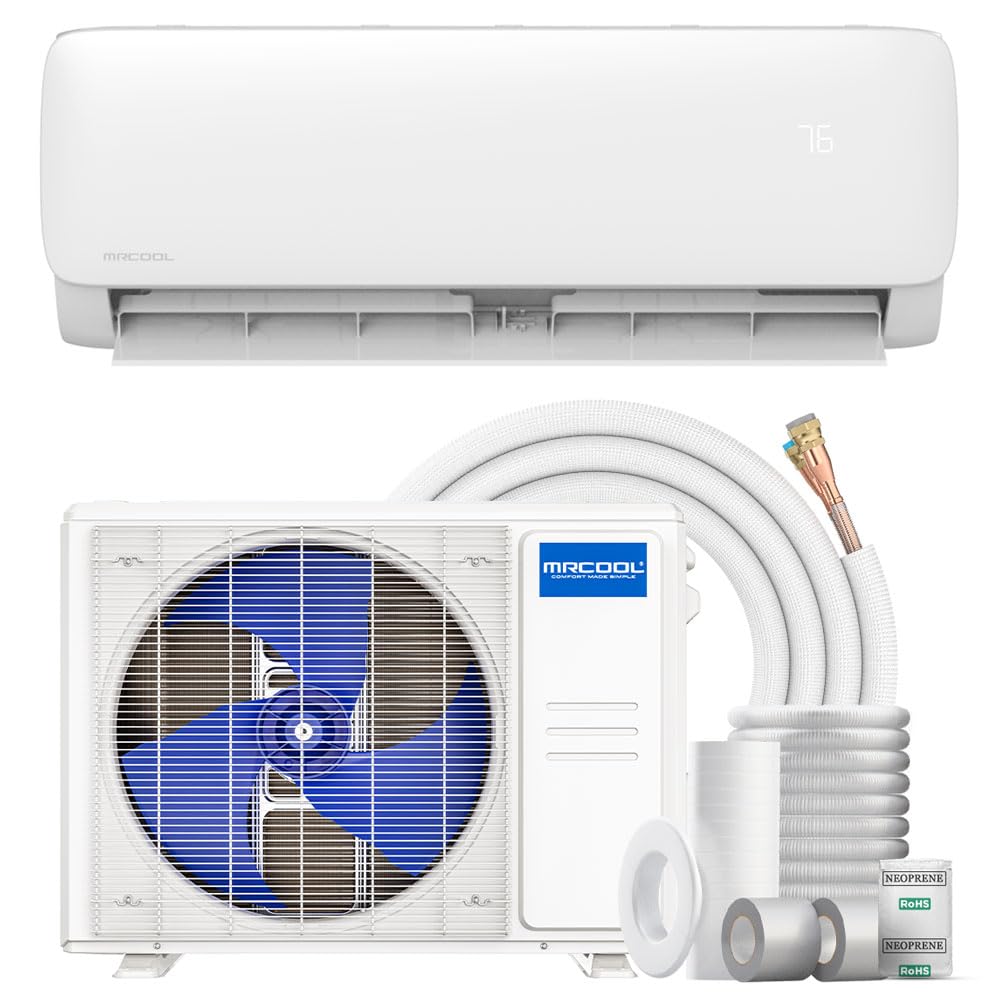
Larger than the MRCOOL DIY Star, with an 11.2 HSPF2 heating rating.
Once you know you want the Quick Connect life, the question becomes size. The Easy Pro jumps to 18,000 BTU (listed as 18,900 BTU at peak) over up to 1,200 square feet — a meaningful step up from the 12,000 BTU Star, and it covers a garage, sunroom, or game room without blinking. Efficiency stays solid at 20 SEER2 (cooling) and 11.2 HSPF2 (heating).
The stand-out hardware detail is the Gold Fin condenser coating — a corrosion-resistant finish on the outdoor coil that protects against rust while keeping heat transfer efficient. In a coastal or humid climate, that is the difference between a condenser that lasts and one that corrodes from the fins inward. The kit ships with a 16-foot line set, and the vendor backs it with a 1-year labor warranty on top of the manufacturer coverage.
The one piece of homework before you buy: check who is actually shipping it. A few buyers on the marketplace side received a used or scuffed air handler and had to chase a return. Buy from the manufacturer or a seller with a clean record, and inspect the packaging before you sign for it.
The Gold Fin difference: a corrosion-resistant condenser coating and an 11.2 HSPF2 heating rating make this the better winter performer of the two MrCool units here.
Check the seller, not just the unit: the hardware is well-regarded; the marketplace shipping experience is the variable.
Strong fit for: a garage, sunroom, or game room that needs 18,000 BTU of quick-connect cooling and better winter heating.
Think again if: your room is small — 18,000 BTU is overkill for a single bedroom.
13. Cooper & Hunter 18,000 BTU 2-Zone Wall Mount Mini Split

One condenser, two heads — a 9,000 BTU and a 12,000 BTU air handler on a single outdoor unit.
This is the only multi-zone pick in the lineup, and that changes the math entirely. One 18,000 BTU Olivia Series condenser powers two separate wall-mounted heads — a 9,000 BTU unit and a 12,000 BTU unit — so you can cool two rooms that would otherwise need two outdoor condensers. It runs at 22.5 SEER, one of the higher efficiency ratings in this article, and each head gets its own smart port adapter for individual app control.
The install kit is generous: each air handler comes with its own 25-foot pre-flared copper line set, 25-foot communication wiring, and 16-foot drainage extension. That long run matters when the two rooms sit on opposite sides of the condenser. Heating works down to -13°F ambient, and the whisper-tech indoor units keep noise down in bedrooms and living rooms alike.
What you’re signing up for is the most complex install here. Two heads, two line sets, two drains, and a 230V supply mean a licensed technician’s job, and the manufacturer’s instructions are clear that this is not DIY equipment. One pair of long-term owners also ran into pest damage to the control board wiring through the openings in the electronic section — block those gaps with mesh during install.
Why two heads beat two systems
- One 18,000 BTU condenser feeds a 9,000 and a 12,000 BTU head — two rooms, one outdoor unit.
- 22.5 SEER efficiency and heating down to -13°F ambient.
- Each zone has its own smart port adapter and app control.
- Two 25-foot line sets included, enough for rooms well apart.
The reality of the install
- Two heads, two drains, and 230V power — professional installation is required.
- Control-board wiring is exposed through open gaps that a few reviewers point out pest damage to; seal during install.
- Longer-term failures have been reported on a couple of units past two years.
Choose this if: you need to cool two rooms at once and want one outdoor unit to do it, with individual room control.
Not the right pick if: one room is your whole goal — you’d be paying for a second head you do not need.
Know the Specs
BTU Rating and Square-Footage Coverage
BTU (British thermal units) is the unit of cooling capacity — a 12,000 BTU unit is effectively a one-ton system. The square-footage figure in each listing assumes a standard ceiling and decent insulation, so treat it as a starting point. A tall shop or a room with large windows will need more capacity than the number suggests, and oversizing a small room leads to short, frequent cycles rather than steady comfort.
SEER2 and HSPF2 Efficiency
SEER2 is the cooling efficiency rating and HSPF2 is the heating efficiency rating; both measure how much electricity the unit draws to do a set amount of work. Higher numbers mean lower running costs. A 24.5 SEER2 system and a 20 SEER2 system will both cool a room, but the higher-rated one tends to leave a smaller mark on your power bill over a full summer.
Quick Connect vs. Pre-Charged Vacuum Install
A Quick Connect line set arrives pre-charged and clicks together, so no vacuum pump is needed — that is the true DIY path. A pre-charged system still needs a vacuum pump and manifold gauges to pull a vacuum on the lines, then release the refrigerant. Both approaches avoid buying refrigerant gas separately, but only the Quick Connect style is an actual no-tools install.
Cold-Climate Operating Ranges
The heating floor is the outside temperature below which the unit’s heat output drops off sharply. A heat pump rated to operate down to -22°F can carry through a hard winter; one rated to 5°F is best in a mild climate. If your winters dip below the floor, plan a backup heat source rather than relying on the mini split alone.
Common Questions
Do I really need a vacuum pump to install a DIY mini split?
Can I install a mini split myself without an HVAC license?
What size mini split do I need for a garage?
Is a 115V or 230V mini split easier to install?
Will a mini split heat my home in winter?
How long do mini split lines need to be?
Do I need to clean a mini split’s filter, and how often?
What does SEER2 actually mean and why does it matter?
Can a mini split cool one room even if the condenser is outside?
What is the difference between a mini split heat pump and a regular air conditioner?
The Bottom Line
For most buyers looking for the best diy mini split, the smartest pick is the MRCOOL DIY Star — its Quick Connect line sets mean you skip the vacuum pump entirely and still get ENERGY STAR efficiency. If cold winters are your main worry, the TOSOT Aoraki carries the highest efficiency rating here at 24.5 SEER2 with a -22°F operating floor. And for two rooms on one condenser, the Cooper & Hunter 2-Zone is the one to reach for.
One last nudge: buy from a seller with a clean packaging and returns record. The biggest recurring issue across these reviews is not the equipment — it is the shipping damage and the warranty paperwork. Sort out the seller’s return policy and the warranty registration before install day, and the hardware itself rarely disappoints.
How we choose
We do not accept paid placement. Every pick is matched to a real buyer and a real use-case; we do not hands-on test units.
Sources
Specifications: manufacturer listings and product documentation. Review insights: verified customer reviews, as of October 2026. Pricing: not shown on this page (it changes often); check the current price via the retailer link.
As an Amazon Associate, Aappliancez earns from qualifying purchases. This does not affect which products we feature.