Disclosure: Some links in this post are affiliate links. As an Amazon Associate I earn from qualifying purchases, at no extra cost to you. Learn more
Specs are compiled from manufacturer listings and verified buyer reviews and can change over time — please confirm the key details on the product page before buying.
An aftermarket ADAS system (an add-on driver-assist kit that warns you of hazards) only earns its place on your windshield if the warnings arrive before you need them. That is exactly where most add-on kits stumble. A forward-collision chime that fires a second late, or a blind-spot box that guesses the following car is twenty feet closer than it is, trains you to ignore the whole system. So the picks below are judged on what decides whether you keep the alerts switched on: how sharp the camera sensor is at night, how far the warning range really reaches, and whether the fit leaves your sun visor usable.
This guide is built by comparing the manufacturers’ published specifications and the patterns across verified customer reviews, so you get each pick’s real strengths and trade-offs instead of marketing spin.
Some kits here replace your mirror entirely and add blind-spot alerts, while others bolt on four-camera coverage and leave the mirror alone. Read on for the honest breakdown of every aftermarket adas system worth mounting on your glass.
Top Picks

How To Choose The Best Aftermarket ADAS System
The mistake most buyers make is shopping for the biggest resolution number and assuming the safety alerts come free with it. They do not. The warning software and the camera sensor are two separate systems, and a kit can shoot gorgeous 4K video while its lane-departure alert never fires. Decide first which warnings you actually want, then check that the hardware behind them is up to the job.
Match the warning type to your real driving
A forward-collision alert (a chime when you are closing on the car ahead too fast) is the one most highway drivers notice first. Lane-departure warning helps on long, sleepy stretches. Blind-spot detection matters most if you change lanes in traffic a lot. Pedestrian alerts are worth having around town. Be honest about which of these you will use, because every alert you do not want is one more thing to mute.
Look at the sensor, not just the resolution
A 4K frame is only as useful as the sensor capturing it at night. Sony STARVIS 2 sensors are the ones serious buyers look for, because they pull detail out of low light where ordinary sensors go grainy — so number plates stay legible under headlights. A kit with a lower resolution but a STARVIS 2 sensor will often beat a bare 4K kit after dark.
Check the fit before you fall for the spec sheet
Mirror-replacement units take over your rear-view mirror, so screen brightness in daylight and headlight glare at night become daily annoyances if the panel is weak. Clip-on and dash-mounted kits leave your mirror alone but add a screen to the dash. Measure your visor clearance and check the rear camera cable length against your vehicle, because a cable that is too short means drilling or skipping the rear camera entirely.
Plan for power and storage
Parking mode (recording while the car is off) needs either a hardwire kit tapped into a constant fuse or an OBD cable. Neither is always in the box. Storage matters too: a 4K front camera fills a card fast, so check the maximum card size the unit accepts before you plan on long trips.
Side-by-Side Comparison
| Model | Best For | Front / Rear Video | Display | Max Card | Amazon |
|---|---|---|---|---|---|
| WOLFBOX G850 PRO★ Best Overall | Mirror swap with full driver alerts | 2160P @30fps / 1080P @25fps | Full IPS touch | 256 GB | Amazon |
| BOTSLAB 4K Front and RearParking Guardian | Parking protection on a hardwired kit | 4K front / 2K rear | LCD | 64 GB | Amazon |
| Magellan 4K+4KDual 4K Unit | Dual 4K with a big card in the box | 4K front / 4K rear | LCD | 256 GB | Amazon |
| Pelsee S3 Ultra | Plate-readable 4K with fast Wi-Fi 6 | 4K native / 2.5K | 3.4-inch IPS touch | 1 TB | Amazon |
| Roadwitness 12″ Mirror | Trailer and long-vehicle rear view | 4K / 4K @30fps | 12-inch anti-glare touch | 256 GB | Amazon |
| Pelsee P12 Pro Max | Premium mirror with 33 ft rear cable | 4K @30fps / 2.5K | 12-inch LED | 512 GB | Amazon |
| AZDOME PG17 Pro | Wide mirror view with zoom on plates | 4K UHD / 2.5K HDR | 12-inch LCD | 256 GB | Amazon |
| Vantrue N5S | Four-camera 360° inside and out | 2.7K+1080P+1080P+1440P | LCD | 1 TB | Amazon |
| Escort Redline 360c + M2 | Radar and laser detection with video | 1080P Full HD | OLED | — | Amazon |
Detailed Reviews
1. WOLFBOX G850 PRO 4K Mirror Dash Cam with ADAS and BSD
Our pick — 4.0+★ from 1,000+ verified ratings; the strongest balance of quality and price.
The mirror you swap in once and stop thinking about — alerts, wide rear view and 4K recording in one glass panel.
If you want a single unit that turns your ordinary rear-view mirror into a wide digital view and adds lane, collision and blind-spot warnings, the G850 PRO covers the most ground here. It records the front at 2160P (2560*1440) at 30fps and the rear at 1080P at 25fps. The 170-degree field of view means the front lens sees well across your lane and into the next. A 64GB card ships in the box, and the slot accepts up to 256GB — but compare the BOTSLAB’s 64GB ceiling and you can see that bigger card support is where this one pulls ahead for road-trip recording.
The WOLFBOX alerts you get are forward collision, pedestrian collision, lane departure, lead vehicle start and distance monitoring, plus a blind-spot algorithm that warns you about cars alongside on a lane change. What owners consistently value is the picture quality — the front camera picks out road signs and number plates cleanly, and the display is a full IPS touch panel you can tap through. Installation reads as one of the friendlier parts of ownership, with the harness routing described as clean and close to factory-looking. Hands-free tweaks run through 12 voice commands, including locking a clip or firing the shutter, so you are not stabbing at a screen at speed.
The catch with any mirror replacement is glare, and this one is no exception. Owners on untinted glass have found the daytime panel dimmer than a real mirror. The digital system also has a learning curve: the blind-spot boxes and distance estimates can drift by a noticeable margin, so treat the alerts as a nudge rather than a precise measurement. One practical note from real use — parking mode needs a hardwire kit and a constant fuse, which is not in the box. And if your visors need full travel, test the fit first; the large mirror can clip the sun visor’s path.
Where the G850 PRO holds up
- Five distinct ADAS alert types plus a blind-spot algorithm in one mirror unit
- 2160P front footage keeps plates and signs readable for evidence
- Up to 256GB card support — the largest ceiling among the mirror kits here
- 12 voice commands keep your hands on the wheel
What to plan around
- Parking mode needs a separate hardwire kit and constant fuse
- Daytime screen brightness trails a real mirror on untinted glass
- Blind-spot distance estimation is approximate, not exact
Worth it if: you want one mirror that covers recording, wide rear view and the main driver warnings without adding a dash screen.
Think twice if: glare on untinted glass bothers you, or you expect the blind-spot boxes to read exact distances.
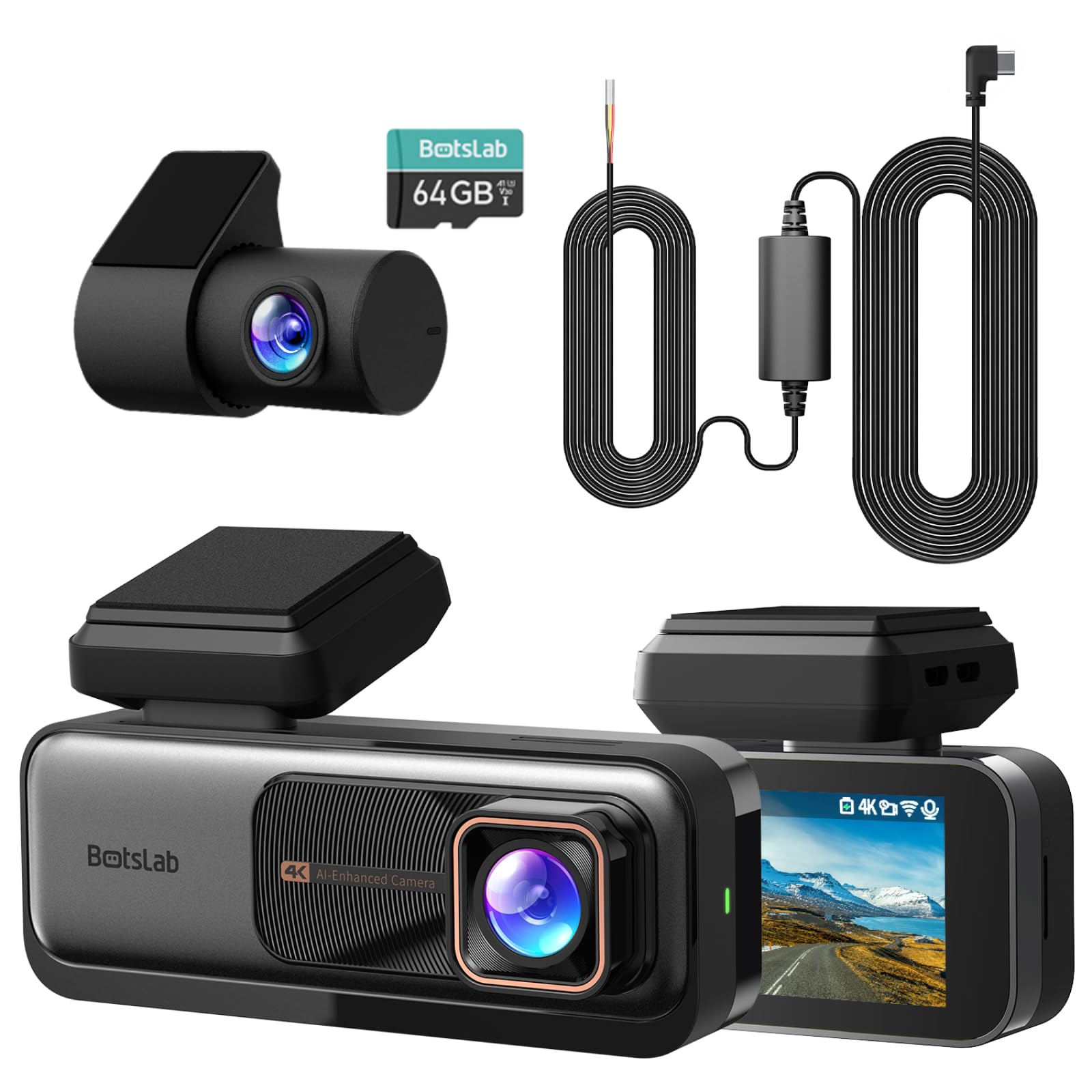
2. BOTSLAB 4k Dash Cam Front and Rear with 24/7 Parking Monitor
The one that keeps watching after you park — a true 4K front, a swiveling rear and a hardwire kit in the box.
Most kits charge extra for the part that makes parking surveillance work. This one hands you the hardwire kit and a 64GB card at the same time, so the around-the-clock recording you bought is ready to switch on. The front camera shoots true 4K (3840 x 2160 pixels) and the rear 2K, and that rear lens swivels a full 360 degrees — so you can aim it at the road behind you or swing it round to watch the inside of the cabin. On frame rate (frames per second, how smooth the video looks) this is the more flexible of the two front-runners: it offers 24, 30 and 60 FPS where the WOLFBOX records at 30 FPS.
Where it wins people over is coverage and value. Owners describe the 170-degree wide front angle as catching nearly everything around the vehicle, with one setup reported as covering the full 560 degrees once front, rear and cabin views are stitched together. Setup reads as easy, and the included kit is what makes a permanent install practical rather than a weekend project. The ADAS side is driven by a 1.5TOPS AI NPU (a small dedicated chip that runs the warning algorithms on-device) handling pedestrian collision, lane deviation, front-vehicle movement and distance alerts. Built-in GPS logs your route and speed.
The honest limits sit in the details. The slot tops out at 64GB, so long 4K trips mean managing files or adding a genuine high-endurance card. Wiring the rear camera around side airbags is fiddly on some vehicles, and the parking-trigger sensitivity is finicky — a few owners have seen a battery-discharge warning after hardwiring. There is also a real learning curve on the pinhole reset button and app pairing, so read the manual fully before you mount anything.
What it nails: a complete, cable-and-card-included package for owners whose main worry is theft or a parking-lot knock, with 4K front footage and a rear camera you can aim wherever you need.
The honest caveat: 64GB is the ceiling here — smaller than several kits on this list — so budget for a high-endurance card and get comfortable clearing files.
Reach for this if: parked-car protection is your top priority and you want the hardwire kit already in the box.
Look elsewhere if: you record marathon drives and need a bigger card ceiling than 64GB.
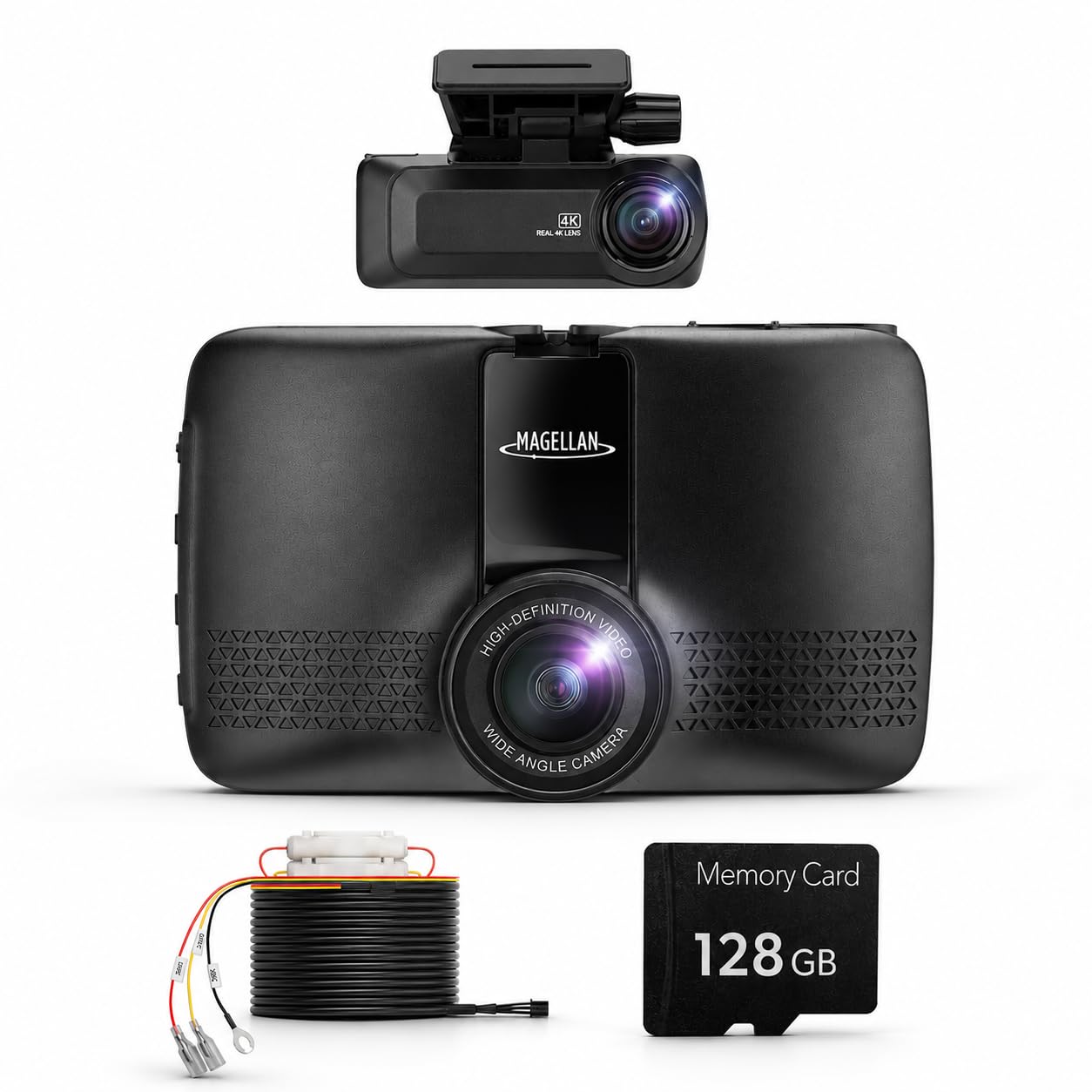
3. Magellan 4K+4K Dash Cam Front and Rear with Dual STARVIS 2
Both lenses shoot 4K 2160P, and a 128GB card plus hardwire kit land in the box.
Most dual-camera kits give you a sharp front and a softer rear. This one puts a 4K (2160P) sensor at both ends, each paired with STARVIS 2 IMX678 sensors for clearer low-light capture. If you mainly want evidence from behind the car — a rear-end collision, a tailgater, a hit-and-run while parked — a 4K rear is the spec that matters, and it is rare at this size. A 128GB high-endurance card and the hardwire kit both ship with it, so parking mode is wired from day one and the slot climbs to 256GB.
Day-to-day the kit gets high marks for a compact footprint that tucks neatly behind the mirror and a clear on-screen picture you can also pull up on the phone app. The speaker for voice alerts is loud and legible, the LCD is bright, and the bundled accessories are described as good enough for a self-install. GPS logging records your route and location, and the app handles playback and downloads over built-in Wi-Fi.
The trade-offs are worth knowing before you commit. The field of view (the angle the lens sees) is 130 degrees, the narrowest front angle on this list, so you trade the widest possible coverage for that dual-4K sharpness. There is a 3-year warranty advertised, but the fine print has bitten some owners — a claim may mean returning the full kit at your own cost, and spare parts like the rear mounting film are not always sent out separately. If long-term support and easy part swaps matter, weigh that against the dual-4K advantage.
The standout spec: rear footage at a full 4K (2160P) with STARVIS 2 sensor tech — the sharpest rear view in this roundup, and the reason to pick it over single-4K rivals.
Who it isn’t for: drivers who want the widest possible 170-degree front angle or who lean on warranty swaps — the 130-degree lens and the return-the-whole-kit claim process both cut against that.
Best fit: owners who care most about a crisp rear plate shot and want the card and hardwire kit already covered.
Consider the alternatives: if a wider than 130-degree front view or easy part replacement is your priority.
4. Pelsee S3 Ultra True 4K+2.5K Dash Cam
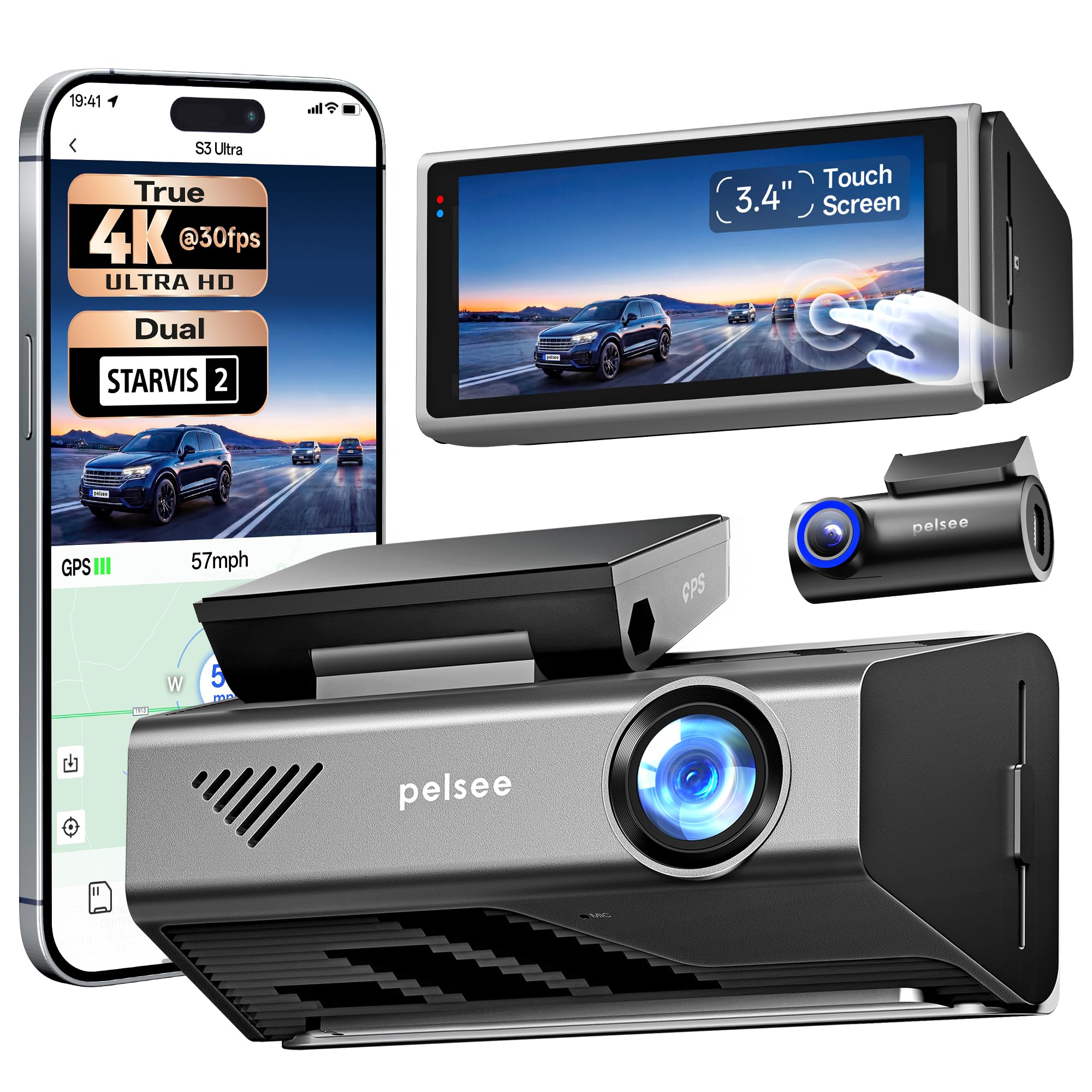
Native 4K up front, 2.5K behind, and a card slot that swallows a full terabyte.
The S3 Ultra’s front camera captures at a native 3840 x 2160 pixels — true UHD, not upscaled — paired with an F1.5 aperture and True HDR for detail in bright and dark patches at once. The rear records 2.5K, and both channels run on Sony STARVIS 2 sensors: an IMX678 (8MP) up front and an IMX675 (5MP) behind. That sensor pairing is the reason the daylight footage reads plate-clean and the night footage keeps its color instead of collapsing into gray. The card ceiling is the headline anywhere on this list: up to 1TB, so you are not clearing footage every couple of days.
Connectivity is the other place it moves ahead. Built-in 5.8GHz Wi-Fi 6 downloads clips to your phone at up to 30 MB/s, which is a real difference when you want a clip off the camera before you leave the car park. The 3.4-inch IPS touchscreen handles settings and the quick-release bracket lets you pop the camera off the glass and leave no attractive mount behind. You also get collision-sensing parking mode and time-lapse recording through the included OBD cable — plug-and-play, no fuse-tapping required.
Two things pull the score down. Configuration is deep, and a few owners found the settings menus took a real session to work through. GPS logs your location and speed inside the app rather than acting as a standalone tracker, and the rear camera cable uses a proprietary connector, so you cannot swap in a standard long cable. ADAS here covers forward collision, lane departure and pedestrian alerts plus voice commands — a focused set, not an exhaustive suite.
Why it earns its premium
- Native 4K (3840 x 2160) front plus 2.5K rear on dual Sony STARVIS 2 sensors
- 1TB card ceiling — the largest in this roundup alongside the N5S
- 5.8GHz Wi-Fi 6 at up to 30 MB/s for fast clip offloads
- OBD cable and 128GB card both included, so parking mode is plug-and-play
Before you commit
- Menu depth means setup takes a proper session
- GPS lives in the app — no standalone route tracking
- Rear camera uses a proprietary cable, so no standard-cable swaps
The pick for: buyers who want the sharpest possible plate detail and a card slot they will not outgrow.
The trade-off: if you want the widest alert suite rather than the crispest sensor, a mirror kit like the WOLFBOX covers more warning types.
5. Roadwitness Dual STARVIS 2 4K+4K 12″ Mirror Dash Cam
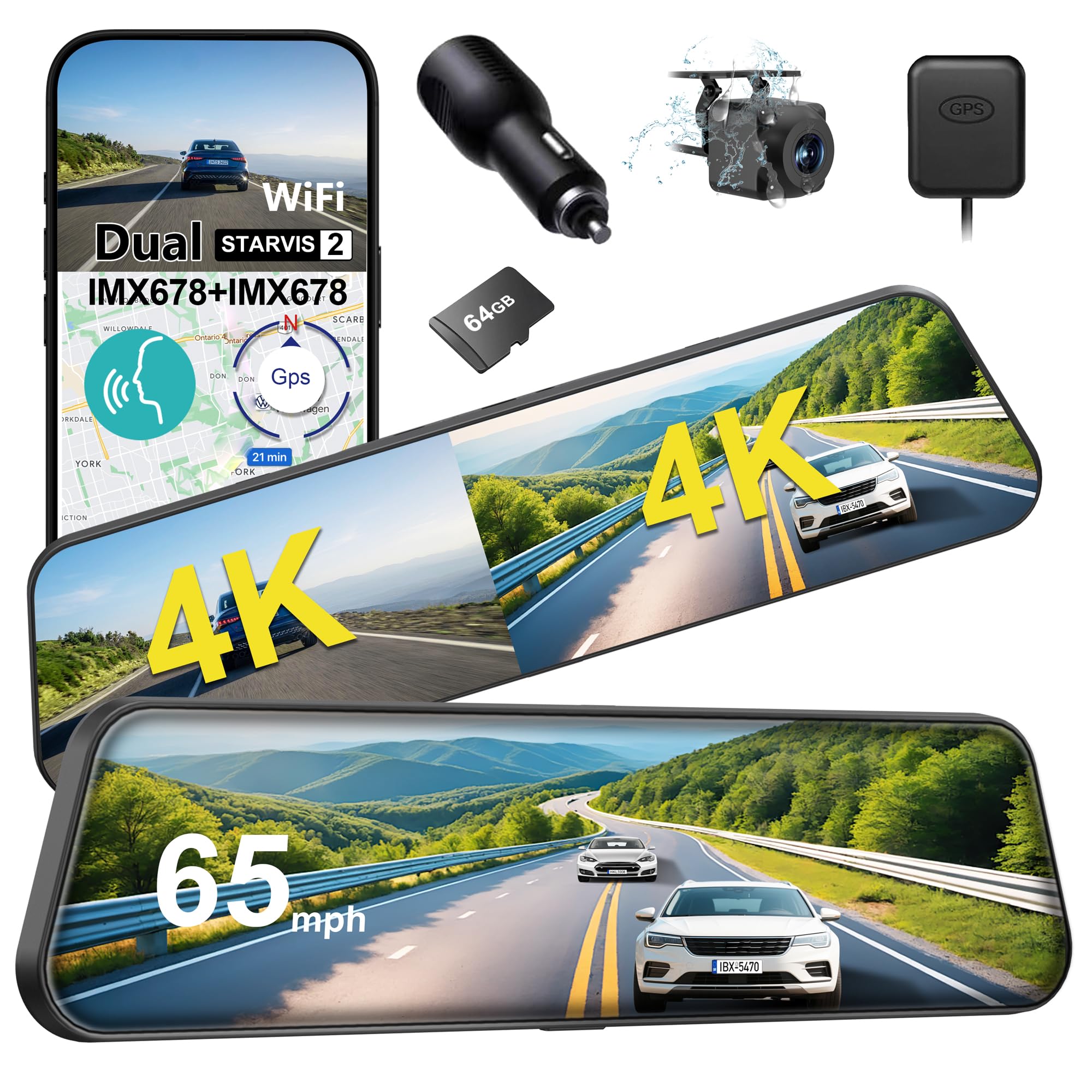
A 12-inch mirror that records 4K front and rear at once and reaches back to a towed trailer.
The headline here is symmetry: both the front and rear cameras record at 3840 x 2160P at 30fps, each on a Sony STARVIS 2 IMX678 sensor behind premium 7-glass lenses. That pairing — identical 4K at both ends, plus a 170-degree ultra-wide angle — is what makes it a fit for long rigs and trailers, where the rear view is doing the same job as the front. Built-in ADAS handles forward collision, lane departure and pedestrian alerts with voice prompts, and a digital blind-spot detection warns you about cars creeping into your flank on lane changes.
The 12-inch anti-glare touchscreen replaces your mirror and hands you a wide, unobstructed rear view. In the towing crowd it has earned its keep — an owner pulling a 30-ft trailer ran the wire and reported the rear camera working well as a digital mirror, rather than paying for a factory integrated screen. It comes with a 64GB card and both a car charger and a GPS antenna. The unit itself is light, and the whole kit is easy to install with the supplied electrostatic stickers and 3M pads.
Reliability is the honest question mark. The rear camera is the part reported to fail for some owners over time, and night glare from headlights behind can wash the display out badly on the highway. Text color on the overlay is locked to white, which disappears on bright backgrounds, and the reverse-camera feed may not trigger on every vehicle even with the red wire connected. If you need rock-solid rear footage with no fuss, weigh that against the towing-friendly reach.
The winning argument: identical 4K STARVIS 2 sensors front and rear plus a 170-degree angle — a matched pair of eyes for long vehicles that a single-4K mirror kit cannot fully match.
The risk to budget for: the rear camera is the weak link owners flag over time, and headlight glare on the night display is a real annoyance.
Right for: truck and trailer owners who want a matched 4K mirror view toward the rear.
Not ideal if: you need bulletproof long-term rear reliability or drive a lot at night on bright highways.
6. Pelsee P12 Pro Max 4K+2.5K Mirror Dash Cam
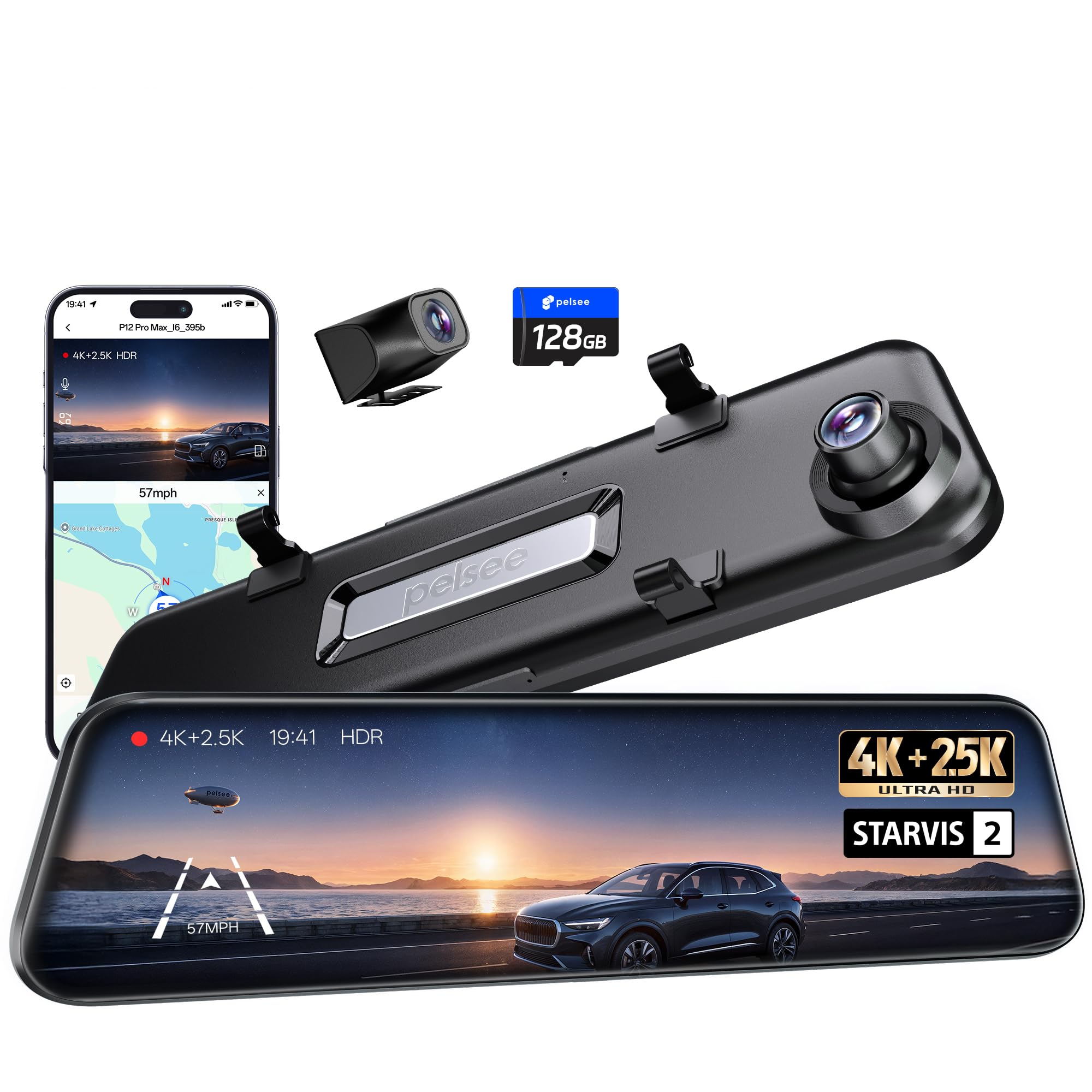
The mirror with the longest rear cable and the sharpest front sensor in the Pelsee line.
If you drive a big SUV or truck, the rear cable length is often the spec that decides whether a mirror kit even works. This one runs 33 ft from the mirror to the rear camera, long enough for a full-size cargo area. The front camera pairs a STARVIS 2 IMX678 sensor with true 4K at 30fps, and the maker claims twice the light capture of standard sensors — the gap between a readable plate and a grainy smudge at night. The rear records at 2.5K on a STARVIS IMX335 sensor. Storage jumps to a 512GB card ceiling and a 128GB card is in the box.
what separates it for long-haul drivers is the alert set. You get forward-collision, lane-departure, pedestrian and front-vehicle-start warnings — the front-vehicle-start chime that pings you when traffic ahead pulls away is the feature that gets switched on and stays on. Blind-spot detection rides on an algorithm (a set of rules the software follows) that watches the zones your mirror cannot. Three control paths run side by side: the touchscreen, voice commands like “show rear camera”, and the app for previews and downloads over 2.4GHz or 5.8GHz Wi-Fi.
The recurring trade-off is glare. On bright days the 12-inch panel can wash out, and at night strong headlights behind can overwhelm the rear camera; a handful of owners add a third-party glare filter to fix it. A small number of long-term owners also report the rear camera going dark after around a year, though the support response in those cases reads as fast and generous. The clock resetting after the car is off is a minor annoyance rather than a dealbreaker.
The case for the P12 Pro Max
- 33 ft rear cable makes it the fit for full-size SUVs and trucks
- Front STARVIS 2 IMX678 at true 4K for plate-readable night footage
- 512GB card ceiling and a 128GB card already included
- Front-vehicle-start alert is the one owners keep enabled
Where it stumbles
- Daytime glare can wash out the 12-inch panel
- Strong headlights behind can overpower the rear camera at night
- Rear camera has been reported to fail after a year for some
The one to choose: for a big vehicle where cable reach and a sharp front sensor are the two hard requirements.
Hold off if: your windshield catches a lot of direct sun — the glare on the panel is a genuine daily friction.
7. AZDOME PG17 Pro 4K STARVIS 2 Mirror Dash Cam
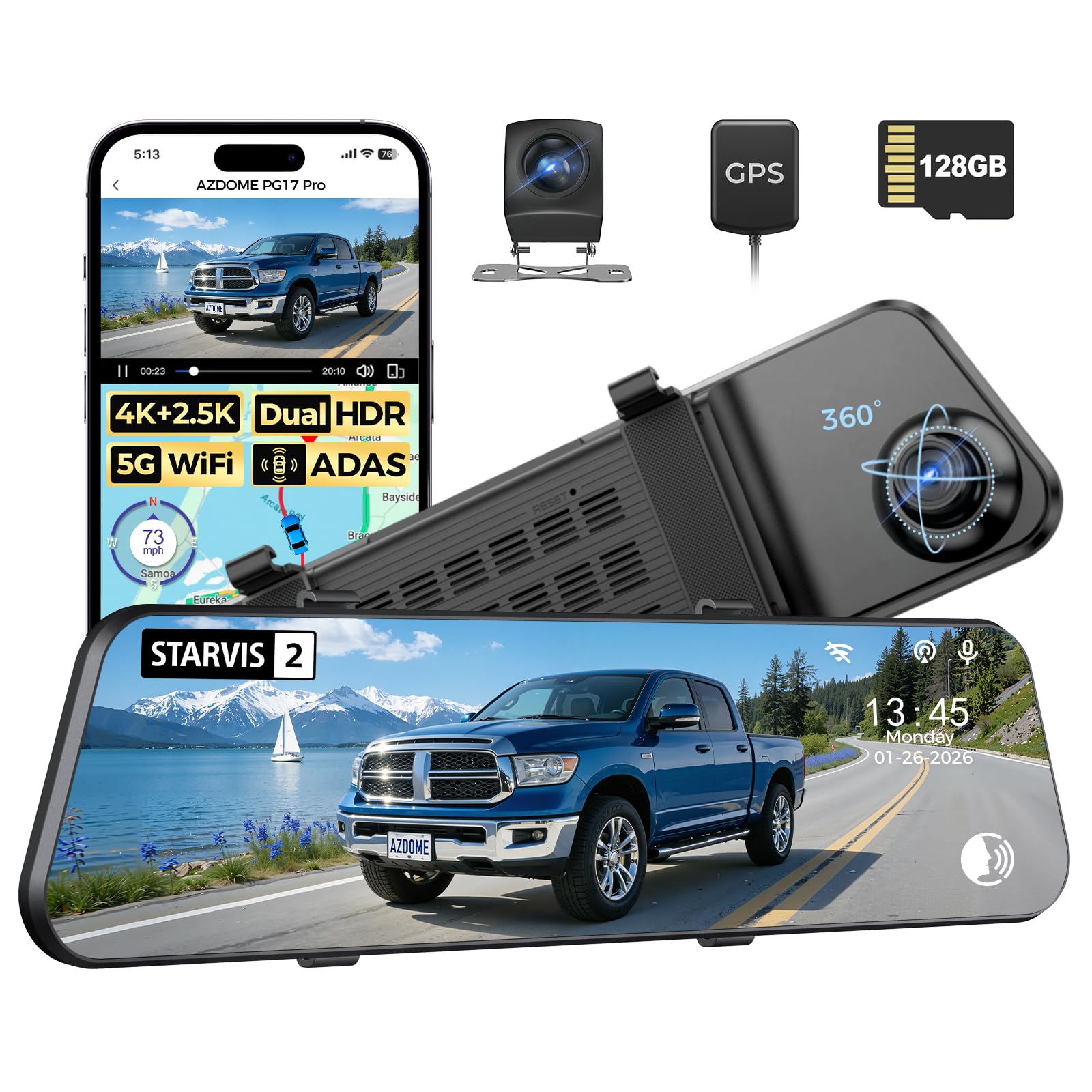
A 12-inch mirror that lets you zoom into a distant plate while the ADAS chimes on the move.
Here is the pitch in one line: 4K UHD up front, 2.5K HDR behind, on a Sony STARVIS 2 IMX678 sensor with Dual HDR — so night footage stays bright instead of washing out under oncoming headlights. The maker rates the rear at 2.4x the pixels of the 1080P rear cameras many mirror kits still ship, so a plate behind you reads clearly instead of blurring. The 12-inch mirror screen gives a wide view past headrests and passengers, and reverse assist lines appear when you shift into gear. A 128GB card is in the box.
The feature owners single out is the zoom. On a clear 4K frame you can pinch into a distant plate and read it, which is exactly what you want after a hit-and-run. The ADAS side handles forward collision and lane departure warnings, GPS logs your speed and route, and 5.8GHz Wi-Fi pushes clips to the app quickly. Clip-on installation up front is easy, and the whole dual-lens job reads as roughly a half-hour effort for a confident DIYer.
The fit has the same glare weakness that shadow every mirror replacement here: oncoming headlights at night can bounce off the panel and leave you squinting. Bluetooth pairing to a phone also reads as hit-or-miss, and a few owners see the unit stay powered after the engine shuts off. The angled fit means the ADAS warnings are not always intuitive to connect, so treat them as a backup rather than the main event.
The deciding feature: the zoom — a 4K frame you can pinch into and read a distant plate from, which turns the mirror into actual evidence after an incident.
The catch: night headlight reflection off the panel and a Bluetooth pairing that is not always reliable.
Best for: drivers who want a mirror-replacement dash cam with a real zoom for post-incident plate reading.
Skip if: you do most of your mileage at night and rely on Bluetooth for setup every trip.
8. Vantrue N5S 4 Channel 360 Degree 2.7K Dash Cam
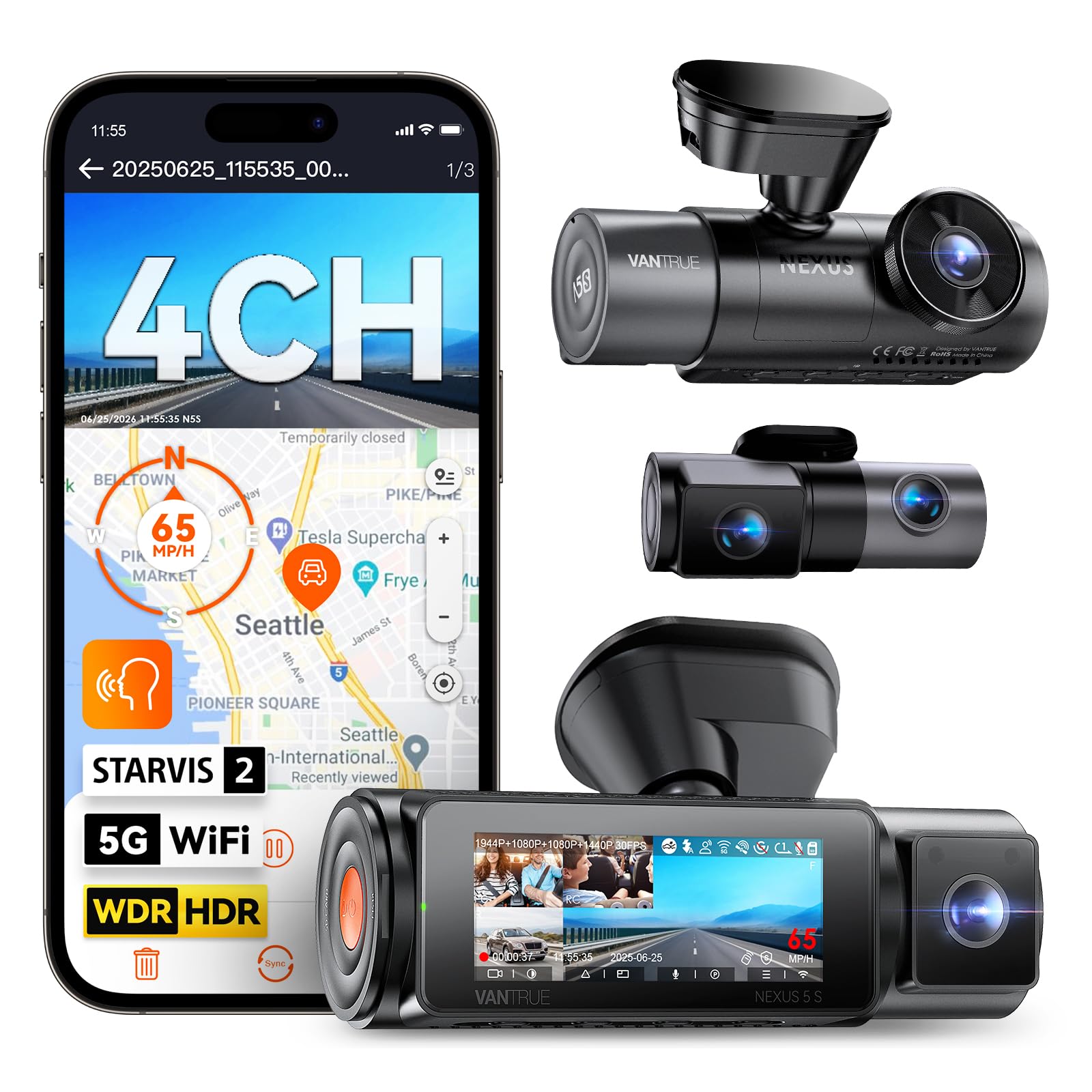
Four cameras, four STARVIS 2 sensors, and a 360-degree record that catches what a windshield-only kit misses.
If your worry is an incident you cannot predict the direction of — a hit-and-run, a curb scrape, a back-seat spill — four lenses cover the ground one cannot. The N5S records in 2.7K+1080P+1080P+1440P across front, front cabin, rear cabin and rear views, with flexible modes that let you run fewer channels when you want. All four cameras use STARVIS 2 sensors, and infrared lighting keeps the two cabin cameras usable in complete darkness, so the inside of the car is monitored as carefully as the road. The card slot accepts up to 1TB, which the maker rates at up to 40 hours of continuous four-channel recording.
The coverage is what owners value. Front, rear and both cabin views are captured in a single clip set, and a buffered parking mode on the hardwire kit holds ten seconds of pre-collision footage so an impact does not start mid-clip. 5GHz Wi-Fi moves files fast, dual-system GPS logs speed and route, and OTA firmware updates arrive through the app. The front camera sits on a ball joint and the cabin and rear cameras adjust independently for precise aiming. It also handles temperature swings from -4℉ to 140℉ with a super-capacitor build rather than a battery.
Two practical hangups. The parking mode requires a hardwire kit sold separately, so the always-on protection is not free. And the sensitivity can trigger on potholes and bumps, filling the locked folder with clips you have to clear periodically. Screen glare on the body under direct sun and app-connection hiccups round out the honest list. If you want four-camera certainty and are willing to wire it in, this is the one that delivers it.
What you gain
- Four channels covering front, rear and both cabin views simultaneously
- STARVIS 2 sensors on all four cameras plus IR for in-cabin night clarity
- 1TB card ceiling with up to 40 hours of continuous recording per the maker
- Super-capacitor build rated from -4℉ to 140℉
What you pay for it
- Hardwire kit sold separately for parking mode
- Collision sensitivity can fill the locked folder on rough roads
- App pairing can be temperamental on first setup
Choose this when: you want inside-and-out coverage and are fine wiring in the parking mode yourself.
Not for you if: you want a set-and-go install without extra parts or periodic footage clearing.
9. Escort Redline 360c Laser Radar Detector

A radar detector and dash cam in one bundle, for the driver who wants warning and evidence together.
This one plays a different game from the camera kits above. The Redline 360c is a radar and laser detector with 360-degree directional awareness, and TELIT GPS for location accuracy within 2.5 meters. It works across the 10.525 GHz, 24.100 GHz and 34.700 GHz bands, and AI-assisted filtering via GPS Autolearn, an updateable IVT filter and the Escort Live network cuts down on false alerts. The M2 Smart Dash Cam pairs with it to record the drive in Full HD 1080P, and a microSD card sits in the box.
What earns it a place on an ADAS list is the long-range warning. Buyers report radar detection 1.5 to 2 miles out on open roads, even against instant-on, with the alert landing well before the police car is in sight. The built-in GPS logs your speed and location onto the video, Apple CarPlay and Android Auto compatibility let you view alerts on your car’s display, and the Drive Smarter community shares live alerts from other drivers. The OLED display shows 360-degree direction so you know where the signal is coming from.
The honest problem is the mount. There are no prices to compare here — just know a solid mount is a real additional purchase for some cars. A few also note false alerts on K-band from things like store door openers, expected for any detector. If a dependable windshield hold matters to you, plan the mount before the purchase.
The strength: 360-degree radar detection across three bands with filtering that owners describe as quiet, plus Full HD video and GPS speed logging in one bundle.
The sticking point: the suction mount — the part most likely to let you down in heat, and a third-party mount is often the fix.
The right buyer: drivers who want radar and laser warning plus a dash cam in one setup and are happy to sort their own mount.
Not the right buyer: anyone who wants ADAS collision, lane and pedestrian alerts — this unit is detection and video, not driver-assist warnings.
Know the Specs
Field of view and sensor type
Field of view (the angle the lens sees) is measured in degrees — a 170-degree lens covers more of the road than a 130-degree one, so it sees into adjacent lanes but can make nearby cars look smaller on screen. The sensor is the chip behind the lens that turns light into a picture. Sony STARVIS 2 sensors pull more detail out of low light, so plates and signs stay readable at night where a basic sensor goes grainy. A wide angle plus a good sensor is the combination that makes ADAS alerts and video evidence dependable.
Card ceiling and parking mode
The card ceiling is the largest microSD card the unit will accept. A 4K front camera fills a card fast, so the 1TB ceiling on the Pelsee S3 Ultra or Vantrue N5S holds far more footage before you clear files than a 64GB cap. Parking mode records while the car is off, but it needs power from a hardwire kit tapped into a constant fuse or an OBD cable. Check whether that kit is included — several kits here ship it, and a few need it bought separately.
ADAS alert types explained
Forward-collision warning chimes when you are closing on the car ahead too fast. Lane-departure warning pings when you drift over a line without indicating. Pedestrian collision alert spots a person in your path. Front-vehicle-start alerts you when traffic ahead moves off. Blind-spot detection (BSD) watches the zones alongside your car and warns on a lane change. These are the warnings that make an add-on kit an ADAS system rather than a plain recorder — and the good ones let you switch off the alerts you do not want.
Wi-Fi speed and video transfer
Wi-Fi speed decides how fast you pull a clip onto your phone. A 5.8GHz or Wi-Fi 6 connection moves files noticeably faster than an older 2.4GHz link, which matters when you need a clip in the moment. The Pelsee S3 Ultra lists up to 30 MB/s over 5.8GHz Wi-Fi 6, while the Pelsee P12 Pro Max lists up to 20 MB/s over 5.8GHz. Frame rate (FPS, frames per second) is separate — more frames give smoother motion, while 30 FPS is standard for most dash cams here.
Common Questions
Can an aftermarket ADAS system add alerts to a car that came without them?
Will a mirror dash cam block my sun visor?
Do I need a hardwire kit for parking mode?
Is 4K worth it over 1080P for reading license plates?
How long does the rear camera cable need to be for an SUV or truck?
What is the difference between STARVIS and STARVIS 2 sensors?
Can an ADAS dash cam interfere with my car battery?
Will a radar detector like the Escort Redline 360c give me forward-collision warnings?
How many cameras can one dash cam record at once?
Do these kits work in extreme heat or cold?
The Bottom Line
For most drivers, the aftermarket adas system winner is the WOLFBOX G850 PRO because it folds five ADAS alert types, blind-spot detection and a 4K front camera into a single mirror swap, with up to 256GB card support to keep the footage flowing. If your priority is parked-car protection with the hardwire kit already in the box, the BOTSLAB 4K Front and Rear covers that ground without extra purchases. And for the driver who wants the sharpest plate detail and a card slot that swallows a terabyte, the Pelsee S3 Ultra is the one to mount.
How we choose
We do not accept paid placement. Every pick is matched to a real buyer and a real use-case; we do not hands-on test units.
Sources
Specifications: manufacturer listings and product documentation. Review insights: verified customer reviews, as of October 2026. Pricing: not shown on this page (it changes often); check the current price via the retailer link.
As an Amazon Associate, Aappliancez earns from qualifying purchases. This does not affect which products we feature.