Disclosure: Some links in this post are affiliate links. As an Amazon Associate I earn from qualifying purchases, at no extra cost to you. Learn more
Specs are compiled from manufacturer listings and verified buyer reviews and can change over time — please confirm the key details on the product page before buying.
If your trim corners keep opening up or your picture frames come out a hair off square, the problem is usually the guide, not your hands. A miter box (or a miter gauge, if you cut on a table saw) holds the workpiece at a fixed angle so the blade travels the same line every time. A good one repeats clean 45s and dead-square 90s; a sloppy one wobbles, drifts, and ruins stock. Below you get seven picks split by what they actually cut — hand-tool boxes for trim and hobby work, plus table-saw gauges for furniture-grade repeatability — so you can match the tool to the job in one read.
This guide is built by comparing the manufacturers’ published specifications and the patterns across verified customer reviews, so you get each pick’s real strengths and trade-offs instead of marketing spin.
Below you’ll find which tool fits trim, which fits frames, and which fits a full shop — a straight answer to the question behind the best Miter Box search.
Top Picks


How To Choose The Best Miter Box
The first decision is not brand, it’s which machine the tool attaches to. A hand miter box sits on the bench and guides a saw you push or pull yourself. A miter gauge rides in the slot of a table saw and carries the wood past a spinning blade. Buying one when you needed the other is the single most common mistake, and no accuracy rating saves you from it.
Know your cutting angle before you buy
A 45-degree slot gives you the miter joint for trim corners and picture frames. A 90-degree slot gives you square crosscuts. Some boxes only offer those two; others cut 60, 75, 105, 120 and 135 degrees too, which matters the moment you hit an outside corner or a coved molding.
Check whether the angle is fixed by a machined slot or set by a movable fence. Fixed slots hold their setting forever but limit you to that angle. An adjustable anvil gives you range, but only if the locking mechanism stays put under a cut.
Match the box to the stock thickness
Mini boxes are built for small stock. One pick here tops out around 2 inch thick and 3 inch wide; another handles trim up to about 1/2 inch thick and 1 inch wide. Measure your molding before you order, because a box that cannot swallow the piece is useless no matter how precise its slots are.
Blade length tells you the reach. A 12-inch blade crosscuts a 2×4; a 2-inch blade does not. That difference decides whether you are building a deck or framing a miniature.
Decide between a saw-included kit and a bare guide
Some boxes arrive with a matching saw whose blade fits the slot exactly. Others are the guide alone, and you supply the saw. A kit removes the guesswork; a bare box lets you use the saw you already trust. Either way, confirm the slot width suits your blade before the first cut.
For table-saw work, look at the fence and the bar
On a table saw, the gauge’s bar must fit the miter slot with zero play. Expansion washers or discs tighten that fit. The fence length decides how much stock trails off the table, and a telescoping fence with a flip stop turns a one-off cut into a repeatable one.
Side-by-Side Comparison
| Model | Best For | Tool Type | Cutting Angle | Max Stock | Amazon |
|---|---|---|---|---|---|
| Shark Corp 10-2312 12-Inch Carpentry Saw★ Best Overall | Fast crosscuts and trim | Hand saw | 15 degrees | 2×4 stock | Amazon |
| FIRSTINFO 9.8 Inch Aluminum Miter BoxFrame Stock Pick | Picture frame stock | Aluminum box + clamp | 90 degrees | 2 in thick, 3 in wide | Amazon |
| Deluxe Razor Saw with Miter Box 35-221 | Fine 90-degree cuts | Box + razor saw kit | 90 degrees | 1/2 in thick, 1 in wide | Amazon |
| O’Shine Miter Shears | Trim and shoe molding | Hand shears | 45-135 degrees | Up to 3/4 in | Amazon |
| Kreg Precision Miter Gauge System KMS7102 | Mid-size shop saws | Table-saw gauge | 45 degrees | Long fence stock | Amazon |
| INCRA MITER1000SE | Repeatable furniture cuts | Table-saw gauge | 41 V-stops | 18-31 in fence | Amazon |
| INCRA Miter1000/HD | Heavy shop use | Table-saw gauge | 180 indexing stops | 18-31 in fence | Amazon |
Detailed Reviews
1. Shark Corp 10-2312 12-Inch Carpentry Saw
Our pick — 4.5+★ from 400+ verified ratings; the strongest balance of quality and price.
The pull saw that eats a 2×4 before you finish setting up the power tool.
Most people buying their first hand miter setup actually need this: a 12-inch high-speed-steel blade with 14 teeth per inch (TPI), which is the tooth count that sets how fast the blade chews through stock. Fourteen TPI is a crosscut pattern, so it slices across the grain quickly and leaves a reasonably clean edge. A blade this long also clears a full 2×4 in one stroke, which is why it holds the top spot for general carpentry rather than delicate trim alone.
What wins people over is the sharpness, and it is not subtle — the blade bites with light pressure and the cut stays on line because the steel is thin and flexible. That thin kerf (the width of wood the teeth remove) makes the saw feel light and quick, but it is also the trade-off: a flexible blade rewards a steady pull stroke and punishes a hurried push. Owners who let the teeth do the work report clean, fast results; those who force it get wander. The pull-stroke design also means the blade cuts on the draw, not the push, so your first few cuts will feel different from a Western saw.
The cut speed is the headline. Reviewers repeatedly report crosscutting a 2×4 in under 20 seconds, and wet pressure-treated lumber is no obstacle — a real win when you are trimming fence posts in damp weather. The blade is replaceable, so a dull saw becomes a fresh saw rather than a landfill item. It handles PVC and ABS plastic pipe as well, which makes it the one saw in a toolbox that covers wood and plastic without switching tools. It ships with a plastic guard; keep it, because the teeth are aggressively sharp.
Where it earns its place
- 14 TPI crosscut pattern slices through a 2×4 in under 20 seconds
- Flexible high-speed-steel blade stays true with light pressure
- Replaceable blade extends the saw’s working life
- Handles wood, PVC, ABS pipe and wet treated lumber alike
What to know before you pull the trigger
- Thin blade and kerf can wobble in a hurried push — straight cuts need a steady draw
- Rip cuts along the grain are only adequate; it is built for crosscuts
- Included storage pouch is flimsy and the plastic guard is basic
Reach for this if: you want one fast hand saw for framing, fencing, trim and plastic pipe — this is the do-everything pick.
Look elsewhere if: you need the accuracy of a fixed-slot miter box for picture frames, where the FIRSTINFO’s aluminum guide does the job better.
2. FIRSTINFO 9.8 Inch Miter Box
A solid block of aluminum that clamps your stock and cuts picture-frame corners dead square.
The specification that decides everything here is the stock capacity: 2 inch maximum thickness and 3 inch maximum width. That is real molding territory, not balsa sticks. The body is aluminum and the built-in slipping pedestal screws down to hold the workpiece — square, flat or round — while you saw. The 90-degree slot is the star; buyers report it holds within half a degree. One 45-degree slot is equally accurate, though the second 45-degree slot runs one to two degrees off. For frames and trim, the correct slot is there and it holds.
This is a box you use with a saw you supply — no blade in the box. The opening is around 3 inch wide by 2.25 inch high, and the small slots suit standard miter and razor saws. A short Japanese pull saw pairs well. The clamp is genuinely useful, though it is small, and a scrap-wood backing board keeps your cuts clean at the bottom of the slot.
The aluminum build is the honest caveat. It is heavy and rugged and it looks and feels like old-school metalwork rather than plastic with adjustment pegs. But aluminum is soft enough that a coping saw can dig into the slot walls and slowly degrade the angle. For frequent fine work, treat it as a hobbyist-grade box rather than a production one. There is also a plastic knob on the clamp screw that has failed on at least one unit, so do not overtighten it.
What it actually is: a fixed-angle aluminum box with a real clamp — better suited to picture frames, model stock and light trim than to daily jobsite abuse.
The part to know: the workpiece sits in a slot barely wider than the blade. That tight fit is what makes the cuts clean, and also what makes a razor-sharp box something to handle carefully by the edges.
Best fit: hobbyist or trim carpenter cutting picture frames and small molding who wants a clamped, repeatable 90-degree cut.
Think twice if: you will be pushing a hacking blade through the box every day — the soft aluminum slot walls wear.
3. Deluxe Razor Saw with Miter Box 35-221, Gold

The 90-degree channel that holds a hairline cut in stock a table saw cannot touch.
Where the Shark pulls a wide, fast kerf through framing lumber, this kit goes the opposite direction: a fine-kerf razor saw matched to an aluminum thin-slot box, and the pair is built for precision on tiny stock. The cutting angle is a true 90 degrees, which is a full 75 degrees tighter than the Shark’s 15-degree rake, and that is exactly why the corners come out square instead of fast. At 11.36 ounces it carries a little more heft than the 8-ounce Shark, but most of that weight is the box itself, which is what keeps the blade tracking straight.
The saw blade and box are matched, and that matters. The saw handle fits the box’s channel exactly, so you are not hunting for a blade that clears the slot. The box itself accepts 90, 45 and 60/30-degree slits — check your specific unit’s machining, since one report notes the slits at 90, 45, 36 and 60 degrees. For cabinet scribe trim at 3/4 inch by 1/4 inch, or for miniature and model work, the arrangement is straightforward and clean.
The real limits are thickness and width. The saw handles wood up to about 1/2 inch thick and 1 inch wide before the blade channel runs out of travel; anything bigger needs a full-size box. It also is not for hard materials in thick sections, and acrylics want tape on the base to stop sliding. One report notes that mirror-image cuts — the two halves of a picture frame — run their 45s in different directions, so you flip the piece and the error adds up. It is precise, but it is a small-stock tool first.
Build and precision: a hardened copper-colored miter plate that resists scratches, with clean machining on the slots and a saw that seats perfectly.
The honest limit: bulky for what it is, and tall stock simply does not fit the channel — working above roughly 7/8 inch is a no-go.
Pick it for: model building, dollhouse trim, scribe molding and any 90-degree cut where square beats speed.
Skip the upgrade if: your stock runs thicker than 1/2 inch — step up to a full-size box rather than fighting the channel.
4. O’Shine Miter Shears

No saw, no dust, no bench — squeeze and the trim corner is cut.
This is the one tool on the list that does not use a blade you push through wood at all. Miter shears are a giant pair of snips: you set an adjustable fence to an angle, drop the molding in, and squeeze. The anvil has machined markings at 45, 60, 75, 90, 105, 120 and 135 degrees, and detent holes click the fence into each setting so it stays put. The Japanese SK5 steel blade is hard-chrome plated and heat-treated to HRC52, and it shears soft wood, PVC strips, quarter round, weather stripping and shoe molding up to 3/4 inch.
What buyers praise most is the build — the anvil and movable fence are high-grade aluminum alloy, large enough to hold stock firmly but light enough for long repeat runs. The handle is PVC with a non-slip shape, and it is ambidextrous. There is an extra SK5 blade in the box with a polypropylene sheath for safe storage or swapping. For a fast trim job around a door casing, the shear cuts in a second where a saw takes setup time and throws dust.
The trade-off is angle accuracy at the edge of its range. Owners mention clean, fast 45-degree cuts, but on some units the fence slips out of detent near the lever, and a tilted workpiece can let the cut drift off true. There is a raised ridge right where the blade descends, so flatter pieces do not sit flush. That ridge is a real design limitation — it is what makes a thin popsicle stick a breeze and a coved quarter round more of a wrestling match. It is also not for metal.
Fastest path to a cut corner: set the fence, click it into the detent, squeeze. That is a real time saver on shoe molding and small trim.
Where it slips: near the lever, a 45-degree setting does not always hold, and the center ridge makes flat pieces sit at a slight tilt.
Buy it when: you are trimming out a room in a hurry and you want a portable, dust-free cut for shoe molding and light stock.
Keep it out of: precision picture-frame work — the angle drift catches up with you on mirror-image 45s.
5. Kreg KMS7102 Miter Gauge
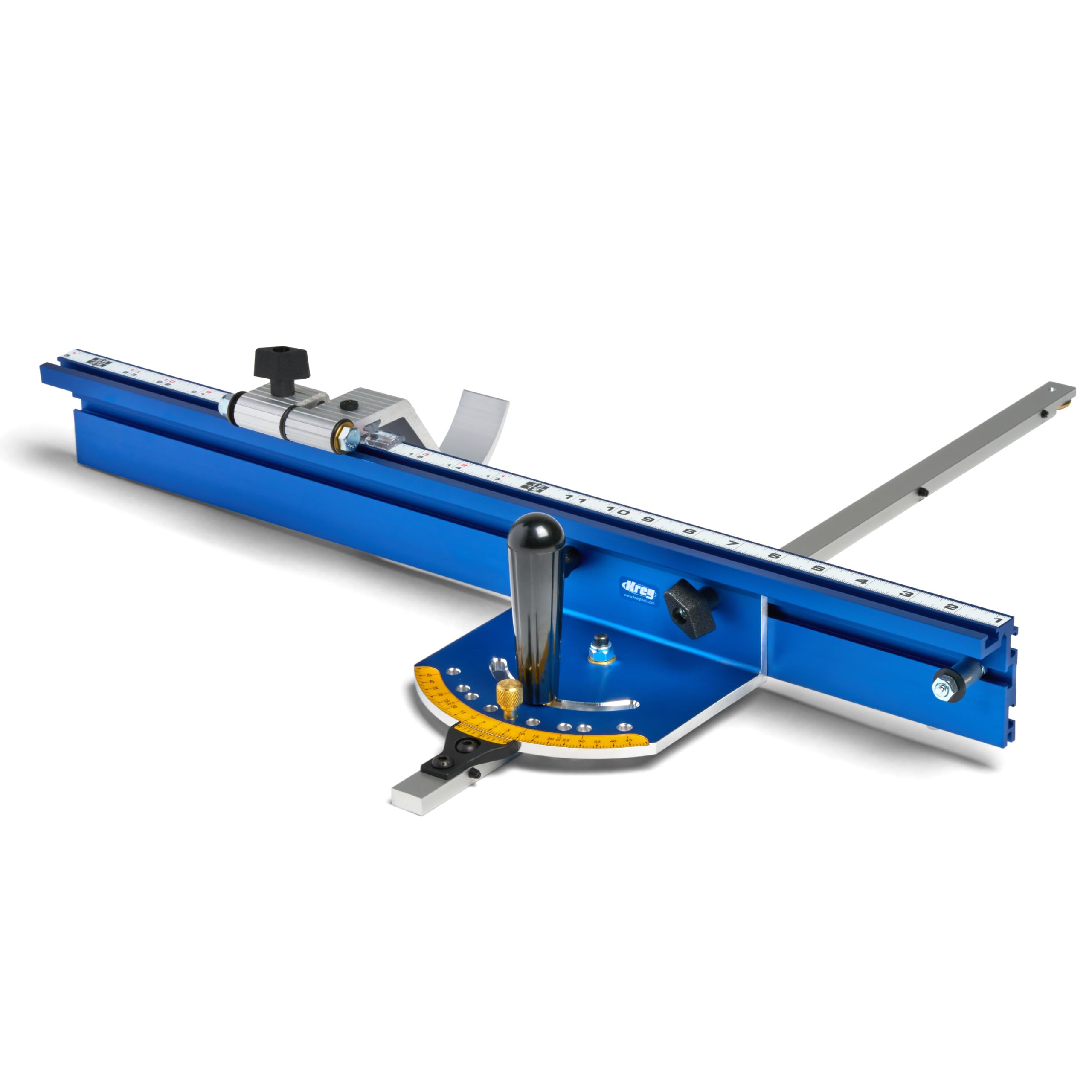
The bolt-on gauge that turns a table saw into a repeatable miter station.
This is a different animal from the boxes above: a miter gauge rides in the table saw’s miter slot and its adjustable fence carries the stock past the blade. The Kreg system ships pre-calibrated, and the locking pin holds a set angle without drifting. There are positive stops at 0, 22.5 and 45 degrees, so the most common miter angles click in instead of being eyeballed. The anodized aluminum fence is long and sturdy, and the bar is adjustable to fit the slot with zero play.
Build quality is where this earns its keep. Owners describe it as beautifully machined and straightforward to assemble, with clear angle markings and a smooth glide in the slot. It sets up in minutes and holds the setting through a run of cuts. The flip stop is the part you will rely on for repeated lengths. For a mid-size shop cutting trim and casework, this is a genuine step up from the stock gauge that came in the saw.
Two honest limits. First, calibrate it yourself to your saw — the box photos help, but the instructions skip some stop placement. Second, and more important, it is built for a full-size table. On a small job-site saw, the fence overhangs the table, the gauge can rock sideways, and a single end washer leaves it loose mid-cut. On a large saw with full table support, none of that happens — the gauge rests flat and the accuracy is there.
What it does well: pre-calibrated accuracy, positive stops at 0, 22.5 and 45 degrees, and a long fence that supports real stock lengths.
What it needs from you: a full-size table saw. On a portable bench saw, the overhang and rock make the accuracy moot.
Worth it for: the woodworker with a full-size table saw who wants repeatable miter cuts without re-squaring the stock every pass.
Not for: a benchtop or job-site table saw where the fence hangs off the table.
6. INCRA MITER1000SE Miter Gauge Special Edition

Forty-one laser-cut angle stops and a fence that stretches to the stock, not the other way round.
Accuracy is the whole point here, and it comes from the dial-in system: 41 laser-cut V-stops (small notches that seat the fence at a fixed angle) let you set popular angles and return to them exactly, cut after cut. The primary scale is engraved stainless steel, and a 1/10-degree vernier cursor reads small increments between the main marks. The telescoping incremental fence slides from 18 to 31 inches so long stock is supported, and the Flip Shop Stop holds a length setting for repeat cuts. The GlideLOCK bar expands at six points to fit the miter slot tight.
Set up is considered easy, and accuracy shows up right away — customers note that it arrives calibrated, that the angle changes and repetitive cuts get faster with the telescoping fence and stop, and that it flat-out removes the constant recalibration a stock gauge demands. The word “precise” and “repeatable” come up a lot. If you cut a lot of identical pieces, the fence and stop combination is the reason to pick this over the Kreg.
The caveats are practical. The miter bar tops out around a 16-inch maximum workpiece before the bar loses reach. Pull the fence too far past the table’s front edge and it can rotate sideways, which is a genuine danger — you learn to keep the stock supported. The miter-slot adjustment washers need serious tension on some saws and can snag a bandsaw slot; thin adhesive tape shims solve it. There is no onboard tool storage. None of that undermines the accuracy; it just means you set it up thoughtfully.
Where the money goes: the 41 V-stops and vernier cursor — a setting you can return to exactly, which is what repeat furniture work demands.
The catch to respect: past the table edge, the fence wants support, and the bar length limits you to roughly a 16-inch workpiece.
The one for you if: you cut matching parts — cabinet doors, segmented turning, picture frames — and need every identical angle to land exactly.
Consider the HD instead if: you want the same accuracy family with heavier-duty machined components for bigger stock.
7. INCRA Miter1000/HD Miter Gauge

The heavy, machined-at-the-factory gauge for shops that cut week in and week out.
Start with the indexing stops: 180 of them, spaced at one degree from 90 left to 90 right, with special stops at plus and minus 22-1/2 degrees. A 1/10-degree vernier cursor reads the small increments. The GlideLOCK bar expands to fill the slot, the fence telescopes from 18 to 31 inches, and the incremental flip shop stop gives you repeat cut-length control. It is built from machined, laser-cut components and weighs 7.7 pounds, which is the heft that keeps it stable on a big table.
Set against the 1000SE, the HD’s real advantage is the beefier machined build and the wider indexing spread. At 7.7 pounds it is heavier than the 8.3-pound 1000SE only because the components are bulkier, and it fills a T-track slot tight enough that buyers describe zero side play and dead-square angles straight from the box. The adjustable miter bar and removable retaining clip for T-slot channels keep it locked. Extruded aluminum T-slots run the length of the fence for mounting sub-fences and jigs.
Here is what it costs you: time on the front end. Reviewers point out about two hours of setup — fitting the bar, squaring the fence, adjusting play — before the first accurate cut. The slide guides can loosen and tighten with the weather, so squaring is a small trial-and-error ritual. And it is bulky enough that it is not the right tool on a router table or bandsaw. If you work on a large table saw, none of that matters once it is dialed in.
The precision payoff: 180 indexed-angle stops and a 1/10-degree vernier cursor make repeatable tenon shoulders, box joints and splines a matter of dialing a number.
The trade-off: around two hours of careful setup, and the slide guide wants occasional re-squaring — a workshop tool, not a grab-and-go one.
Choose the HD if: you run a full-size table saw and want the most adjustability and the strongest indexing of the group for day-in, day-out cuts.
Bypass it if: you need a compact gauge for a small portable saw or you will not invest the setup time.
Know the Specs
Teeth per inch and cut speed
Teeth per inch, or TPI, is the tooth count per inch of blade. A higher TPI like 14 cuts faster through a crosscut but leaves a rougher edge than a fine-kerf razor saw. A lower tooth count would cut more slowly and cleaner in dense stock. Match the TPI to your stock — 14 TPI is the crosscut all-rounder.
Cutting angle and the miter joint
The cutting angle is the fixed rake of a blade or the guide setting of a box. A 90-degree slot cuts square cross-members; a 45-degree slot cuts the corners of a frame or trim. Some boxes add 60, 75, 105, 120 and 135 degrees for outside corners and cove molding.
Stock capacity
Maximum thickness and width define what a mini box can swallow. Two inches thick by three inches wide covers molding; a half-inch by one-inch limit covers miniature and model stock. Measure before you buy.
Fence and miter bar fit
The miter bar must fit the table-saw slot with zero play. Expansion washers or GlideLOCK discs tighten the fit. The fence length and telescoping range decide how much stock is supported during a long crosscut.
Common Questions
Will a miter box work with my existing saw?
Can the O’Shine miter shears cut metal?
What is the difference between a miter box and a miter gauge?
How thick a piece can the Deluxe Razor Saw cut?
Are the INCRA gauges compatible with a T-slot table saw?
Why did my miter box’s angle drift after a few months?
Which is better for picture frames — the FIRSTINFO, the ZONA, or the INCRA?
Can I use a miter gauge on a band saw or router table?
What does zero side play mean on a miter bar?
The Bottom Line
The tool that fits your bench is the one you will actually reach for. If you are cutting framing, trim, fencing or pipe by hand, the Shark Corp 12-Inch Carpentry Saw is the clear winner — a 12-inch replaceable blade that crosscuts a 2×4 in under 20 seconds and still cuts clean in wet treated lumber. It earns the crowd favorite label with the best mix of speed, reach and versatility in this group.
For picture frames and molded stock where the joint must close clean, the FIRSTINFO aluminum box clamps the stock and holds the 90-degree slot to within a half degree. If you trim whole rooms and want the dust-free, fast option, the O’Shine Miter Shears click into 45 through 135 degrees and cut shoe molding in a squeeze.
And if your work happens at the table saw, the INCRA Miter1000/HD gives you 180 indexed stops and the strongest repeatability in this group — worth the couple of hours it takes to dial in. Between the two INCRA gauges, the HD’s heavier machined build earns the pick for a serious shop. One nudge from the data: the hand boxes and shears cut just as accurately as the premium gauges on their own scale, so pick by the machine you actually reach for, not the highest price on the list.
How we choose
We do not accept paid placement. Every pick is matched to a real buyer and a real use-case; we do not hands-on test units.
Sources
Specifications: manufacturer listings and product documentation. Review insights: verified customer reviews, as of October 2026. Pricing: not shown on this page (it changes often); check the current price via the retailer link.
As an Amazon Associate, Aappliancez earns from qualifying purchases. This does not affect which products we feature.