Disclosure: Some links in this post are affiliate links. As an Amazon Associate I earn from qualifying purchases, at no extra cost to you. Learn more
Specs are compiled from manufacturer listings and verified buyer reviews and can change over time — please confirm the key details on the product page before buying.
If you want one answer: buy a power bank rated under 100Wh with enough USB-C output to run your laptop, then stop shopping. The watt-hour figure (Wh) is the number airport security actually checks, and it is the number that decides whether your charger flies in the cabin with you. Most of the banks people buy are packable, powerful and completely fine on a plane — the trick is reading the label before you buy, not at the gate.
This guide is built by comparing the manufacturers’ published specifications and the patterns across verified customer reviews, so you get each pick’s real strengths and trade-offs instead of marketing spin.
Below you will find picks sorted by what they do best, from a pocket-size travel bank to a full laptop charger with a built-in retractable cable. Every model here carries a published watt-hour figure you can check against your airline’s carry-on limits, which is exactly what a smart shopper wants from a 100wh power bank.
Top Picks
How To Choose The Best 100Wh Power Bank
Start with the watt-hour label, not the milliamp-hour number on the box. Watt-hours (Wh) describe how much total energy the pack holds, and they are the figure airline staff check at the security lane. Milliamp-hours (mAh) only tell you half the story unless you also know the cell voltage.
Watt-hours versus milliamp-hours
For carry-on travel, a 20,000mAh bank (milliamp-hours, the usual measure of how much charge a battery holds) is usually the balance. One pick here lists 20,100mAh as 72.36Wh (watt-hours, the energy figure airlines actually check), and another lists a 27,000mAh pack as 98Wh. Both sit under the common 100Wh carry-on ceiling, so both are practical flight companions. A 25,000mAh pack stores more energy and still fits the same general rule, but always confirm the printed Wh figure on the unit you buy.
Output wattage is what charges your laptop
If a laptop is on your packing list, look at the output number first. A 65W or 100W USB-C port will run a MacBook or a Windows ultrabook at a useful speed. A 220W total output bank can split power across three ports at once. Ports that throw out 12W or 18W are for phones and accessories only — they will not keep a laptop alive through a full workday.
Built-in cables versus separate cords
A built-in USB-C cable removes the most common traveling annoyance: the cord that stays in the hotel room. One pick here touts a cable tested to withstand over 10,000 bends. A retractable cable is a further convenience, pulling out for use and winding back for storage. If you carry multiple devices with different connectors, though, check the port mix carefully — a built-in cable does not replace a spare USB-A lead.
Side-by-Side Comparison
| Model | Best For | Capacity | Max Output | Weight | Amazon |
|---|---|---|---|---|---|
| Anker Prime Power Bank, 20,100mAh 3-Port★ Best Overall | High-power laptop charging | 20,100mAh (72.36Wh) | 220W total | 510 g | Amazon |
| Anker Power Bank, 20,000mAh Travel EssentialBest Everyday Value | Everyday travel value | 20,000mAh | 87W total | 440 g | Amazon |
| CUKTECH 25000mAh Power Bank | Long trips and cruises | 25,000mAh (90Wh) | 100W | 540 g | Amazon |
| AsperX Laptop Power Bank | Retractable cable convenience | 20,000mAh | 165W total | 666 g | Amazon |
| UGREEN Nexode 25000mAh 165W | Dual-cable business travel | 25,000mAh | 165W total | 550 g | Amazon |
| Baseus Laptop Portable Charger 100W | Slim flat carry | 20,000mAh | 100W | 451 g | Amazon |
| Paopaoyu Portable Power Bank with AC Outlet | Wall-plug devices on the move | 27,000mAh (98Wh) | 100W AC / 65W PD | — | Amazon |
Detailed Reviews
1. Anker Prime Power Bank, 20,100mAh 3-Port Portable Charger
Our pick — 4.5+★ from 750+ verified ratings; the strongest balance of quality and price.
A laptop charger that slips into a carry-on and still pushes 220W across three ports.
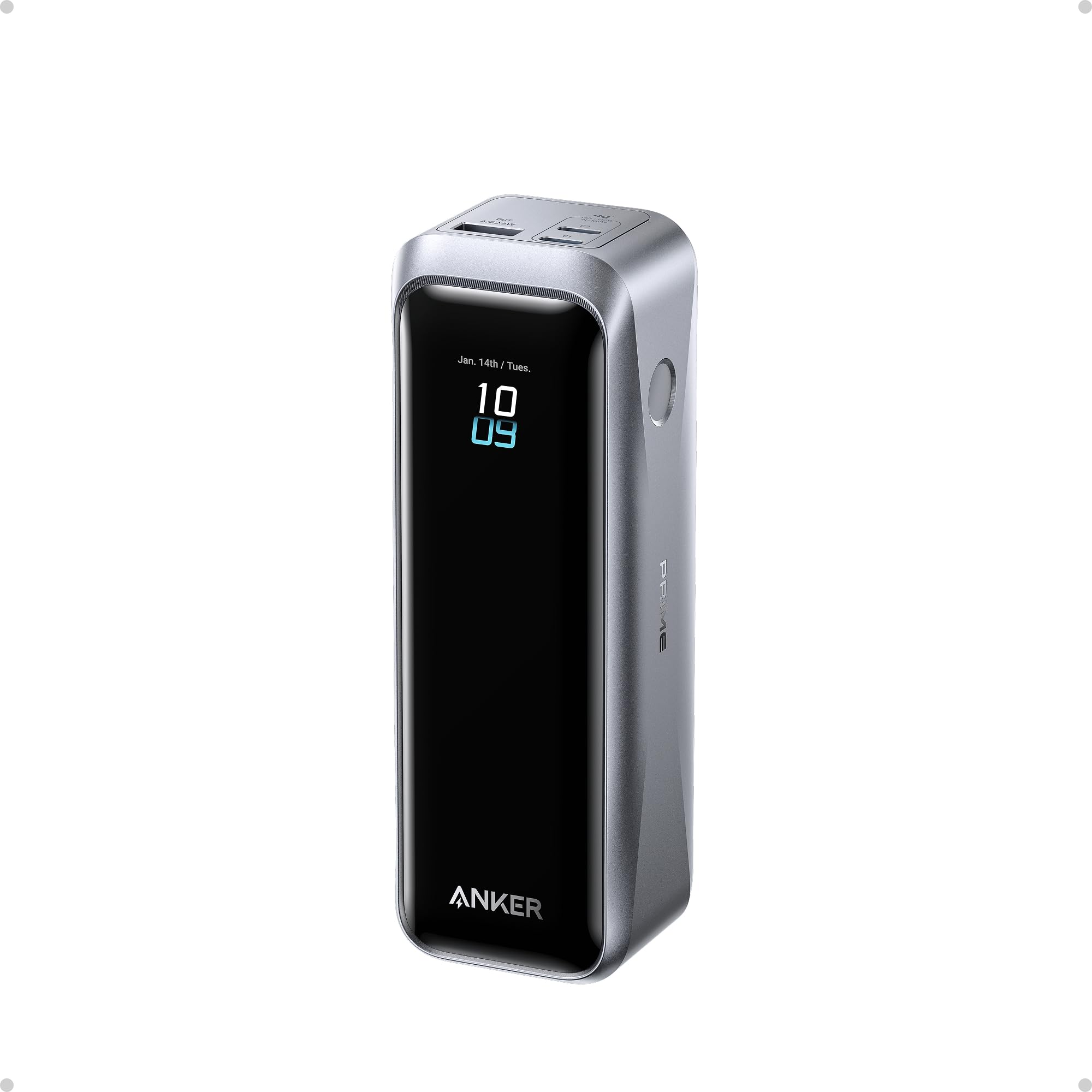
For anyone who works from a laptop away from a socket, this is the one to beat. The headline is 220W total output from two USB-C ports and one USB-A port, which means you can top a MacBook, a phone and a pair of earbuds in the same sitting. The pack itself holds 20,100mAh, listed as 72.36Wh — a number that keeps it inside the common 100Wh carry-on ceiling. As a comparison against the travel-focused Anker pick further down, this one more than doubles the output (220W versus 87W) while they carry nearly identical capacity.
The fast-charging hardware is genuinely the point. A single USB-C port delivers up to 140W with a 5A cable, and Anker pins a 16-inch MacBook Pro (M4 Pro) going from empty to 50% in 28 minutes on that. Recharging the bank is just as quick: up to 100W in gets you to 50% in 25 minutes. A built-in display shows you exactly where the power is going, and the companion app lets you watch charge state and port parameters in real time. That Bluetooth setup is the sort of thing that either clicks instantly or feels like extra steps — most who use it stick with it.
What wins people over is speed, and it comes back again and again in the feedback. The weight is the honest trade-off at 510 g, and the price is on the high side for the capacity you get — both are noted as the recurring gripes. Buyers report a real-world result that sums up the efficiency: the bank “charged Z Fold 7 from 37% to 80% using only 14% bank power.”
Where it earns its keep
- 220W total across three ports handles a laptop and phone together
- Up to 140W single-port output with a 5A cable
- 100W max input recharges it to 50% in 25 minutes
- 72.36Wh keeps it inside common carry-on limits
What to weigh up
- 510 g is the heaviest part of your day bag
- Premium pricing sits high for the capacity
Reach for this if: you want a single pack that charges a laptop at near-wall speed and still clears security.
Look elsewhere if: a light bag matters more than raw output — the travel bank below saves real weight.
2. Anker Power Bank 20,000mAh
The pack you stop thinking about: one cable built in, one charge that covers the day.
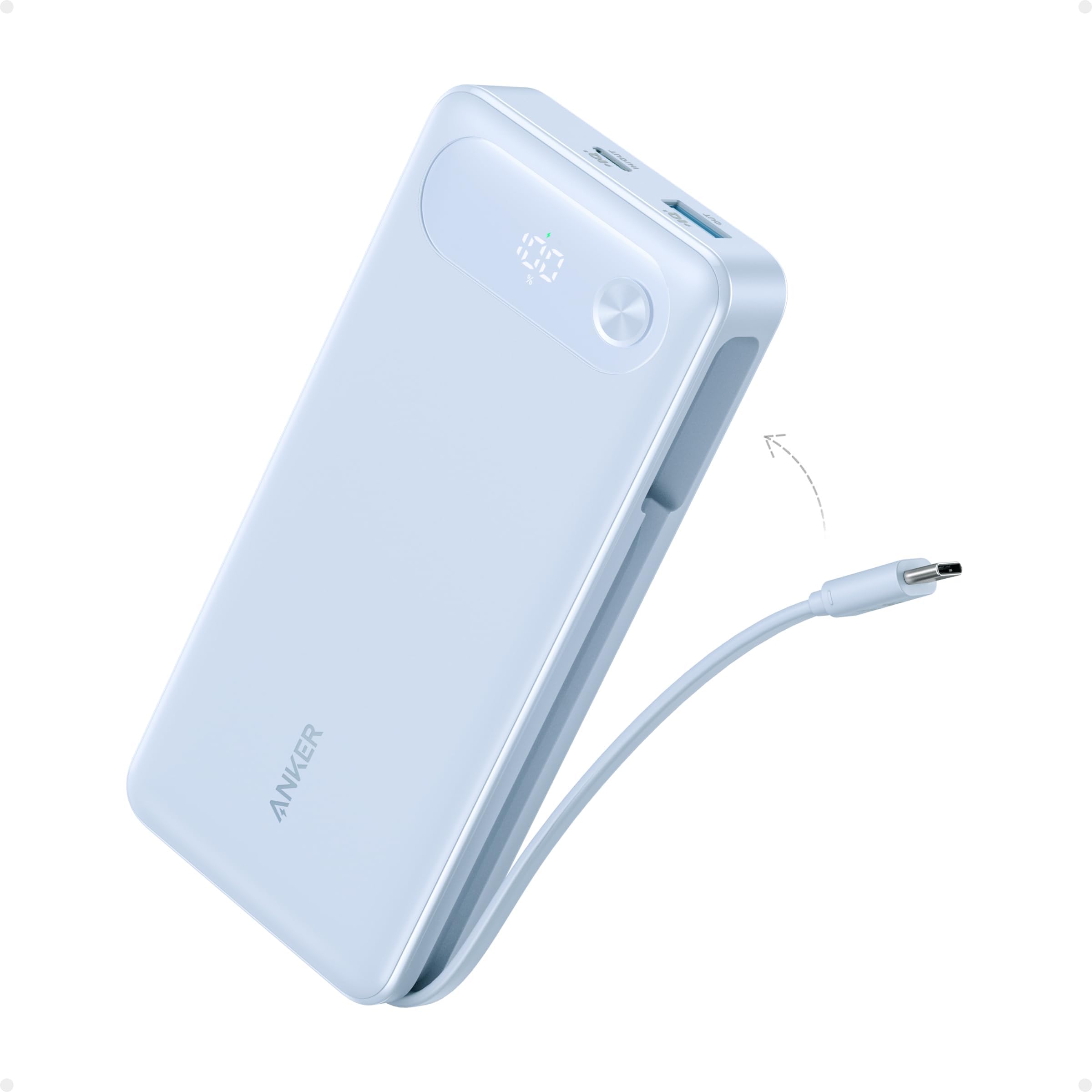
If you charge a phone and a laptop but do not want to carry a bag of cords, this is the pick. You get 87W (watts, the rate power flows out) shared across three devices, with a single device able to pull up to 65W. Anker claims a 14-inch MacBook Pro reaches 50% in under 40 minutes on that, and the bank itself refills in 1.5 hours with a 65W charger. The dimensions are 6.2 x 2.89 x 1.02 inches at 440 g — a foot shorter than the Prime above and 70 g lighter, which is the difference between “toss it in a purse” and “leave it in the hotel.”
What everyone notices first is the cable. It is tested to withstand over 10,000 bends, and it doubles as the charger for the bank and for your USB-C devices. That single detail removes an entire category of travel frustration. Owners have taken it backpacking, to Italy, on flights with the iPad, and it has kept phones, headlamps, GoPros and camera batteries topped up. One detail worth knowing: for Apple gear, a certified cable is the safer route, since the charging specs and power management differ.
The honest limit is longevity. Heavy daily use can wear the built-in cable over a couple of years, and a small handful of units have stopped charging after long service — though Anker’s customer care replaced at least one unit without friction. At 440 g, it is not a featherweight either. Owners mention the practical payoff that makes the weight worth it: “at 12% battery it charged phone from 5% to 40% immediately.”
The cordless reality: a built-in USB-C cable that charges the bank and your devices from one lead is the feature that turns a charger into a travel routine.
And the cost of that convenience: 440 g and a cable that ages with use — reserve it for the bag you actually use daily.
Confident verdict: this is the one to reach for if your daily carry is a phone and a laptop and you refuse to pack a second cable.
Second thoughts only if: you want the fastest possible laptop speeds — the Prime above pushes far more wattage.
3. CUKTECH 25000mAh Power Bank
Built for the long cruise, the cross-country flight, and the laptop that has to keep working.
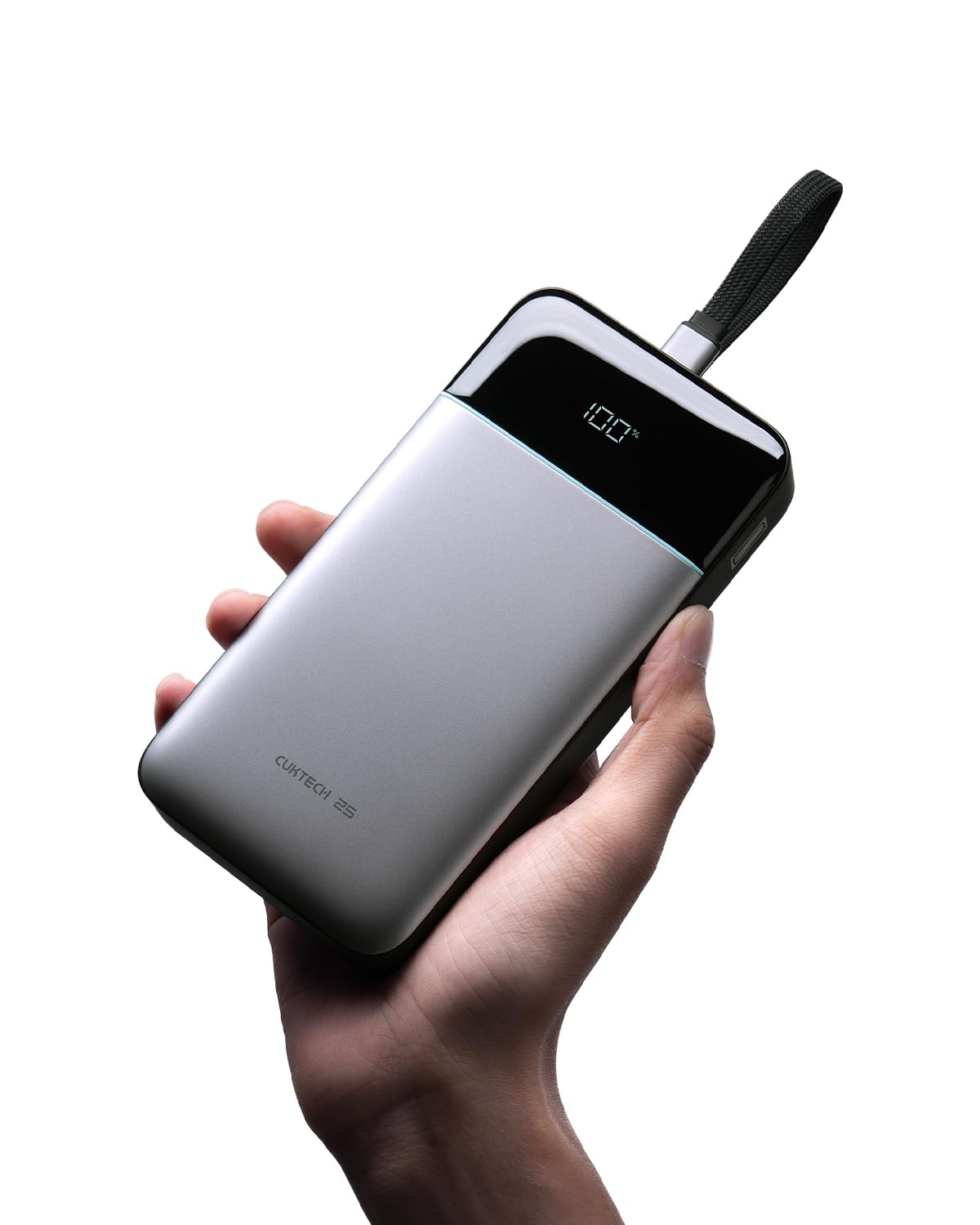
Twenty-five thousand milliamp-hours is the number to note here, rated at 90Wh and so still under the usual 100Wh carry-on ceiling. That capacity is pitched at up to 1.2 charges for a MacBook Air or 3.2 charges for an iPhone, which is a full working trip in a single pack. The 100W USB-C output puts a MacBook Air 13-inch M3 at about 56% in 30 minutes, so a coffee break buys you real working time.
The built-in USB-C cable is the smart design move — it does output and input, so one lead handles charging your gear and filling the bank back up. With a compatible 100W or higher PD charger, it recovers roughly 25% in about 15 minutes. Three devices can run at once from the built-in cable, the USB-C port and the USB-A port. Under the shell it uses automotive-grade cells with real-time temperature monitoring and overcurrent, overvoltage, overtemperature and short-circuit protection.
Weight is the recurring conversation. At 540 g and 7.09 inches long, this is a pack you notice in a bag. The travel feedback is mixed on that exact point — some have carried it on a cruise and a flight with no trouble, others find it too heavy for everyday phone backup. One traveler’s note on the security lane is encouraging: the pack went through without a question.
Why the frequent flyer likes it
- 90Wh rating keeps it inside standard carry-on limits
- 100W output and 100W input from the same built-in cable
- 25,000mAh covers a laptop and a phone across a long trip
- Automotive-grade cells with real-time temperature monitoring
The part to plan around
- 540 g and a long body make it a dedicated travel item
- Heavy enough that some prefer it as laptop backup only
Built for: the traveler who wants one pack for a laptop and a phone across several days away.
Not the one for: pocket carry or quick evening top-ups — the weight is the price of the capacity.
4. AsperX Laptop Power Bank 20,000mAh
Pull the cable out, plug in, and skip the tangle — this one charges two laptops at once.
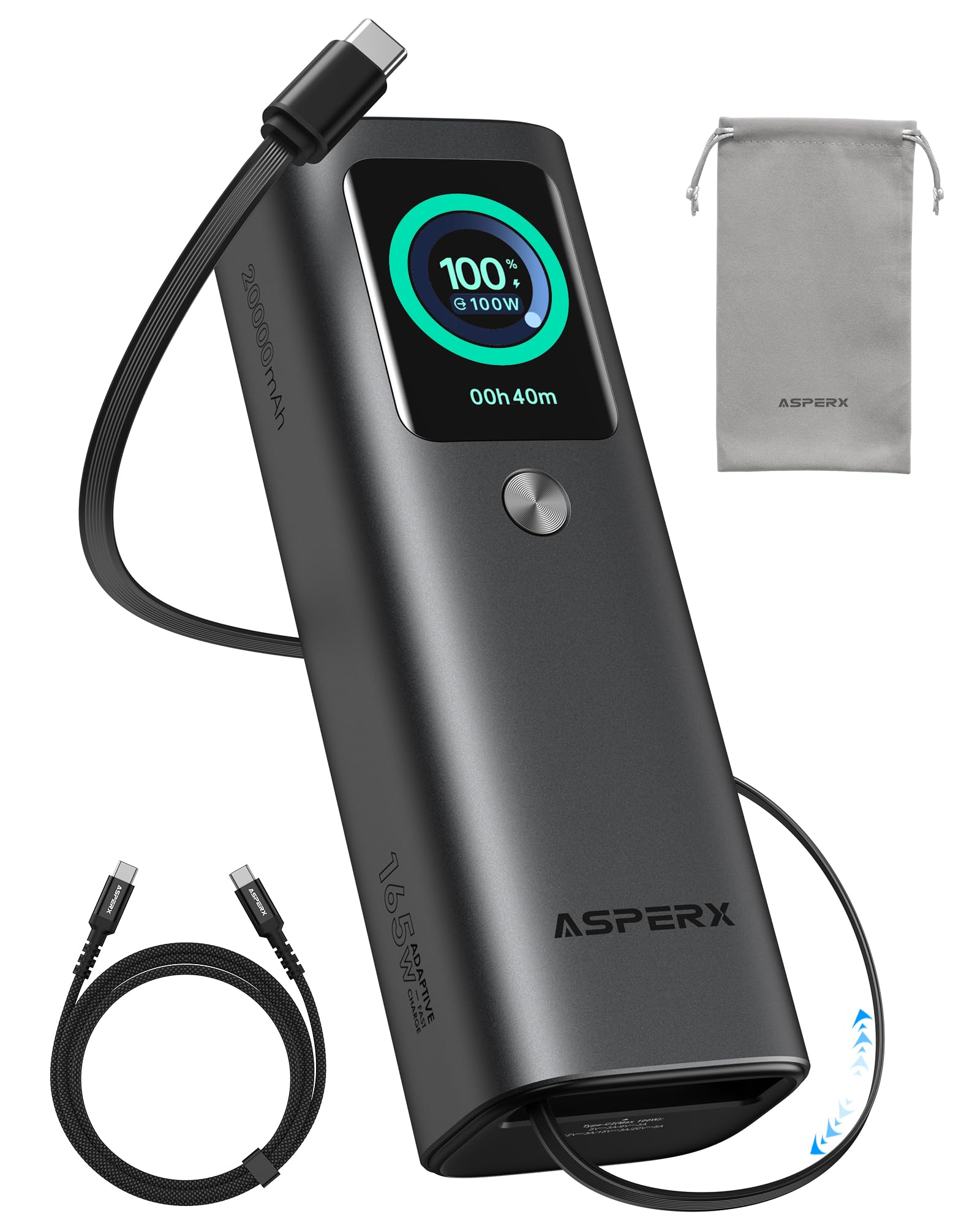
The defining feature is the retractable USB-C cable that winds back into the body, so there is nothing to lose and nothing to untangle. Behind it sits 165W of total output, with up to 100W on a single port and the ability to feed 100W and 65W to two computers simultaneously. The 20,000mAh capacity has kept a nearly dead HP laptop running through about three hours of work, and owners have used it daily for phones, tablets and laptops. It is built from an aluminum alloy casing rather than plastic, which the maker says helps with heat dissipation.
The display is larger than most, showing battery percentage, remaining time and live output and input wattage — and the brightness can be adjusted for indoor or outdoor use. There is also a Small Power Mode, entered by long-pressing the power button, for low-draw devices like earbuds and smartwatches that standard banks sometimes refuse to charge. A 240W USB-C to USB-C cable and a carrying bag come in the box, and the recharging rate tops out at 65W, so a higher-power wall adapter gets you a faster fill.
Battery life is what people talk about most, followed closely by how solid it feels in the hand. The honest caveats are weight and speed. At 666 g it is the heaviest pick here, and the charging-speed feedback is genuinely mixed — some find it quick, some have hit a stretch where it would not charge the battery for about an hour. One user also found a specific lighting rig would not handshake over PD, so specialist gear deserves a test before you rely on it.
What the retractable design buys you: a cable that is always there, a 165W ceiling that runs two laptops, and a metal body that feels like a tool rather than an accessory.
What it costs you: 666 g in the bag and a charging handshake that does not agree with every pro device.
Pick this one if: you are done hunting for cables and want two laptops charging from one brick.
Pass if: you carry your bank in a pocket or rely on specialty lighting gear.
5. UGREEN Nexode 25000mAh Power Bank
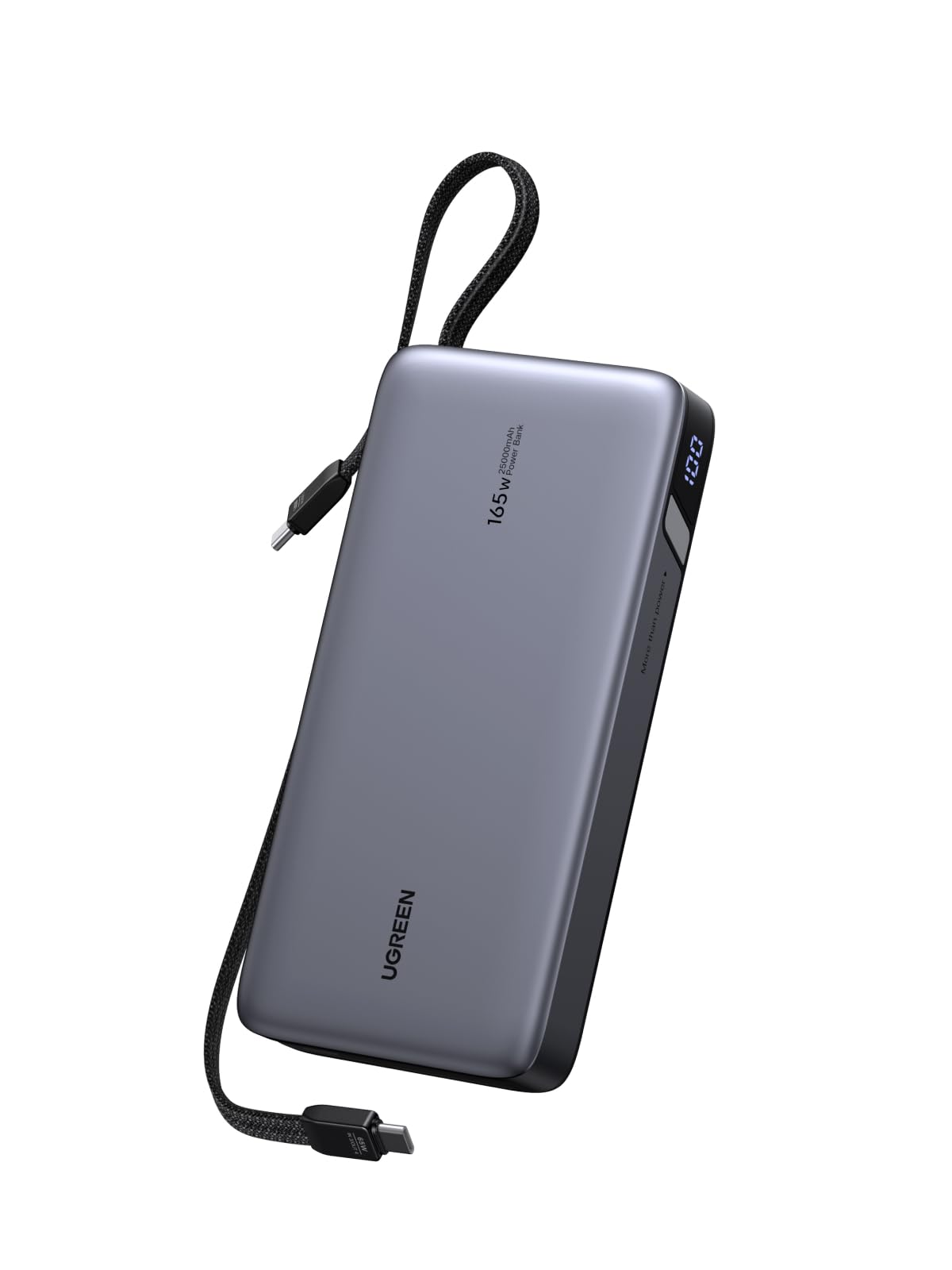
Two cables built into one pack — one for the laptop, one for the phone, none for your bag.
This is the desk-away-from-desk pick. Two built-in USB-C cables extend when needed and store flush when not, so a co-working session or a client meeting needs no extra leads. Power is the star: up to 140W on a single port and 165W total, enough to charge a laptop and a phone at the same time without either slowing down. The 25,000mAh capacity is rated for extended runtime on laptops and multiple full phone charges, and the pack recharges at 90W to full in roughly two hours.
What wins people over is the combination of output and organization. The dual cables keep a work bag tidy, and the digital display gives live stats on what is going in and out. Pass-through charging works well too, so you can plug the bank into the wall and still feed your devices. On flights it is listed as carry-on compatible at 25,000mAh. If any single spec sells this pack, it is 165W in a body small enough to forget about between meetings.
The catch is the same one that follows high-capacity packs: 550 g in the hand, and the weight shows up in the feedback as the one recurring negative. It is a business-travel tool rather than a pocket charger. Owners describe it as the best daily pack they have carried, with “quite the battery output of 165W” cited as the reason it beat the alternatives.
What the road warrior values
- 165W total and 140W single-port handle a laptop and phone together
- Two built-in USB-C cables keep the bag organized
- 90W recharging brings it back to full in about two hours
- 25,000mAh covers a full workday and multiple phone charges
The trade you make
- 550 g is noticeable in a slim briefcase
- Heavier than smaller packs, so it lives in a bag rather than a pocket
Made for: the road warrior who wants laptop-grade power from a pack that keeps its own cables.
Skip the upgrade if: you only charge phones — a smaller bank will do the job at half the weight.
6. Baseus Blade Power Bank 20000mAh
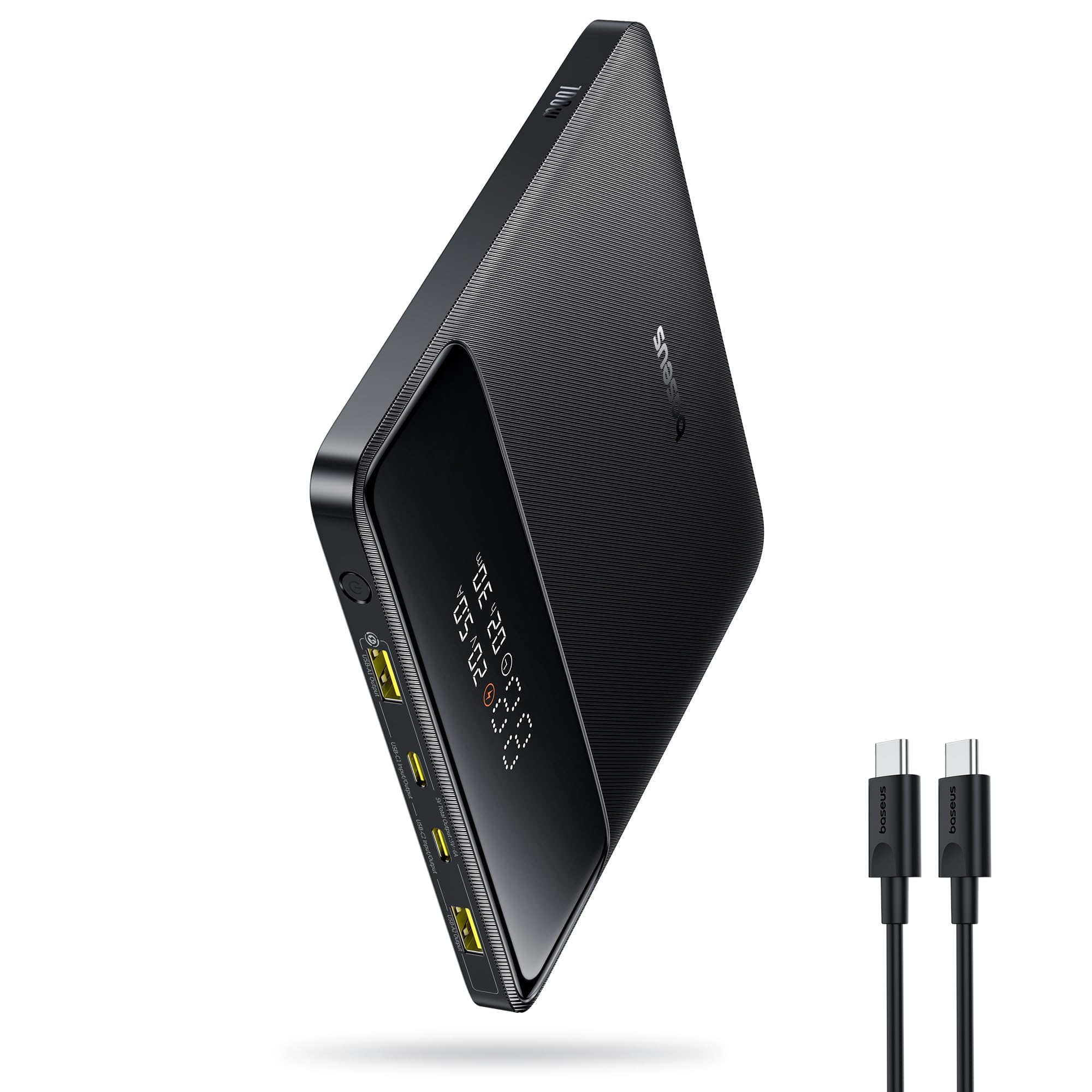
The flat one that disappears into a laptop bag and still pushes 100W to a MacBook.
A 5.27 by 5.27 inch square that is 0.78 inches thick — this is the pick for the traveler who hates bulk. The 20,000mAh capacity is rated at 3-4 charges for an iPhone 16 Pro or over 70% for most 13 to 15-inch laptops, so a coast-to-coast flight becomes routine. On the power side, 100W USB-C PD puts a MacBook Pro at 50% in 30 minutes, and dual USB-C plus dual USB-A ports let you charge a laptop and a phone at once. The real-time display shows battery percentage, output wattage and estimated charge time.
There is more flexibility here than the flat shape suggests. One user ran it with an iPad across long flights and with a Samsung S23 tracking bike rides over an hour at a stretch. Another powered a portable CPAP machine for roughly eight hours at pressure 10 with about 20% left, and pass-through charging held up over two nights. It is FAA-compliant and TSA-approved, and the box includes a 100W USB-C cable plus a 24-month warranty.
Two honest notes. Under heavy combined load the pack drains quickly, which is the cost of pushing dual ports. And the size feedback is mixed — some find it nice, others find it too wide to sit behind a phone on a table, so this is a bag charger rather than a pocket one. At 451 g it stays manageable for a tote or backpack.
The shape advantage: a flat profile that slips into a laptop sleeve is the reason to pick this over a chunky cylindrical bank.
The honest caveat: combined load drains it fast, and the wide body does not sit politely behind a phone.
Best fit: business travelers who want laptop speed in the flattest possible package.
Think twice if: you want a pack that runs three devices hard all day — combined load eats the capacity quickly.
7. Portable Power Bank with AC Outlet

A wall socket in your bag for the gadgets that never got a USB-C port.
This is the one for the traveler carrying something that plugs into a wall — a CPAP machine, a small fan, a charger brick. There is a 100W AC outlet for loads under 100W, plus a 65W PD USB-C port, a 12W USB port and an 18W USB port. The capacity is 27,000mAh, rated at 98Wh, so it stays under the common 100Wh carry-on ceiling. The USB-C port does 65W in and out, and a full recharge from that port takes about 1.5 hours.
What owners value most is the raw capacity for odd jobs. It has run a CPAP with humidifier for four to five hours at high humidity, added five-plus hours of laptop runtime, and pushed an e-bike battery roughly two bars. One traveler bought a second unit after a couple of years of reliable service. The body is 6.7 x 2.6 x 2.6 inches and comes with a carry case, and FCC, CE and RoHS certifications sit behind the overcharge, overvoltage, overcurrent and short-circuit protections.
The honest note is the one the pattern of feedback makes clear: the AC outlet is the headline, and reliability and battery life over the long term are the areas to think about carefully. This is a tool for a specific job — wall-powered devices away from a wall — rather than an everyday phone bank. It is a niche pick, and a good one within that niche.
Where the AC outlet pays off
- 100W AC outlet runs wall-plug gadgets away from a socket
- 98Wh rating keeps it inside carry-on limits
- 27,000mAh with four output ports for mixed gear
- 65W USB-C input recharges it in about 1.5 hours
Buy it for the right job
- A niche tool — not the everyday phone bank most people want
- Long-term reliability is the area to watch in the feedback
The right buyer: someone with a wall-powered device — CPAP, small appliance, odd charger — that needs to run off-grid.
Not the right buyer: anyone who just wants to top up a phone and a laptop over USB-C.
Know the Specs
Watt-Hours (Wh)
Watt-hours describe the total energy a pack holds, and they are the figure airline staff check at security. A 20,100mAh pack listed at 72.36Wh and a 27,000mAh pack listed at 98Wh both sit under the common 100Wh carry-on ceiling. Milliamp-hours (mAh) alone are not enough because they ignore cell voltage, so always look for the printed Wh number on the unit you buy.
Output Wattage (W)
Output wattage decides what a pack can run. A 65W or 100W USB-C port will charge a laptop at a useful speed, while 12W and 18W ports are for phones and accessories. A bank rated at 220W total can split power across three ports at once. If a laptop is on your packing list, match the port wattage to the laptop’s own charger rating.
Input Wattage and Recharge Time
Input wattage is how fast the bank refills. A 100W input takes a 20,100mAh pack to 50% in 25 minutes, and a 90W input fills a 25,000mAh pack in about two hours. A 65W input fills a 20,000mAh pack in 1.5 hours. Lower input wattage means longer waits between trips, so check the input spec as carefully as the output.
Built-In and Retractable Cables
A built-in cable removes the cord you forget in a hotel room. One design is tested to withstand over 10,000 bends, and a retractable cable winds back into the body for storage. Cables that handle both output and input on the same lead are the easiest for travel, but check the port mix if you carry devices with different connectors.
Common Questions
Is a 20,000mAh power bank under 100Wh and allowed in carry-on?
Can a 100W power bank charge a MacBook Pro?
What is the difference between a USB power bank and one with an AC outlet?
How long does it take to recharge a 25,000mAh power bank?
Is 165W output enough to charge two laptops at once?
Do built-in cables wear out?
Will a power bank with a built-in cable charge an iPhone or an Android phone?
How many phone charges should I expect from 20,000mAh?
Can I charge a laptop and a phone from one power bank at the same time?
Do I need a special wall charger to refill these power banks quickly?
The Bottom Line
For most travelers, the 100wh power bank winner is the Anker Prime Power Bank because 220W of total output, a 72.36Wh flight-ready rating and 140W single-port charging cover a laptop and a phone without drama. If you want the simplest travel routine, the Anker Travel Essential builds the cable in and keeps the weight down. And for wall-powered gear that never got a USB-C port, the Paopaoyu carries a 100W AC outlet inside a 98Wh pack. Check the printed Wh on whichever one you pick, pack the right cable, and the security lane stays boring.
How we choose
We do not accept paid placement. Every pick is matched to a real buyer and a real use-case; we do not hands-on test units.
Sources
Specifications: manufacturer listings and product documentation. Review insights: verified customer reviews, as of October 2026. Pricing: not shown on this page (it changes often); check the current price via the retailer link.
As an Amazon Associate, Aappliancez earns from qualifying purchases. This does not affect which products we feature.