Disclosure: Some links in this post are affiliate links. As an Amazon Associate I earn from qualifying purchases, at no extra cost to you. Learn more
Specs are compiled from manufacturer listings and verified buyer reviews and can change over time — please confirm the key details on the product page before buying.
Your factory speakers are usually stamped paper cones with tiny magnets — the cheapest parts in the car. Most are stamped paper cones with tiny magnets, which is why music turns to mush once you roll the windows down. A good replacement set fixes that without an amplifier or a custom build. The pick that suits most people is the Polk Audio DB692, a 6×9 that handles up to 150W RMS with a splash-proof build that survives boats and motorcycles. Below are seven sets that genuinely work, sorted by what each one is actually good at.
This guide is built by comparing the manufacturers’ published specifications and the patterns across verified customer reviews, so you get each pick’s real strengths and trade-offs instead of marketing spin.
Fit matters more than wattage, so every entry here lists what it physically drops into and what it does not. Read on for replacement speakers that deliver more bass and clearer vocals from the factory radio you already own.
Top Picks


How To Choose Replacement Speakers for Car Audio
The order of checks is simple: measure the hole, then read the sensitivity, then look at power handling. Most people start at power handling and buy a set that won’t fit the door. That mistake costs you a return and a second install.
Measure the opening and the mounting depth first
Most cars run either a 6×9 or a 6.5-inch speaker in the doors or rear deck, and those two sizes are not interchangeable without an adapter plate. Mounting depth is the number that ruins installs — the shallow end here sits at 2 inches on the JBL GTO629, while the Orion Cobalt CM654 needs 2.63 inches at the mounting diameter. If your window glass travels right behind the speaker hole, a deep magnet will block it from rolling down.
Sensitivity in decibels tells you how loud the stock radio can go
A speaker’s sensitivity (measured in dB, or decibels — roughly how much sound you get per watt) decides whether the factory head unit has enough juice. A set rated 91 dB plays loud off minimal power, while a low-sensitivity set needs an amp to wake up. If you are not adding an amplifier, sensitivity matters more than any wattage figure on the box. High-efficiency designs here reach 96.67 dB for exactly that reason.
Impedance in ohms changes what your radio gives you
Ohms measure electrical resistance — lower ohms let more current flow from the same radio. A 3-ohm speaker pulls more power out of a stock head unit than a 4-ohm one, which is why the JBL set advertises exactly that trick. Do not mix wildly different impedances across your four speakers, because the radio balances volume across them.
Two-way, three-way and four-way: what the number actually means
The number counts separate drivers — pieces of the speaker dedicated to a slice of the frequency range. A 3-way splits lows, mids and highs across three drivers, while a 4-way adds another tweeter for finer top-end detail. More drivers do not guarantee better sound; a well-tuned 2-way can beat a cheap 4-way. What matters more is the crossover, the circuit that sends each frequency to the right driver instead of letting bass bleed into the tweeter.
Side-by-Side Comparison
| Model | Best For | Size | Peak / RMS Power | Sensitivity | Amazon |
|---|---|---|---|---|---|
| Polk Audio DB692 DB+★ Best Overall | Marine-tough all-rounder | 6″ x 9″ | 450W peak / 150W RMS | — | Amazon |
| Pioneer TS-A1671F A-SeriesBest Value | Budget dash upgrade | 6.5″ | 320W peak / 70W RMS | 91 dB | Amazon |
| Kenwood KFC-6966S | Rear-deck thump on a budget | 6″ x 9″ | 800W peak / 90W RMS | — | Amazon |
| Orion Cobalt CM654 | Loud midrange on an amp | 6.54″ | 1000W peak / 250W RMS | 96.67 dB | Amazon |
| Pioneer TS-A1681F A-Series Plus | Four-way clarity, four doors | 6.5″ | 350W peak / 80W RMS | 91 dB | Amazon |
| BOSS Audio 6.5″ Coaxial 2 Pairs | Doing all four doors cheaply | 6.5″ | 400W peak / 200W RMS per pair | 90 dB | Amazon |
| JBL GTO629 | Aimable tweeter, real bass | 6.5″ (16.5 cm) | — | — | Amazon |
Detailed Reviews
1. Polk Audio DB692 DB+ Series Coaxial Marine 6×9 Speaker
Our pick — 4.5+★ from 950+ verified ratings; the strongest balance of quality and price.
The one that keeps its composure whether it is bolted into a door or a boat hull.
Start with what survives: an IP56 marine certification (a rating for protection against dust and powerful water jets), plus salt-fog, UV and humidity testing on coated steel baskets. That is why this 6×9 turns up in ATVs and motorcycles as often as in cars. It carries 450W peak and 150W RMS — a continuous-power figure that beats the Pioneer TS-A1671F’s 70W RMS, which is more headroom for loud, long listening before things strain.
Under the grille sits a 6″ x 9″ polypropylene woofer, a 1/2″ super tweeter and a rubber surround, fed by a built-in crossover that routes highs and lows to their own drivers. Polk’s Dynamic Balance process uses laser imaging to pick materials that stay calm, and the payoff lands in the bass — a firm, punchy low end from a single coaxial rather than a thin thump. Frequency response runs 30-22kHz, so cymbals and strings stay distinct instead of smearing together.
Where it shines: fit is the thing that wins people over, and the mounting hardware plus styled grilles make a custom install look finished rather than improvised. Buyers report driveshaft-deep output that holds together at highway volume. The price-to-sound math is the recurring note — as buyers put it: “Cant beat the quality for the price.”
What to plan for: these are not a plug-and-play harness job on every vehicle. Some Fords need adapter plates for the openings, and one owner found the sedan needed no window interference despite the larger magnet — a good sign, but not a guarantee for your car. If you plan to submerge a marine speaker, seal inside the magnet under the sticker with silicone first.
Worth it for: anyone who wants one set to handle doors, rear decks, or a vehicle that sees water and weather.
Think twice if: your openings are 6.5-inch only — you’ll need adapter plates before this 6×9 goes in.
2. Pioneer TS-A1671F 6.5″ 3-Way Coaxial Speakers
Cheap enough to replace all four, sensitive enough to run off the radio you already have.
The number that decides this one is 91 dB sensitivity. That means the speaker turns a small amount of radio power into a lot of sound, so a stock head unit can drive it to satisfying volume without an amplifier. Pair that with 70W RMS and 320W peak, and you have a set designed for factory-radio owners who want a lift, not a rebuild. Frequency response spans 37 Hz to 31 kHz, which covers the whole range you can hear and a bit past it.
What earns the loyalty here is clarity at normal listening levels. A linear, balanced response across the range is exactly what a 3-way design with separate drivers for lows, mids and highs should produce, and it keeps vocals and instruments separate instead of muddy. The included 6-1/2″ multi-fit adapters widen the vehicles it slots into, and the mounting design is simple enough that one buyer had it done in roughly five minutes.
Reasons owners keep buying
- 91 dB sensitivity means real volume from a stock radio, no amp required
- Multi-fit 6-1/2″ adapters included, so more vehicles bolt up cleanly
- Balanced mid-and-high response that stays clear at medium volume
Before you order
- No plug-and-play connectors — expect to splice into factory wiring
- Some factory openings (rear decks especially) need trimming or a separate bracket for a flush fit
- Durability is the one split opinion, so treat the surround gently
Reach for this if: you are replacing tired factory speakers in a daily driver and want an audible jump for entry-level money.
Look elsewhere if: you plan a big amplifier build — the 70W RMS ceiling leaves less headroom than the Polk or Orion sets.
3. Kenwood KFC-6966S 6″ x 9″ 3-Way Coaxial Speakers Pair

Eight hundred watts of headline number in a 6×9 that costs less than a tank of fuel.
Here is the figure on the box: 800W peak per pair, against 320W peak on the Pioneer TS-A1671F — a 2.5x gap. Treat that as how much power the speaker will briefly accept, not a promise of volume, because the RMS figure that matters for daily listening is 90 watts per pair. It runs at 4 ohms impedance (electrical resistance, and a standard load most radios handle easily) with a polypropylene mid-woofer cone and a foam-rubber surround.
The physical spec that decides your install: top-mount depth of 3″, and a cutout of 6-1/16″ x 8-3/4″. Frequency response spans 35 Hz to 20000 Hz, so low end reaches down usefully. In the rear deck of a sedan these dig hard — the owner who swapped out both sides in about 30 minutes got exactly the bump they wanted. Others describe them as a natural match beside Kenwood door speakers already in the car.
Honest read on the fit: 6×9 openings (a common oval speaker size) are not universal. A handful of drivers found their particular door or hatch simply did not take this shape — a 2006 Charger was one example, left with a small gap. Measure your openings before ordering and this becomes a non-issue.
Wiring heads-up: there are no factory connectors in the box. You splice, and you may need a speaker adapter cable. That is the trade-off of the price, not a defect. As one blunt owner put it: “you need to rewire the speaker but took 30 min to replace both sides.”
Suits: rear-deck and hatch builds where 6×9 openings already exist and you want maximum thump for minimal spend.
Skip if: you want a screwdriver-only install — the splice and possible adapter raise the effort level.
4. ORION Cobalt CM654 6.5″ High Efficiency Mid-Range Speakers

Efficiency this high means your amplifier barely works to make your ears ring.
Efficiency of 96.67 dB is the standout number, and it is a big one — that figure describes how much sound you get per watt, and it sits well above the 91 dB Pioneer sets here. Feed it an aftermarket head unit or a modest amp and it goes punishingly loud. Power handling runs 1000W max and 250W RMS, so it takes a real amplifier without flinching. The 250W RMS also tops the Polk Audio DB692’s 150W RMS, giving it the deeper power ceiling of the pair.
The design is a dedicated midrange, not a full-range speaker — a 1.5″ high-temperature voice coil sits behind a bullet-shaped phase plug that lets it reach high frequencies without giving up the mid and low-mid range. Mounting depth is just 2.63″, and the shallow footprint means it drops into tight doors and roll bars where a deeper magnet would not go. Hertz on a Jeep’s roll bar with a good head unit is the classic use, and the sound stays crisp rather than distorting at volume.
What the loud crowd likes
- 96.67 dB efficiency makes real volume with modest amplification
- 250W RMS ceiling handles serious amp power
- 2.63″ mounting depth fits shallow doors and bars
The catches to know
- A midrange, not a full-range — it wants a woofer or sub to handle the deep bass
- It’s a bare box: no wiring and no grilles included, so plan for both
- Lifespan is the split opinion here, so don’t drive it past its RMS rating
Built for: amp-driven systems in Jeeps, side-by-sides and doors where sheer volume is the goal.
Not for: someone expecting a complete out-of-the-box set with wiring and covers in the carton.
5. Pioneer TS-A1681F 6.5″ 4-Way Coaxial Car Speakers

Four separate drivers per speaker, tuned for the person who hears the difference.
A 4-way design splits the music into four slices with dedicated drivers, and that extra tweeter work shows up as detail you can pick out. Frequency response runs 35 Hz to 29 kHz — wider at the top than the TS-A1671F’s 31 kHz ceiling and deeper at the bottom than its 37 Hz floor, so it reaches further in both directions. Sensitivity stays at 91 dB, so it still sings off a stock radio, while power handling climbs to 80W RMS and 350W peak. That 80W RMS sits above the 70W RMS of the standard A-Series, giving it more breathing room under an amp.
The installation story is friendly, with 6-1/2″ multi-fit adapters in the box and a mounting design that many describe as a 15-to-20 minute job per location. In a Jeep Cherokee Trailhawk the direct fit makes it a painless swap. Owners running them off a stock radio report they handle volume cleanly — no crackle as the dial climbs. The clarity across genres is the draw: vocals stay forward, and instruments hold their own.
The detail payoff: going from a stock speaker to a 4-way is the kind of jump that makes you replay old songs just to hear what was buried. That wider 35 Hz to 29 kHz range is doing the heavy lifting.
Some assembly logic: the included adapters do not fit every vehicle — some trucks need a separate bracket and wire harness to hit a flush, plug-and-play fit. Budget for those adapters and the install goes smoothly.
Great match: anyone replacing all four doors in a modern truck, SUV or Jeep who wants maximum frequency detail.
Hold off if: your vehicle needs a model-specific bracket — the included adapter may not be the one.
6. BOSS Audio Systems 6.5″ Full Range Coaxial Speaker, 2 Pairs

One box, all four doors — the fastest way to replace every blown speaker in the car.
The spec that carries this one is the count: four complete coaxial speakers in a single package, each pair handling 400W max and 200W RMS. That makes it the cheapest route to refreshing every door and deck location at once. Materials are poly-injection woofer cones with a rubber surround, plus stamped steel baskets and metal mesh grills — the kind of build meant to hold up to long daily use. Frequency response runs 65-20 kilohertz with 90 decibels of sensitivity, and each speaker needs just 2.25 inches of mounting depth at a 5.63-inch mounting diameter.
For stock-radio owners, the honest ceiling is the low end: 65 Hz is where the bass rolls off, so deep notes do not come through the way they do on a 6×9. What you get instead is clear, loud sound off modest power. A Silverado owner swapped in all four, ran them at 85W per channel, and got distinct mids and clear highs without clipping. A Trailblazer owner put it plainly — not the best sound, but better than the failing factory cones and good for the budget.
The value math: four speakers for roughly the price of one premium pair is the whole pitch, and it lands for people replacing worn-out factory gear on a tight budget.
Where it gives ground: these are entry-level, and a few drivers pushed them hard enough to blow — most likely feeding more than their 200W RMS allows. Keep the power sensible and they hold. Some vehicles also need front-deck trimming, so measure before cutting.
Pair this with: a tired factory system that needs all four locations replaced without much spend.
Pass on it if: deep bass is your goal — look to a 6×9 set instead.
7. JBL GTO629 Premium 6.5-Inch Co-Axial Speaker – Set of 2
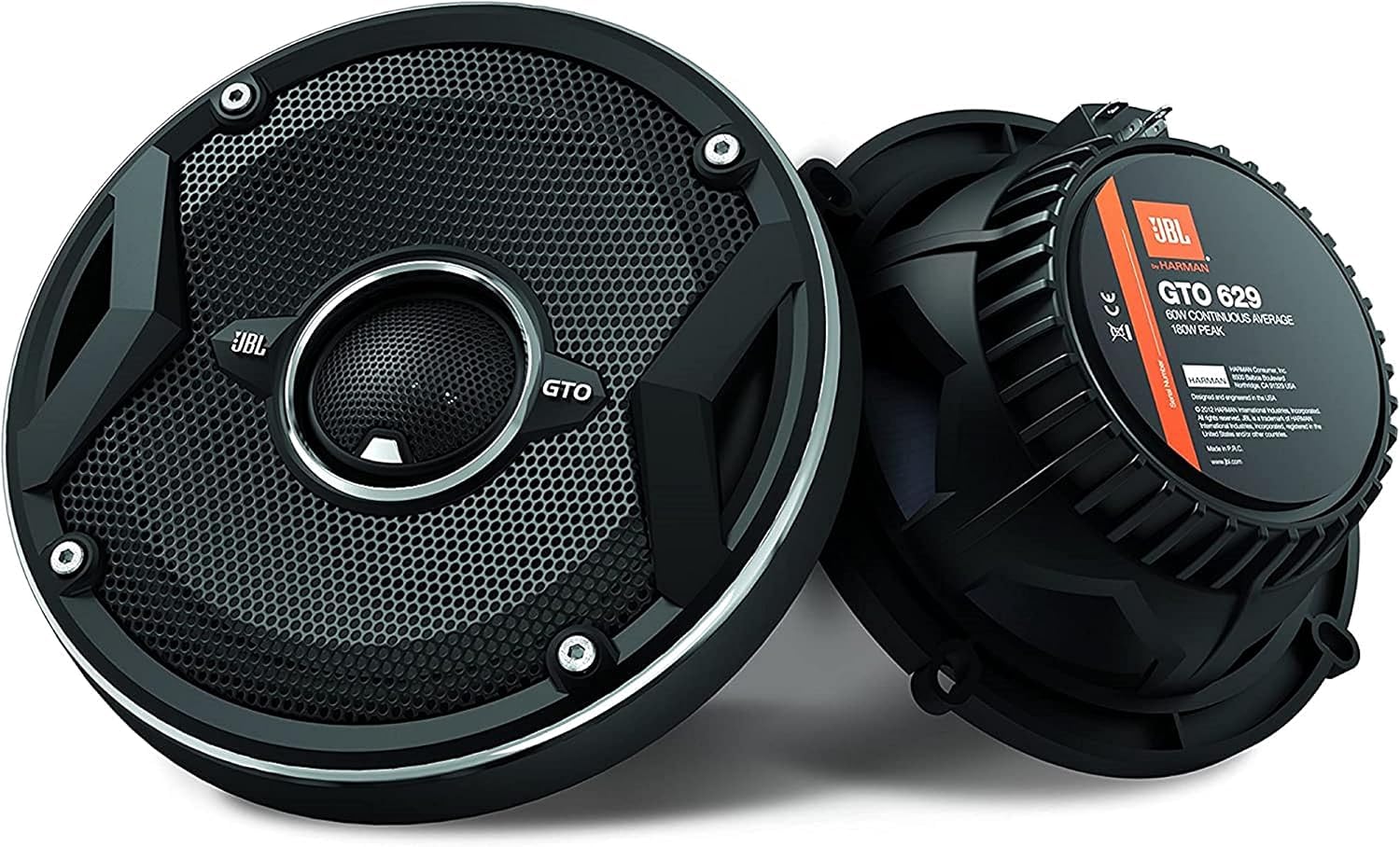
A tweeter you can physically aim at your ears — the trick the cheaper sets skip.
Most coaxial speakers fire the tweeter wherever the speaker points, which is not where your head sits when the speaker lives low in a door. The patented UniPivot design lets you angle the tweeter toward your ears, so the highs reach you instead of the door panel. There is also a dual-level tweeter volume control to compensate for awkward placement or to match your taste. Both are features the other sets here simply do not offer.
The cone is a carbon-injected Plus One design — larger than others in its 6.5-inch class, which means it moves more air for more bass. A dedicated 12dB/octave crossover sends highs and lows to their proper drivers, and the 3-ohm impedance makes the most of the small factory wiring in many cars. Mounting depth is just 2 inches, with a 5-1/16-inch cutout, so it drops into tight doors. Owners mention real, felt bass and clean highs that hold up at highway speed.
Why it costs more
- UniPivot tweeter aims at your ears for lifelike highs
- Plus One carbon-injected cone moves more air for real bass
- 3-ohm impedance squeezes more from factory wiring
The honest trade-offs
- Fit isn’t universal — some vehicles need cover or bracket mods
- Lifespan is the split opinion, so power it sensibly
- Bass-hungry drivers may still want an amp for maximum thump
Pick it for: a premium 6.5-inch drop-in where you want real bass and aimable highs, and don’t mind trimming a bracket or two.
Leave it if: your openings are strictly 6×9 — this set won’t fit without an adapter.
Know the Specs
Peak vs RMS power (watts)
Peak power is the most a speaker will briefly take; RMS is the continuous figure that matters day to day. A 150W RMS rating means it can play loud for long stretches without strain. Match your amp’s continuous output to a speaker’s RMS, not its peak, or you risk cooking the voice coil. Higher RMS generally means more clean headroom before distortion.
Sensitivity (decibels)
Sensitivity measures how much sound you get per watt. A set rated 91 dB or higher plays loud off a stock radio, while a lower rating wants an amplifier. If you are keeping the factory head unit, pick the highest dB rating — it does more for real-world volume than a bigger power rating.
Impedance (ohms)
Ohms measure resistance to current flow. Lower ohms pull more power from the same radio, which is why a 3-ohm speaker often sounds louder than a 4-ohm one on factory gear. Keep all four speakers at the same impedance so your radio volumes them evenly.
Frequency response (Hz to kHz)
This is the range of pitches a speaker reproduces, from low bass in hertz to high treble in kilohertz. A wider range, like 35 Hz to 29 kHz, covers more of the music. For car doors, the low-end number matters most — 65 Hz drops deep bass, while 30 Hz digs much further down.
Common Questions
Will a 6×9 speaker fit where a 6.5-inch came out?
Do I need an amplifier to run these speakers?
What is the difference between peak and RMS power on a speaker?
Which matters more, sensitivity or RMS wattage?
How long do replacement car speakers usually last?
Can I install replacement speakers myself?
Do marine-rated speakers work as well in a regular car?
Do speakers come with wiring and grilles?
Should I replace all four speakers or just two?
What does mounting depth mean and why does it matter?
The Bottom Line
Your replacement speakers for car choice really depends on two things: fit and sensitivity (how efficiently a speaker turns power into volume). For the widest range of uses — doors to decks to a vehicle that sees water — the Polk Audio DB692 is the set to beat, with 150W RMS (continuous power handling) and a marine-tough build. If your openings are strictly 6.5-inch and you’re on a stock radio, the Pioneer TS-A1681F gives you four-way clarity at 91 dB (a measure of how loud it plays per watt) that sings without an amp. And for refreshing all four doors on a tight budget, the BOSS Audio 2-pair set does the job in one box.
Whichever you choose, measure your opening and mounting depth first — fit beats a bigger spec sheet.
How we choose
We do not accept paid placement. Every pick is matched to a real buyer and a real use-case; we do not hands-on test units.
Sources
Specifications: manufacturer listings and product documentation. Review insights: verified customer reviews, as of October 2026. Pricing: not shown on this page (it changes often); check the current price via the retailer link.
As an Amazon Associate, Aappliancez earns from qualifying purchases. This does not affect which products we feature.