Disclosure: Some links in this post are affiliate links. As an Amazon Associate I earn from qualifying purchases, at no extra cost to you. Learn more
Specs are compiled from manufacturer listings and verified buyer reviews and can change over time — please confirm the key details on the product page before buying.
If you want a red and near-infrared light you can actually stick with, the Hooga PRO300 is the one to open first: 60 dual-chip LEDs, a built-in timer and separate red and near-infrared controls. But this shelf is crowded with panels, belts, pads and heat lamps that all sound the same in the listing. The real difference is where you plan to use it — standing in front of a panel, strapped to your back, or tilted over a sore knee. That one question narrows seven legitimate options down fast.
This guide is built by comparing the manufacturers’ published specifications and the patterns across verified customer reviews, so you get each pick’s real strengths and trade-offs instead of marketing spin.
You will see which devices are panels, which are flexible wraps and which are classic heat lamps, plus what each wavelength actually does for you. Below are the seven best infrared light devices for home use, sorted by what you really need.
Top Picks

How To Choose The Best Infrared Light
Buying an infrared light is really two decisions: what shape fits your body and routine, and what wavelengths and power the device offers. Get the shape right and it earns a nightly spot in your routine. Get it wrong and it sits in a closet with the charger still in the box.
Panel, wrap or heat lamp — pick your posture first
A flat panel is for standing or sitting in front of it while it works on your face, chest or back. A flexible wrap or mat lets you lie down, wrap a knee, or wear it under clothes around the house. A classic heat lamp like the Beurer is a single bulb aimed at one spot while you read or watch TV. Each shape decides where the device can go and how long you can tolerate a session.
660nm red versus 850nm near-infrared
Red light is the visible glow — the warm, bright wash you can see. Near-infrared is invisible to your eye but feels like penetrating warmth. Panels with dual-chip LEDs put both in one LED, so you are not choosing between them. Every device on this list that names both wavelengths covers them; check whether the controls let you run each separately, since that is the main flexibility decision here.
The specs that decide a good session
Irradiance — the light intensity landing on your skin, measured here in mW/cm² — tells you how long a session needs to run. A higher-irradiance panel covers the same area in fewer minutes. LED count tells you how evenly the light spreads across a surface, and the size of the treatment area tells you whether one session covers a knee or your whole back. A timer and eye protection are the two safety basics you should not buy without.
Side-by-Side Comparison
| Model | Best For | Form | Light Source | Wavelengths | Amazon |
|---|---|---|---|---|---|
| Hooga PRO300★ Best Overall | All-round daily sessions | Tabletop panel | 60 dual-chip LEDs | 660nm + 850nm | Amazon |
| Viconor Red Light Therapy LampBest Coverage | Whole-body sessions at home | Curved panel on stand | 120 LEDs | 660nm + 850nm | Amazon |
| Astarexin Dual-Headed Lamp | Small-space and wall setups | Dual-head lamp on stand | Dual-head LED | 660nm + 850nm | Amazon |
| Comfytemp Red Light Therapy Pad | Hands-free back and knee work | Flexible pad, 24” x 12” | 242 beads, 2 chips each | 660nm + 850nm | Amazon |
| Beurer IL60 | Targeted deep heat | Single heat lamp | 300W infrared bulb | Infrared heat | Amazon |
| BestQool Red Light Therapy Belt | Wearable on-the-go sessions | Flexible belt | 660nm + 850nm LEDs | 660nm + 850nm | Amazon |
| Lifepro Bioheal Panel | Room-to-room flexibility | Hangable panel | 120 dual-chip LEDs | 660nm + 850nm | Amazon |
Detailed Reviews
1. Hooga Red Light Therapy Panel PRO300
Our pick — 4.5+★ from 750+ verified ratings; the strongest balance of quality and price.
Sixty dual-chip LEDs that warm your back and brighten your face in the same ten-minute sit.
The number that matters here is 60 — dual-chip LEDs, meaning each one LED fires both 660nm red and 850nm near-infrared light at once, so you are not picking one effect over the other mid-session. It draws 300 watts and spreads light across a 60-degree beam angle, wide enough to cover a torso in one position. The panel is built on an iron frame with flicker-free LEDs and internal cooling fans. In your day, it is a tabletop unit you sit near while you answer messages or read, not a device you strap to yourself.
The results people describe are the kind that show up in a routine, not a single session. Sleep is the most-cited benefit in the feedback — buyers often report falling asleep easier after an evening session, with skin and post-workout recovery close behind. There is real anecdotal weight too: the review pages sum it up with a buyer describing a single 10-minute-per-side session at roughly six inches, after which pain dropped from 5-6/10 to 0.5 within 20 minutes. That is one experience, not a guarantee — but it tells you the panel runs strong. If you are comparing surfaces, the Hooga’s 60 LEDs are a third of what the Comfytemp pad packs, though the two are built for completely different setups.
The extra controls are what let this live on a stand rather than behind a closet door. A built-in digital timer handles session length, and separate red and near-infrared controls mean you can run visible red alone when you want a gentle glow. The adjustable tabletop stand holds its angle, and the panel connects to other PRO Series units if you later want a larger wall of light. The set includes the panel, the stand and the power cord, backed by a 3-year manufacturer warranty. The honest catch is the touch-sensitive buttons on the side — they can trigger accidentally when you reposition the panel, so grip it by the frame, not the face.
What earns its place
- 60 dual-chip LEDs fire both 660nm red and 850nm near-infrared at once, so no session choice to make
- Flicker-free LEDs with internal cooling fans keep the panel steady through long sessions
- Separate red and near-infrared controls plus a built-in timer put session length in your hands
- Adjustable tabletop stand holds position well and the panel links to other PRO Series units
- 3-year manufacturer warranty backs the hardware
Where it asks a little care
- At 4.3 kg it stays put on a desk rather than moving room to room easily
- Touch-sensitive side buttons can be nudged by accident while adjusting the panel
Built for: anyone who wants one serious daily panel in a fixed spot at home — desk, dresser or studio corner.
Think twice if: you need to wrap a knee or walk around while the light works, since this unit sits on a stand.
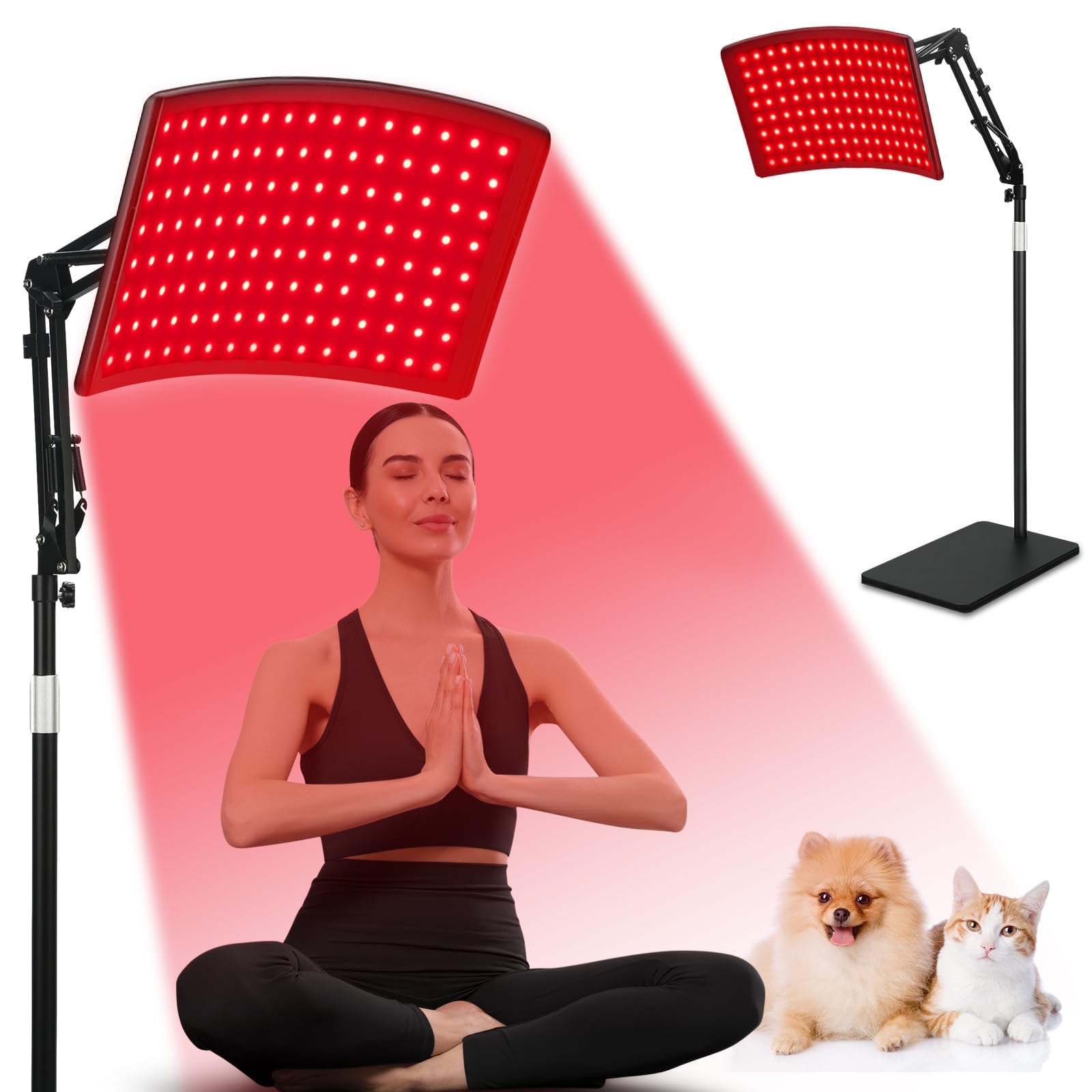
2. Viconor Red Light Therapy Lamp with Stand
A curved 120-LED lamp on a stand that tilts to whatever part of your body needs the light.
Start with the count: 120 LEDs, and each light positions one 660nm red bulb plus two 850nm infrared bulbs, so the panel runs twice as many LEDs as the Hooga PRO300. That is a jump in coverage per session, especially when the curved face is designed to focus the light into one concentrated pool. The whole unit weighs 7.2 pounds and comes with a hook, a 1.8m power cord and a stand. Height and angle adjust through 180°, which means it will reach your back while you stand or your face while you sit.
What wins people over is how well it fits a busy day. Feedback is full of people who hang it, tilt it, or carry it from bedroom to living room — the adjustability and the wide coverage area get most of the attention from buyers. Recovery and inflammation are the reasons buyers give for keeping it out of the closet. There is a floor on that, though: the stand can feel wobbly at certain angles, so set it where it will not be knocked and point it with the base squared under the head.
For a whole-body approach at home, the price-to-coverage math is hard to argue with. If you prize a low-effort panel that folds down to a slim lamp and tilts almost any direction, this is a smart shortlist entry. The remote lets you adjust brightness and start a timer without leaving your seat. Softer point: there is no dedicated warmth setting, so if you want the penetrating heat of a bulb lamp, that lives elsewhere on this list.
Where the light lands: the curved panel focuses output instead of scattering it, and the 180° stand means one device handles face, neck, shoulders and back without moving furniture.
One thing to know: stability is the recurring note — give the stand a flat base and a little clearance so a brush against it does not tip the head.
Strongest case: you want maximum LED count for the room you actually use it in, on a stand you can angle anywhere.
Not the one for: a household that needs a device to lie flat under the body or wrap around a limb.
3. Astarexin Dual-Headed Infrared Light Therapy Lamp
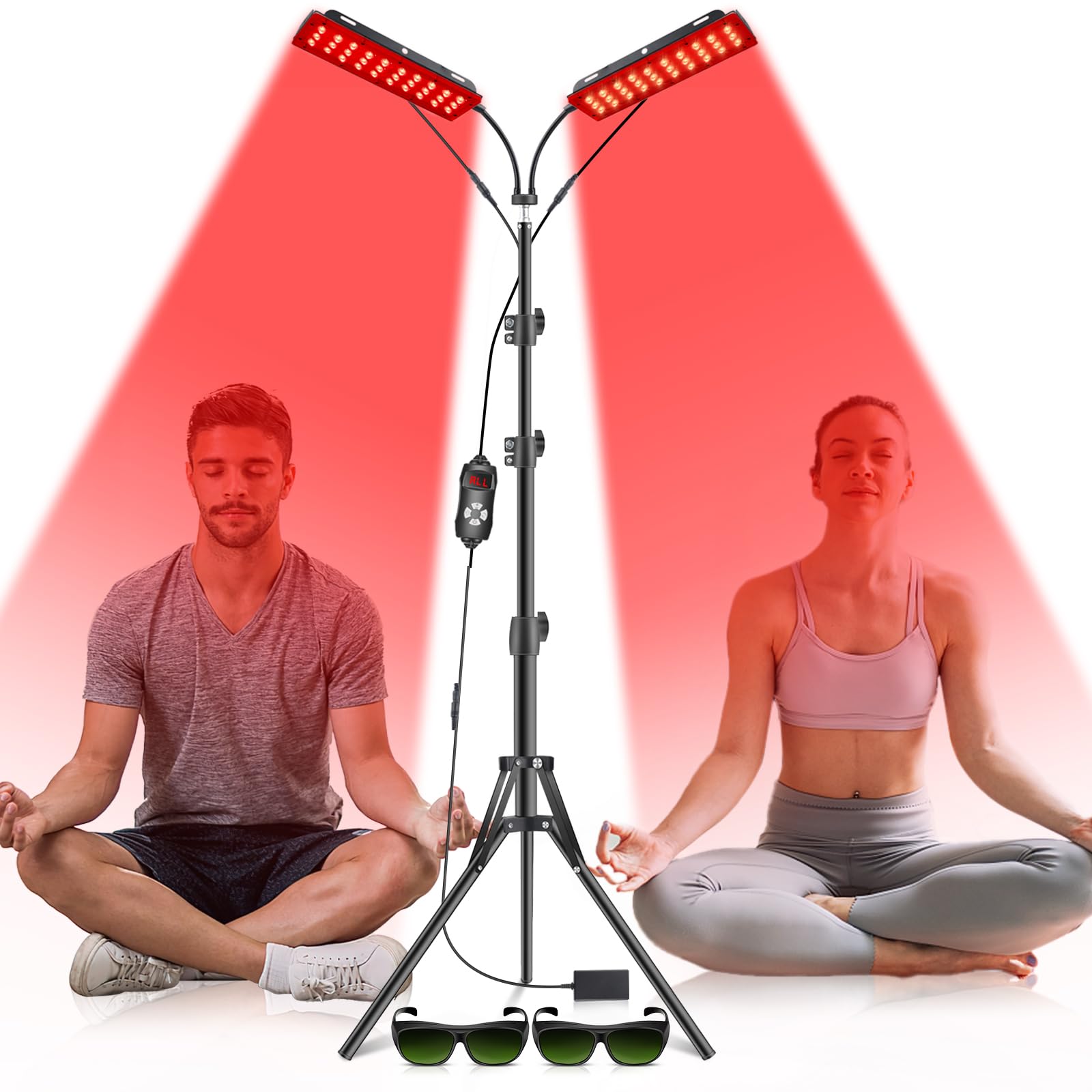
A two-headed lamp light enough for one hand, with five brightness levels and pulse modes built in.
The defining choice here is the dual-head setup: two lamp heads, each running 660nm red and 850nm near-infrared LEDs, so you can aim the light at two spots at once or widen the wash across a back. Five adjustable brightness levels each carry both a steady and a pulse mode, which gives you a dial between a gentle glow and a stronger session. The whole package weighs about 55oz, roughly a laptop, so it moves between rooms without a second trip. It ships with a stand and hanging accessories, so it can sit on the floor or be mounted to a wall in a tight room.
Where it falls short for some people is the treatment surface itself. Each head is smaller than a full panel, so the light lands on a narrower area, and you will spend more time repositioning to cover everything. The effectiveness feedback is genuinely split — the quality of the build and the brightness get solid marks, but a few buyers report a unit that quit after the first use. Look at this as a starter and travel device, not a whole-body workhorse. The included glasses matter too: wear them for face sessions, as the maker’s own reminder notes.
The real-life upside is where it lives. A wall-mounted lamp in a small apartment bedroom, a head aimed at a shoulder while you read, a second head covering the neck. That flexibility is why it earns a slot on a list of this length. If you have a full room to yourself and want broad coverage in one sitting, the 120-LED Viconor below is the better call. For a compact second unit or a solo bedroom, this one does the job on a wall.
Why it fits a tight room
- About 55oz total — one hand carries it to a shelf or wall bracket
- Five brightness levels, each with steady and pulse modes
- Stand and wall-mount accessories included, so it works on a floor or a wall
- Two heads run 660nm red and 850nm near-infrared together
The honest limits
- Each head is smaller than a full panel, so one session covers less of the body
- A few reports of a unit quitting after the first use — worth testing fully in the return window
Worth grabbing for: a wall-mounted or small-floor setup where a full panel will not fit, and where portability matters.
Better to pass if: you want broad whole-body coverage from a single fixed position every night.
4. Comfytemp Red Light Therapy Pad

A 24” x 12” pad that lies over your back while you scroll, with 242 beads each firing red and near-infrared.
Here is the shape that changes everything: this is a flexible pad, not a panel. It carries 242 lamp beads, and each bead has two chips — a visible 660nm red and an invisible 850nm near-infrared — so the light covers skin the moment the pad touches it. At 24” x 12” it wraps a back, a belly, a knee or a thigh. There is a 35” x 2” strap in the box so you can tie it around your waist and work with both hands free. One button switches it on and cycles three levels; a second button handles four modes. A 20-minute daily session is the maker’s own recommendation.
What the pad wins on is sheer size and contact coverage — the surface area is why people describe it as reaching places a panel cannot, from hips to shoulders to the full back. Customers praise the build quality first, then how the pad eases back and knee discomfort. There is a caveat on the verdict side: the light density question. A larger pad can spread the same LED count across more material, and the durability picture is mixed, with some units needing a replacement power supply and the odd one arriving with a cord shorter than expected. Those are fit-and-care notes, not a reason to skip the pad.
For anyone who finds standing in front of a panel tiring, this is the practical answer. Lay it on the sofa, cover it with a blanket, and let 20 minutes pass. Just wear light-coloured, thin clothing or use it on bare skin — the maker warns that darker or heavier fabric wastes some of the light. It is also the cheapest way to cover your whole back on this list. Add the included strap and it becomes your daily routine without rearranging a room.
What the size buys you: 24” x 12” of contact coverage plus a strap means knees, hips and lower back all get a session without you repositioning a stand.
The catch worth knowing: power supplies and cords are the weak link — treat the cable gently and keep the adapter off the floor, and test the whole pad fully inside the return window.
Reach for this if: you want to lie down or sit back with hands free while the light works on your back, hips or knees.
Look elsewhere if: you need a device to work on your face at arm’s length while you stand.
5. Beurer IL60 Infrared Heat Lamp

The one that feels like a warm blanket on a stiff joint, with a 300W bulb and an automatic shut-off.
This is not a panel and it does not pretend to be. It is a single heat lamp built around a 300W infrared bulb behind a glass-ceramic cover, and the whole point is deep warmth on one spot. The head tilts through 0-40° so you can aim it at a knee, a shoulder or your sinuses while you sit back. A built-in timer runs 1-15 minutes, and automatic shut-off plus overheat protection mean it turns itself off if you nod off. The set includes protective eyewear and a 6 foot cord, and the bulb is designed to be replaceable.
What makes it so widely used is how physical the experience is. Buyers call the heat instant and penetrating, and the deep warmth on tight joints and muscles is what keeps them coming back. Build quality stands out in the feedback, with relief close behind — and buyers reach for it after a shower to shake off a chill. Sinus relief comes up too. The most common practical caution is the timer: a few units do not always click off at zero, so verify yours switches off correctly on day one, while the return window is open.
Two things are worth knowing before you buy. First, it is a heat lamp — it is not a 660nm/850nm panel, so if you are specifically chasing a red-light wavelength, this is a different tool. Second, its eye-safety note is serious: never look into the bulb and keep the recommended distance. Used correctly, it is the easiest device on this list to start with. You plug it in, set the dial, and sit back with a book.
Why it has a following
- 300W infrared bulb delivers deep warmth quickly, on one targeted spot
- 1-15 minute timer with automatic shut-off and overheat protection
- 0-40° head tilt focuses the heat exactly where you point it
- Protective eyewear and a 6 foot cord included; bulb is replaceable
What to keep in mind
- It is a heat lamp, not a 660nm/850nm red-light panel — different tool, different job
- Test the timer on arrival, since a few units have needed a check before trusting the shut-off
Suits you if: you want one spot of deep, penetrating warmth on a stiff joint or tight muscle while you sit still.
Skip the aisle if: you are set on a full red and near-infrared wavelength panel for face and body coverage.
6. BestQool Red Light Therapy Belt

A soft belt that wraps your lower back or a knee and lets you keep moving through the session.
The specs that decide this one: a 72 mW/cm² irradiance figure, a 21.5” x 5.0” light-coverage strip, 21W power consumption and a body weight of 1.08 pounds. It runs 660nm red and 850nm near-infrared together, with a smart control system for timing and intensity. The shell is TPU soft material with diving fabric — abrasion-resistant, stretchable and breathable — so it can sit against your skin or go under a shirt. The AC range of 85-265V means it travels well with the right plug adapter.
Where it shines is the wearability. It weights barely a pound and rolls into a handbag, so people wear it around the house, on the couch, or while cleaning. Lower back and knee soreness dominate the feedback, with ease of use and warmth close behind. That makes it a natural fit for anyone who wants light on a moving body part. The trade-off is a smaller surface — 21.5 inches long, so it covers a lower back or a single knee with wrap-around, not a full torso in one pass.
Durability deserves your attention before you buy. This is a light, flexible device, and the soft construction wears faster than a solid panel, with some reports of LEDs dimming over time and a few cords working loose at the pad. It holds up best when stored flat and kept out of the washing machine. If you want a set-and-forget panel for ten years, buy a panel. If you want a belt you can actually wear on a Tuesday night while you tidy up, this is the most comfortable way to deliver light to a creaky lower back.
What it does best: the soft TPU body and 1.08 pound weight let you wrap a knee or lower back and keep moving — the opposite of standing in front of a panel.
The honest caveat: flexible construction wears over time; store it flat, keep the cord junction clear, and get the maximum life from it.
Best matched to: people who want light on a knee, hip or back while moving around, not sitting still in one spot.
Not what you want if: you plan to treat a wide area like the full chest or shoulders in one unmoving session.
7. Lifepro Bioheal Red Light Therapy Panel
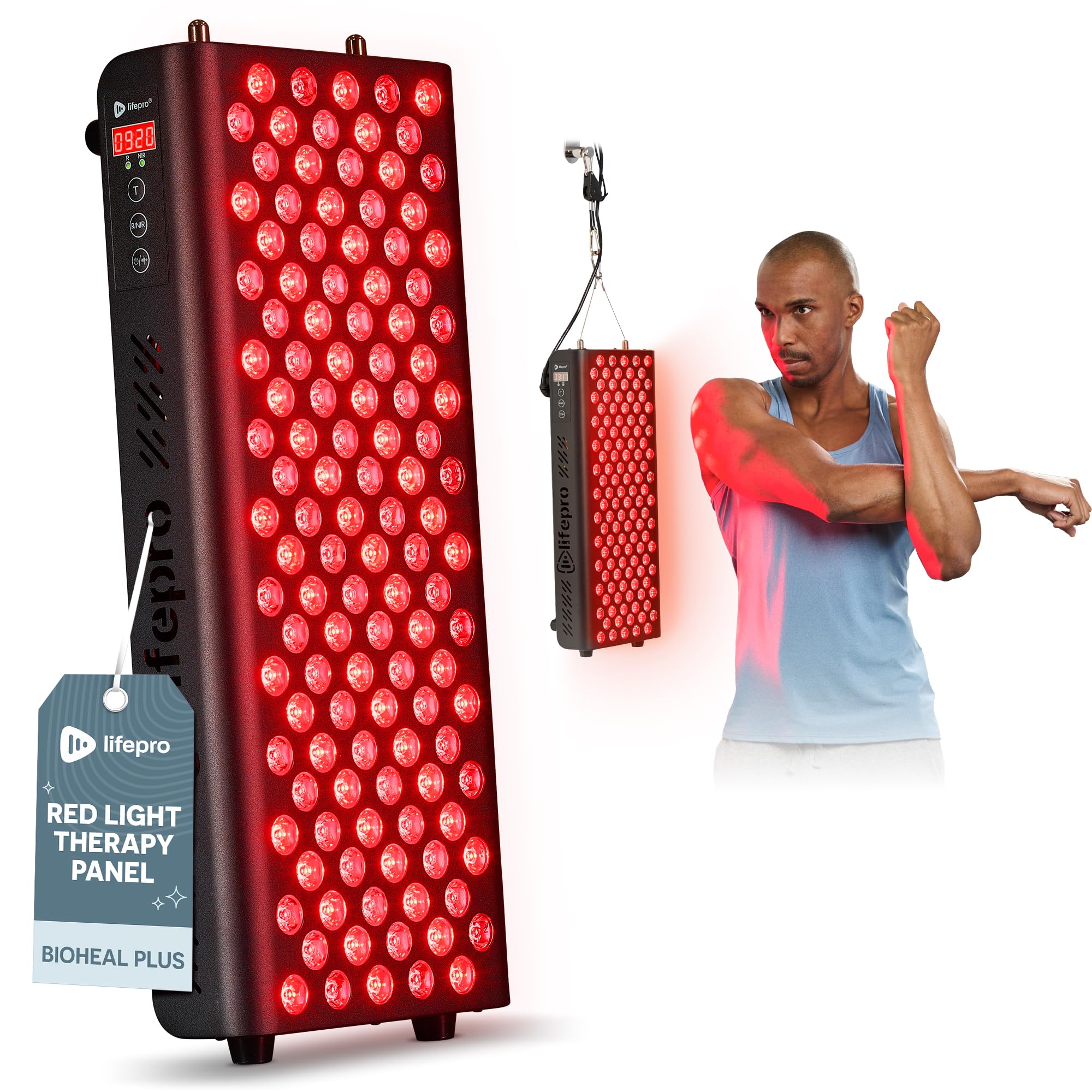
120 dual-chip LEDs pushing 203 mW/cm² at three inches — the brightest figure on this list.
The headline number tells the story: 203 mW/cm² of irradiance at 3 inches, measured against the BestQool belt’s 72 mW/cm², so this panel lands light on you noticeably harder at close range. The 120 dual-chip LEDs each run 660nm red and 850nm near-infrared together. Three light modes and a 1-30 minute adjustable timer let you set session length to what you actually have. The panel itself is 20.3 x 8.3 x 3.4 inches and weighs 9.7 pounds, and it stands, hangs on a door, or lies flat. A hanging kit and eyewear are included.
Build quality is what keeps it in the conversation — the frame is heavy and sturdy, and it feels like a piece of equipment rather than a toy. Aches, sleep quality and post-workday relaxation are the most frequent notes, with skin and joint comfort also mentioned. That does not mean it suits everyone’s body: the panel covers a face, an arm, a leg or a neck in one position, so if you want a whole-back wash you will be stepping up to a larger size. It is also a strong family device — one household has its dog curling up nearby after ten minutes. Compare it with the Hooga PRO300 and you are choosing between a wide 60-LED spread and a brighter 120-LED panel.
What sells it for most people is that single brightness figure. Short sessions at 203 mW/cm² at close range get the job done, and a 1-30 minute timer gives you room for both face and body passes. Softer points: the power-cord jack placement sits close to the handle, and the included sunglasses do not fully seal off light — buy a proper pair of goggles if your eyes are sensitive. The unit is best used as the bright, close-range panel in the corner of a room, not as the carry-around device for daily errands.
What stands out
- 203 mW/cm² at 3 inches — the highest irradiance on this list, alongside 72 mW/cm² on the belt
- 120 dual-chip LEDs cover both 660nm red and 850nm near-infrared in one pass
- Three light modes and a 1-30 minute timer, with 30 minutes per area a safe daily limit
- Hanging kit, eyewear and a heavy, sturdy frame included
Small things to accept
- The panel covers one area at a time — a face, an arm or a knee, not a whole back
- Cord jack sits near the handle and included sunglasses leave gaps; a proper pair of goggles helps
Right for you when: short, bright close-range sessions in one corner of a room are exactly the routine you want.
Look further if: you need to hang a panel on a door, move it room to room nightly, or treat wide areas in one pass.
Know the Specs
Wavelengths: 660nm and 850nm
Wavelengths, measured in nanometers (nm), describe the colour of the light. 660nm is red — you can see it as a warm glow. 850nm is near-infrared — invisible to your eye but felt as heat. Devices on this list that pair the two give you visible red for the skin surface and deeper warmth for muscle and joint comfort, in one session. A panel with separate controls lets you run red alone on a gentle day.
Irradiance in mW/cm²
Irradiance measures how much light energy lands on one square centimetre of skin, in milliwatts per square centimetre. Higher figures mean a shorter session for the same coverage — the Beurer’s single 300W bulb is heat-dominant, the Lifepro’s 203 mW/cm² at 3 inches is close-range intensity, while the BestQool belt’s 72 mW/cm² is a softer wrap-around figure. Check how long a device’s own recommended session runs and plan your routine around that.
LED count and treatment area
LEDs are the individual light sources on a panel, pad or belt. More of them, or dual-chip versions that fire both wavelengths at once, spread the light more evenly. The Hooga and Lifepro run 60 and 120 dual-chip LEDs respectively; the Comfytemp pad carries 242 beads with two chips apiece. A larger treatment area spreads the same count wider, so match the surface size to the body part you plan to use.
Timers, eye protection and safety
A built-in timer matters because sessions have a daily limit — the Beurer runs 1-15 minutes with automatic shut-off, the Hooga has a digital timer, and the Lifepro runs 1-30 minutes. Wear the protective eyewear any device includes, and never look straight into a bulb or panel. Keep a heat lamp at a safe distance and test its auto-shut-off inside the return window before you trust it.
Common Questions
Should I buy a panel or a belt for my lower back?
What is the difference between 660nm red light and 850nm infrared light?
How long should a session last with an infrared light device?
Do I need to wear eye protection during a red light session?
Will an infrared light work through my clothing?
Is an infrared heat lamp the same thing as a red light therapy panel?
How do I read the irradiance figure on a device?
Can I use an infrared device on my face?
How durable are the flexible pad and belt devices compared with a panel?
What extras should be in the box before I buy?
The Bottom Line
The best infrared light for most people is the Hooga PRO300, because 60 dual-chip LEDs pair both wavelengths with separate controls and a built-in timer for a routine that fits on a desk. The crowd favourite for sheer reach is the Viconor stand, whose 120 LEDs cover face and body on a 180° adjustable arm. And if you spend most nights against a sore back or knee, the Comfytemp pad is the hands-free option to reach for.
Two honest notes before you decide. If wavelength control and a sturdy build matter most, the Hooga earns its place as the top pick at 4.5+ stars across 700+ owners. If deep, penetrating warmth on a single stiff joint is what you are after, the Beurer IL60’s 300W bulb is the classic choice and does one job very well. Match the shape to your routine first — every other decision falls into place after that.
How we choose
We do not accept paid placement. Every pick is matched to a real buyer and a real use-case; we do not hands-on test units.
Sources
Specifications: manufacturer listings and product documentation. Review insights: verified customer reviews, as of October 2026. Pricing: not shown on this page (it changes often); check the current price via the retailer link.
As an Amazon Associate, Aappliancez earns from qualifying purchases. This does not affect which products we feature.