Disclosure: Some links in this post are affiliate links. As an Amazon Associate I earn from qualifying purchases, at no extra cost to you. Learn more
Specs are compiled from manufacturer listings and verified buyer reviews and can change over time — please confirm the key details on the product page before buying.
If harsh white light gives you a headache by 9 p.m., swap the bulb in your bedside lamp for a warm incandescent. These four picks all run on a standard screw-in base and throw the soft, yellow glow that LEDs keep failing to copy — and one of them is the honest crowd favorite with 4.5+ stars across 500+ owners. Below you will find exactly which one belongs in your living room lamp, which one belongs in your fridge, and which one belongs on the porch.
This guide is built by comparing the manufacturers’ published specifications and the patterns across verified customer reviews, so you get each pick’s real strengths and trade-offs instead of marketing spin.
Every pick here is judged on Kelvin, dimming behavior, and rated hours. Read on for the straight answer on the best incandescent bulbs for cozy, flicker-free rooms.
Top Picks

How To Choose The Best Incandescent Bulbs
Don’t assume a 60-watt label guarantees brightness. On a vintage-style incandescent it doesn’t — the amber glass eats a chunk of the output (lumens, the measure of visible light). So a 60W Edison bulb can land around 240 to 260 lumens, while a plain frosted 40W bulb can hit 340 lumens. That means the lower-watt frosted bulb can light a countertop more brightly than the higher-watt Edison. Decide first if you want a decorative glow or usable task light, then pick the bulb that matches.
Color temperature: the number that sets the mood
Color temperature is measured in Kelvin, and lower is warmer and more yellow. The warmest picks here sit at 2100 Kelvin, while the warmest of the Edison four-packs runs 2200 Kelvin. Anything in that range reads as candle-like and cozy. If you want a bulb that still looks natural on skin and food, also glance at the color rendering index (CRI) — a score of 80 or above keeps colors from looking washed out.
Base, shape, and where the bulb will live
Almost every bulb on this list uses an E26 medium screw base, which is the standard 26mm fitting on table lamps, ceiling fans, and sconces. Shape matters more than people expect: an A19 is the familiar rounded bulb that fits most shades, while an ST64 is the tall teardrop you want in an exposed fixture where the filament is the show. If the bulb sits behind frosted glass or inside an appliance, a small A15 frosted bulb is the practical call.
Dimming and lifespan, read honestly
A bulb marked dimmable will fade smoothly on a compatible dimmer switch, which matters for touch lamps and bedside reading. Lifespan is rated in hours — the Edison four-pack claims over 2500 hours, while the appliance bulb is rated at 1,000 hours. Treat those as best-case figures and buy a spare pack, because these are glass bulbs with filaments and the occasional early failure is normal.
Side-by-Side Comparison
| Model | Best For | Color Temp | Brightness | Rated Life | Amazon |
|---|---|---|---|---|---|
| Brightever 60W Edison ST64 4-Pack★ Best Overall | Cozy exposed-bulb lamps | 2200 Kelvin | 260 lumens | 2500 hours | Amazon |
| SYLVANIA 10181 A15 40W 2-Pack | Fridge and appliance sockets | 2850 Kelvin | 340 lumens | 1,000 hours | Amazon |
| New Lights A19 Edison 4-Pack | Porch lights and warm ambiance | 2100 Kelvin | 240 lumens | — | Amazon |
| runquiz A19 Amber Edison | Whole-house warm swap | 2100 Kelvin | 240 lumens | — | Amazon |
Detailed Reviews
1. Brightever ST64 60 Watt Incandescent Edison Light Bulbs
Our pick — 4.5+★ from 500+ verified ratings; the strongest balance of quality and price.
The warm, no-flicker ST64 Edison that turns a bare-socket lamp into a centerpiece.
This is the pick for anyone with an exposed-bulb fixture — a table lamp with a bare socket, a sputnik chandelier, a wall sconce. The ST64 shape (a tall teardrop) puts the amber filament on show, and the glass itself is tinted amber rather than clear, which softens the light before it ever leaves the bulb. You get a 2200 Kelvin color temperature, the warmest reading on this list, and a 360-degree beam angle so the glow spreads evenly instead of pooling downward.
Brightness here is 260 lumens with a CRI score of 80, which keeps skin tones and food looking natural rather than sickly. The part buyers actually notice is the finish on the glass — the vintage amber look is what wins people over, hands down. It is also fully dimmable, and the filament stays steady when you dim it, as owners put it: “perfect dimmable for touch lamps… No flickers!” That steady, flicker-free dimming is exactly what you want beside a bed.
The honest trade-off is that this is a glass filament bulb, and a few report burnout earlier than the 2500-hour rating suggests. That is not unusual for the category, and at four bulbs per pack one spare covers you. Weighing 9.76 ounces, it is also far heavier than the little Sylvania appliance bulb at 1.76 ounces — a noticeable heft that suits the tall ST64 shape. If you need maximum brightness rather than ambience, look elsewhere; at 260 lumens this is a mood bulb first.
What earns its place
- 2200 Kelvin glow turns any bare-socket lamp into a warm centerpiece.
- Steady filament on a dimmer — no shimmer on touch lamps.
- 2500-hour rating beats the appliance bulb’s 1,000 hours.
- Four bulbs per pack means one spare in the drawer.
What to weigh first
- 260 lumens is ambience, not task light — not the one for reading.
- Amber color is a taste call; it reads deeply yellow in person.
- Glass filament bulbs occasionally fail early despite the hour rating.
Reach for this if: your fixtures show the bulb and you want the room to feel warm and lived-in the moment you flip the switch.
Think twice if: you need bright overhead coverage — this is a decorative bulb, not a workhorse.
2. SYLVANIA 10181 A15 40W Incandescent Bulb
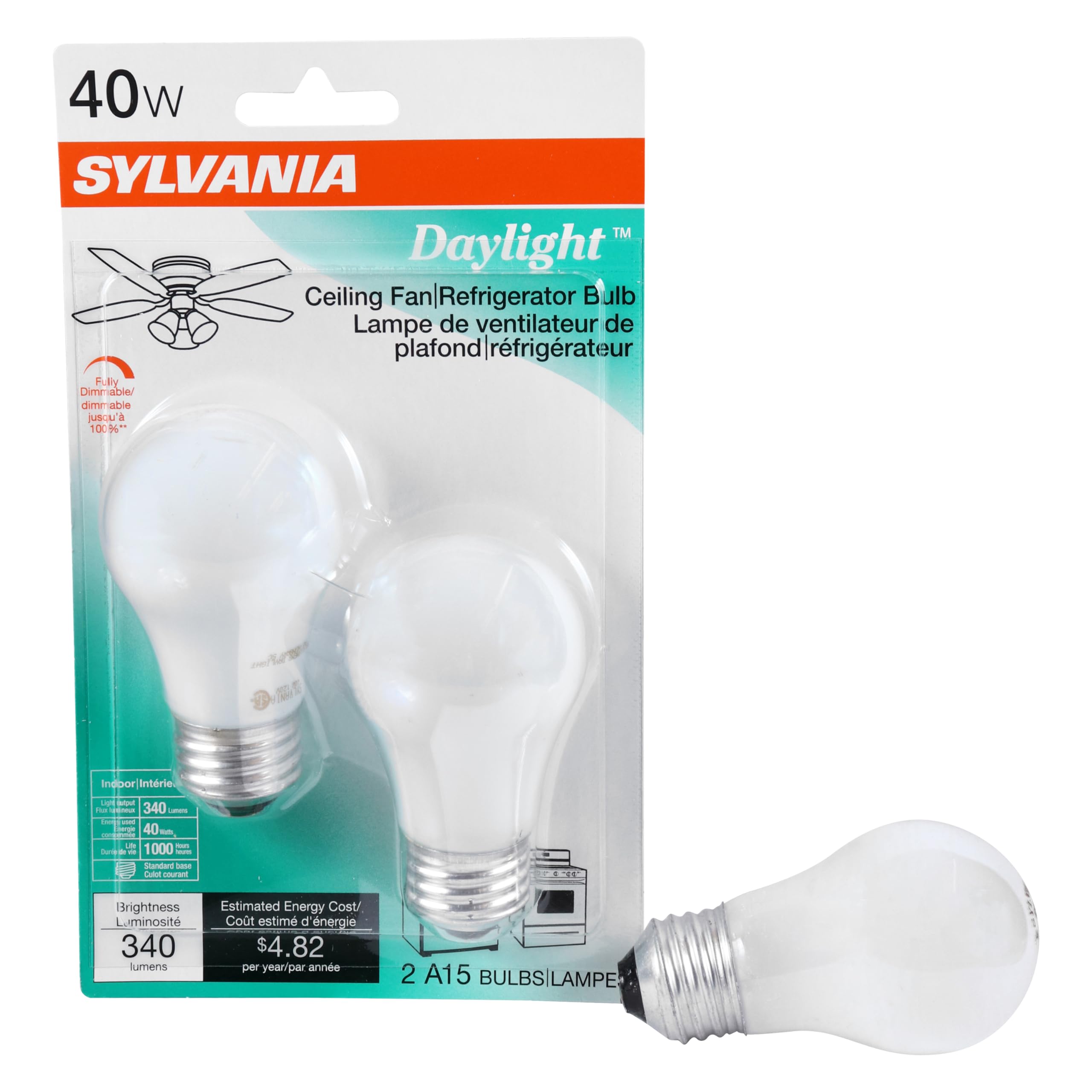
The slim, frosted A15 that belongs in your fridge, not your living room.
Here is the bulb nobody thinks about until the refrigerator goes dark. It is an A15 (a slimmed-down version of the standard A19 shape) with a frosted finish, 40 watts of draw, and 340 lumens of output. That makes it the brightest of the four — 340 lumens versus the 240 lumens the two A19 Edison packs put out. Frosted glass spreads the light evenly and keeps glare off the shelves, so you are not squinting past your own shadow to find the milk.
The 2850 Kelvin color temperature is the most natural-looking on this list, which is why it works so well behind a door: it reads as soft white, not yellow and not blue. Quality is clearly the reason people keep buying it, and the functionality follows. It is what the review pages keep coming back to, and buyers report it “cost me… nice and bright” for the exact job it was built for — swapping a burned-out appliance bulb. The rated life is 1,000 hours, so plan on keeping a spare.
The catch is sizing and lifespan. Only two bulbs ship in the pack, and at 1,000 hours (the rated time before it burns out) it is the shortest-rated bulb here. A fair share of the complaints land on how quickly these can quit — the same pattern you see across small incandescent appliance bulbs. It is also the plainest-looking of the four. That hardly matters, since it stays hidden inside a fridge or cabinet socket.
Where it earns the slot: 340 lumens through frosted glass makes it the right bulb for enclosed, hard-to-see spaces like refrigerators, range hoods, and small cabinets.
The size to check: an A15 is smaller than a standard A19, so it fits shallow appliance sockets that would crowd a full-size bulb.
Buy it for: appliance and enclosed-fixture swaps where natural white light and even coverage matter more than looks.
Not the one for: anyone who wants decorative exposed-bulb charm — this is a behind-the-door workhorse.
3. New Lights A19 Vintage Incandescent Edison Bulbs

The porch-light pick: rated for indoor and outdoor use, and properly golden at 2100 Kelvin.
What stands out first is the shape. This is an A19 with an amber-tinted glass shell and a squirrel-cage filament — the spiral design where the wire wraps around an inner cage so you see the glow from the sides, not just the bottom. It fits a standard E26 base, and it is the only pick on the list sold for both indoor and outdoor use. That makes it the natural candidate for a porch fixture or a lamp beside a drafty window.
Color temperature is 2100 Kelvin, just a touch warmer than the Brightever’s 2200 Kelvin, and output is 240 lumens. It is the second-smallest bulb here at 4.72 inches tall, so it slips into a fixture shade without bumping the frame. What surprises people is the durability: it survives outdoor temperature swings, and owners who had spent years watching other bulbs burn out noticed this one keeping pace.
Be clear-eyed on the brightness question, because it is the loudest recurring note. These are not bright bulbs. A 240-lumen Edison is a glow, not a floodlight — the same reviews that praise the warm, homey amber also flag that it reads dim and very yellow. If you are putting it beside a mirror for grooming, this is the wrong bulb. For a porch light or a lamp you flick on at night to wind down, it is exactly right.
What holds up: a 360-degree beam from the spiral filament plus indoor/outdoor rating makes it the most versatile placement of the four.
The honest limit: 240 lumens in a very warm 2100 Kelvin tone means mood lighting — reserve it for decorative fixtures, not task lighting.
Best for you if: you want golden ambiance that also survives a porch or patio fixture through changing seasons.
Look elsewhere if: you need usable brightness on a desk or near a mirror.
4. runquiz A19 60 Watt Incandescent Light Bulbs

The 2100 Kelvin A19 for a whole-house warm swap, with the largest ownership base of the four.
If you are converting the entire house from LED back to incandescent, start here. This runquiz pack carries the biggest ownership base of the list, and the warmth is what people talk about — that soft yellow candle-like wash you cannot get from a cool-white LED. It runs at 2100 Kelvin with a CRI of 80, so colors stay believable and skin does not turn grey. The bulb is an A19 in amber glass, sized at 4.25 inches tall and 2.36 inches wide, small enough for most shades and sconces.
The brightness spec is 240 lumens at 60 watts of draw, and it is fully dimmable on a compatible switch. Here is the part worth knowing: the small physical size and 360-degree beam are what let it disappear into a fixture and just glow. It arrives packed with extra pearl cotton in the box to cushion the glass, and that care pays off — most boxes show up intact, and the bulbs light the first time.
The catch is lifespan, and it is worth saying plainly for this one. This is a glass filament bulb, and a few of them quit early — some within the first day. That is a risk on any incandescent, but with this many owners and this much warmth, the occasional dud is the price of the glow. Buy a pack and keep one spare, and the color temperature alone makes it worth it.
The case for the runquiz
- 2100 Kelvin amber glow is the warmest, most candle-like of the four.
- A19 shape fits standard shades and sconces without crowding.
- Extra pearl-cotton packing protects the glass in transit.
- Fully dimmable on a compatible switch for bedside control.
Where it asks patience
- 240 lumens is soft, not bright — expect ambiance over illumination.
- A few bulbs fail early despite the vintage claim.
- 60 watts of draw costs more to run than an LED equivalent.
Pick this one when: nostalgia and a warm, eye-friendly glow matter more than raw brightness across several rooms.
skip it if: you need bright, even light for a workspace — this is a wind-down bulb.
Know the Specs
Color temperature in Kelvin
Kelvin measures how warm or cool the light looks, and lower numbers are warmer and more yellow. Incandescent Edison bulbs sit around 2100 to 2200 Kelvin, which reads as a soft, candle-like glow that is easy on the eyes at night. A frosted bulb around 2850 Kelvin reads as crisp soft white — better for seeing clearly inside a fridge or cabinet.
Lumens versus watts
Watts tell you how much power the bulb draws; lumens tell you how bright it actually is. That gap matters with amber glass, because the tint swallows some of the light — a 60-watt Edison can put out as little as 240 lumens. Check the lumen figure, not just the wattage, before you assume a bulb will be bright.
Color rendering index (CRI)
CRI scores how faithfully colors appear under a bulb, on a scale where higher is truer. A score of 80 or above keeps skin tones natural and food looking appetizing, which is why dimmable Edison bulbs with an 80 CRI are popular for dining rooms and living spaces.
Base and shape codes
E26 is the standard medium screw base found on most lamps and fixtures. A19 is the familiar rounded bulb; an ST64 is the tall teardrop you want in an exposed socket; an A15 is the small, slim bulb that fits shallow appliance sockets where bigger shapes will not seat.
Common Questions
Will these bulbs fit my existing lamps and fixtures?
Why is a 60-watt Edison bulb dimmer than a 40-watt bulb?
Can I use these with a dimmer switch?
How long will an incandescent bulb actually last?
Can I put an Edison bulb in a refrigerator?
Are these bulbs safe for outdoor fixtures?
What does color temperature in Kelvin mean for my room?
Do amber Edison bulbs use more electricity than LEDs?
Will dimming an incandescent bulb change its color?
What is the difference between A19 and ST64 bulbs?
The Bottom Line
For most rooms, the incandescent bulbs winner is the Brightever 60W Edison 4-Pack — it pairs a 2200 Kelvin warm white glow (a color temperature scale where lower numbers look warmer and more yellow), a steady filament on a dimmer, and a 2500-hour rating that beats the appliance bulb’s 1,000 hours. Its 260 lumens are for ambiance rather than task light, though the 340-lumen SYLVANIA A15 handles the fridge and cabinet sockets the Edison cannot. And if you want the warmest, most eye-friendly glow spread across several rooms, the runquiz A19 at 2100 Kelvin has the strongest following of the four — grab a pack and a spare, and enjoy the soft yellow light.
How we choose
We do not accept paid placement. Every pick is matched to a real buyer and a real use-case; we do not hands-on test units.
Sources
Specifications: manufacturer listings and product documentation. Review insights: verified customer reviews, as of October 2026. Pricing: not shown on this page (it changes often); check the current price via the retailer link.
As an Amazon Associate, Aappliancez earns from qualifying purchases. This does not affect which products we feature.