Disclosure: Some links in this post are affiliate links. As an Amazon Associate I earn from qualifying purchases, at no extra cost to you. Learn more
Specs are compiled from manufacturer listings and verified buyer reviews and can change over time — please confirm the key details on the product page before buying.
If your speakers sound flat and you are still beaming music over Bluetooth, the fix is cheaper than a new stereo. An audio streamer pulls music from Spotify, TIDAL, Qobuz or your own library over Wi-Fi and hands it to your amplifier or powered speakers at full quality. The trick is picking one that fits the inputs you already own. This guide ranks nine of them by what they genuinely do well, from budget boxes that transform an old receiver to premium units with balanced outputs and room correction.
This guide is built by comparing the manufacturers’ published specifications and the patterns across verified customer reviews, so you get each pick’s real strengths and trade-offs instead of marketing spin.
You will see which units add room correction, which ones handle DSD and hi-res files natively, and where each one falls short before you commit. These picks are the strongest audio streamers for turning an existing hi-fi into a modern streaming system.
Top Picks

How To Choose The Best Audio Streamers
Most buyers get this wrong by shopping for the biggest spec sheet instead of the right fit. A streamer is a bridge between the internet and the gear you already own. If it does not match your amplifier’s inputs or your Wi-Fi, the numbers on the box mean nothing.
Start with the outputs your amplifier accepts
If your amp has its own DAC, a streamer’s coaxial or optical output lets you skip the internal converter entirely. That is the cheapest upgrade path for a serious stereo. If you run powered speakers, you need analog RCA or XLR outputs, because there is no separate amp to convert the signal.
The DAC chip decides the tone, not the brand
The DAC (digital-to-analog converter) turns your files into the analog signal your speakers push out. Chip families have a character — ESS Sabre parts tend toward detail and crispness, while R2R ladder designs lean warm and analog-like. Neither is better; you are matching a flavour to your room and your ears.
Room correction earns its keep in real rooms
Most living rooms are not studios. Room correction measures the boomy or hollow spots and flattens them automatically. On units that include it, an automatic calibration pass can do more for your sound than any chip upgrade — the room itself is usually the biggest problem.
Side-by-Side Comparison
| Model | Best For | DAC Chip | Max Resolution | Key Outputs | Amazon |
|---|---|---|---|---|---|
| WiiM Ultra★ Best Overall | All-in-one hi-fi upgrade | ESS ES9038 Q2M | 24-bit/192 kHz | Phono, HDMI ARC, sub out | Amazon |
| Cambridge Audio MXN 10Purist Pick | Feeding an external DAC | ESS Sabre ES9033Q | — | USB, coax, optical | Amazon |
| AIYIMA A80Best Desktop Hybrid | Desktop amp plus streamer | ESS9038Q2M | DSD256 / PCM hi-res | TRS balanced, optical, coax | Amazon |
| WiiM Pro Plus | AirPlay 2 multiroom on a budget | AKM 4493SEQ | 24-bit/192 kHz | Coax, optical, RCA passthrough | Amazon |
| FiiO K13 R2R | Headphone listening desk | 24-bit R2R ladder | PCM 384kHz / DSD256 | XLR balanced, dual RCA, 4.4mm | Amazon |
| Bluesound Node Nano | BluOS multiroom ecosystem | ESS ES9039Q2M Sabre | 24-bit/192 kHz | RCA, optical, coax, USB | Amazon |
| Eversolo DMP-A6 Gen 2 | Touchscreen library hub | Dual-mono ESS | DSD512 / PCM 768kHz | XLR + RCA simultaneous | Amazon |
| Yamaha R-N800A | Streamer and amp in one | ESS Sabre ES9080Q | DSD 11.2 MHz / 384 kHz | Speaker outs, phono, sub | Amazon |
| Yamaha R-N2000A | Premium two-channel anchor | ESS Sabre ES9026PRO | DSD 11.2 MHz / 384 kHz | Speaker outs, phono, XLR | Amazon |
Detailed Reviews
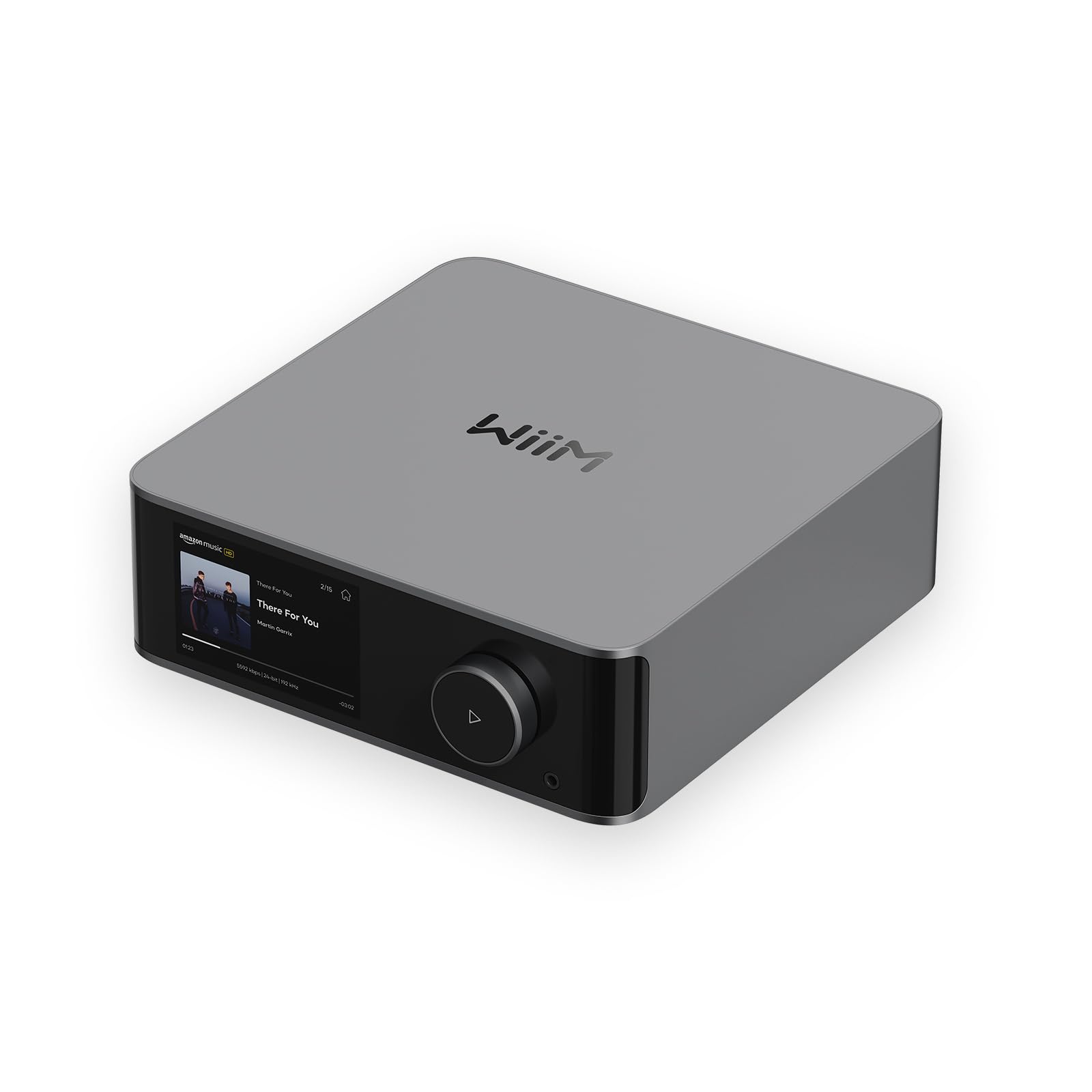
1. WiiM Ultra Hi-Res Music Streamer with Touchscreen & ESS DAC
Our pick — 4.5+★ from 3,500+ verified ratings; the strongest balance of quality and price.
One box that swallows your turntable, TV and streaming into a single chassis and adds room correction your speakers never had.
The crowd favourite of this whole list — 4.5+ stars across 3,700+ ratings — earns its spot because it does everything a mid-range streamer should and then some. At its heart sits an ESS ES9038 Q2M DAC (the converter chip that turns digital files into analog sound), rated for a total harmonic distortion plus noise figure of -116dB and a signal-to-noise ratio of 121dB. In plain terms, the background is silent and detail stays clean, so quiet acoustic passages do not get buried.
Its back panel is where the real value lives. You get phono input for a turntable, HDMI ARC for pulling TV audio straight from your television, a subwoofer output, and a dedicated headphone jack. That means one unit handles your records, your movie nights and your late-night headphone sessions. The 3.5″ touchscreen shows what is playing without you reaching for a phone.
What wins people over is how it adapts to a difficult room. Buyers report: “Initially underwhelmed until Automatic Room Correction (~5 min setup) made night-and-day difference; EQ tweaks gave room-filling sound despite awkward room layout.” That five-minute calibration is the difference between a streamer that sounds fine and one that sounds like it belongs in your room. The catch is AirPlay — this unit is incompatible with it and cannot work as an AirPlay receiver, so iPhone-first households should look at the WiiM Pro Plus below.
Why owners keep it
- Phono input, HDMI ARC and subwoofer out in one chassis, so vinyl, TV and bass management all live in a single box
- ESS ES9038 Q2M DAC with 24-bit/192 kHz streaming and gapless playback
- 3.5″ touchscreen plus remote, app and voice control — four ways to drive it
Where it pulls up short
- No AirPlay support at all, which rules out an Apple-centred home
- The DAC is capable but not the finest — some buyers bypass it with their own converter
The right call for: anyone with a receiver, powered speakers or a turntable who wants streaming, TV audio and room correction from one compact box.
The honest catch: if every device in your house is Apple, skip this and take the WiiM Pro Plus instead.
2. Cambridge Audio MXN 10 Compact Network Audio Streamer
A screenless, knobless digital transport that feeds your own DAC over USB, coax or optical and stays out of the way.
Cambridge Audio built this for the listener who already owns a good DAC or amplifier and just wants a clean digital feed. The StreamMagic Gen 4 module retrieves music quickly, and the ESS Sabre ES9033Q DAC handles the conversion when you want to skip your own gear. Spotify Connect, TIDAL and Qobuz are built in, and Roon Ready support means one consolidated browser for everything in your library.
On sound quality, users are vocal: “Sound quality was a bit bright, I had it connected via coax” is one dissenting view, but the majority describe instruments finding their own space in the soundstage. Wi-Fi proved steady in practice — owners mention “2-3 hiccups in 6 months” and Qobuz FLACs loading “in 1-2 sec under 60 mbit/sec.” That is real-world proof this thing streams hi-res without drama.
The honest trade-off is setup and software. Some find the app smooth and the presets handy; others hit connection bugs and internet radio that refuses to load without a device prompt. There is also no display and no volume control, which is fine if you are feeding an external preamp and frustrating if you are not.
Where the money goes: into the DAC implementation, the analog stage and a two-year warranty — not into a screen or a remote.
What you give up: no Amazon Music support inside the app, and Apple Music only arrives via non-bit-perfect AirPlay.
Reach for this if: you have a dedicated DAC or preamp and want the cleanest possible digital transport with Qobuz and TIDAL built in.
Look elsewhere if: you need a screen, a volume knob or Amazon Music in the native app.
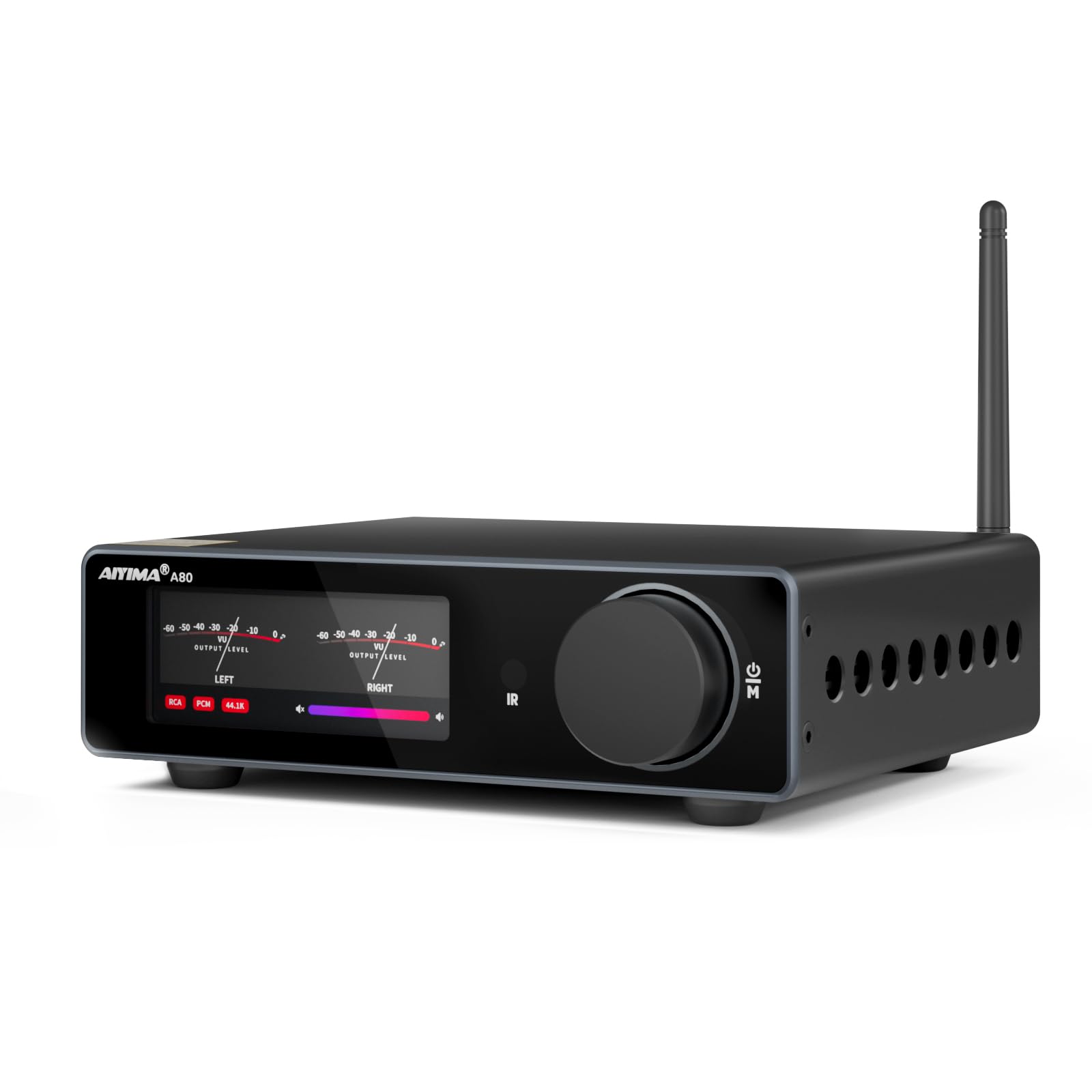
3. AIYIMA A80 Bluetooth Stereo DAC Amplifier
A TPA3255 Class D amplifier, ESS9038Q2M DAC and Bluetooth receiver crammed into a 6.1-inch desktop chassis.
The A80 is the odd one out on this list because it does the amplifying too. A TPA3255 Class D chip (a power-efficient amplifier design that runs cooler than traditional class A/B) delivers a maximum of 300W per channel, while an ESS9038Q2M decoder handles DSD256 and hi-res PCM. Distortion sits at 0.006%, and the SINAD figure of 109dB speaks to a very quiet noise floor.
What people talk about most is the sheer build and the sound. Over seventy owners single out the quality of the unit itself, and it has clearly earned it — a sturdy metal chassis, smooth knobs, and an LCD that shows input, volume and Bluetooth codec. The real gem is the TRS balanced input, a feature most desktop amps skip entirely; it isolates interference and kills speaker hiss. There is also a 12V trigger, a sub pre-out, and tone control on the remote.
Two honest notes. It runs warm after half an hour at average volume, which is normal for class D but worth knowing if it will sit in a closed cabinet. And if you only need RCA input or huge power, the A80 is overkill — a plain streamer into your existing amp gets you there for less.
The standout spec: balanced TRS inputs plus an ESS9038Q2M DAC plus a 300W-per-channel amp, all in one 6.1-inch chassis.
The catch: it warms up with use and the small display needs a nudge of volume before the VU effects read clearly across a room.
Who it beats: anyone building a desk or small-room system from scratch needs no separate amp, DAC or streamer.
Who should pass: owners of a capable amplifier who just want a source — you would be paying for power you already have.
4. WiiM Pro Plus Music Streamer for Stereo Systems
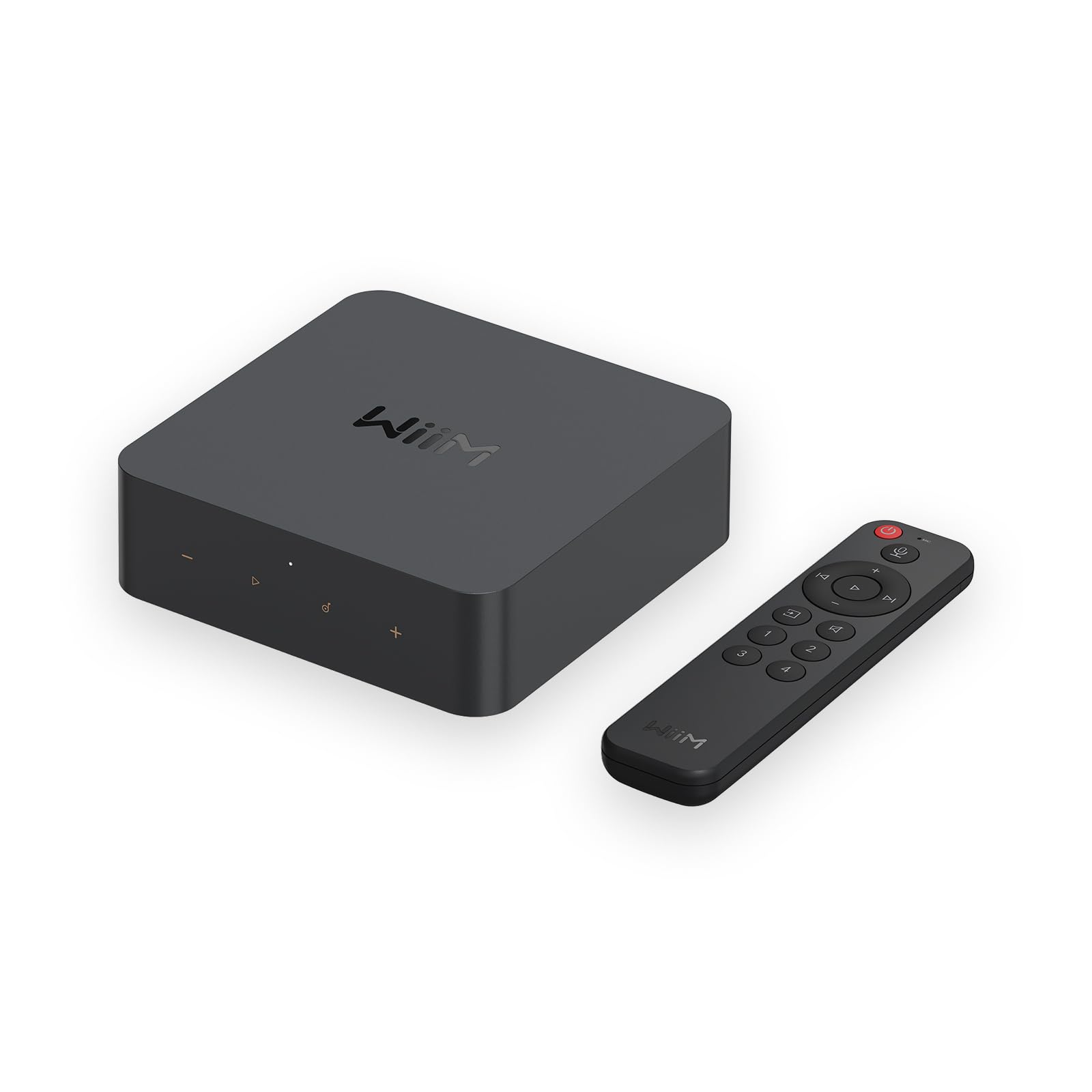
The WiiM sibling that adds AirPlay 2 and Google Cast, so an iPhone or Apple TV can push audio to your old stereo.
Where the WiiM Ultra refuses AirPlay entirely, the Pro Plus turns your old stereo into an AirPlay 2 and Google Cast target. That means TV audio from an Apple TV, podcasts, and anything in a Cast-enabled app can land on your speakers. It streams up to 24-bit/192 kHz on both digital and analog outputs, with bit-perfect output over optical or coax. TIDAL Connect users get its MQA core decoder up to 24-bit/96kHz.
The AKM 4493SEQ DAC inside is genuinely good for the tier — one owner describes it as sounding more three-dimensional than the ESS Sabre chip in the WiiM Amp. The app carries a 10-band equalizer with parametric options and frequent firmware updates. It also runs multiroom groups across AirPlay 2, Google Home and Alexa devices, so you can sync an Echo, a HomePod and several WiiM units together.
Two things to plan around. The shell is plastic and the power port is tight, so handle the cable gently. And local network folder playback is slow and draggy compared to streaming from a service — if your library lives on a NAS, budget time for setting up a media server.
Why it fits Apple homes: AirPlay 2 and Google Cast in one box, with a 10-band EQ the Ultra’s app does not need to share.
What to watch: it is not Roon-certified and shows up as a Squeezebox Lite, which matters if Roon is your library tool.
Best fit: mixed-household setups with iPhones, Apple TVs and Google speakers that all need to reach the same stereo.
Think twice if: your music lives on a network drive and you want snappy browsing.
5. FiiO K13 R2R Desktop DAC & Headphone Amp
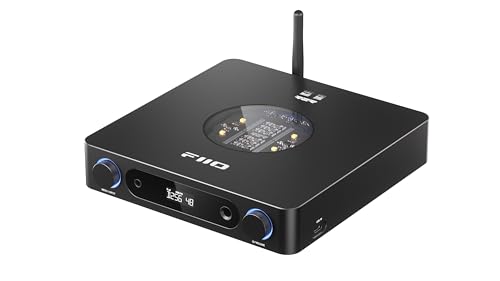
A desktop DAC and headphone amp built on a 24-bit R2R ladder that trades delta-sigma crispness for a warmer, analog-leaning tone.
The headline here is the converter. Inside sits a fully differential 24-bit R2R ladder DAC built from 192 thin-film resistors, each with 0.1% tolerance and 30ppm temperature drift. An R2R design converts digital to analog with a resistor network rather than the usual chip architecture, and the result is a warm, analog-leaning timbre rather than clinical detail. It handles PCM up to 384kHz/32bit and DSD256, with NOS and OS modes so you can keep the original sample rate or upsample to 384kHz.
On the amp side you get 2400mW of output through a 4.4mm balanced jack and a 6.35mm single-ended one, plus XLR balanced and dual RCA line outputs for feeding powered speakers. LDAC over Bluetooth 5.4 keeps wireless listening hi-res. A 10-band parametric EQ with app and web control lets you correct headphone response or share profiles.
The everyday reality is a desk tool, not a living-room streamer — you feed it from a computer, phone or source over USB or Bluetooth and it drives headphones or a small amp. And its signature is deliberately coloured. If you want neutral reference sound, this will not give it to you; it adds character, especially in NOS mode.
The defining number: 192 resistors at 0.1% tolerance is what makes the tone feel analog instead of digital.
The trade-off: setup rewards patience — you will want a few minutes of warm-up and the right gain setting before you judge it.
Suits you if: you listen on headphones at a desk and want a warmer, less fatiguing sound than a delta-sigma chip delivers.
Skip the upgrade if: you need a reference-flat signature or a living-room streamer with app presets and a screen.
6. Bluesound Node Nano Wireless Music Streamer

The cheapest entry into BluOS, Bluesound’s multiroom platform that syncs every player in the house from one app.
Bluesound’s pitch is the ecosystem. The Node Nano runs BluOS, which ties together every Bluesound player in your house into one synced system. A quad-core 1.8GHz ARM Cortex A53 processor and an ESS ES9039Q2M Sabre DAC handle up to 24-bit/192 kHz, with MQA and DSD playback arriving via future update. Stereo RCA, optical, coaxial and USB outputs cover almost any amplifier you own.
Setup is the thing buyers keep mentioning as painless — auto software updates, a clear startup booklet and an app that walks you through. The internal DAC sounds impressive, and AirPlay 2 support gets lossless or hi-res Apple Music onto the system. Two programmable quick-touch presets on the front let you jump straight to a station or playlist, and the tiny footprint means it disappears on a bookshelf.
Connectivity is the honest weak spot. Several buyers hit Bluetooth drops, and the occasional Wi-Fi dropout is fixed by wiring in Ethernet. Use the included USB-C power supply too — a third-party brick restarted playback mid-track for at least one buyer.
What earns the price
- BluOS multiroom, the most polished ecosystem at this tier
- Compact footprint with wall-mounting and two preset buttons
- ESS ES9039Q2M DAC with AirPlay 2 and Qobuz Connect support
What to keep in mind
- Bluetooth dropouts push you toward wired Ethernet
- The printed manual is thin — the LED colour codes live online only
The best reason to buy: you plan to expand to more rooms later and want the software that grows with it.
Where it falls short: if you only stream to one room and need rock-solid Bluetooth, the FiiO or the WiiM Ultra is cheaper.
7. EVERSOLO DMP-A6 Gen 2 Hi-Fi Music Streamer
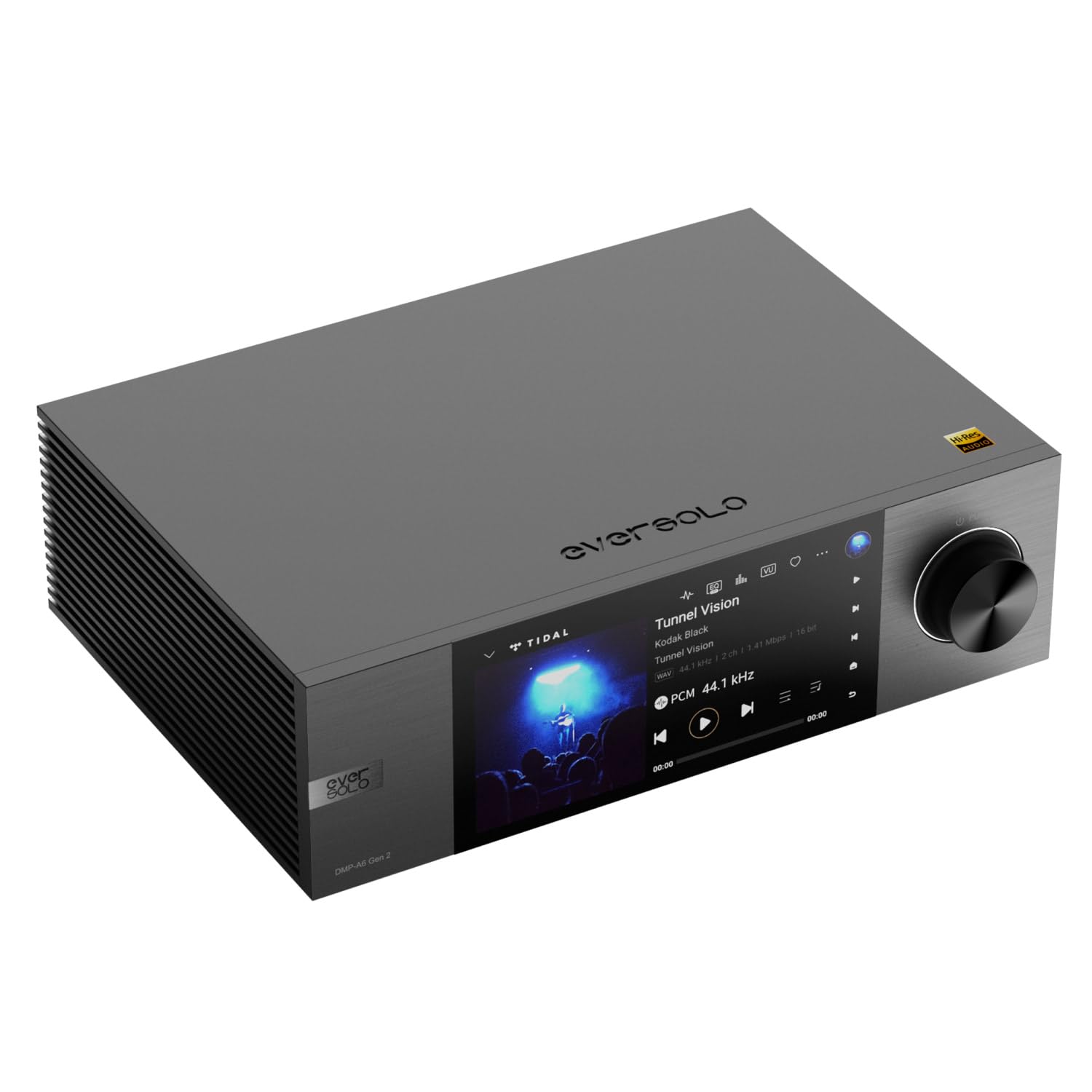
An Android-based streamer with a 6-inch colour touchscreen, native DSD512 decoding and an NVMe bay for local libraries.
If you want a streamer that behaves like a small tablet for your library, this is it. The 6″ colour LCD runs an Android 11 system that has been tailored for music, and a dedicated app covers iOS and Android phones and tablets. DSD512, multichannel DSD, FLAC, WAV, APE and MQA all decode natively. The Gen 2 upgrade adds a linear power supply with a noise floor below 40uV, plus HDMI ARC and a 12V trigger for automatic power-on with a home theatre.
Comparing it to the WiiM Ultra at the top of this list is instructive. The Ultra leads on ARC auto-switching, instant standby and subwoofer bass management. The Eversolo answers back with native DSD, PCM up to 768kHz and DXD, an NVMe drive bay with SMB upload, and true balanced XLR plus RCA outputs running at the same time. If you have no subwoofer, the Eversolo is the bigger step up.
The catch is the user interface and reliability. The UI feels clunky at times, Qobuz queuing can pause playback and the app is grainy under your finger. It is a lot of hardware for the tier, and the occasional unit fails to power on — not a pattern, but real enough to buy with a warranty in mind.
The showpiece: a 6″ touchscreen plus native DSD512 in a chassis that looks premium on a rack.
The blemish: polished software it is not — plan on learning its quirks and skipping the mediocre app queueing.
Choose it for: a large local hi-res library and a setup where you want the streamer to be the star of the rack.
Leave it for later if: a subwoofer and a simple TV-ARC workflow matter more than DSD depth.
8. Yamaha R-N800A Network Receiver with Phono and DAC

A two-channel network receiver with a built-in ESS Sabre DAC, phono stage, MusicCast streaming and YPAO room correction.
The R-N800A is a two-channel network receiver, which means it does the amplifying too. An ESS Sabre ES9080Q Ultra DAC handles conversion, and a USB DAC input decodes DSD 11.2 MHz native and PCM up to 384 kHz. YPAO-R.S.C. room correction measures your room and corrects for reflections. A phono input means your turntable plugs straight in, and MusicCast ties everything into multiroom streaming.
The sound is the reason to buy. It drives a 12-inch sub cleanly, and the app’s physical controls on the front panel earn praise for being genuinely usable rather than afterthoughts. AirPlay outperforms Bluetooth on this unit, and the internal DAC satisfies all but the pickiest listeners.
Plan around two things. The phono stage is thin and most buyers add an external preamp, so budget for that if vinyl is central. And YPAO occasionally muddies the midrange; most keep it off and tune by ear instead.
Why it justifies the chassis: amplifier, DAC, phono stage and streaming in one controlled system, with room correction built in.
The caveat: the phono input is the weakest link and the room correction is a tool to try rather than trust blindly.
Worth it for: a first serious system where you have passive speakers and no amp yet.
Not for you if: you already own a good amplifier and only need a streamer.
9. Yamaha R-N2000A Hi-Fi Network Receiver with Streaming

Forty-eight pounds of brushed aluminium and a toroidal transformer — a receiver you buy for the next twenty years.
This is the end-of-the-road pick. An ESS Sabre ES9026PRO Ultra DAC, a toroidal power transformer for a spacious sound, and USB DAC support for DSD 11.2 MHz native and PCM up to 384 kHz. MusicCast handles streaming services, and a phono input brings the turntable along. Brushed metal, piano-black sides and front VU meters round out the look.
What buyers come back to is the tone — clear and smooth, with rich bass and headroom that does not strain. It delivers an immediate step up over Yamaha’s own AVRs when driving demanding speakers, and MusicCast keeps Amazon Music HD, internet radio and Bluetooth all working without fuss. YPAO room correction here is easy to run and preserves bass at low volume, which matters for late-night listening.
The honest weight of it is literal: at 48.7 pounds it wants a sturdy stand, not a shelf. Bluetooth tops out at 4.2, there is no gapless playback or track scrubbing in the current software, and MusicCast cannot search network shares. Buy this for the amp and the build, not for the app polish.
The anchor spec: a toroidal transformer and a 48.7-pound chassis — that mass is where the power and calm come from.
Where it asks patience: no gapless playback and no scrubbing, which is an old-school trade-off for a modern streamer.
It earns its keep if: you are building a two-channel system to live with for years and want the amplifier, streaming and phono stage finalised in one purchase.
Turn away if: you need gapless albums, network-share browsing, or a small footprint.
Know the Specs
The DAC chip and its resolution
The DAC is the chip that turns your digital music into analog sound. Chips like the ESS Sabre family lean detailed and crisp. R2R ladder designs, built from resistor networks, sound warmer. Resolution figures such as 24-bit/192 kHz or DSD512 describe how much detail the chip can decode, so high-resolution masters come through unaltered instead of being downsampled.
Outputs, inputs and what feeds what
Coaxial and optical outputs pass the digital signal untouched into your own DAC. RCA, XLR and headphone outputs deliver analog sound to speakers or a headphone amp. Balanced XLR uses two signal-carrying legs to cancel interference, so long cable runs stay quiet. Match these to whatever your amplifier or powered speakers accept before anything else.
Common Questions
What is the difference between a streamer and a network receiver?
Can I use a streamer with my old amplifier?
Do I need an external DAC if the streamer has one built in?
Which audio streamers support AirPlay 2?
Will hi-res streaming work over Wi-Fi or do I need Ethernet?
What does Roon Ready mean and do I need it?
Is room correction worth having in a streamer?
Can a streamer play files from a USB drive or NAS?
How much power do I need from a network receiver?
Do streamers support Spotify, TIDAL and Qobuz at the same time?
The Bottom Line
For most people, the audio streamers winner is the WiiM Ultra because it packs a phono input, HDMI ARC, subwoofer out and room correction into one compact box. If you are an Apple household, grab the WiiM Pro Plus for its AirPlay 2 support. And if you are building a two-channel system to last, the Yamaha R-N2000A is the anchor that makes every other component optional.
How we choose
We do not accept paid placement. Every pick is matched to a real buyer and a real use-case; we do not hands-on test units.
Sources
Specifications: manufacturer listings and product documentation. Review insights: verified customer reviews, as of October 2026. Pricing: not shown on this page (it changes often); check the current price via the retailer link.
As an Amazon Associate, Aappliancez earns from qualifying purchases. This does not affect which products we feature.