Disclosure: Some links in this post are affiliate links. As an Amazon Associate I earn from qualifying purchases, at no extra cost to you. Learn more
Specs are compiled from manufacturer listings and verified buyer reviews and can change over time — please confirm the key details on the product page before buying.
If you want the shortest possible answer, it is this: the DEWALT DW735X is the planer most buyers should start with, because it holds a 4.5+ star rating across 7,000+ owners and handles wide boards with a 15-amp motor. Everything below explains who should step up, who should save, and which machine actually fits your bench. A wood planer is a machine that mills rough or twisted lumber flat and to an even thickness, and the wrong one turns a pleasant afternoon into an argument with a board.
This guide is built by comparing the manufacturers’ published specifications and the patterns across verified customer reviews, so you get each pick’s real strengths and trade-offs instead of marketing spin.
The real difference between these machines is not the badge on the side — it is cutterhead type, board width, and how much snipe (the dip at each end of a board) you are willing to fight. Here is how to read the specs before you commit to any of these best wood planers.
Top Picks

How To Choose The Best Wood Planers
Start with the board you actually own, not the machine you secretly want. Most hobbyists never feed anything wider than a glued-up panel, so the width number on the box matters less than how often you plane twisted hardwood with deep knots.
Cutterhead: three knives versus spiral inserts
A three-knife cutterhead (three long blades bolted across a rotating drum) is the traditional setup and it can leave a very smooth face, especially on the slower feed setting. The trade-off is noise and knife cost — long knives take the full hit of a nail or grit and can dull in a single afternoon of dirty lumber.
A spiral cutterhead uses many small square inserts (tungsten carbide is typical) staggered across the drum. When one edge dulls, you rotate it a quarter turn instead of replacing a whole blade, and the slicing angle tends to leave less tear-out on figured grain. The catch is insert count and access: some drums carry dozens of inserts held by hex bolts, so a full rotation is an afternoon job, not a coffee break.
Cuts per inch and feed speed
Cuts per inch (CPI) counts how many knife marks land in every inch of board as it passes. A slower feed raises that count and leaves a smoother face with less sanding. A faster feed moves lumber through quickly when you only need rough thicknessing before final passes.
Two-speed gearboxes let you pick the trade-off, and that is why they matter more on premium machines. If you mill rough sawn stock for a living, the faster feed saves hours. If you build furniture from hardwood, the slow setting saves your sandpaper.
Snipe, tables, and bench stability
Snipe is the dip cut at the leading and trailing end of a board, where the board is supported only by one roller. A carriage lock, a four-post design, and long infeed and outfeed tables all fight it. On a short bench-top unit, long boards still need support beyond the tables — that is on your shop, not the machine.
Dust and power reality
Planers move a lot of chips fast. A dedicated 4-inch dust port feeding a real collector is a different experience from a shop vac hanging off an adapter. And check your circuit: a 15-amp motor on a long run can nuisance-trip a breaker, especially under heavy hogging cuts on hardwood.
Side-by-Side Comparison
| Model | Best For | Cutting Width | Amperage | Cutterhead | Amazon |
|---|---|---|---|---|---|
| DEWALT DW735X★ Best Overall | Wide boards and heavy hobby use | 13 inches | 15 A | Three knife, two speed | Amazon |
| Cutech 40700HQuiet Spiral Cut | Quiet spiral finish for beginners | 12.5 inches | — | Spiral, tungsten carbide inserts | Amazon |
| Makita KP0800KEdge Specialist | Handheld edge and door fitting | 3-1/4 inches | 6.5 A | Two blade, 17,000 RPM | Amazon |
| WEN PL1252 | Occasional boards on a budget | 12.5 inches | 15 A | Two blade | Amazon |
| DEWALT DW734 | Long-term benchtop reliability | 12.5 inches | 15 A | Three knife, 96 CPI | Amazon |
| Wahuda Tools 13″ | Two-speed spiral on a mid budget | 13 inches | 15 A | Spiral, 4-sided carbide | Amazon |
| JET JWP-13BT | Helical style cut in a small shop | 13 inches | 15 A | Helical-style, 26 inserts | Amazon |
| Makita 2012NB | Quiet jobsite and commercial work | 11.86 inches | — | Disposable double-edge blades | Amazon |
| WEN PL1303 | Cheapest route to 13-inch width | 13 inches | 15 A | Three reversible SK5 blades | Amazon |
Detailed Reviews
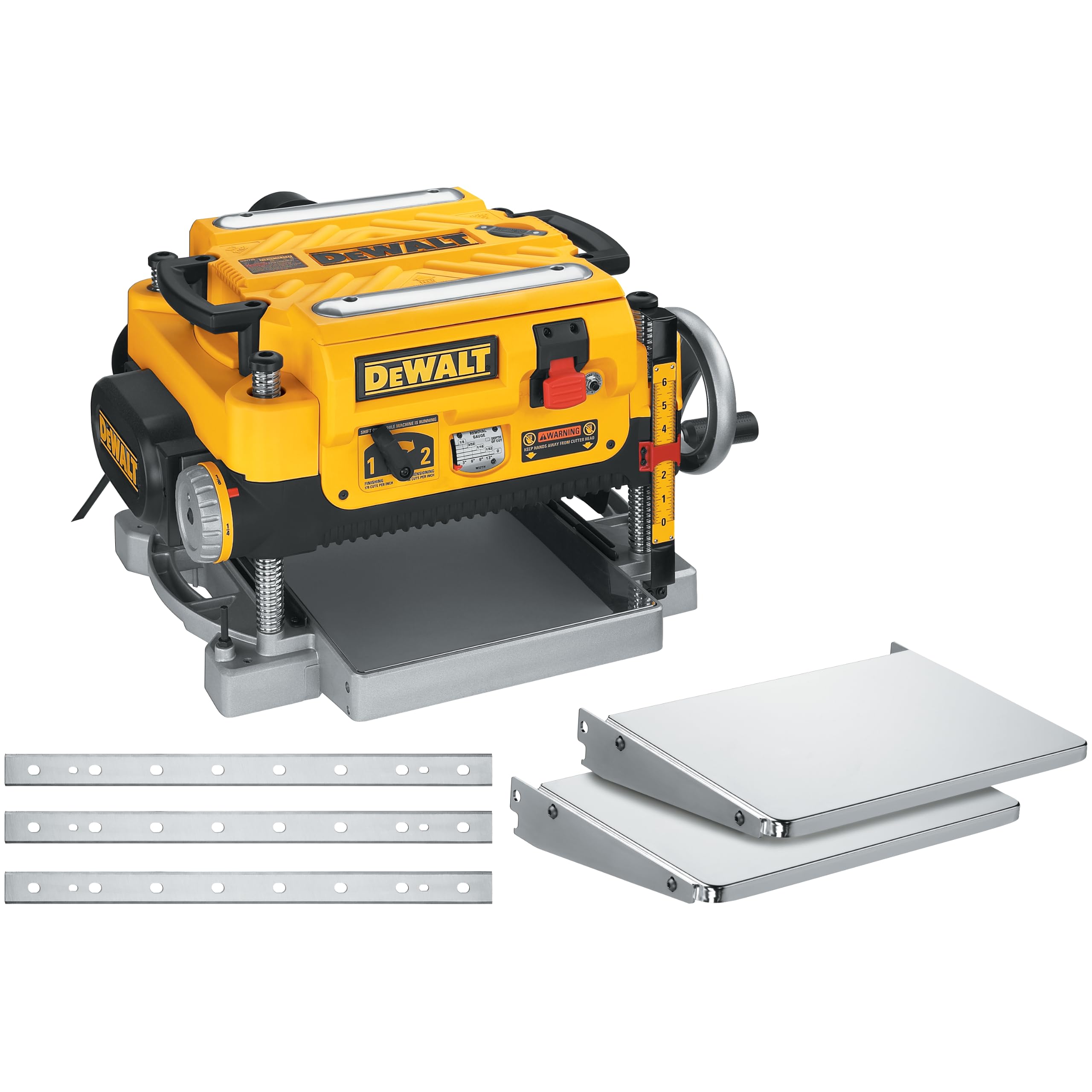
1. DEWALT Thickness Planer (DW735X)
Our pick — 4.5+★ from 7,500+ verified ratings; the strongest balance of quality and price.
Thirteen inches of cutting width and two feed speeds in a machine that eats rough sawn ash without flinching.
You get a 15-amp motor spinning the cutterhead at 10,000 rpm, and that head carries three knives. In plain terms, that is a drum with three long blades that shaves a wide board in one pass instead of several narrow ones. For anyone with a stack of rough lumber in the garage, this is the machine that turns it into usable stock.
The two-speed gearbox is the part that quietly earns the price. At the slower setting you get 96 cuts per inch, and buyers report cherry planed at 1/16 inch per pass came off the machine with a finish close to 100-grit sanding. Flip to 179 CPI when you only need thickness and want to move faster. That flexibility is why it holds 4.5+ stars from a huge owner base, and why the quality of the cut is the thing people talk about most.
A 19-3/4 inch cast aluminum base and an automatic carriage lock handle the snipe question — the lock squeezes the carriage so the head cannot drift as the board enters and leaves. The included infeed and outfeed tables and an extra knife set mean you are not buying accessories on day one. What you should know going in: this is a roughly 100-pound machine, and the chip blower throws debris hard enough that you want a hose and a bucket rather than a shop vac. Budget the shop space and the noise honestly.
What earns its keep
- 13-inch cutting width planes a full glued-up panel in one pass
- Two speeds let you choose 96 CPI finish or 179 CPI speed
- Automatic carriage lock fights the snipe that plagues short benches
- Fan-assisted chip ejection clears the head without a shop vac fight
- Infeed and outfeed tables plus a spare knife set in the box
The honest costs
- Roughly 100 pounds — plan a permanent home for it, not a shelf
- Loud enough that hearing protection is not optional
- The blower needs a real chip collector, not a small vacuum
- Replacement knives add up if you feed dirty lumber
Reach for this if: you have rough sawn boards wider than a foot and want a finished face in a couple of passes.
Think twice if: your bench is tiny or you cannot tolerate a genuinely loud machine.
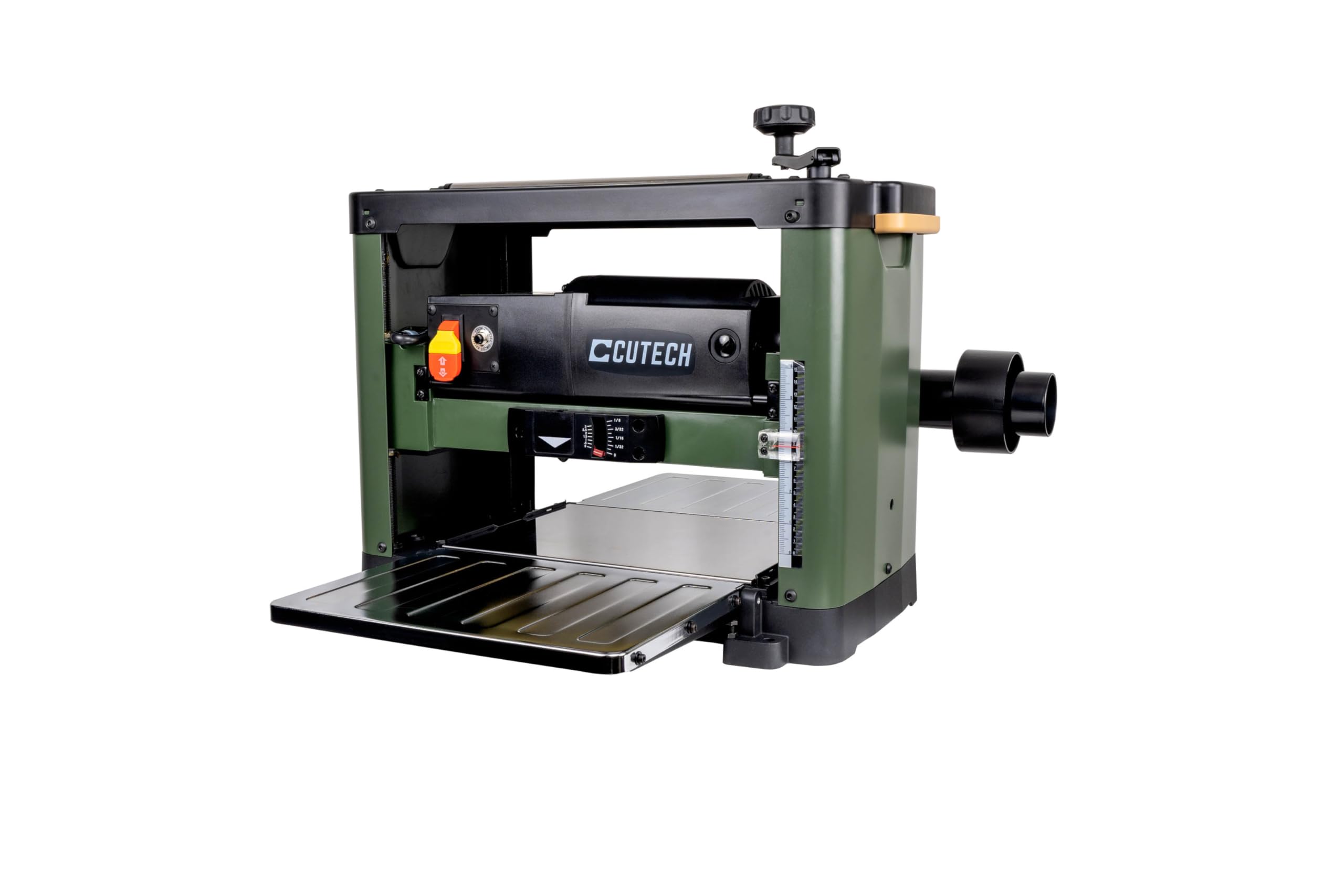
2. Cutech 40700H 12½-Inch Spiral Cutterhead Benchtop Planer
A spiral drum with staggered inserts, built for the woodworker who cannot stand the noise.
Beginners tend to think a planer is a planer, and the cutterhead is the one spec that disproves it. Here the drum carries six rows of staggered two-sided tungsten carbide inserts. Each insert has a non-cutting edge that keeps it from skewing while it works, and the design is what lets this machine take a lighter bite out of the motor than a knife-head unit of the same width.
The quiet, low-drama cut is what the buyers here celebrate. Owners coming from an older 12-inch Delta say it runs dramatically calmer, and one had pine, cedar and oak planed within five minutes of unboxing. The board return rollers on top are a genuinely smart touch — send a board back to the front for the next light pass without walking around the machine.
What to weigh: the snipe minimizer relies on the company’s four lead screws and coupling design, and it works, but it is not the same as a carriage lock on a heavier machine. And this is a newer model with a small owner base behind it, so long-term wear is an open question rather than a proven record. For a small shop that shares walls with a living space, the spiral head is the reason to pick it.
Where the value sits: six rows of inserts plus a depth-of-cut scale on the front means you know exactly how much you are taking before you push the board in.
The fair caveat: a newer name with a short track record, so treat it as a considered bet on the spiral design rather than a proven workhorse.
This one suits: the garage woodworker who needs quieter passes and hates sanding.
Second-guess it if: you want a decade of owner history before you commit bench space.
3. Makita KP0800K 3-1/4″ Planer with Tool Case
A handheld planer that trims a door edge in one pass — not a thickness planer, and that is the point.
This one is a different animal, and buyers get burned by that mismatch all the time. Its cutting width is 3-1/4 inches, against the 13 inches on the DEWALT above, and its 6.5-amp motor is sized for a hand tool rather than a bench machine. What it does is shave a door, level a joist, or take a live edge down before sanding — with the tool in your hands, moving along the board.
The two-blade cutterhead runs at 17,000 rpm, which is why owners describe an excellent surface after just a cleaning pass. A spring-loaded stand lifts the base when you set the tool down, keeping the blades off the bench and the workpiece undamaged. Owners who fit doors and level deck joists lean on it for exactly this reason, and it arrives ready to work.
Two things to plan for. It does not ship with a dust bag or the adapter, so you will order those separately. And the fence and blade alignment take some trial and error — even with the setting jig, expect to spend an evening chasing parallel edges. If you feed rough lumber, use it to break the surface and let a thickness planer do the rest. Treat it as the finishing edge tool, and it stays a favorite.
The honest pitch: a 3-1/4 inch cut at 17,000 rpm means a door trim in one or two passes, in the air, without wrestling a board onto a bench.
The honest catch: blade alignment is fiddly, and it is not meant to dress rough sawn stock.
Pick it if: you fit doors, trim jambs, or level framing and want the work done in place.
Choose elsewhere if: you need to flatten boards to a consistent thickness.
4. WEN PL1252 15-Amp 12.5-Inch Two-Blade Benchtop Planer

Six inches of thickness capacity and a cast iron base, aimed at the woodworker who planes on weekends.
For occasional work, the numbers here add up quickly. A 15-amp motor drives a two-blade head at 20,000 cuts per minute with a 26 feet per minute feed rate, and the depth dial moves from 0 to 1/8 inch per pass. That is enough to take a warped cedar board and true it up, then dress reclaimed lumber without a second machine.
Owners describe it as fast and smooth, with lumber feeding easily and a finish that needs very little cleanup. One buyer built six end-grain cutting boards in under an hour with slow quarter-turn passes and a 45-degree back-edge bevel to avoid chip-out. Setup is quick — most owners are planing within half an hour of unboxing. The cast iron base is what keeps it planted under a heavy pass.
The trade-off is durability of the consumables. The two-blade head does fine on softwoods, but the knives are the weak link on dirty or hard stock, and this machine wants light, patient passes rather than hogging cuts all day. It is a weekend tool for a weekend shop — not a production machine. Weigh that against what you save, and it is a sensible entry.
Why it earns the bench: 12.5 inches of width and 6 inches of thickness capacity cover most furniture and trim work.
What you trade: blades that want respectful passes and softer lumber to stay sharp.
Built for: the home woodworker who planes a few boards a month and wants them flat.
Not the tool for: a production shop running hard maple all week.
5. DEWALT Benchtop Planer DW734, 15-Amp, 12-1/2-Inch
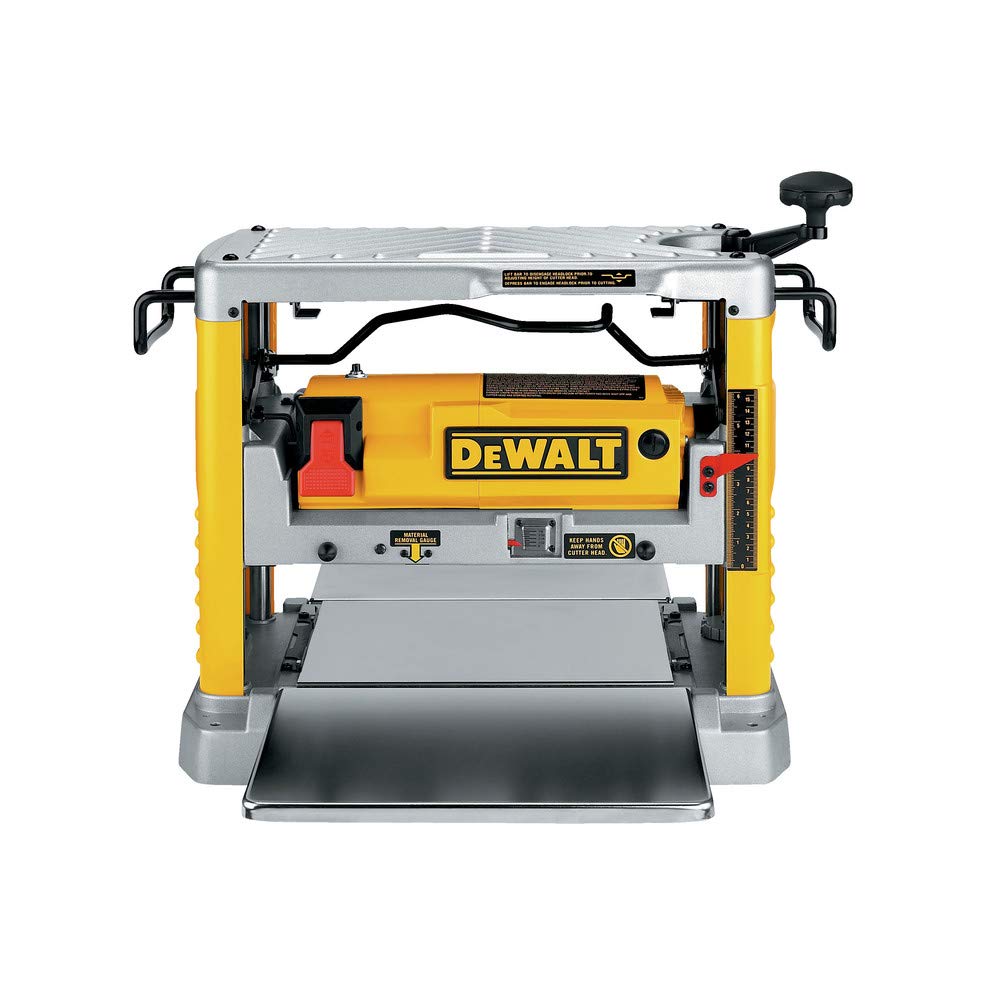
The long-haul benchtop — owners mention nearly two decades of service from this three-knife design.
If longevity is your deciding number, look at what this machine does with a 15-amp motor and a three-knife head at 10,000 rpm cutterhead speed. That yields 96 cuts per inch, which is one of the finer finishes a portable planer delivers. The reversible disposable knives are rated for 30 percent more life than the prior design, and swapping them takes minutes.
The four-column carriage lock is the quiet hero. It clamps the head so it cannot shift, and that is what keeps snipe off the ends of your board. The extra-long infeed and outfeed tables give 33-1/2 inches of support, so a long board has somewhere to rest. A material removal gauge and an oversized thickness scale help you dial in a pass without guessing.
What lets it down is the same thing that lets every heavy machine down: it is a fixed shop tool. At around 90 pounds it takes two people to lift onto a bench, and the screw-on dust port blocks the outfeed table when folded. Owners also flag that it can struggle in hard maple if the knives are tired. Set it on a solid stand and this machine will outlast several of your projects.
Why owners keep it for years
- 96 cuts per inch gives a finish that needs only light sanding
- Four-column carriage lock cuts sniping at board ends
- 33-1/2 inches of table support for longer stock
- Three-year limited warranty covers defects in materials and workmanship
Plan around this
- Roughly 90 pounds — it lives where you put it
- The dust port blocks the outfeed table when folded
- Hard maple asks for sharp knives and patience
The right call for: the woodworker who wants one machine to last a decade or more.
Look past it if: you want a quiet, portable planer you can move to a jobsite.
6. Wahuda Tools 13″ Spiral Cutterhead Planer

Thirteen inches wide, two feed speeds, and four-sided carbide inserts you rotate instead of replace.
You pick a finish here rather than accept one. The feed runs at 26 fpm for quick thicknessing or 18 fpm for a smooth surface on figured stock with minimal to no tear-out — a slow-feed setting aimed squarely at grain that wants to lift. The spiral cutterhead carries 4-sided carbide inserts, and when an edge goes dull you rotate it rather than buying a new set of knives.
The table setup is where the value shows up for furniture builds. The extensions adjust to sit coplanar (level with the main bed), and with the pull-out extensions deployed you get 45 inches of total support for long stock. An 8-position preset depth stop returns you to the thicknesses you use often, and the whole machine weighs 77 pounds, so it is movable if you shop out of a shared space.
An honest limit: the infeed and outfeed trays flex a little when the rollers are fully extended, which is typical of benchtop units at this size. A 15-amp motor over a 13-inch by 6-inch capacity at 1/8 inch maximum depth per pass is the working envelope. The included 4-inch to 2-1/2 inch dust port adapter saves you a scavenger hunt. A strong middle path if you want spiral cutting without the top-tier brand premium.
The standout line: a 13-inch width with a slower 18 fpm setting for figured grain is the kind of flexibility a knife-head machine at this level cannot offer.
Worth knowing: fully extended tables flex slightly — the usual benchtop compromise at this weight.
Best matched to: mid-budget woodworkers who want spiral cutting and a slow feed for tricky grain.
Skip the upgrade if: you keep your boards under a foot wide and only need rough thicknessing.
7. JET 13-Inch Benchtop Thickness Planer (JWP-13BT)

Twenty-six quick-change inserts across six rows, driven by 2 HP in a folding-table body.
Count the cutting edges and the appeal is obvious. This helical-style head holds 26 individual high-speed steel inserts in six rows, and each one swaps on its own without pulling the drum. The 2-HP, 15-amp motor turns that head at 10,000 rpm and takes a 13-inch wide, 6-inch deep board at up to 1/8 inch per pass. A precision-machined cast iron bed and four-post design hold the board flat and steady as it feeds.
Where it shines is grain that usually fights a straight knife. Ash, oak, and maple come off with less chipping than a straight-blade head produces, and the folding infeed and outfeed tables level to the bed and collapse out of the way when the shop gets small. Owners who replaced problem-feed machines with this one describe a solid, space-friendly planer and an impressively clean surface.
The reason to slow down is the knives and the power. The steel inserts dull on hard stock, and a full set plus the hour or two of bolt work to swap them is a real cost. Under heavy cuts, some units draw enough current to trip a 15-amp breaker, so a 20-amp circuit is the safe move. This is a fine pick if the helical-style cut is what you want — just go in with a sharp plan for the inserts.
The case that lands
- 26 quick-change inserts in 6 rows deliver a quieter, cleaner cut than a 3-knife head
- 2-HP, 15-amp motor at 10,000 rpm handles a 13-inch by 6-inch board
- Folding tables save bench space between projects
- Four-post construction and a cast iron bed resist snipe
The real friction
- Steel inserts dull on hardwood and a full swap is a multi-hour chore
- Heavy cuts can nuisance-trip a 15-amp breaker — a 20-amp circuit is safer
- Higher entry cost for the helical-style cut
Choose this for: the compact-shop woodworker who wants insert-to-insert maintenance instead of knife changes.
Reconsider if: you are not set up for a 20-amp circuit or a spare set of inserts.
8. Makita 2012NB 12″ Portable Planer

Twelve inches of width at 83 dB — the planning machine that lets you talk over it.
Noise is the hidden tax on planers, and this machine rates 83 dB, which is the quietest in its class by the maker’s own measure. The build backs that up with a four-post design and diagonal cross supports for stability, plus large table extensions so a long board has real support. It is compact and light enough to carry to a jobsite, which is not something you say about most benchtop planers.
The blade story is the practical hook: it runs disposable double-edge blades on the fastest and easiest blade change system in its class, according to Makita. Owners call it solidly built and ready to work from the start, with glassy surfaces on softwoods and minimal snipe.
One honest limit is worth flagging: a two-blade head leaves more tear-out on highly figured wood than a spiral drum does, so figured stock may want lighter passes. The dust port is sold separately, and it expects a dust collector rather than a shop vac connection. If you need one planer that travels with you and does not scream, this is the machine for it.
The number to note: 83 dB puts it in a much quieter class than most three-blade bench machines, which matters on a shared or residential jobsite.
The honest limit: a straight two-blade head can tear figured grain — treat that as a fit note, not a fault.
The ideal owner: a remodeler who carries a planer site to site and needs quiet operation.
Not for you if: your work is exotic figured hardwood that wants a spiral head.
9. WEN PL1303 13-Inch Benchtop Thickness Planer

Thirteen inches of cutting width for a fraction of the big-bench money.
Here is the value math in one line: a 15-amp motor that spins the head to 30,000 cuts per minute, a feed rate of 26 feet per minute, and three reversible 13-inch SK5 blades. That is the same cutting width as the top pick in the DEWALT above, on a single-speed machine, with a cast iron base for stability under a heavy pass. For a buyer who wants size without the spend, this is the obvious place to look.
The finish is the thing that surprises people. Three blades leave a smoother surface than a two-blade head of the same width, and the solid cast iron base means the machine does not walk under a load. Boards up to 6 inches thick and 13 inches wide fit, with up to 1/8 inch of cut per pass. Owners describe good value for the money with a lively, capable handheld feel to the feed.
The honest caveat is the detail parts. The hard plastic feed thickness gauge is the weak point: one owner’s broke within weeks and a phone call got a free replacement. The three blades are sharp from the start, and the setup stays simple for a first-timer, but do not expect a production-grade build. That is the cost of entry, and it is a fair swap if you plane occasionally.
The value read: 13-inch width, a 15-amp motor, and three blades put a lot of capability on the bench for the entry-level tier.
The real-world headline: a fragile feed gauge and a single-speed head are the compromises to accept.
The plan-A choice: the first-time buyer who wants full width and a decent finish without stretching the budget.
Step up if: you plan to run hard stock often and want a more durable detail package.
Know the Specs
Cutting width and capacity
Cutting width is the widest board the machine will accept, measured across the bed. A 13-inch machine planes a glued-up panel in one pass, while a narrower head forces you to run the board in sections and join them. Maximum depth of cut is a separate number — the most material the head will remove in a single pass, often 1/8 inch — and it sets how many passes your rough board needs. Thickness capacity is the other half: how thick a board can pass under the head at all.
Spiral inserts versus straight knives
A straight-knife head has two or three long blades spanning the full drum. It can leave a very clean face, and it is simple to set. A spiral or helical head carries many small inserts set at an angle. When one edge dulls, you rotate it a quarter turn and keep planing. The spiral cut tends to be quieter and gentler on figured grain, but a full set of inserts plus the bolt work takes real time to rotate. Choose by your lumber, not by the brochure.
Cuts per inch and feed speed
Cuts per inch counts how many knife marks land in each inch of board, and it rises as feed slows. A two-speed machine lets you drop to a slow feed for a smoother face, or speed up when you only need thickness. On a single-speed machine, the cut count is fixed, so you trade finish against time in a way you cannot adjust. For furniture work, the slower setting nearly always wins.
Snipe and table support
Snipe is the shallow dip cut at the ends of a board, where only one roller holds the stock. A carriage lock, a four-post frame, and long infeed and outfeed tables are the standard defenses. Even a well-set machine can snipe on a long unsupported board, so build support for the far end. Matching the tables level with the bed is the first adjustment to make on any bench-top planer.
Common Questions
What is the difference between a thickness planer and a handheld planer?
Will a spiral cutterhead really reduce snipe?
How thick a board will a benchtop planer take?
Do I need a dust collector with a planer?
Can I plane end-grain cutting boards on a benchtop planer?
Will a 15-amp planer trip a standard breaker?
How long do planer knives or inserts last?
Is a cast iron base better than an aluminum base?
Can a planer flatten a warped or twisted board?
What is the difference between 96 and 179 cuts per inch?
The Bottom Line
The wood planer that suits most buyers here is the DEWALT DW735X, because 13 inches of width, a two-speed gearbox, and an automatic carriage lock are the three things that decide how a board comes off the bed. If quiet and spiral inserts matter more than raw width, the Cutech 40700H is the one to reach for. And for the woodworker who wants a proven long-haul benchtop with a fine 96 cuts per inch, the DEWALT DW734 is the pick. Whichever you choose, match the cutterhead to your lumber and your breaker to your motor — that is what keeps a planer useful for years.
How we choose
We do not accept paid placement. Every pick is matched to a real buyer and a real use-case; we do not hands-on test units.
Sources
Specifications: manufacturer listings and product documentation. Review insights: verified customer reviews, as of October 2026. Pricing: not shown on this page (it changes often); check the current price via the retailer link.
As an Amazon Associate, Aappliancez earns from qualifying purchases. This does not affect which products we feature.