Disclosure: Some links in this post are affiliate links. As an Amazon Associate I earn from qualifying purchases, at no extra cost to you. Learn more
Specs are compiled from manufacturer listings and verified buyer reviews and can change over time — please confirm the key details on the product page before buying.
You want a model that takes paint cleanly, not one that fights you at the sanding block. That is the whole game with filament for painting. The right spool lays down a matte, faintly chalky surface that hides layer lines and gives primer a tooth to grip. The wrong one clogs, strings, or shines so hard that paint beads right off. Below are five spools that prop makers and cosplay builders actually reach for, matched to what each one does best.
This guide is built by comparing the manufacturers’ published specifications and the patterns across verified customer reviews, so you get each pick’s real strengths and trade-offs instead of marketing spin.
When a print is headed for primer and a brush, surface finish matters more than rated print speed. Weigh nozzle range, surface texture, and sanding behavior before you commit to a spool, because the right filament for painting saves you hours of rework later.
Top Picks

How To Choose The Best Filament for Painting
Paint does not bond to plastic the way it bonds to wood. It needs a surface with a little tooth — a faint roughness that gives primer something to grip. Glossy filament is smooth and slightly slick, so primer pools and lifts. Matte filament has a dull, chalky skin that holds a coat far more evenly. That single property is the hinge this whole category swings on.
Surface finish beats headline speed
A spool rated for very high print speed is only useful if the finished surface still sands flat. Fast extrusion can leave ridges and inconsistent layers that show up the moment you spray primer. Look for a matte or low-gloss description, then confirm the manufacturer lists a nozzle temperature window you can actually tune to. A matte surface that hides layer lines saves real sanding time.
Nozzle and bed temperatures you can dial in
Nozzle temperature (how hot the hot-end melts the plastic) and bed temperature (how warm the build plate stays) both shape layer adhesion. Spools with a wide, forgiving window — say 190–260°C — are easier to dial to a smooth finish. A spool that only prints well in a narrow range can leave weak layers that crumble when you sand them.
Dimensional accuracy for clean edges
Accuracy tolerance (±0.02mm, ±0.03mm, ±0.05mm) describes how consistent the filament’s 1.75mm diameter stays across the spool. Tighter tolerance means the extruder feeds a steady bead, so your prop edges stay sharp and your sanding lines stay straight. Loose tolerance can cause uneven walls that are harder to finish cleanly.
Side-by-Side Comparison
| Model | Best For | Material | Accuracy | Max Speed | Amazon |
|---|---|---|---|---|---|
| SUNLU High Speed Matte PLA 1.75mm, Olive Green★ Best Overall | Matte surface that hides layer lines | PLA | ±0.02mm | 600mm/s | Amazon |
| Official Creality Hyper ABS 1.75mmBest for Heat | Heat-resistant functional parts | ABS | ±0.05mm | 350mm/s | Amazon |
| FLASHFORGE ABS Pro 1.75mm, Black | Low-warp ABS for large prints | ABS | ±0.02mm | — | Amazon |
| Polymaker CosPLA 1.75mm, Version A | Helmets, masks, sanded props | PLA | — | 300mm/s | Amazon |
| ZIRO Fast Color Change Matte PLA, Paint Splash | Multicolor display pieces | PLA | ±0.03mm | 70mm/s | Amazon |
Detailed Reviews
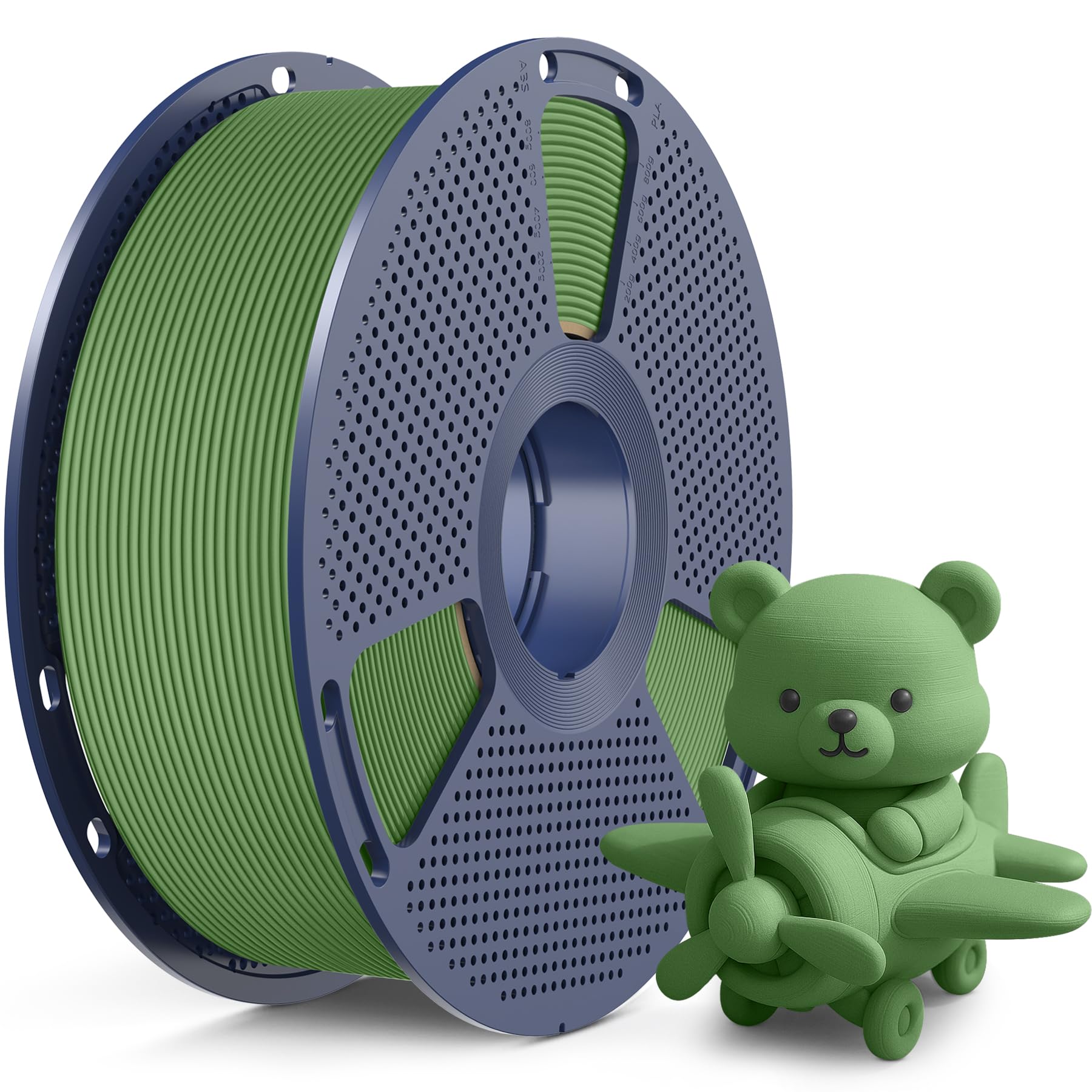
1. SUNLU High Speed Matte PLA 1.75mm 1KG
Our pick — 4.5+★ from 400+ verified ratings; the strongest balance of quality and price.
The matte spool that erases layer lines before your brush ever touches it.
For prop work headed to primer, the finish is the product. SUNLU’s matte PLA lays down a dull, faintly chalky skin that swallows layer lines rather than highlighting them — the buyer consensus is that this is the thing everyone raves about, and it is exactly why the surface takes paint so evenly. It prints fast, too: up to 600mm/s with a nozzle window of 190–260°C and a bed of 50–60°C, so you can produce a large helmet shell in a fraction of the time a slow spool demands.
The diameter sits at 1.75mm with ±0.02mm tolerance, which keeps the extruded bead steady so your prop edges stay clean and your sanding passes stay true. Buyers put it to work on Bambu machines with the stock PLA Matte profile and no tuning at all — clean detail, strong bridging, and overhangs handled on long prints. One reviewer reports: “Prints at 600mm/s with 26–28 mm³/s flow, no under-extrusion or clicking.” That flow rate means you are not trading speed for a rough surface.
The catch sits in durability. Paint hides a lot, but if your prop needs to flex or take impact, this matte PLA is the wrong material for that job — it sags on strength where ABS would hold. An occasional spool also sheds debris that can clog a feed system. For wall-hung display pieces and con-safe accessories, though, those limits rarely come into play. It arrives vacuum-sealed, wound tight on a reusable 195mm spool, and Sunlu backs it across a whole color range for matching paint batches.
Finish advantages for painters
- Matte surface hides layer lines so primer sits flat
- 600mm/s print speed speeds up large shell prints
- ±0.02mm tolerance keeps edges clean for sanding
- Reusable 195mm spool with vacuum-sealed, tangle-resistant winding
Where it pulls up short
- PLA durability is a mixed bag — fine for display, not for flexing props
- Some spools shed debris that clogs a feed system
Reach for this if: you are building display helmets, masks, and wall pieces that will be sanded and painted.
Look elsewhere if: your prop needs to survive drops and flexing — that is ABS territory.
2. Official Creality Hyper ABS Filament 1.75mm
An ABS built for parts that sit in the sun or against a hot engine bay.
Not every painted part lives on a shelf. This Hyper ABS holds a heat deflection temperature of 80°C — 25°C higher than ordinary PLA — and an impact strength of up to 19kJ/m². If you are painting a mount, a bracket, or a housing that will face heat and knocks, ABS makes more sense than PLA for the base material. Creality formulates it with lower residual monomer content to cut volatiles during printing, and it supports open-air printing without a full enclosure by the maker’s account.
Speed lands at a rated 350mm/s with ±0.05mm diameter accuracy, so it is a step down from SUNLU’s 600mm/s pace. The wider tolerance is a fair trade for a heat-resistant material, though fine prop detail needs more care here. Functional prints — brackets, enclosure parts, mechanical prototypes — come out strong and precise when dialed in, with better heat resistance than PLA and a smooth black finish that takes primer cleanly.
The honest limit is winding. Buyers wrestle with the spool: the recurring gripe is snags, with the strand sometimes wound beneath another and the extruder starving mid-print. One buyer reports: “Not happy to have to watch a 11-hour print constantly to avoid the printing to stop because the filament binds up!” If you plan a long unattended print, rewind or babysit it. Treat this as a functional-material pick rather than a showpiece spool.
Heat and impact first: The 80°C heat deflection and 19kJ/m² impact strength are the reasons to pick ABS here over any PLA on this list — parts that face heat and knocks hold up.
Babysit the spool: Winding is inconsistent across rolls, so plan to rewind before a long print and you will side-step most of the grief.
Pick it for: functional, heat-facing parts you will still prime and paint — mounts, housings, mechanical brackets.
Think twice if: you want a set-and-print spool for a 12-hour unattended run at fine detail.
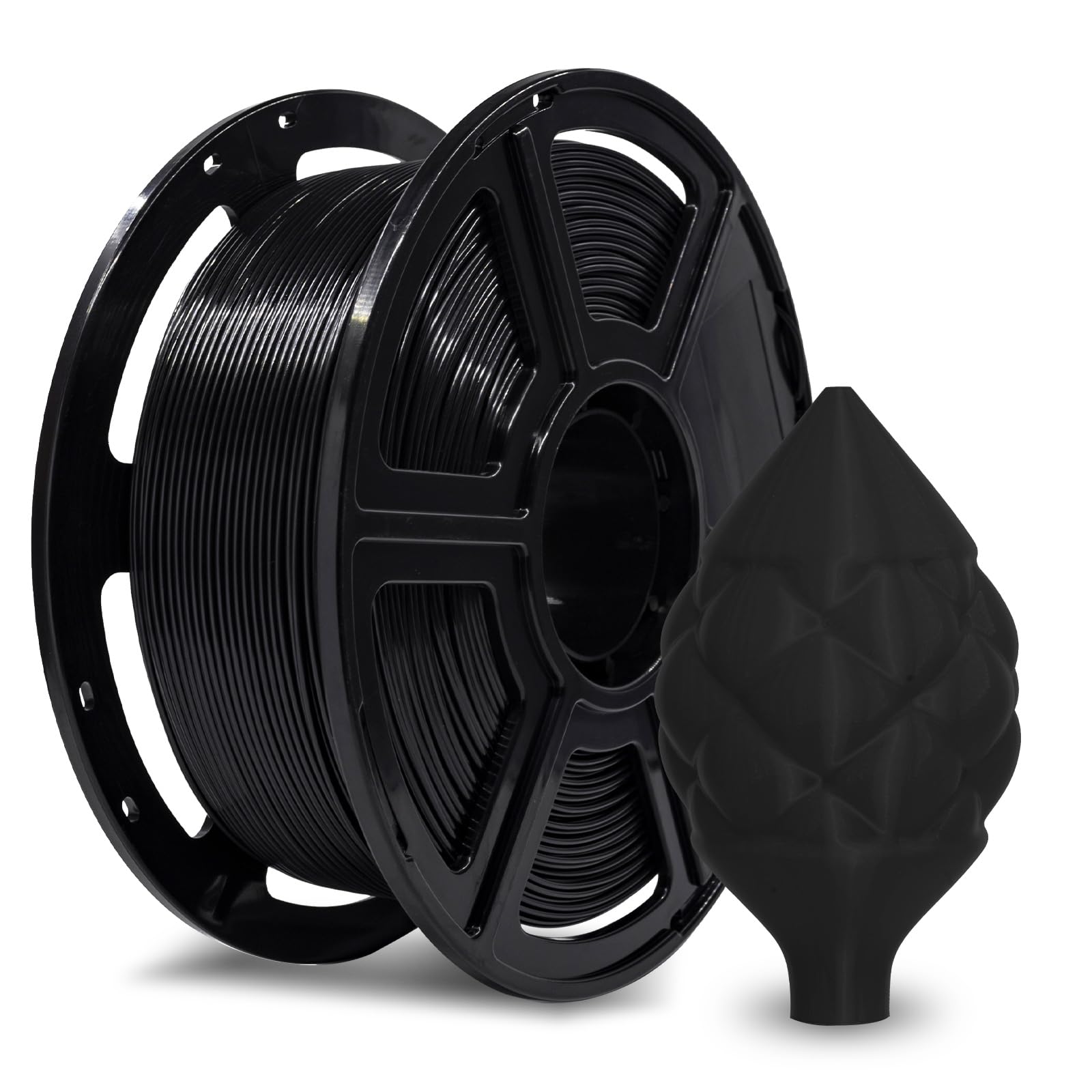
3. FLASHFORGE ABS Pro Filament 1.75mm Black
ABS with the warping and the smell dialed down for bigger painted builds.
Standard ABS warps and cracks on large prints, and it stinks while it does it. FlashForge’s ABS Pro attacks both problems: reduced shrinkage, lower warping and cracking risk, and a low-odor formulation that keeps the room bearable. That matters when you are printing a piece big enough to prime and paint in sections. The diameter is held to ±0.02mm, tightening the tolerance tighter than Creality’s ±0.05mm, so wall thickness stays even across a multi-hour build.
It prints well without pre-drying for most owners, strong bed adhesion holding the first layer stable and bridging performance heading off delamination. Quality is the strong suit — buyers consistently describe good, easy prints with vivid color and solid appearance. Run it around 230°C with the bed at 90°C and layer adhesion is at its best.
Two things to plan for. This ABS is unusually thirsty: leave it out about a week and prints turn rough, stringy, and less vibrant until a few hours in a dryer brings it back. And it stays brittle — long thin props will snap if flexed hard, so thicker walls are your friend. Keep the spool sealed between sessions and the finish stays reliable for painting.
The paint-prep pitch: Warping is the enemy of a paint-ready surface. ABS Pro keeps large prints flat enough that your sanding and primer work does not fight a warped base.
Keep it dry: Hygroscopic behavior is the one chore — store it sealed and a dryer rescues it in a few hours when it gets rough.
Go here for: large ABS props and functional parts where warping would ruin the paint job.
Skip if: you will not store the spool sealed and dry — moisture roughs up the finish fast.
4. Polymaker CosPLA 3D Printing Filament 1.75mm, Version A

A PLA formulated with one job in mind: sand it flat, then paint it.
Version A of Polymaker’s CosPLA is not trying to be a general-purpose spool. It is built for helmets, masks, and detailed props where the printed surface gets sanded, primed, and painted. The finishing workflow is the whole point — sand the surface, prep it with primer and paint, and the material is designed to take that work. You can run it on a 0.4mm nozzle anywhere from 190–230°C, bed 25–60°C, and 50–300mm/s, with no enclosure needed.
Print quality is what buyers keep coming back to: load it, use the maker’s downloadable profiles, and it prints cleanly without fuss on everything from a current Bambu to an older Ender-3 Max. The grey tone is a sensible base color for paint. One buyer reports: “Great PLA for cosplay! Easy to sand but still requires bondo for a smoother finish” — which is honest about what sanding alone can achieve on deep layer lines.
The sandability story is genuinely mixed. Some owners find it finishes fast and sands easily; others hit brittleness that makes sanding risky and layer adhesion that lets go. Tuning matters here — a 0.6 nozzle and dialed-in settings help, and it does want its own calibration rather than a stock PLA profile. Plan for a smaller spool too: 1kg does not go far on a full helmet build.
Built for the finishing bench
- Formulated specifically for sanding and painting props
- Prints cleanly with the maker’s downloadable profiles
- Grey base tone suits primer and paint
- No enclosure required — 190–230°C nozzle range
The honest caveats
- Sandability splits opinions — some hit brittleness and weak layer adhesion
- Wants its own calibration, not a stock PLA profile
Suits you if: you are building a helmet or mask and expect to do real sanding work before paint.
Not your spool if: you want zero-tuning, general-purpose PLA — the finish work is the whole reason it exists.
5. ZIRO PLA Fast Color Change Matte 1KG
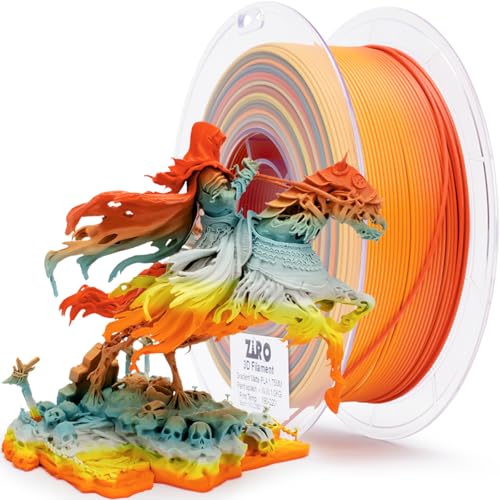
The spool that shifts color as it prints — finish pieces with no paint at all.
Sometimes you want color baked in rather than brushed on. ZIRO’s Paint Splash twists multiple vibrant colors into one matte PLA so the hue changes as the print climbs, at a faster rate than a slow gradient. The matte, chalky surface keeps a no-gloss look, and the multicolor result stands out without a single brush stroke. Because the color runs through the whole print, sanding and a clear coat hold the look — no primer needed if the color is the point.
The tolerance is ±0.03mm with a 190–220°C nozzle and 50–70°C bed window, a bit wider than the ±0.02mm spools above but still stable across the spool with no tangles or diameter jumps reported. It arrives with a free reseal bag and a 5M cleaning filament. Buyers rate quality highest — 134 name it — and the fast color change shows even on small prints.
The fast color change still needs a certain model size to show all the colors in one work, so a tiny keychain may only catch one hue. And matte ends of the spectrum split: some find it surprisingly smooth and worth the cost, others describe the feel as sandpaper. Print a small test first to see which side of that you land on.
Color without a paintbrush: The fast color change and matte surface make it a finishing shortcut for display pieces — the color is in the plastic, so no primer base coat is required.
Size-dependent payoff: Small models catch only part of the rainbow, so reserve this for medium and large display prints.
Choose this when: you want vibrant, self-colored display pieces with a matte finish and no painting step.
Pass if: you are printing tiny parts — the multicolor transition needs model size to reveal itself.
Know the Specs
Matte Finish & Paint Adhesion
A matte filament prints with a dull, chalky surface instead of a shine. That texture gives primer and paint something to bite into, so coats sit flatter and layer lines stay hidden. Glossy spools are slicker and often need extra sanding before paint will hold. Look for the words “matte” or “smooth matte” in the listing — they signal a paint-ready skin.
Nozzle Temperature Window
Nozzle temperature is how hot the hot-end runs to melt the plastic. A wide window, like 190–260°C, lets you tune for clean layer bonding without pushing the material too hard. Run too cool and layers stay weak and crumble when sanded; run too hot and the surface can blob. Start at the middle of the maker’s range and adjust after a small test print.
Dimensional Accuracy
Accuracy tolerance — ±0.02mm, ±0.03mm, ±0.05mm — describes how steady the filament’s 1.75mm diameter stays across the spool. Tighter tolerance means the extruder feeds a consistent bead, so walls come out even and prop edges stay sharp. Loose tolerance can leave uneven walls that need more sanding to flatten for paint.
PLA vs ABS for Painted Parts
PLA is easier to print and a good base for display props that get sanded and painted. ABS handles heat better and resists impact, which suits functional, heat-facing parts. Both take primer and paint; the choice hinges on whether the finished piece needs to flex, survive knocks, or sit in heat — if so, lean ABS.
Common Questions
Does matte PLA actually take paint better than regular glossy PLA?
Do I have to sand a print before painting it?
Can I paint ABS prints the same way as PLA prints?
Is PLA or ABS better for cosplay helmets that will be painted?
What does dimensional accuracy like 0.02mm mean for a painted prop?
How fast can I print filament that will be sanded and painted?
Does moisture in filament affect how paint holds?
Can I use color-changing matte PLA and skip painting altogether?
Do I need an enclosure to print filament for painted props?
What primer works on sanded 3D printed props?
The Bottom Line
For most people painting printed props, the filament for painting winner is the SUNLU High Speed Matte PLA because its matte surface hides layer lines and takes primer evenly — rated 4.5+ stars across 400+ owners. If your part has to face heat or take knocks, grab the Creality Hyper ABS. And when you want vibrant color printed straight in with no brushwork, the ZIRO Paint Splash is the one to reach for.
How we choose
We do not accept paid placement. Every pick is matched to a real buyer and a real use-case; we do not hands-on test units.
Sources
Specifications: manufacturer listings and product documentation. Review insights: verified customer reviews, as of October 2026. Pricing: not shown on this page (it changes often); check the current price via the retailer link.
As an Amazon Associate, Aappliancez earns from qualifying purchases. This does not affect which products we feature.