Disclosure: Some links in this post are affiliate links. As an Amazon Associate I earn from qualifying purchases, at no extra cost to you. Learn more
Specs are compiled from manufacturer listings and verified buyer reviews and can change over time — please confirm the key details on the product page before buying.
You want a diesel generator, but most units you see burn gasoline, propane, or natural gas. You are not stuck. The strongest home-backup machines here are tri-fuel and dual-fuel portables that let you pick the fuel you can actually store, plus a pair of automatic standby units that run on natural gas or propane. The real question is not “diesel or nothing” — it is how many running watts your house needs, whether your air conditioner can start on that power, and which fuel you can keep on hand through a week-long outage.
This guide is built by comparing the manufacturers’ published specifications and the patterns across verified customer reviews, so you get each pick’s real strengths and trade-offs instead of marketing spin.
You will see running watts, peak watts, fuel types, outlet sizes, and engine displacement explained in plain terms, so you can match a machine to your panel and your family’s habits. Every pick below is sorted by what it does best, and the comparison table lines up the numbers that matter side by side for diesel generators.
Top Picks


How To Choose The Best Diesel Generators
Start with the load, not the label on the fuel cap. Add up what you want running at the same time — fridge, freezer, well pump, lights, fans, and the air conditioner — then compare that total to the running watts of each machine. Peak watts only cover the first second or two when a motor starts, so a unit that lists a big peak number can still stumble when your compressor kicks in.
Running watts versus peak watts
Running watts are what the generator can hold all day. Peak watts are a short burst for motor startup. If your central air needs a soft-start kit to get going, that kit changes the math in your favor, and several owners in this list added one rather than buying a bigger machine. Write your numbers down before you shop, because the gap between a 9,000-watt and a 12,000-watt machine is the difference between “fridge and fans” and “whole house with AC.”
Fuel choice: gasoline, propane, or natural gas
Gasoline gives the most watts per machine but spoils in storage and needs stabilizing. Propane stores indefinitely, which is why so many owners keep a tank on hand for storm season. Natural gas never runs out if your home is already plumbed, but it typically delivers the lowest wattage of the three. A tri-fuel machine lets you switch between all three from a front-facing selector, so a fuel shortage never leaves you stranded.
Outlets, transfer switches, and how the power gets inside
The 50-amp outlet is the one that feeds a whole-house transfer switch or interlock kit. A 30-amp twist-lock handles a smaller panel or an RV. If you plan to run your main air conditioner, check that the machine has a 50-amp outlet and that your electrician can wire an inlet — several buyers here hired one before the first storm, not during it.
Inverter output and THD for sensitive electronics
An inverter generator cleans up the power wave before it reaches your outlets. Total harmonic distortion, or THD, measures how dirty that wave is — under 3% is the number to look for if you are running computers, a modern TV, or a heat pump control board. Standard open-frame generators are fine for fridges and lights but can be rougher on delicate electronics.
Side-by-Side Comparison
| Model | Best For | Fuel Type | Engine | Wattage | Amazon |
|---|---|---|---|---|---|
| Westinghouse 12500 Peak Watt Dual Fuel★ Best Overall | Whole-home backup on a budget | Gasoline / Propane | 457cc | 9500 running / 12500 peak (gas) | Amazon |
| DuroStar DS13000MXBiggest Displacement | Big power at mid-range value | Gasoline / Propane | 500cc | 13,000 W | Amazon |
| Pulsar GD10KBN InverterMost Portable | Compact inverter for RV and home | Gasoline / Propane | 312cc | 10.5 KW max | Amazon |
| DuroMax XP13000HXT | Tri-fuel flexibility | Gasoline / Propane / Natural Gas | 500cc | 13,000 W | Amazon |
| Pulsar PGD105TiSCO | Quiet inverter tri-fuel | Gasoline / Propane / Natural Gas | 458cc | 10,500 peak / 8,500 running (gas) | Amazon |
| Westinghouse iGen12000TFc | Clean power for electronics | Gasoline / Propane / Natural Gas | 457cc | 12,000 peak / 9,000 running (gas) | Amazon |
| GENMAX GM10500iETC | Quiet whole-house inverter | Tri Fuel | 458cc | 10,500 starting / 8,500 running (gas) | Amazon |
| DuroMax XP15000HXT | Maximum portable wattage | Gasoline / Propane / Natural Gas | 670cc | 15,000 W | Amazon |
| Champion 15,000-Watt Tri Fuel | Long-run storm coverage | Gasoline / Propane / Natural Gas | 717cc V-Twin | 15,000 starting / 12,000 running | Amazon |
| Generac Guardian 10kW | Automatic standby, smaller homes | Natural Gas / LP | 460cc G-Force | 10 KW | Amazon |
| Honda EU7000iS | Quietest portable inverter | Gasoline | Inverter | 7000 W | Amazon |
| Generac Guardian 22kW | Whole-home automatic standby | Natural Gas / LP | 999cc G-Force | 22 KW | Amazon |
Detailed Reviews
1. Westinghouse 12500 Peak Watt Dual Fuel Generator
Our pick — 4.5+★ from 800+ verified ratings; the strongest balance of quality and price.
The balance point of this whole list: whole-house watts, two fuels, and a key fob.
The number that sells this machine is 9500 — that is running watts on gasoline, the power it can hold hour after hour rather than the short burst. Peak watts reach 12500 on gasoline, and if you switch to propane you get 8500 running and 11200 peak. That propane route matters more than most buyers realize. Stored propane does not gum up a carburetor the way old gasoline does, so a tank that sits for a year is still a tank you can use.
Under the hood sits a 457cc Westinghouse four-stroke engine with a cast iron sleeve, which is the wear surface inside the cylinder. A digital hour meter tracks your maintenance intervals, and a CO sensor shuts the unit down if carbon monoxide builds up. The outlet set covers the whole job: two GFCI 120V 20A household receptacles, a transfer-switch-ready 120V 30A L14-30R, and an RV-ready 120/240V 50A 14-50R. Rubber covers on every outlet keep rain and grit out. Runtime tops out at up to 12 hours on the 6.6-gallon tank with a fuel gauge you can read at a glance.
The remote fob is the feature that changes daily life. One owner runs an entire 100-amp home, AC included, through the 50-amp outlet and starts it from indoors with the fob. It is a 212.1-pound machine, and it is noticeably heavier than the 125-pound Pulsar GD10KBN inverter — you will want a second person for stairs or a truck bed. Noise lands in mixed territory: some owners say it beats their old generator, others note it can be loud. Set it on the far side of the house from bedrooms and that trade-off disappears.
What wins people over is performance, and the reliable start-from-cold behavior is the second thing that comes up again and again — this is a machine that fires on the first button press rather than the fifth pull. One note on unboxing: the wheels and feet ship unattached, and the feet are welded rather than bolted as some guides suggest. Budget for a friend and a half hour of assembly.
Where it earns the crown
- 9500 running watts on gas runs a whole 100-amp panel including AC
- Dual fuel lets you store propane indefinitely without carburetor trouble
- Remote key fob starts it from indoors; electric and recoil backup both on board
- 50A RV outlet and transfer-switch-ready 30A outlet in the same panel
- CO shutdown and automatic low-oil shutdown protect the engine
What to plan around
- 212.1 pounds; moving it solo is a chore
- Noise is genuinely mixed depending on load and distance
- Wheels and feet need assembly from the start
Reach for this if: you want a whole-panel backup that starts from a key fob and can run on a propane tank you keep for years.
Think twice if: you need a one-person portable — the Pulsar GD10KBN weighs 125 pounds and is far easier to wheel out alone.
2. DuroStar DS13000MX Dual Fuel Generator
A half-liter engine that carried a two-story home through the storm.
Here is a machine that answers the air-conditioner question without a soft-start kit. Buyers report running a 1.5-ton AC, a garage split unit, the fridge, stove, microwave, TVs, and the water heater at the same time without it flinching. That is a full household load from a 500cc engine rated at 13 KW maximum, and the 50-amp outlet is what makes the wiring possible.
Compare the engine to the Pulsar GD10KBN: 500 cubic centimeters versus 312 cubic centimeters, and 13 KW maximum versus 10.5 KW. Those two numbers are why this DuroStar handles the AC startup that the smaller inverter may not. The trade is weight and footprint — measured 29.75″L x 27.5″W x 25.75″H, it takes up real floor space in a garage or shed.
Build quality is the thing that gets talked about here, and the value for the wattage backs it up. The steel frame and reinforced power panel are meant for outdoor weather, and the front-facing fuel selector lets you flip from gasoline to propane without opening anything. CO detection shuts it down automatically if fumes build. The honest gap is startup procedure: more than one buyer reports a cold no-start that turned out to be a closed gas valve, and reading the directions first saves a frustrating afternoon. A small number of units have tripped the CO shutoff in outdoor spots owners thought were clear, which is the one thing to watch in the first week. The machine is rated 4.0+ out of 5.
Power-to-price read: 13 KW from a 500cc dual-fuel engine with a 50A outlet puts this firmly in premium-portable territory for a mid-range price, and the whole-house results bear it out.
Do this first: confirm your gas valve is open and follow the cold-start sequence in the manual before you decide anything is broken.
Best for: households with a central AC and a transfer switch who want the big-engine reliability without tri-fuel plumbing.
Look elsewhere if: you want a remote fob or a lighter machine to wheel around — this is a two-person lift.
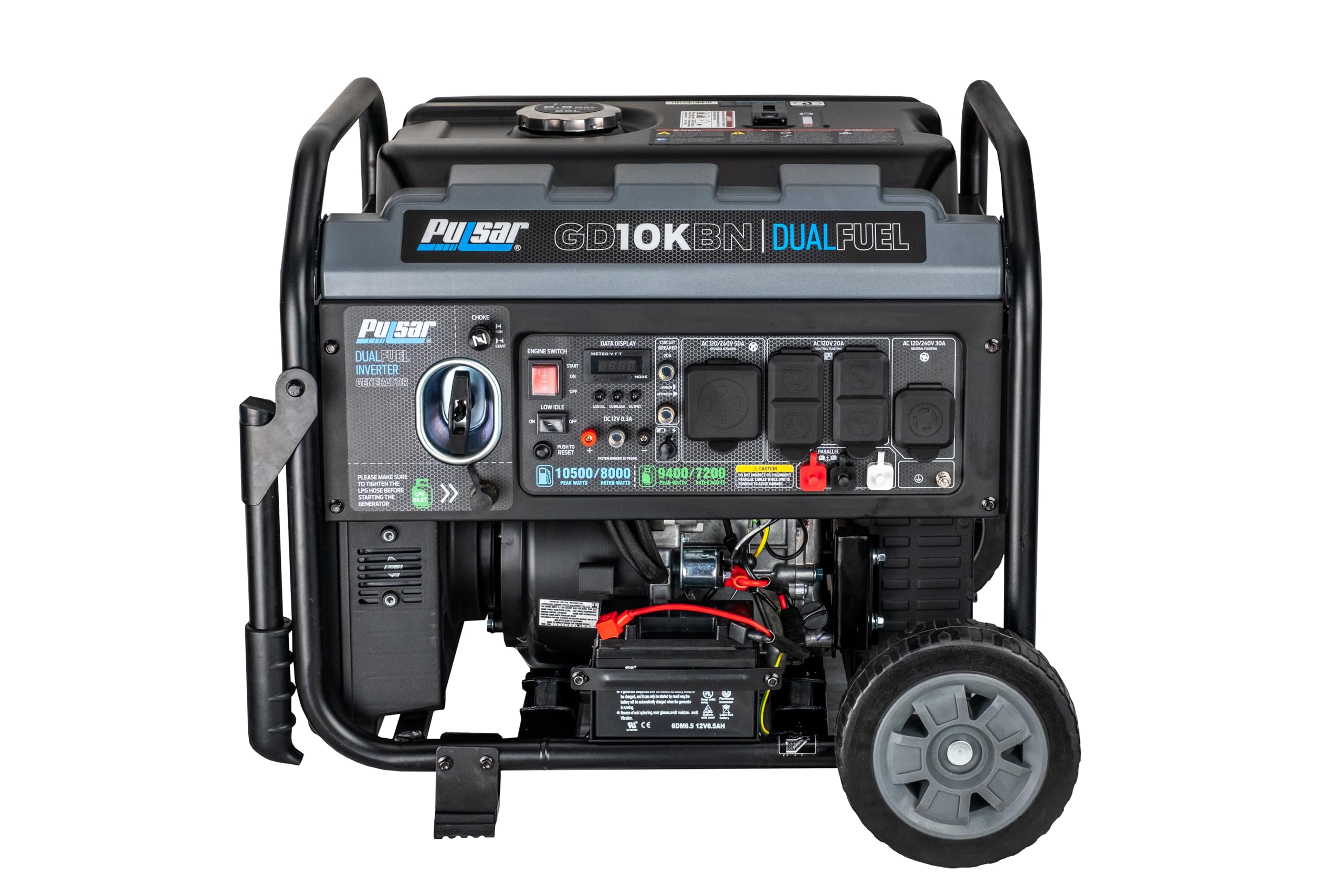
3. Pulsar GD10KBN Dual Fuel Inverter Generator
The featherweight of the group, all things considered — 125 pounds you can actually roll alone.
At 125 pounds, this is the machine you can move by yourself. Set it beside the 212.1-pound Westinghouse and the difference is a one-person job versus a two-person job. Its 29.9″L x 21.5″W x 22.8″H footprint also slips into tighter garage corners, and the 312cc engine keeps the whole package compact. It still makes 10.5 KW maximum and carries a 15-50R RV outlet for campgrounds and tailgates.
Inverter output is the reason to pick this over an open-frame unit. Inverter technology cleans the power wave so laptops, phones, and control boards are not exposed to rough current. The digital display shows volts, frequency, total hours, and hours until your next maintenance — a small thing that saves you guessing when the oil change is due.
What consistently holds up is reliability through long outages; owners describe running multiple 12-plus hour stretches without trouble. The trade-off is sound. Noise is the topic that comes up most here, and not in a good way — this is a loud machine, and it starts harder on propane, often taking two or three pulls because the hose needs bleeding. The 4.0+ rating reflects that honest split. If you need silence, look at the Honda EU7000iS at 52 to 58 dB(A). If you need dependable power from a machine you can wheel out alone, this is your pick.
The value case: you get inverter power, dual fuel, and a manageable weight at a mid-range price, which is exactly where the smaller-budget buyer lands.
One setup gap: no battery charger for the electric start ships in the box, so plan on picking one up before the first outage.
Pick this if: portability and clean inverter output matter more to you than a quiet exhaust note.
Instead choose: an open-frame tri-fuel unit if you need natural gas and a lower starting effort on propane.
4. DuroMax XP13000HXT 13,000-Watt 500cc Tri Fuel Generator
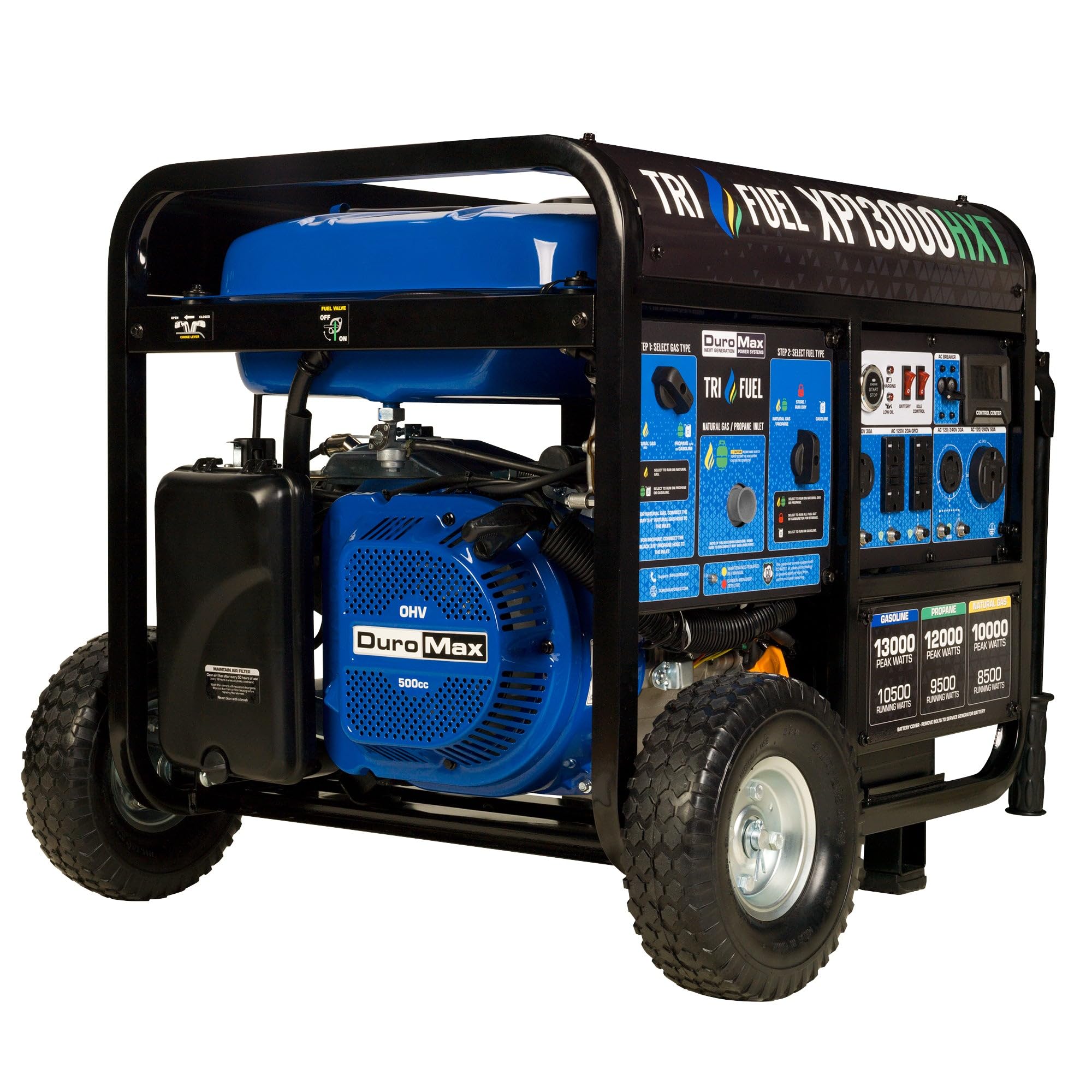
When the storm outlasts your propane, the natural gas line keeps it running.
Three fuels is the whole pitch, and it is a serious one. Gasoline, propane, or natural gas, switched from a front-facing selector in seconds. If your home is already plumbed for natural gas, that means no refueling, no fuel storage, and no midnight drive to find a station with the pumps working. It is also the single biggest advantage over the DuroStar DS13000MX, which stops at two fuels.
The 500cc OHV engine pushes 13,000 watts, and the outlet panel is loaded: a transfer-switch-ready 50-amp, a front-facing interface, and push-button start or a remote fob to fire it up from inside. CO Alert shuts it down automatically if carbon monoxide levels rise. At 240 pounds and 30″L x 30″W x 26″H, this is a wheeled machine, not a carryable one.
What buyers keep coming back to is the tri-fuel flexibility — the ability to run on propane when the tank is full and switch to natural gas when it is not. One described a full natural gas hookup running the whole house during an outage and losing a little wattage on natural gas in exchange for never storing fuel. That is the real trade. On natural gas you give up some output compared to gasoline, so plan your load accordingly. A few buyers noted the battery drains when it sits, which is a trickle-charger fix, not a flaw.
Why it tops the tri-fuel tier: 13,000 watts from all three fuels plus a 50-amp transfer-switch outlet makes it the most complete general-purpose machine here.
The logistics: 240 pounds means wheels and a flat surface; a natural gas hookup needs a plumber and, if you want a 1-inch line, a willing one.
Matches you if: you have natural gas at the house and want backup that never needs a fuel run.
Skip the upgrade if: propane alone covers your risk — the dual-fuel DuroStar costs less and does the same job on a tank.
5. Pulsar PGD105TiSCO Tri Fuel Inverter Generator, 10500-Watt

The 62 dB sticker is the claim; real-world owners have a say too.
On paper, the PGD105TiSCO runs at 62 dB — quieter than the open-frame machines in this list, and roughly conversation level. On gasoline it makes 10,500 peak watts and 8,500 running. On propane, 9,500 peak and 8,000 running. On natural gas, 8,400 peak and 6,800 running. Each fuel step down is worth knowing before you commit to running a heat pump on natural gas.
The 458cc OHV engine is EPA and CARB compliant, and the inverter output is safe for sensitive electronics, which means laptops and TVs can plug in without a surge worries. The outlet panel is genuinely complete: four GFCI 120V 20A household outlets, a 120/240V 30A, a 120/240V 50A, plus USB-A and USB-C. The digital control center shows hours, voltage, load, and frequency. The 6.9-gallon tank supports up to 9 hours of continuous operation at half load.
Honest read: this is the one pick where the rating sits below the rest. Performance comes up mixed — some units run outstandingly, including one powering a 3,000-square-foot home with two air conditioners totaling 5 tons on soft starts. Others hit a defective fuel selector valve that got replaced under warranty but left the owner without clear instructions. Noise is also split: fairly quiet for its class at idle, louder than expected under load. At 247 pounds with tightly fitted service panels, in-home repair is the realistic path if anything goes wrong.
What stands out on the spec sheet
- 62 dB rating is the quietest tri-fuel in this list
- Tri-fuel selector covers gasoline, propane, and natural gas
- Six outlets including a 50A and two USB ports
- Inverter output is safe for sensitive electronics
Real-world watchpoints
- Mixed outcomes on the fuel selector valve
- Louder under load than the 62 dB suggests
- 247 pounds; service needs to happen where it sits
Suits you when: quiet operation at idle and a full outlet panel top your list, and you want all three fuels in one machine.
Rather not gamble if: you need the most consistent start-up record — the Westinghouse iGen12000TFc has a stronger track record for the same tri-fuel job.
6. Westinghouse 12000 Peak Watt Tri-Fuel Inverter Generator
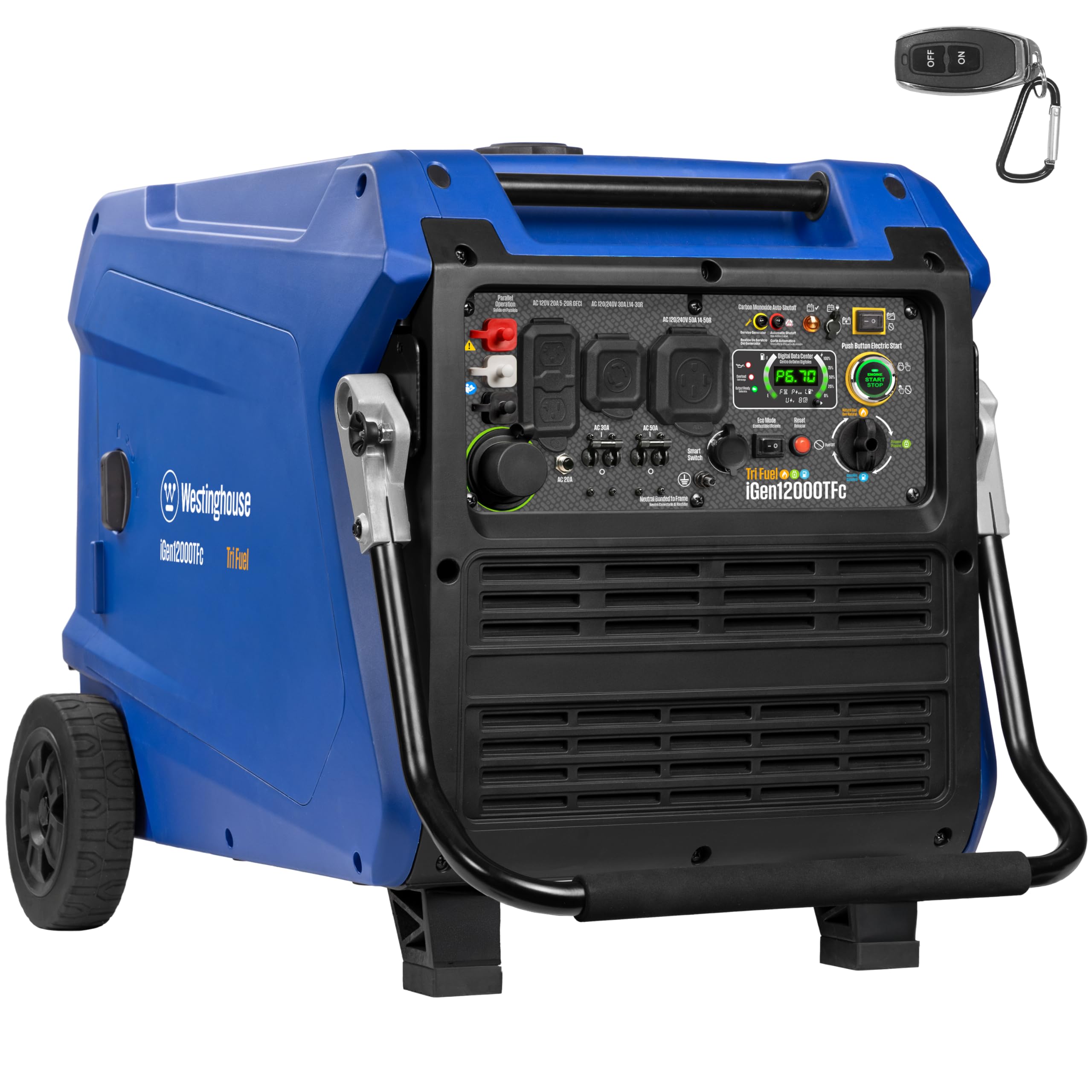
Under 3% distortion, which is the number your heat pump control board actually cares about.
THD is the spec here that matters most. Under 3% total harmonic distortion means the power wave is clean enough for sensitive electronics — laptops, modern TVs, and the control boards in a heat pump or furnace. On gasoline it makes 12,000 peak watts and 9,000 running. On propane, 11,000 peak and 8,100 running. On natural gas, 9,800 peak and 7,200 running. The 50A outlet is there for a transfer switch, plus a 30A twist lock and one GFCI 120V duplex household outlet.
The 457cc Westinghouse four-stroke engine pairs with Eco Mode, insulation, and mufflers to keep noise as low as 64 dBA. The 7.9-gallon tank supports up to 19 hours at 25% load, and the LED data center shows fuel level, power output, remaining runtime, voltage, and lifetime hours. Low oil shutdown and a CO sensor are both included. Parallel-ready means you can pair a second unit to double output later.
This pick earns its spot with build quality and the confidence owners describe during outages. Quiet operation shows up repeatedly in reviews — one buyer calls it extremely quiet for the size of the unit, though they note it uses more propane than advertised. That is a fair caveat: the propane trade is fewer fumes and safer refueling in exchange for more fuel burned. A single unit’s battery can drain while sitting even with switches off, so plan a charger if it lives in storage. At 191 pounds, it is manageable on its wheels.
The winning combination: under 3% THD, tri-fuel, and a 50A outlet together is the cleanest whole-home inverter option in this tier.
The honest catch: propane consumption runs higher than the spec sheet suggests — budget more fuel than you expect.
This is your pick if: you run a heat pump, modern TVs, or computers and want the cleanest power from a machine that switches fuels.
Better to skip if: the quietest possible exhaust note is the priority — the Honda EU7000iS at 52 to 58 dB(A) is quieter.
7. GENMAX Tri Fuel Generator, 10500-Watt 458cc

A whole-house inverter that can carry a 4-ton heat pump and dial itself down when the load eases.
The GM10500iETC is built around one idea: big load, quiet operation. It holds 8,500 running watts and 10,500 starting watts on gasoline, 8,000 running and 9,500 starting on LPG, and 6,800 running and 8,400 starting on natural gas. THD under 3% (total harmonic distortion — a measure of how clean the power is) makes it safe for computers and phones. The control panel is fully loaded — a 120/240V 30A L14-30R outlet (a 30-amp twist-lock connector for heavy appliances), a 120/240V 50A 14-50R outlet (a 50-amp plug for large loads like an RV or welder), four 120V 20A household outlets, a 12V DC cigarette lighter outlet at 8.3A, ATS automatic control (automatic transfer switch — starts the generator for you), CO alarm (carbon monoxide detector), parallel connectors (to link a second unit for more power), and a battery charging port.
Quiet operation is the aspect that shows up most after build quality in owner feedback, and the inverter design is what delivers it — it runs at lower RPM when the load drops. One buyer powers the whole house, including a 4-ton air conditioner on a soft start, and the inverter then settles into idle. That is the Eco Mode benefit in practice. The 458cc engine and 304 pounds are real — this is a two-person roll it into place job, and the 30.9″L x 22.6″W x 29.3″H footprint needs a committed corner of the garage.
The honest caveat is at the panel: reliability comes up mixed in the reviews. Several describe strong service and consistent starts; a smaller set hit voltage fluctuation issues on the 240V side that support did not resolve quickly. The neutral floating design also means bonding it for portable use needs a separate plug, and the conversion instructions are thin. Read the manual and confirm your electrician’s plan before you wire it. The 3-year warranty and lifetime technical support help if something does go off.
Where it delivers
- Runs a 4-ton heat pump with soft start, then idles down
- THD under 3% for electronics
- Full outlet panel including 50A, 30A, and four 20A household outlets
- 3-year warranty with lifetime technical support
Where it asks patience
- Neutral floating requires a separate bonding plug and clear instructions
- 304 pounds at 30.9″L — this is a shop floor machine
- A handful of voltage-regulation complaints on the 240V side
Best matched to: homes with a 4-ton heat pump and a 50A inlet, where quiet whole-house inverter power matters.
Go a different way if: you want a simpler bonding setup — the Westinghouse iGen12000TFc ships with a more direct transfer-switch path.
8. DuroMax XP15000HXT 15,000 Watt Tri Fuel Portable Generator
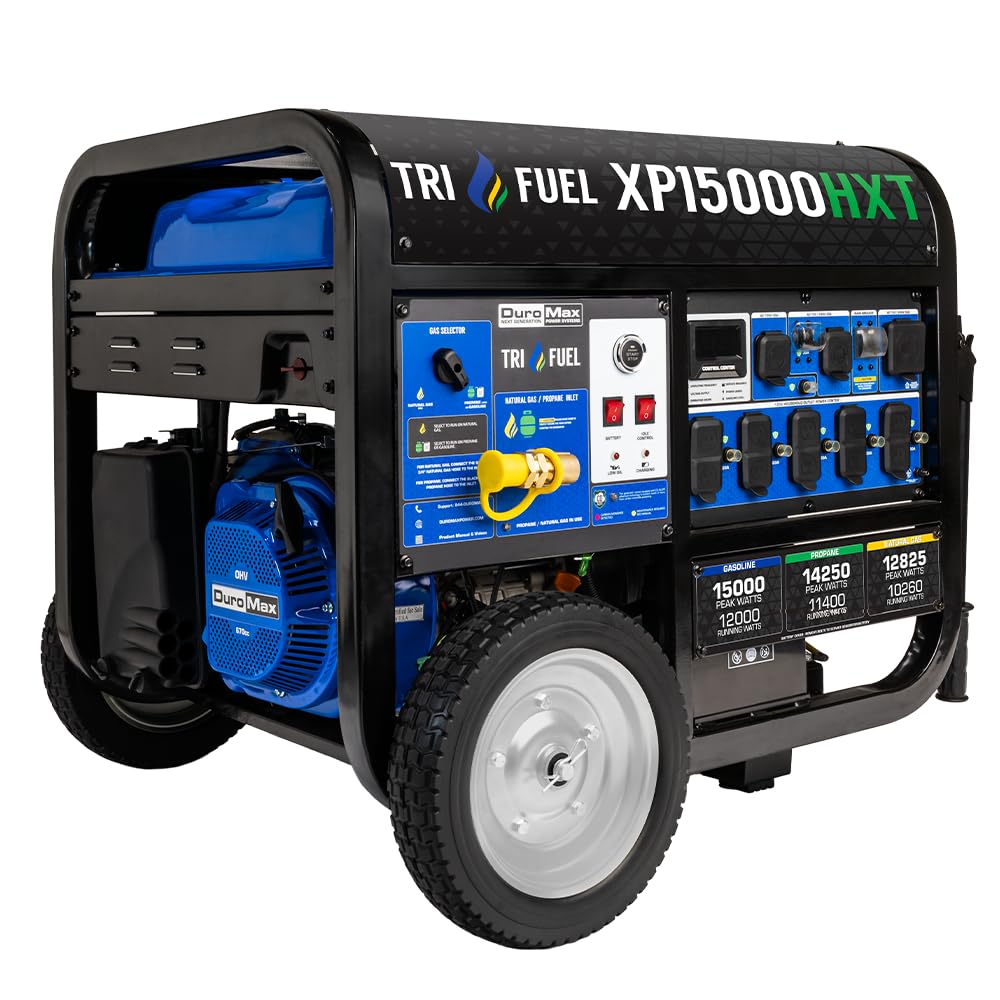
The 670cc heavyweight that lists 15,000 watts and lists it honestly.
15,000 watts is the number that defines this machine, and the supporting tech is 100% copper windings — copper conducts heat better than aluminum, which extends the life of the generator. The 670cc engine is the largest displacement in this lineup outside the V-Twin Champion, and it comes tri-fuel ready for gasoline, propane, or natural gas. The power panel is fully loaded: four 120V 20A GFCI outlets, a 120V 30A twist lock, a 120/240V 30A twist lock, and a 120/240V 50A heavy-duty outlet.
The advanced computer interface with a large LED display shows gas gauge, load gauge, voltage, frequency, and time at a glance. CO Alert shuts the unit down if carbon monoxide builds. Push-button and remote start both work from the same fob. At 36″L x 33.2″W x 32″H it is a big footprint — plan a level pad or a dedicated corner.
Pure power output is the standout in owner experience. It will run an 1800-square-foot house with a full basement without a problem, and it handles propane and gasoline both well enough for a food trailer. One reviewer noted it runs an old welding machine with good beads — welding isn’t in the usage section of the manual, but the load capability covers it. The honest caveat: reliability shows a mixed split, and the recurring note is the propane intake not working for some owners. If propane is your primary fuel, test that pathway before storm season rather than the night of. The machine itself is rated 4.0+ out of 5.
The headline: 15,000 watts from a 670cc engine with copper windings puts it ahead of every other portable on raw output here.
Check before the season: confirm your propane intake is operating — it is the single most-mentioned problem area.
Fits you when: you want the most portable wattage available and can test the propane path in advance.
Go smaller if: an 1800-square-foot home with natural gas is the target — the XP13000HXT is easier to move and still covers it.
9. Champion 15,000-Watt Tri Fuel Generator

The 717cc V-Twin that spent 90 hours on a house after a hurricane.
This is the biggest engine on the list, a 717cc Milwaukee Series V-Twin, and it shows. 15,000 starting watts and 12,000 running watts, with up to 9 hours of run time on a full tank of gasoline. The noise figure is 78 dBA from 23 feet, which is honest — it is a serious machine. Natural gas and propane hoses both ship in the box, so it runs on any fuel out of the crate, and the battery-included electric start uses a toggle switch.
The Intelligauge tracks voltage, hertz, and run-time hours, so you can monitor output and time your oil changes. CO Shield shuts it down automatically when carbon monoxide builds. The 331 pounds and 33″L x 33.7″W x 33.1″H footprint make it a wheel-it-into-place unit for the shed or the side of the house.
The word that keeps surfacing is reliability. One owner ran an entire 4400-square-foot house, both ACs on soft starts, for 100-plus hours on this 717cc V-Twin with zero issues. Another ran the whole house for seven days after Hurricane Beryl on natural gas, holding 70°F indoors. That is the kind of run time a standby system delivers — and this portable did it for a fraction of the installed cost. The honest catch: CO Shield is sensitive. One owner had it shut down every 1.5 to 2 hours outdoors, and would have given five stars otherwise. Placement matters more here than on most machines.
What makes it worth the space
- 717cc V-Twin with 15,000 starting and 12,000 running watts
- Up to 9 hours run time on a full gasoline tank
- All three fuel hoses included for out-of-the-box tri-fuel
- Intelligauge for hours, hertz, and voltage — maintenance made simple
What to expect
- 78 dBA at 23 feet; it is a loud machine
- CO Shield can trip outdoors if placement is too close to the house
- 331 pounds; two people for loading and unloading
Your match if: you want the run times a standby delivers from a portable, with all three fuels in the crate.
Consider another route if: noise and CO sensitivity are deal-breakers — a standby like the Generac Guardian 10kW runs automatically and quieter.
10. Generac Guardian 10kW Home Generator

No wheels, no fob, no refueling — a box on the side of the house that starts itself.
The 10kW Guardian is the smallest of the automatic standby machines here, and 10,000 watts is the number to match to your house. True Power Technology keeps harmonic distortion under 5% for clean current, and the 100-amp 16-circuit transfer switch (a panel that connects the generator to your home’s electrical system) is designed to integrate with the home panel smoothly. The 460cc G-Force 400 Series engine (460 cubic centimeters — a mid-size engine) runs on natural gas or LP (liquid propane) and is built to be low-maintenance.
Mobile Link Wi-Fi lets you track generator performance from anywhere, with status and maintenance alerts on your phone. The aluminum enclosure is made for outdoor weather and includes a 5-year limited warranty on the transfer switch. Installation is not a DIY job — Generac recommends a certified and licensed electrician, and a plumber is often needed to run the gas line. Engine oil and an oil funnel come in the box.
Owner experience tends to be long-term satisfaction. One buyer reports their previous Guardian lasted 24 years, and a condensed review says the 10kW handles whole-house backup on natural gas with no refueling. Sound is mower-like outside, quiet enough indoors that you may not notice. A few owners found Wi-Fi setup fiddly.
The real win: automatic transfer at 10,000 watts means the lights come back without you leaving the kitchen to pull a cord.
Plan for: electrician and plumber costs, plus clearance measurements, before the box is delivered.
Choose this when: your home fits comfortably under 10kW and you want it to run itself while you are at work.
Step up if: you have multiple ACs and a large square footage — the 22kW Guardian is built for that load.
11. Honda EU7000iS 7000 Watt 120/240V Inverter Generator
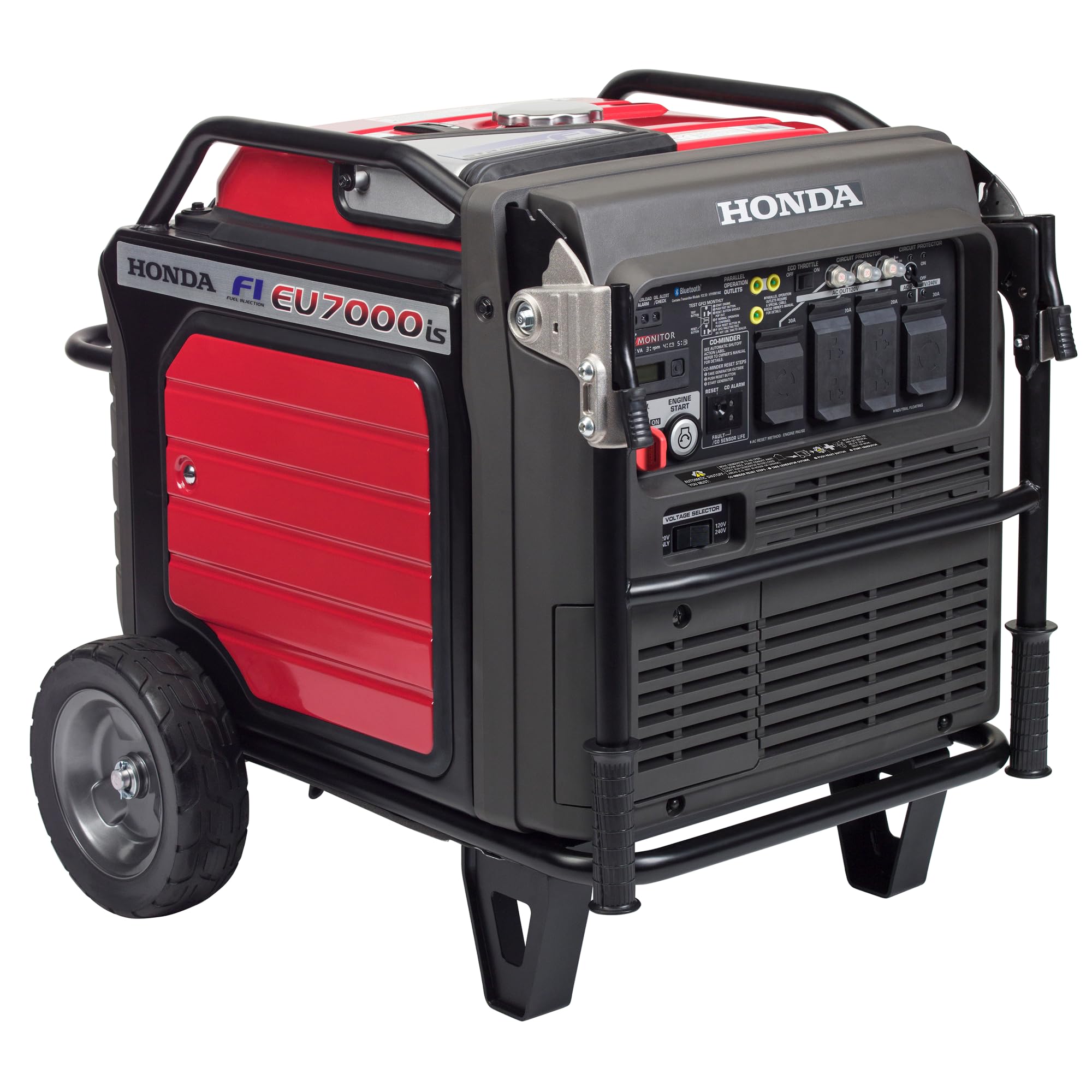
52 to 58 dB(A) — quieter than a normal conversation, which is the whole point.
Some generators talk about being quiet. This one has the number: 52 to 58 dB(A), which Honda describes as less noise than a normal conversation. For a camping, RV, or tailgating setup, that changes the experience. The advanced inverter technology delivers clean power reliable enough for computers. The 5.1-gallon fuel tank supports 6.4 to 16 hours depending on load, and Eco Throttle matches engine speed to demand for efficiency. Both 120 and 240 volts are available.
My Generator, Honda’s Bluetooth app, gives youremote power operation and monitoring, plus wireless stop and service reminders. The CO-MINDER system tracks carbon monoxide levels and shuts the generator down before they reach dangerous levels near the home or camper. A 3-year residential warranty covers the whole unit, and electric start fires it up from the panel or the app.
Owners describe this as the most reliable machine in its power class. One buyer powers an entire house through a Generlink setup with breaker management, including a 3-ton Trane AC and the water heater, on this 7,000-watt inverter. Pairing two with Honda’s Parallel Cable Kit doubles the output to a stated 11KWt stable. The honest catch: it costs more than everything else here, and at 263.2 pounds it is not a carry toy. A few owners noted the battery can arrive discharged, so plan a charge before storm season. Rated 4.5+ out of 5.
The defining spec: 52 to 58 dB(A) (decibels — a measure of sound) is quieter than every other machine in this guide, and the app lets you stop it without leaving the tent.
Worth knowing: gasoline only, no propane or natural gas option — the quietest choice, not the most fuel-flexible one.
Head straight for this if: quiet and clean power top everything else, and you will pay for the quietest portable made in this class.
Turn away if: you need propane or natural gas — without a fuel selector, this one runs on gasoline only.
12. Generac Guardian 22kW Home Generator
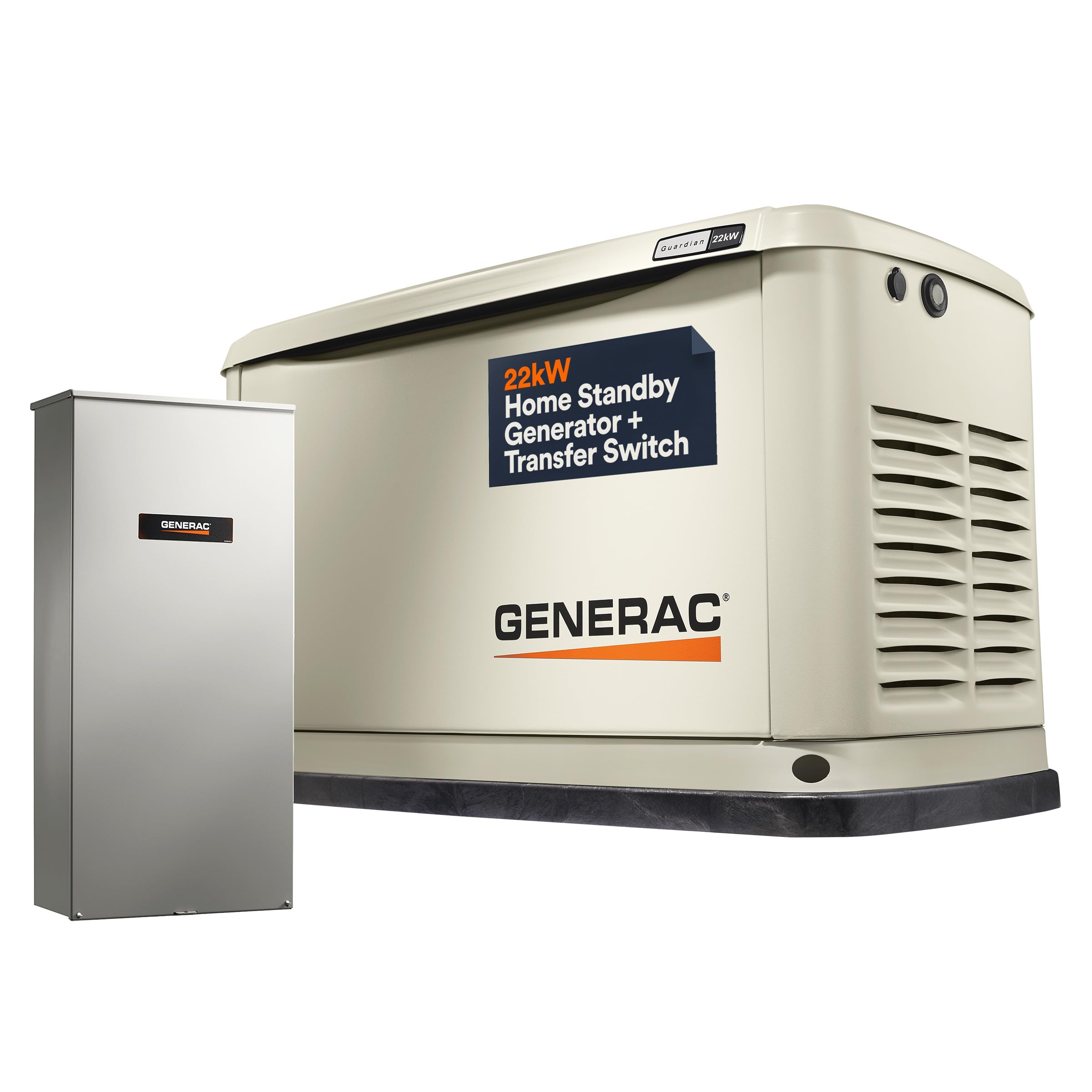
For homes where a portable is out of the question — the 22kW runs the whole panel without you touching a cord.
22,000 watts is a different class from every portable here. The True Power Technology keeps harmonic distortion under 5% for clean current, and the 999cc G-Force 1000 Series engine runs on natural gas or LP without a refueling step. The 200-amp NEMA 3R smart switch handles the full panel in an aluminum enclosure for outdoor use, and the whole package carries a 5-year limited warranty on the switch.
The engine and switch are installed, not wheeled in place — Generac recommends a certified and licensed electrician, and the dimension sheet (50″L x 27″W x 29″H) drives the pad layout. Mobile Link Wi-Fi tracks status and maintenance alerts from anywhere, and the 466-pound unit is designed to sit outside for the long haul. That is the point of a standby: it runs whether or not you remembered to check the fuel gauge.
The owners who are happiest describe relief more than specs. Power comes back in about ten seconds, the whole house stays lit including a 5-ton AC and heat pump, and there is no cord to drag. Some owners added a large in-ground propane tank to feed the unit plus the house. The honest notes: a battery and cold-weather kit are extras rather than included items, and shipping communication can lag. The computer-controlled design also means the unit depends on its own electronics, so ask your electrician about surge protection at the panel. This unit is rated 4.5+ out of 5 across 250+ ratings — the crowd favorite in the standby category.
Why it earns the top standby slot: 22,000 watts across a 200-amp switch covers a whole-house load, and the 999cc engine runs on gas you already have.
The honest catch: battery and cold-weather kit are not in the box — budget those extras before you install.
This is for you if: your home has a 200-amp panel and multiple AC units, and you want power back in seconds without lifting a finger.
Size down if: your panel is 100 amps and one AC — the 10kW Guardian covers that at a much smaller footprint.
Know the Specs
Running watts and peak watts
Running watts are what the generator can sustain continuously. Peak watts are the brief surge for motor startups — the moment your compressor or well pump kicks in. When you compare machines, use the running figure for your load math and use the peak figure only to judge starting headroom. The gap between them on any given machine tells you how much inrush current it can absorb.
THD and inverter output
Total harmonic distortion (THD) measures how closely the power wave matches clean grid power. Inverter generators convert the engine’s raw output to a stable wave, and the lower the THD, the safer that power is for computers, TVs, and heating control boards. The machines here that advertise under 3% THD are the closest to utility-grade power from a portable.
Transfer switch and outlet size
A transfer switch is the panel connection that lets the generator feed the house safely, and the 50-amp outlet is the standard feed for a whole-home setup. If your wiring has an interlock kit instead, the same outlet works. A 30-amp outlet serves a smaller panel or an RV. Your electrician will tell you which outlet your panel needs — get that answer before you shop.
Dual fuel versus tri fuel
Dual fuel means the machine runs on gasoline or propane. Tri fuel adds natural gas, which is the fuel that never runs out when the house is already plumbed. Each fuel step reduces wattage — the numbers on the spec sheet stack gasoline highest, then propane, then natural gas. Pick the fuel you can actually store or supply, then confirm the wattage for that exact fuel covers your load.
Run time and tank size
Run time is stated at the load the manufacturer tested, usually half load. A 6.6-gallon tank running up to 12 hours at half load tells you roughly what an overnight outage costs in fuel. Run the same math for your own expected load — a heat pump draws more than a fridge, so the tank drains faster. Keeping one extra full can or tank on hand covers the difference.
CO shutdown and low-oil protection
A CO sensor measures carbon monoxide and shuts down the generator when levels rise, which is the safety feature that matters most for a machine sitting near windows or a camper. Low-oil shutdown protects the engine if oil runs low. Both are worth confirming on any pick — they are the difference between a tool and a liability.
Common Questions
Can a dual-fuel or tri-fuel generator replace a diesel generator for home backup?
What size generator do I need to run a central air conditioner?
Do I need a transfer switch to connect a portable generator to my house?
Will an inverter generator run my computer and TV without damage?
How long does a generator run on a full tank?
Is propane or natural gas better for a backup generator?
How noisy is a portable generator compared to a standby unit?
What kind of oil and maintenance does a generator need?
Can I run a generator during a hurricane or storm?
Does a standby generator need professional installation?
The Bottom Line
For most households, the diesel generators winner is the Westinghouse 12500 Peak Watt Dual Fuel because it delivers 9500 running watts on gasoline, a 50-amp transfer-switch-ready outlet, and a remote key fob that starts it from indoors — with the propane option that keeps a stored tank usable after a year. If you have natural gas plumbed to the house and want to skip refueling, grab the DuroMax XP13000HXT. And for whole-home power that comes back on its own without you lifting a finger, the Generac Guardian 22kW is the one to reach for.
The honest nudge: the top standby pick is the crowd favorite at 4.5+ stars across 250+ ratings, which is a track record you rarely see in a category where most units live or die on one storm season. Match the fuel to what you can actually store, size the watts to your real load, and confirm the outlet your panel needs before the box arrives — that is the whole decision.
How we choose
We do not accept paid placement. Every pick is matched to a real buyer and a real use-case; we do not hands-on test units.
Sources
Specifications: manufacturer listings and product documentation. Review insights: verified customer reviews, as of October 2026. Pricing: not shown on this page (it changes often); check the current price via the retailer link.
As an Amazon Associate, Aappliancez earns from qualifying purchases. This does not affect which products we feature.