Disclosure: Some links in this post are affiliate links. As an Amazon Associate I earn from qualifying purchases, at no extra cost to you. Learn more
Specs are compiled from manufacturer listings and verified buyer reviews and can change over time — please confirm the key details on the product page before buying.
You are standing on a heeled deck with one hand on the rail, and the wrong vest is either riding up into your neck or sitting so stiff you cannot trim a sheet. That is the real buying decision: a sailing PFD has to stay locked in place while you move and stay comfortable enough that you keep it on. This guide sorts the field by how each vest fits a seated, twisting, rope-hauling body — and by how much flotation it actually delivers when the water gets serious.
This guide is built by comparing the manufacturers’ published specifications and the patterns across verified customer reviews, so you get each pick’s real strengths and trade-offs instead of marketing spin.
Below you will find foam vests built for long days and inflatables that pack away until you need them, with honest notes on sizing and buoyancy along the way. Every entry is chosen by one test: does it keep you afloat without getting in the way of trimming a sheet? This is the short list I would hand to anyone hunting the best pfd for sailing.
Top Picks

How To Choose The Best PFD for Sailing
A sailing PFD carries a different job than a ski vest or a pool noodle float. You wear it for hours while seated, leaning, and pulling lines, so fit and freedom of movement matter as much as the flotation number. Start with these three decisions and the list narrows fast.
Approval type decides where you can wear it
A USCG Type III vest is the classic foam life jacket — the one most sailors buy because it is rugged and needs no maintenance. A USCG Type V inflatable offers the same performance but only counts as approved while you are actually wearing it, so it is not something you can toss in a locker and forget. If you sail with guests who may not gear up properly, foam is the safer default.
Buoyancy in pounds is the number to compare
Look at the stated buoyancy and compare it across the field. A lightweight foam sail vest might offer around 16 lbs, while an inflatable can deliver 26 lbs or 35 lbs once it fires. More buoyancy is not automatically better for inshore day sailing — it can mean more bulk — but on cold water or open passages the extra lift is worth having.
Fit around a seat back and a moving body
A high-back or mesh-back design clears the top of a seat so the vest does not push your head forward while you steer. Look for a cross-chest cinch or side straps that pull the vest down against your body, because a vest that slides up around your ears is a vest you will stop wearing mid-passage.
Side-by-Side Comparison
| Model | Best For | Approval / Type | Buoyancy | Weight / Fit | Amazon |
|---|---|---|---|---|---|
| Stohlquist Fisherman Lifejacket★ Best Overall | Inshore days and big frames | USCG Type III | 16 lbs 4 oz | Up to 300 lbs, adjustable | Amazon |
| Mustang Survival M.I.T. 100Cold-Water Pick | Cold water and offshore | Automatic inflatable | 28 lbs | 1.8 lbs, custom fit | Amazon |
| BLUESTORM Stratus 35Top Flotation | Maximum lift on the water | USCG Type II inflatable | 35 lbs | Universal, chest 30–56″ | Amazon |
| Overton’s Universal Adult Life Jacket (4-Pack) | Equipping a whole boat | USCG Type III | Closed-cell foam | 3.5 lbs, chest 30–52″ | Amazon |
| BLUESTORM Cirrus26 | All-day inshore comfort | USCG Type V (Type III perf.) | 26 lbs | 16 oz, up to 350 lbs | Amazon |
| Stohlquist Piseas Lifejacket | Mixed paddling and sailing | USCG Type III | — | 1.6 lbs, S/M | Amazon |
| O’Neill Men’s Slasher Comp Vest | High-impact water sports only | Not USCG approved | — | 16 oz, neoprene | Amazon |
| NRS Chinook Fishing Life Jacket | Seated fishing from a kayak | USCG Type III | 16.5 lbs | Six adjustment points | Amazon |
| Astral V-Eight Fisher Life Jacket | Hot-weather paddling and fishing | USCG Type III | 16 lbs | 1.4 lbs, S/M–L/XL | Amazon |
Detailed Reviews
1. Stohlquist Fisherman Lifejacket (PFD)
Our pick — 4.5+★ from 550+ verified ratings; the strongest balance of quality and price.
The foam vest that stays where you put it, even on a long day of line work.
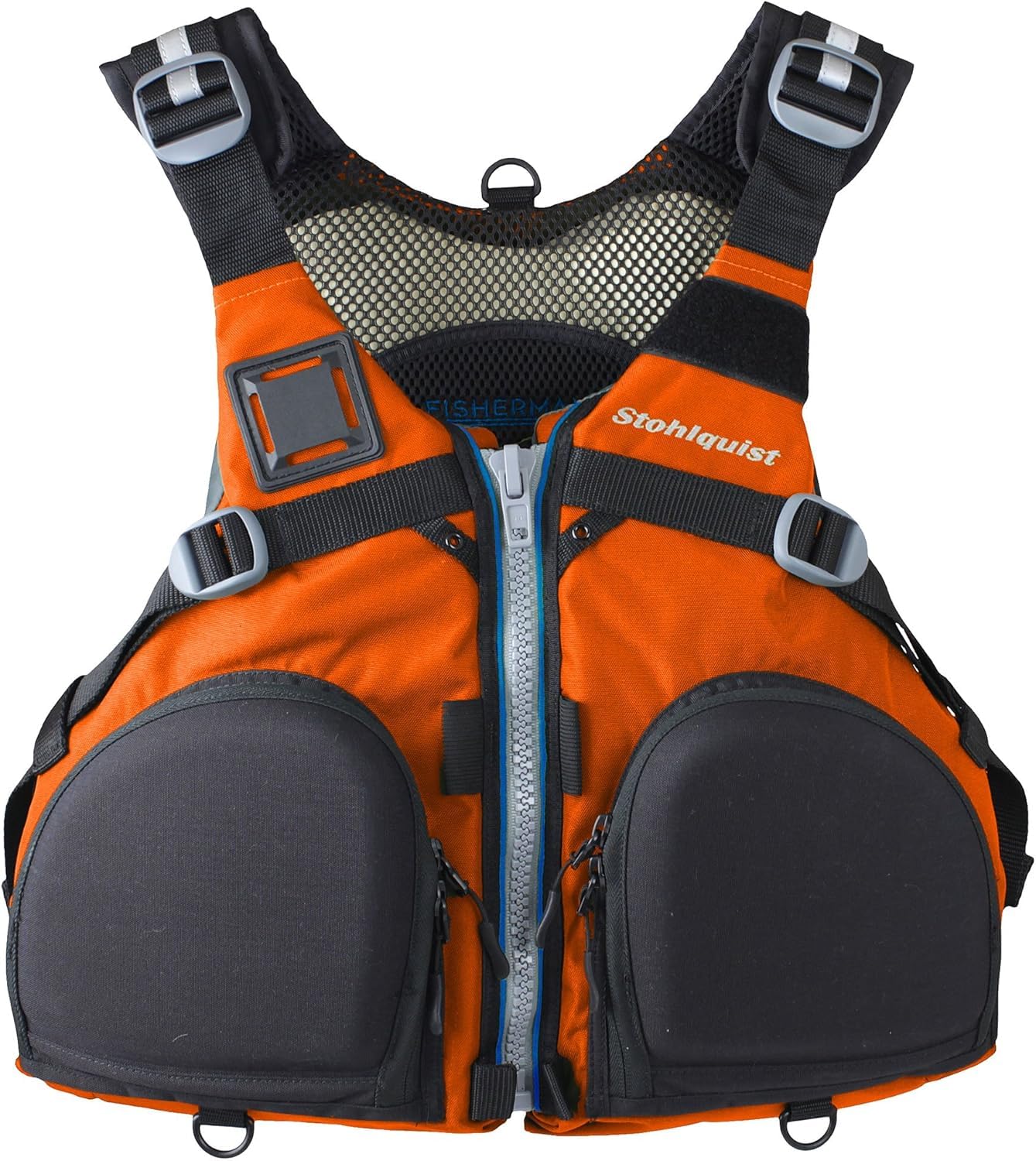
The Fisherman earns the top spot for one specific reason: a graded sizing system with a maximum weight recommendation of 300 pounds and a fit that stays put once you dial in the straps. Its USCG Type III approval means it is a foam vest you can wear and forget about maintenance. The sea level buoyancy is 16 lbs 4 oz, a sensible figure for inshore sailing and day trips. Contrast that with the Mustang inflatable, which delivers 28 lbs only after it inflates.
The mesh-back design is the detail that matters for sailors. It leaves clearance around a tall seat back so the vest does not shove your head forward while you steer. The outer shell is 500 denier Cordura with a 200 denier oxford liner — a durable fabric grade that holds up to snagging on cleats and shackles. Two EVA pockets fold down into flat work surfaces, which is genuinely handy when you need a spot for a shackle key or a snack.
Fit is where this vest wins people over. The chest adjusts through the straps to lock the vest down and stop it riding up. Buyers report: “Fits great at 6’2″/230#/47″ chest in XXL; high-quality materials, no loose threads; spacious zippered pockets, functional D-rings/loops; adjustable straps dial in fit, no ride-up, full arm mobility. Durability TBD.” What the review pages sum up is that it works for both heavyweight and average frames, with room to layer underneath on cold days. The catch is the front pockets — hardened panels that fit larger phones only by a hair, and smaller ones get crowded out by pliers and tackle.
pocket-heavy fishing cut
- Graded sizing up to a 300-pound maximum weight recommendation
- Mesh back clears a tall seat back for a better seated fit
- 16 lbs 4 oz of sea level buoyancy with USCG Type III approval
- 500 denier Cordura shell holds up to deck hardware
- The straps cinch it down with no ride-up, so it stays put
bulky shoulders
- Pockets run tight — larger phones fit only barely
- Needs a belly buckle for easier zipping
- Durability is still being watched, not proven over seasons
anglers wading rivers: bigger frames and anyone who wants a rugged foam vest that never needs a cartridge or a check.
paddlers wanting slim: you sail in cold open water where the extra lift of an inflatable matters more than a simple foam vest.
2. Mustang Survival M.I.T. 100 Inflatable PFD Automatic
Barely there until the water hits it, then 28 lbs of lift fires up.
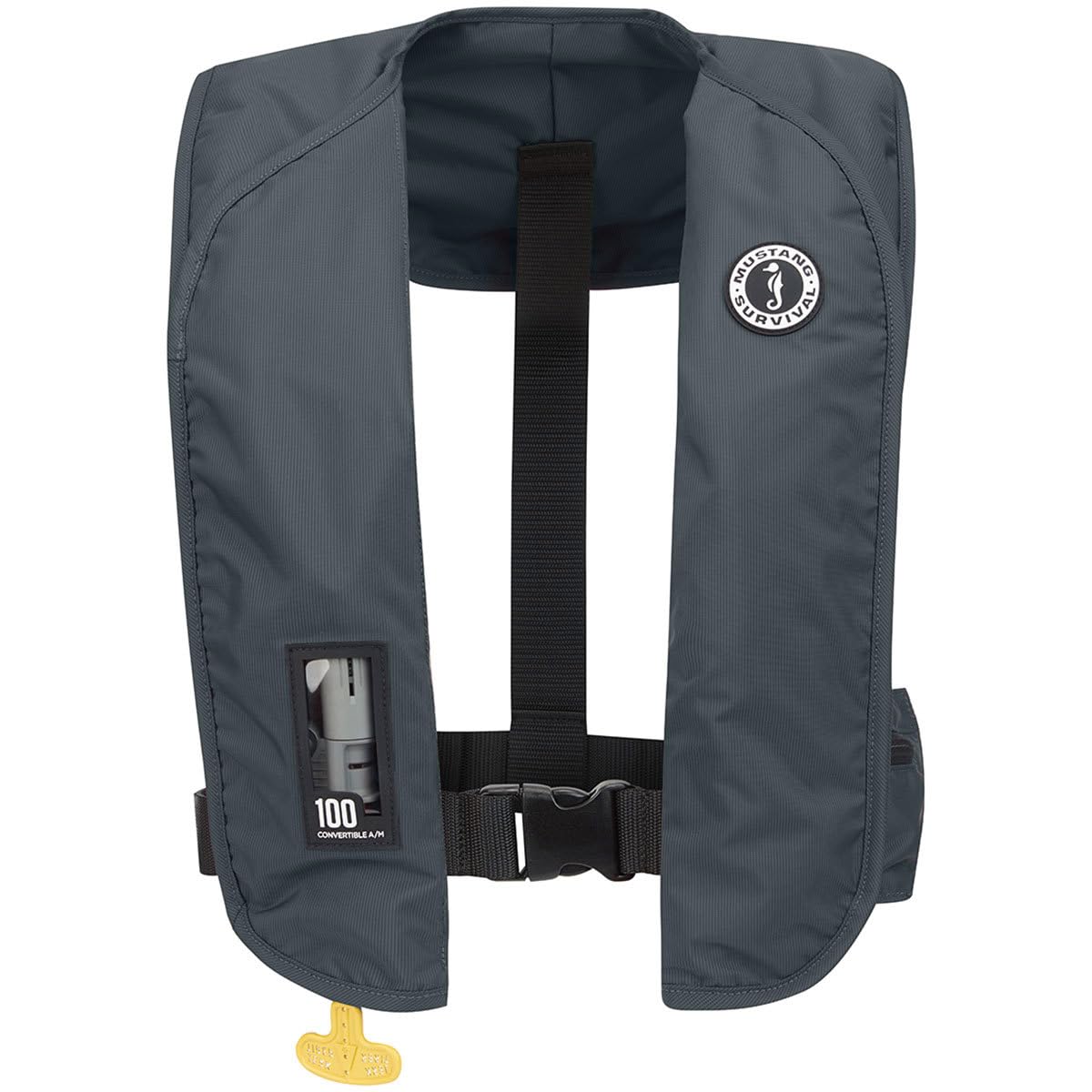
For a sailor heading into cold water or an offshore passage, this is the pick that trades bulk for auto-inflation. It delivers 28 lbs of buoyancy once inflated — the maker states that is 1.5x regular foam PFDs. Compare that with the 35 lbs of the BLUESTORM Stratus 35 for a sense of where it sits — a middle step between light foam and the highest-lift inflatables. The Membrane Inflatable Technology keeps the fit flexible so it folds down around your body instead of sitting like a cushion.
The safety systems work two ways. It inflates automatically on water immersion for the case where you go over unexpectedly, and it also has a manual inflation cord so you can fire it yourself. The 1-fold repack design means you can reset it without a wrestling match, and the Re-Arm Kit D keeps it serviceable over time. At 1.8 pounds it barely registers on your shoulders during a long watch.
What wins buyers over is build quality and low-bulk comfort on a long watch. Owners mention: “Purchased for Quebec fly-in fishing; low 60s water requires reliable PFD. Mustang brand high quality, reliable, beats bulky clammy foam vests despite higher price.” That same pattern holds for sailors who want a vest they can forget is on. The trade-off is honest: an inflatable demands upkeep you never do with foam — you have to check the cylinder, respect the repack, and remember it only counts as approved while worn.
auto-inflates on splash: every inflatable needs cylinder checks and repacking, and this one is no different — factor that into your pre-season routine.
offshore boaters: you sail cold water and want low bulk with strong lift on demand.
budget-strapped buyers: you would rather grab a vest from a locker and never think about a cartridge again.
3. BLUESTORM Stratus 35 Inflatable Life Jacket PFD
The highest lift on this list, with a soft collar that does not claw at your neck.
If you want the most buoyancy per ounce on your body, this is it. The Stratus 35 delivers 35 lbs when inflated — the maker states that is 2.5x a Type 3 foam vest. That puts it ahead of the 28 lbs Mustang above it for raw flotation. It is a USCG-approved Type II PFD that can inflate automatically on water immersion through a replaceable CO2 cylinder, or manually with a jerk of the inflate cord or the back-up oral tube.
Comfort is a strong suit here. The ultra-breathable soft polyester collar wicks moisture away from your neck, and the 2-inch waist belt plus large adjustment slider give a snug fit for sizes from small through XXL, with a chest range of 30 to 56 inches. There is a large zippered front pocket for sunglasses, pliers, or a license. When it fires, the airbag deploys immediately — enough that it has kept a wearer’s head above water in a real fall.
The thing everyone raves about is how little it feels like a life vest. Customers note: “These seem to be of high quality and are nice and compact. If I take the boat out alone or are in not so great boating conditions I always put this on.” The recurring gripe is deployment tuning — the vest is sensitive enough that rain can set it off, so use the manual mode when you expect spray or a soaking. Larger wearers near the top of the size range may find the mid-section strap short.
light 35lb buoyancy: the fit is universal, but if you are near the outer edge of the weight range, verify the belt length before you count on a comfortable day.
kayak anglers: maximum on-water lift and a soft collar top your wish list.
broad-chested users: you spend time in the rain and want an inflatable that will not fire on its own.
4. Overton’s Universal Adult Life Jacket — 4-Pack
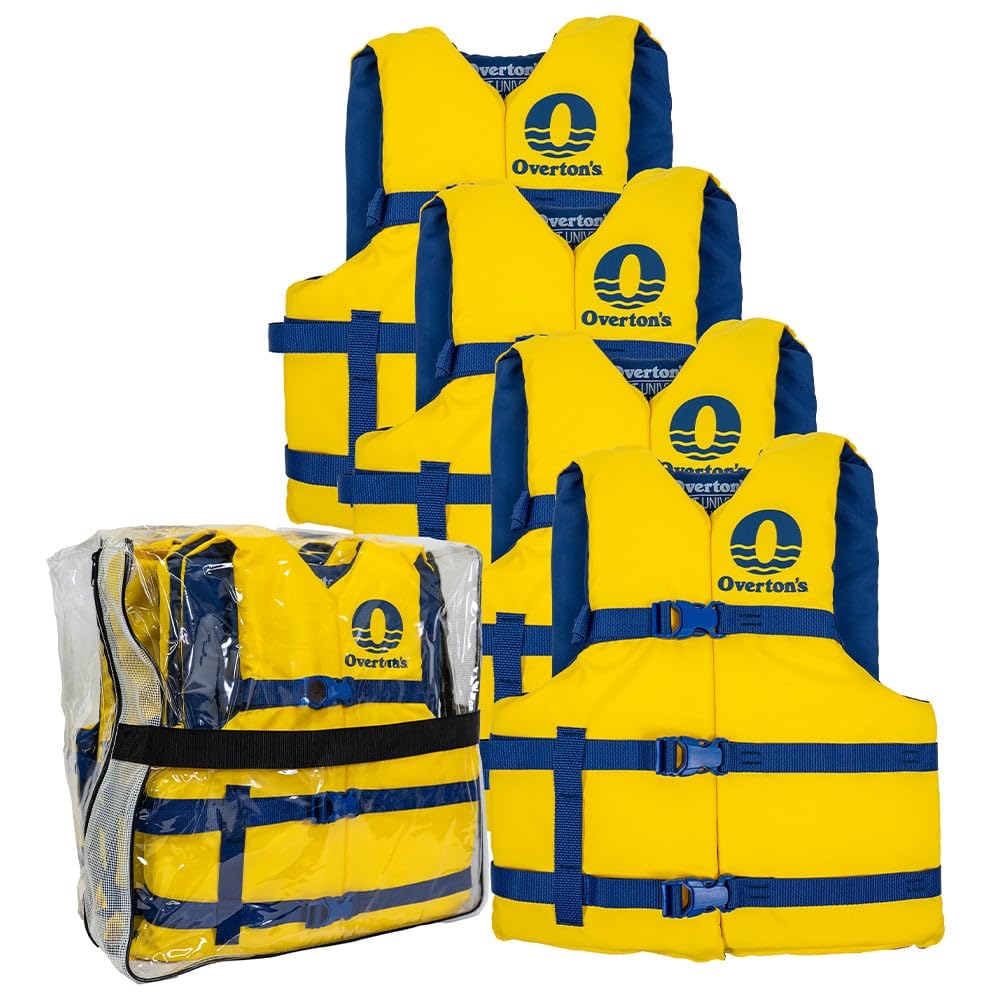
Four approved vests for guests, packed down into one zippered bag.
Not every sailing vest needs to be a personal one. This four-pack covers a crew in one go, which makes it the practical answer if you regularly carry guests who show up empty-handed. Each vest is a USCG Type III with closed-cell foam and a nylon shell, and the set includes a zippered storage bag to keep the boat tidy when the vests come off. The open sides and sturdy belt with slide-release buckles are built for quick on and off.
Fit is the thing to check carefully. These are sized to fit chests from 30 to 52 inches, but the listing itself warns that they may run small. What owners praise most is the value — a full set of approved vests without a premium per-vest spend. The appearance gets good marks too, with yellow shells that are easy to spot on deck. The functionality is simple foam that needs zero maintenance.
The recurring gripe is size. Several wearers note that a vest cut for the wide end of the range still feels snug, so if you are near the upper limit or want a loose fit, measure before you commit. Functionally they do the job, with one note that a vest met the requirements for a lighter adult. Keep the fit caveat in mind and this is a sensible way to equip a boat.
family boat crews: skippers who need a full set of approved vests for crew and guests without a big per-vest spend.
serious paddlers: you are near the top of the chest range — this cut runs snug, so confirm the measurements first.
5. BLUESTORM Cirrus26 Inflatable PFD

Switch it to manual when spray is flying, so the vest only fires when you do.
This is the inflatable that solves the rain-trigger problem. A manual-only conversion cap locks the vest so it will not auto-inflate when it gets wet — the maker recommends it for anyone who will be submerged in a non-life-threatening situation. It is a USCG-approved Type V PFD with Type III performance and 26 lbs of buoyancy — the maker states that is 2x a Type 3 foam vest. That sits between the Mustang’s 28 lbs and a lightweight foam vest.
Comfort is engineered for long days. The ergonomic collar and mesh upper back strap pull the collar down and away from your neck, and the long shell design puts the waist belt in a lower position on your body. It weighs 16 ounces and takes a maximum weight recommendation of 350 pounds. There is an internal spare CO2 cylinder pocket and an accessory attachment point. On the water it is compact enough to forget you have it on.
Quality is what comes up most. Reviewers point out: “This is perfect for me. I do a lot of kayak fishing and the big bulky normal life vests are not ideal.” For a solo sailor or a small-boat skipper, it stows flat and comes out only when needed. The honest trade-offs: the auto-fire can be set off by rain, and the value depends on whether you will use the convertibility to its full extent.
compact 26lb pack: after a deployment the cover pops off and can be pushed back on, but budget for replacements and a little practice packing it flat again.
traveling paddlers: you want inflatable lift with the option to lock out auto-inflation in wet weather.
cold-water sailors: you prefer a foam vest with zero conversion steps and nothing to check.
6. Stohlquist Piseas Lifejacket

A trim foam vest that crosses over from the paddleboard to the small sailboat.
The Piseas is a USCG Type III vest that also meets Transport Canada standards, which is useful if you sail north of the border. Its TruSize fit is cut for more body types, and a cross-chest cinch pulls it down to stop ride-up. The mesh-back design clears the seat for ventilation and easy seated work. It weighs 1.6 pounds and uses a 500 denier Cordura outer with a ripstop build.
Storage is the selling point on deck. Dual zippered pockets fold down into compact work surfaces for small tools and a phone, and the multiple mounting points make it easy to hang a whistle or a knife. It is the kind of vest that suits a mixed day — some sailing, some paddling — where you want pockets and an easy fit without overthinking it.
The catch appears in the details. The pockets are on the smaller side and front-pocket items can drop when the zipper is open, since there is no under-zipper strap to secure the jacket when unzipped. A single hard-run zipper failure has also been reported. Treat it as a light-use vest and it delivers where it counts: comfort, clearance, and storage for a modest shell.
sea kayakers: you want a lightweight foam vest with pockets for a mix of sailing and paddling.
gear-heavy anglers: you need a vest that holds a heavy tool load securely day in and day out.
7. O’Neill Men’s Slasher Comp Neoprene Vest
Built to move, not to pass a Coast Guard inspection.
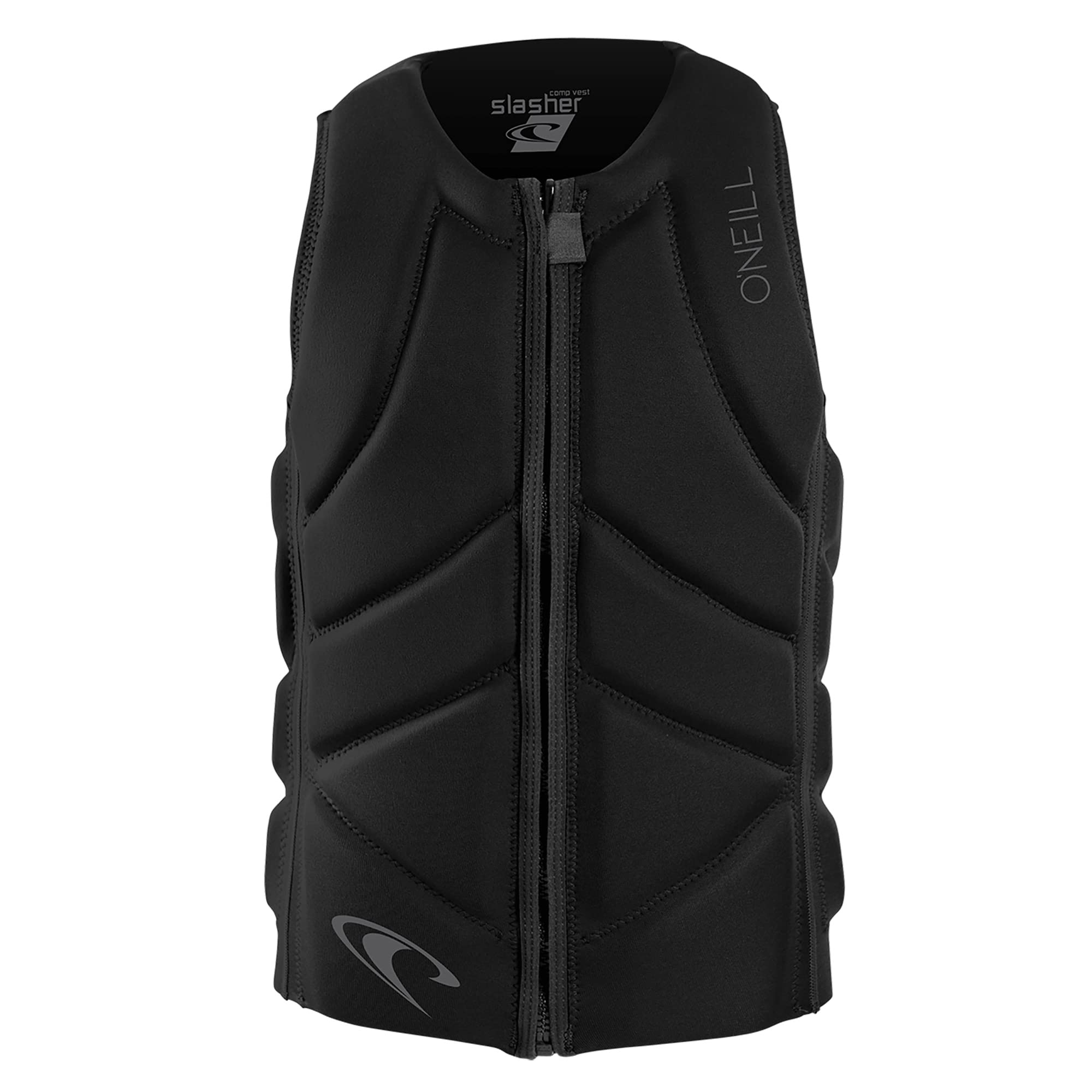
This needs a clear label up front: it is not approved by the U.S. Coast Guard. O’Neill builds it for competition waterskiing and wakeboarding, so it belongs on this list only as a cross-reference for someone who wants a snug impact vest for time in the water between races. If you need a legal sailing PFD, start with the Fisherman or an inflatable instead. If you want an unrestricted fit while you move, this is the shape for it.
The NytroLite foam core is, per the maker, 3x lighter, 10% more buoyant, and absorbs 15–20% less water than regular PVC foam. Segmented foam and anatomical flex points let your arms and torso move freely, and the front zip gets it on and off in a hurry. At 16 ounces it is one of the lightest vests here, matching the weight of the Astral V-Eight and the Cirrus26.
Comfort and movement are what owners come back to, and it does not slide up while you swim. Sizing runs small — a fit that needs a full size up is common — so check the chart before you buy. The reversible design is a nice touch, though the inner tag makes inside-out wear awkward in practice.
wakeboarders: high-impact water sports where unrestricted movement matters and you have another approved vest for the boat.
cold ocean swims: you sail where an approved PFD is required — this one is not USCG certified.
8. NRS Chinook Fishing Life Jacket

The tackle-box vest for sailors who fish when the wind dies.
Its zippered front entry gets it on fast, and six adjustment points let you mold the fit to your body. The high-back design with PlushFit foam pairs with a mesh lower back for ventilation, so it works against a kayak or boat seat on a warm day.
Storage is where it earns a spot. Two large clamshell pockets are sized for tackle boxes and feature internal organization built from angler feedback. A single exterior pocket on the right side holds a quick-reach item, and a fifth tool-holder pocket secures pliers or line cutters with a hook-and-loop fastener. There is also a rod holder, a strobe attachment point, reflective accents, and a knife lash tab. The shell is 400-denier ripstop nylon.
This one suits a sailor who fishes — someone who wants the vest to hold tackle, tools, and a rod while remaining comfortable in a seat. It runs custom-fit, so take the time to set the six points properly. If you want a plain sailing vest with no tool clutter, the simpler Fisherman is the tidier choice.
kayak fishermen: anglers who sail and want their tackle and tools on their chest, not in a bag.
casual lake floaters: pure sailors who want a clean, pocket-free vest.
9. Astral V-Eight Fisher Life Jacket
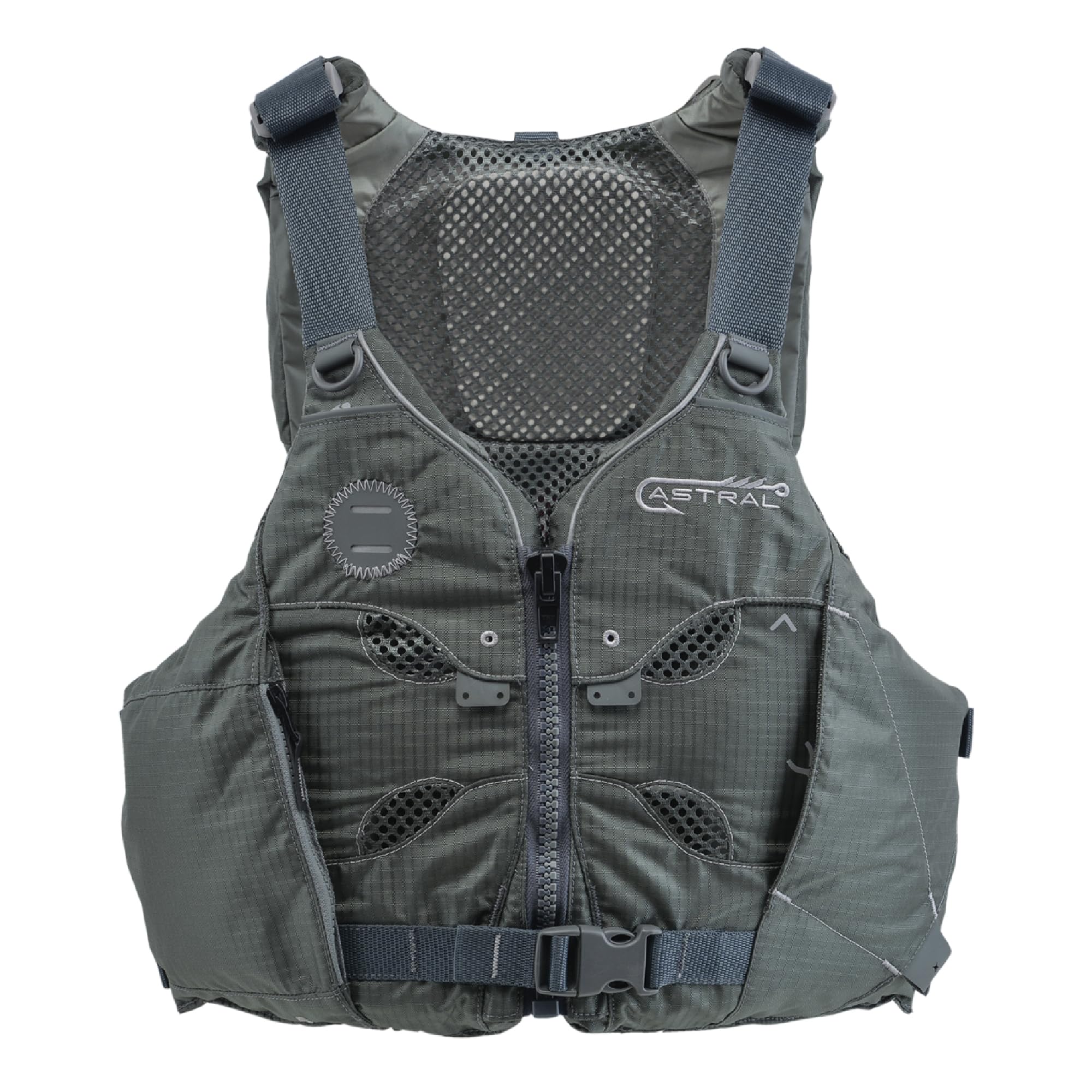
The hot-weather vest that keeps air moving so you do not bake on deck.
The V-Eight is a USCG Type III vest with 16 lbs of design buoyancy, built around the Airescape Airflow System that keeps air circulating to hold down heat. The high mesh back accommodates a seat comfortably, so it works whether you are at the helm or fishing from a kayak. It weighs 1.4 pounds and uses a 420 x 220D nylon ripstop shell with a YKK Auto-Locking Vislon zipper. Sizing runs in three ranges — S/M at 31 to 37 inches, M/L at 38 to 44 inches, and L/XL at 45 to 51 inches.
Storage is designed around fishing. There is a pliers holster, an easy-access slip pocket, a zippered pocket, and clipping points for line nips. Hook-and-loop shoulder straps work with the side straps and front entry to seat the pre-shaped foam correctly at the front and back. That is what stops it from riding up on your neck while you move around. The foam inserts are polyethylene and EVA.
What wins people over is the breathability and the comfort around the neck and shoulders. It fits well above a tall seat without neck-riding, and the vented back keeps you cool on hot days. What is mixed is the value read — it is a premium-priced vest, and the spend is the main question. Treat it as a comfort-first choice for warm-weather sailing and fishing.
breathable mesh back: the venting that makes it comfortable in heat is the same feature that means less closed coverage — choose it for warm days, not cold passages.
hot-weather paddlers: warm-weather sailors and kayak anglers who roast inside a closed foam vest.
rough-water users: you sail cold water and want more lift than 16 lbs.
Know the Specs
Buoyancy in pounds (lbs)
This number tells you how much lift the vest provides once it is inflated or floating. Foam sail vests hover around 16 lbs, while inflatables reach 26 lbs, 28 lbs, or 35 lbs. For inshore day sailing, a lighter foam vest is easy to wear; for cold water or open passages, the higher-lift inflatables give you more margin. Always check the figure against the approval type, since a Type V only counts while worn.
USCG approval type
The US Coast Guard rates vests by type. Type III is the classic foam vest, ready to wear with no upkeep. Type V inflatables offer similar performance but only count as approved while you have them on. Some vests, like the comp vest here, are not approved at all, and those are for sport use only. If you sail where a legal PFD is required, check this rating first.
Mesh back and seat clearance
A mesh or high-back design leaves room around a tall seat so the vest does not push your head forward. That matters when you are seated at the helm or in a kayak for hours. Look for a high-back cut and a cross-chest cinch that pulls the vest down. Together they hold the vest in place so it does not ride up around your ears while you work the lines.
Chest sizing and fit
Chest ranges and fit notes tell you how the vest will sit before you try it. Some run from 30 to 56 inches and fit a universal range, while others come in graded S/M, M/L, and L/XL cuts. Weight recommendations combine with these. If you are near the upper limit, measure carefully, since several vests here are noted as running snug for bigger frames.
Common Questions
Is a foam PFD or an inflatable better for sailing?
How much buoyancy do I need for coastal sailing?
Can an inflatable PFD inflate by accident in the rain?
What is the difference between Type II and Type III PFDs?
How should a sailing PFD fit over layers?
Is a comp vest like the O’Neill Slasher legal to wear while sailing?
Does an inflatable PFD have to be worn to count as approved?
How often do inflatable PFDs need servicing?
Can I use a fishing PFD for sailing?
The Bottom Line
For most sailors, the winner here is the Stohlquist Fisherman Lifejacket because it pairs USCG Type III approval with graded sizing up to a 300-pound weight recommendation and a fit that stays put. If you sail cold water and want low bulk with 28 lbs of lift on demand, reach for the Mustang M.I.T. 100. And if you want the most lift on the list, the BLUESTORM Stratus 35 delivers 35 lbs with a soft collar that spares your neck. Match the vest to your water and your crew, and it will be on your back every time you cast off.
How we choose
We do not accept paid placement. Every pick is matched to a real buyer and a real use-case; we do not hands-on test units.
Sources
Specifications: manufacturer listings and product documentation. Review insights: verified customer reviews, as of October 2026. Pricing: not shown on this page (it changes often); check the current price via the retailer link.
As an Amazon Associate, Aappliancez earns from qualifying purchases. This does not affect which products we feature.