Disclosure: Some links in this post are affiliate links. As an Amazon Associate I earn from qualifying purchases, at no extra cost to you. Learn more
Specs are compiled from manufacturer listings and verified buyer reviews and can change over time — please confirm the key details on the product page before buying.
A hex bar solves one very specific problem: it lets you pull, squat and carry without a straight bar dragging your lower back into the lift. The catch is that buying one blind is genuinely risky. Frame width, handle diameter, sleeve length and plate-hole size vary wildly, and the wrong bar either won’t take your plates or puts your hands somewhere your elbows hate. This guide walks through nine real options on Amazon and shows you which one actually fits how you train.
This guide is built by comparing the manufacturers’ published specifications and the patterns across verified customer reviews, so you get each pick’s real strengths and trade-offs instead of marketing spin.
Everything below is sorted by what the bar does for you, not by what the listing shouts loudest. By the end you’ll know which frame width, handle height and capacity actually match your plates and your ceiling — so you can pick the right hex bar first time and skip the return label.
Top Picks


How To Choose The Best Hex Bar
Most first-time hex bar buyers get tripped up by the same three things: plate size, frame width and handle height. Get those right and almost any bar on this list will serve you for years. Get one wrong and you’ll be lugging it back to the courier.
Start with your plates, not the bar
Your weight plates dictate which bars can even load. Olympic plates have a 2-inch hole in the middle; standard plates have a 1-inch hole. A bar built for one will not accept the other without an adapter. If you already own a pile of 1-inch plates, look for a bar with a 1-inch mounting hole. If you’re building an Olympic setup from scratch, a 2-inch sleeve is the long-term play.
Frame width decides your stance and your comfort
The width of the hex frame is what your body sits inside. A narrow frame keeps everything tight; a wide frame gives your legs room but pushes your hands further apart. That second part matters more than most people expect, because wide-set handles load your elbows and shoulders differently on heavy pulls. Read the width figure honestly and measure the space between your own hands on a comfortable grip.
Raised or flush handles, and why it changes everything
Raised handles lift your starting position off the floor, which shortens the pull for anyone with stiff hips or a limited setup. Flush handles put you closer to the ground and give you more range of motion. Some bars let you flip them to switch between the two. If you want to train the full pull, flush or convertible is the better route; if you want to get under load comfortably, raised is kinder.
Bar weight is not the same as capacity
Two figures come with every hex bar and buyers confuse them constantly. The bar weight is what the empty bar itself tips the scale at. The rated capacity is the maximum load the manufacturer says the frame will take. A heavier bar eats into your usable load, but it also tends to feel steadier underfoot. Neither number tells you the other.
Side-by-Side Comparison
Every row uses the same three dimensions so you can scan across and compare like for like. Where a manufacturer doesn’t publish a number, the cell reads “—” rather than a guess.
| Model | Best For | Plate Hole Size | Rated Capacity | Bar Weight | Amazon |
|---|---|---|---|---|---|
| Sunny Health & Fitness Olympic Hex Trap Bar★ Best Overall | Rotating handles for easier wrist work | 2 inches | 400 LB | 22 pounds | Amazon |
| Fitvids Olympic 2-Inch Hex Trap BarMost Sleeve Room | Long loadable sleeves | 1.97 inches | 500 pounds | 47 pounds | Amazon |
| CAP Deluxe Open Trap BarBest For Mixed Plates | Standard and Olympic plates in one bar | 1 inch (2-inch adapter included) | 500 pounds | 30.9 pounds | Amazon |
| Jayflex Hyperbell Dumbbell Converter | Turning adjustable dumbbells into a bar | — | Up to 200 lb | 5 pounds | Amazon |
| GYMAX Olympic Folding Trap Bar | Folding storage in tight spaces | 1 inch | 800 pounds | 35 pounds | Amazon |
| Synergee Olympic Hex Barbell | Standard-height knurled handles | 28 millimetres | 750 lb | 18.82 kg | Amazon |
| Titan Fitness Olympic Hex Trap Bar | Raised handles for easier setup | 48 mm | 500 lb | 44 pounds | Amazon |
| XMark Tri-Grip Hex Trap Bar | Three grip diameters in one bar | 2 inches | — | — | Amazon |
| Bells of Steel Open Hex Trap Bar | Built-in jack for fast plate changes | 2 inches | 700 lb | 47 pounds | Amazon |
Detailed Reviews
1. Sunny Health & Fitness Olympic Hex Trap Bar
Our pick — 4.5+★ from 750+ verified ratings; the strongest balance of quality and price.
Swivel handles that let your wrists turn naturally through every rep — and a bar light enough to move around.
If your wrists are the thing that complains after a heavy pulling session, this is where to start. The handles rotate a full 360 degrees (they spin freely as you lift) and carry a diamond knurled pattern (a small crosshatch cut into the steel for grip). That combination lets your hands find their own angle instead of locking you into one position, so the pull travels through your arms rather than fighting them. At 4.5+ stars across 770+ owners, it’s the crowd favorite on this list, and the build quality is the single thing people keep coming back to.
The bar itself weighs 22 pounds, which is the lightest proper trap bar here — the Fitvids below is 47 pounds, so you’re carrying well over double. That matters if you store your bar on a wall rack or move it between rooms. The loadable sleeves are 11 inches long and take 2-inch Olympic plates, rated to 400 LB, and each bar ships with two weight clips to hold plates in place. The 57.5-inch length is the longest in this lineup, ahead of the Fitvids at 56 inches, so check your wall space before you commit.
Here’s the honest limit, and it comes straight from how owners talk about it. The rotating handles sit above the bar, which shortens your range of motion — you’ll want a deficit platform or a raised stance if you’re chasing a deep pull. Buyers also report the empty bar weighing in lighter than a standard heavy trap bar, so treat the 400 LB rating as the working ceiling rather than a target. For a home setup doing deadlifts, shrugs, farmer carries and squats, those are fair trade-offs against the price and the portability.
What earns it the top spot
- 360-degree rotating handles ease wrist strain through the whole pull
- 22 pounds makes it the easiest bar here to move and store
- 11-inch sleeves give you real room to stack plates
- Knurled grip holds without shredding your palms
Where it asks you to adapt
- Raised handles shorten the pull — a deficit platform helps
- Lighter empty weight than a traditional heavy trap bar
- Longest frame here at 57.5 inches, so measure first
Reach for this if: you want an easy-to-live-with trap bar for deadlifts, shrugs and carries in a home gym, and wrist comfort matters to you.
Look elsewhere if: you pull near the rated ceiling or need every inch of range of motion from a flush-handle design.
2. Fitvids Olympic 2-Inch Hex Weight Lifting Trap Bar
Seventeen inches of loadable sleeve on each side — the most plate room of any bar here.
Plate stacking is the whole pitch. The sleeves run 17 inches per side, which is far longer than the 9.75 inches on the Titan below or the 10 inches on the Synergee, so you can pile on more weight before you run out of real estate. The frame is built from solid steel rather than hollow tubing and is rated to 500 pounds. The bar ends measure 1.97 inches in diameter, sized to seat 2-inch Olympic plates cleanly.
One thing needs saying plainly, because it’s the whole story with this listing. The bar has a single rating on record, and it is a one-star review from a buyer who describes chipped paint, uneven knurling and “razor sharp edges that cut my hand removing it from the box.” That is not a pattern — it’s one experience, and it may well be a shipping or quality-control miss on a single unit. But you should go in knowing that finish quality is unproven here and that a careful unboxing is wise.
The spec case: 17-inch rotating sleeves and a 500-pound rating are genuinely strong numbers on paper, and the 56-inch length keeps the frame compact enough for a garage corner.
The catch: with a single recorded review, there’s no track record to lean on. If you need certainty about welds and finish, the Titan or the Bells of Steel below have far more evidence behind them.
The deciding question: do you need maximum sleeve length for heavy plate stacking? If yes, this delivers it.
Pause if: unproven finish quality would bother you more than extra loading room would help.
3. CAP Deluxe Open Trap Bar
An open U-frame that accepts both 1-inch and 2-inch plates — rare, and genuinely useful.
Here’s the spec that makes this bar worth a look: it takes 1-inch standard plates and 2-inch Olympic plates, usually via an included adapter. If you’re sitting on a pile of standard plates from an old set, that alone can save you from buying a second bar. The frame capacity is 500 pounds, and the open U-shape means you can step in from the front for lunges and split squats, not just deadlifts. It’s also the lightest full trap bar here at 30.9 pounds.
Where the bar draws mixed reaction is width. Owners describe the frame as surprisingly wide, with the outer handles putting stress on the elbows — one tall lifter found the spread awkward, and the general read is that it suits broader frames better than narrow ones. Handle spread and frame width are the numbers to check against your own body before ordering. Build quality and ease of assembly are what carry it, and the sturdiness of the frame is the thing people come away impressed by.
The other thing to know: the handles are fixed in a wide position and the bar is hollow-built. Several owners flag that heavy low-rep pulling is where it shows its limits, while high-rep work and lighter movements are where it’s comfortable. As one owner put it, this is a bar for rows and moderate loads rather than one-rep max attempts. At 500 pounds rated, that’s not a defect — it’s an honest ceiling for a bar at this build weight.
Who this solves a problem for: anyone with standard 1-inch plates who wants an open frame for lunges and carries without buying a second weight set.
The trade-off to accept: a wide handle spread that some lifters find hard on the elbows, and a hollow build that’s better suited to volume than to maximal singles.
Fits you if: you’ve got standard plates and want an open-frame bar for lunges, rows and carries.
Walk past if: you’re narrow-framed or planning to pull close to the 500-pound rating often.
4. Jayflex Hyperbell Dumbbell Converter
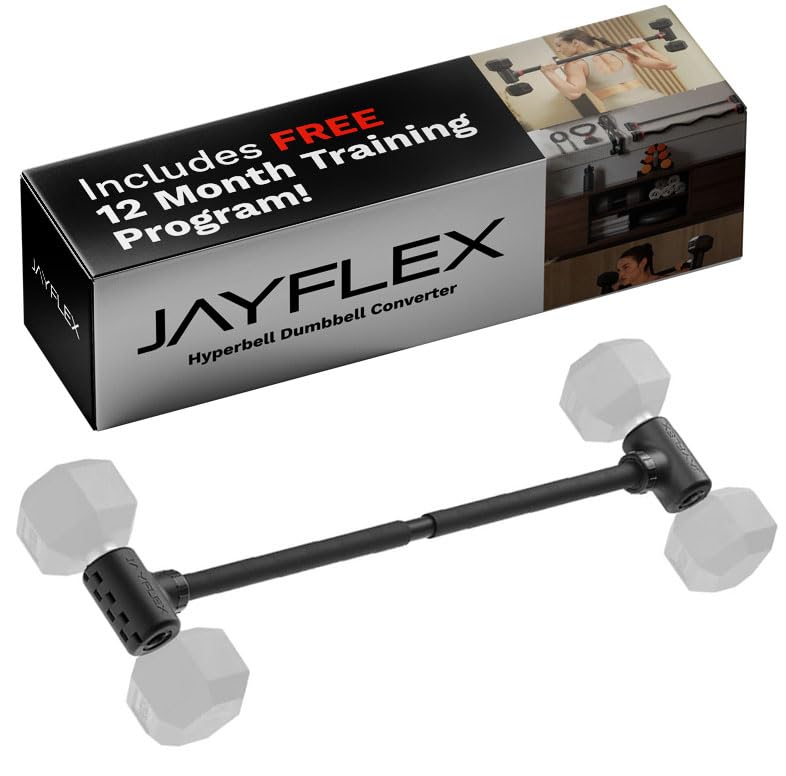
Not a trap bar at all — a 5-pound converter that turns your adjustable dumbbells into a bar.
This is the odd one out on this list, and I’m keeping it in because it solves the exact problem some readers have. If you already own adjustable dumbbells and have zero floor space for a real trap bar, this 40-inch converter bar clamps onto them and gives you a straight-bar feel. It’s rated up to a 200 lb capacity, weighs just 5 pounds on its own, and fits dumbbells with handles up to 1.5 inches thick and at least 4.5 inches long. Buyers report it working cleanly with Bowflex SelectTech sets.
Now the honest part. This is a converter, not a trap bar, so it doesn’t give you the neutral-grip, weight-centred pull that makes a hex bar easy on the back. Owners describe some play in the foam grip and a tendency for the bar to sit off-orientation with non-circular dumbbells. The plastic screw collars need care too — cross-threading them is easy if you force them. What it does well is save space and money for someone building a home gym around dumbbells.
Versatility is where it wins people over — it opens up barbell-style movements like squats and bench presses without doubling your equipment. But go in expecting a stand-in, not a replacement. If deadlifting with a neutral grip is your goal, a real hex bar is the right tool.
The genuine win: a 5-pound bar that open up barbell movements from dumbbells you already own, with a 200 lb ceiling and real space savings.
The honest trade-off: it’s not a trap bar. Expect some grip play and careful handling of the plastic collars.
Pick this if: you own adjustable dumbbells, want barbell-style lifts, and have no room for a full hex bar.
Don’t pick this if: you actually want a trap bar’s neutral-grip pull — this won’t give you one.
5. GYMAX Olympic Folding Trap Bar

An 800-pound rating and folding handles — the highest capacity in this lineup folds flat for storage.
Storage is the reason this bar exists. The handles fold down so the 56-inch frame tucks against a wall or into a corner, which is the difference between owning a trap bar and having nowhere to put one. Capacity is the standout number: 800 pounds, the highest of any bar here, ahead of the 700 lb on the Bells of Steel and the 500 lb on the Titan. It’s chrome-finished over an alloy steel frame and weighs 35 pounds.
Two grip positions arrive on knurled stainless handles — the coarse diamond texture gives you a secure hold without slipping. It uses a 1-inch mounting hole, so this is a bar for standard plates, not Olympic ones. Owners mention it performing well under load and holding steady around the 400-pound mark in real use. The dual handles let you switch between a flush and raised position depending on the lift.
The caveat is the 1-inch plate size. If your plates are 2-inch Olympic, this bar won’t take them without an adapter, so check your plate holes before anything else. Some owners also note the bar runs lighter in the hand than its capacity suggests, and the included spring clips are what you get from the start rather than premium collars.
Where this bar shines
- 800-pound rating is the highest capacity in this lineup
- Folding handles turn a 56-inch frame into a storable one
- Two knurled stainless grip positions give you flush or raised pulls
- Chrome finish holds up without rust or bubbling
What to check first
- 1-inch mounting hole means standard plates only
- Spring clips ship in the box rather than premium collars
- Feels lighter in the hand than its 800-pound ceiling implies
The right fit: you lift with standard 1-inch plates and need a trap bar that disappears when the workout ends.
Wrong turn if: your plates are Olympic 2-inch — this bar won’t accept them as-is.
6. Synergee 20kg and 25kg Olympic Hex Barbell Trap Bar

A 20kg chrome bar with standard-height knurled handles and a 750 lb rating.
Some lifters want a trap bar that feels like a real barbell — same weight class, same finish, same steady feel in the hands. At 20kg (18.82 kg listed), this one sits right at that familiar barbell weight, and the chrome over alloy steel gives it the look and wipe-clean finish you’d expect. The 750 lb rating is among the highest here, and the 10-inch loadable sleeves take 2-inch Olympic plates and 28 mm mounting holes.
The handle design is the detail worth weighing. It’s a standard-height, non-slip knurled grip at 1.2 mm knurl depth, which is moderate rather than aggressive. That’s a plus if you’re doing high-volume work and don’t want your palms torn up, but owners do describe the knurling on the dual-handle version as aggressive enough to grip hard. The bar is 56 inches long and 23 inches wide, which is on the narrower side of this list.
Two honest points sit on the reviews. One owner reports the bar arriving bent, with the handles sitting at an angle — an occasional shipping or quality-control miss worth inspecting for on arrival. And there’s a discrepancy in the grip diameter: some listings quote 28 mm while owners measure closer to 25 mm, so don’t buy it purely for an exact hand-feel spec. The packaging has also drawn complaints, so check the box before signing.
Why it earns a spot: a faithful 20kg barbell feel, a 750 lb rating, and moderate knurling that suits volume work.
What to verify on arrival: check the bar is straight and handles are evenly set, and treat the quoted grip diameter as approximate.
Good match for: lifters who want a chrome trap bar that feels like a standard barbell and handles moderate volume deadlifts.
Think twice if: you need an exact grip diameter or want a heavier-duty build for maximal loads.
7. Titan Fitness Olympic Hex Trap Bar
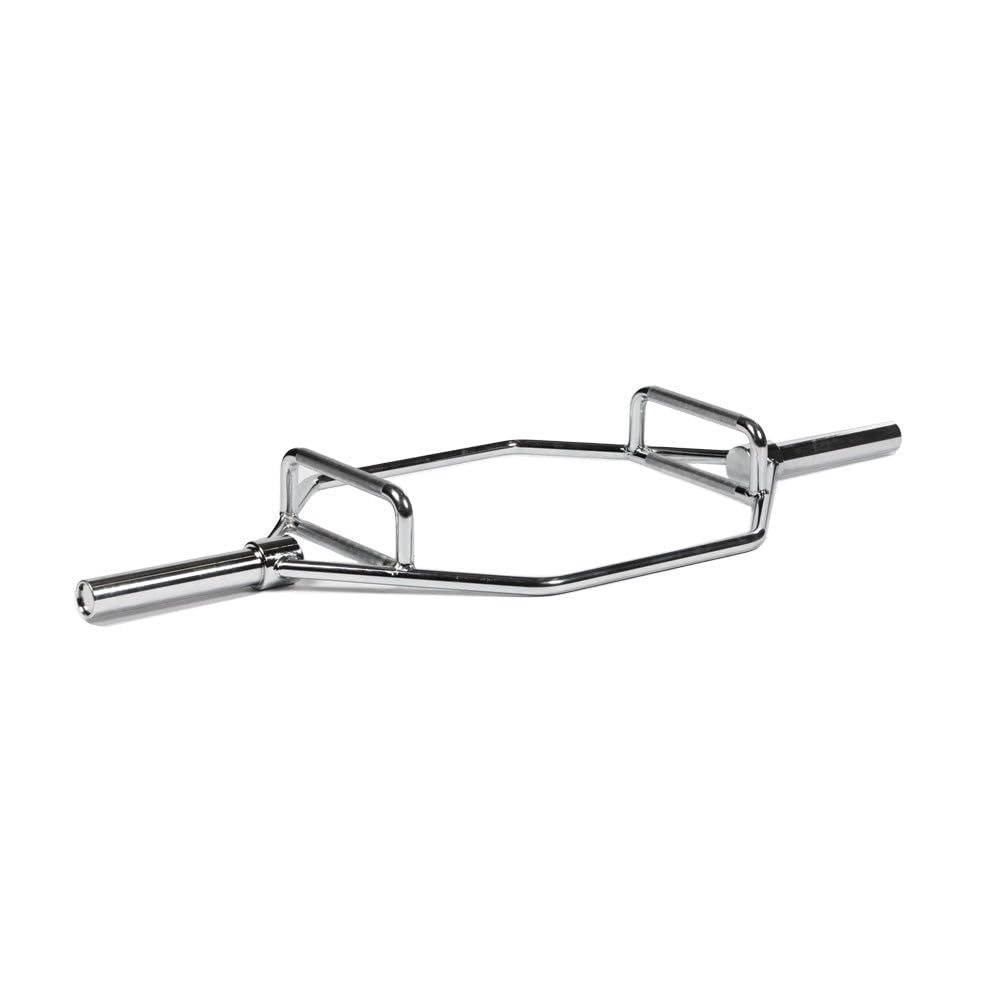
Raised handles standing 6 inches off the floor — the easiest setup of the standard bars.
Setup ease is what this bar is built around. The handles sit 6 inches up from the floor, so you’re not bent as deep to get your hands on them between sets, and the two sets of 25 mm medium diamond knurled handles let you flip the bar to switch between handle heights. Overall it’s 56 inches long, 22.75 inches wide with a 44-pound frame, and the 9.75-inch sleeves take standard Olympic plates at 48 mm diameter. Rated to 500 lb.
What separates it from the Synergee above is evidence. This is the second-most-reviewed bar on the list and the build quality is the single thing that carries it — welds, grip and weight capacity all draw consistent praise, and it holds heavier loads without form breaking down. One lifter’s household uses it as an alternative to conventional deadlifts for a spouse with mobility limits, which speaks to how accessible the raised handles make the setup.
The recurring gripes are small ones. The included spring clips are described as a little lame, so a decent pair of collars is a worthwhile add-on if you’re pressing or pulling overhead. Some knurling runs aggressive, and one owner thought the welds looked hasty although the bar performed fine. Neither rises to a reason to skip it — just things to expect.
The case for it
- Raised handles make getting set between sets easier
- Flipswappable dual-grip handles change handle height
- Consistently praised welds and construction
- Holds 500 lb without flex or form breakdown
The small catches
- Included spring clips feel flimsy — upgrade the collars
- Knurling may be too aggressive for some hands
- One report of rough-looking welds (cosmetic)
Built for: lifters who want an established, well-evidenced bar with raised handles for easier picks.
Keep looking if: you want a flush-handle pull for maximum range of motion.
8. XMark Tri-Grip Hex Trap Bar with Rotating Handles
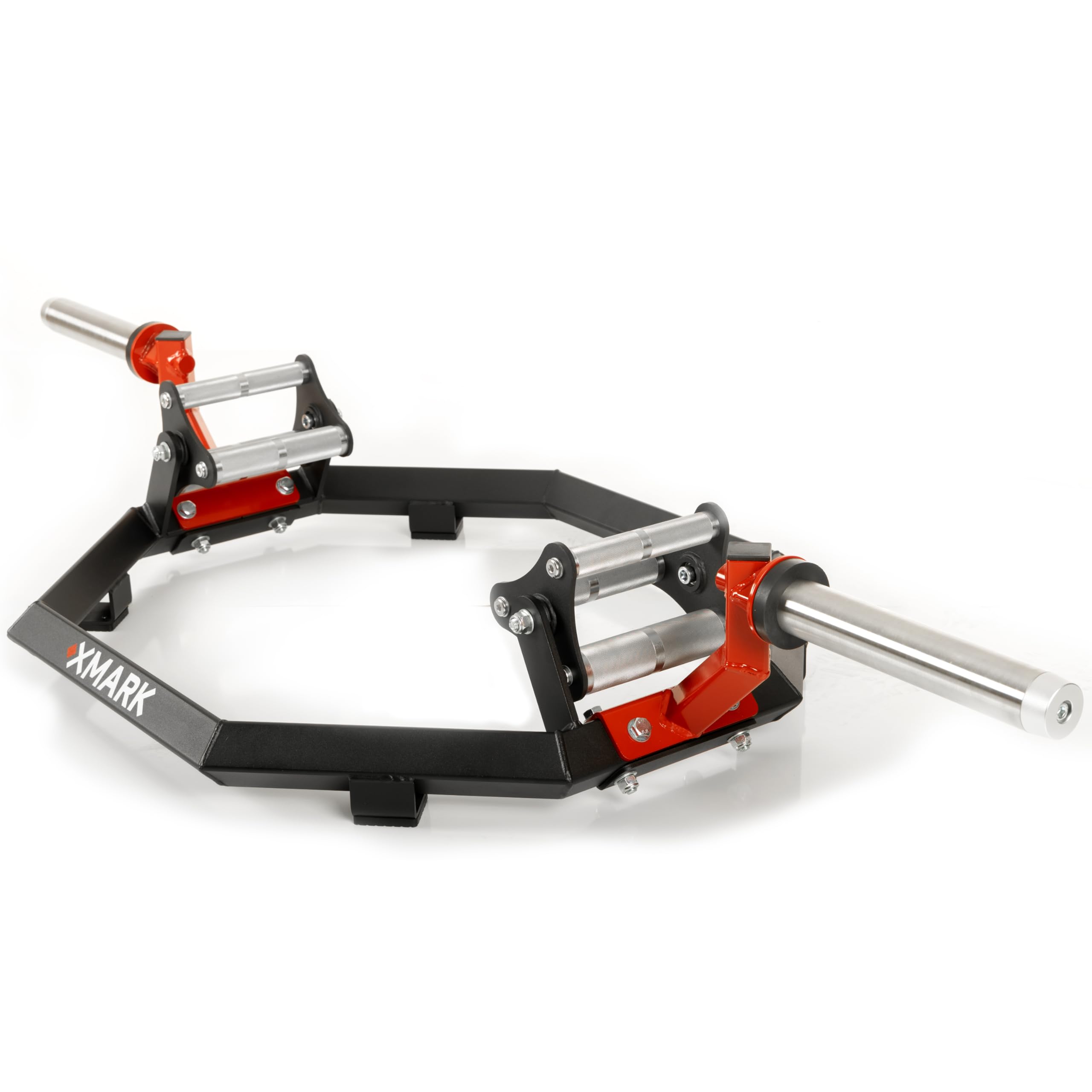
Three grip diameters on rotating handles, plus rubber feet that protect your floor.
Three grips in one bar is the headline. The knurled revolving handles come in 30 mm, 38 mm or 45 mm diameters, so you can work grip and forearm strength on the fat options and pull heavy on the standard one. The handles rotate, and improve plate storage lets you load and unload without dropping to the floor for every plate. Bolt-on rubber feet protect your flooring and give the bar a stable base while it sits loaded.
The spec that stands out is length: 69.25 inches, comfortably the longest bar in this lineup — significantly longer than the 56-inch Titan or the 59-inch Bells of Steel. That extra length is why it handles farmer’s walks so well. One taller lifter reports walking with it without the bar ever hitting their legs, which is exactly what a long front-to-back frame buys you. It weighs in at just under 70 pounds, so it eats into your usable load but feels planted underfoot.
The caveat is assembly. Owners describe a 60-to-90-minute build with a lot of bolts before it’s ready, though the instructions are clear and the result is solid once it’s together. The rotating handles also draw mixed feedback — some find them a standout for hand placement, others find them loose. For a home gym where the bar lives in one spot, the assembly time is a one-off.
What stands out: three rotating grip diameters (30 mm, 38 mm, 45 mm) and a 69.25-inch frame that’s the longest here — great for farmer’s walks and floor protection with the rubber feet.
What to budget for: a 60-90 minute assembly with many bolts, and rotating handles that some owners find looser than they’d like.
Worth it for: lifters who want to train grip with three handle diameters and need a long frame for loaded carries.
Look elsewhere if: you want a grab-and-go bar with zero assembly or a perfectly locked rotating mechanism.
9. Trap Bar Bells of Steel

A built-in jack lifts the sleeves off the floor so you load plates without bending — 700 lb rated.
The jack is the reason to look here. A built-in deadlift jack lifts the loadable sleeves off the floor so you can slide plates on and off without hauling the bar upright, and it removes a lot of the back strain that comes with plate changes. Pair that with the open frame — good for split squats, lunges and farmer’s walks, not just deadlifts — and you get a bar that’s built around daily convenience. The frame is 59 inches long, 22.2 inches wide, weighs 47 pounds and is rated to 700 lb.
The rotating sleeves are the other standout. Olympic-grade rotating sleeves reduce wrist torque under a loaded bar, so heavy pulls don’t twist your arms as the bar moves. The shaft is black oxide and the sleeves are white zinc, and it ships in a state you can use right away rather than needing assembly. Under load, customers note it feeling solid at around 400 pounds of deadlifts with no flex.
The trade-off is weight tipping. When you load a single heavy plate on one end, the bar tends to tip, which you manage by pressing down on the unloaded side. Some owners also wish the loading bar were longer for extra plate room, and the 47-pound frame means the empty bar is a real load on its own. For most home lifters those are manageable quirks, and the build quality is the most-praised aspect of the bar.
Why it’s a strong premium buy
- Built-in jack means plate changes without bending
- Rotating Olympic-grade sleeves reduce wrist torque
- Open frame covers split squats, lunges and carries
- 700 lb rating with no flex reported at ~400 lb pulls
The quirks to expect
- Bar tips when a single plate is loaded on one end
- Sleeve length could be longer for heavier stacking
- 47-pound empty bar is heavy to move around
My pick for: lifters who change plates often and want a bar that saves their back in the setup as much as in the lift.
Not for you if: you’d rather have a lighter frame or longer sleeves than a built-in jack.
Know the Specs
Plate hole size
This is the diameter of the hole in the middle of your weight plate, and it decides whether a bar will take your weights at all. Olympic plates use a 2-inch hole; standard plates use a 1-inch hole. A bar built for one size won’t fit the other without an adapter. Check this before anything else, because a brilliant bar in the wrong hole size is a very expensive paperweight.
Rated capacity
This is the maximum load the manufacturer says the frame will take, including the plates you add. It’s not the same as bar weight. A higher rating gives you more headroom as your strength grows, but the bar’s build and sleeve length also matter for how it actually handles that weight. Be honest with yourself about where your current training sits relative to the rating.
Handle height and grip
Raised handles lift your starting position and shorten the pull, which is easier on stiff hips. Flush handles put you closer to the floor for more range of motion. The knurling — that crosshatch pattern cut into the steel — is what keeps the bar from slipping, and more aggressive knurl grips harder but can be harsh on high-volume days. Choose based on comfort and your training volume.
Sleeve length
This is the loadable section on each end of the bar where your plates slide on. Longer sleeves let you stack more plates; shorter sleeves run out of room sooner. If you’re close to your bar’s capacity with heavy plates, sleeve length becomes the limiting factor before the frame does. Check it alongside the rated capacity rather than separately.
Common Questions
Will a hex bar fit my Olympic plates?
Is a hex bar easier on your back than a straight bar?
What is the difference between raised and flush handles?
Can you do squats with a hex bar?
How much does a hex bar weigh on its own?
Can a hex bar be used for farmer’s carries?
Do open-frame and closed-frame trap bars perform differently?
Will a trap bar fit standard Olympic weight plates comfortably?
Does a hex bar need assembly when it arrives?
How do I stop a hex bar tipping while I load it?
The Bottom Line
For most people setting up a home gym, the winner among these hex bar picks is the Sunny Health & Fitness Olympic Hex Trap Bar. It earns first place on the strength of its build, its 360-degree rotating handles that keep your wrists comfortable through every rep, and its 22-pound frame that you can actually move around. If you want more plate room and don’t mind an unproven track record, the Fitvids gives you 17-inch sleeves. And if plate changes without bending down are worth paying for, the Bells of Steel open hex bar with its built-in jack is the one to reach for.
How we choose
We do not accept paid placement. Every pick is matched to a real buyer and a real use-case; we do not hands-on test units.
Sources
Specifications: manufacturer listings and product documentation. Review insights: verified customer reviews, as of October 2026. Pricing: not shown on this page (it changes often); check the current price via the retailer link.
As an Amazon Associate, Aappliancez earns from qualifying purchases. This does not affect which products we feature.