Disclosure: Some links in this post are affiliate links. As an Amazon Associate I earn from qualifying purchases, at no extra cost to you. Learn more
Specs are compiled from manufacturer listings and verified buyer reviews and can change over time — please confirm the key details on the product page before buying.
A multi gym for home is the single biggest fitness purchase most people ever make, so the real question is simple: which machine will still be standing square and wobble-free after a year of daily squats, pulldowns and cable work? The answer hinges on a few physical things you can read straight off the spec sheet — the weight stack size, the steel gauge of the frame, and whether the cable system uses smooth rolling bearings or cheap sliding bushings.
This guide is built by comparing the manufacturers’ published specifications and the patterns across verified customer reviews, so you get each pick’s real strengths and trade-offs instead of marketing spin.
Every machine below is sorted so the strongest all-rounder sits first, the premium Smith machine and power cage builds fill the middle, and the compact budget-friendly stations round out the list — all covered in this guide to the best multi gym for home.
Top Picks

How To Choose The Best Multi Gym for Home
Before you pick a machine, measure your room. A power cage or Smith machine that ships in four boxes and weighs 400-plus pounds will not slide around a basement once it is built, so the spot you assemble it in is the spot it lives. Check your ceiling clearance against the tallest part of the cage, then check the floor space against the full footprint.
Weight stack versus plate-loaded
A selectorized weight stack is a tower of pre-mounted weights with a pin you pull and push to pick your load. That means no walking to a plate tree between sets, and no floor clutter from stacked plates. Plate-loaded racks are cheaper to ship but force you to buy the plates separately and load them by hand, which slows a workout and eats space.
Steel gauge and frame thickness
Frame thickness drives how much wobble you feel under a heavy rep. A rack built from 50 x 50mm steel square tube at 1.5mm wall presents a stiffer platform than a thinner tube, and weight rating scales with it — a machine rated at up to 1200 pounds handles a home lifter with room to spare. Lighter cages flex more and can walk across the floor.
Pulley quality and cable routing
Bearing pulleys roll; cheap plastic bushings slide. Rolling bearings feel smoother and wear slower, which is why you see silicone spray or light grease recommended in owner feedback. Also note the pulley ratio — a 2:1 setup means the resistance at the handle is about half the stack number, so you need a bigger stack to hit the same load.
Assembly time and tools
Most full stations take four to ten hours to build, and nearly all go faster with two people. Metric wrenches and Allen keys are commonly required, and the manual is frequently the weakest part of the kit. Budget a weekend afternoon, lay out the hardware first, and follow the video if one is provided.
Side-by-Side Comparison
| Model | Best For | Weight Stack | Weight Capacity | Footprint (D x W x H) | Amazon |
|---|---|---|---|---|---|
| SunHome Multifunction Workout Station★ Best Overall | Couples training at once | 138 lb | 138 lb | 96.85″ x 55.12″ x 86.61″ | Amazon |
| Body-Solid BFFT10B Functional TrainerCrossover Specialist | Cable crossover work in a garage | 190 lb | 190 lb | — | Amazon |
| Sportsroyals Power Rack RK2Best Cage Value | Compound lifts with a cage | — | 1200 lb | 56″ x 61.6″ x 82.6″ | Amazon |
| Marcy MWM-8147 Stack Home Gym | Compact full-body circuits | 150 lb | 300 lb | — | Amazon |
| ARMAC Leg Press Home Gym | Leg press and extensions | 150 lb | 265 lb | 66.9″ x 53.1″ x 79.9″ | Amazon |
| SincMill Full Body Workout Station | Cable work in tight rooms | 160 lb | 160 lb | 74.6″ x 34″ x 79.6″ | Amazon |
| Mikolo Home Gym Pro Station | Near-commercial feel | 152 lb | 300 lb | 75″ x 36.3″ x 80″ | Amazon |
| SunHome Smith Machine 2000LBS Cage | Heavy solo training | — | 800 lb | 72″ x 60″ x 90″ | Amazon |
| pooboo Power Cage P43 | Small-space cage workouts | — | 2000 lb | 62.9″ x 43.3″ x 82.6″ | Amazon |
| Marcy SM-4903 Smith Machine | Beginner to intermediate lifting | — | 600 lb | 73″ x 86″ x 85″ | Amazon |
| DONOW Smith Machine With Stacks | Dual cable crossover setups | 352 lb | 2240 lb | 54.7″ x 78.58″ x 88″ | Amazon |
Detailed Reviews
1. SunHome Home Gym Equipment Smith Machine
Our pick — over 4.5★ from 250+ verified ratings; the strongest balance of quality and price.
The two-person station that ends the “you go first” wait in a shared garage gym
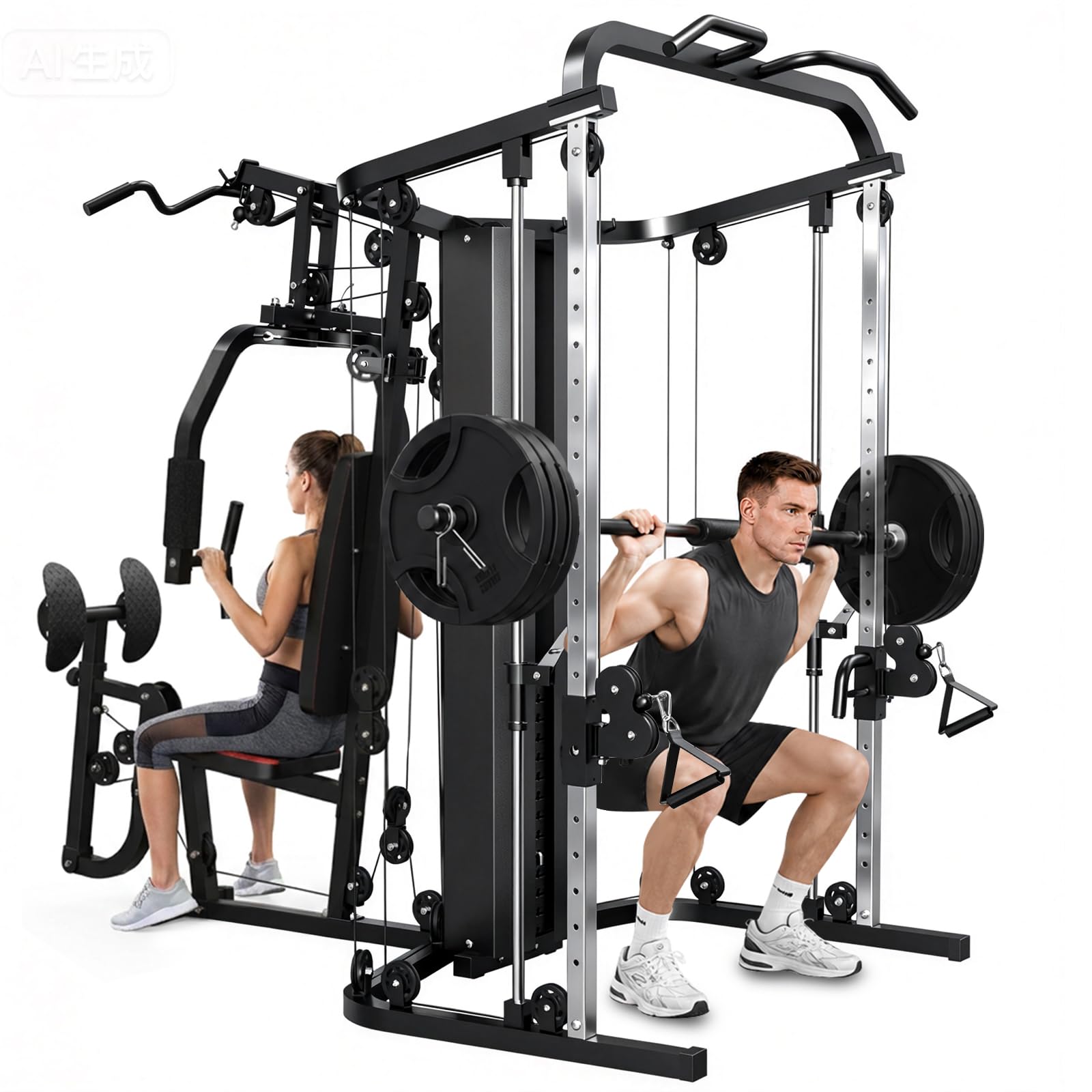
For a couple or two training partners sharing one garage bay, the SunHome earns its spot at the top because both of you can train at the same time. One person racks a Smith machine squat while the other pulls cable crossovers on the opposite side, so nobody stands around waiting for a turn. That dual-user layout sits inside a single footprint of 96.85″ deep by 55.12″ wide by 86.61″ tall, which is the whole reason a pair of users gets two workouts out of one machine.
The independent 138-pound stack on each side is the detail that makes the two-user setup actually work. Each person sets their own pin position, so a stronger lifter and a lighter one both get a useful load without swapping plates. SunHome lists more than 100 synchronized exercise combinations across the two stations. The frame is 2″x2″ commercial-grade steel with the maker reporting a capacity of up to 2000LBS, and the whole package rides on a 1-year warranty.
The owner consensus is that this is a sturdy, high-quality build for the money with a clear manual behind it. Assembly runs roughly four to five hours with two people, and the included 17mm and 19mm wrenches plus Allen keys cover most of it. What wins people over is how much exercise range arrives in one box — chest press, butterfly, leg work, lat pulldowns and Smith squats all pull from the same station. Do weigh the honest caveats: the leg press foot pads feel basic, the seat does not adjust, and the pulley has a clunky feel that a few owners notice. The machine also will not move once assembled, so pick its permanent spot before you start bolting.
What Earns It The Top Spot
- Two people train at once on independent stations without interference
- Each side carries its own adjustable 138-pound selectorized stack
- 2″x2″ commercial-grade steel frame with a capacity of up to 2000LBS
- Four to five hour assembly with the included metric wrenches and Allen keys
Where It Falls Short
- Seat is not adjustable, which limits fit for some body types
- Leg press foot pads and pulley feel are on the basic side
- Cannot be moved once assembled — it is a permanent fixture
Best matched to: a two-person household where both partners lift and space is tight
Look at another pick if: you train solo and want your budget pointed at maximum single-user weight instead of a second station
2. Body-Solid Best Fitness Functional Trainer Cable Machine
A genuine cable crossover tower that carries 52 more pounds than the SunHome station
If cables are where you live and plates are not something you want to touch, this Body-Solid functional trainer is the machine for the job. Its 190-pound selectorized stack out-weighs the 138-pound stack on the SunHome above, so a stronger lifter gets a heavier ceiling on the same crossover and pulldown movements. The adjustable pulleys swivel a full 180°, which lets you set starting positions from wide flyes down to low rows, and the no-cable-change design means you hop between movements without re-rigging.
Where the design earns its keep is the hardware around the stack. The stack pulleys are rounded for comfort, the loading pins are textured to prevent slippage, and the adjustable lat bar gives you a full range of motion. A 330-pound assembled weight keeps the tower planted, so heavy cable pulls do not walk it across the garage floor. Cables are rated for 360 pounds per side, which is plenty of headroom for a home lifter working crosses, triceps pulldowns, curls and leg extensions.
Buyers consistently describe a smooth, sturdy machine that is easy to put together and holds weight without bending. The one hiccup the manual causes is that it does not tell you to apply the supplied silicone spray to the vertical frames and bushings — do that during the build and the weight carriages glide. Owners also note a few quirks: the cables and plastic covers look entry-level, and there is roughly a 40% resistance loss through the pulley path at about 120 pounds on the low cable, which some solve by adding an L brace. Assembly runs around two to three hours solo. One owner’s one-year update reports no defects and perfect operation.
The standout spec: a 190-pound selectorized stack and 180° swivel pulleys make this the pick for pure cable crossover work, and its 330-pound frame holds that load steady.
The recurring gripe: the instruction set is thin and skips the silicone-spray step needed for smooth carriage travel, so plan on a little trial and error on the first build.
Reach for this if: crossover and cable isolation work is the backbone of how you train and you want the heaviest standalone cable resistance here
Better to compare elsewhere if: you want a cage for heavy barbell squats and deadlifts, which this tower is not built for
3. SPORTSROYALS Power Rack
A 1200-pound-rated cage that covers squats, bench and pulldowns on one rig
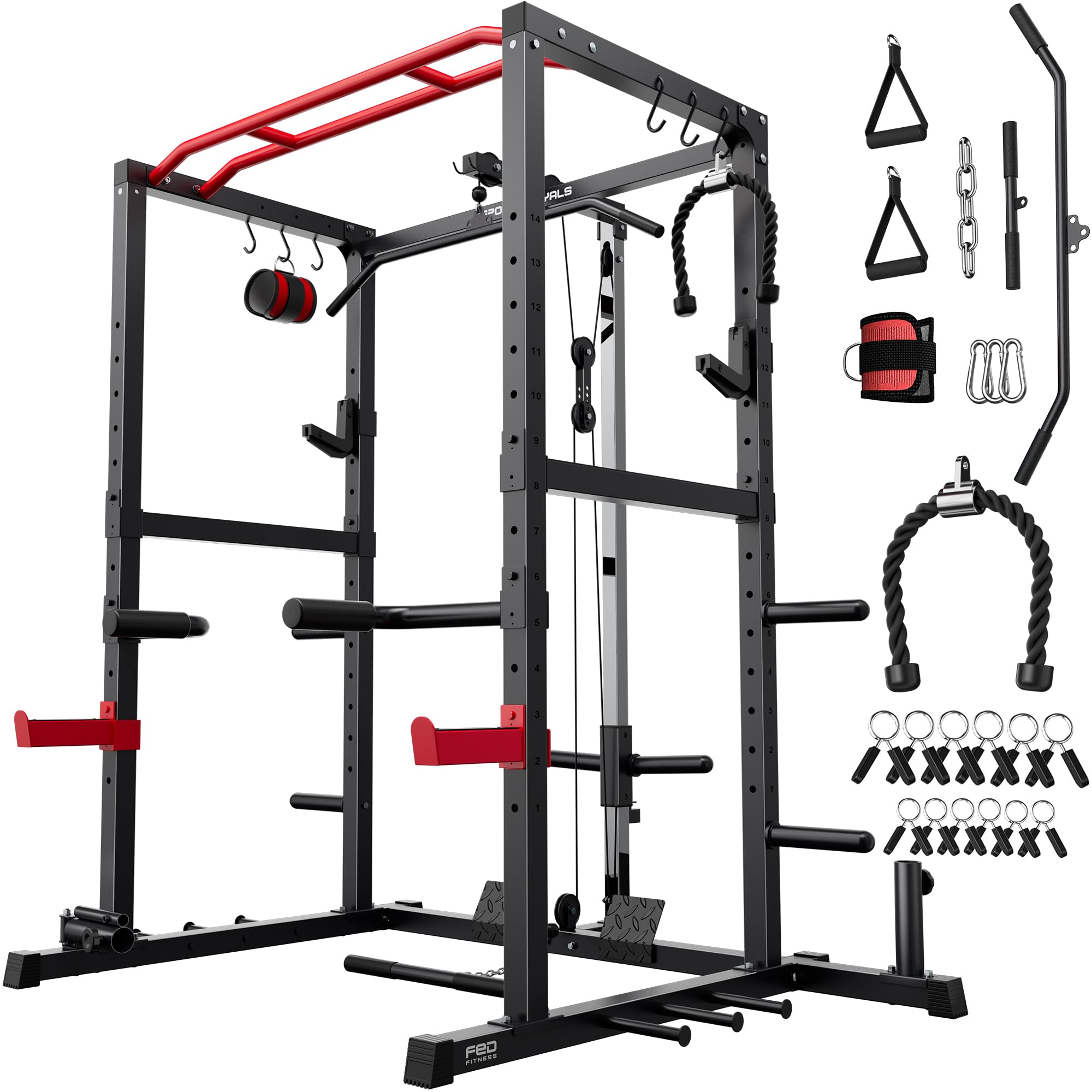
For the lifter whose week revolves around squat, bench and pull-day work, this Sportsroyals cage is the anchor to build a home gym around. The frame is built from 50 x 50mm steel square tube at 1.5mm wall thickness and rated to support 1200 pounds, so the cage takes the heaviest home-lifting loads without flexing. It weighs 150 pounds with two reinforcing tabs that stiffen the base, and it carries 14 adjustable height levels plus a two-way pulley system on top of the standard rack.
The pulley system is the hidden second machine here. The upper and lower pull-down stations run on precision bearing pulleys with electroplated telescopic poles, and the PU-coated steel cable is rated to hold up to 500 pounds. That covers lat pulldowns, seated cable rows, triceps work and landmine movements. The gear list is long — rowing bar, four weight plate storage posts, six band pegs, safety arms, safety bars, J-hooks, dip stands, tricep rope, ankle strap, barbell clamps, cable handles, a wide and narrow pull-up frame, a 360° landmine and a foot board all ship with it. Plate storage fits both 2″ Olympic and 1″ standard plates, and the rack measures 61.6″ long by 56.0″ wide by 82.6″ tall.
Owner feedback on this rack reads as a genuine value play for intermediate training. The build quality delivers for the category, and the pulley is smooth enough that it becomes the favorite feature for many. Heads up on the honest limits: the cable feels useful above about 70 pounds but less controlled below that, and the squat position sits close enough to the pulley that many owners face the other way. Dip bars and spotter arms carry some play, and the accessories are light but adequate. Assembly runs about five hours solo, and it is the kind of support work you can upgrade a piece at a time as you outgrow it.
Why compound lifters pick it: a 1200-pound capacity cage with a 500-pound-rated cable system, 14 height levels and a fully loaded attachment list — a full barbell platform and a pulldown station in one frame.
The fine print worth knowing: the squat position is tight against the pulley tower, so you will likely face away from it for squats, and a couple of owners find the accessories a touch light.
Fits you best when: your training centers on squats, bench and pulldowns and you want one rig that does all three with 1200 pounds of headroom
Consider a different rack if: you need a true heavy cable stack for high-volume cable days rather than pulley work as a secondary use
4. Marcy Home Gym Station

Pin-and-pull circuit training for the garage gym that has to stay tidy
This Marcy station is built for the lifter who wants to move from chest press to lat pulldown to leg extension without ever touching a plate. A single 150-pound selectorized stack feeds every exercise on the machine, so you grab the pin, set your weight, and go. The press arms lock together for a standard chest press or swing independently for flyes, and both movements switch with one pin. A high pulley handles lat pulldowns and ab crunches while a low pulley covers rows, curls and leg work — a lat bar and ankle strap come in the box so you can start the day it is built.
Upper-body isolation is handled by a removable, adjustable preacher curl pad, and the padded leg developer takes over for extensions and curls. The steel tubing runs heavy-duty with guard rods keeping the stack tracking straight, and a lock on the selector pin keeps curious kids off the machine. Boxed vinyl seats over high-density foam are built for daily use. The whole rig carries a 2-year manufacturer limited warranty. The station weighs in around a 300-pound capacity for structural support, which is plenty for standard home strength work.
Because the entire workout flows from that one stack, this machine lives best in a smaller room where a barbell and plate tree would not fit. It does not need spotter support for most movements and the safety lock is a real benefit in a house with children. If you are chasing a 400-pound squat, look at the cage options instead — but for circuit-style strength and conditioning at home, this is a tidy, self-contained package.
Suited to: a lifter who wants one compact station to cover chest, back, arms and legs through a single 150-pound stack
Worth knowing: this is home-grade strength equipment, not a powerlifting platform — it settles in best for circuit training rather than maximal barbell loads
Picks you up when: you want a no-plate, small-space circuit machine with a child-safety lock on the selector pin
Pass it over if: your goals run toward heavy compound barbell work that needs a 1200-pound-capable cage
5. ARMAC Home Gym
A leg press and extension machine that still covers chest, back and arms
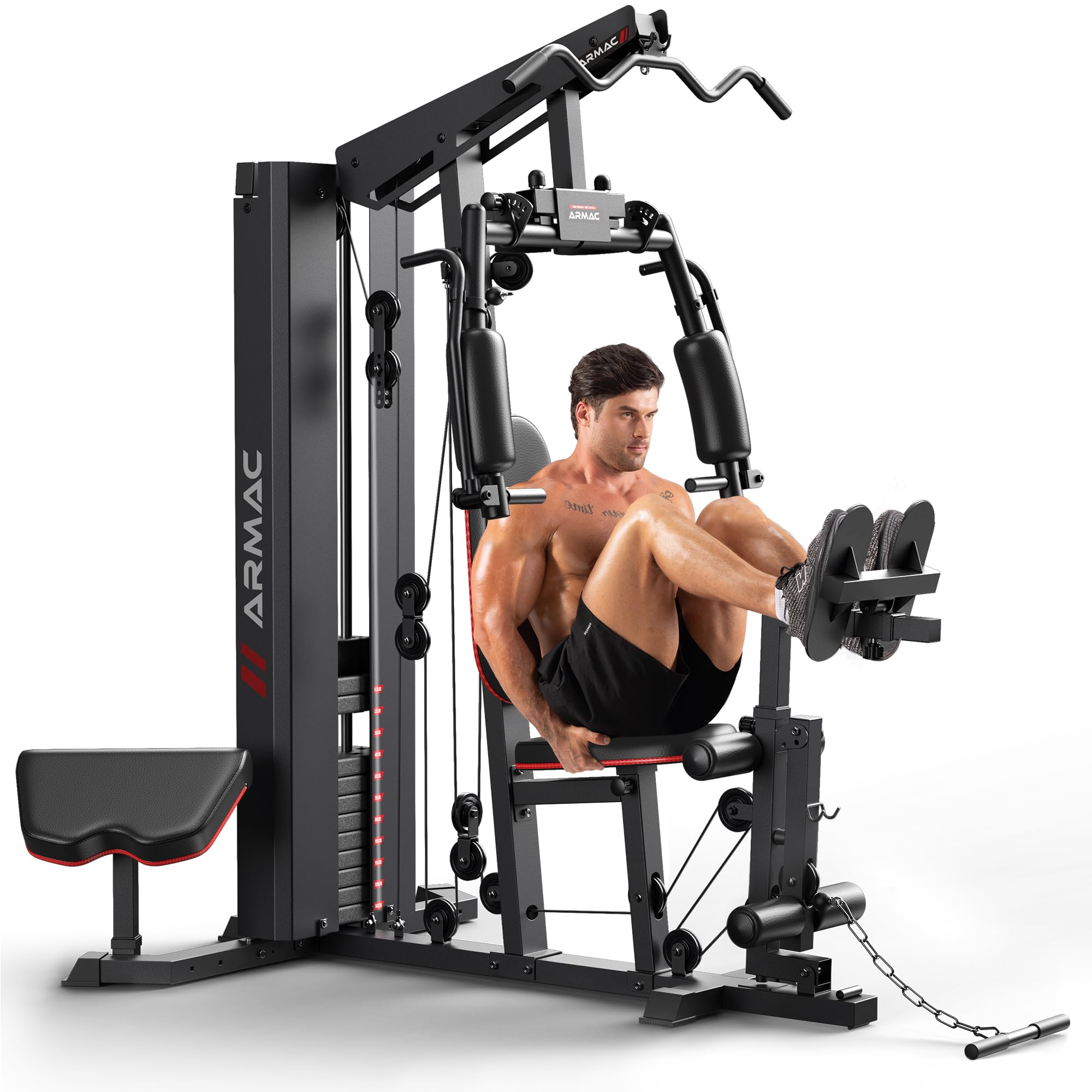
If lower-body training is the weak link in your home setup, the ARMAC station answers it with a dedicated leg press, leg extension and calf station sitting under a 150-pound selectorized stack. The machine claims more than 35 exercise functions across chest flys, lat pulldown, low row, chest press, shoulder press, preacher curl, abs and back extension. So you get leg-day capacity plus enough upper-body range to cover most weeks without buying a second machine. The compact footprint of 66.9″ x 53.1″ x 79.9″ is sized for a basement, garage or apartment corner.
The design leans on adjustability for different body sizes. Leg extension pedals move up and down and front to back, the butterfly arms and seat cushion offer multi-level adjustment, and the seat is meant to fit a range of heights. The 150-pound stack is waterproof and rust-proof, and it switches with a selectorized pin so you can dial resistance to your progress. Steel shaft pulleys and a high-strength wire rope keep the motion smooth and quiet. A reinforced U-shaped base and 70 x 50mm main frame with non-slip foot pads check the lateral sway that plagues some home stations.
The owner picture here is one of a functional, compact machine at a fair value, with the main friction showing up in the build. Assembly splits buyers — some finish it easily while others find it takes significant work. A few buyers report the foot plates need heavy tightening to stop slipping and that the rowing function is not as effective as the rest. Reviewers with longer reaches have no trouble with the tooling, and the 150-pound stack is sufficient for a range of users including older lifters. One buyer’s verdict: “Get it you will like it.”
Where it earns points: a dedicated leg press, extension and curl station combined with 35+ functions and height-adjustable pedals for fitting different users
Where it asks patience: assembly is the wildcard, with some owners describing it as a lot of work and a few finding the rowing function thin
Choose this if: you want a compact station with a real leg press and enough upper-body coverage to run full-body circuits in a small room
Steer elsewhere if: you want push-button assembly — this one rewards a patient builder
6. SincMill Home Gym
A 34-inch-wide station for rooms where every inch of floor space counts
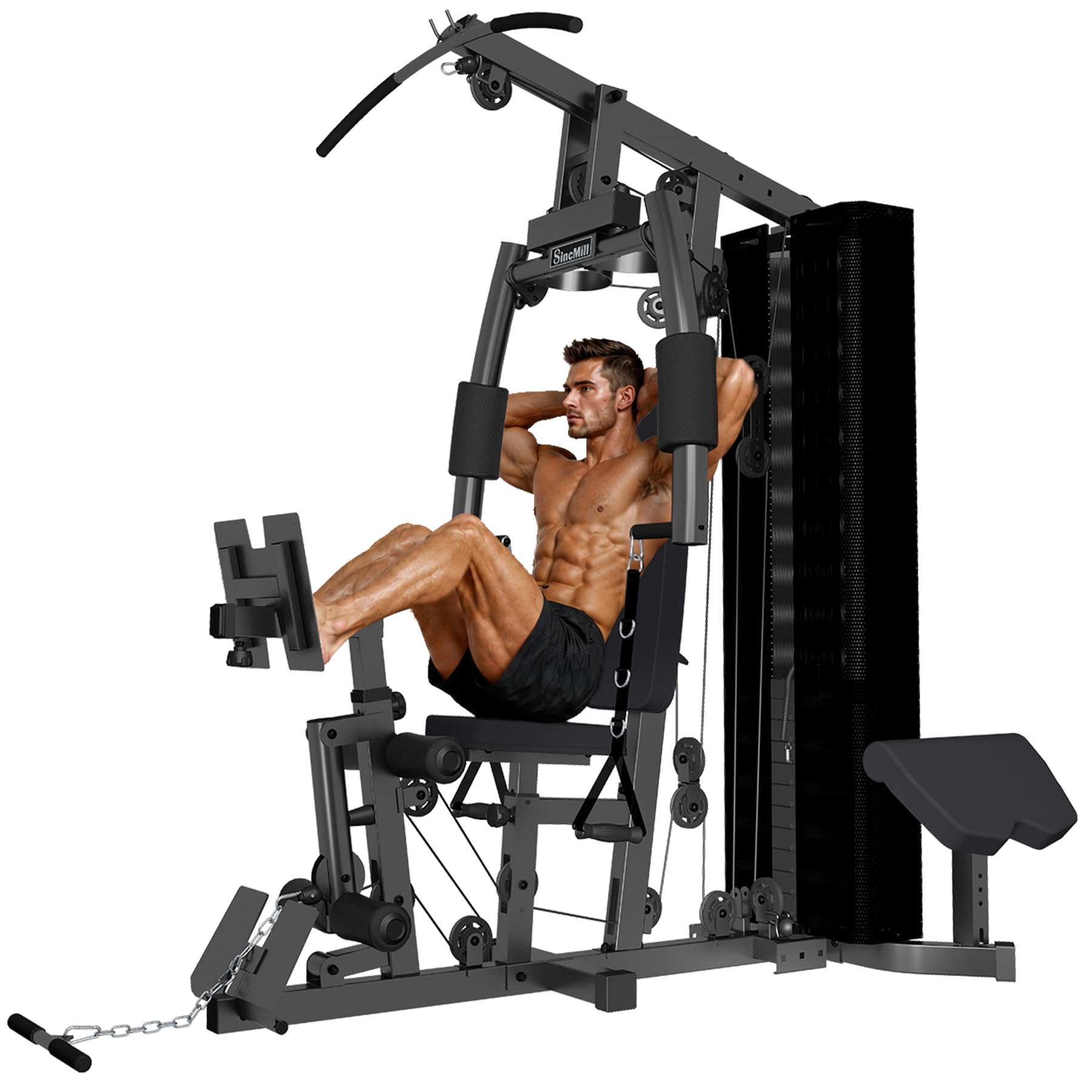
Living-room and apartment buyers should look hard at this SincMill station. At just 34″ wide, it slides into spots most cages cannot, and the full package of thick steel frame and weight guards is built for the 160-pound stack it carries. That stack uses a selectorized setup with quick-release latches, so you switch resistance without touching a plate. The machine covers chest press, chest fly, lat pulldown, rows and leg movements from a single stand. The elbow pad helps block the arms in place for pressing, and it lifts off for other work.
Design-wise, the unit leans on a no-adjustment approach for its pressing and clamping motions — parts switch functions without a manual flip. The seat is a fixed position rather than a sliding one, and the machine is tuned to work best for users roughly 5’2″ to 5’7″ tall, where the range of motion lines up naturally. Hardware arrives labeled and sorted, and the manufacturer supplies a step-by-step video alongside the printed manual. The 160-pound stack delivers resistance through a cable path that noticeably compounds the load — owners often note the cable system makes a given stack number feel heavier than the label suggests.
The standout in the review data is build quality above all else. Owners describe serious resistance and a frame that holds up well once assembled, with particular praise for back-day work. Being honest about the trade-offs: this unit is designed for shorter users, and taller lifters past roughly 5’8″ report a cramped lat pulldown and limited leg-extension range. The seat does not slide fore and aft. Assembly takes about four hours solo, and cleanup of packaging runs a bit over an hour. A socket set comes recommended, and a helper makes the cable routing much easier.
Built to fit: a 34-inch footprint, a 160-pound cable-loaded stack that feels heavier than labeled, and a design engineered toward 5’2″–5’7″ users and small rooms
Honest limitation: taller lifters and users wanting a sliding seat will feel the constraints here — this machine trades adjustability for its small footprint
Right for you when: you are between roughly 5’2″ and 5’7″, work out in a compact room, and want a stable 160-pound-stack station for full-body work
Think twice if: you are taller than around 5’8″ and want maximum range of motion, or you need a sliding seat to fit your form
7. Mikolo Home Gym
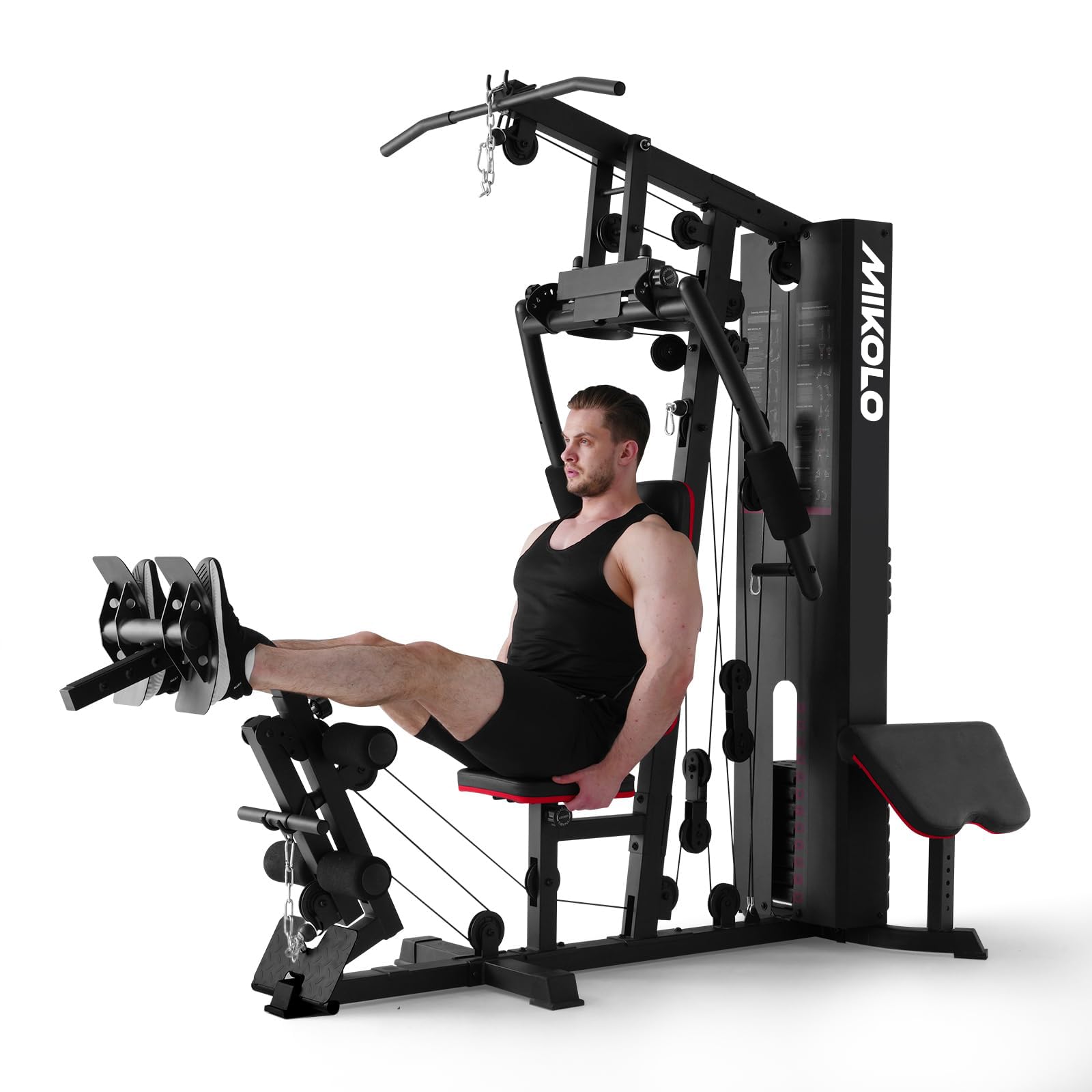
The 300-pound station that delivers near-commercial heft at home
When a home gym needs to feel like the real thing, this Mikolo Pro Station is where to look. It weighs 300 pounds and is built from 14-gauge steel with a sturdy structure, so it plants firmly rather than flexing under load. The unit claims more than 90 exercises across pec fly, lat pulldown, low row, chest press, leg extension and press, preacher curl, core, calf and seated row. The 152-pound weight stack is protected by a steel sheet, and its 10-to-154-pound range steps in 12-pound increments, so progression is easy to track. That combination of a heavier frame and a protected stack is what gives it a near-commercial feel in a home bay.
Attachments round out the versatility. The preacher curl pad and leg press gear come off or on easily, and a professional bearing on the cable bar eases wrist stress through the pull. The machine runs a high, mid and low pulley system alongside its chest press, fly and back extension stations, so you can mix movement patterns in one session. The unit fits users up to about 5’11”, though someone around 5’0″ may find the lat pulldown a stretch at full extension. Footprint comes in at 75″ deep by 36.3″ wide by 80″ tall, which is sized for a low-ceiling basement or garage.
Owner feedback centers on quality and sturdiness, and the standout theme in the review pages is that the machine exceeds expectations and ships with a full accessory set. The build is described as near commercial-grade. The one recurring headache is assembly: the printed instructions and the video sometimes disagree on cable guides, which forces reworking pulleys and stretches the build toward eight hours over two days. The cable system multiplies the felt resistance — a gym chest press of 145 pounds feels around an “8” out of 12 on this machine — so the 152-pound stack plays heavier than the number implies. A single arm can run tight from the start, but the maker ships replacement bushings when asked. A 5-pound adder plate is an easy addition for half-step jumps.
Reasons Buyers Trust It
- 300-pound frame in 14-gauge steel delivers a planted, near-commercial feel
- 152-pound stack with 12-pound increments and a 10-to-154-pound range
- 90+ exercises across high, mid and low pulley stations
- Preacher curl pad, leg press and bearing cable bar all included
What To Prep For
- Instructions and video disagree on cable guides — budget real assembly time
- Users around 5’0″ may find the lat pulldown a stretch at full extension
- A single tight arm can show up from the start until replacement bushings arrive
Best for: a lifter who wants a heavy, protected stack and commercial-grade feel without stepping up to a full rack rig
Be aware: the build runs long due to conflicting assembly instructions, so a weekend block beats an evening
8. SunHome Smith Machine

The 440-pound cage that lets a solo lifter fail a rep safely
Training alone at home means a heavy bench press can go wrong fast, which is exactly where this SunHome Smith machine proves its worth. Auto-lock safety hooks let the bar catch at any angle, so you can push to failure on a bench press with no spotter and let the bar lock rather than pin you. The frame is built from 2mm thickened commercial steel square tube, and the assembled 440 pounds keeps the whole rig planted. The footprint is 72″ deep by 60″ wide by 90″ tall, so measure your ceiling before delivery.
The 3-in-1 layout stacks a Smith machine, a power cage and a butterfly chest station into one unit. A rowing cable is included alongside the lat pulldown and cable crossover hardware, and the pulley system uses a rolling bearing design rather than a sliding one. That bearing approach means smoother travel and less wear on the parts. The rig also gives you storage room — six weight plate posts, one barbell post and hooks for the smaller accessories — which keeps the training floor clear. Grip size on the bar runs a standard 2.0 inches. A 2-year spare part availability window covers future service.
What buyers value most here is the combination of price-to-capability and the machine’s all-round workout range. Owners mention solid build quality and a smooth Smith machine with good pulley action, and the unit is genuinely versatile for squats, bench, lat pulldowns and cable work. Honest trade-offs exist: the cable and pulley routing is the hardest part of the build, and the printed diagrams have few words and no part numbers, so plan to hand-tighten everything first and tighten later. Some owners note the bumper plates collide on the center storage post and that the main post benefits from light lubricant. Assembly runs about four hours solo and faster with two or three people.
What makes it a solo-training pick: auto-lock safety hooks that catch at any angle, an 800-pound capacity and a 2mm commercial steel frame — the combination that lets one lifter train to failure safely
The build reality: the cable routing is the tricky part and the diagrams are sparse, so allow a full weekend with a helper if you can get one
Where it shines: for a solo garage lifter who needs a Smith bar with auto-lock hooks and wants cage, cables and butterfly station in one footprint
Second-guess it if: you lack the ceiling clearance or the patience for the sparse assembly diagrams
9. pooboo Power Cage Smith Machine
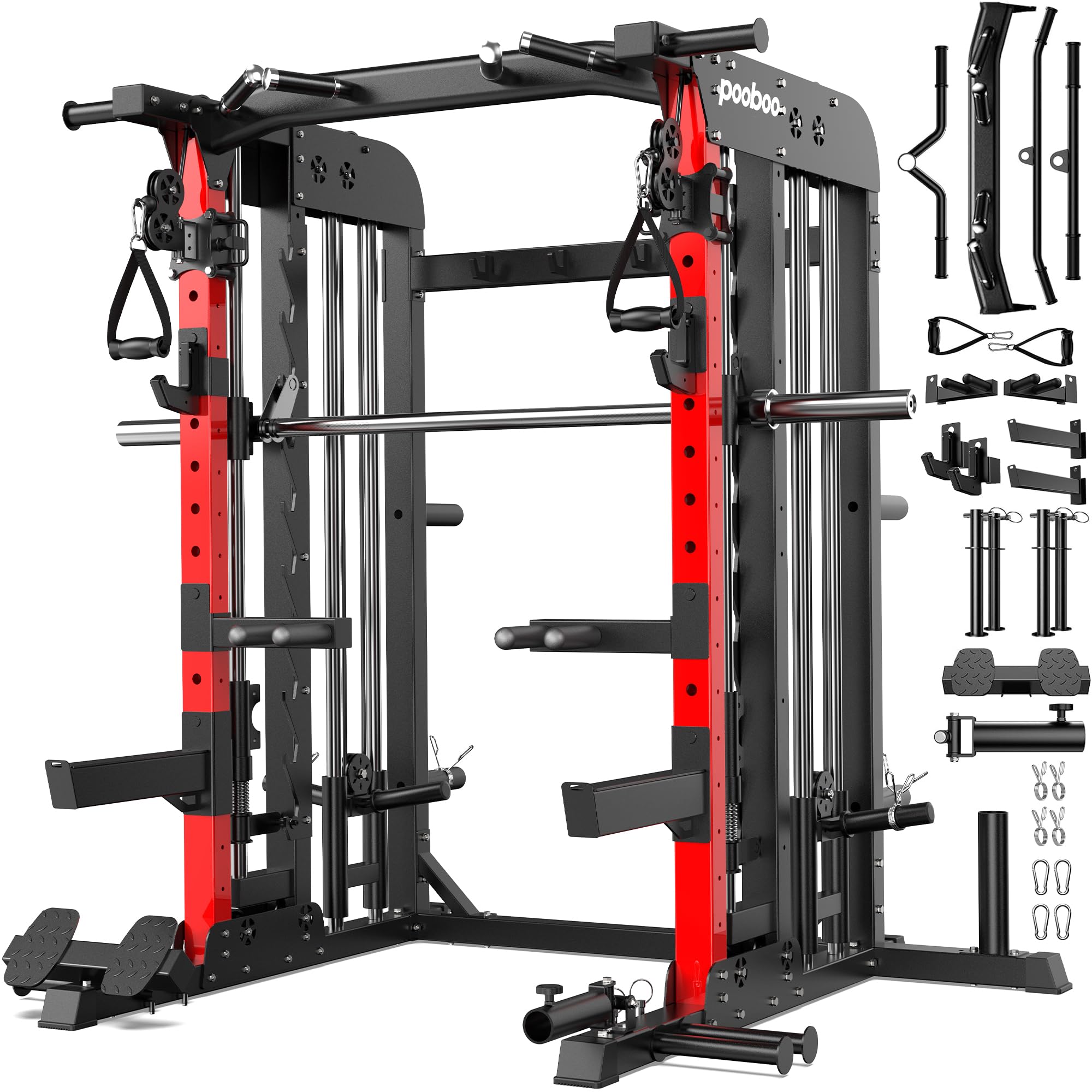
The most-loved cage in this guide, and it earns it on pure sturdiness
Between the two 2000-pound cages here, the pooboo is the one owners reach for and rate from the top of the list. It uses heavy-duty steel with a 2,000-pound weight capacity, and it places a real emphasis on build feel — every metal component is polished by high-speed sandblasting for a burr-free surface, then finished with rust-proof paint. The precision pulley system runs on bearing pulleys and durable PU wire rope for smooth, quiet operation. The footprint of 62.9″ deep by 43.3″ wide by 82.6″ tall fits a garage or dedicated corner without crowding.
The attachment list is a big part of the draw: more than 20 free pieces ship with it, including 2 J hooks, 2 safety spotter arms, 2 dip bars, 2 cable grip handles, a lat pulldown bar, a row bar, a row low foot board, a 360° landmine, 4 plate storage pins, 4 weight holders and 4 band pegs. That gear covers cable flys, lat pulldowns, rows, squats, bench, deadlifts, curls, tricep work, pull-ups and chin-ups — a full-body gym in one frame. Ship weight is 417 pounds across two packages, and a 1-year warranty covers the frame and accessories.
The consistent theme in owner feedback is that this machine rivals much pricier commercial gear. Buyers describe a sturdy, well-finished setup that feels planted and versatile, with smooth Smith machine and cable action. Assembly is described as easy with solid instructions, though a few find it takes real time — several give it a multi-day build. Practical notes owners pass along: grease the slide bars, since a squeak can show up after about two weeks; the pull-up cross-member takes two people to bolt into place; and the machine ships in multiple boxes, so confirm they all arrive before you start. Customer support is called out as responsive and quick to resolve a straggling box. One owner notes it carries the same dimensions as a Major Fitness B52 machine, so accessories bolt right on and a weight stack fits without any adjustment.
Why It Wins On Rating
- 2000-pound capacity and heavy-duty steel with a burr-free sandblasted finish
- 20+ attachments including 4 plate storage pins and a 360° landmine
- Precision bearing pulleys with PU wire rope for smooth, quiet pulls
- Responsive support and a 1-year frame and accessories warranty
Small Realities Of Ownership
- Slide bars can squeak after a couple of weeks and want grease
- Pull-up cross-member needs two people for one bolt step
- Ships in several boxes that may arrive on different days
The match for: a lifter who wants the most complete attachment set and the highest-rated build quality in this lineup without hitting the top price
Not quite it for: a solo builder with no second set of hands, since the pull-up cross-member really wants two people
10. Marcy Smith Machine SM-4903
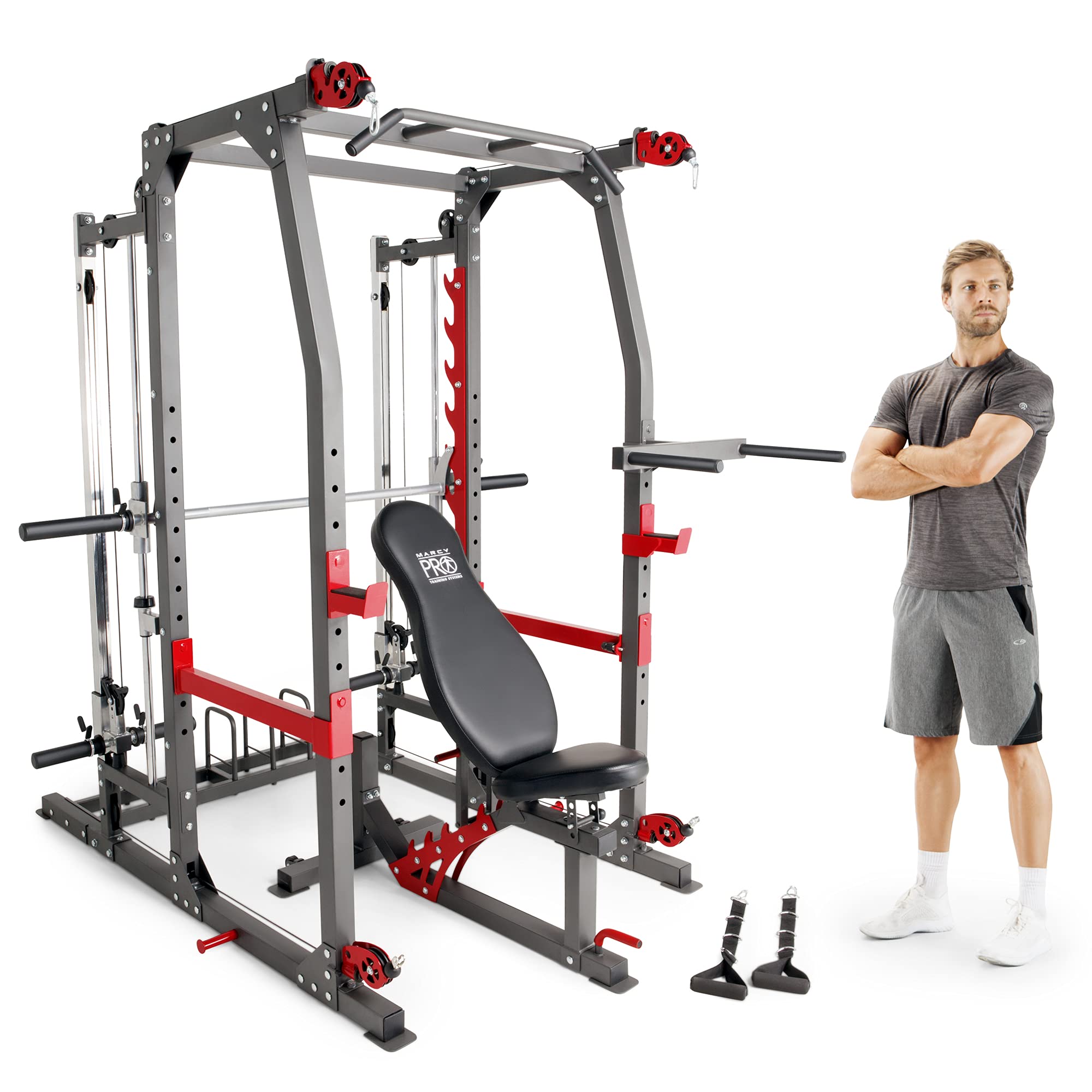
An all-in-one Smith cage that arrives with its own adjustable weight bench
For the lifter starting from zero equipment, this Marcy package removes one purchase straight away — it ships with its own adjustable weight bench on top of the Smith machine cage. The cage itself runs 73″ deep by 86″ wide by 85″ tall, the bench measures 48″ x 27″ x 49″, and the full system carries a 600-pound maximum weight capacity. Cable-routed pulleys handle crossover work, and adjustable Smith bar catches plus Olympic safety stoppers let you lock the bar and train without a spotter. Wheels on the base make it possible to reposition despite its size, and a weight plate storage rack (plates sold separately) keeps the floor clear between sessions.
The frame is heavy-duty tubular steel with a powder-coated finish, so the cage holds up against regular crossover work. Smith bar action runs 90-degree and smooth, and the pulley system uses a 4-point pivot for even cable travel. Pull-up and dip stations attach to the cage, the dip station being detachable for flexibility. On the honest side, this cage suits beginner to intermediate lifters rather than anyone chasing 500-pound-plus barbell work — the Smith bar is rated at 300 pounds, and the plates will not fit if you try to load oversized bumper weights close to the pulleys. The pulley ratios are also 2:1, which means you need extra plates to reach the felt load on the cable.
Long-term customers note no regrets with this machine. The build gets described as steady and smooth for the price, with reliable pulleys and solid pull-up and dip support, and the safety bars let beginners bench and squat without a spotter. Two recurring gripes do show up in the review pages: the included bench feels light and sits at a taller 20″ height, and the nylon Olympic adapters wear out over time. Assembly is a multi-hour job — expect eight to ten hours with small pictures and large pieces that are not numbered. Owners who add a chain to link the upper pulleys for lat pulldowns report a cleaner pull. After a year of use, reviewers point out no structural issues.
The practical draw: an included adjustable bench, a 600-pound capacity cage, wheels for repositioning and a plate storage rack — a fuller starting kit than any cage here that ships bare
The catch to weigh: the bench is the weak part of the package, and the nylon adapters wear over time, so plan on upgrading the bench if you lift seriously
Ideal for: a beginner or intermediate lifter who wants a complete cage-and-bench package in one purchase with no-spotter safety
Skip past it if: you lift near 300 pounds on the bar, since the Smith mechanism tops out there
11. DONOW Smith Machine
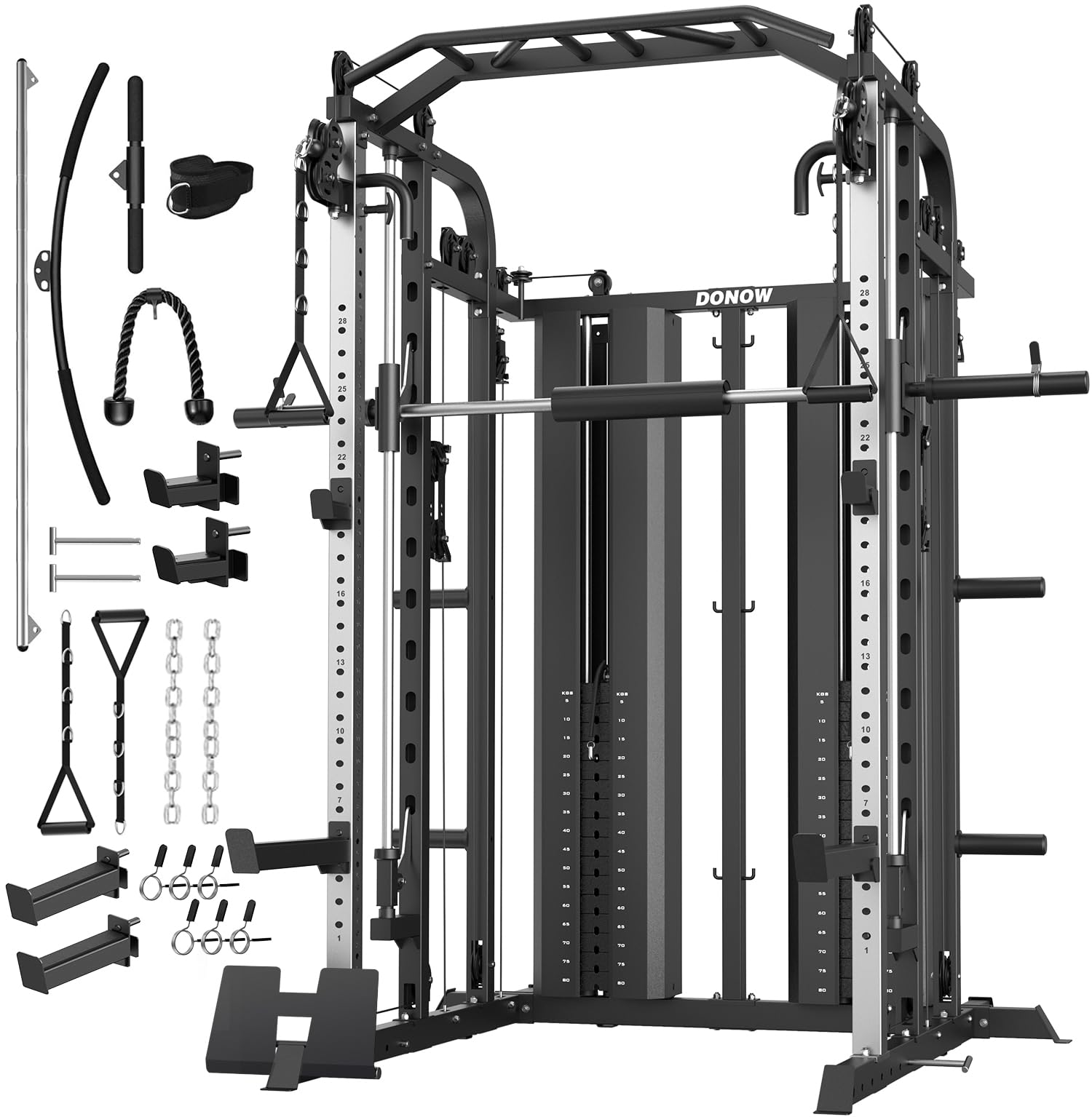
Two weight stacks and a 2240-pound frame for the home gym that does it all
The top-of-the-line machine in this lineup is the one to look at when you want a full commercial-gym feel at home. The DONOW combines a solid Smith machine, a power rack with safety arms, a dual cable crossover system and a multi-grip pull-up station in a single unit. The headline spec is the pair of weight stacks totaling 352 pounds, which lets you run lat pulldowns, rows and cable crosses without ever leaving the machine to add plates. The 2″x2″ steel frame is rated to 2240 pounds, and the linear-bearing Smith bar glides on smooth rails for stable lifts. The footprint is 54.7″ deep by 78.58″ wide by 88″ tall.
The dual cable crossover runs independent stacks on each side at a 2:1 ratio, so a strong pull on one side does not move the other. Eight boxes ship in the kit, including the Smith machine, a leverage bar, a pair of cable handles, a lat pulldown bar, a cable bar, a bicep rope and an ankle strap. The weight stacks are encased in steel covers, which keeps cables and weights contained and the gym looking tidy. In a home setting, that enclosed design cuts down on the exposed-plate look of plate-loaded racks and removes the floor clutter of loose plates. The cables run adjustable from overhead to floor level, so you can cover most isolation movements that mimic commercial machines.
Buyers rate this machine for its quality and its sturdy, gliding feel. Assembly is straightforward with a clear manual and video, though it runs about ten hours with two people. Two things to know before you buy: the cable stacks run at a 2:1 ratio, so the resistance you feel at the handle is about half the number on the stack, and the weight plates themselves are labeled in kilograms rather than pounds. The rear pulley occasionally tangles and the Smith bar guide can arrive slightly misaligned. But none of that stops owners from calling it the best value in the tier — one owner calls it a replacement for an entire gym membership in one space-saving unit.
Standout Strengths
- 352-pound dual independent stacks eliminate plate-loading between sets
- 2240-pound capacity frame with linear-bearing Smith bar
- Eight-box kit ships with the full set of cables and attachments
- Enclosed weight stacks keep the home gym clean and safe
What To Know Up Front
- 2:1 cable ratio means felt resistance runs about half the stack number
- Weight stacks are labeled in kilograms, not pounds
- The rear pulley can occasionally tangle on the crossover line
The one for: a buyer who wants a full setup with dual independent stacks, a power rack and a Smith machine all in one footprint and no plate handling
Think around it if: you want every ounce of cable resistance to match the printed number, since this runs 2:1 throughout
Know the Specs
Weight stack size
This is the tower of weights a machine carries, selected by a pin rather than loaded by hand. Bigger is not automatically better — what matters is whether the number matches what you actually lift. A 138-pound stack covers most intermediate home work, while a 190-pound stack gives a strong lifter more headroom on cable moves. When you read a stack number on a cable machine, though, remember that most routes use a pulley that lightens the load at the handle, so a stack labeled 150 pounds may feel closer to about half that on the pull.
Weight capacity versus stack size
These are two different numbers and they get confused all the time. Capacity is how much weight the frame is rated to support when lifted, so a cage rated to 1200 pounds is telling you the structure will hold that load safely. Stack size is a separate figure — the actual weight on the cable tower. A machine can be rated to 2000 pounds of capacity while only carrying a 138-pound stack, and that is not a contradiction; the frame rating is about strength, while the stack size is about available resistance.
Steel gauge and frame thickness
The steel thickness is often given in millimeters or by the tube size. A 2″x2″ or 50 x 50mm square tube is a stiffer frame, so it resists the twist and wobble that thin tube structures can show under a heavy rep. Thicker tube also means a heavier machine, which plants it more firmly — one of these rigs weighs north of 400 pounds fully assembled. If a listing or seller only says “heavy-duty” without giving a thickness, treat the frame rating as the more useful number.
Pulley bearings versus bushings
Pulleys either use rolling bearings or plastic bushings. Bearings feel smoother over long sessions and wear slower. Bushings are common on value-priced gear and work fine with a little care, which is why some manuals call for silicone spray or grease on the vertical frames. If you want quiet, consistent cable movement, look for bearing pulleys and durable wire or PU-coated cable rated well above your lifting weight.
Common Questions
How much floor space does a multi gym for home really need?
What ceiling height do I need for a power cage or Smith machine?
Is a weight stack better than plate-loaded for a home gym?
What does a 2:1 pulley ratio mean on a cable machine?
How long does it take to assemble a home multi gym?
Can one person safely use a Smith machine without a spotter?
What is the difference between a power cage and a multi gym station?
Will a multi gym fit a taller lifter?
How much weight stack do I actually need?
Do I need to lubricate a home gym cable system?
The Bottom Line
For most homes, the multi gym for home winner is the SunHome Multifunction Workout Station, because two independent 138-pound stacks and dual stations let couples or training partners work out at the same time in one footprint. If heavy solo cable crossover work is your focus, grab the Body-Solid Functional Trainer with its 190-pound stack and 180° swivel pulleys. And for the widest full-body cage setup with the highest-rated build in this lineup, the pooboo Power Cage is the one to reach for.
Whichever machine fits your space and your training, the honest nudge is this: pick the model whose stack size and footprint match the way you already lift, and it will serve you for years — the SunHome’s dual 138-pound stacks let two people train at once, so it stays useful as both partners get stronger.
How we choose
We do not accept paid placement. Every pick is matched to a real buyer and a real use-case; we do not hands-on test units.
Sources
Specifications: manufacturer listings and product documentation. Review insights: verified customer reviews, as of October 2026. Pricing: not shown on this page (it changes often); check the current price via the retailer link.
As an Amazon Associate, Aappliancez earns from qualifying purchases. This does not affect which products we feature.