Disclosure: Some links in this post are affiliate links. As an Amazon Associate I earn from qualifying purchases, at no extra cost to you. Learn more
Specs are compiled from manufacturer listings and verified buyer reviews and can change over time — please confirm the key details on the product page before buying.
For thick, tart, high-protein Greek yogurt without the sugar in most flavored tubs, the fastest route is to make or strain it yourself. The picks below cover every way to get there: a countertop strainer, starter cultures, electric incubators, and a couple of ready-made tubs for the days you simply cannot wait.
This guide is built by comparing the manufacturers’ published specifications and the patterns across verified customer reviews, so you get each pick’s real strengths and trade-offs instead of marketing spin.
Whether you strain whey from a store tub or ferment from a sachet overnight, the goal is the same: a thicker, tangier bowl with minimal added sugar. Here is how to pick the right No Sugar Greek Yogurt setup for your kitchen.
Top Picks

How To Choose The Best No Sugar Greek Yogurt Setup
“No sugar” on a Greek yogurt label usually means no added sugar — but plain dairy still carries lactose, the natural milk sugar. The trick every home fermenter learns is that straining off the whey (the thin, watery part of the yogurt) leaves behind a thicker curd with less lactose. So the real question is not which tub says “zero sugar,” it is how much whey you can remove from your batch.
Decide which job you actually need done
Three different tools handle three different steps. A starter culture is the bacteria that turns milk into yogurt in the first place. An incubator or yogurt maker holds the milk warm long enough for those bacteria to work. A strainer sits in your fridge and pulls the whey out afterward. If you already own a yogurt maker, you probably just need a good strainer or a fresh culture.
Buying the wrong one is the most common mistake. A strainer will not ferment anything on its own, and a starter sachet will not thicken yogurt you already made.
Match capacity to your weekly habit
If you eat a bowl most mornings, look at a strainer or incubator that handles a half-gallon batch, because that yields several servings at once. If you are testing whether homemade yogurt is even for you, a small starter sachet pack costs little and tells you fast. People who go through a quart every few days will want the larger container sizes so they are not re-running the process constantly.
Check the temperature story
Fermentation lives and dies by warmth. Most cultures want the milk held steady somewhere in the low hundreds of degrees Fahrenheit for hours on end, and a maker that drifts too warm can thin out or kill the culture. Adjustable temperature control and a clear timer are the two features that separate a forgiving machine from a fussy one.
Side-by-Side Comparison
| Model | Best For | Type | Capacity | Cleanup | Amazon |
|---|---|---|---|---|---|
| Ultimate Greek Yogurt Strainer, 2.3 Quart★ Best Overall | Straining a full half-gallon batch | Whey strainer | 2.3 quarts | Dishwasher safe | Amazon |
| Whynter ICM-220CGY Ice Cream & Yogurt MakerMost Versatile | Frozen treats plus a yogurt function | Compressor machine | 2 quarts | Removable stainless bowl | Amazon |
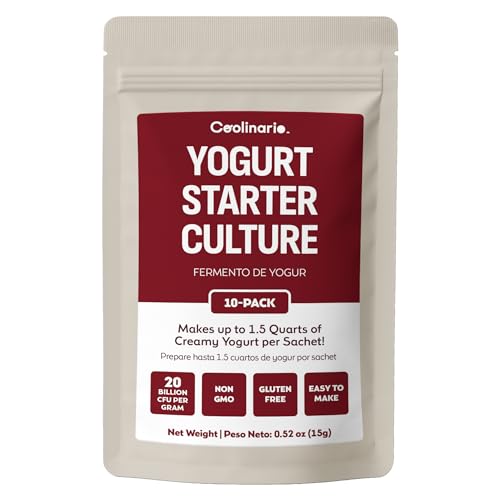
| Coolinario Yogurt Starter Culture (10-Pack)Best Starter | Beginners testing the hobby | Starter culture | 10 sachets of 1.5g | Non-perishable sachets | Amazon |
| Cultures for Health Greek Yogurt Starter | Reusable heirloom-style culturing | Starter culture | 2 packets | Keep frozen between uses | Amazon |
| Yogourmet Yogurt Starter (16 Pack) | Long shelf life, repeat batches | Starter culture | 16 sachets of 3g | Individually sealed sachets | Amazon |
| Judee’s Greek Yogurt Powder | Shelf-stable smoothies and baking | Powdered yogurt | 11.25 oz pouch | Resealable pouch | Amazon |
| Euro Cuisine YM80 Yogurt Maker | Seven flavors at once in glass jars | Electric incubator | 7 glass jars of 6 oz | Dishwasher-safe jars | Amazon |
| Yomast Organic Plain Yogurt, 64oz (2-Pack) | Ready-to-eat Persian-style yogurt | Finished yogurt | Two 64 oz tubs | Keep refrigerated | Amazon |
| Chobani Vanilla Greek Yogurt, 4 oz (12 per case) | Single-serve convenience | Finished yogurt | 12 cups of 4 oz | Keep refrigerated | Amazon |
| Dannon Oikos Triple Zero, 5.3 oz (18 per carton) | High-protein grab-and-go cups | Finished yogurt | 18 cups of 5.3 oz | Keep refrigerated | Amazon |
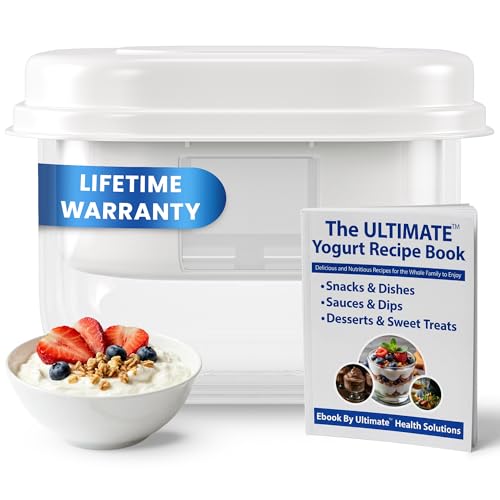
| Ultimate Probiotic Yogurt Maker with TruTemp | Long, low-temperature probiotic ferments | Electric incubator | Two 1-quart containers | BPA-free lids, glass containers | Amazon |
Detailed Reviews
1. Ultimate Greek Yogurt Strainer, 2.3 Quart Fine Mesh
Our pick — over 4.5★ from 700+ verified ratings; the strongest balance of quality and price.
The fridge-friendly strainer that turns a half-gallon of milk into seven thick servings
The single most useful number here is 2.3 quarts. That is the size of the strainer basket, and it is what lets you pour in a whole half-gallon batch of yogurt at once instead of straining in awkward, messy rounds. The payoff is about seven 6-oz servings from one session — enough to cover most of a week of breakfasts before you have to think about it again.
Straining is where the sugar story actually happens. When the whey drains off, you are removing the watery, lactose-heavy part and keeping the dense curd behind, which is exactly why strained Greek yogurt tastes so much sharper and thicker than the tub it started as. The manufacturer claims straining can cut sugar and lactose by up to 70%, but that figure depends on your starting yogurt and how long you strain it.
What wins people over is the mesh quality. It is an ultra-fine nylon weave, and it is the reason the results come out silky rather than grainy or lumpy. The whole thing rinses in seconds and every part goes in the dishwasher. The lid seals tight for storage in the fridge, and lifting one corner breaks the seal instantly.
What holds up over months of use
- 2.3-quart capacity handles a full half-gallon batch in one pass
- Ultra-fine nylon mesh delivers smooth, grit-free results
- Entire unit is dishwasher safe and rinses clean in seconds
- Lifetime replacement warranty covers it if it ever fails
The one handling detail to respect
- The lid needs to seat evenly — a crooked fit is how one owner dropped and cracked theirs
- Straining takes hours, so plan the batch ahead
Reach for this if: you already make yogurt and want a bigger, cleaner way to thicken a full half-gallon without cheesecloth.
Look elsewhere if: you have nothing to strain yet — this needs finished yogurt before it earns its keep.
2. Whynter ICM-220CGY
A machine that skips the overnight freezer chore and still runs a yogurt cycle
Most countertop frozen-dessert machines make you freeze the bowl a day ahead. This one carries its own CFC-free compressor inside, so you can churn batch after batch without any pre-freezing at all. The stainless bowl is removable for washing, and the whole shell wipes down in seconds.
Capacity sits at 2 quarts, and the yogurt incubator function is a separate mode on the same unit, which is why it lands on a no-sugar yogurt list at all. Set it to incubate and you control what goes in — no gums, no sweeteners, nothing you did not add yourself. Owners who churn at home describe the flavor going further than store tubs because the fat and richness are higher. One owner logged their first batch freezing in 60 minutes and a second in 45, stopping early once it got too thick for the blade.
The honest scale check: this is a 24.3-pound machine in a champagne gold stainless shell, so it owns real counter space and is not something you tuck into a cupboard between uses. The value picture is genuinely split in owner feedback — plenty find it well worth it while others question the spend — so go in knowing it is a considered purchase rather than a casual add-on. The built-in timer and motor protection are the details that keep a batch from overworking.
Why it earns the space: no pre-freezing, an LCD panel with a timer, and a second life as a yogurt incubator make it the only two-job appliance here.
Worth knowing: at 24.3 pounds and a 2-quart capacity, it rewards people who will actually use it weekly.
Suits you if you want one machine for frozen desserts and yogurt and refuse to plan a day ahead.
Think twice if counter real estate is tight — the 24.3-pound footprint stays put.
3. Coolinario Yogurt Starter Culture with Probiotics (10-Pack)
Ten little sachets that stand between you and your first homemade batch
The number that matters for a beginner is ten. That is how many 1.5g sachets arrive, and each one is a fresh dose of live culture, so you can run a batch, learn what went wrong, and try again without running out. For anyone who has never fermented anything, that margin is the whole point.
The method is spelled out precisely: heat 2 liters of milk to 82°C (180°F), cool it to 42°C (108°F), stir the culture into a cup of that cooled milk, pour it all into your yogurt maker, and incubate for 8 hours. Chill for at least 2 hours before eating. Heating the milk first is the step beginners skip, and it is the one that changes texture most — the maker notes a longer boil gives thicker, creamier yogurt while a shorter one keeps it light and smooth.
Where buyer sentiment gets more complicated is consistency. The tang and texture land well for most people, and a home fermenter working from basic supermarket milk reported the culture turning that cheap milk into a creamy base that thickened up properly after a long strain. The counterpoint is real: some batches come out grainy and cottage-cheese-like rather than smooth, and the sachet-to-milk ratio is the usual suspect when that happens.
The value angle: ten sachets give you ten separate attempts, and one home cook worked out that a single portion of starter carries a whole week of yogurt.
Take this home if you are brand new and want cheap, forgiving attempts at a first batch.
Pass if you want an heirloom culture you can reculture forever — this is a single-use sachet pack.
4. Cultures for Health Greek Yogurt Starter Culture, 2 Packets

Two packets that, with care, keep reculturing yogurt indefinitely
What sets this one apart is that two packets can become an endless supply. This is described as heirloom style, meaning you reserve 2 tbsp of your finished batch and use it to start the next one — so the purchased culture is seed stock rather than a recurring cost. Maintaining a starter is optional, though. If you would rather just eat the whole batch and start fresh next time, that works too.
The Greek angle here is worth understanding. This culture makes traditional yogurt, and the thick, protein-rich texture you associate with Greek style comes from the whey straining step afterward — not from the packet itself. The maker lists the resulting yogurt as low carb and a source of Vitamin B12 and riboflavin. Each batch is pathogen tested by a third-party lab, and the product is gluten free and non-GMO.
This is the highest-risk pick on the list and it should be framed as such honestly. The experiences are genuinely split: long-time yogurt makers have reported perfect first batches with a firm set and low tartness, while the opposite end is just as documented, with starters failing to thicken two quarts of goat milk even after extended incubation with double the dose. Because it takes a couple of attempts to dial in your milk, temperature, and timing, this suits the patient cook rather than someone who wants a guaranteed result on day one. If your first batch runs thin, the brand has replaced packets for owners who reached out.
Reasons the patient cook sticks with it
- Reusable heirloom style means one purchase can keep culturing indefinitely
- Flavor reportedly deepens batch over batch as the culture settles in
- Third-party pathogen tested, gluten free, and non-GMO
Why it asks more of you
- Failures to thicken are well documented, especially on alternative milks
- Instructions here do not include the whey-straining step Greek yogurt needs
The long-game choice for experienced fermenters who want to buy a culture once.
Not your match if you want a low-maintenance first attempt — the learning curve is part of the deal.
5. Yogourmet Yogurt Starter, 16 Pack, 3 g Sachets
Sixteen sealed doses and a two-year shelf life make this the stasher’s pick
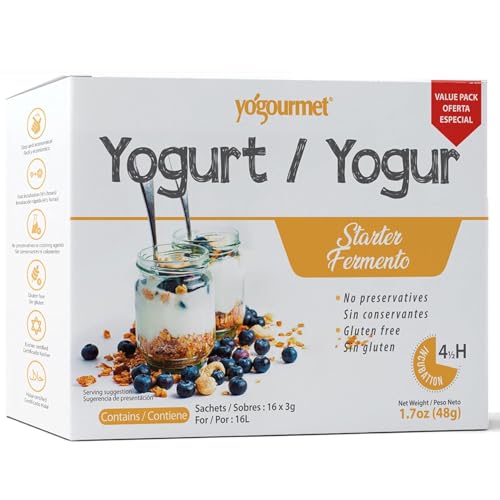
Sixteen sachets at 3 g each, and each one makes a full liter of yogurt. That ratio is the reason this pack suits someone who has already decided homemade yogurt is a habit — you buy once, stash the box, and pull a fresh sachet whenever you want a batch.
Shelf life is the quiet advantage. The maker states a 24-month shelf life from production and notes the starters remain usable past that date without health risk. Practically, that means no pressure to use them up before they turn — a real difference from cultures you have to keep alive in the fridge. Each sachet is individually sealed, and the blend lists L. bulgaricus, S. thermophilus, and L. acidophilus.
Texture is the part to manage yourself. Owner results genuinely differ at the two ends — some describe a really thick, traditional Turkish-style set with balanced tartness, while others get something as thin as milk. The common thread in the thick reports is straining: a home cook running a half-gallon of half-and-half through a sous vide at 110°F for about 18 hours, then straining and chilling overnight, reported a full 2 quarts of thick Greek yogurt at the end. The culture does its job; the strain step is what delivers the density. Longtime buyers also note it stores fine in the fridge and does not go to waste between batches.
The bulk logic: 16 sachets at one liter each is a long runway, and the 24-month shelf life removes the clock pressure.
Plan for it: without a strain step, results skew thin — budget the time to drain the whey.
Built for the weekly fermenter who wants a stocked supply and predictable results batch after batch.
Skip if you would rather not strain — thick Greek texture does not happen on its own.
6. Judee’s Gluten Free Greek Yogurt Powder, 11.25 Oz

Thick tang without a fridge, spooned straight from a shelf-stable pouch
This is not a yogurt you eat from a tub. It is an 11.25-ounce pouch of freeze-dried Greek yogurt powder that keeps at room temperature and mixes into whatever you are making. No refrigeration is required, which makes it the outlier pick for camping, small kitchens, and anyone who has watched a tub spoil before it got eaten.
Where it shines is the kitchen. It is fat-free, gluten-free, and nut-free, and it blends into smoothies, salad dressings, pastry fillings, frozen yogurt bars, and sugar-free frozen yogurt mixes as a substitute for liquid Greek yogurt. People using it that way describe mixing in a little water, stirring through protein powder, and topping with fruit or granola for a quick snack. The tang is the point — this is a sharp, savory yogurt flavor rather than a sweet one.
Be realistic about the reconstitution side. Mixing this into a bowl of yogurt is the harder road: reports describe clumping that is slow to dissolve, a chalky note in the plain version, and ratios that need testing — a one-to-one mix thickened to a ricotta-like body but tasted burnt to one cook. A blend of one part powder, one part water, and one part evaporated milk fared better. The pouch reseals and stays fresh at room temperature, so mistakes are cheap to fix.
Where it earns its shelf: no refrigeration, 11.25 oz per resealable pouch, and real tang for baking, smoothies, and dressings.
Pick this if you want Greek yogurt flavor in baked goods and shakes without a refrigerated tub.
Not for spoon-from-the-bowl eating — reconstituting it into a smooth set takes trial and error.
7. Euro Cuisine YM80 Electric Yogurt Maker with Glass Jars

Seven glass jars and one switch — the machine that made homemade yogurt normal
Seven 6-oz glass jars is the pitch: you can incubate seven different yogurt types side by side in a single run. Because the jars are glass, your yogurt never touches plastic during the ferment, and the BPA-free lids snap on airtight so the same jars do double duty for fridge storage. When you are done, they go straight into the dishwasher.
The control panel is deliberately plain — an on/off switch, an indicator light, and a time reminder with no confusing buttons. That simplicity is the reason so many owners describe it as the easiest maker they have used. The transparent lid also lets you watch the batch set, which is a small thing that new fermenters appreciate more than they expect. A 3-year warranty backs it, and at 4.4 pounds with a 9.5″L x 9.5″W x 6″H footprint, it nests away without much fuss.
Two things to know before you buy. First, there is no timer auto-shutoff — the reminder chimes but you switch it off, so a batch left overnight is on you to retrieve. Second, temperature behavior varies: some owners watch it hold steady in the low 110s°F, while others report it running cooler than expected. It also comes with no strainer, so thick Greek texture means buying a separate one or straining through your own setup. If your batch starts tasting chalky or thin, temperature and starter dose are usually the first places to look.
Why the jars win people over
- Seven 6-oz glass jars let you run seven flavors at once
- One-switch operation with an indicator light and time reminder
- Dishwasher-safe jars double as airtight fridge storage
- Covered by a 3-year warranty
The corners it cuts
- No auto-shutoff — you must switch it off yourself
- No strainer included, so Greek thickness needs a separate step
- Temperature hold draws mixed reports from owners
Match for anyone feeding a family who wants portioned jars ready to grab and go.
Reconsider if you want an unattended overnight ferment with automatic shutoff built in.
8. Yomast Organic Yogurt Plain 64oz (Pack of 2)
One ingredient, twelve hours of fermenting, and nothing else in the tub
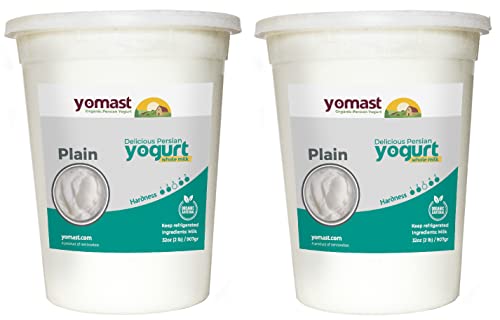
The ingredient list is the entire sales pitch: organic whole milk, full stop. No gums, no sugar, no additives — which is the cleanest label you will find on this list. Two 64-ounce tubs arrive together, aimed at households that go through plain yogurt fast enough to justify the bulk.
Flavor is built on time. It is naturally fermented for 12+ hours and slow-strained for a thick consistency, which lands it in genuine Persian-style territory — tangy, dense, and made for savory use as much as sweet. Owners describe it working as a dip, alongside rice, or eaten plain, and one calls out that it keeps the tangy taste yogurt used to have. Pair it with herbs, fruit, or honey and it holds its own.
The maker offers a nice shortcut for gauging texture: their hardness scale treats each notch as 12 hours of straining, so a higher number simply means thicker yogurt. The honest risk with this pick is not the yogurt at all — it is cold-chain delivery. One reviewer noted a box left in direct sun for about two days in near-100°F heat, which spoiled the shipment entirely. This is worth ordering when someone will be home to bring it inside promptly.
Label purity: a single ingredient and a 12+ hour ferment make this the most hands-off way to get genuinely tangy, unsweetened yogurt.
Delivery caveat: it arrives refrigerated, so plan for someone to be there.
For you if you want restaurant-style Persian yogurt without touching a single piece of equipment.
Order with caution if your deliveries sit outside in the heat — cold chain is on the line here.
9. Chobani Vanilla Greek Yogurt, 4 Ounce, 12 per Case
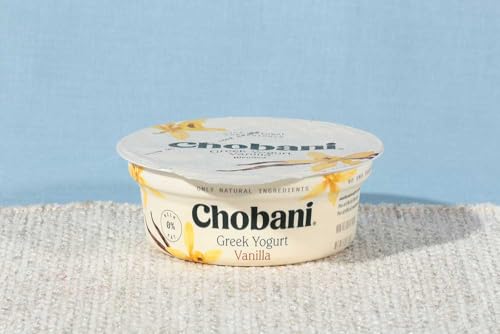
A dozen grab-and-go cups for the days you will not touch a strainer
Twelve cups at 4 ounces each, ready to eat straight from the fridge. This is the pick for people whose real constraint is time, not technique — no incubating, no straining, no waiting, just a single-serve portion you can drop in a lunch bag.
The formulation is straightforward. It is Greek yogurt made from milk from cows not treated with rBST, blended with vanilla, using all-natural non-GMO ingredients. Because it is vanilla rather than plain, expect some added sweetness compared with an unflavored tub — if your no-sugar goal is strict, read the panel before committing to a case.
This pick is honest about what it is. It is not a way to cut sugar to zero, and it is not the cheapest route per ounce compared with making your own. What it buys you is consistency and zero effort on the mornings when a homemade batch ran out. Buyers of single-serve Greek yogurt generally come for the portion control and the fact that nothing goes to waste at the bottom of a large tub.
Works best for commuters and lunch-packers who want portioned Greek yogurt with no prep.
Not the one if you need a strictly unsweetened, unflavored tub.
10. Dannon Oikos Triple Zero
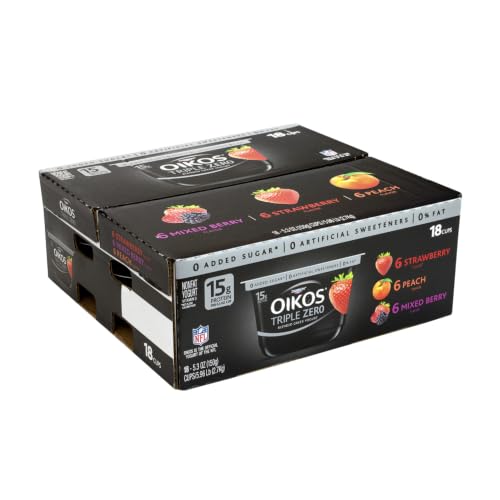
Eighteen protein-heavy cups for the gym-bag crowd who counts every gram
Eighteen cups at 5.3 ounces each — the largest per-cup size on this list and a full case of them. The name points at the formulation: nonfat, no added sugar, and no fat, in blended strawberry, mixed berry, and vanilla flavors. If protein per serving is your reason for eating Greek yogurt in the first place, this is built for that exact goal.
The texture leans dense. Owners describe it as thick enough that they thin a scoop with a splash of whole milk to loosen it up, which is a texture preference rather than a flaw. Flavor holds up — one buyer notes it is not overly sweet, which fits the no-added-sugar promise. The case format suits anyone who eats a cup daily and would rather restock once than shop weekly, and buyers report the bulk route costs less than buying singles.
The recurring note in owner feedback is value. The yogurt itself lands well; the amount you pay for a case draws more skepticism than the flavor does. There are also occasional fulfillment mismatches, like a shipment arriving with a different flavor than the one listed, which is worth knowing if a specific flavor matters to your order.
Protein-first design: 18 cups, all nonfat and no added sugar, in a size that actually fills you up.
The honest note: it is a considered spend per case, so it pays off if you go through cups quickly.
Built for high-protein eaters who want a case of nonfat, no-added-sugar cups on hand.
Look past it if you are price-sensitive per cup or need a specific flavor guaranteed.
11. Ultimate Probiotic Yogurt Maker
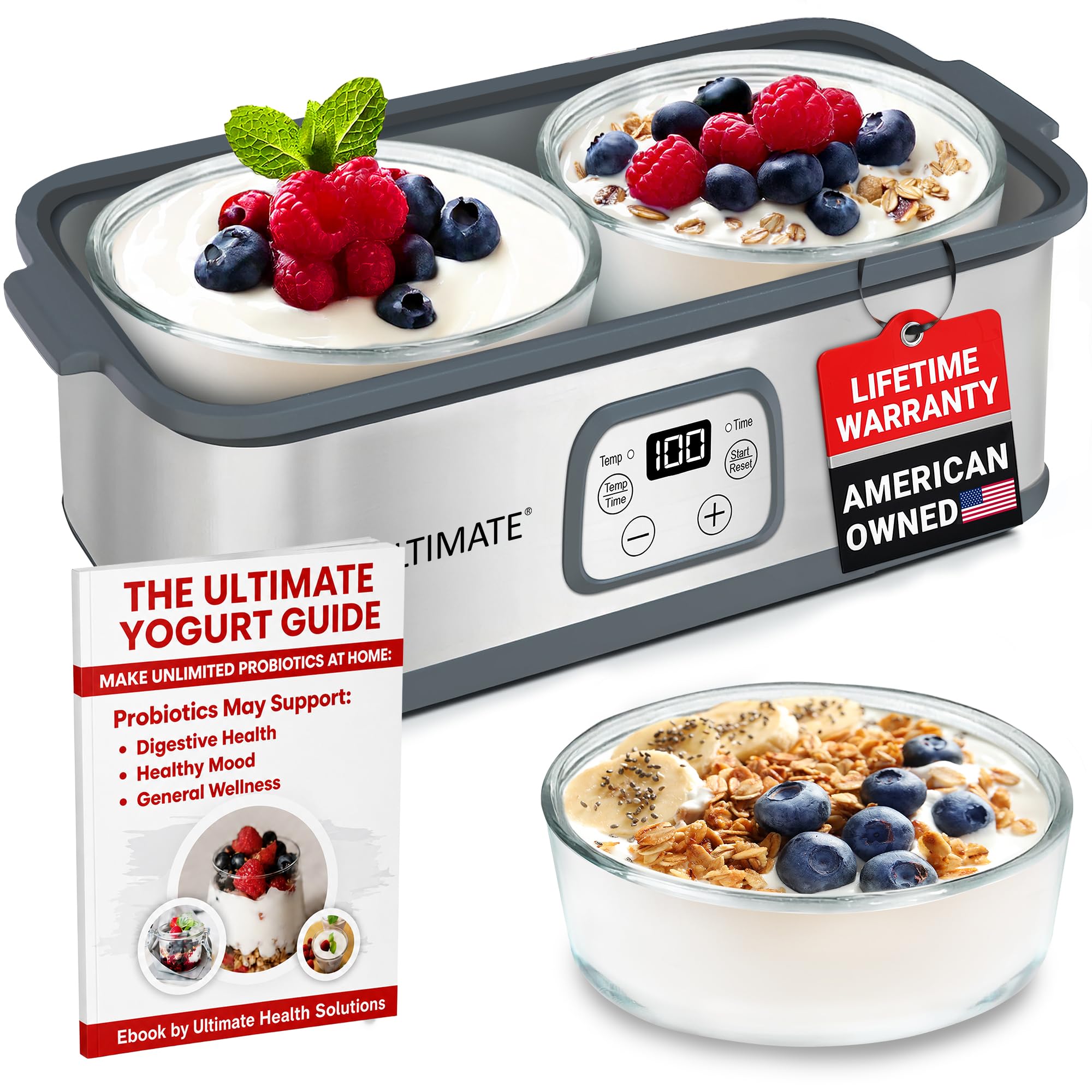
Holds a steady low temperature for 48 hours — the window the fussiest cultures need
The headline spec is a 48-hour hold at a steady temperature. Long, low-temperature ferments are exactly where delicate cultures fall apart, and the TruTemp regulation is built to keep the environment from overheating during those extended runs. If you are following a popular 36-hour recipe, that headroom is the difference between a working batch and a ruined one.
Capacity comes in two 1-quart glass containers with BPA-free lids, which works out to about eight 1-cup servings per batch. It ships with a recipe eBook, and the maker describes the recipes as taking under five minutes to prepare. The default settings of 99°F for 36 hours are what owner feedback keeps coming back to — people running those numbers report densely creamy, tangy yogurt and describe the machine as succeeding on the first attempt.
Two things to weigh. First, temperature control draws more divided feedback than anything else on this unit, so expect to verify your own hold with a thermometer during early batches. Second, it is one of the larger footprints here at 14.37 by 7.6 by 5.71 inches and 4.45 pounds, though owners still describe it as counter-friendly. The unlimited lifetime manufacturer’s warranty softens the risk considerably on both counts.
The 48-hour case: adjustable temperature and time, two 1-quart glass containers, and a warranty with no end date make it the pick for serious long ferments.
The check to run: confirm the hold on your first batch, since temperature reports vary.
Right for the fermenter chasing long, low-temperature probiotic batches with real control over the dial.
Overkill if you just want a basic overnight set — the extra control costs counter space.
Know the Specs
Straining vs. Fermenting — two different jobs
Fermenting is the step where bacteria turn milk into yogurt; straining is the step afterward where whey drains off and the curd thickens. A starter culture handles the first, a strainer handles the second, and neither one does the other’s work. If your goal is thick, lower-sugar Greek yogurt, you usually need both — a culture to make the base and a strainer to concentrate it. This is also why some thick reports come from people who strain and thin reports come from people who do not.
Temperature hold and time control
Fermentation depends on keeping the milk warm and steady for hours. Delicate cultures used in long, low-temperature ferments are the most sensitive to drift, which is why adjustable temperature and time settings matter — they let you match the machine to the recipe instead of guessing. Many basic makers hold one preset warmth and rely on you to switch them off, so a batch left too long can over-ferment. Being able to dial in a specific temperature and duration is what separates a forgiving incubator from a finicky one.
Capacity and servings per batch
Capacity tells you how much you make in one go, and it should match your weekly eating. A 2.3-quart strainer handles a full half-gallon batch in a single pass and yields about seven 6-oz servings. An incubator with two 1-quart containers produces roughly eight 1-cup servings. Smaller jar setups give you portioned singles instead. Match the number to how fast your household actually eats yogurt, or you will either be running batches constantly or watching them sit.
Shelf life and storage
Freeze-dried starter sachets are the most forgiving thing to keep on hand — one brand lists 24 months from production and notes they stay usable past that date. Liquid cultures you maintain from a previous batch need refrigeration and attention. Finished yogurt is its own category of perishable and depends on a working cold chain from the moment it ships, which is why resealable sachets and shelf-stable powders are popular backup options.
Common Questions
Does straining Greek yogurt actually remove sugar?
Can I make thick Greek yogurt without a yogurt maker?
How long does a yogurt starter culture stay usable?
My homemade yogurt came out thin — what went wrong?
Do I need a separate strainer if I already own a yogurt maker?
How much yogurt does a starter sachet make?
Is it cheaper to make Greek yogurt at home than to buy it?
What temperature should I ferment yogurt at?
Can I use a strainer with soy or coconut yogurt?
Is Greek yogurt with no added sugar the same as plain Greek yogurt?
The Bottom Line
For most kitchens, the strongest starting point is the Ultimate Greek Yogurt Strainer — the 2.3-quart basket handles a full half-gallon batch, turns out about seven 6-oz servings, and rinses clean in the dishwasher, which is why it is the pick the crowd keeps coming back to. Pair it with a starter and you control exactly what goes into the bowl. If frozen desserts and yogurt both live in your rotation, the Whynter ICM-220CGY runs both without any pre-freezing. For sheer convenience, the pre-made options like Yomast deliver tang without you touching a piece of equipment. For most people, the smartest first step is the strainer — it thickens the yogurt and cuts the sugar in one move.
How we choose
We do not accept paid placement. Every pick is matched to a real buyer and a real use-case; we do not hands-on test units.
Sources
Specifications: manufacturer listings and product documentation. Review insights: verified customer reviews, as of October 2026. Pricing: not shown on this page (it changes often); check the current price via the retailer link.
As an Amazon Associate, Aappliancez earns from qualifying purchases. This does not affect which products we feature.