Disclosure: Some links in this post are affiliate links. As an Amazon Associate I earn from qualifying purchases, at no extra cost to you. Learn more
Specs are compiled from manufacturer listings and verified buyer reviews and can change over time — please confirm the key details on the product page before buying.
Twenty minutes into a session, does the pad still stick and the current still feel steady? That is the real test of an e-stim machine, and the models below answer it differently. Pick by how you plan to use it — clipped to a belt during a workday, or propped against a chair for a knee that aches after training. This guide separates units with genuinely adjustable intensity and honest pad life from ones that only look capable on the box.
This guide is built by comparing the manufacturers’ published specifications and the patterns across verified customer reviews, so you get each pick’s real strengths and trade-offs instead of marketing spin.
Below you’ll find channel counts, mode totals, and run times laid side by side, plus the settings and pad-fit details that decide whether a unit earns a place on your shelf. Every pick here is a capable e-stim machine, so the real work is matching one to your body and your routine.
Top Picks

How To Choose The Best E-Stim Machine
An e-stim machine (short for electrical stimulation) sends small pulses of current through sticky pads on your skin to work a muscle or calm a sore spot. The buyer decision is not “does it pulse” — almost all of them do. It is whether the controls let you dial the current low enough to stay comfortable, and whether the pads hold their grip long enough to finish a session. Start with how many pad pairs run at once, then work down to run time and pad life.
Count your channels before anything else
A channel is one independent pad circuit. Two channels means front and back, or both shoulders, at once. If you want to treat a wide area like the lower back, more pad pairs give you better coverage; a unit with a single output will only ever reach one patch of skin at a time.
Look at intensity steps, not just mode totals
Modes are preset pulse patterns; intensity is how much current you feel. A unit with 40 adjustable levels lets you creep up in small increments instead of jumping from “barely there” to uncomfortable. For first-time users, small steps matter more than a big mode count.
Plan for pad replacement from day one
Pads are the consumable part — the gel dries, skin oil builds up, and grip fades. Check that the unit uses a standard connector type so you can buy third-party replacement pads rather than being locked into one brand’s refills. This is the single biggest long-term cost and the most common source of frustration.
Rechargeable or replaceable battery
A rechargeable unit plugs into a USB-C cable and skips the battery aisle. A replaceable-battery unit never bricks when the cell ages, and you can carry a spare. Neither is wrong; pick based on whether you would rather plug in every week or keep a spare battery in the case.
Side-by-Side Comparison
| Model | Best For | Modes | Channels | Run Time / Power | Amazon |
|---|---|---|---|---|---|
| AUVON Rechargeable Digital TENS Unit★ Best Overall | Everyday pain relief and easy travel | 8 (40 levels) | 2 (CH1 / CH2) | 600 mAh, 60 hours | Amazon |
| AVCOO 3-in-1 TENS UnitMost Versatile | Versatility with a hard travel case | 24 (40 levels) | 2 (A / B) | 40 hours | Amazon |
| TENS 7000 Digital TENS Unit | Proven, widely used basic unit | Multiple modes | 2 (dual leads) | 9V battery (included) | Amazon |
| Comfytemp 32-Mode Wireless TENS | Wire-free, app-controlled sessions | 32 (20 levels) | 2 wireless hosts | 10 hours per host | Amazon |
| TENS 7000 Rechargeable | Rechargeable recovery and growth | TENS + EMS | 2 (dual leads) | Rechargeable battery | Amazon |
| Beurer EM59 3-in-1 | Heat plus TENS in one device | 64 presets + 6 custom | 2 independent | Rechargeable, 5–100 min timer | Amazon |
| Chattanooga Primera | Serious rehab with HAN waveform | 8 TENS + 6 NMES | 2 outputs | 9V battery (included) | Amazon |
Detailed Reviews
1. AUVON Rechargeable Digital TENS Unit Muscle Stimulator
Our pick — 4.5+★ from 950+ verified ratings; the strongest balance of quality and price.
The belt-clip unit with a 60-hour battery that stays out of the way through a full workday.
What makes this the pick for most people is how little you have to think about it. Clip it to a belt and the compact body does not hinder movement. For a knot in the shoulder that you want to chip away at after work, that means charging maybe once a month rather than working around a dead unit.
Control is split across CH1 and CH2, so both pad pairs can run at different intensity. You get 8 modes with 40 levels of adjustment, and you can change pulse width and frequency yourself if you follow a physical therapist’s settings. That is fewer modes than the AVCOO’s 24, but the trade runs the other way on pad life: the included low-impedance gel pads here are rated for 45 uses, against 50 on the AVCOO. Twelve pads come in the box, so you are set for a good while.
The pitch is drug-free relief for sore muscles in the shoulders, waist, back, neck, arms and legs — strain from exercise or household work. It is not a nerve-pain device and it will not fix an injury. Two things buyers report as fair trade-offs: the interface is not the most intuitive until you learn it, and a custom rate/width/time setting is not remembered between sessions. The pads have no pull tabs either, so peel them carefully.
Where it earns its top spot
- 60 hours of continuous therapy from a 600 mAh battery, with USB-C charging from any wall charger, power bank or laptop port
- Two channels with 40 intensity levels each, so you can creep up in small steps instead of jumping
- Flip cover guards the controls against accidental contact, and the 2mm connectors take industry-standard replacement pads
- Twelve low-impedance gel pads rated for 45 uses each, with upgraded TPE wires that resist tangling
Honest notes before you buy
- Custom rate, width and time settings reset between sessions — you re-enter them each time
- Fewer modes (8) than several picks below, so pattern variety is modest
- The menu takes a session or two to learn; the buttons make more sense after you read the manual
Reach for this if: you want one do-everything unit that clips to your belt and treats two areas at once without fuss.
Look elsewhere if: you need a long menu of distinct pulse patterns, or a unit that remembers your custom program from yesterday.
2. AVCOO 3-in-1 TENS Unit Muscle Stimulator, 24 Modes, EVA Bag
Twenty-four modes in a shock-resistant case that fits a jacket pocket.
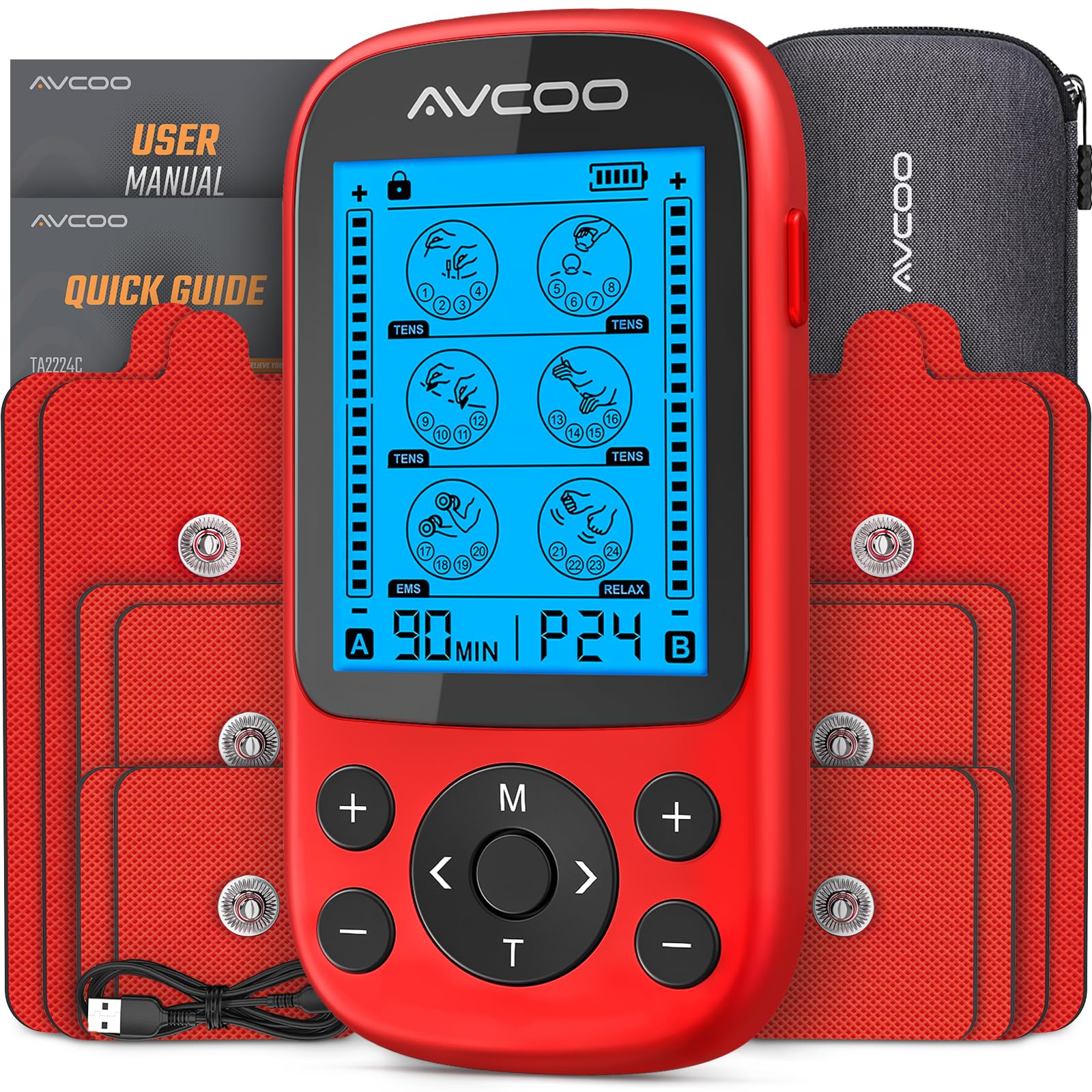
If you want options, this is the unit that hands them to you. You get 24 pre-programmed modes against the AUVON’s 8 — a 3.0x gap — plus 40 levels, and the therapy timer stretches to 90 minutes in continuous mode. Three functions share the body: TENS for pain, EMS for muscle work, and a RELAX mode for general loosening. Each mode also hides sub-settings, which the included manual covers more thinly than most buyers would like.
Coverage is broad by design. Two pads (A/B channels) handle a focused spot; four pads run a wider area at once. The twelve included pads come in two sizes — 4 rectangular pads at 2” x 4” for the lower back and thighs, and 8 square pads at 2” x 2” for the neck, knees and ankles. They are latex-free, skin-friendly gel rated for more than 50 uses, so replacement packs are a later problem rather than a weekly one.
On battery, this runs 40 hours of continuous relaxation against the AUVON’s 60. What makes it a serious shortlist pick anyway is the hard EVA travel case — moisture-resistant, holding the stim machine, pads and accessories together, so it lives in a gym bag without the pads picking up lint. One thing to size in advance: the package measures 7.44 x 4.8 x 2.64 inches and weighs 14.46 ounces, so it is a bag item, not a pocket one. It is genuinely powerful, often too powerful to run at max strength.
The mode spread: three therapy types and 24 presets cover most of what a home user needs, and the up-to-90-minute continuous timer suits a long evening session.
The real catch: the manual is the weak link — adjustability lives in sub-menus it does not fully explain, so expect to experiment to find the settings that suit your body.
The verdict: the broadest set of options in this group, wrapped in a case you can throw in a bag — best for the tinkerer who wants to try many pulse patterns and treatment areas.
Trade to weigh: 40 hours of run time where the AUVON gives 60, so charge it more often if you run long sessions daily.
3. TENS 7000 Digital TENS Unit with Accessories

The no-frills 9V workhorse that has been on the market since 2014.
Some buyers do not want 64 programs and an app — they want a unit that turns on, pulses, and shuts off. This is that unit. It has been on the market since 2014, runs on a single 9V battery (a rectangular battery you can buy at any drugstore), and arrives with everything to start: two lead wires, a four-pack of reusable premium electrode pads, the battery, a manual and a hard carrying case. Nothing about it is clever, and that is precisely the point.
It is an over-the-counter device aimed at back pain, neck pain, tennis elbow, sciatica and general muscle recovery. The 9V battery is the honest weak spot. Some buyers find it lasts well; others say it dies sooner than expected, and that split shows plainly in the review pages. A spare 9V in the case solves it, and the unit weighs 13.7 ounces, so it adds little to a bag.
The pads are the part you will replace first — they stay sticky until they simply do not, then you buy more, and the standard connectors make that easy. It will not remember a program, will not connect to a phone, and will not tell you which mode is best for your shoulder. Take those limitations as given and it is among the most dependable basic units you can put in a drawer.
Why it stays relevant: simple, battery-powered and complete from the start — nothing to charge, nothing to pair, nothing to install.
Set your expectation on power: the 9V cell is the variable. Keep a spare on hand if you run daily sessions and you sidestep the one recurring gripe entirely.
Who it fits: the no-frills user who wants a dependable unit with a hard case and no app dependency.
skip it if: you want rechargeable convenience or app control — this one is deliberately old-school.
4. Comfytemp 32 Modes Wireless TENS Unit Muscle Stimulator

Two cordless pods you steer from your phone — no wires to tuck under a shirt.
Every other pick here has a lead wire running from pads to a controller. This one does not. The Comfytemp uses two wireless hosts (small control units) that snap magnetically onto the pads and talk to an iOS or Android app, so you can set time, strength and body area from your phone while the hardware sits under your clothes. You bring the hosts, the pads and your phone — that is the whole kit. Each host runs up to 10 hours, and a full charge takes about 2 hours over USB.
The mode count is the highest in this group: 32 modes with 20 intensity levels, across TENS (nerve-stimulation for pain relief), EMS (muscle-stimulation for recovery) and MASSAGE functions. Critically, the two hosts adjust separately, so a sore left shoulder can take more current than the right. A 10–60 minute timer handles session length. The four included pads split into 2 butterfly pads at 5.2 x 2.4 in and 2 linear pads at 3.5 x 2.8 in, and the two-piece linear design is meant to straddle a painful area on both sides for focused relief at the knees, elbows and shoulders.
Here is what to plan for. The premium gel is rated for 60+ uses, but sweat and skin oil shorten that fast — wipe the area dry before applying, and rinse the pads with water when grip fades to bring the stickiness back. Sessions are capped at 60 minutes, so a long evening treatment is not on the menu. And 20 intensity levels tops out lower than the 40 levels on several wired units, which matters if you like a strong current.
What sold the wire-free crowd
- Two independent wireless hosts mean you can treat two body areas without a single cable
- 32 modes across TENS, EMS and MASSAGE — the widest selection here
- Magnetic snap keeps each host secured to its pad during light movement
- Fits in a bag and runs from a phone at work, on a commute, or after a workout
What to expect honestly
- Sessions stop at 60 minutes, which rules out long continuous treatment
- Gel pads lose grip quickly with sweat; replacement packs come bundled rather than singly
- 20 intensity levels is a modest ceiling for anyone wanting strong stimulation
Pick this one when: wires are the reason you have not stuck with a TENS routine — this removes them entirely and hands control to your phone.
Know the ceiling: 20 intensity levels and a 60-minute session cap mean it suits steady, moderate relief, not maximum output.
5. TENS 7000 Rechargeable Tens Unit Muscle Stimulator, EMS

The familiar workhorse, rebuilt rechargeable, with an EMS side for post-training muscle.
This is the modern take on the TENS 7000 idea: same simple intent, but a rechargeable battery replaces the 9V cell, and an EMS function joins the TENS side for muscle recovery and growth. It suits the fitness buyer as much as the office worker with a stiff back — tennis players use it on ankles and shoulders after a match, and the residual soreness fades for the rest of the day, though not permanently. Skinny enough to be called cigarette-pack size, and it ships with a small hardshell case that holds everything.
The controls are basic, which cuts both ways. Two pads run from the dual leads, and the 2mm pin pads stick well with strong transfer, so the current reaches where you put them. Electrode placement takes a few minutes to learn — a diagram or a video helps. But some functions are not explained clearly, and the unit is not the most communicative about what each setting does. One buyer found it did nothing for nerve pain, only muscle issues, which is consistent with how TENS works in general.
Battery life is the point of the rechargeable design, and it lasts well between charges, though that too is a mixed report across the reviews — some find it excellent, some less so. The pad adhesive holds up, but placing pads on your own back is genuinely awkward; they bend and stick to themselves. If back coverage matters, have someone help the first time.
The upgrade that counts: dropping the 9V battery for a rechargeable cell means no battery aisle and no surprise cut-out mid-session.
Where it asks patience: the feature set is deeper than the controls explain, and self-placing pads on the back takes practice.
Good match for: active people who want pain relief plus an EMS session for tired muscles, and will not mind learning the menus.
Consider the basic 9V model instead if: you want the same brand with zero learning curve and a battery you can swap in seconds.
6. Beurer EM59 Digital 3-in-1 TENS Unit, EMS & Heat Therapy
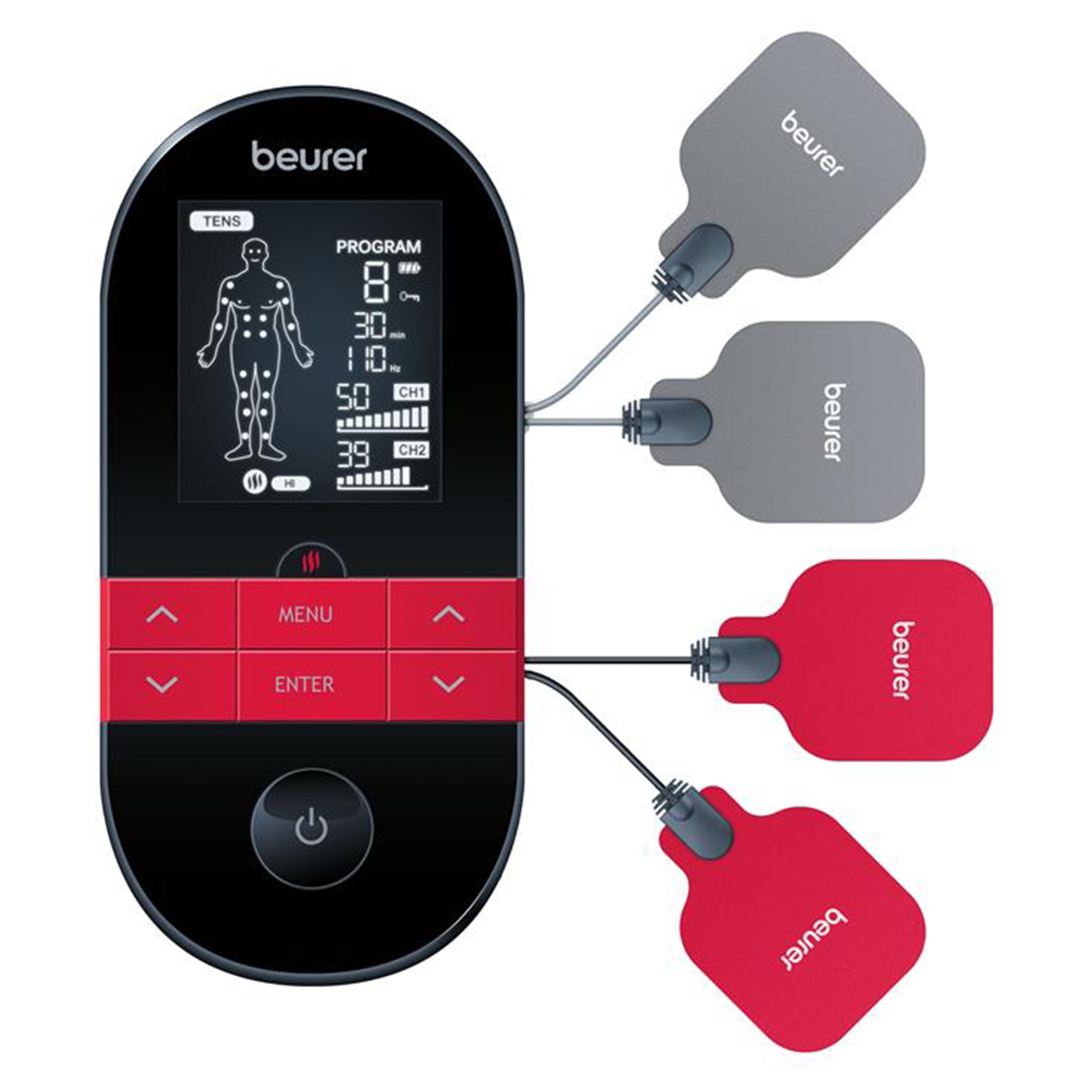
The only pick that adds heat to the current — three therapies in one palm-sized body.
Heat is the feature nobody else in this lineup has. The EM59 combines TENS, EMS and a warming element in a single device, with 2 independently adjustable channels and 4 self-adhesive pads to spread across the back, neck, knees, shoulders or legs. It carries 64 preset programs and 6 custom slots, and the adjustable 5–100 minute timer lets you set a session length exactly. An inverse LCD display walks you through program selection and tells you where the pads go.
For focus, the 450us pulse width (how long each electrical pulse lasts) and independently adjustable channels give you fine control over how the current feels, and the power is described as strong for a unit this small — one tennis player with an old ACL tear finds it relaxes the surrounding muscle after workouts. The belt clip and 6.7 ounce body keep it portable, and a safety switch-off adds confidence. The construction feels solid in the hand.
The caveat is the pads. Beurer’s own electrodes are the recommended pairing, and cheaper third-party pads fit but are not always the right match — a recurring gripe is that the included pads do not grip well and replacements are not cheap. The manual is thorough, the controls take some learning, and some find the Menu button awkward. Read the pad instructions carefully: the gel sticks to the wrong layer if you peel it the wrong way first.
Where it stands apart: the heat function adds a dimension the wired TENS units simply cannot offer, and 64 presets means you are unlikely to run out of options.
Budget for pads: plan on branded replacements and treat the pads as a consumable; that is the cost of the heat-and-current combination.
The verdict: the pick for someone whose muscles respond to warmth as much as current — two therapies in one device, with serious customization behind the presets.
An honest caution: budget for branded replacement pads from the start; grip is the one thing buyers regularly flag.
7. Chattanooga Primera TENS/NMES Unit with HAN Waveform

Built for rehab work, with a waveform you will not find on a consumer unit.
The HAN waveform is the reason to consider this one. It layers low- and high-frequency stimulation to calm muscle spasms and manage pain, and it sits alongside 8 TENS and 6 NMES presets. NMES works a muscle rather than just soothing it, which is why this is the pick when the goal is movement recovery, not just comfort. Rehab owners mention improvement in arm and hand movement after regular sessions. It runs on a single 9V battery and comes with a carrying case, lead wires, electrodes, a positioning back belt and a manual.
Two outputs mean two pad pairs at once. If that covers your area, the unit is close to perfect — easy to self-administer, with a belt clip for walking around and an open-circuit safety shutoff that stops the current if a pad loses contact. If you want full lower-back coverage, two outputs will not be enough; this is the wrong tool for wide-area treatment. An end-of-session alarm is also absent, so you will not be notified when the timer finishes.
The 9V battery is a mixed bag — a great report from some, a shorter one from others, and it is not rechargeable, so keep a spare. Included pads wear out over weeks of daily use. Settings do not always save between sessions. None of that changes the core value of the HAN waveform, but it means the Primera suits a specific buyer: someone with a therapist-guided plan who needs the NMES (neuromuscular electrical stimulation) and waveform tools, and who is willing to accept a simple battery and modest accessory life.
The professional angle: 8 TENS and 6 NMES presets with the HAN waveform give a rehab-focused user tools a basic consumer unit cannot match.
The honest limit: two outputs, a non-rechargeable 9V cell and pads that need replacing — fine for focused work, short for wide-area coverage.
Choose it if: you are working a guided rehab plan that calls for NMES and the HAN waveform, and your treatment is focused on one or two areas.
Do not pick it for: large-area back treatment or app-style convenience — this is a clinical-style tool with a clinical-style interface.
Know the Specs
Channels and pads
A channel is one independent electrical circuit, and each one drives a pair of pads. One channel means one area at a time; two channels means you can run both shoulders or the neck and lower back together, with each set at its own intensity. The AVCOO and AUVON both offer two channels and can run either 2 or 4 pads at once. More pads do not mean more power per pad — they mean wider coverage at lower strength per area. Plan channels around how many zones you actually want to treat simultaneously.
Modes vs intensity levels
These are two different dials. Modes are preset pulse patterns — a steady hum, a slow throb, a rapid flutter. Intensity is how much current flows, and more levels means smaller, gentler steps. A unit with 40 levels lets you inch up from “barely there” to “working” without overshooting. The Comfytemp’s 20 levels cap the top end sooner than the 40-level wire units, which matters if you like a strong current. Look at both the mode count and the intensity count when comparing.
Pad life and replacement
Pads are the part you will buy again. The gel loses tackiness as skin oil and sweat build up, and once it stops gripping it delivers uneven current. Rated life varies across this lineup — 45 uses on the AUVON, 50 on the AVCOO, 60+ on the Comfytemp — and sweat can shorten any of those. Wiping your skin dry first extends life. Confirm the unit takes standard 2mm or 3.5mm connectors so you can buy third-party replacements instead of relying on branded packs.
Battery and run time
Run time is measured in hours of continuous therapy. The AUVON’s 600 mAh cell gives 60 hours, the AVCOO 40 hours, and each Comfytemp host 10 hours with a 2-hour charge time. A rechargeable unit means no battery aisle but a cell that ages; a 9V unit like the TENS 7000 or Primera means a quick swap and no charging cable. If you run a session daily, estimate how often you want to plug in. If you want zero downtime, keep a spare battery or a charged backup.
Common Questions
How many pad pairs do I need for lower back pain?
Do replacement pads need to be the same brand?
How long does a charge usually last on a wireless unit?
What is the difference between TENS and EMS modes?
Can I use an e-stim machine on my neck or head?
Why do my pads stop sticking after a few uses?
Is a rechargeable unit better than a 9V battery one?
Will it help nerve pain as well as muscle pain?
How do I place pads on my own back?
The Bottom Line
For most people shopping for the best e-stim machine, the answer is the AUVON Rechargeable Digital TENS Unit. Its 60-hour run time is the longest here, its two channels let you treat two areas at once, and it clips to a belt and stays out of the way during a workday. If you want the widest set of modes and a hard carry case, the AVCOO 3-in-1 gives you 24 modes and a 90-minute continuous timer. And if treating muscle after training matters as much as pain relief, reach for the TENS 7000 Rechargeable — same trusted brand, rechargeable battery and an EMS side. Pick by pad coverage and control, and you will land on the right one for your routine.
How we choose
We do not accept paid placement. Every pick is matched to a real buyer and a real use-case; we do not hands-on test units.
Sources
Specifications: manufacturer listings and product documentation. Review insights: verified customer reviews, as of October 2026. Pricing: not shown on this page (it changes often); check the current price via the retailer link.
As an Amazon Associate, Aappliancez earns from qualifying purchases. This does not affect which products we feature.