Disclosure: Some links in this post are affiliate links. As an Amazon Associate I earn from qualifying purchases, at no extra cost to you. Learn more
Specs are compiled from manufacturer listings and verified buyer reviews and can change over time — please confirm the key details on the product page before buying.
Here is the thing that decides whether an extendable tree pruner actually works for you: how far it reaches, and whether the pole still feels steady once it is stretched out. A pruner that tops out below your highest limbs still sends you back for the ladder. One whose pole whips at full extension turns every cut into a fight with the blade. The picks below cover both problems, and each one is built for a slightly different job.
This guide is built by comparing the manufacturers’ published specifications and the patterns across verified customer reviews, so you get each pick’s real strengths and trade-offs instead of marketing spin.
Some pruners here are short-handled loppers you work overhead, while others are long saw poles that reach well past a single-story roof. Your tallest branches and their thickness decide which one you need. Below is the honest breakdown of the best extendable tree pruner options for home gardeners who would rather keep both feet on the ground.
Top Picks

How To Choose The Best Extendable Tree Pruner
Ask what you are cutting and where you stand before you ask how long the pole is. A saw pole that reaches 14.5 feet works well on stiff oak limbs near the trunk. It is close to useless on floppy new growth that moves away from the blade. Pick the jaw or saw head first, then match the pole length to your trees.
Match the tool to the wood
If your problem is living branch tips on hedges and fruit trees, a bypass lopper with extendable handles gives you a clean single cut and a clean heal on the tree. If your problem is dead limbs high up an oak, you want a saw blade with teeth, not a scissors jaw — a straight or three-sided saw blade chews through dry wood that would stall a lopper. Compound action and ratcheting mechanisms both trade a little speed for a lot more force, so you get through a thick limb without leaning your whole body weight into the handles.
Longer poles flex more at full extension
Every pole loses some rigidity as it stretches. A sectional pole with threaded steel connections holds together more firmly at full extension than a thin telescoping push-button pole, and that difference shows up as blade chatter against the branch. If you regularly work at the very top of the pole’s range, plan on a firmer, heavier tool. If you mostly cut at mid-height, a lighter pole saves your shoulders over a long afternoon.
Blade steel and capacity, in plain terms
A 2-inch cutting capacity means the jaw or gap physically swallows a two-inch-thick branch in one bite. That number is the honest limit — anything fatter means a second bite or a different tool. Blade steel matters for how long that bite stays clean: SK5 and carbon steel hold an edge through green wood, while alloy steel with a low-friction coating slides through sappy limbs without grabbing.
How the weight sits overhead
A pole pruner is a lever, so a heavier head at the far end of a long pole feels much heavier than the bare number suggests. A 3.8-pound lopper held straight up overhead is a real workout; a lighter pole that flexes instead is its own kind of tiring. Weigh the trade-off against how many branches you plan to clear in one session.
Side-by-Side Comparison
| Model | Best For | Maximum Reach | Blade Length | Blade Material | Amazon |
|---|---|---|---|---|---|
| TRUPER TR-82M-A Tree Pruner★ Best Overall | Overhead cuts with control | 2.4 m telescopic | 12 inches | SK5 Steel | Amazon |
| YRTSH Loppers Branch CutterLeast Effort Per Cut | Thick branches, less effort | 28 to 41 inches | 2-inch cut capacity | Alloy Steel | Amazon |
| BlumeTrec 14.5FT Pole Saw | Highest reach on a budget | 14.5 ft | 16.7 inches | Alloy Steel (Mn) | Amazon |
| Kings County Tools Loppers | Overgrown brush and vines | 26 to 40 inches | 2-inch cut capacity | Alloy Steel | Amazon |
| SISUPASSIE 26FT Pole Saw | Very tall trees, no ladder | 5 to 20 feet | Carbon Steel (serrated) | Carbon Steel | Amazon |
Detailed Reviews
1. TRUPER TR-82M-A Tree Pruner w/ Extendable Aluminum Pole
Our pick — 4.5+★ from 1,000+ verified ratings; the strongest balance of quality and price.
A 12-inch triple-edged SK5 blade on an aluminum pole that reaches 2.4 m — controlled enough for a small woman to run alone.
If you want one pruner that handles the reach, the bite and the control without demanding gym strength, this is the one to start with. The 12-inch blade is made of SK5 steel with triple-edged teeth — three rows of cutting points that slice on the pull stroke instead of tearing. The aluminum telescopic handle stretches to a maximum 2.4 m, so you stand on the ground and reach branches well above head height. The blade is rectangular, and it carries 60 teeth across that edge, which is what makes the cut fast on green wood.
Control, not raw reach, is what wins people over. This is a saw-and-pruner head on a balanced pole, and the weight sits where you can steer it. One small gardener used it for full-control trimming on a jackfruit tree, a heavy-wood job for a hand tool. The triple-edged teeth give a clean single cut on small and medium branches without stripping bark. Thicker trunks take a couple of extra passes, but the tool does not fight you.
Weigh the reach ceiling before you buy. With a 12-inch blade and a 2.4 m maximum extension, this sits below the long sectional pole saws in this guide. The BlumeTrec reaches 14.5 ft with a 16.7-inch blade. If your tallest limbs sit above a single-story roof line, the longer pole wins. If your work is fruit trees, hedge tops and reachable limbs, the firmer pole here gives you a cleaner cut than a long flexy one. Wipe the blade with cooking oil straight after cutting sap-heavy wood, or you will reach for solvent later.
What earns its place
- SK5 steel blade with triple-edged teeth and 60 cutting points for fast, clean bites
- Aluminum telescopic handle extends to a maximum 2.4 m so you stay grounded
- Balanced enough that a smaller user keeps full control even on dense wood
- Clean single cuts on small and medium branches without bark damage
What to plan around
- 12-inch blade and 2.4 m reach fall short of the long sectional poles for very tall trees
- Thick trunks need two or more passes before the branch drops
- Sappy wood demands an immediate blade wipe-down or the residue sets hard
Grab this one when: your trimming lives in fruit trees, hedge tops and limbs you can see clearly from the ground — this is the well-rounded pick most yards actually need.
Look past it if: the branches you dread are higher than one story, where the longer pole saws below earn their keep.
2. YRTSH Loppers Branch Cutter
Two inches of clean cut capacity, multiplied by a compound lever that takes the fight out of thick limbs.
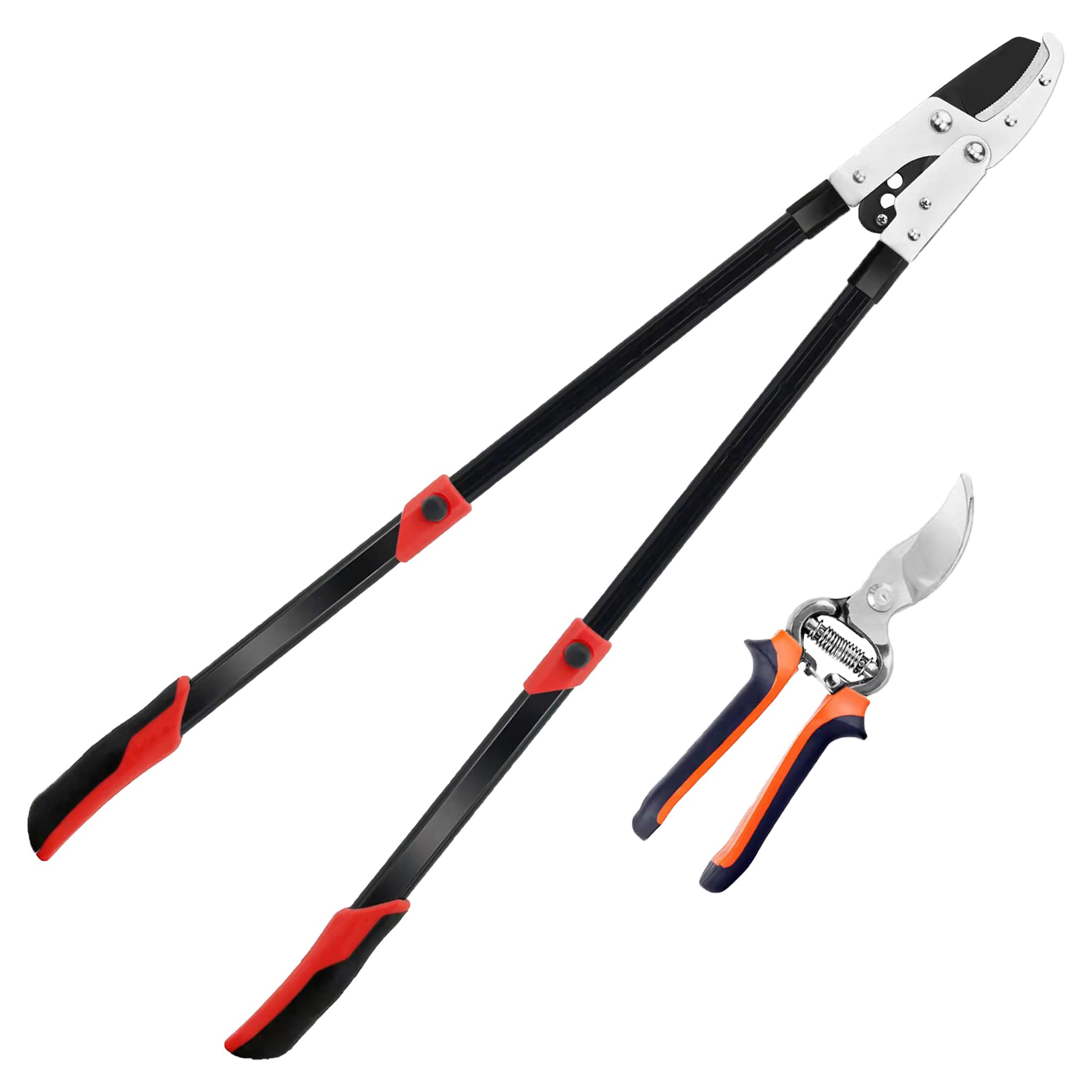
The 2-inch cutting width is the number that matters here — that jaw swallows branches that would stall a plain pair of loppers. Compound action technology does the heavy lifting, using a linked lever to multiply your hand pressure into far more force at the blade. An alloy steel blade with a Teflon and low-friction coating slides through green wood and dry wood alike without gumming up. The handles telescope through 6 steps, adjusting from 28 to 41 inches so you can reach higher without hauling a ladder out.
Buyers rave about how little the job hurts afterward. One buyer with spinal issues that rule out bending found the extended length exactly right. The shears grip well and perform without stooping. Another reviewer summed it up: “needed a replacement, works great and love the adjustable handles so i can reach higher with out a ladder.” The soft rubber, non-slip grip is ambidextrous, so left- and right-handed work feel the same. A full day of pruning does not leave your palms raw.
The honest limit is the cutting head over the long term. The blade arrives sharp, but there is no long track record yet on how well that edge holds up after a season of hard use. Know that before you hand it to a landscaping crew. Reach tops out at 41 inches, so this handles fence-line growth and low canopies rather than anything near a roofline. For that 41-inch band, the leverage is hard to argue with.
Where it shines: thick limbs that turn into a wrestling match with ordinary loppers simply give way, and the 6-step adjustable handles go from 28 to 41 inches for overhead work.
What to expect: a coated alloy blade that cuts clean on arrival, with long-term edge retention still an open question — buy it for leverage, not for a decade-long promise.
Reach for this if: your shoulders or back make ordinary loppers miserable, and the branches you fight sit within a 41-inch extension.
Look elsewhere if: you need real height — this is a leverage tool, not a long-reach pole.
3. BlumeTrec 14.5FT Pole Saw
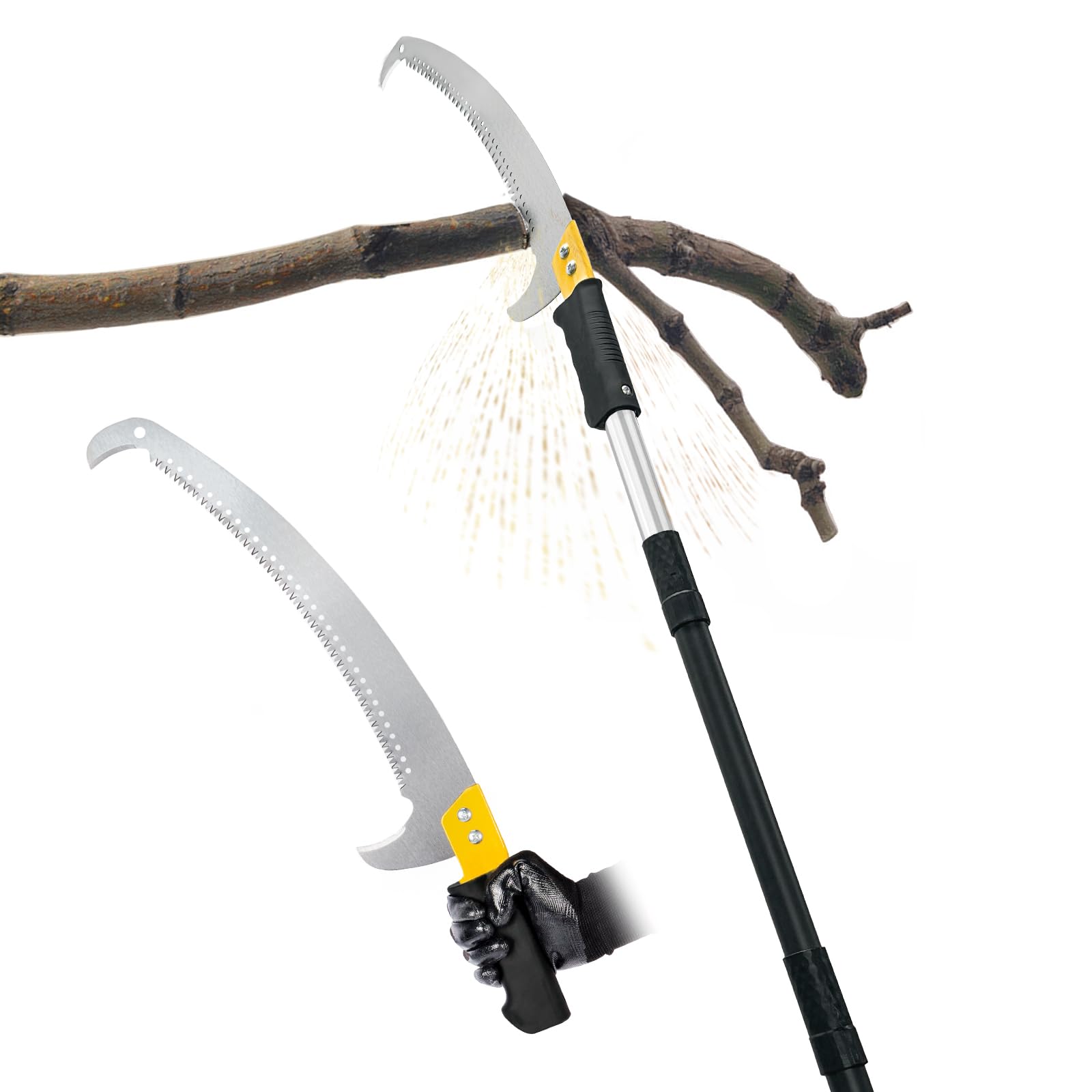
Eleven screw-together sections take you to 14.5 ft, with a 16.7-inch blade that grips and cuts in either direction.
This is the pick for anyone whose branches live past the reach of a lopper. Three length options — 8.5 ft with 6 sections, 11 ft with 8 sections, and 14.5 ft with 11 sections — let you build the pole you need for the job in front of you. The 16.7-inch blade is made of Mn steel, and its three-sided edge carries a double-sided barb design, so the teeth grip the branch and cut smoothly from multiple angles. The stainless steel poles are powder-coated against rust, and an anti-slip grip keeps the whole thing stable as you raise it.
What buyers consistently report is that the reach translates into real cutting power. One sums up a full afternoon of work: “Reached 12–13 ft overhead limbs, cut like butter.” Others clear a hunting tower’s worth of branches in ten minutes, and the detachable sections break down small for storage between seasons. An extra screw locks the saw head firmly to the pole, which stops the wobble that usually creeps into long poles mid-cut.
Know the structural trade-off going in. The multi-section screw-together design eases storage and length changes. But a long stack of thin sections flexes at full extension, so expect a little more effort per cut at the very top of the 14.5 ft reach than at 8.5 ft. The Mn blade is genuinely sharp, so leather gloves are not optional. For reach at this level, the flexibility is the price of the length.
Why it earns the reach crown
- Builds to 8.5 ft, 11 ft or 14.5 ft from 6, 8 or 11 sectional poles
- 16.7-inch Mn steel blade with a double-sided barb grip on the pull stroke
- Powder-coated stainless poles plus an anti-slip grip for stable control
- Detachable sections store small and swap easily between jobs
Fair warning before you buy
- Thin sections flex at full extension, so the top-end cuts take extra effort
- The blade is sharp enough to demand gloves every single time
Your tool if: tall oaks, palms, pines or firs are the problem and a ladder is not something you want to climb again.
Not your tool if: all your cutting sits within easy arm-and-lopper range, where the sections would just be extra weight to assemble.
4. Kings County Tools Tree Trimmer Loppers
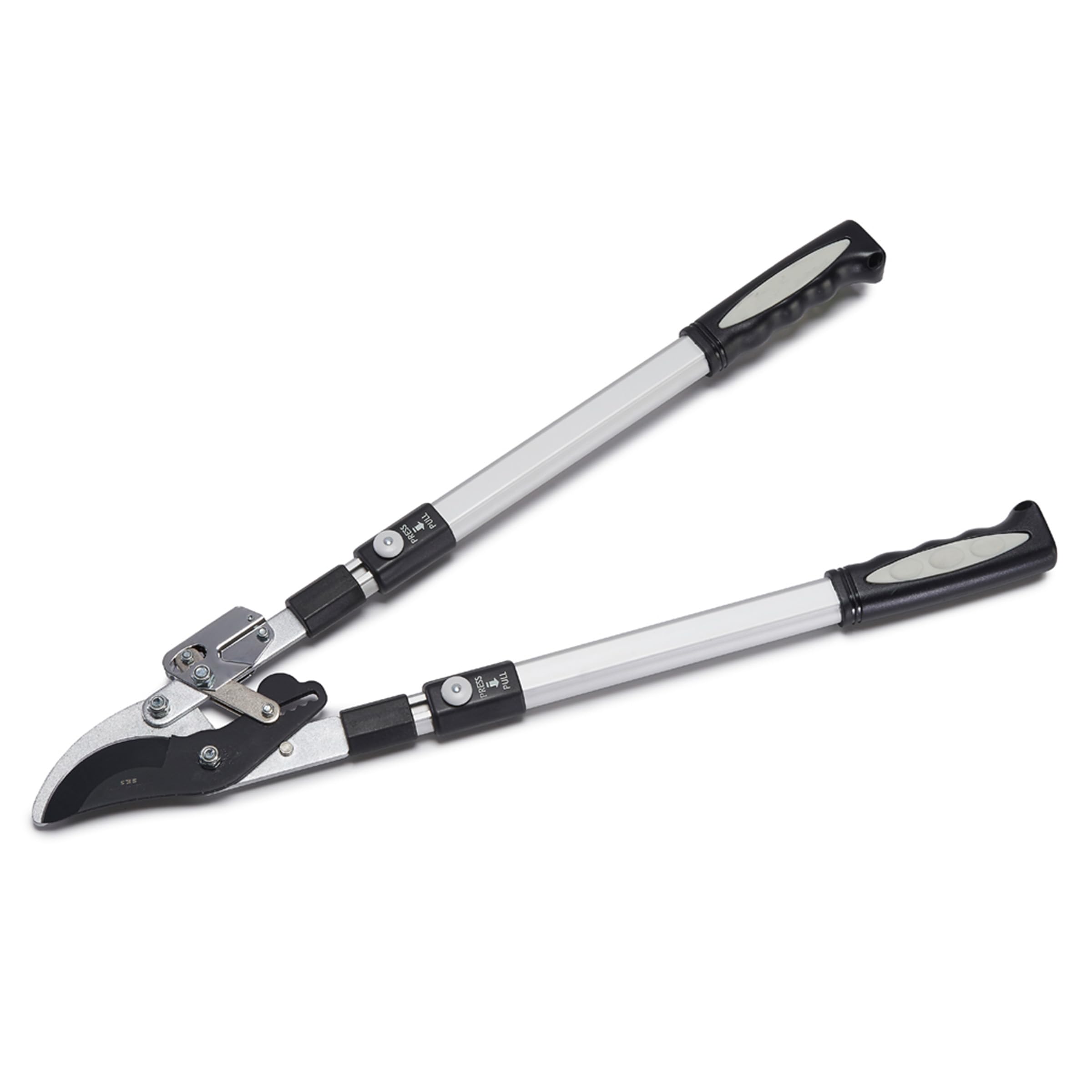
A double ratcheting bypass jaw that chews a 2-inch branch through without shoulder force, on handles you can stretch to 40 inches.
Bypass blades are built for living wood — the two edges pass each other and slice clean rather than crushing the branch. This one adds a special double ratcheting lopper mechanism on top, which multiplies your squeeze into a cutting force strong enough for a 2-inch jaw capacity. The handles telescope from 26 to 40 inches with 6 pin-locked position stops, so each length locks where you set it. Alloy steel blades and rubber grips round out the build, and the whole tool weighs 3.8 pounds.
What wins people over is the ratchet. It gives you the cutting power of a much bigger tool without needing to open the handles wide, which makes all the difference in tight quarters between branches. Owners clearing invasive honeysuckle, privet and vines call it beefy and powerful. The telescoping handles lock securely with no slipping mid-cut, and there is a satisfyingly simple trick to it — extend, lock, and the overhead branch comes down without bending your back. Replacement blades are available when the edge eventually needs it, and when one tool did fail, the maker shipped a brand-new pair.
Here is the catch worth taking seriously: that ratcheting action is slow, and on small-diameter cuts it is overkill — you spend extra handle strokes where a quick snip would have done. Opinion on the weight splits both ways, because the body is light but the blades are heavy, which tips the tool downward when you hold it straight overhead. A petite user may actually prefer that lighter body, since a heavier one could be hard to lift at all.
The real selling point: a double ratcheting bypass mechanism and a 2-inch jaw that take overgrown brush and thick green limbs down to size, with 6 pin-locked handle stops between 26 and 40 inches.
The honest catch: the ratchet trades speed for force, so small cuts feel slow, and the heavy blades tip the tool forward overhead.
This suits you if: thick green limbs, vines and overgrown brush are the enemy and you want real cutting power locked into a pole you can extend.
Give it a pass if: most of your work is twig-sized cleanup, where the ratchet just slows you down.
5. SISUPASSIE Upgraded Tree Trimmer, 26FT Heavy-Duty Pole Saw
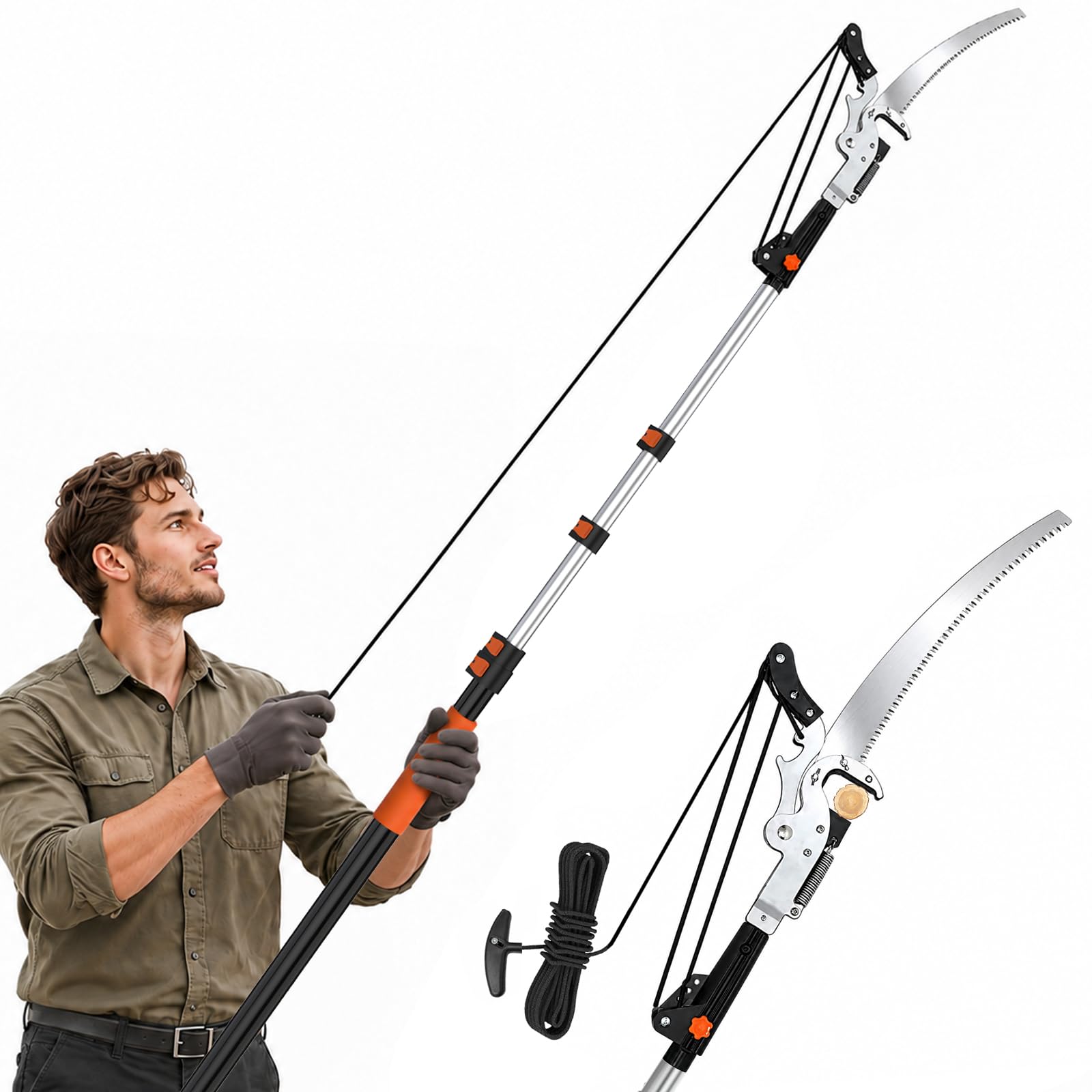
A telescoping pole that runs from 5 to 20 feet, with a pulley-driven lopper head for branches no ladder would safely reach.
Reach is the whole point of this tool, and it delivers more of it than anything else here. The telescoping design extends from 5 feet to 20 feet, so towering oaks and tall palms come within range from the ground. A high-leverage pulley system drives the lopper head, which lets you pull a cord rather than wrestle a jaw directly — less effort on thick branches and tangled vines. The carbon steel saw blade carries a sharpened serrated edge for fast, clean cutting, and the anti-slip foam grip holds steady even when your hands get wet.
The versatility is what surprises people. The pole has a universal telescopic thread design, so it takes a range of accessories, and the saw can convert to a handheld for lower trimming work. One owner cut through a 3-inch branch in 20 seconds. Another reports the pull-string lopper reached high fruit that had been out of reach for years. The secure screw connection pins the head to the pole so it does not come loose mid-cut.
The one honest weakness is pole rigidity at the far end. As the aluminum sections stretch toward 20 feet, the top thins out and the whole tool bows sideways during lopper work, and the pole can self-extend while you are sawing. A section bolt may also start to loosen over time, so check it before each session. Treat this as a long-reach specialist for occasional high work, not a heavy-use daily driver — and keep aluminum well clear of power lines.
What it does best
- Telescopes from 5 to 20 feet for the tallest trees in this lineup
- High-leverage pulley design drives the lopper with a cord pull, not a hard squeeze
- Carbon steel serrated blade cuts fast and converts to a handheld saw
- Anti-slip foam grip stays secure when wet
Where it asks patience
- Pole bows sideways and thins near the top at full 20-foot extension
- Pole can self-extend while sawing; check the section bolt before each use
- Aluminum conducts electricity, so keep it away from power lines
The pick for truly tall trees: when the branch is 20 feet up and the ladder stays in the shed, the pulley lopper head earns its keep.
Know before you commit: accept the flex and the section-bolt check, and this long-reach saw does the job — expect a slightly wobbly pole at the very top of its range.
Know the Specs
Maximum Reach and How It Is Measured
Maximum reach is the highest point the pole or handle can extend to from your standing position. A sectional pole like the 14.5 ft option uses connected stainless steel sections, so it builds to a set height in fixed steps. A telescoping pole like the 5 to 20 foot model slides continuously. Longer reach keeps you on the ground, but each extra foot of pole also flexes a little more under its own weight. So a long pole cuts best on stiff branches near the trunk, not on limbs that sway away from the blade.
Cutting Capacity and Blade Steel
Cutting capacity is the thickest branch the jaw can swallow in one clean bite — typically listed as a diameter in inches, like the 2-inch jaws here. Saw blades are a different measure: a 12-inch or 16.7-inch blade length tells you how long the cutting edge is, and more teeth (like the 60 on the SK5 blade) mean faster, smoother cuts per stroke. On blade material, SK5 and carbon steel hold a sharp edge through green wood, while coated alloy steel resists sap and friction so it slides through living branches without grabbing.
Common Questions
Should I buy a lopper or a pole saw for high branches?
What does a 2-inch cutting capacity actually mean?
How high can a sectional pole saw reach without a ladder?
Do compound action and ratcheting loppers really cut with less effort?
Which blade material holds its edge longest on green wood?
Can I use an extendable pruner near power lines?
How do I stop a sectional pole from wobbling at full extension?
Does sap damage a pruner blade and how do I clean it?
Is a heavier pole pruner easier or harder to control?
Can I replace a dulled blade on an extendable pruner?
The Bottom Line
For most yards, the extendable tree pruner winner is the TRUPER TR-82M-A Tree Pruner, because its 12-inch SK5 blade and balanced 2.4 m aluminum pole let you cut clean from the ground without a wrestling match. If thick, stubborn limbs are your real enemy, grab the Kings County Tools Loppers for the double ratcheting jaw. And when the branch is 20 feet up, the SISUPASSIE 26FT Pole Saw is the one that reaches it without a ladder. Match the pole length and cutting force to your tallest limbs, and the ladder can stay in the shed.
How we choose
We do not accept paid placement. Every pick is matched to a real buyer and a real use-case; we do not hands-on test units.
Sources
Specifications: manufacturer listings and product documentation. Review insights: verified customer reviews, as of October 2026. Pricing: not shown on this page (it changes often); check the current price via the retailer link.
As an Amazon Associate, Aappliancez earns from qualifying purchases. This does not affect which products we feature.