Disclosure: Some links in this post are affiliate links. As an Amazon Associate I earn from qualifying purchases, at no extra cost to you. Learn more
Specs are compiled from manufacturer listings and verified buyer reviews and can change over time — please confirm the key details on the product page before buying.
Switching off a knee scooter, a walker, or underarm crutches is the moment your arms have to take over — and the best forearm crutch for you is the one that feels steady under your hand on a staircase. Get the wrong pair and you feel it fast. The cuff digs into your forearm, the rubber tip squeaks across tile, or the frame sits too short and tips you forward. This guide fixes that. Below are seven current picks, each matched to a body type and a recovery stage, so you can stop guessing and start walking.
This guide is built by comparing the manufacturers’ published specifications and the patterns across verified customer reviews, so you get each pick’s real strengths and trade-offs instead of marketing spin.
Every crutch here is judged on the same few things that decide whether an aid actually works: how much weight it holds, how far the height range stretches, what the cuff and grip are made of, and whether it folds small enough to travel. One pick carries 275 lb, another carries 500 lb, and the height spans run from 36 to 74 inches. Here is how each of the best forearm crutches handles real life, from a 135-pound stair climber to a 500-pound bariatric frame.
Top Picks


How To Choose The Best Forearm Crutches
A forearm crutch carries your weight through your hand and forearm instead of your armpit. That is why physical therapy patients tend to prefer it over an underarm pair. The design trades one problem for another, though. Your hand now does more work, and the cuff (the arm holder that wraps your forearm) has to sit where your arm naturally hangs — not where a factory guessed. Three things decide whether a pair works for you: the height range, the weight rating, and the cuff style. Everything else is comfort polish on top of those.
Match the height range to your body before anything else
Most crutch returns happen because the buyer ordered outside their height range. Crutches are sold with an advertised height span, and if you sit at the very bottom of that span, the fit often runs tall. Measure from the floor to your forearm while wearing your normal shoes, then check that number against the listing. The PEPE Mobility crutches, for example, adjust from 36 to 46 inches of total height, with handle height from 28 to 38 inches — and the maker notes tall buyers should measure before ordering. A crutch that sits too tall or too short will tip you forward no matter how thick the grip padding is.
Weight capacity and material go hand in hand
Every pair here lists a maximum user weight. That number matters because it tells you what the aluminum or steel frame was built to hold every single day. Lighter riders on aluminum frames get the easiest carry — you lift the crutch with one hand onto a step. Heavier riders should stay at or under the listed rating and look at a sturdier build. Aluminum keeps a crutch light, while alloy steel adds heft and often a higher capacity number, so the weight rating and the material are really two sides of the same choice.
Closed cuff or open cuff — and why grip matters
A closed cuff wraps fully around your forearm, so the crutch stays put even when you let go to open a door. An open cuff lets you pull your arm out fast, which feels freer but means the crutch can tip when you release it. Neither is safer in the abstract. The right one depends on if you need hands-free pauses or quick in-and-out. Below that decision sits the grip and the tip, which decide how your palm feels after a long day and whether the base holds on wet tile or gravel.
Side-by-Side Comparison
| Model | Best For | Weight Capacity | Height Adjustment | Foldable | Amazon |
|---|---|---|---|---|---|
| KMINA Forearm Crutches for Adults★ Best Overall | Everyday post-surgery and rehab use | 275 lb | 11 regulations | No | Amazon |
| VEVOR Forearm Crutches for AdultsBest Value | Heavier riders wanting a tall, adjustable pair | 350 lb | 11-level height, 4-level cuff | No | Amazon |
| PEPE Mobility Forearm Crutches for Adults | Most buyers wanting proven stability | 275 lb | 11 height settings | No | Amazon |
| Forearm Crutches Pair, Folding | Travel and transient mobility needs | — | 10 adjustable buttons | Yes | Amazon |
| Drive Medical Heavy-Duty Bariatric Steel Forearm Crutch | Bariatric riders needing high capacity | 500 lb | 60 to 74 inches | No | Amazon |
| in-Motion Pro Underarm Crutches for Adults | Tall users wanting spring shock absorption | 350 lb | 15 cradle positions, 5 grip positions | Yes | Amazon |
| Ergobaum 7G Forearm Crutches for Adults | Buyers wanting premium extras and long-term use | 360 lb | 5′ to 6’6″ | Yes | Amazon |
Detailed Reviews
1. KMINA Forearm Crutches Open Cuff
Our pick — 4.5★ from 800+ verified ratings; the strongest balance of quality and price.
The balanced pick for anyone coming off a walker and finding their balance again.
This pair earns the top spot on 2.49 pounds of total weight against a 275 lb capacity — light enough to swing onto a stair with one hand, strong enough for a large adult to lean on. The frame is silver-coloured aluminium (a light, rust-resistant metal) with a polypropylene grip and elbow section (a stiff, hard-wearing plastic). Eleven height regulations mean eleven small steps, so most adults land on a setting that does not force them to lean. For a first pair, that fine adjustability is the difference between walking upright and shuffling.
The padded grips are the piece buyers keep coming back to in reviews — one 135-pound stair climber reports the padding ends the hand pain that underarm crutches cause. The handle pads are washable and interchangeable, which matters over months of daily use. One buyer made the switch off a walker to work on balance and called them “fantastic very stable very good support very well cushioned handles overall just excellent.” That same buyer notes you don’t have to spend on carbon to get a light pair — these are lighter.
The honest catch is the adjustment clips. A first-time user found the clip hard to remove and worried about losing it. Quality feedback on this listing is genuinely mixed, not uniform praise. The crutches also lean slightly less stable than underarm style, which is simply how a forearm crutch works. Made in Spain, the pair holds up in all kinds of environments according to one long-use report, with only minor creaking from the rubber tips. For a light, low-cost, well-padded pair to bridge the walker-to-walking gap after surgery, this is the pick.
What Earns It The Top Spot
- Holds up to 275 lb while weighing only 2.49 pounds as a package
- 11 height settings let you fine-tune the fit instead of settling for close
- Washable, interchangeable hand pads tackle the wrist pain underarm crutches cause
- Aluminium frame with polypropylene grip and elbow section, made in Spain
Where It Asks For Patience
- The adjustment clips take effort to remove and are easy to misplace
- Slightly less stable than underarm crutches, and the rubber tips can creak
Grab these if: you want a lighter, lower-cost pair to bridge the gap from walker to independent walking after surgery.
Pass if: you need hands-free balance — the open cuff will tip when you let go.
2. VEVOR Forearm Crutches 11-Level
Two separate adjustment points — one for height, one for the cuff — on a frame rated for 350 lb.
A 350 lb rating puts this pair above the KMINA for heavier riders, and only the bariatric Drive Medical beats it here. The aluminum alloy frame spans a height range of 55.12 to 67 inches (140 to 170 cm), so a taller adult can stand tall instead of hunching. what separates it from the KMINA is the second adjustment axis: a 4-level upper arm cuff that moves independently of the 11-level height setting. You tune where the cuff sits on your forearm, not just how tall the crutch stands. That second axis is what keeps the cuff on your forearm instead of sliding down toward your wrist.
The ergonomic grips are the daily-use detail buyers mention most — shaped with support at the base of the thumb, which eases the joint strain long-time cane and walker users describe. Rubber non-slip foot pads absorb shock and hold on uneven ground, so gravel and cracked pavement stay walkable. The whole thing stays compact enough to store without hogging space. Quiet is a theme too: one buyer who had tried other aids reported these felt sturdier and steered them toward a more upright, faster walk.
Here is the trap to watch: sizing. Buyers report that one 6-foot user found these far too small and had to return them, with the set reading more like a fit for a smaller adult or a child than a grown man. That is the most-flagged issue on the listing — size, not build. Check your height against the 55.12-to-67-inch span carefully before ordering. If you sit at the top of that range, measure floor to forearm first. Assembly is easy once it arrives.
Why it competes: a 350 lb aluminum frame, a 140-to-170 cm height span, and an independent 4-level cuff put real adjustment range into a value-tier package.
Worth it for: average-to-taller adults who want the cuff and the height to adjust separately without moving up a price tier.
Measure first if: you are around 6 feet — this pair runs short for some tall buyers.
3. PEPE Mobility Forearm Crutches for Adults Open Cuff

A stability-first pair that has quietly become the default choice for long-term users.
Steadiness is the whole story here, and it comes straight from the build: 36 to 46 inches of total crutch height and 28 to 38 inches of handle height across 11 height settings, with a maximum user weight of 275 lb when correctly adjusted and used as intended. The open cuff and the polypropylene/TPE handles give a firm grip, and each crutch weighs 550 grams — light enough to swing, solid enough to plant. It is also FSA/HSA eligible (you can pay with pre-tax health account funds), which matters if you are paying out of pocket.
Buyers talk about stability here more than anything else, and it shows in who sticks with them. One post-op foot surgery user at 5’11” and 285 lb switched from a knee scooter and found them sturdy, comfortable, and quiet, recommending them over underarm crutches. Another buyer who has been disabled four years is on a fourth pair, and reports the handles stay grippy even with lotion or liquid on their hands. The zippered elbow cover with a Velcro strap lets you release your grip without the crutch clattering to the floor — handy when you use one indoors and two outdoors.
The friction point is the adjustment mechanism itself, which some buyers find fiddly — the maker even warns to set both crutches to the same height and lock the clip fully into the matching hole before use. The open cuff can also feel wider than a closed cuff until you adjust, and the firm handles may feel hard during prolonged use. None of that undercuts the core job. The KMINA wins on weight and price; this one wins on the stability record.
The standout: 11 height settings spanning a 36-to-46-inch total height lets you dial in a true fit, and the FSA/HSA eligibility softens the out-of-pocket hit.
Reach for this if: you want the most-proven stability play and expect to use your crutches for months, not weeks.
Look elsewhere if: you want a friction-free adjustment — the clip mechanism frustrates a few users.
4. Forearm Crutches Pair Folding

The pair that folds down and rides in a carry-on instead of staying in the closet.
This pair collapses for storage and travel — the reason it stays in a bag for a flight or a day out instead of leaning against a wall at home. Ten adjustable buttons cover a height range of 58 to 72.8 inches, so most adults land on a working setting. The base locks in position by rotating, so nothing loosens mid-step, and the Oxford base material is wear-resistant and corrosion-resistant according to the maker. If your mobility need comes and goes rather than sticking around, that folding trick is the main event.
The anti-drop cuff is the detail buyers appreciate most for hands-free moments — a semi-enclosed arm section keeps your arm straight and spreads pressure off your wrist. The elastic cuffs mean the crutch hangs on your arm while you open up a door or pick something up. One traveler using them after Achilles tendonitis found them durable and easy to adjust down to 5’2″, folding neatly for storage. Another used them for transient endometriosis-related mobility needs and liked being able to use just one at a time. They are also light enough that shoulder strain drops compared with a walker.
The recurring gripe is the rubber tips — several users swapped them out for grippier replacements, and they can slip on a damp floor. The folding hinge itself is a point of contention too, though plenty of buyers never bother to fold them at all and are perfectly happy. It is a fair trade for the portability you get. For a permanently planted frame, look at the PEPE Mobility instead; for a frame that travels, this is the pair to beat.
Why Travelers Like It
- Folds down for a carry-on bag or a car trunk
- 10 adjustable buttons cover a 58-to-72.8-inch height range
- Anti-drop semi-enclosed cuff shares pressure off the wrist
- Oxford base locks by rotation for steadiness
The Honest Trade-Off
- The stock rubber tips can slip on moisture — many replace them
- Some find the folding mechanism fiddly and just leave it unfolded
Best for: intermittent users who need crutches they can stash in a bag and forget until needed.
Skip if: you want a permanently planted, non-folding frame — this one is built to move.
5. Drive Medical Forearm Crutch Chrome

Built for the heaviest riders — a bariatric steel frame rated to 500 lb.
A 500 lb capacity is the entire reason to consider this frame — the alloy steel and hard plastic build supports it, with height running from 60 to 74 inches and handle height of 28 to 37 inches. The leg and forearm sections adjust independently with a push-button, so you set the standing height and the arm support separately. The vinyl hand grips and vinyl-coated, contoured arm cuffs are molded for comfort and stability, and the contoured crutch tips are extra large for heavy-duty grip. For a bariatric user, that capacity headroom is worth a lot.
Users describe the crutches as strong, quiet, and good-looking. One buyer appreciates that the hardware uses regular bolts and nylon lock nuts, which makes home repair straightforward rather than a trip to a specialist. It climbs stairs and ladders carefully under a one-crutch load for a weak right knee. The frame is heavier than a standard pair by design, and that heft is part of what makes it feel confidence-building for its intended rider.
The catch — and it is the one to know before you buy — is the cuffs. The arm cuffs run small and hard, and one buyer who weighed 185 lb found them too tight. Owners mention that the manufacturer confirmed only the crutch frame is bariatric-rated, not the cuffs, and that a very tall, slender user had to spread the cuffs by about two to two and a half inches to fit. The fit is the most-flagged issue on the listing, not the frame. If you have large forearms, plan for that adjustment or look at a different cuff design.
The core strength: a 500 lb capacity with independently adjustable leg and forearm sections, plus extra-large contoured tips for heavy-duty ground contact.
Suits: heavier riders who need the highest weight rating in this set and don’t mind a heavier frame for the confidence it brings.
Think twice if: your forearms are large — the hard cuffs run tight and may need spreading.
6. in-Motion Pro Underarm Crutches
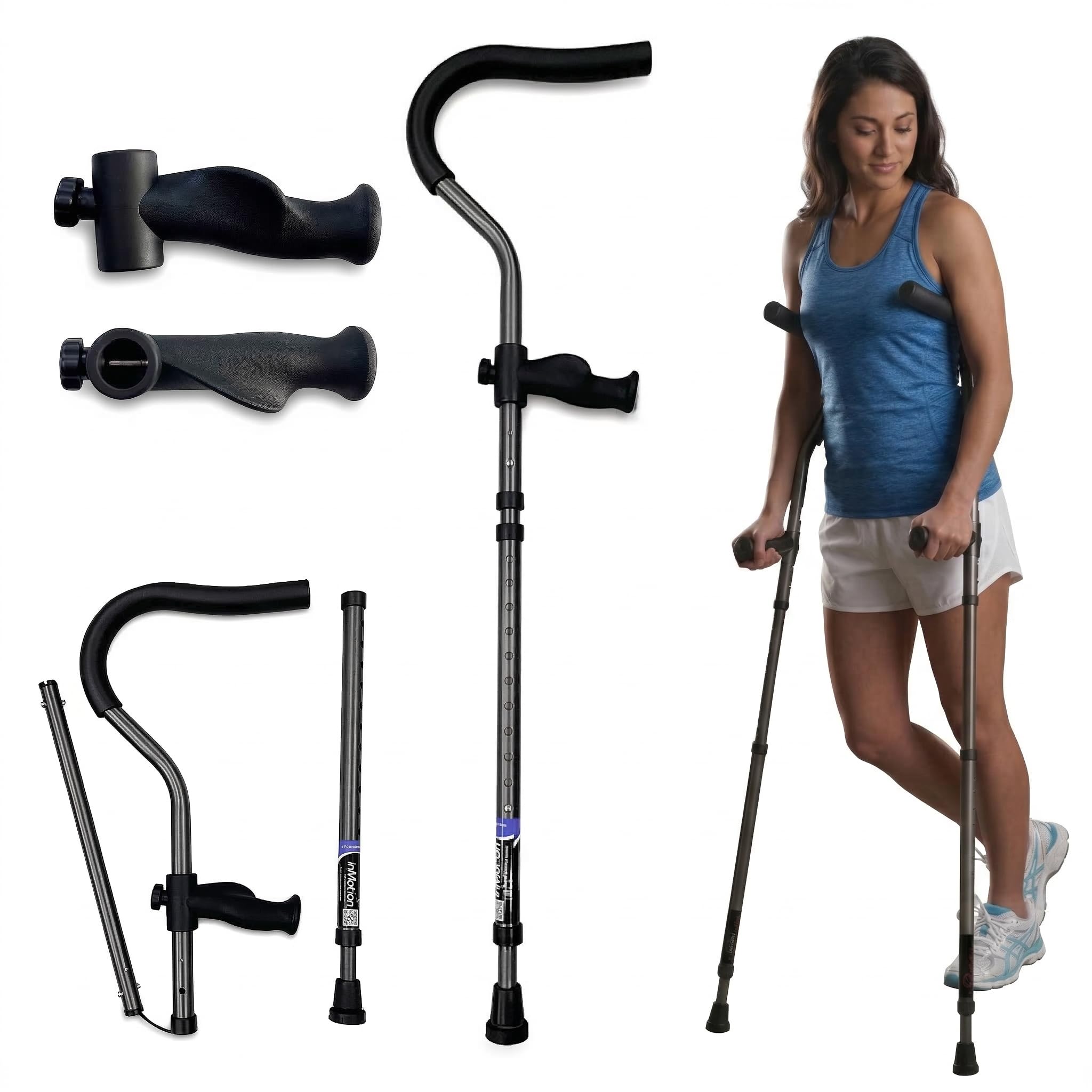
A tall-rider design where a spring eats the impact so your shoulders and arms don’t.
This is a different animal from the forearm crutches above — it is an underarm design built for a specific body: the tall size fits users 5’10” to 7’1″, with a floor-to-underarm measurement that should fall between 52.5 and 65.5 inches. The underarm cradle adjusts across 15 positions and the hand grip at 5 independent positions, and it carries up to 350 lb. The contoured left/right ergonomic grip is angled to keep your wrist in its natural position, which is the design detail aimed at the wrist kink conventional crutches cause. Each crutch weighs 2.6 lb, and it folds in half in seconds for an overhead bin.
The spring is the talking point in both directions. The lower post spring absorbs the shock of each step and returns that energy forward, and the foam rubber padding at the underarm cradle eases pressure. One 6’6″, 430 lb buyer with foot drop and arthritis used them for six months and found them sturdy enough to relieve joint stress and allow longer walks. Another ten-year user reports no armpit or wrist pain thanks to the ergonomic handles and shock absorption. The articulating tips pivot to keep full ground contact on hardwood, carpet, grass, and gravel.
Now the honest part: the spring splits opinion. Some find the action helpful and noticeably quieter than traditional crutch springs; others find the springs squeaky or gummy and the motion less steady going down stairs. Foldability divides buyers the same way — great for travel, but a few find it hard to collapse. Tips also wear with heavy use, and this is a taller, more expensive aid than the forearm pairs here. For users 5’10” to 7’1″ who want spring shock absorption over a simple fixed frame, this is the one.
what separates it
- Tall sizing for users 5’10” to 7’1″ with a 52.5-to-65.5-inch underarm range
- 15-position cradle and 5-position grip for a dialed-in fit
- Spring assist returns energy to reduce fatigue on long recoveries
- Articulating tips keep full ground contact on uneven terrain
Where It Divides
- The spring feel is divisive — some love it, some find it squeaky or unsteady on stairs
- Tips wear with heavy use, and folding is fiddly for some
Made for: tall, heavier users who want shock absorption to take pressure off the shoulders over long recovery periods.
Consider carefully if: you dislike a springy underfoot feel — this crutch is defined by it.
7. Ergobaum 7G Forearm Crutches for Adults (1 Pair-2 Units)
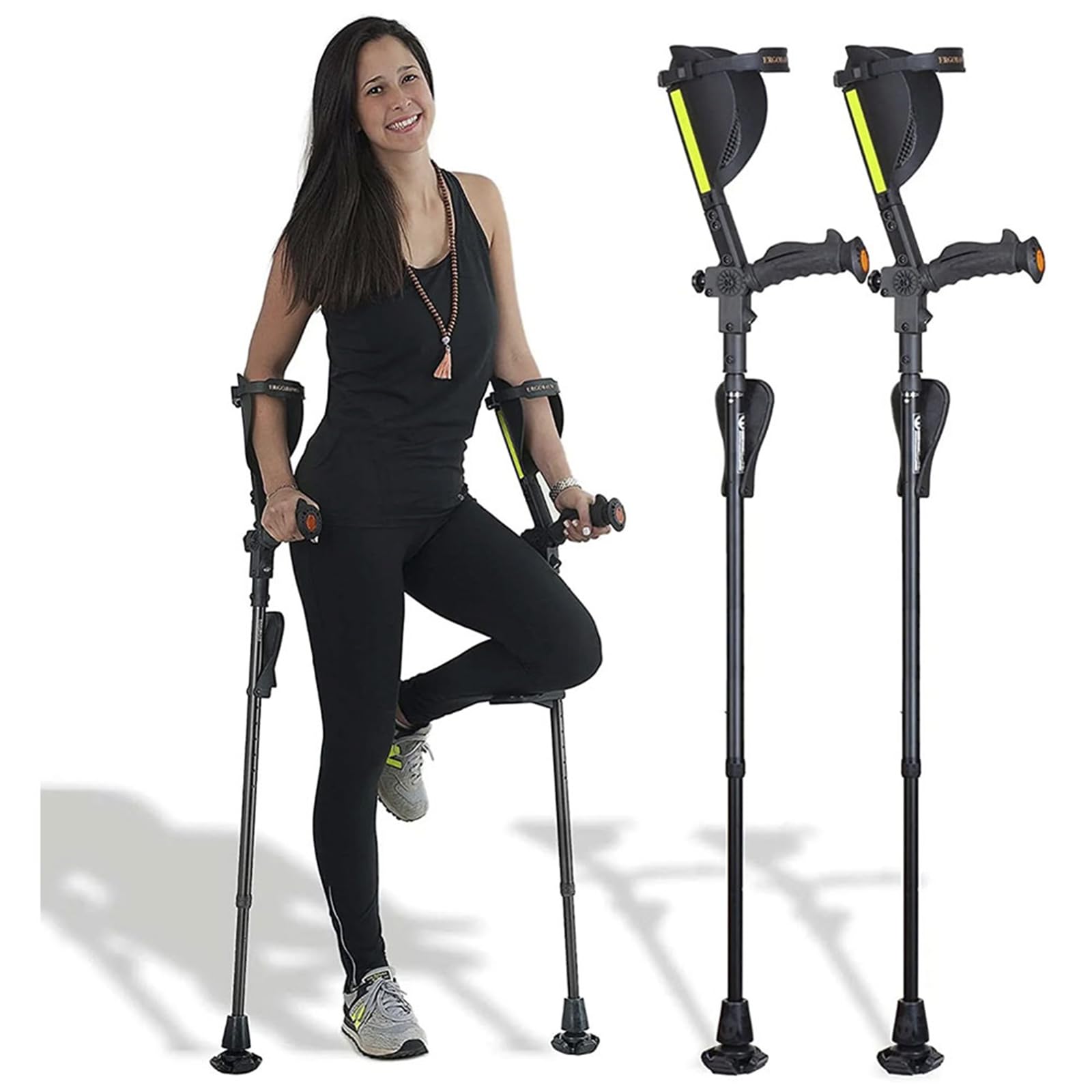
The loaded-up option with a built-in light, a knee rest, and a foot-shaped tip.
Six LR44 batteries come included here, and they power a built-in LED flashlight for visibility at night plus an alert button — so you skip buying those accessories separately. The medical-grade aluminum frame supports up to 360 lb and fits users from 5′ to 6’6″, with adjustable cuff height and handle angle. The crutches fold flat for travel, and an integrated knee rest gives you a place to stand and rest. For buyers who have fought sore hands and wrists with plain crutches, the contoured grip and padded cuff are the reason to step up to this tier.
The contoured grip is easy on the hands, shoulders, and elbows, which is the whole point of moving the load off your underarms. The patented tip is the standout piece on paper — the maker says it replicates your foot’s natural walking motion from heel to flat to toe, holding full ground contact on wet, icy, and uneven surfaces so you get smooth forward motion instead of the stop-and-go of a plain rubber tip. The fold-flat design fits a car trunk or a carry-on.
The trade-off is weight and durability. At six pounds as a package, this is the heaviest pick in this light-forearm category. Sturdiness feedback is mixed — some buyers find it sturdy, others report the handles breaking over time — and it reads heavy for some users and light for others depending on their strength. At six pounds it is the heaviest pick here, so weigh whether the LED, knee rest, and heel-to-toe tip justify the extra carry.
What you pay for: a built-in LED and alert button, an integrated knee rest, and a heel-to-toe tip design that holds ground contact on uneven surfaces.
Buy this if: you want one pair loaded with night visibility and a resting-station knee rest and don’t mind a heavier overhead.
Reconsider if: you want the lightest possible carry — some find this one heavy.
Know the Specs
Weight Capacity
Check this number first, because it tells you what the frame was built to hold day after day. On the listings here, that figure ranges from 275 lb on the KMINA and PEPE Mobility pairs up to 500 lb on the Drive Medical bariatric frame, with 350 lb on the VEVOR and in-Motion Pro sets. Stay at or under the rated number and the crutch holds its shape and stability; go well over it and tip wear and frame stress climb fast. A higher capacity usually comes with a heavier frame, so match the number to your body rather than chasing the biggest rating.
Height Adjustment Range
Height range is the spec that decides whether a crutch fits you at all. These pairs stretch across a wide span — from a 36-to-46-inch total height on the PEPE Mobility with handle height of 28 to 38 inches, to a 60-to-74-inch span on the Drive Medical, with the VEVOR covering 55.12 to 67 inches and the folding pair covering 58 to 72.8 inches. Counts of adjustment points matter too: 11 settings, 10 buttons, or 15 cradle positions mean a finer fit. Always measure floor to forearm in your normal shoes and check it against the listed span before you order.
Common Questions
How do I know if a pair of forearm crutches will fit my height?
Should I choose an open cuff or a closed cuff?
What weight can these crutches safely support?
Are forearm crutches better than underarm crutches for stairs?
How long do the rubber tips last and can I replace them?
Do any of these crutches fold for travel or storage?
What is the FSA or HSA eligibility on these crutches?
Can I use just one forearm crutch instead of a pair?
What should I check on the crutches when they arrive?
Why do some forearm crutches feel hard on the hands?
The Bottom Line
The best forearm crutches pick for most buyers is the KMINA Forearm Crutches for Adults, because they balance a light 2.49-pound package with a 275 lb capacity and the washable padded grips that make long recovery days manageable. If you want the most-proven stability and FSA/HSA eligibility, reach for the PEPE Mobility pair. For heavier riders needing the highest rating here, the Drive Medical bariatric frame is the one to get — just check the cuff fit on large forearms. And if you travel and need crutches that fold into a bag, the {“@context”: “https://schema.org”, “@graph”: [{“@type”: “ItemList”, “name”: “7 Best Forearm Crutches”, “url”: “https://aappliancez.com/best-forearm-crutches/”, “numberOfItems”: 7, “itemListElement”: [{“@type”: “ListItem”, “position”: 1, “name”: “KMINA Forearm Crutches for Adults, Open Cuff, Adjustable Height”, “url”: “https://aappliancez.com/best-forearm-crutches/#product-1”}, {“@type”: “ListItem”, “position”: 2, “name”: “VEVOR Forearm Crutches for Adults, 11-Level Height Adjustable Walking Crutches”, “url”: “https://aappliancez.com/best-forearm-crutches/#product-2”}, {“@type”: “ListItem”, “position”: 3, “name”: “PEPE Mobility Forearm Crutches for Adults Open Cuff”, “url”: “https://aappliancez.com/best-forearm-crutches/#product-3”}, {“@type”: “ListItem”, “position”: 4, “name”: “Forearm Crutches Pair, Folding Forearm Crutches Adults Lightweight Adjustable”, “url”: “https://aappliancez.com/best-forearm-crutches/#product-4”}, {“@type”: “ListItem”, “position”: 5, “name”: “Drive Medical Heavy-Duty Bariatric Steel Forearm Crutch, Chrome, Adult”, “url”: “https://aappliancez.com/best-forearm-crutches/#product-5”}, {“@type”: “ListItem”, “position”: 6, “name”: “in-Motion Pro Underarm Crutches for Adults, Spring Assist, Foldable”, “url”: “https://aappliancez.com/best-forearm-crutches/#product-6”}, {“@type”: “ListItem”, “position”: 7, “name”: “Ergobaum 7G Forearm Crutches for Adults (1 Pair-2 Units)”, “url”: “https://aappliancez.com/best-forearm-crutches/#product-7”}]}, {“@type”: “Product”, “position”: 1, “name”: “KMINA Forearm Crutches for Adults, Open Cuff, Adjustable Height”, “image”: “https://m.media-amazon.com/images/I/61CKWIcMQ1L.jpg”, “brand”: {“@type”: “Brand”, “name”: “KMINA”}, “url”: “https://www.amazon.com/dp/B07KKBJ11C/?tag=aappliancez-20”, “offers”: {“@type”: “Offer”, “url”: “https://www.amazon.com/dp/B07KKBJ11C/?tag=aappliancez-20”}}, {“@type”: “Product”, “position”: 2, “name”: “VEVOR Forearm Crutches for Adults, 11-Level Height Adjustable Walking Crutches”, “image”: “https://m.media-amazon.com/images/I/61wSn-hN97L.jpg”, “brand”: {“@type”: “Brand”, “name”: “VEVOR”}, “url”: “https://www.amazon.com/dp/B0DFXV71KD/?tag=aappliancez-20”, “offers”: {“@type”: “Offer”, “url”: “https://www.amazon.com/dp/B0DFXV71KD/?tag=aappliancez-20”}}, {“@type”: “Product”, “position”: 3, “name”: “PEPE Mobility Forearm Crutches for Adults Open Cuff”, “image”: “https://www.amazon.com/images/I/71bY5dbaVsL.jpg”, “brand”: {“@type”: “Brand”, “name”: “PEPE”}, “url”: “https://www.amazon.com/dp/B07P7KMTQB/?tag=aappliancez-20”, “offers”: {“@type”: “Offer”, “url”: “https://www.amazon.com/dp/B07P7KMTQB/?tag=aappliancez-20”}}, {“@type”: “Product”, “position”: 4, “name”: “Forearm Crutches Pair, Folding Forearm Crutches Adults Lightweight Adjustable”, “image”: “https://m.media-amazon.com/images/I/61LIqlycR+L.jpg”, “brand”: {“@type”: “Brand”, “name”: “Forearm”}, “url”: “https://www.amazon.com/dp/B09KG8SPRM/?tag=aappliancez-20”, “offers”: {“@type”: “Offer”, “url”: “https://www.amazon.com/dp/B09KG8SPRM/?tag=aappliancez-20”}}, {“@type”: “Product”, “position”: 5, “name”: “Drive Medical Heavy-Duty Bariatric Steel Forearm Crutch, Chrome, Adult”, “image”: “https://m.media-amazon.com/images/I/61QmaTxUQEL.jpg”, “brand”: {“@type”: “Brand”, “name”: “Drive”}, “url”: “https://www.amazon.com/dp/B002VWK0MI/?tag=aappliancez-20”, “offers”: {“@type”: “Offer”, “url”: “https://www.amazon.com/dp/B002VWK0MI/?tag=aappliancez-20”}}, {“@type”: “Product”, “position”: 6, “name”: “in-Motion Pro Underarm Crutches for Adults, Spring Assist, Foldable”, “image”: “https://m.media-amazon.com/images/I/71nIQPQ+ZPL.jpg”, “brand”: {“@type”: “Brand”, “name”: “in-Motion”}, “url”: “https://www.amazon.com/dp/B011NXK1LU/?tag=aappliancez-20”, “offers”: {“@type”: “Offer”, “url”: “https://www.amazon.com/dp/B011NXK1LU/?tag=aappliancez-20”}}, {“@type”: “Product”, “position”: 7, “name”: “Ergobaum 7G Forearm Crutches for Adults (1 Pair-2 Units)”, “image”: “https://m.media-amazon.com/images/I/61Nei428XdL.jpg”, “brand”: {“@type”: “Brand”, “name”: “Ergobaum”}, “url”: “https://www.amazon.com/dp/B07CRP1XXB/?tag=aappliancez-20”, “offers”: {“@type”: “Offer”, “url”: “https://www.amazon.com/dp/B07CRP1XXB/?tag=aappliancez-20”}}, {“@type”: “FAQPage”, “mainEntity”: [{“@type”: “Question”, “name”: “How do I know if a pair of forearm crutches will fit my height?”, “acceptedAnswer”: {“@type”: “Answer”, “text”: “Measure from the floor to your forearm while standing in the shoes you normally wear, then compare that number to the crutch’s listed height range before ordering. The VEVOR set, for instance, runs from 55.12 to 67 inches, while the folding pair suits 58 to 72.8 inches and the PEPE Mobility spans 36 to 46 inches of total height. If you sit at the very bottom of a range, the fit often runs tall, so size up your measurement carefully rather than guessing.”}}, {“@type”: “Question”, “name”: “Should I choose an open cuff or a closed cuff?”, “acceptedAnswer”: {“@type”: “Answer”, “text”: “It depends on how you pause. An open cuff lets you pull your arm out quickly but can let the crutch tip against a wall when you release it, which some users find awkward. A closed or semi-enclosed cuff keeps the crutch on your arm so you can use both hands for a door or a bag, and the folding pair’s elastic cuff is built for exactly that. Pick based on if you need quick in-and-out or steady hands-free moments.”}}, {“@type”: “Question”, “name”: “What weight can these crutches safely support?”, “acceptedAnswer”: {“@type”: “Answer”, “text”: “Each pair lists its own maximum, and they differ widely. The KMINA and PEPE Mobility pairs support up to 275 lb, the VEVOR and in-Motion Pro carry 350 lb, the Ergobaum 7G supports up to 360 lb, and the Drive Medical bariatric frame holds up to 500 lb. Stay at or under your crutch’s rated weight, and confirm the pair is correctly adjusted and assembled before you put full weight on it.”}}, {“@type”: “Question”, “name”: “Are forearm crutches better than underarm crutches for stairs?”, “acceptedAnswer”: {“@type”: “Answer”, “text”: “They use your arms differently. Forearm crutches move the load through your hand and forearm and tend to feel easier on stairs because they sit clear of your armpit, while underarm styles rest under the arm and can cause soreness with heavy use. The trade-off is that forearm crutches feel less stable than underarm ones for some users, since they rely more on your grip and balance. The in-Motion Pro is an underarm design built for tall users, so the right choice depends on which load you can carry more comfortably.”}}, {“@type”: “Question”, “name”: “How long do the rubber tips last and can I replace them?”, “acceptedAnswer”: {“@type”: “Answer”, “text”: “Tip life depends on how much and where you walk, and heavier daily use wears them faster. Several picks here ship with attention on the tips: the VEVOR set uses rubber non-slip pads that absorb shock, the folding pair uses an Oxford base the maker calls wear-resistant, and the Ergobaum 7G uses a tip designed to hold ground contact on uneven surfaces. Tips are a consumable part, so plan to inspect them regularly and swap them when they flatten or lose grip.”}}, {“@type”: “Question”, “name”: “Do any of these crutches fold for travel or storage?”, “acceptedAnswer”: {“@type”: “Answer”, “text”: “Three of the seven fold. The folding forearm pair collapses to fit a carry-on, the Ergobaum 7G folds flat for a car trunk or carry-on, and the in-Motion Pro folds in half in seconds. Folding is a real benefit if you want to stash the crutches in a bag or a small closet, though some users find the hinge mechanism fiddly and simply leave the crutches unfolded. For portability, compare the folding forearm pair, the Ergobaum 7G, and the in-Motion Pro.”}}, {“@type”: “Question”, “name”: “What is the FSA or HSA eligibility on these crutches?”, “acceptedAnswer”: {“@type”: “Answer”, “text”: “The PEPE Mobility set is listed as FSA/HSA eligible, which means you may be able to pay for it with funds set aside in a flexible spending or health savings account (pre-tax health accounts). It has 11 height settings and adjusts to a maximum user weight of 275 lb. If you are buying out of pocket, checking eligibility before purchase can soften the cost. Eligibility rules vary by plan, so confirm with your account administrator.”}}, {“@type”: “Question”, “name”: “Can I use just one forearm crutch instead of a pair?”, “acceptedAnswer”: {“@type”: “Answer”, “text”: “Yes, and buyers do. The KMINA pair can be used as a single cane for a weak knee, and the folding pair is often used with one crutch indoors and two outdoors for easier walking. The PEPE Mobility is likewise suited to one or two depending on your stability. Using one reduces the load on your arms but puts more weight on one side, so decide based on your balance and which limb needs the support.”}}, {“@type”: “Question”, “name”: “What should I check on the crutches when they arrive?”, “acceptedAnswer”: {“@type”: “Answer”, “text”: “Inspect before the first use. The PEPE Mobility maker advises confirming both rubber tips, clips, handles, cuffs, and tubes are present, secure, and undamaged, and never using a broken, incomplete, previously used, or open-package unit. Set both crutches to the same height and make sure the adjustment clip is fully locked into the matching hole. Doing this before you rely on the crutches prevents the mid-step wobble that comes from a loose clip.”}}, {“@type”: “Question”, “name”: “Why do some forearm crutches feel hard on the hands?”, “acceptedAnswer”: {“@type”: “Answer”, “text”: “It is a mix of grip material and how much of the load your palm takes. The PEPE Mobility uses polypropylene and TPE handles that provide a firm grip and may feel hard during prolonged use, while the KMINA pair uses padded grips that reduce hand and wrist pain and are washable and interchangeable. The folding pair spreads wrist pressure through a semi-enclosed arm section, and the in-Motion Pro angles its grip to keep your wrist in a natural position. Padding and grip shape are where hand comfort lives.”}}]}]}