Disclosure: Some links in this post are affiliate links. As an Amazon Associate I earn from qualifying purchases, at no extra cost to you. Learn more
Specs are compiled from manufacturer listings and verified buyer reviews and can change over time — please confirm the key details on the product page before buying.
How many people can talk at once without anyone getting cut off? A true 4-line system lets four separate phone numbers ring in at the same time, so your front desk, your back office, and your bookkeeper can each pick up a different call without trading handsets. If you are replacing a dead PBX (a private branch exchange, the old office phone switchboard) or moving off a single analog line, the picks below cover every realistic small-business setup — from a two-person home office to a ten-station clinic.
This guide is built by comparing the manufacturers’ published specifications and the patterns across verified customer reviews, so you get each pick’s real strengths and trade-offs instead of marketing spin.
Every unit here has been checked for line count, expansion headroom, and what actually breaks first in daily use. The winner of this roundup is a value-priced VTech extension deskset that shows why a scalable 4 line phone system beats a single-piece landline every time you add a desk.
Top Picks


How To Choose The Best 4 Line Phone System
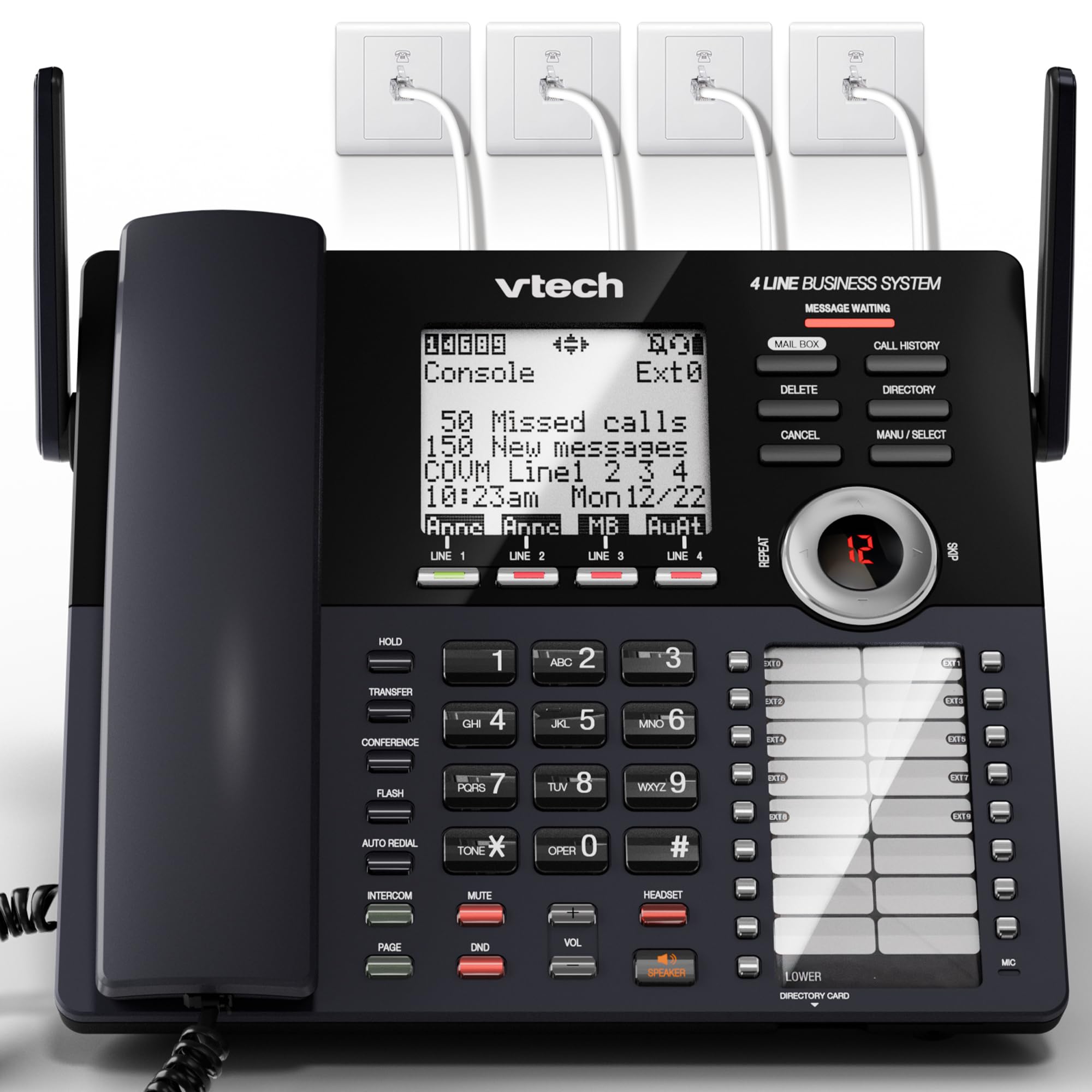
Line count is the first thing to get right, and it trips up more buyers than any other spec. A “4-line” label on a cordless set often means four phone jacks on the base — the handsets still share those four lines rather than each owning one. On a business deskset like the VTech CM18245, each extension is its own working entity with its own voicemail box, which is what most offices actually want when four people take calls all day.
Corded base versus cordless extensions
A corded base station stays tethered to your phone jacks and holds the incoming lines, while cordless handsets or desksets pair wirelessly to that base. That split keeps the wiring simple — one jack near the modem feeds the whole system. The trade-off is placement: the base has to sit near your line jacks, and if there is no jack near your desk, you are relying on the wireless range, not the cable.
Auto attendant, voicemail, and hold behavior
An auto attendant answers an incoming call and routes it to an extension, which is what lets a caller reach “sales” or “billing” without a human answering. Per-extension voicemail keeps messages separate rather than piling all four lines into one bin. Watch how the system handles hold — on some units, switching lines puts the first call on hold instead of hanging it up, which quietly ties up a line until someone releases it manually.
Headset support and expansion headroom
If anyone on your team wears a headset, confirm the headset jack works with the part you actually own. Some AT&T SynJ desksets accept a cordless headset while the matching handsets do not. Expansion headroom matters too: most systems here cap out at ten stations, so buy a base that already supports the number of desks you expect in three years, not just the two you have today.
Side-by-Side Comparison
| Model | Best For | Lines | Stations | Answering / Directory | Amazon |
|---|---|---|---|---|---|
| VTech CM18245 Extension Deskset★ Best Overall | Growing offices adding desks | 4 | Extension deskset (needs CM18445 console) | 100-name phonebook, 32 speed dials | Amazon |
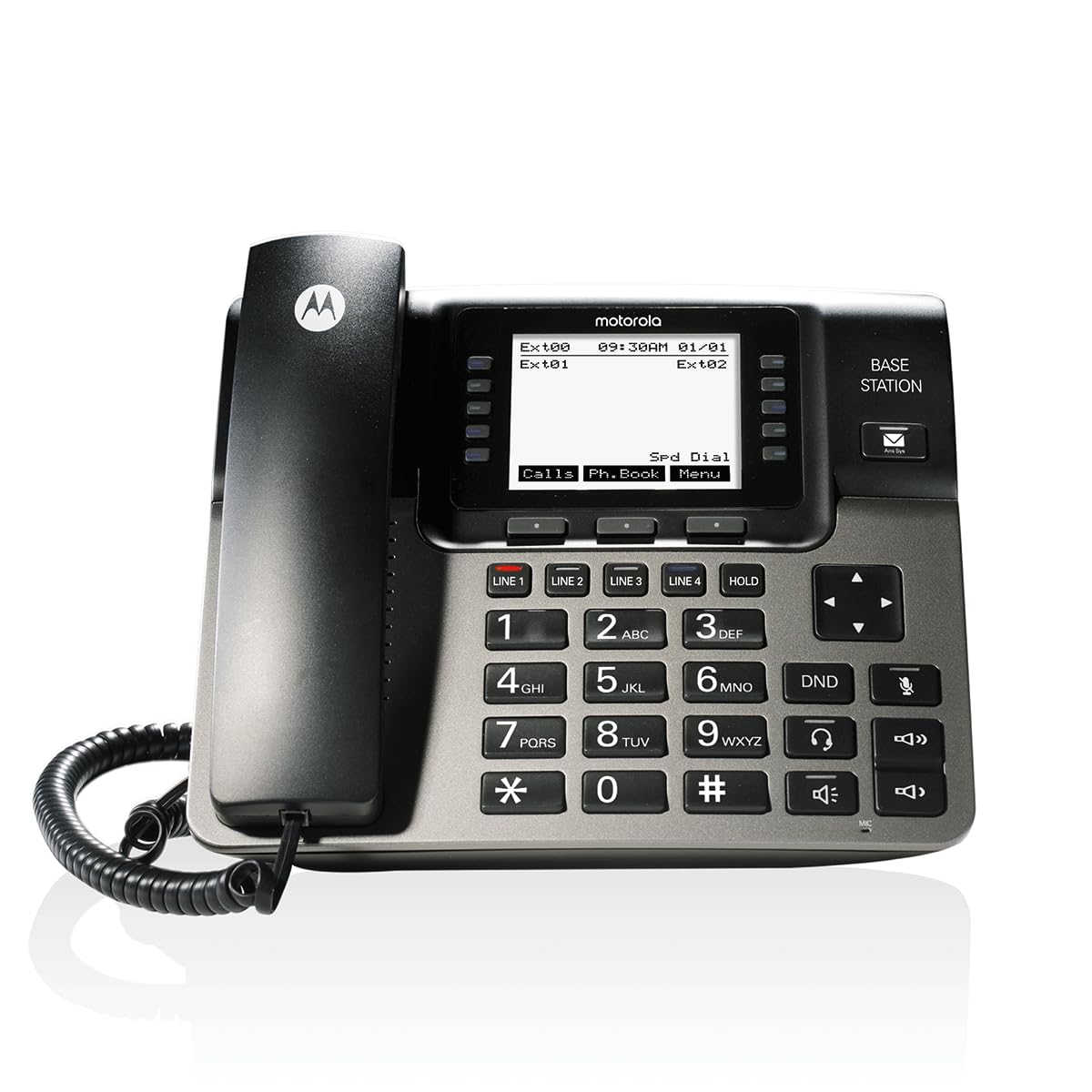
| Motorola ML1000 4-Line Corded BaseMost Expandable | Small teams building from scratch | 4 | Up to 10 wireless extensions | 200-minute answering, 10 mailboxes | Amazon |
| Panasonic KX-TGF944B 4-HandsetBest Call Screening | Home offices drowning in spam calls | 2 | 4 handsets included | Answering machine, 2000-number block list | Amazon |
| VTech AM18447 Main Console | Replacing an aging PBX on a budget | 4 | Up to 10 stations | 180-minute answering, 100-name phonebook | Amazon |
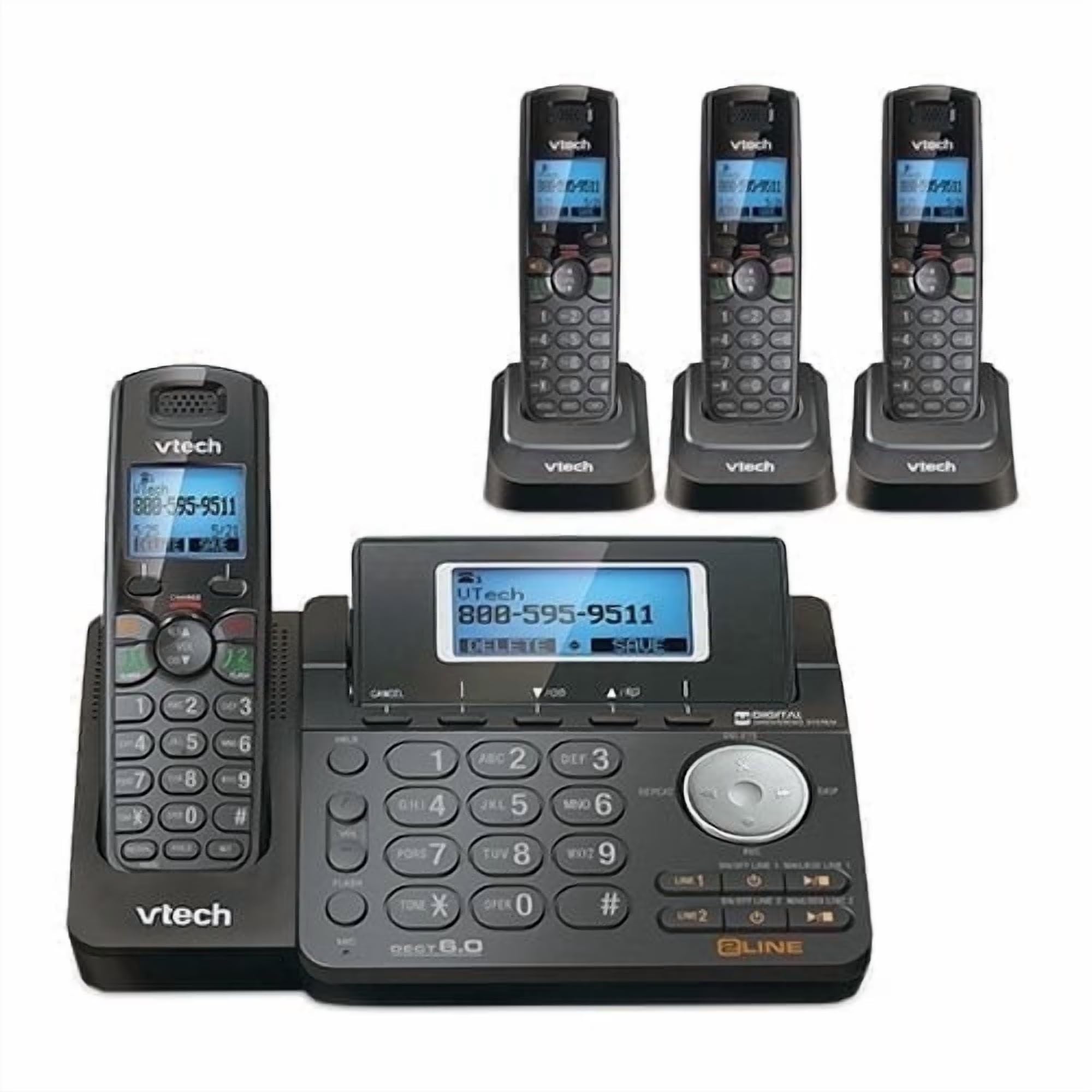
| VTech DS6151-11 + 3 Handsets | Two-line home and shop setups | 2 | Up to 12 handsets | 13-minute answering, 50-name directory | Amazon |
| AT&T TL88102 + 5 TL88002 Handsets | Multi-room coverage on two lines | 2 | 6 handsets included | Digital answering system | Amazon |
| AT&T SynJ SB67158 | Offices with a corded front desk | 1 to 4 | Expandable, corded + cordless | Per-line digital answering | Amazon |
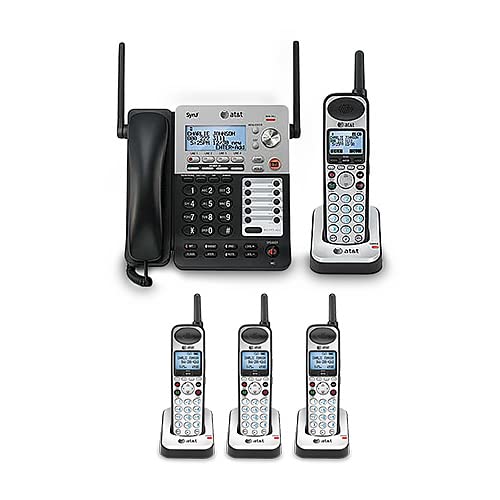
| AT&T SB67138 SynJ 4-Line | Salons and front-desk businesses | 4 | Up to 10 handsets or desksets | Per-line mailbox and auto attendant | Amazon |
| AT&T SB67118 / SB67138 + 3 Handsets | Full-team coverage with maximum range | 4 | Up to 10 handsets | 100-name directory, 3-way conferencing | Amazon |
Detailed Reviews
1. VTech CM18245 Extension Deskset
Our pick — 4.5★ from 350+ verified ratings; the strongest balance of quality and price.
The deskset you buy one at a time, then keep buying as the team grows
If your office already runs a VTech CM-series console, this is the cheapest honest way to add a station. It plugs into the CM18445 console and pairs over DECT 6.0 wireless, so you are not running new cable to a desk across the room. Each extension works as its own entity with its own voicemail box, which is exactly what a small office with four separate job functions needs.
What makes it a standout is the daily-use spec list rather than the headline number. A 32-number speed dial means your most-called clients are one button away, and the extra-large display keeps caller ID readable without squinting. Buyers report “Likes expandability (added phone for total of 4), easy setup,” which tracks with the most-praised trait here — setting up a desk is something almost anyone can do the afternoon it arrives.
The honest catch is the caller ID behavior. A recurring gripe is that the number doesn’t stay on the display after the call, so if your staff needs to verify a customer’s number they have to scroll back through the history. And because this is an extension, it is dead weight on its own — it refuses to work without the CM18445 console, so this is a pick for existing VTech owners, not a starting point.
Where it earns its keep
- Pairs wirelessly over DECT 6.0, so no new wiring to the desk
- Runs as its own extension with a separate voicemail box
- 32-number speed dial and an extra-large, easy-to-read display
- 100-name and number phonebook for the shared office directory
What to know before you buy
- Useless without the CM18445 console — this is an add-on, not a standalone system
- Caller ID number drops off the display after the call ends
- Unplugging the main phone accidentally can require a support call to restore
Right for you if: you already run a VTech CM-series console and need a fourth, fifth, or sixth desk without rerouting cable.
Think twice if: you do not yet own the CM18445 base — start with the AM18447 console instead.
2. Motorola ML1000 4-Line Corded Base Station
One jack, ten extensions, and a receptionist that never takes a lunch
For a business starting from zero phones, this is the cleanest foundation on the list. The ML1000 is the main base station for the Motorola ML Series, and it supports four lines plus up to ten wireless extensions from the ML1100 and ML1200 families. Only one phone jack is needed to start the whole system, and you add wireless extensions without running additional wiring to any desk.
The receptionist feature is what gets it into medical offices and service businesses. A digital auto attendant answers incoming calls and routes them to the correct department automatically, so a customer never sits in silence wondering whether anyone picked up. The 200-minute answering system holds up to ten separate mailboxes with time and date stamps, plus remote message retrieval so you can check in from off-site.
Where it demands honesty is size. Owners mention the base and deskset run larger than they expected — one said they would have preferred the base about three inches narrower to fit their desk. The recurring secondary gripe is a persistent “no line” message on unused lines that cannot be dismissed through the menu, plus oversized buttons on the base. Neither stops the phone from doing its job; both are cosmetic annoyances you can live with for the price of a full 4-line system.
The receptionist earns it: an auto attendant on a base station is normally a premium-tier feature, and here it comes standard with ten mailboxes and remote retrieval.
Pair it with the Motorola ML1100 or ML1200 desksets as your team grows — you can add stations over DECT 6.0 wireless up to the ten-extension ceiling, no re-cabling needed. Wall-mountable, headset-ready, and hearing-aid compatible, so the desk setup works how you want it.
Built for: a growing office that wants to start with one jack and scale to ten desks without touching the wiring again.
Not for: a tight desk footprint — the base runs noticeably wide.
3. Panasonic KX-TGF944B Cordless Phone
Four handsets built to make spam calls stop ringing altogether
This is the pick for a home office or small shop that is losing time to nuisance calls rather than juggling call flow. The KX-TGF944B is a two-line cordless system with four handsets and the most aggressive call screening of anything on this list. Automated Call Block pre-blocks robocalls, Telemarketing Call Block lets you block announced callers, and the one-touch Call Block Button handles 2000 more. As one buyer sums it up: “Automatically blocks 14 thousand known spam callers!”
The One-Ring Scam Alert is a small feature with a real payoff. When someone hang-up-then-calls-back in the classic one-ring scam pattern, this phone shows a confirmation screen before you return the call, so you are less likely to ring back a premium-rate number by accident. The 2-Way Recording with “Start Recording” voice announcement is a second layer of deterrence, useful for anyone who takes vendor or intake calls and needs a record.
Where you need to be careful is battery life. The mixed feedback on sound quality is real but split — plenty of owners find it very good, and others find voice quality thin — but the more consistent gripe is handsets not holding a charge. Panasonic uses rechargeable batteries on this model rather than disposable AAA cells, and a small share of units ship with cells that give up early. If that happens, a fresh set of rechargeable cells fixes it.
What people keep coming back for
- Four handsets included, so a whole household or small office gets coverage
- One-touch block button plus 2000-number capacity for aggressive spam fighting
- One-Ring Scam Alert screens suspicious callbacks before you dial back
- 2-Way Recording with voice announcement deters sketchy callers
The trade-offs to weigh
- Only two lines — this is a screening tool, not a four-line business base
- Rechargeable handset batteries can fail early on a small number of units
- Sound quality divides owners, with some finding voice thin compared to a landline
- Directory is entered manually, and there is no cellular-link on this specific model
Pick this if: you want your phone to stop ringing every time a robocaller hits your area code, and two lines is enough.
Move on if: three or four simultaneous lines are the actual requirement — go for the VTech AM18447 or Motorola ML1000 instead.
4. VTech AM18447 Main Console
A full PBX feature set without the installer visit or the PBX price tag
This is the console that most small offices should be comparing to their old PBX quote. It connects to your analog lines through a standard RJ11 jack, then pairs cordless handsets and desksets over one-touch DECT 6.0 — no professional wiring and no technician visit on install day. You can scale it to ten stations, which covers most two- to eight-person operations with room for a few more desks before you outgrow it.
What makes it read like a business system rather than an oversized home phone is the feature depth. A full-duplex speakerphone lets both sides talk at the same time without clipping the other person off. There is a per-line auto attendant that answers each of the four lines, offers a company directory, routes callers to extensions, and records voicemail. A custom music-on-hold input via a 2.5mm jack handles the “please hold” experience, and the digital answering system stores 180 shared minutes of messages.
Rooms with hard walls and metal shelving are where this earns trust. Customers note it reaches through concrete and steel where a lighter system would struggle, with a 100-name phonebook and 32 quick-dial slots doing the day-to-day work. The honest caveat is sound quality on some units — a few owners hit a high-pitched or crackling line and returned. That is a small share, but if you are sensitive to line noise, test the speakerphone in the first week.
The real working reality: headsets plug in and mostly do their job, but the wired headset port runs quiet for callers and the call timer does not register on a wireless headset. If headsets are core to your operation, confirm the compatibility with your specific model before relying on it.
Buyers compare it directly to a business PBX and come away impressed — setup with three desksets is easy, and call privacy and screening can be disabled per station if you want them off. The 100-name directory ceiling is worth knowing for a larger office, and the missed-call counter requires you to look at the call history rather than showing on the main screen.
Best for: any small office replacing an aging PBX who wants auto attendant, music on hold, and ten-station expansion on a working budget.
Confirm first if: you need a headset-heavy workflow — the wired port runs quiet and wireless headset call timers do not register.
5. VTech DS6151-11 Cordless Phone
A two-line cordless set that stretches a home-and-shop setup across every room
If you are running one residential line and one business line off the same setup, this is the smarter buy than a four-line business base you would only half-use. The DS6151-11 runs two lines with DECT 6.0 at 1.9GHz — the frequency band chosen specifically to sidestep Wi-Fi interference — and it expands up to twelve handsets, so coverage is not your constraint. Four handsets come in the box to start.
The daily-use feature list is where it earns the price of a cordless set. A dual speakerphone runs on both the base and the handset, so conference calls do not require passing the phone around. A 13-minute digital answering system covers messages for both lines, the large backlit LCD display reads easily in a dim office, and the 50-station phonebook plus 50-station caller ID memory handle the shared contact list.
The catch here is that this is a two-line system, not four — so if three or four people pick up separate client calls at the same time, you will run out of lines before you run out of handsets. Owners also note the screen backlight and feature depth feel on the simple side compared to a full business console. If your call volume is two lines, this is fine; if it is four, move up to the Motorola ML1000 or VTech AM18447.
Worth noting: VTech rates this model at 30% more battery life than its prior generation, and the seven AAA batteries needed for the base and handsets ship in the box.
Handset paging lets you hunt down a misplaced phone by ringing it from the base, and the 13-minute answering window handles short greetings without forcing callers to wait. If you want a cordless set with real-range DECT 6.0 for a two-line home-plus-shop setup, this delivers it.
Reach for this one if: you want a wide cordless footprint and two lines are all you actually need.
Look elsewhere if: your team juggles three or four live calls — this system physically cannot take more than two lines at once.
6. AT&T TL88102 Cordless Phone

Six handsets for one base — built for offices with bodies in every room
When your problem is people spread across a large space, not call-flow management, six handsets on one base is the answer. The TL88102 base runs two-line DECT 6.0 with the full feature set — caller ID, call waiting, and call transfer — and five TL88002 cordless handsets ship alongside it. One buyer runs these across an 8000 sq ft business, with each person carrying a designated handset that doubles as a personal pager.
What brings buyers back is the charging behavior. Hands-free coverage is only useful if the handsets are actually ready when someone picks one up, and buyers moving over from VTech units note that these AT&T handsets charge and hold their charge in a way their previous phones did not.
The honest limitation is audio quality, and it splits owners. A minority find the sound clear and easy to use, while a few report that callers cannot hear them well and that the earpiece must be held precisely centered or the voice sounds muted. That rarely matters on a soft-spoken call, but if clear voice is your single priority, test the handset position on the first call. This remains a two-line system, so four-line businesses should look at the Motorola or VTech options higher up.
Why multi-room setups like it
- Six handsets included — one per room or one per person, no add-ons needed
- DECT 6.0 with extended range handles larger footprints
- Charging behavior holds up well after extended daily use
- Caller ID, call waiting, and call transfer for basic call management
Where it falls short
- Only two lines — four-line operations need a bigger base
- Audio quality is inconsistent, and a small share of units have weak earpiece clarity
- No auto attendant or per-extension voicemail for a real business workflow
Suits: a two-line business that needs one handset in every room with no wiring changes.
Not the pick if: three or four callers need to be on separate lines at once, or if per-extension voicemail is a hard requirement.
7. AT&T SynJ SB67158 Phone System

A corded base that keeps the front desk live even when the power blinks
For a receptionist desk that cannot afford a dead handset, the corded base is the whole point. The SB67158 runs one to four lines through a corded base station with cordless extensions paired over DECT 6.0, and it works with the TL7600 and TL7800 cordless headsets for hands-free desk coverage. DSL subscribers may need a DSL filter — worth checking your jack setup before you plug in.
Where it makes itself useful is line handling and range. Owners switching from an older Panasonic setup report that the SB67158 handles three lines with four handsets smoothly, that the double antenna reaches two floors down, and that registering a new handset takes about 45 seconds. Two people can share one line at once using the built-in 3-way conference capability.
Two quirks demand attention before purchase. The recurring gripe is that switching lines puts the first call on hold without hanging it up — which quietly ties up a line until someone releases it manually. The other is longevity: this is a system built for value, and some owners find the base is the component most likely to fail first. Not a dealbreaker, but budget for the possibility that you will replace the base rather than run it a decade.
Best in rooms with hard wiring needs: the corded base plus DECT 6.0 cordless extensions is exactly the combination for a front desk with a phone jack and a back office without one.
The corded base also means the primary phone works even when the cordless handset is charging or lost in another room — a feature worth the trade-off on its own if your front desk is the phone lifeline for the business.
Built for: offices with a fixed front desk and a need for cordless coverage deeper in the space.
Skip if: you rely on releasing lines quickly — the hold behavior on line switching can tie up a line if staff forget to hang up.
8. AT&T Sb67138 Phone/answering System

Four lines with separate voicemail per line — the salon front-desk balance
Salons, dental offices, and any business where the front desk is not the whole operation get a lot out of this base. The SB67138 is a four-line SynJ system with a corded handset plus a cordless handset in the box, expandable up to ten handsets or desksets. The per-line mailbox and auto-attendant voicemail mean a call to line one and a call to line three land in different inboxes, so staff can sort out who handles what without listening to the entire day’s messages.
The physical layout suits a reception counter: a large backlit display, three-way calling, speed dial, redial, mute, hold, selectable ringtones, and remote access for checking messages from off-site. One buyer uses it specifically to avoid robo spam — the auto attendant requires callers to enter an extension, which silently blocks automated callers without ringing through. Setup runs about ten minutes when the wiring is already in place.
The downside here is button responsiveness. More than one owner notes the buttons require a firm press, and a few have experienced hang-ups from a light keystroke. There is also a base-specific reliability note from one reviewer whose line three failed and required a base replacement. Neither turns this into a bad pick — just press deliberately, and know the base is the part that wears fastest over time. The business feature depth is where it lands clearly above average: the hold feature other brands skip is included, and the routing to individual handsets keeps personal calls separate.
What sticks with owners
- Per-line voicemail keeps each phone number’s messages separate
- Auto attendant screens robocalls by requiring extension entry
- Corded and cordless handsets together — front desk and floor coverage in one
- Hold feature other brands at this level often leave out
Where buyers want more
- Buttons require a firm press, and a light keystroke can accidentally hang up
- One owner had a base line fail and needed to replace the base unit
- Feature learning curve is steeper than a basic cordless set
Ideal for: salons, clinics, and non-desk businesses that need per-line voicemail and front-desk-to-floor coverage from one base.
Wait on this if: you need feather-light button presses — the keys demand a firm, deliberate press.
9. AT&T SB67118 Corded-Cordless
The fully-loaded SynJ kit — four lines, four handsets, and the highest owner satisfaction of the SynJ models here
If you want the SynJ 4-line system set up in one order, this is the complete package. The kit bundles the SB67118 or SB67138 base with three SB67108 cordless handsets for a total of four phones on a 4-line DECT 6.0 system. It expands up to ten handsets, does 3-way conferencing, and includes a 100-station phonebook plus dual speakerphone on the base and the handset.
What carries this pick is the DECT 6.0 wireless at 1.9GHz, tuned for interference-free range, with 30% more battery life than the prior generation. Owners who moved from a hosted system to this report it working with a Cisco adapter and RingCentral for digital service, holding up stable after an initial adjustment period. Team members can put a call on hold and another person can pick it up, and it takes four lines at once with room for additional incoming calls.
The honest trade-offs are the same ones that hit every SynJ system: the base is the part you replace if something fails, and switching lines while on a call demands a deliberate hang-up rather than an automatic release. This kit runs the highest sticker of anything on the list, so it is only the right call if you actually need four concurrent lines with room to expand. Two-line offices should look at cheaper cordless sets with the same coverage per line.
Line-handling confidence: the combination of 4-line operation, 3-way conferencing, and 100-station directory puts this on par with what small offices expect from a hosted PBX — without the monthly service fee.
For a fully staffed office that needs four handsets ringing at once and a team that shares line pickup, this is the most complete SynJ kit. If your call volume is closer to one or two lines, save the complexity for a smaller system.
Champion of: four-line offices that want the full SynJ system in a single order with maximum handset coverage and range.
Pass on it if: two lines would cover your calls — a two-line cordless set does the same job for far less layout complexity.
Know the Specs
DECT 6.0 technology (1.9GHz)
DECT 6.0 is the wireless standard almost every cordless business phone uses, and the 1.9GHz number tells you the frequency band it broadcasts on. That band sits above Wi-Fi and microwave traffic, which is why DECT handsets tend to stay clear in an office that already has heavy wireless. Range on DECT 6.0 pairs is typically measured in floors and rooms rather than feet, but the practical rule is to expect full coverage of a single office floor with the base at the center. When you see “30% more battery life” on a DECT datasheet, that is the manufacturer’s comparison to its own prior generation — not a number to compare across brands.
Line count versus handset count
The number that matters most is the line count: how many incoming phone numbers the system can handle at once. A four-line base lets four separate calls ring in simultaneously, each on its own line. Handset count is different — that is how many desks can pick up from the same set of lines. A system with four handsets but only two lines still only takes two calls at a time; the extra handsets just let different desks answer the same two calls. Match the line count to your busiest hour, and the handset count to the number of desks, then you have the right system regardless of brand.
Auto attendant and per-line voicemail
An auto attendant is a digital receptionist that answers an incoming call and offers a menu of extensions so a caller reaches the right department without a human picking up first. Per-line voicemail means each of the four lines records messages into its own mailbox, so a call to the sales line and a call to the billing line land in separate inboxes. For a front desk juggling more than one number, per-line voicemail is what keeps messages from piling into a single blur. Business systems include it; a basic cordless set with one shared answering machine does not.
Answering machine minutes versus phonebook size
Two numbers describe the built-in memory of a business phone system, and they mean different things. Answering machine minutes (recorded as “minutes” on your spec sheet) is how many total minutes of caller messages the system stores before it starts erasing old ones — 180 shared minutes versus a 13-minute bin is a real difference in how much history you keep. Phonebook size is the number of contacts the shared directory holds and, on business desksets, that the caller ID can match against for incoming calls. Both numbers matter, and higher is generally better — but you rarely need more than the smallest business tier unless you record every call.
Common Questions
Will a 4-line phone system work with VoIP or only with traditional phone jacks?
Can a 4-line base station be expanded beyond four handsets?
What happens if I plug in a VTech CM18245 without a CM18445 console?
How long do the rechargeable batteries in a cordless handset last?
Do these systems support a corded headset and a cordless headset?
What is a one-ring scam and how does the Panasonic KX-TGF944B stop it?
Do 4-line phone systems need a separate answering machine?
How quickly can I set up one of these systems on a busy Monday morning?
Can I run fax machines and answering machines off the same 4-line setup?
Why is the base the part that fails first on these systems?
Do any of these systems force callers into an indefinite hold?
The Bottom Line
For most offices, the 4 line phone system winner is the VTech CM18245 Extension Deskset because it makes the smartest case for four-line business telephony — buy the desks you need, add more later over DECT 6.0 (a wireless standard for cordless phones), and skip the base-wiring project entirely. If you want a complete base station with an auto attendant (a system that answers and routes calls automatically) and ten mailboxes from day one, the Motorola ML1000 is the pick. And for a small office replacing an aging PBX on a working budget, the VTech AM18447 delivers auto attendant, music on hold, and ten stations with no installer visit.
If your office already swims in spam calls and two lines are enough, the Panasonic KX-TGF944B does the most convincing job of killing robocalls — the block button and one-ring scam protection do most of the daily work. And for a four-line front-desk-to-floor operation where per-line voicemail and hold behavior matter more than decoration, the AT&T SB67138 is the quiet workhorse that keeps each phone number’s messages sorted on its own. Whichever you pick, the worthwhile move is buying today for the number of desks you expect in two years, not the number on your floor right now.
How we choose
We do not accept paid placement. Every pick is matched to a real buyer and a real use-case; we do not hands-on test units.
Sources
Specifications: manufacturer listings and product documentation. Review insights: verified customer reviews, as of October 2026. Pricing: not shown on this page (it changes often); check the current price via the retailer link.
As an Amazon Associate, Aappliancez earns from qualifying purchases. This does not affect which products we feature.