Disclosure: Some links in this post are affiliate links. As an Amazon Associate I earn from qualifying purchases, at no extra cost to you. Learn more
Specs are compiled from manufacturer listings and verified buyer reviews and can change over time — please confirm the key details on the product page before buying.
Peel and stick tiles fail for one boring reason: the surface under them was never ready. Most lifting, curling and sliding complaints trace back to dust, moisture or a slick old finish the tile can’t grip. Get the prep right and the adhesive itself does the rest. That is what this shortlist is built around.
This guide is built by comparing the manufacturers’ published specifications and the patterns across verified customer reviews, so you get each pick’s real strengths and trade-offs instead of marketing spin.
Below you get one full-spread flooring adhesive, one bonding primer that lets paint grip tile, and three peel-and-stick tile sets that live or die on their own factory-applied glue. Each entry covers what it actually sticks to, how long it takes to set, and where it falls short, so you can match the right adhesive for peel and stick tiles to your floor before you open a single box.
Top Picks

How To Choose The Best Adhesive for Peel and Stick Tiles
The job sounds simple until you get to the aisle. A tube of glue is not always the answer, and a bucket of flooring adhesive is not always the answer either. Peel and stick tiles already carry a pressure-sensitive adhesive on the back, and that glue only does its job on a clean, flat, dry surface.
Know which adhesive job you actually have
There are two different problems hiding under one keyword. The first is loose tile: planks or squares that have already curled and need a full-spread flooring adhesive underneath. The second is a slick or sealed surface, such as old vinyl, ceramic tile or melamine cabinets, where paint or new covering will not grab until you put down a bonding primer first. Buy for the job in front of you, not the label on the bucket.
A full-spread flooring adhesive is a liquid you trowel onto the subfloor. You let it go tacky, then press the tile into it. A bonding primer is different — it is a paint-like liquid you roll or brush on so a topcoat or a covering sticks to a hard, shiny surface. Mixing these two up is the single most common purchase mistake in this category.
Read the cure and open time before anything else
Open time is how long the adhesive stays workable once it hits the floor. Cure time is how long it needs before it is fully set. Fast-setting adhesives force you to work in small patches, which is fine for a trailer or a bathroom but miserable across a whole living room. A longer open time lets you lay whole sections without racing the clock.
Check the temperature and the surface it is rated for
Adhesive chemistry has limits written right on the container. Some formulas are not rated for radiant heated subfloors whose surface temperature climbs above a set ceiling, and some are not meant to go over existing self-stick tile at all. Match the products’ stated surface list to your actual floor before you commit, because a great adhesive on the wrong surface behaves like a bad one.
Side-by-Side Comparison
| Model | Best For | Type | Rated Surfaces | Weight | Amazon |
|---|---|---|---|---|---|
| ROBERTS Universal Resilient Flooring & Vinyl-Backed Carpet Tile Adhesive★ Best Overall | Gluing down LVT, LVP and vinyl-backed carpet tile | Acrylic latex, solvent-free, pressure-sensitive | Concrete, APA-rated plywood, steel, marble, terrazzo, bonded vinyl tile | 8.4 pounds | Amazon |
| 20-Pack Peel & Stick Floor Tiles 12 x 12 inch VinylBest Value | Covering a small room or RV floor on a budget | Peel and stick PVC tile, 0.05 inch thick | Clean, flat interior surfaces | 7.5 pounds | Amazon |
| INSL-X SXA110099-04 EMW1421981 Acrylic Bonding Primer | Making paint or new covering grip tile, glass and metal | Waterborne acrylic bonding primer, 32 fl oz | Glass, metal, ceramic tile, wood, melamine, engineered wood | — | Amazon |
| Art3d 30-Pack Peel and Stick Vinyl Floor Planks, Taupe Ash | Wood-look floors over a large area | Peel and stick vinyl plank, 1.6 mm thick | Clean, flat, dust-free surfaces | 0.22 kg | Amazon |
| Art3d 30-Pack Peel and Stick Vinyl Floor Tiles, Black & White Marble | A fast, high-impact room transformation | Peel and stick PVC tile, anti-slip, 12 x 12 inch | Clean, flat interior surfaces | 14 pounds | Amazon |
Detailed Reviews
1. ROBERTS Universal Resilient Flooring & Vinyl-Backed Carpet Tile Adhesive – 1 Gal. (3.78 L)
Our pick — 4.5★ from 400+ verified ratings; the strongest balance of quality and price.
The full-gallon workhorse that hides under LVT, LVP and carpet tile without complaint.
If you are gluing planks or carpet tile down across a real room, this is the gallon to start with. The ROBERTS Universal is an acrylic latex adhesive, meaning the binder is a water-based synthetic resin rather than a solvent. It is solvent-free, so you are not working in a cloud of fumes, and it is pressure-sensitive, which means pressing the tile down is what activates the grip rather than just wetting the back.
The surface list is the part worth reading closely. It bonds to properly prepared concrete, flooring-grade APA-rated plywood, steel, marble, terrazzo, and existing well-bonded vinyl tile flooring — with self-stick tile specifically excluded from that last one. It is also not rated for radiant heated subfloors whose surface temperature exceeds 85 degrees Fahrenheit. It carries Microban product protection, which helps fight the growth of stain that can cause product degradation.
Application rewards patience. Roll or trowel it out, wait for it to turn tacky, then lay the tile in small sections so the adhesive never skins over before you press. One trailer-floor install took several days, pressing each section with weights and kettlebells instead of a roller and letting the adhesive dry overnight. Clean spills and tools with water immediately — once this dries, it is nearly impossible to shift, even with lacquer thinner. One honest catch: the bucket can leak in transit and the lid is not taped, so set it on cardboard the day it arrives.
What earns it the top slot
- Solvent-free acrylic latex — water cleanup while wet, no harsh fumes
- Rated for LVT, LVP, VCT, vinyl sheet goods and vinyl-backed carpet tile
- Pressure-sensitive formula grips hard once you press the tile down
- Dries clear, so chalk lines stay visible while you work
Where it asks more of you
- Bonds only to properly prepared surfaces — dust and moisture ruin it
- Not for self-stick tile floors or radiant heat above 85 degrees Fahrenheit
- Low spots can take hours to dry clear, so plan your working time
Reach for this if: you are gluing resilient planks or carpet tile down and want one bucket that covers the whole job.
Think twice if: you are going straight over existing self-stick tile or a radiant floor running hot — the surface list rules it out.
2. 20-Pack Peel & Stick Floor Tiles 12 x 12 inch Vinyl
The entry ticket to a new floor: twenty squares, no glue bucket, one afternoon.
Here the adhesive comes already glued to the back. Each tile in this ZRJT set measures 12 x 12 inches, and a pack of 20 covers 20 square feet — about right for a bathroom, a laundry room or an RV floor. The PVC body is 0.05 inch thick, which is the spec that matters most here: that thickness is what lets the tile bridge slightly uneven surfaces and resist curling at the edges. It is rated waterproof, and at 12% lighter than the ROBERTS gallon, the box is easier to carry around a job than a heavy pail.
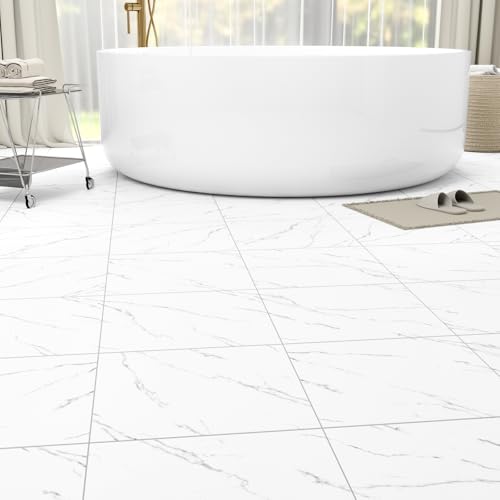
The look is where this one wins people over. The matte white vein marble finish and square edges give a clean, grout-free surface, and it is available in several color options to suit different rooms. Cutting is straightforward — you trim to size by hand and press it down. The own-brand adhesion layer is designed to keep its stickiness when it gets wet and to resist curling from friction, and the surface is built to shrug off stains and wipe clean.
Now the honest part. Thickness, durability and alignment all draw divided feedback, and a minority of buyers find the tiles lifting soon after they go down. That is usually a prep problem rather than a glue problem — this tile needs a genuinely clean, flat, dry surface, and it will hold even less patiently than the full-spread ROBERTS route over a dusty floor. Firm hand pressure across the whole tile matters too, because the pressure-sensitive layer only activates where you actually press.
Why it stands out: the marble-look finish and easy trimming make it a genuinely quick cosmetic upgrade, and the waterproof PVC body suits bathrooms and laundry rooms where spills are routine.
What it won’t fix: a lumpy or dusty floor. This is a self-adhesive tile for decent substrates, not a repair layer for a damaged one.
Best for: a small room or RV floor you want covered this weekend without mixing anything.
Look elsewhere if: you need guaranteed long-term hold over an imperfect subfloor — use the full-spread ROBERTS adhesive instead.
3. INSL-X SXA110099-04 EMW1421981, 32 Fl Oz Acrylic

Not glue at all — the primer that lets paint and new surfaces bite into slick tile.
This is the one entry on the list that is not an adhesive you squeeze onto a tile. INSL-X STIX is a waterborne acrylic bonding primer in a 32 fl oz container, and it exists to solve the opposite problem: making a hard, shiny surface accept something new. It is rated indoor, is waterproof, and dries to a semi-gloss white finish with a color code of #FFFFFF. Coverage is listed at 400, and full cure is 4 hours.
Where it earns a place next to flooring adhesives is on the surfaces that defeat everything else — glass, metal, ceramic tile, and wood. It bonds where ordinary primers slide off, and it is the standard move when you want to paint ceramic tile or melamine cabinets rather than cover them. For a peel-and-stick project it is the prep step: seal and prime a troublesome substrate so your covering has something to hold. On terra cotta tile countertops, buyers got good results with two coats, letting each dry before the next.
The trade-off is technique. On engineered wood, where other primers and paints had shriveled, this one did too until it was re-brushed after two to three minutes while still tacky, which let it lay down smooth. Surface prep matters as much as the product — a TSP wash followed by sanding and a dust-free wipe is what makes it stick. Budget the time honestly, because it wants to reach full bond over the cure window rather than straight away.
Where it beats everything else here: versatility. Ceramic tile, glass, metal, melamine and engineered wood all fall inside its rated surface list, which no single flooring adhesive on this page can claim.
The fine print: “bond” is not instant. Re-brushing while tacky and letting it cure are part of the method, not optional extras.
Pick this when: your tile is going over a glossy or sealed surface that refuses to hold anything.
Skip the primer if: you are laying planks on bare concrete or plywood — that job calls for the ROBERTS gallon, not a bonding coat.
4. Art3d 30-Pack Peel and Stick Vinyl Floor Planks, 12 x 12 in, Taupe Ash

Thirty wood-grain planks that turn a tired room into something worth photographing.
Wood-look flooring without the sawdust — that is the pitch, and the numbers back the coverage. Thirty tiles at 12 x 12 inches give 30 square feet per pack, and the taupe ash finish is fade-resistant, scratch-proof and built for kitchens, dining rooms and bedrooms. The rigid core is rated 100% waterproof and fireproof, and the high-strength construction is designed so the planks do not expand, which keeps seams tight over time. At 1.6 millimeters thick, the planks are firm enough to bridge minor dips.
Installation is the main selling point and the reviews agree: this is genuinely easy to lay, cut and clean. A utility knife or scissors handled the trimming on jobs done around the house, and the peel-and-stick backing means no glue bucket and no contractor. One buyer laid an entire room from an office chair, which tells you how manageable the individual planks are to handle. On a properly prepped base, high-traffic sections stayed down past the first week.
The catch is the floor underneath. Tiles need a perfectly clean, dust-free surface or every bump telegraphs through the plank, and floor prep — filling, sanding, wiping down — is what separates a floor that lasts from one that lifts. The printed grain also drifts out of alignment across tiles, so matching the pattern consistently takes attention, and the direction arrows on the backing are not reliable on their own. The smooth surface offers little grip for socks and rugs, and a minority of units have failed over time. Preparation is not optional here.
What you get right away
- 30 square feet per pack with a realistic taupe ash wood grain
- Rigid, waterproof core rated to resist wear, scratches and abrasion
- Cuts easily with a utility knife or scissors for fast fitting
- Peel-and-stick backing needs no adhesive and no installer
What to plan around
- Requires a spotless, flat floor — any bump or dust shows through
- Printed grain misaligns across tiles; the backing arrows are not reliable
- Surface is smooth, so socks and rugs slide
Made for: anyone covering a bedroom, dining room or kitchen who wants real wood grain without the glue or the labor.
Not the pick for: a rough or unresurfaced floor. Prep this one properly or the planks will not last.
5. Art3d 30-Pack Peel and Stick Vinyl Floor Tiles, Black & White Marble

Checkerboard drama in a box — thirty marble tiles that remake a room in an afternoon.
Quality is the headline here, and the spec sheet reads like it. The Art3d black and white marble set packs 30 tiles at 12 x 12 inches for 30 square feet total, with 15 tiles per color, so you get a balanced split for a checkerboard layout out of a single box. Each tile is anti-slip as well as waterproof, and the thick PVC construction is what makes the tiles feel substantial in hand — this 14-pound pack is one of the heaviest on the page, and for good reason.
For a fast cosmetic transformation, this is the one. Two people covered an 18 by 11.5 foot room in two and a half to three hours, trimming almost nothing and finding the tiles still firm weeks later. Two boxes covered an entry floor laid directly over old linoleum in a few hours. A utility knife gives cleaner, straighter cuts than scissors, and lining up a measuring tool stops the pattern from drifting as the rows go down.
Two honest notes. The color reads as deep charcoal and gray-white rather than a true jet black, which most buyers find attractive but is worth knowing before you commit. Adhesion and color both draw mixed feedback — where the surface underneath is not properly clean, the tiles will not hold as well as they should. Get the prep right and this set performs like the premium option it is; treat the floor carelessly and even a tile this thick will eventually move.
The defining strength: all-around quality, from the rigid, waterproof core to the anti-slip finish and the balanced 15-per-color split that makes a patterned layout simple.
Worth knowing: the black leans charcoal, and the set is only as good as the floor you lay it on.
Choose this if: you want a bold marble look and a room you can walk on the same day you install.
Pass it up if: you need a true jet-black tile, or your subfloor is rough and unfinished.
Know the Specs
Pressure-Sensitive Adhesive
A pressure-sensitive adhesive stays tacky and only grips properly when you press the tile down firmly across its whole surface. That is why a full-spread liquid adhesive like the ROBERTS gallon is troweled on and allowed to go tacky first, and why push-and-press matters as much as the glue itself on self-adhesive tiles. Loose spots on a new floor are usually places the tile was never pressed hard enough.
Open Time, Dry Time and Cure Time
These are three different things. Open time is how long the adhesive stays workable once it is down — short open times mean small sections and fast hands. Dry time is when the surface stops being wet (the INSL-X primer is rated at 4 hours). Cure time is when the bond is fully set and strongest. Plan your working day around all three, because rushing past a cure window is how a floor ends up lifting.
Coverage and Format
Coverage is how much floor a container or pack will actually do. A 20-tile pack at 12 x 12 inches covers 20 square feet; a 30-tile pack covers 30 square feet. Buy one pack more than your measured area for cuts and mistakes, because matching a fresh box to an old one later is not always straightforward. The INSL-X primer lists coverage at 400.
Tile Thickness and Rigid Core
Thickness is measured in hundredths of an inch or in millimeters. A 0.05 inch PVC tile or a 1.6 millimeter plank is thick enough to cover slight unevenness and resist curling at the edges. A rigid core keeps the tile stable and prevents expansion, which protects the seams over time. Thin tiles follow every bump in the floor; thicker ones hide more.
Rated Surfaces and Temperature Limits
Every adhesive and primer names the materials it will hold to, and some name the ones it will not. The ROBERTS gallon is not for self-stick tile floors or radiant heat above 85 degrees Fahrenheit, while the INSL-X primer covers glass, metal, ceramic tile and wood. Check your actual surface against the list before you buy — this one step prevents most failed installs.
Solvent-Free vs Solvent-Based
Solvent-free formulas like the ROBERTS acrylic latex use water as the carrier, which means lower fumes and easier cleanup while wet. Solvent-based adhesives can be stronger in some applications but are harder to work with indoors and need more ventilation. For most residential peel-and-stick projects, a solvent-free formula is the more comfortable choice.
Common Questions
Can I use extra adhesive on peel and stick tiles that already have sticky backing?
How long should I wait before walking on new peel and stick tiles?
Will the ROBERTS adhesive work over existing vinyl tile?
Do I need a primer if I am painting over ceramic tile?
How many boxes of peel and stick tiles do I need for a small room?
What is the difference between a flooring adhesive and a bonding primer?
Why are my peel and stick tiles lifting after a few days?
Can I cut peel and stick vinyl tiles with scissors?
Are waterproof peel and stick tiles safe for a bathroom or laundry room?
Will the INSL-X primer bond to melamine cabinets?
The Bottom Line
For most people, the adhesive for peel and stick tiles answer is the ROBERTS Universal Resilient Flooring & Vinyl-Backed Carpet Tile Adhesive, because a solvent-free acrylic latex that bonds to concrete, plywood, steel, marble and terrazzo covers almost every floor you will actually meet. If you are working over ceramic tile, glass or melamine, the INSL-X STIX waterborne bonding primer is the surface prepper you want, with its rated coverage of 400. For a small room or RV floor that needs a fresh face today, the 20-Pack Peel & Stick Floor Tiles gets it done without mixing a thing.
Whichever you pick, the prepped floor wins. Fill, sand, wipe it clean and dry, then let the adhesive do its job.
How we choose
We do not accept paid placement. Every pick is matched to a real buyer and a real use-case; we do not hands-on test units.
Sources
Specifications: manufacturer listings and product documentation. Review insights: verified customer reviews, as of October 2026. Pricing: not shown on this page (it changes often); check the current price via the retailer link.
As an Amazon Associate, Aappliancez earns from qualifying purchases. This does not affect which products we feature.