Disclosure: Some links in this post are affiliate links. As an Amazon Associate I earn from qualifying purchases, at no extra cost to you. Learn more
Specs are compiled from manufacturer listings and verified buyer reviews and can change over time — please confirm the key details on the product page before buying.
If you need one rope to do real work — hauling limbs, anchoring a swing, belaying a partner, or lashing gear to a truck — the safest buy on this list is the Black Diamond 9.9 Sport. It has the deepest pile of positive owner reviews and covers the widest range of climbing jobs. The rest of this page separates the static rigging lines from the jute training ropes and the certified dynamic lead lines, so you can match the rope to the job.
This guide is built by comparing the manufacturers’ published specifications and the patterns across verified customer reviews, so you get each pick’s real strengths and trade-offs instead of marketing spin.
Rope buying gets confusing fast, because the same shelf holds static tree-rigging line, jute training rope, accessory cord, and dynamic lead rope — and they are not interchangeable. The numbered reviews below break down the strength, stretch, and handling that decide each job, so you can find the right best rope for your work without overbuying.
Top Picks


How To Choose The Best Rope
Start with the job, not the rope. A static line that holds a truck from sliding is a poor choice for catching a leader fall, and a stretchy dynamic lead line makes a miserable pull rope. Once you know the work, three numbers decide almost everything: breaking strength, stretch, and diameter.
Match the rope type to the task
A static rope (one built with almost no give) is made for tree work, hoisting, pulling, and towing — the load stays put and the rope does not bounce. A dynamic rope (one that stretches on purpose) is built for climbing, because that stretch absorbs the shock of a fall instead of slamming it into your body and gear. Dynamic rope is often certified to a climbing standard and marked as single, half, or twin use, while static work line is judged mostly on its maximum tension load.
Read the breaking strength, then leave margin
Look at breaking strength first — that is the maximum tension load the rope can take, usually printed in pounds. On this list it runs from 3,820 lbs up to 9,000 lbs and 18,000 lbs, so a 9,000 lb line can hold a heavy load that a 3,820 lb line cannot. Diameter tells you how the rope feels in your hand and how long it lasts: a 1/2 inch or 3/4 inch line is thick, easy to grab with gloves, and slow to wear through, while an 8 mm cord is thin and light for hauling up a route. Thicker rope costs you weight and money; thinner rope costs you grip and abrasion life.
Side-by-Side Comparison
| Model | Best For | Diameter | Breaking Strength | Length | Amazon |
|---|---|---|---|---|---|
| Black Diamond 9.9 Sport★ Best Overall | All-around climbing | 9.9 mm | — | 70 m (229.65 ft) | Amazon |
| GM CLIMBING 8mm Accessory CordMost Versatile | Anchors and prusiks | 8 mm (5/16 in) | 3,820 lbs | 600 in | Amazon |
| Arborist Rigging Rope 1/2 in | Tree work on a budget | 1/2 in | 9,000 lbs | 1,200 in | Amazon |
| Perantlb Climbing Rope | Fitness and climbing | 1.5 in | 500 lbs | 120 in | Amazon |
| Zeluga Double Braided Static Rope | Heavy tree and load work | 0.55 in | 8,400 lbs | 125 ft | Amazon |
| CRAYZA Double Braid Arborist Rigging Rope | Demanding rigging jobs | 3/4 in | 18,000 lbs | 100 ft | Amazon |
| EDELRID Boa 9.8mm Dynamic | Certified climbing | 9.8 mm | — | 70 m | Amazon |
Detailed Reviews
1. BLACK DIAMOND 9.9 Sport Rock Climbing Rope
Our pick — over 4.5★ from 500+ verified ratings; the strongest balance of quality and price.
The do-everything dynamic line that beginners and gym regulars both keep coming back to.
If you are buying your first real lead rope and want one that will serve gym sessions and outdoor single-pitch routes alike, this is the pick. The 9.9mm diameter is the whole story: wide enough that it feeds smoothly through a belay device and resists abrasion on rough rock, yet it does not handle like a heavy cable on long clips. As owners put it, it is “supple,” rarely snags, and feeds cleanly so an ATC belay device can grab the rope firmly. A halfway marker helps you find the middle when setting up a rappel, and the low-stretch-for-a-dynamic build keeps falls firm rather than springy.
The thing buyers single out most is grip and feel, and the knot-work backs it up. It ties easily and rolls up neatly at the end of a session, both of which matter when you are packing up tired. For a climbing rope, it also carries less weight than you might expect — owners repeatedly mention that it is not overly heavy on the wall. If you compare it to a thicker lead line, that handling is the payoff of the slimmer build.
The one honest catch: this is a dynamic rope, and a few buyers discovered the hard way that a dynamic line is the wrong tool for static work like hauling or rigging, because it stretches by design. If your job is pulling, towing, or tree work, look at the static rigging options below instead. For actual climbing, the feedback is overwhelmingly positive, which is why it anchors this list.
What climbs well
- 9.9mm diameter balances abrasion resistance with easy clipping and belaying
- Halfway marker makes rappel setup quick and simple
- Low-stretch dynamic build gives reliable control on the wall
Where it bites
- It stretches on purpose, so it is the wrong rope for static hauling or rigging
- At 2.5 kg it carries real weight on a long approach
Grab this if: you want one dependable dynamic rope for gym laps, sport routes, and general climbing.
Pass if: your work is pulling, hoisting, or tree rigging that needs a no-give line.
2. GM CLIMBING 8mm Accessory Cord Rope Double Braid
A slim, tough cord that does the small jobs a bulky climbing rope cannot.
This is the cord you reach for to build an anchor, tie a prusik loop, or rig a lanyard — not a lead rope. At 8mm it slips into a pack and clips to your harness without weighing you down, and its 3,820 lb maximum tension load is honest capacity for anchor building rather than hauling trees. Against the Arborist Rigging Rope here it is a fraction of the strength and length, which is exactly the point: this is the precision tool, not the workhorse.
What wins people over is how well it functions where it counts. The double braid — a braided core wrapped in a braided cover — gives it a firm feel and serious resistance to fraying on sharp rock. Buyers report it holds up over months of use with no fraying or tearing, and that it stays easy to tie and untie even after heavy loading, so overhand knots pull apart when you want them to. The all-polyester build resists moisture, so it shrugs off a damp climbing day.
One split worth knowing about: the feel is genuinely mixed. Some owners describe it as very flexible and supple, while others call it very stiff right out of the bag. For everything from prusiks to tree nets, the pre-cut lengths save setup time.
Why climbers keep it: the double-braid construction resists abrasion, and a 3,820 lb capacity is plenty for lanyards, ice threads, and anchor construction.
Buyer reality check: opinions on stiffness split down the middle, so order a small length first if you like a very soft cord.
Reach for this if: you build anchors, prusiks, and accessories and want a light, tough cord.
Look elsewhere if: you need a single main line for leading — go dynamic.
3. Arborist Rigging Rope 1/2″ x 100ft 48 Strand Braid Bull Rope
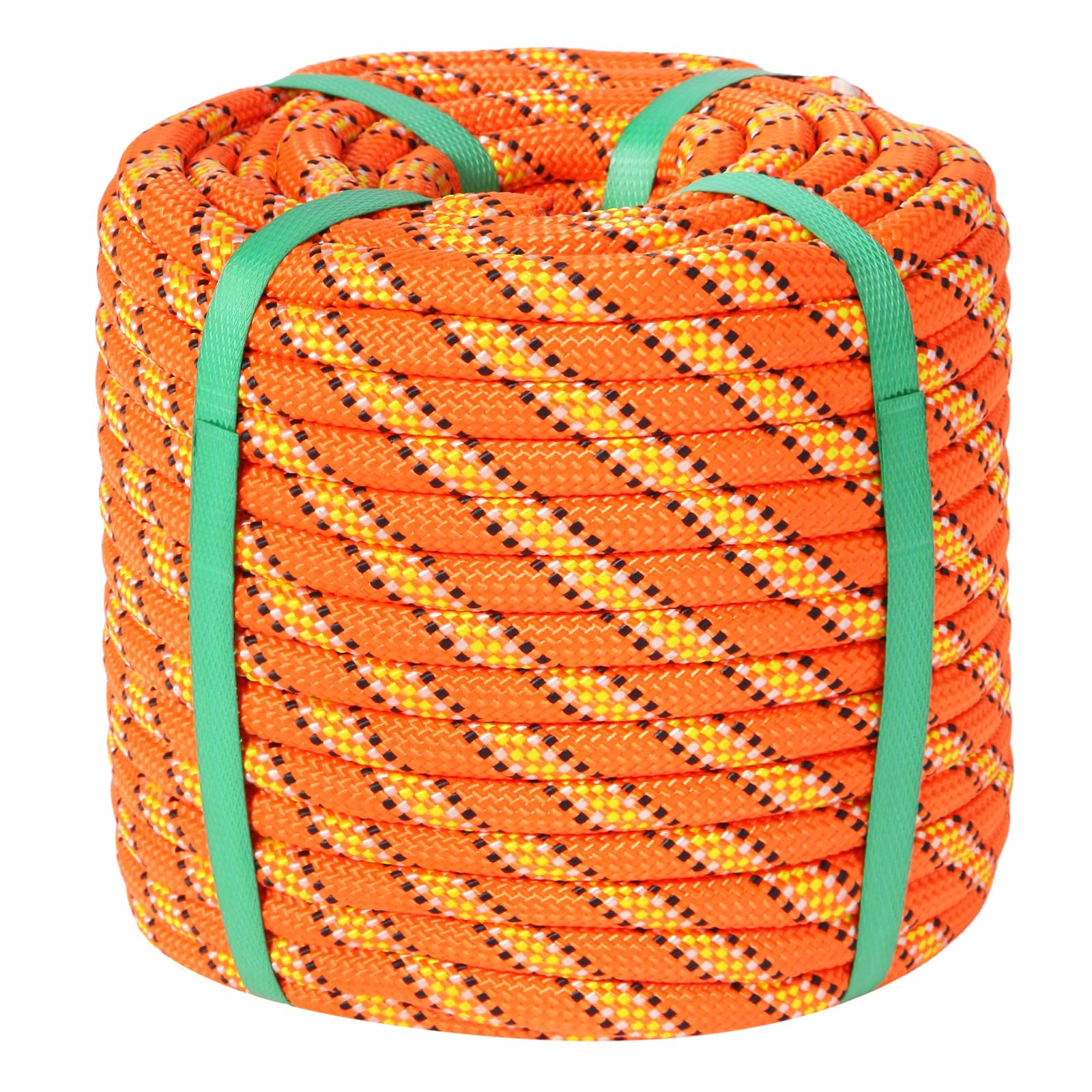
Half-inch tree-rigging line with a static strength figure that rivals far pricier ropes.
For the homeowner dropping a leaner away from the fence, this is the smart spend. It is a static rope, so it does not stretch, and its 9,000 lb maximum tension load is real pulling capacity for the money. It runs 100 feet, and its 48-strand polyester core under a polyester sheath gives it the round, firm body that keeps it manageable under tension. Owners mention putting it on a tree, tying it to a tractor, and watching the tree fall on the intended line under tension.
The build details earn their keep. A hot-melt cutting process seals the ends to slow fraying, and the polyester resists moisture, UV rays, and aging, with a stated service life of at least 5 years. For a budget rigging line, that is respectable working life. It is a little stiff right out of the package, which most owners note as a minor handling point rather than a problem.
The honest trade-off is durability at the sheath. The outer cover is the part that takes the abuse from bark and sharp edges, and a few buyers found the sheath scuffed or split in heavy first use while the core held. Treat it as a capable budget line for occasional tree work, not a daily driver for a pro crew, and keep it away from sharp edges and stumps.
The pulling proof: a 9,000 lb maximum tension load on a 100-foot static line, at a price that undercuts most rigging ropes.
Handle it kindly: the sheath — not the core — is the wear point, so pad sharp edges and stumps.
Best for: occasional tree work, limb lowering, and hoisting where you want real capacity on a budget.
Skip if: you need a soft, supple line for climbing — this is a stiff static rope.
4. Perantlb Climbing Rope

Thick natural-jute rope built for training and grip work, not for catching falls.
This is the one on the list you hang for climbing, pulling, and grip training. At 1.5 inches across, the natural jute gives you a fat, easy handful, and the rope supports up to 500 pounds when mounted correctly — a climbing-gym figure, not a climbing-on-rock figure. It comes in six lengths from 10 feet to 50 feet, so a home setup can match the space you actually have. The looped eye at the end braids back into the rope itself, so you mount it to any sturdy anchor without metal clasps or brackets.
Owners praise the surface here. The natural jute offers a grippier, less-slip feel than synthetic rope, which cuts down on forearm fatigue during long swings, and it wraps around the foot easily. Setup is quick — customers note it takes under a minute to install with the included manual. It also makes a popular outdoor swing, because the kids can swing and climb on the same rope.
Two real-world catches. Jute is a natural fiber, and owners who left it outdoors in damp conditions saw it wear and even rot after a couple of years of swings, so it belongs under cover when not in use. And the natural fibers feel rougher and itchier to some hands than synthetic rope — one young climber disliked the feel while others loved the grip. Match it to your climate and your tolerance for texture.
Hands-on strengths
- 1.5 inch jute gives a fat, grippy hold that reduces slip and forearm fatigue
- Looped end mounts to a sturdy anchor with no brackets needed
- Six lengths from 10 ft to 50 ft fit different spaces
Honest limitations
- Natural jute can rot if left outside in the damp, so store it dry
- Rougher, itchier texture than synthetic rope bothers some hands
Choose it when: you want a training, swinging, and grip rope for a home or gym setup.
Think twice when: you need it to live outdoors permanently in wet weather.
5. Zeluga 15-135 Double Braided Arborist Static Rope

A certified, no-stretch work line for heavy pulling and rigging that needs control.
When the job is hauling a wedged limb out of a tree or towing something heavy, this static rope brings the muscle. A polyester outer around a high-tensile nylon core delivers an 8,400 lb breaking strength, and it carries the EN 892:2012+A2:2023 certification — the European safety standard for arborist and climbing ropes. At 125 feet long and 0.55 inches thick, it is thick enough to grip firmly and control a load, but still flexible enough to tie knots.
The thing everyone raves about is how little this rope gives. It is a zero-stretch design, and owners say the no-flex feel is exactly what they wanted — one pulled down a big dead tree and reported no problem at all. It handles weather too: it is UV and weather resistant, so it can live outdoors, and its hot-melt sealed ends are fused to stop fraying. There is an anti-skid surface texture across the rope that protects the inner core and extends its working life.
The trade-off is stiffness. Rope this thick and this no-stretch does not bend like a soft line, and some owners find it more work to handle than they expected. There are also reports of the outer jacket “milking,” or sliding along the core, over time — which is why it is not the pick for climbing or as a lifeline. It is a pulling and rigging rope, and it is excellent at that.
Where it leads
- 8,400 lb breaking strength with EN 892:2012+A2:2023 certification
- Zero-stretch build keeps a load steady with no bounce
- UV and weather resistant for long-term outdoor storage
Set your expectations
- Stiff and heavy to manage compared to a soft climbing line
- The outer jacket can slide along the core over time, so it is not for climbing
Made for: heavy pulling, tree rigging, and towing where you want zero give and certified strength.
Not for: lead climbing or life-safety use, since it has no stretch and is not a climbing line.
6. CRAYZA Double Braid Polyester Rope

The thickest, strongest work rope here — built to drag, hoist, and lower without quitting.
If your rigging involves genuinely heavy loads, this is the one that never blinks. It is a 3/4 inch double-braid polyester line, and its 18,000 pound tensile strength is the highest figure on this list. Both layers are tightly woven from 72 strands of reinforced polyester — a thick braided cover over a stout core — so it resists the abrasion that bark, stumps, and rough ground throw at a working rope. It is 100 feet long, and the bright orange color is easy to spot in a tree canopy or on a truck bed.
Owners are happy with how it holds up. Reviewers point out using it to pull down a huge tree without breaking, and one turned it into a lineman rope for saddle hunting that held up through a season. The polyester material resists moisture and UV, so it is at home on trees, backyard swings, docks, and halyards. Hot-melt cut ends stay neat after sizing, and the firm core keeps the rope round and tangle-resistant under load.
Its heft is the honest trade-off. A 3/4 inch rope is thick and a little stiff, so it is not the quick, supple line you would toss easily through a tight crotch. Some owners love how it moves and others find it slightly stiff — a handling note, not a failure. Bring it for dragging and lowering, not for delicate high-angle work.
The strength headline: an 18,000 pound tensile strength — the highest of any rope on this page — makes it the pick for demanding rigging.
The weight you pay: 3/4 inch girth and a firm, slightly stiff body mean it is bulk to carry and stiff to manipulate in tight spots.
Pick it for: heavy rigging, logging, hauling, and lowering where raw strength is the priority.
Leave it for: everyday light-duty work where a thinner, livelier rope is easier to handle.
7. EDELRID Boa 9.8mm Dynamic Climbing Rope

A German-made dynamic lead line for climbers who want certified, soft-handling performance.
For the climber who wants a rope built to a strict environmental and safety standard, this single dynamic rope is the premium choice. It is made in Germany, carries the BLUESIGN certification — a strict standard for environmental protection, consumer protection, and occupational safety — and comes from a maker with 150 years of rope-making and alpine equipment work behind it. At 9.8mm it is a relatively narrow dynamic rope, and its single-rope build with Thermo Shield treatment delivers the smooth handling climbers value on a lead.
Owners describe the feel as soft and solid when tied into knots, and they report it absorbs fall impact well — exactly what you want a dynamic line to do. It handles cleanly, runs reliably through belay devices, and stays durable through repeated climbs. At 70 meters it is long enough for most climbs, giving you reach on longer single-pitch routes. It is light in the hand and packs down small, so it does not weigh down the approach.
The catch is the same one that applies to any dynamic rope (a rope built to stretch and absorb a fall): it stretches by design, so it is for climbing, not for hauling or rigging loads. At this level you are paying for certification, German manufacturing, and the handling that comes with it. That is worth it for climbers who care about those credentials, and unnecessary if you just need a cheap pull line. For lead climbing, the performance and the confidence are the whole point.
What the certification buys: BLUESIGN compliance and a 70m single dynamic build aimed at climbers who want verified standards.
The soft-feel payoff: Thermo Shield treatment and a 9.8mm diameter give the smooth, knot-friendly handling owners keep praising.
Built for: lead climbers who want a certified, German-made dynamic rope with a soft, controlled feel.
Overkill if: your only job is hauling or tree work — a static rope serves you better and for less.
Know the Specs
Breaking Strength (Maximum Tension Load)
This is the load a rope is rated to hold before it fails, usually printed in pounds, and it is the number that should drive your choice for any work rope. On this list it ranges from 3,820 pounds on the slim accessory cord up to 9,000 pounds and 18,000 pounds on the heavy rigging lines. Match the breaking strength to the job and leave a margin — hauling a heavy limb puts far more on a rope than its resting weight, so a line rated well above your load is the safe call.
Diameter and Fiber Type
The diameter (the rope’s thickness in inches or millimeters) decides how it feels in your hand, how well it resists abrasion, and how easily it ties. Thicker lines like 1/2 inch, 3/4 inch, and 1.5 inch are easy to grip with gloves and slow to wear, while 8mm and 9.8mm ropes are light and feed cleanly through devices. Fiber matters too: polyester shrugs off moisture and UV for outdoor work, nylon adds strength and stretch, and natural jute gives a grippy training texture but can break down when left in the damp.
Common Questions
What is the difference between a static rope and a dynamic rope?
How much weight can these ropes actually hold?
Can I use a climbing rope for tree work?
What length of rope do I need for tree rigging?
How long does a rope last?
What does the breaking strength number mean on a work rope?
Will an 8mm cord work for making a prusik loop?
How do I stop a rope’s ends from fraying?
Is a thicker rope always stronger?
What does a climbing rope certification like EN 892 mean?
The Bottom Line
For most people, the best rope here is the Black Diamond 9.9 Sport, because it is the strongest all-around performer — a dynamic line that handles gym laps and outdoor routes with the grip, half marker, and low-stretch control climbers rely on. If your job is pulling trees, hoisting, or towing with zero give, grab the Arborist Rigging Rope for its 9,000 lb static strength at a budget-friendly price, or step up to the CRAYZA 3/4 inch line when you need the highest tensile strength on the page. And for a certified lead rope with a soft, controlled feel, the EDELRID Boa is the one to reach for. If you are deciding today, the Black Diamond is the pick with the deepest pile of happy owners behind it — a vote of confidence you can weigh before you buy.
How we choose
We do not accept paid placement. Every pick is matched to a real buyer and a real use-case; we do not hands-on test units.
Sources
Specifications: manufacturer listings and product documentation. Review insights: verified customer reviews, as of October 2026. Pricing: not shown on this page (it changes often); check the current price via the retailer link.
As an Amazon Associate, Aappliancez earns from qualifying purchases. This does not affect which products we feature.