Disclosure: Some links in this post are affiliate links. As an Amazon Associate I earn from qualifying purchases, at no extra cost to you. Learn more
Specs are compiled from manufacturer listings and verified buyer reviews and can change over time — please confirm the key details on the product page before buying.
If your dental hygienist keeps scraping the same rough ledge off the back of your lower front teeth, the mouthwash you swish every night may not be doing the job you think it is. No rinse can dissolve tartar that has already hardened, but the right rinse can interrupt the bacterial film that turns into it. That is the whole game here: pick a rinse that fights plaque hard enough, long enough, and gently enough that you actually keep using it twice a day.
This guide is built by comparing the manufacturers’ published specifications and the patterns across verified customer reviews, so you get each pick’s real strengths and trade-offs instead of marketing spin.
If your gums bleed when you floss, you need a rinse that calms them without stinging. The picks below cover three jobs: a gentle daily rinse for bleeding gums, a zinc formula that fights odor and plaque all day, and concentrated rinses for existing buildup. Each mouthwash to remove tartar here fits one of those jobs best.
Top Picks
How To Choose The Best Mouthwash to Remove Tartar
Start with one honest fact: tartar is calcified plaque, and once it has hardened onto a tooth it takes a metal scaler to remove it. A rinse works upstream of that. It reduces and loosens the soft plaque film so less of it survives long enough to mineralize. Buyers shopping this category are usually trying to slow the ledge down between cleanings, not erase what is already there.
Look at the active ingredient first, not the flavor
The ingredient list decides what a rinse can do. CPC (cetylpyridinium chloride, an antibacterial agent) targets the germs tied to plaque and gum inflammation. Stannous fluoride is a fluoride form that addresses cavities, plaque, and tooth sensitivity at once. Zinc, especially in a dual-chamber formula, neutralizes the sulfur gas behind bad breath. Any of these can support a tartar-control routine; the label tells you which job you are buying.
Then check whether it burns, and how long the freshness holds
Alcohol-free formulas skip the sting that makes people quit after a week, which matters because consistency is the only thing that changes plaque levels. The rinse also has to last long enough that you are not masking odor an hour later. A formula that holds your breath for hours and does not dry your mouth out is one you will still be using next month.
Finally, weigh strength against bottle logistics
Concentrated rinses ship as a small bottle of gel or powder you mix with water in a marked cup. They are potent and light to store, but they demand a little measuring discipline. Ready-to-pour rinses are simpler and heavier to shelve. Neither approach is better on its own; pick the one you will actually follow twice a day.
Side-by-Side Comparison
| Model | Best For | Active Ingredient | Size | Alcohol Free | Amazon |
|---|---|---|---|---|---|
| TheraBreath Healthy Gums Oral Rinse★ Best Overall | Everyday gum care and gentle breath freshening | CPC (cetylpyridinium chloride) | 1 Liter | Yes | Amazon |
| SmartMouth Clinical Zinc Activated MouthwashTop Performer | All-day breath control and plaque defense | Zinc (dual-chamber) | 16 fl oz | Yes | Amazon |
| Perio Maintenance Alcohol Free Mouthwash | Sensitivity, cavities, and a one-rinse-daily routine | Stannous fluoride | Concentrated, mix with water | Yes | Amazon |
| TheraSol with Xylitol | Gum inflammation and sensitive mouths | Xylitol-based rinse | 16 oz | — | Amazon |
| Periogen Oral Rinse Mint | Heavy tartar buildup and long-term maintenance | Powdered concentrate | 3 oz powder (makes 3 gallons) | — | Amazon |
Detailed Reviews
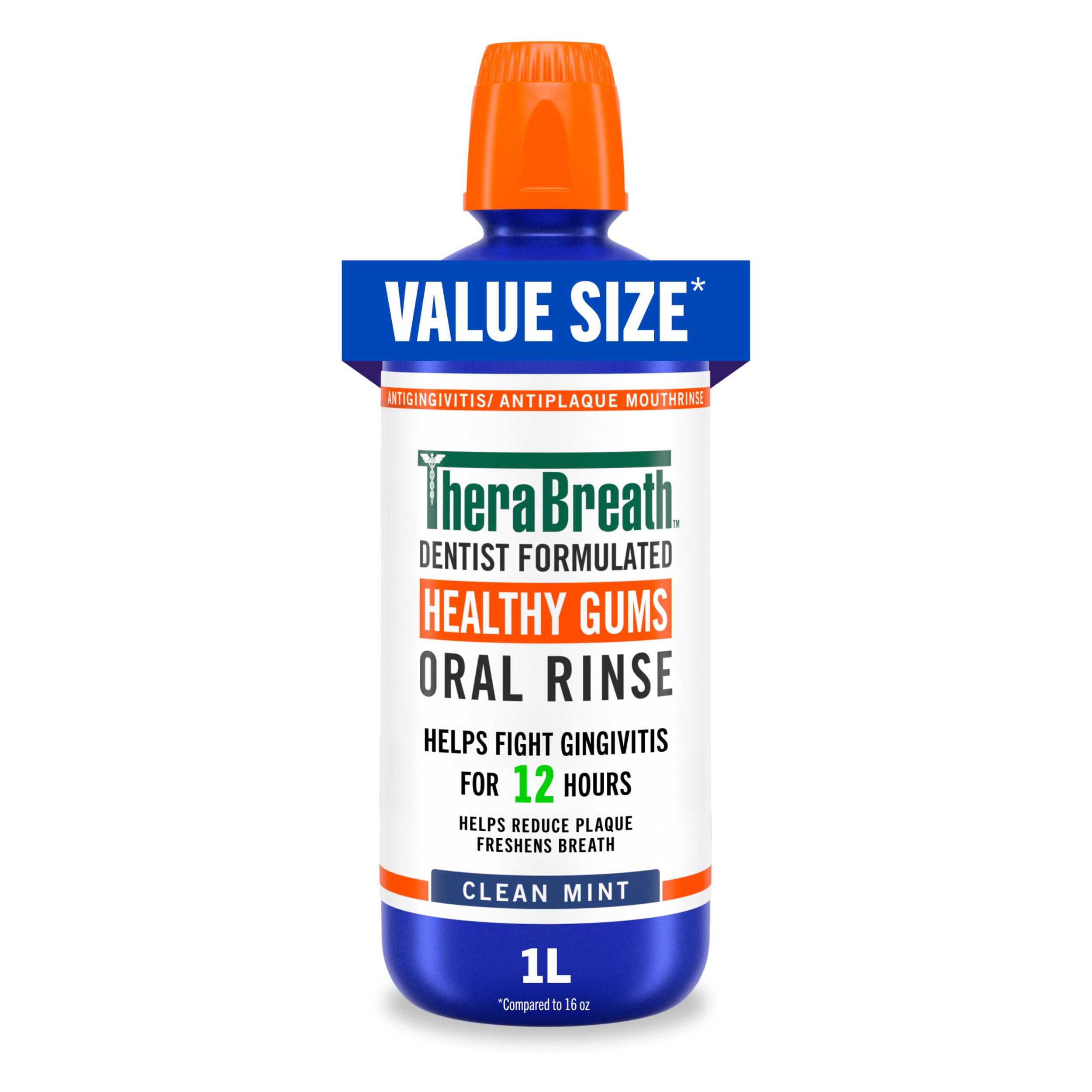
1. TheraBreath Healthy Gums Oral Rinse, Clean Mint, 1 Liter
Our pick — over 4.5★ from 1,000+ verified ratings; the strongest balance of quality and price.
A full liter of CPC rinsing power that gums actually tolerate twice a day.
If your floss comes back pink, start with this rinse. It is a 1 Liter bottle of alcohol-free mouthwash built around CPC (cetylpyridinium chloride, an antibacterial that targets the germs behind gum inflammation and plaque). The maker claims 12-hour germ-fighting action per swish, so a morning and a night rinse cover the full day. It carries no dyes, no colors, no SLS/sulfates, and no parabens, and the packaging is BPA-free.
The size is the quiet advantage. At 2.36 pounds and 3.38 x 3.38 x 9.5 inches, this bottle stands about as tall as a standard tumbler, so it tucks under a bathroom cabinet shelf without needing a special spot. That liter dwarfs the SmartMouth bottle on this list, which weighs 1.26 pounds. The two are not in the same size class, and if you rinse twice daily the bigger pour stretches noticeably longer between reorders.
What keeps people loyal is how it treats sore gums. The mint is clean and refreshing with none of the burn you get from an alcohol-based rinse. Buyers report breath staying clean 8 to 10 or more hours with no dry-mouth side effect. Review pages show gum irritation settling down after about two weeks of twice-daily use. As one customer puts it plainly: “I used it twice a day for a few weeks and my gum issues went away.” A few owners mention that it worked for their minor gum trouble but cannot speak to anything more serious. That is fair — this is an everyday maintenance rinse, not a stand-in for a hygienist’s scaling.
What lands it the top spot
- Liter bottle at a value tier price — the lowest cost per ounce in this lineup
- 12-hour CPC action against the germs linked to plaque and gingivitis
- No burn, no dry mouth, so twice-daily use actually sticks
- Certified vegan, gluten free, halal, and kosher
- TheraBreath was created by Dr. Harold Katz in 1993
Worth knowing before you buy
- Not a substitute for professional tartar removal — it works on soft plaque only
- Swish a full minute, then wait 30 minutes before eating or drinking
- The 2.36-pound bottle is awkward to travel with
Buy it if: your gums bleed a little when you floss and you want one gentle, high-volume rinse to use every single day.
Budget note: this is the value winner of the whole list — a full liter for less than the concentrated options charge for a fraction of the volume.
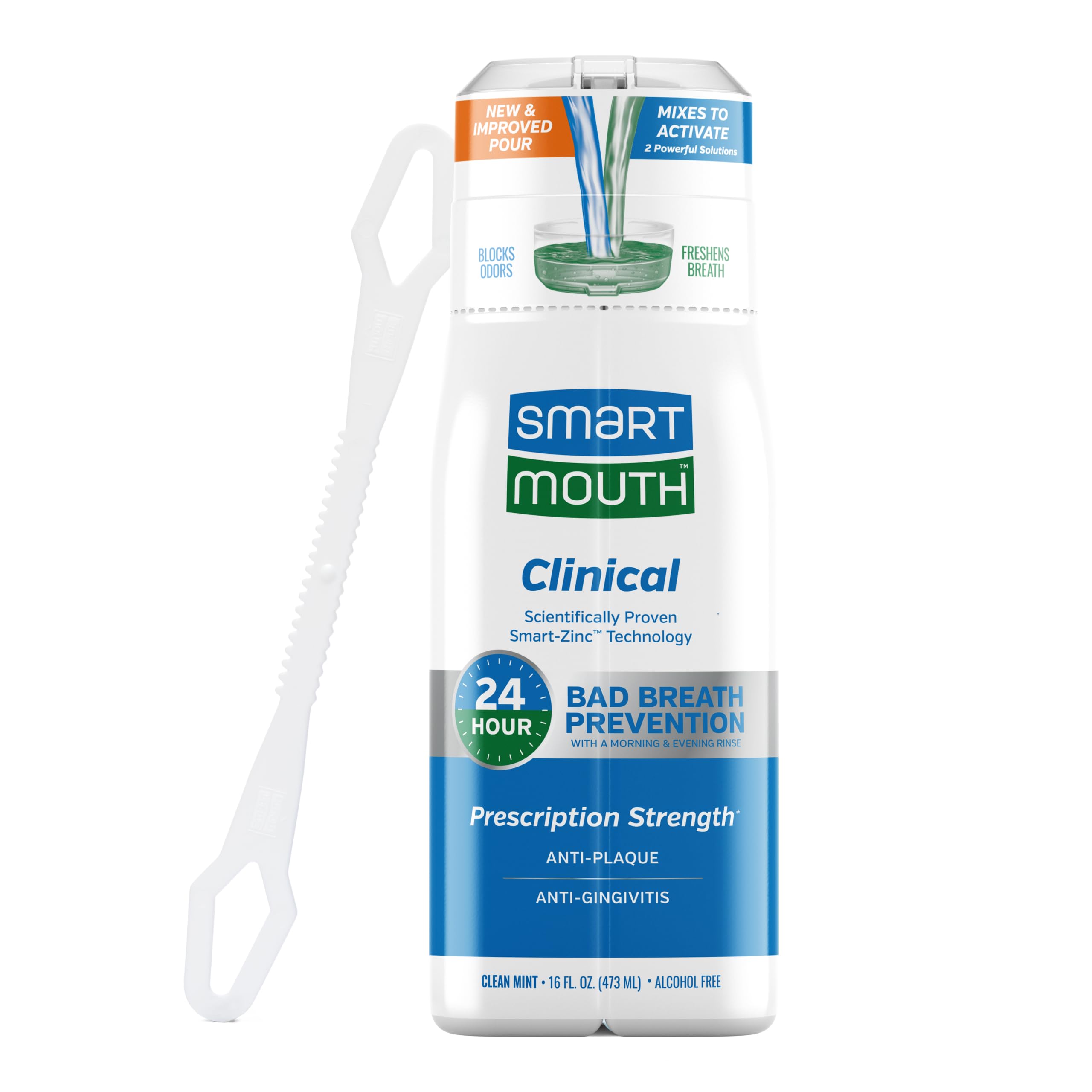
2. SmartMouth Clinical Mouthwash
Two chambers, one pour — zinc activates on contact and shuts down odor for the long haul.
If the rinse you use now wears off by lunch, this is the one to study. SmartMouth’s patented dual-solution Smart-Zinc technology keeps two liquids apart in the bottle, then activates the zinc ions the moment you pour them together. Zinc neutralizes sulfur gas — the source of bad breath — and the maker says it also stops new odor from forming, which is a different job than simply masking what is there. The maker claims 24-hour fresh breath with twice-daily rinsing, and a tongue cleaner comes in the box.
Owner feedback backs up the longevity. The effectiveness of the formula is the single thing buyers bring up most, and the day-long freshness follows right behind it in the same breath. A buyer in the review pages called it “the gold standard,” and five-year users exist in the comments, which says something about how the routine holds up over time. The maker also stands behind it with a 60-day satisfaction guarantee.
The trade-off is the bottle itself. The dual-chamber design has a documented habit of leaking, and the pour can come out uneven with one solution lagging the other. Several buyers simply transfer the liquid into another container before it travels. It is also the smaller bottle here at 1.26 pounds versus the 2.36-pound TheraBreath liter, so if volume per reorder matters you will be restocking sooner. The flavor is a split decision too — some find the mint or citrus crisp, others find it hard to take. Neither issue touches the formula’s performance, but both are real annoyances to plan for.
Why the praise stacks up: the dual-chamber zinc format is the reason this rinse fights odor instead of covering it, and the all-day hold is the feature owners name over and over. The manufacturer’s antiplaque and antigingivitis claim also covers bleeding gums.
What to plan around: expect to decant it for travel and to accept a smaller bottle. If you want the zinc shield more than you want a big jug on the counter, that is the exchange.
Reach for this if: persistent breath is your main worry and you want a formula engineered to prevent odor, not just cover it.
Look elsewhere if: you need a bottle that survives a suitcase — the dual-chamber seal is the recurring complaint here.
3. Perio Maintenance Mouthwash

One rinse a day, mixed by hand, built around stannous fluoride for teeth that twinge.
This is the pick for the person who winces at cold water. It is a concentrated stannous fluoride (a fluoride form that addresses cavities, plaque, and tooth sensitivity) mouthwash. You mix it with water in the marked cup that comes in the box, swish, and spit — and the label says once a day does it. No wait, no second bottle, no shoving a big jug into a carry-on.
The concentrated format is the whole story here. This bottle measures just 2.25 x 3 x 6 inches — notably shorter than the 9.5-inch TheraBreath liter on this list — so it stows in a medicine cabinet or dopp kit without crowding anything. It is also crafted without parabens, alcohol, dyes, or gluten, so the daily swish skips the sting.
Owners confirm the taste side is pleasant. The flavor earns more praise than almost anything else about the product, with a light mint sweetness that a fifteen-year user describes as “light mint taste with a hint of sweetness.” The effectiveness follows right behind it. Two honest limits show up. The bottle uses a pump dispenser that some buyers find does not seat properly, and the neck opening is small enough that pouring takes a steady hand. One buyer found the later replacement fit fine, so it may be a batch inconsistency rather than a design failure. The stannous fluoride also causes a brief dry-mouth feeling during the swish that resolves within seconds.
Best for: sensitive teeth and cavities, and anyone who wants a compact concentrated rinse that lasts a long stretch of daily use.
Watch out for: that pump dispenser — plan around the small neck opening when you pour, and give the dry-mouth moment a few seconds to fade.
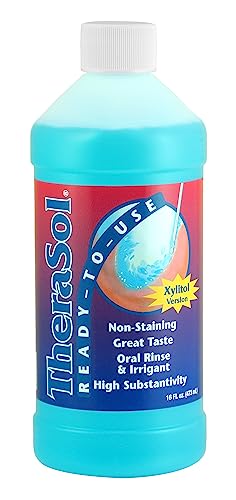
4. TheraSol with Xylitol, 16 oz.
A xylitol rinse that goes easy on inflamed gums and tastes like something you’d actually finish.
Some rinses are so aggressive you dread them, and dread is how routines die. TheraSol takes the other road. It is a 16 oz. oral rinse built on xylitol (a sweetener that does not feed plaque the way sugar does). OraTec has kept it in production for years on the strength of a simple idea: a pleasant rinse gets used daily, and a daily rinse is what makes a difference.
Customers note improved teeth and gums, with one describing results within a couple of days. The taste is the second thing everyone mentions, and it is positive: not harsh, not medicinal, not the kind of thing you spit out early. It also does not stain, which matters if you have bonding or a white filling you want to keep looking uniform.
This is also the mildest option on the list. It does not sting, which makes it a reasonable fit for a mouth recovering from a deep cleaning or a periodontal procedure. The one caveat worth knowing: if you are in the middle of an active gum flare-up, this may be too gentle to be the first line of defense, and some buyers find the price hard to swallow. It is less about stopping tartar cold and more about keeping a daily habit alive without flinching.
The real niche: a rinse for mouths that cannot take a strong formula — irritated gums, a fresh deep-clean, or just a low tolerance for burn.
Trade-off to weigh: the gentleness is the point and the limitation. If you have hardened tartar to fight, pair this with a stronger rinse rather than asking this one to carry the whole job.
Pick this if: your mouth is tender and a milder, pleasant-tasting rinse is what will actually get used every day.
Think twice if: you are chasing serious tartar reduction and want the most aggressive formula available.
5. Periogen Oral Rinse Mint (1-Pack)
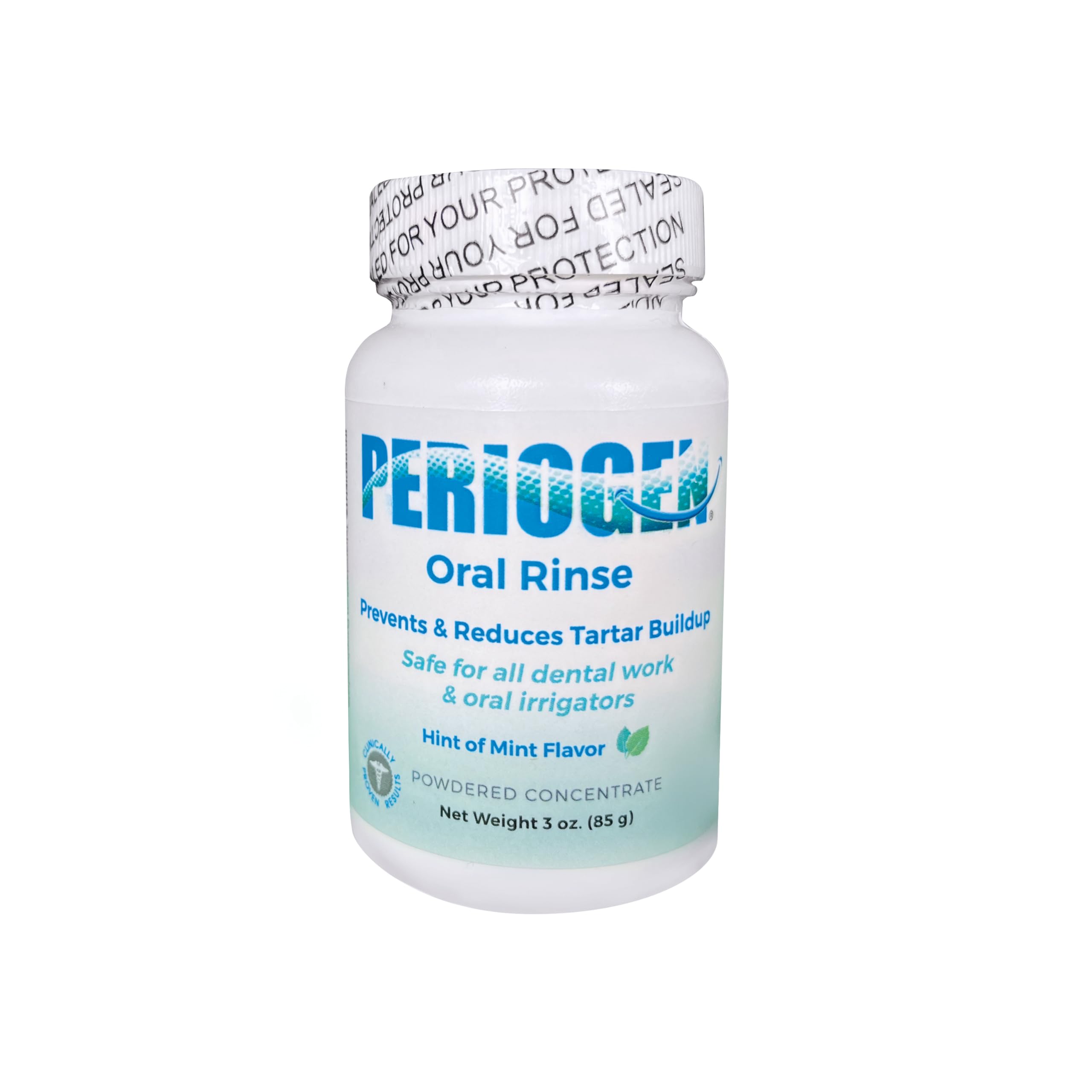
A three-ounce jar of powder that turns into three gallons of tartar-focused rinse.
Periogen is the oddball of this list, and that is exactly why it belongs. It is a powdered concentrate — a 3-ounce bottle that you mix with water to make 3 gallons of rinse. If you are specifically targeting tartar and plaque rather than general freshness, this is the formula designed for that job. The maker’s patented formula is aimed at keeping tartar from building up, and the manufacturer states users typically see 40% or greater improvement in oral health scores.
The math on the concentrate is where it earns its keep. Three ounces becoming three gallons means you mix a fresh cup whenever you need it, the way you would measure out a cleaning solution. The small jar takes up barely any shelf space compared with a liter jug. It is the lightest thing on this list to store and the easiest to keep in a drawer. The manufacturer also notes it works best alongside Periogen’s toothpaste.
The warning label here is thinner than you would guess for something this potent. Some users report it is genuinely hard on sensitive gums, so it is not a first-choice starter rinse for someone whose gums already bleed easily. Flavor gets mixed marks too — some find the mint crisp, others find it strange. But the effectiveness is the part everyone keeps talking about: buyer outcomes range from teeth simply feeling cleaner after each use to one user whose pocket depth dropped from 8 to 5 over eight weeks while pairing it with a waterpik and brushing. That is the ceiling of what a rinse can contribute. The proof is in what it does over months, not in the first sip.
Where it shines
- Purpose-built tartar reduction — the specific job this list is about
- Powdered concentrate makes 3 gallons per 3-ounce jar, so cost per use stays low
- Lightest item here to store — takes almost no shelf or drawer space
- Long-term users report clean-feeling teeth and improved gum scores
The honest catch
- Can feel harsh on already-sensitive gums — work up slowly if that is you
- Mixing a fresh batch takes a moment of discipline each time
- Taste divides opinion; the mint is not for everyone
The right pick if: tartar buildup is the exact problem you are trying to slow down and you do not mind mixing your own rinse.
Not the one for: anyone whose gums are already raw and sore — start with a gentler formula and graduate here.
Know the Specs
Active Ingredient: CPC vs. Stannous Fluoride vs. Zinc
These are the three germ-and-plaque fighters you will see on tartar-control labels, and they do different jobs. CPC (cetylpyridinium chloride) is an antibacterial aimed at the germs tied to plaque and gum inflammation. Stannous fluoride adds fluoride protection against cavities plus help for sensitive teeth. Zinc, especially in a dual-chamber formula, neutralizes the sulfur gas behind bad breath. Read the label to see which job you are buying for.
Ready-to-Pour vs. Concentrated
A ready-to-pour rinse is exactly that — open the cap and swish. A concentrated rinse ships as a small bottle of gel or powder you measure into water yourself. Concentrated formulas give you more rinses per bottle and take up far less shelf space, but they ask for a measuring cup and a little patience each time. Match the format to how much effort you will genuinely put in twice a day.
Alcohol-Free and Its Aftermath
Alcohol-free rinses skip the sting that makes people abandon the habit after a week. The trade-off is that some formulas leave a brief dry-mouth feeling during the swish that fades within seconds. For anyone with gums that are already sore or bleeding, dropping alcohol is usually the difference between sticking with it and quitting.
Routine Timing and the Thirty-Minute Rule
Order matters more than people expect. Swish after brushing, then wait roughly 30 minutes before you eat or drink. Rinsing right after certain toothpastes can wash away the fluoride you just applied. Set a simple order: brush, rinse, wait, then let your mouth be for a bit. Consistency across weeks is what shifts plaque and gum scores, not any single swish.
Common Questions
Can a mouthwash actually remove tartar that has already formed?
Which ingredient is better for tartar — CPC or stannous fluoride?
How long should I swish a tartar-fighting mouthwash?
Is an alcohol-free rinse weaker at fighting plaque than an alcohol one?
How long does one bottle of each rinse actually last?
Can I use a tartar-control rinse with my regular toothpaste without issues?
Why does the Periogen concentrate feel harsh on sensitive gums?
Is a rinse enough on its own, or do I still need to floss?
What should I do if my bottle’s dispenser leaks or the pump won’t seat?
How long does it take to notice a difference from a tartar-fighting rinse?
The Bottom Line
The best mouthwash to remove tartar for most people is the TheraBreath Healthy Gums Oral Rinse, because a full liter of gentle CPC formula at a value tier price is the easiest rinsing habit to keep, and it holds a 4.8-star rating. If all-day breath control matters more than volume, the SmartMouth Clinical Zinc Activated Mouthwash is your pick. And if you are specifically fighting tartar buildup, the concentrated Periogen Oral Rinse is the one built for that exact job. Whichever you choose, consistency across weeks is what actually moves the needle on plaque.
How we choose
We do not accept paid placement. Every pick is matched to a real buyer and a real use-case; we do not hands-on test units.
Sources
Specifications: manufacturer listings and product documentation. Review insights: verified customer reviews, as of October 2026. Pricing: not shown on this page (it changes often); check the current price via the retailer link.
As an Amazon Associate, Aappliancez earns from qualifying purchases. This does not affect which products we feature.