Disclosure: Some links in this post are affiliate links. As an Amazon Associate I earn from qualifying purchases, at no extra cost to you. Learn more
Specs are compiled from manufacturer listings and verified buyer reviews and can change over time — please confirm the key details on the product page before buying.
If you get that unmistakable tingle on your lip and want something you can actually swallow, you are in the right place. The real question is which lysine format you can take consistently, at the right dose, without dreading the pill. This guide compares five lysine options — 1,000 mg tablets, 500 mg free-form capsules, a four-capsule immune blend and a 1 KG powder — so you can match the format to your routine.
This guide is built by comparing the manufacturers’ published specifications and the patterns across verified customer reviews, so you get each pick’s real strengths and trade-offs instead of marketing spin.
Lysine works best taken early and often, which is why pill size and format decide whether you actually stick with it. Below are the honest trade-offs on each option, plus a breakdown of lysine for cold sores.
Top Picks
How To Choose The Best Lysine for Cold Sores
Every bottle on this list contains L-lysine, an essential amino acid — meaning your body cannot make it and you have to get it from food or a supplement. The differences that matter are in the dose, the format and the pill size, not the ingredient. They come down to dose per serving, whether the lysine is free form or pressed into a tablet, and whether you can actually swallow the thing twice a day.
How much lysine is in one serving
This is the number that decides everything else. A 500 mg capsule and a 1,000 mg tablet are not interchangeable when you are trying to hit a higher intake during an outbreak window. Higher-dose products often mean fewer pills per day, which is the whole reason people switch formats.
Free form versus tablet
Free form lysine is the unpackaged version of the amino acid, and the marketing claim is better absorption. In practice, what buyers notice most is simpler: free-form capsules tend to be smaller and easier to swallow than a pressed tablet carrying the same dose. That size gap is why so many people switch from 1,000 mg tablets to free-form capsules.
Why the pill size keeps coming up
The pattern across this category is simple: the bigger the dose per pill, the bigger the pill. The bigger the dose per pill, the bigger the pill. A 1,000 mg tablet is physically large, and no amount of coating changes that. If you have ever gagged on a supplement, dose density is the spec you need to check before anything else.
Added ingredients and what they do
Some formulas pair lysine with vitamin C, quercetin and zinc rather than selling straight lysine. That is a real difference in what you are taking, not just marketing — and it usually changes the serving size, because a multi-ingredient formula often spreads a dose across several capsules.
Side-by-Side Comparison
| Model | Best For | Lysine Per Serving | Format | Count | Amazon |
|---|---|---|---|---|---|
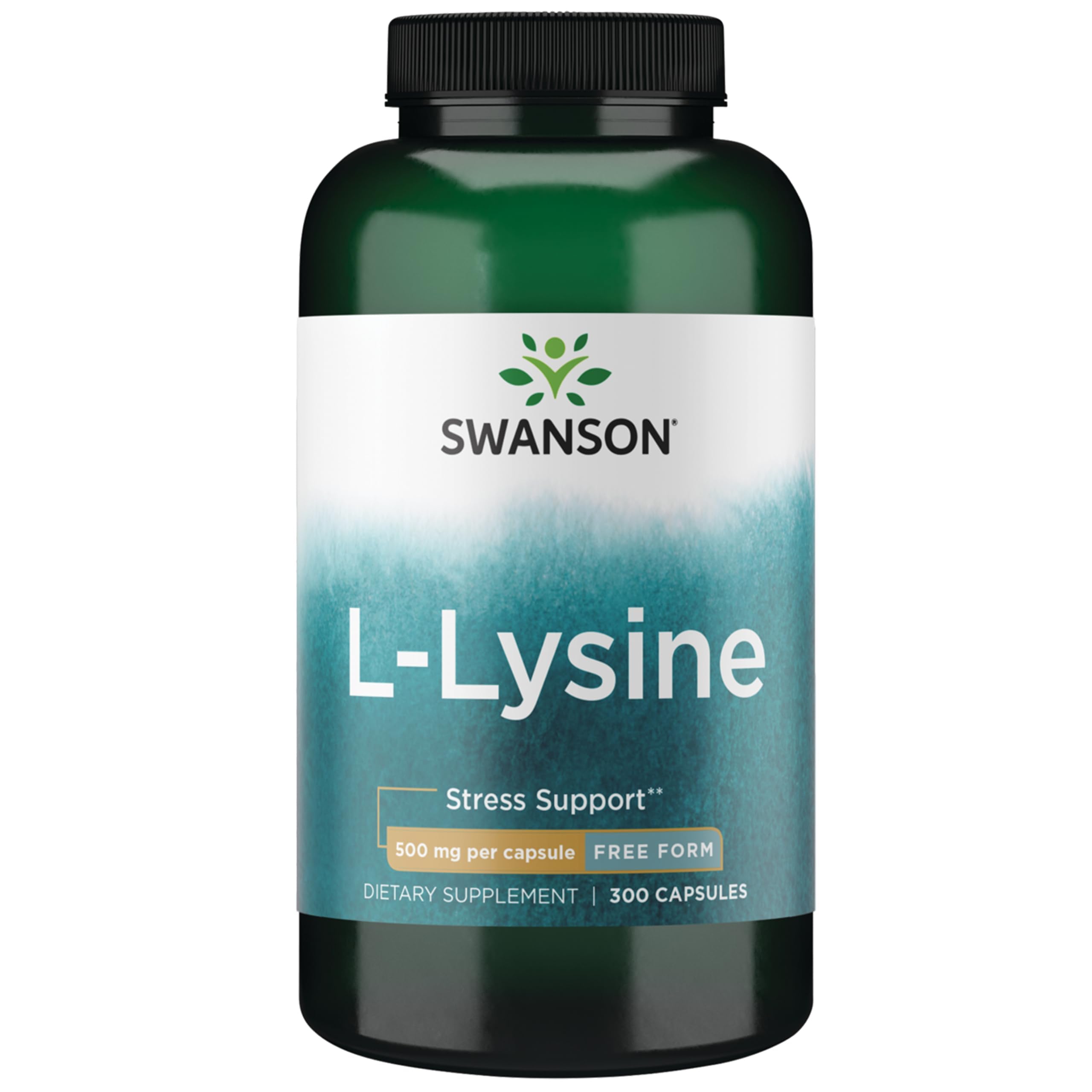
| Swanson L-Lysine Amino Acid, 500 mg Free Form★ Best Overall | Daily prevention routine | 500 mg | Free form capsule | 300 capsules | Amazon |
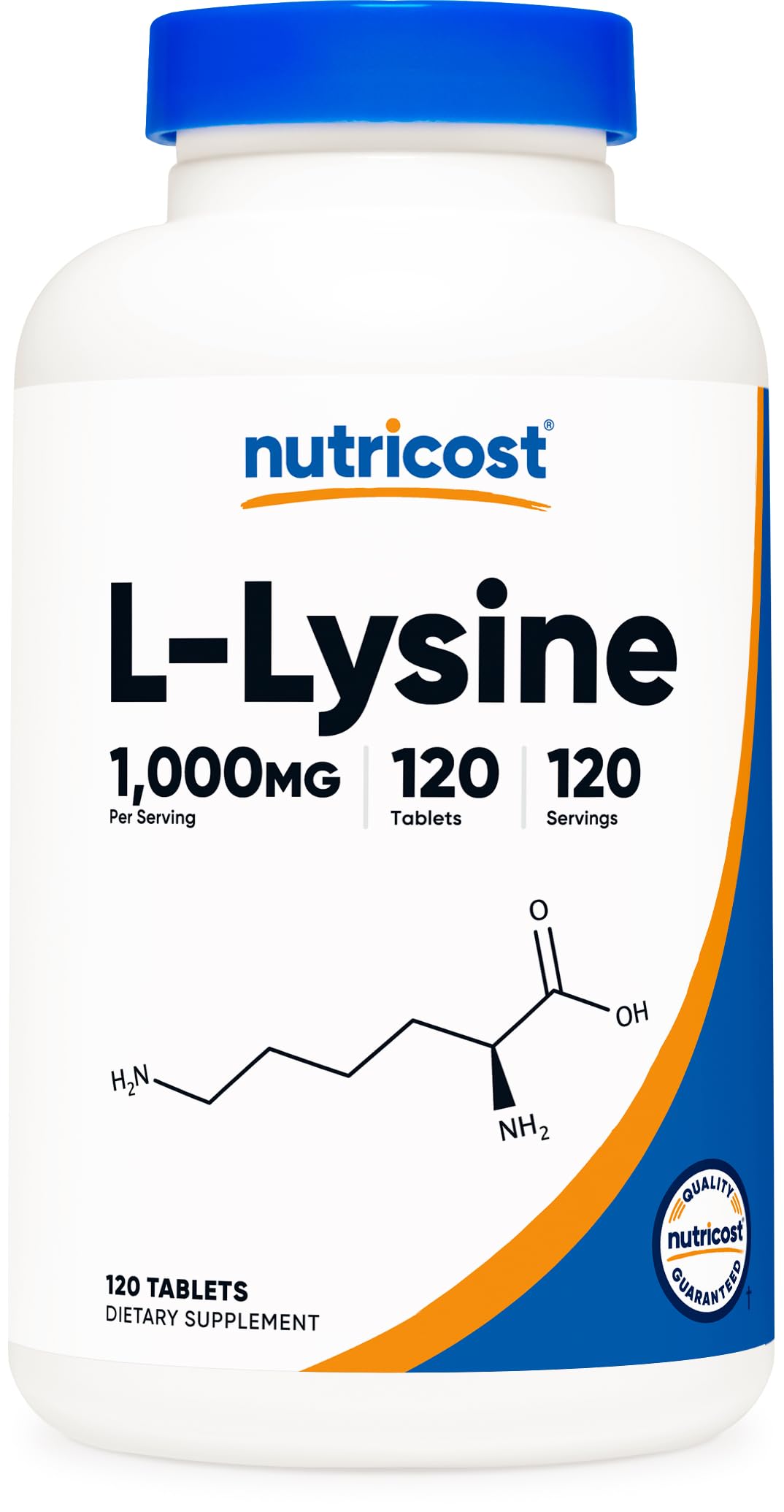
| Nutricost L-Lysine 1000mg TabletsHighest Dose | Highest dose per tablet | 1,000 mg | Tablet | 120 tablets | Amazon |
| NatureBell L-Lysine 1,000mg with Quercetin, Vitamin C and Zinc | All-in-one immune formula | 1,000 mg | Capsule complex | 240 capsules | Amazon |
| Nutricost L-Lysine Powder 1KG | Bulk, flexible dosing | 1 gram | Powder | 1 KG (1,000 servings) | Amazon |
| Solgar L-Lysine 500 mg Vegetable Capsules | Small capsules, vegan-friendly | 500 mg | Vegetable capsule | 250 capsules | Amazon |
Detailed Reviews
1. Swanson L-Lysine Amino Acid, 500 mg Free Form, 300 Capsules
Our pick — over 4.5★ from 900+ verified ratings; the strongest balance of quality and price.
Half-gram capsules in a 300-count bottle — the format long-term lysine users keep coming back to.
Start with who this suits. If your plan is a steady daily dose rather than a single heroic scoop, 500 mg free-form capsules give you the most control over how much you take and when. Free form here means the lysine is not pressed into a dense tablet, and the practical payoff shows up at the sink: this is a small, easy capsule rather than something you have to brace yourself for. That matters most on the days you are doubling up.
The scale difference is worth stating plainly. This bottle weighs 1.76 ounces, while the Nutricost 1000mg tablet bottle runs 8.47 ounces — nearly five times the heft for the same job category. Capsules are lighter because the lysine is not compressed with tablet binders. The bottle itself measures 1.97 x 1.97 x 4.72 inches, so it stores easily in a medicine cabinet or a travel pouch.
Buyers single out the formulation quality more than any other trait, ahead of the skin and lip benefits and the overall effectiveness they describe. The review pages read like a long-term user base: repeated repurchases, mentions of capsules that go down without a fight, and a steady drumbeat of people who describe it as the one thing that has kept their routine intact. The recurring gripe is not about the formula at all — it is the fact that some buyers find the capsules large, which is a fit question, not a quality one.
Where it pulls ahead of the tablets
- 500 mg free-form capsules let you fine-tune your daily dose instead of committing to a full gram each time
- 300 capsules per bottle means fewer reorders and less chance of running out mid-outbreak
- Light and compact at 1.76 ounces — easy to keep in a bag or a drawer
The honest catch
- Some buyers find the capsules on the large side and wish they were smaller
- At 500 mg each, a higher daily target means more capsules per day than a 1,000 mg product
Made for the routine keeper: pick this if you want a steady daily preventive dose you can adjust capsule by capsule, and you would rather take two small pills than one enormous one.
Look elsewhere if: you have trouble with capsules of any size and need the smallest possible format — the Solgar vegetable capsules below run even smaller.
2. Nutricost L-Lysine (1000mg) 120 Tablets, Gluten Free
A full gram of lysine in a single tablet — maximum dose, maximum size, zero ambiguity.
If your instinct at the first tingle is to load up fast, one tablet per serving removes the counting. That is the entire pitch: 1,000 mg of lysine in each tablet, 120 servings in the bottle, no powder and no scoop. The label also notes it is non-GMO, gluten free and vegetarian friendly, made in a GMP compliant, FDA registered facility — GMP meaning the plant follows a documented manufacturing standard.
Here is the trade-off you have to accept. Twice the lysine per pill means a physically enormous tablet, and this is the one product in the group where buyers consistently describe them as hard to swallow. Picture a tablet you would genuinely notice going down. If you already struggle with big pills, this is the wrong format for you no matter how good the value is.
Against the Swanson capsules above, this is the opposite philosophy: half the pill count, twice the commitment per swallow. What people value most is that the dose works and the bottle goes the distance — the effectiveness is the trait that stands out, and there is real appreciation for the simple ingredient list and the lack of aftertaste. The large-tablet complaint is the most-discussed topic by a wide margin, and it is worth hearing honestly: plenty of buyers describe them as the biggest tablets they have ever taken, yet still report they go down fine with water.
What you gain: a single tablet handles the whole gram, so a two-per-day routine is genuinely two pills — the least pill-handling of any swallowable option here.
What it costs you: tablet size is the honest stumbling block, and a 4.4-star overall picture with pill size as the loudest theme tells you it is not a rare gripe.
Go for it when: you want the highest dose per pill and have no trouble with big tablets, or you are buying for someone who prefers one-and-done dosing.
Think twice if: you have ever had to cut a supplement in half to get it down — the powder below sidesteps pill size entirely.
3. NatureBell L-Lysine Capsules
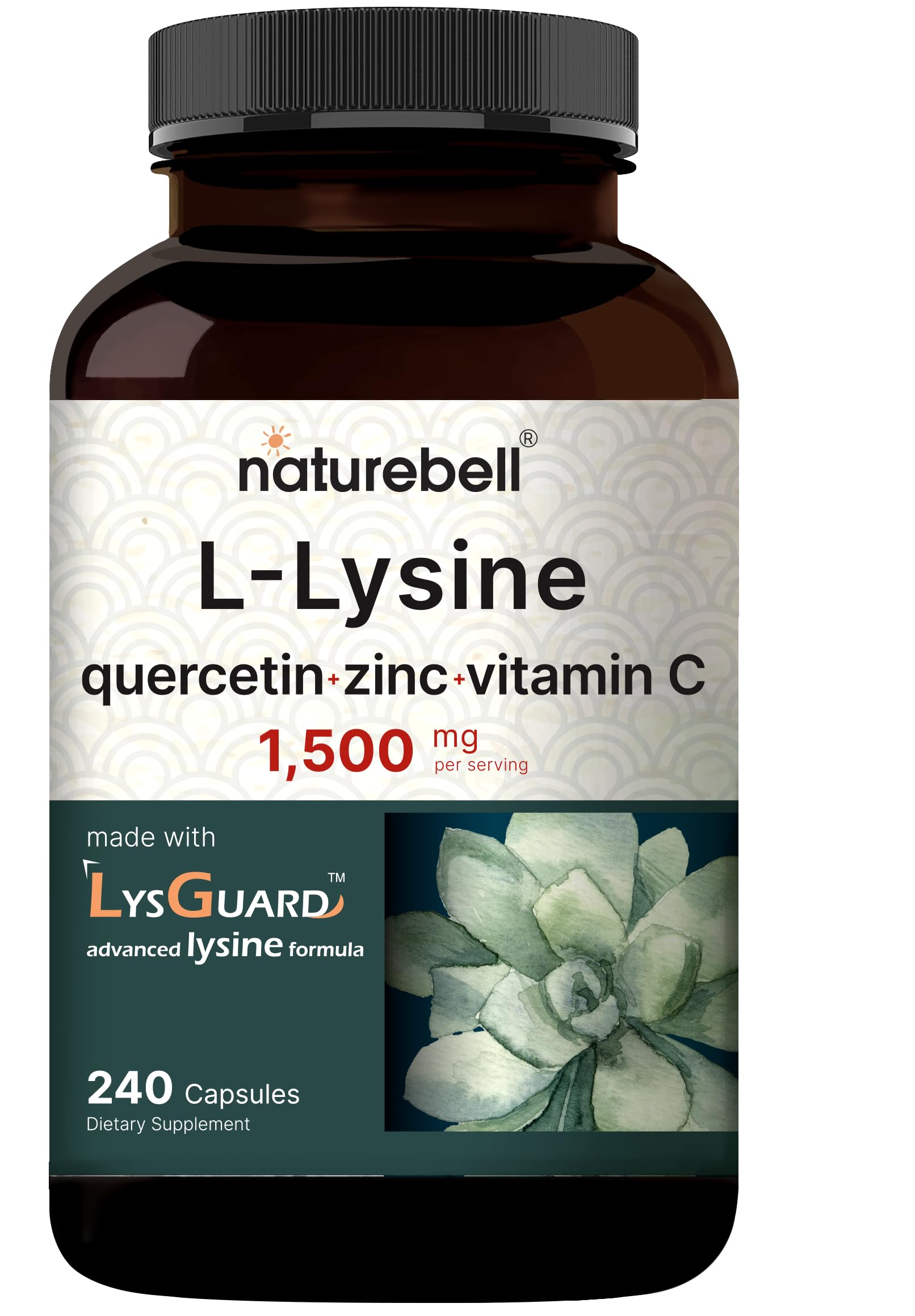
Four ingredients in one capsule blend, so you stop buying lysine, vitamin C and zinc separately.
This is the pick for anyone who was already stacking three bottles. One formula covers 1,000 mg of free-form lysine hydrochloride alongside 250 mg of quercetin dihydrate, 200 mg of vitamin C and 50 mg of zinc picolinate — quercetin being a plant compound and zinc picolinate being a form of the mineral zinc. That is a genuine consolidation, and it also means you are not guessing at ratios.
Dose density is where it separates from the tablets above. You get the same 1,000 mg of lysine as the Nutricost tablet, but delivered in capsules that buyers describe as normal-sized and easy to take, with no chalky taste to fight through. The bottle runs 5.12 x 2.91 x 2.83 inches, which makes it noticeably wider and flatter than the tall Swanson and Solgar bottles — easier to lay down in a drawer, harder to lose behind things.
What people respond to is effectiveness, followed closely by the value of replacing multiple supplements with one. The recurring honest note is the serving size: a full serving is four capsules, so a bottle that looks enormous on arrival is doing more work per swallow than the raw count suggests. Some also catch a slight vitamin taste from the C and zinc, though nothing lingers. The label carries the standard disclaimer that these statements have not been evaluated by the Food and Drug Administration.
Why the stackers choose it
- 1,000 mg lysine plus 250 mg quercetin, 200 mg vitamin C and 50 mg zinc in one place
- Capsules rather than tablets, so the gram dose arrives in a far friendlier shape
- 240 capsules at four per serving — roughly a two-month supply
Before you commit
- A serving is four capsules, so daily pill count climbs fast if you increase your intake
- Non-GMO and free of gluten, wheat, soy, dairy and tree nuts, but the added vitamin C and zinc bring a faint taste
Built for the multi-bottle buyer: if you already take lysine with vitamin C and zinc, this replaces that lineup with one capful of capsules and no guesswork on quantities.
Not the fit if: you want plain lysine and nothing else — the Swanson or Solgar straight-lysine bottles keep the formula simple.
4. Nutricost L-Lysine Powder 1KG
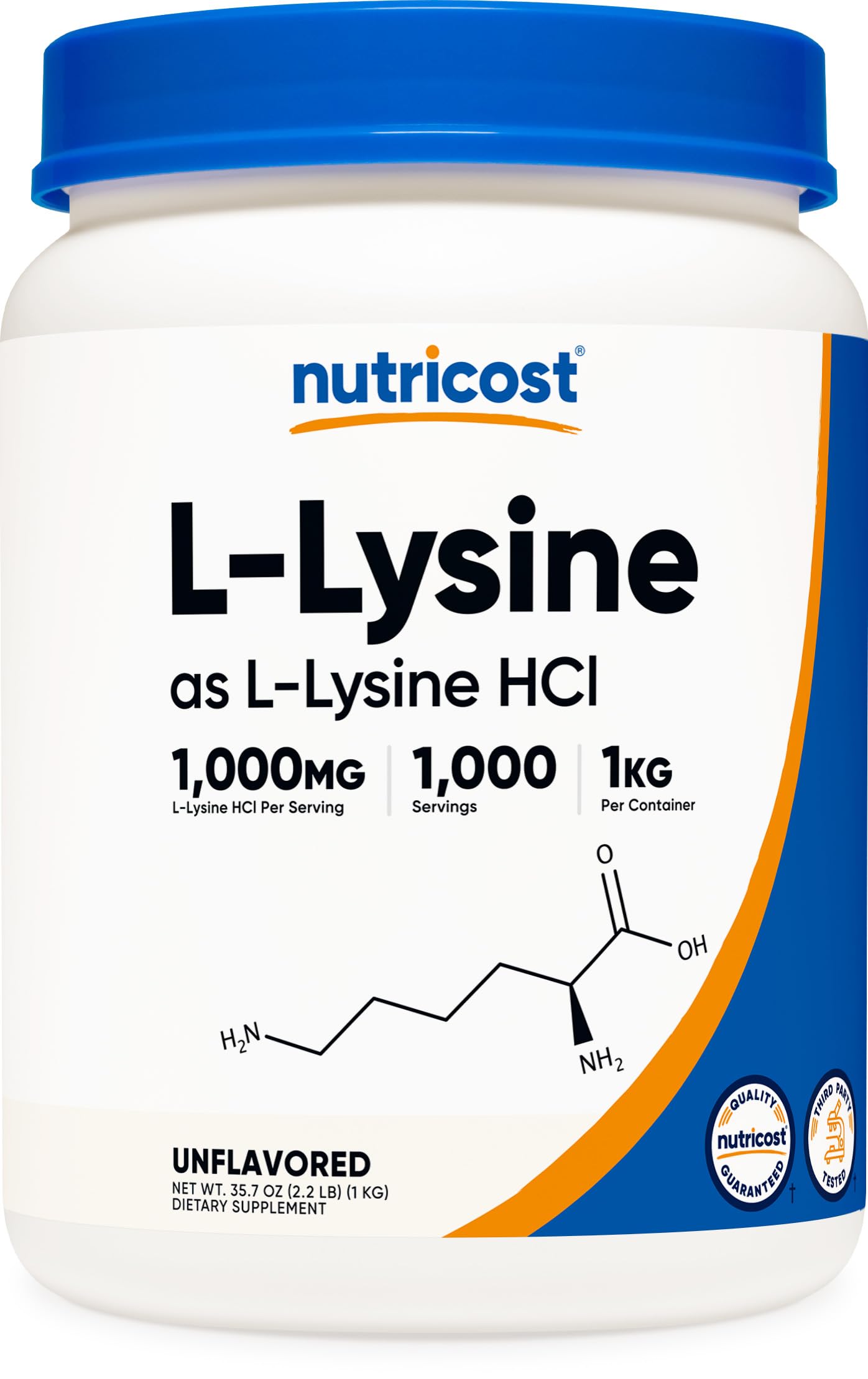
A kilogram of loose lysine and a scoop — the option that laughs at pill size entirely.
No capsule, no tablet, no swallowing problem. A scoop delivers 1 gram of lysine powder, and the container holds 1,000 servings, which is the kind of quantity that turns lysine from a purchase into a supply. It is non-GMO, gluten free and third-party tested, made in a GMP compliant, FDA registered facility.
Flexibility is the real argument. You are not locked to 500 mg or 1,000 mg increments — you measure what you want, in water, coffee or juice, and adjust as needed. Travelers tend to like it for exactly that reason: a few scoops into a smaller container and the whole routine goes in a carry-on. Buyers describe it dissolving quickly in both hot and cold liquid, with nothing detectable in water or coffee once it is stirred in.
The one thing to know before ordering is the taste test. Dry powder on a fingertip reads a little salty, and that is the honest knock — mixed properly into a drink, it disappears. There is also the practical reality of a kilogram: this is a large container that will sit on your shelf for a long while, with an expiration date the reviews describe as roughly two years out. It suits households, multi-person routines, and anyone who wants to stop reordering, and it is the format several buyers reached for specifically to get through winter.
The dose-freedom angle: a scoop is a measuring tool, not a fixed dose — you scale up or down without buying a different bottle, which no tablet or capsule here can match.
The trade you are making: powder means measuring and mixing every single time, and dry it tastes faintly salty, so this rewards people who will actually stir it into a drink.
Reach for this if: pills are the obstacle, you want total control over how much you take, or you are supplying more than one person from a single container.
Pass on it if: you want to grab a dose on the way out the door with no scoop and no glass of water involved.
5. Solgar L-Lysine 500 mg

Half-gram vegetable capsules built for people who want lysine small, clean and plant-based.
Same 500 mg dose as the Swanson capsules, but a different audience. These are vegetable capsules rather than gelatin, so they suit vegans and vegetarians, and the formula is free of gluten, wheat, dairy, soy, yeast, sugar, sodium, artificial flavor, sweetener and color. The free-form lysine is there for absorption, which is the whole reason this format exists rather than a compressed tablet.
Where it earns its place is the swallowing experience. Across the reviews, the same point keeps surfacing from very different households: capsules are easier than large tablets or powder, including for a child being given lysine before school. That is the practical case for 500 mg capsules — you take more of them, but each one is a non-event. If your barrier has always been the act of taking the supplement, that distinction decides it.
Effectiveness is what carries this one, with the immune-support angle close behind it, and buyers describe noticing a difference quickly and using it both to head off outbreaks and to shorten the ones that break through. Some pair it with a topical lysine ointment for a belt-and-braces approach. The honest caveats are minor: a few mention digestibility and a couple query the ingredient list, and one review held back a star pending a longer trial — reasonable caution rather than a red flag.
Why it stands out: a 500 mg free-form capsule that is easy on the throat, plant-based, and stripped of the additives most capsule formulas carry.
Worth knowing: the long ingredient-free list is a real plus, but a couple of buyers still question the formulation, and 500 mg means more capsules per day at a higher target.
The match for you: vegan or vegetarian, sensitive to swallowing pills, or buying for a child who needs a capsule small enough to get down without a negotiation.
Consider the 1,000 mg options instead if: your priority is fewer pills per day rather than the smallest possible one.
Know the Specs
Dosage Per Serving
This is the milligrams of lysine in one dose, and it is the number that shapes everything else. A 500 mg product means you take two to reach a gram; a 1,000 mg product gets you there in one. Powder is measured by the gram with the included scoop, so a serving is a scoopful rather than a fixed pill. Match the number to how many times a day you are willing to take it.
Free Form Versus Tablet
Free form means the lysine is not bound into a pressed tablet — it is the loose amino acid, usually delivered in a capsule. Tablets are compressed with binders to hold their shape, which is why a 1,000 mg tablet is physically much larger than a 1,000 mg capsule. If swallowing is your sticking point, the word to look for on the label is free form.
Serving Size and Capsule Count
Do not confuse capsules per bottle with servings per bottle. A 240-capsule formula taken four capsules at a time is a two-month supply, not a 240-day one. Always check how many capsules make a serving before you compare bottles, or a large count can look like more than it is.
Added Ingredients
Some formulas are pure lysine; others blend in vitamin C, quercetin and zinc. Quercetin is a plant-based compound and the zinc here comes as zinc picolinate, a specific form of the mineral. A blend saves you juggling separate bottles but usually stretches the serving across several capsules, so it is a convenience trade rather than a free upgrade.
Common Questions
Should I take 500 mg or 1,000 mg of lysine when I feel a cold sore coming on?
Does lysine actually help with cold sores?
What is the difference between free form lysine and lysine tablets?
How do I take lysine powder instead of pills?
Can I take lysine capsules with vitamin C and zinc at the same time?
Why is a 1,000 mg lysine tablet so much bigger than a 1,000 mg capsule?
How long will one bottle of lysine last?
Is there a difference between lysine for cold sores and lysine for skin and collagen?
Are lysine capsules suitable for vegans and vegetarians?
Will the 1 KG lysine powder expire before I finish it?
The Bottom Line
For most people, the lysine for cold sores winner is the Swanson L-Lysine 500 mg Free Form Capsules, because 500 mg free-form capsules let you control your intake capsule by capsule without wrestling with an oversized pill. If your barrier has always been the swallowing itself, the Solgar L-Lysine Vegetable Capsules are the smallest, simplest route and they suit vegan and vegetarian routines. And if you want the loosest possible control over dose, the Nutricost L-Lysine Powder turns a scoop into a serving and skips pills altogether. The one nudge worth making: the Swanson bottle is the crowd favorite for a reason — a long-standing free-form formula that keeps its users coming back — so if you are undecided between formats, that is the safest place to start.
How we choose
We do not accept paid placement. Every pick is matched to a real buyer and a real use-case; we do not hands-on test units.
Sources
Specifications: manufacturer listings and product documentation. Review insights: verified customer reviews, as of October 2026. Pricing: not shown on this page (it changes often); check the current price via the retailer link.
As an Amazon Associate, Aappliancez earns from qualifying purchases. This does not affect which products we feature.