Disclosure: Some links in this post are affiliate links. As an Amazon Associate I earn from qualifying purchases, at no extra cost to you. Learn more
Specs are compiled from manufacturer listings and verified buyer reviews and can change over time — please confirm the key details on the product page before buying.
If your fingers feel cramped on a standard neck, the fix isn’t more practice — it’s a guitar built with more room for your hand. That means a wider nut, a chunkier neck profile, and string spacing that lets your fingertips land cleanly on one string at a time instead of muting the neighbors. Every pick below was chosen because its published specs point to a roomier, more forgiving feel, and because the people who actually bought them keep saying the same thing.
This guide is built by comparing the manufacturers’ published specifications and the patterns across verified customer reviews, so you get each pick’s real strengths and trade-offs instead of marketing spin.
A wider nut and fuller neck profile give your fingertips room to land on one string at a time instead of muting the neighbors. These picks cover electrics and acoustics across every budget tier, so you can find the one whose neck finally matches your hand.
Top Picks


How To Choose The Best Guitar for Fat Fingers
Nut width, neck profile, and fret spacing decide whether your fingers land cleanly or crowd each other. Everything else — the finish, the pickups, the shape of the body — matters far less than how much room the fretboard gives your fingers. Before you compare models, understand these five things.
Nut width: the first number to check
The nut is the slotted strip at the top of the neck that holds the strings in place. Its width decides how far apart the strings sit at the headstock end. A wider nut (measured in millimeters or inches) gives each string more breathing room, so your fingertip can press one string without brushing the one above it. If standard necks feel cramped, this single measurement is the one to look at first.
Neck profile and thickness
Neck profile is the shape of the back of the neck in cross-section — how deep and rounded it feels in your palm. A slimmer “C” profile suits smaller hands, while a fuller, deeper carve gives larger hands a surface to grip without your palm wrapping awkwardly. The right profile for you depends on whether you fret with your fingertips or the pads of your fingers.
Fretboard radius
Fretboard radius measures how curved the fretboard surface is, usually quoted in inches. A flatter radius feels more even under the fingers for barred chords, while a more curved one suits wrapping your thumb over the top of the neck. For crowded fingers, a flatter radius tends to help barre chords ring out cleanly.
Action and fretwork
Action is how high the strings sit above the frets. High action means you press harder, which is exactly the wrong thing for fingers that already feel tight between strings. Cleanly finished fret ends — the metal edges along the sides of the fretboard — also stop your hand from snagging as you move up and down the neck.
Scale length
Scale length is the distance from the nut to the bridge, and it sets how far apart the frets sit. A shorter scale brings the frets closer together, which can cramp wide fingers on the higher notes, while a longer scale spreads them out. Match the scale to your reach before anything else.
Side-by-Side Comparison
| Model | Best For | Body Size (in) | Neck Material | No. of Strings | Amazon |
|---|---|---|---|---|---|
| Yamaha Pacifica PAC012DLX★ Best Overall | Best overall fit for larger hands | 43 x 18 x 5 | Maple bolt-on | 6 | Amazon |
| WestCreek 333 Semi HollowBest for Jazz | Slim C neck for jazz and blues | — | Maple | 6 | Amazon |
| Fender FA-25 DreadnoughtBudget Champion | Budget first acoustic | 40.5 x 15.75 x 4.75 | Basswood | 6 | Amazon |
| Donner Acoustic Electric Kit | Full starter bundle with amp | 41 x 15.75 x 3.15 | Spruce top, mahogany body | 6 | Amazon |
| Grote LPYS-006 | Stainless steel frets on a budget | 40.16 x 13.09 x 1.4 | Maple | 6 | Amazon |
| Fender CD-60S | All-mahogany warm acoustic | 44 x 17 x 7.4 | Mahogany | 6 | Amazon |
| Bullfighter D190 | Stage-ready locking tremolo | 38.58 x 12.6 x 2.87 | Alder body | 6 | Amazon |
| Ibanez Artwood Dreadnought | Solid-top acoustic value | 44.49 x 20.67 x 5.71 | Mahogany neck | 6 | Amazon |
| Yamaha FG800J | Beginner solid-top acoustic | 40.51 x 16.22 x 4.65 | Nato and mahogany | 6 | Amazon |
Detailed Reviews
1. Yamaha Pacifica PAC012DLX Electric Guitar
Our pick — over 4.5★ from 500+ verified ratings; the strongest balance of quality and price.
The full-size electric that gives big hands a full-size neck — no toy proportions here.
Your fingers get room to move because this is a full-size instrument. Its body measures 43 x 18 x 5 inches — the largest footprint in this guide — so the neck is scaled for adult hands rather than shrunk down for a child. The neck itself is a maple bolt-on piece with a sonokeling fingerboard (a dense hardwood similar to rosewood), and a smooth, rounded edge that lets your hand slide up the fretboard without snagging.
On tone, the combination pickup configuration and 5-position switch give you a wide spread of sounds from a single guitar — bright single-coil snap in one position, warmer humbucker growl in another. A vintage tremolo bridge (the pivoting plate that lets you bend notes by moving the arm) adds a little expressiveness without forcing you into a complicated setup. For a first serious electric, that range means you’re not outgrowing it in six months.
The players who own this guitar, including people with dozens of instruments behind them, consistently describe near-perfect tuning straight from the start and fretwork that feels hand-finished rather than machine-stamped. What buyers report about this one is worth repeating: “Experienced owner of 20+ guitars rates Yamaha Pacifica top-five: excellent fit/finish, near-perfect tuning out of box, great tone/playability.” That level of consistency on a budget-tier electric is rare.
The case for this neck
- Full-size 43-inch body with room for adult fingers
- Polished fretwork and detailed fret ends that don’t catch your hand
- Stays in tune even with moderate tremolo use
- A maple bolt-on neck with a warm rosewood-toned sonokeling fingerboard
Where it gets picky
- The stamped bridge hardware looks basic up close
- The standard tuners are fine, though the most demanding players swap them for more stability
Best fit for: Players with larger hands who want a full-size electric with a neck that doesn’t cramp them.
One to note: The bridge looks stamped and plain compared to the rest of the build, but it holds tuning fine — this is a cosmetic trade-off, not a playability one.
2. WestCreek 333 Semi Hollow Body Jazz Electric Guitar
A semi-hollow with a slim C neck and bone nut that translates every note.
Your fingers reach each string with less strain because this guitar has “a comfortable slim C guitar neck,” and the manufacturer states outright that it “makes your hands comfortable when playing.” A slim C profile means the back of the neck sits shallow in your palm, giving your fingers a shorter reach to each string — a real advantage when your fingers feel thick against the fretboard. A bone nut, denser than the plastic nuts many budget guitars use, transfers string vibration efficiently instead of absorbing it, so notes ring cleanly even when you finger them lightly.
You get jazz on the clean setting and blues or rock when you push the gain, thanks to two alnico-5 humbuckers (powerful twin-coil pickups that cancel hum). That’s a lot of sonic territory from one instrument. The semi-hollow body itself is a hybrid design that sits between an SG and an ES-335 profile, so it feels slightly smaller and thinner than a full-size hollow-body — meaning it hangs comfortably against your body while still giving your fretting hand a workable neck.
The reviews from experienced players are consistent on this: the setup quality punches well above the tier. One owner with decades of experience put it plainly — you could “blindfold would guess -800” by feel. The tuning feedback is mixed, so treat the stock tuning stability as adequate rather than perfect, and plan to give it a fresh set of strings.
What the neck offers: Your fingers stay close to the strings and your tone stays alive even with a light touch, because a slim C profile and a bone nut create a combination that’s rare at this tier. For a semi-hollow, that’s a genuinely thoughtful pairing.
Worth knowing: The tuning holds up, but the owner feedback flags it as mixed — a fresh set of strings and a quick truss rod check will get you the rest of the way.
Reach for this if: You want a semi-hollow jazz machine with a slim neck that keeps your fingers close to the strings.
Look elsewhere if: You need rock-solid tuning from the start — plan to dial this one in first.
3. Fender FA-25 Dreadnought Acoustic Guitar, 2-Color Sunburst
The beginner acoustic that keeps its “C”-shaped neck easy to wrap your hand around.
The spec to notice here is the neck shape. Fender describes an “easy to play ‘C’-shaped neck” paired with a walnut fingerboard and a light all-laminate body. A C profile is the most common rounded neck carve — it gives your palm a gentle curve to grip without a sharp shoulder cutting into your hand. The light all-laminate body (built from layered wood rather than a single solid slab) makes the whole guitar easier to hold, which matters if you’re fighting a full-size dreadnought for the first time.
For a starter instrument, this comes with something genuinely useful: a Fender Play subscription that includes lessons with thousands of instructional videos. If you’re a beginner working through the same four chords until your fingers build calluses, having guided lessons baked in saves you from hunting tutorials. A two-year warranty backs the build, which is generous at this tier.
This is easier to handle than the Yamaha Pacifica electric above it, because at 40.5 x 15.75 x 4.75 inches it has a noticeably smaller frame than the Pacifica’s 43 x 18 x 5 inches — but it’s no less playable. Owner feedback is warm: great sound for the money, reliable tuning, and a finish that looks pricier than the tier suggests. The recurring gripe is a QR-code sticker on the pickguard that leaves adhesive behind — treat it as a small cleanup job, not a flaw.
One-line verdict: The safest entry point into steel-string acoustic playing, with a C neck that’s forgiving for new hands.
Worth a look if: You want lessons built in and don’t mind peeling a sticker off the pickguard on day one.
4. Donner Acoustic Electric Guitar Full Size Kit, 41 Inch

A complete bundle with a slim spruce-top body and a plug-in pickup for practice or stage.
This one solves a different problem: getting everything at once. The kit includes an amplifier, tuner, capo, strings, strap, picks, wrench, and a 10-foot 1/4-inch guitar cable, so there’s nothing extra to buy before you can play. The body itself is a 41-inch cutaway design — cutaway meaning the lower body is scooped so you can reach the higher frets, which helps when your fingers need that extra travel room. A spruce top with a slim body profile delivers a richer, brighter sound with a balanced tone and a full mid-range.
You can plug into an amp and shape your sound across a range of preferences, because the built-in passive pickup gives you volume control from 0 to 100 and tone adjustment from ±10. For a beginner who wants to experiment with amplification without buying pedals or extras, that’s a self-contained setup. The high-precision polishing process gives the all-wood body a glossy finish that shows off the wood grain — the brand notes that color and grain can vary slightly under different lighting, which is worth knowing before you open the box.
The honest trade-off here is sound consistency. Reviews praise the looks and the value, but the sound quality draws mixed feedback — some describe it as nice, others report buzzing when strumming. A setup with fresh, name-brand strings closes much of that gap. If you want a plug-and-play kit to learn on, this delivers; if you want the most refined out-of-box sound, a setup or professional adjustment is money well spent.
Why the bundle works
- 41-inch cutaway body for reaching upper frets
- Passive pickup with 0-100 volume and ±10 tone control
- Includes amp, tuner, capo, straps, picks, and 10-foot cable
Give it a tune-up
- Some owners notice buzzing when strumming — a setup and fresh strings help
- The stock tuners are the weakest link in the kit
Picks itself for: Beginners who want absolutely everything in one order and don’t mind a light setup.
Second thought for: Players who want a finished, buzz-free tone straight from the start — a professional setup is a smart add.
5. Grote Electric Guitar Solid Body LPYS-006 with Gigbag

Stainless steel frets on a solid mahogany body — smooth edges where your hand travels.
Stainless steel frets are the standout here, and for fingers that snag on rough fret ends, that’s precisely the feature that matters. The reduced fret wear and consistently level surface mean your fingers glide without catching. The body is a compact 40.16 x 13.09 x 1.4-inch solid slab, so it’s narrower than a dreadnought — manageable against your chest without feeling like a paddle. The mahogany body and neck combined with a rosewood fingerboard produce a warm, rich sound that suits a wide range of genres.
Your fretting hand isn’t fighting a moving target because the 3.4 kg weight stabilizes the instrument against your body — that’s standard for a solid-body LP style. A humbucker pickup and 3-way switch give you a range of tonal options. One thing buyers flag as both a quirk and a plus: the maple top is a printed veneer, not real figured wood — it looks the part and keeps the cost down, and one owner mentioned that “no upgrades needed” after just tuning and conditioning the fretboard.
Where this guitar separates from cheaper entry instruments is out-of-box setup. Owners describe fret ends that are smoother than an Epiphone and intonation that plays cleanly right out of the case. The tuning retention reads as mixed, with some reporting it holds well and others wanting a bit more stability — but the frets themselves, and their effect on your fingers, are consistently praised across the board.
Standout detail: Stainless steel frets are the reason your fingers move freely here. The smooth, level surface means less friction and less fret wear over years of playing. For anyone whose fingers catch on rough edges, that alone justifies the pick.
What to watch: Tuning retention is described as adequate by most owners, but not remarkable — a fresh set of quality strings and a proper wind on the tuning pegs will keep it stable.
Suits you when: You want stainless steel frets and a solid, warm sound without paying a premium tier price.
Skip if: You need pinpoint tuning stability with zero tweaking — set aside a few minutes to dial it in.
6. Fender CD-60S Dreadnought Acoustic Guitar, All-Mahogany

A full-size all-mahogany acoustic whose wide dreadnought body suits bigger hands.
Your hands get the room they need because the full-size dimension here is a feature, not a knock. At 44 x 17 x 7.4 inches, this sits among the largest instruments in this guide — meaning the neck and body are both scaled up. A mahogany top, sides, and back with scalloped “X” bracing (a structural pattern that supports the soundboard while letting it vibrate freely) delivers a rich, lively tone with plenty of volume. The gloss finish gives it a deep, dark, almost vintage look.
What owners appreciate most is the consistency. The finish is described as flawless, the factory setup as near-perfect with spot-on intonation, and the frets as cleanly finished. The warm, full tone with a deep low end gives you a sound that makes this instrument feel like it plays at a higher tier than its price. It’s equally comfortable for a beginner learning their first chords or an experienced player who wants a reliable dreadnought.
The one honest caveat: this is a big guitar, and it plays quiet for its size. One owner noted it’s “too quiet for jamming with banjo, mandolin, Martin, and BlueRidge” instruments, though it works beautifully as a solo practice and songwriting instrument. If you’re pairing it with loud acoustic bandmates, an acoustic amp or pickup would round it out. For anything solo, it’s a warm, dependable instrument.
Where it shines
- Full 44-inch body with a wide neck for larger hands
- All-mahogany with scalloped “X” bracing for rich, warm tone
- Two-year limited warranty against defects
Consider before buying
- Plays quiet for its size — better for solo work than loud jams
- Big body takes some getting used to if you’re used to smaller guitars
Best for: Solo players and songwriters who want a full-size, warm-sounding acoustic with a substantial neck.
Reconsider if: You need to be heard over a full acoustic band without amplification.
7. Bullfighter D190 Electric Guitar
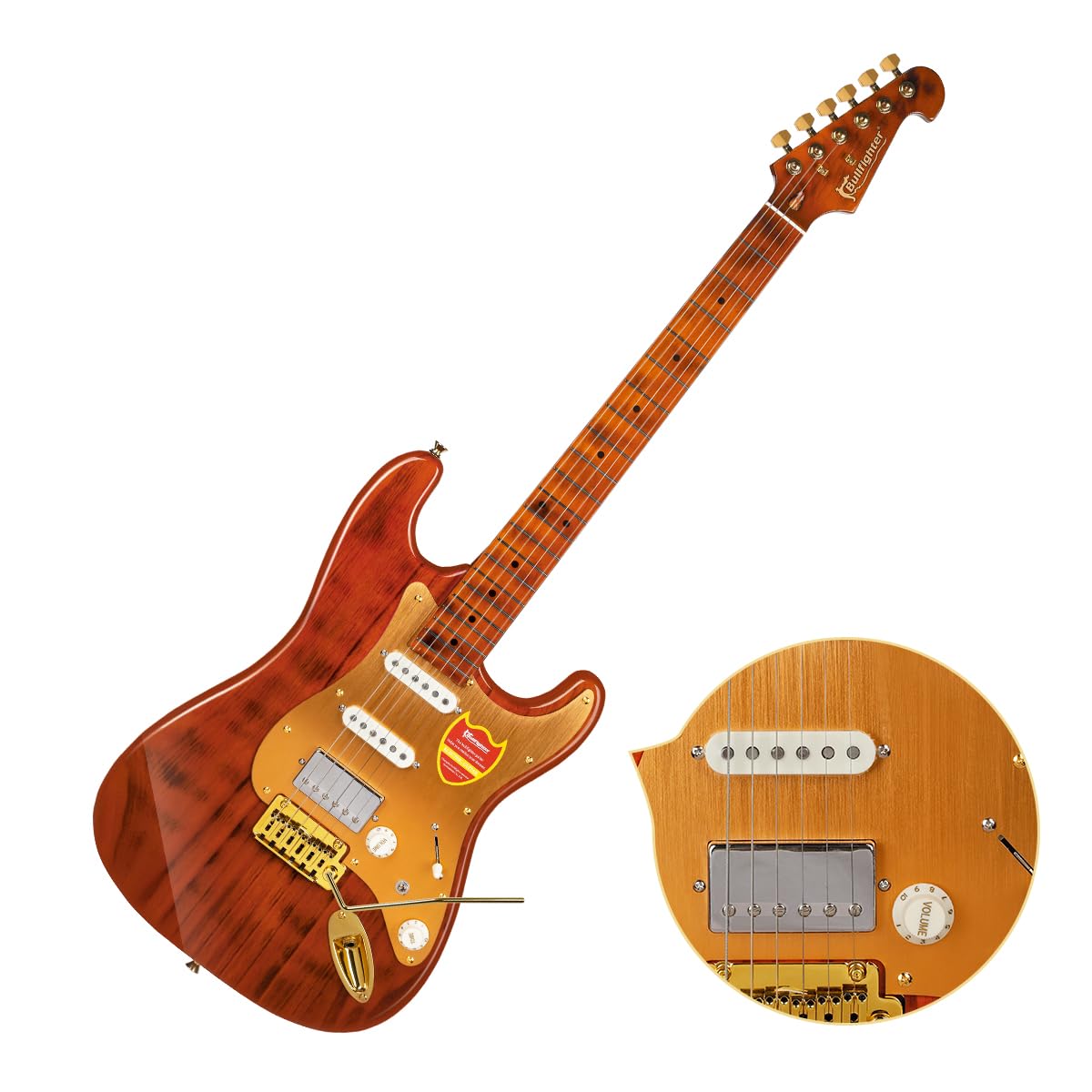
A stage-ready electric with a double-locking tremolo and a body built for expression.
The feature that defines this guitar is the double-locking tremolo system, which supports dive bombs, vibrato, and tremolo harmonics. A locking tremolo clamps the strings at both the bridge and the nut, which keeps them from slipping during heavy whipping — a genuinely useful setup if you plan to use the bar a lot. The integrated locking mechanism prevents the arm from loosening mid-performance, and you can adjust its tension from smooth and easy to firm and steady to match how you play. For a player with wide fingers who wants to add expression without fighting tuning drift, that system earns its place.
The guitar measures 38.58 x 12.6 x 2.87 inches — compact and easy to hold against your body. Its H-S-S pickup configuration (one humbucker and two single-coils) covers rock, metal, blues, and clean settings across a wide tonal range. A tiger-stripe maple veneer top with a gold pickguard gives it strong visual identity, and the brand notes that natural wood grain variation means every guitar’s stripe pattern will look slightly different.
Owners mention strong quality overall, with the finish and components drawing praise and the pickup quality receiving mixed notes. One guitarist summed up the feel well — “I haven’t been able to put it down from the time I took it from the start.” Others highlight that it needed a neck adjustment and a fresh set of strings after shipping. Treat the stock setup as a starting point and the instrument as one worth dialing in.
The tremolo advantage: A double-locking tremolo means you can dive-bomb and return to pitch without the strings slipping out of tune. The adjustable arm tension lets you set the feel to your own playing style — a level of control you typically find on much pricier instruments.
Plan on a setup: The pickup quality draws mixed feedback and a few customers note the locking tuners feel loose. A professional setup with new strings will get the most out of the tremolo system.
The one for: Players who want a flashy, stage-ready electric with a genuine locking tremolo for expressive playing.
Not the one if: You want a plug-in-and-play guitar with zero tweaking — this one benefits from a proper setup first.
8. Ibanez Artwood Dreadnought Acoustic Guitar
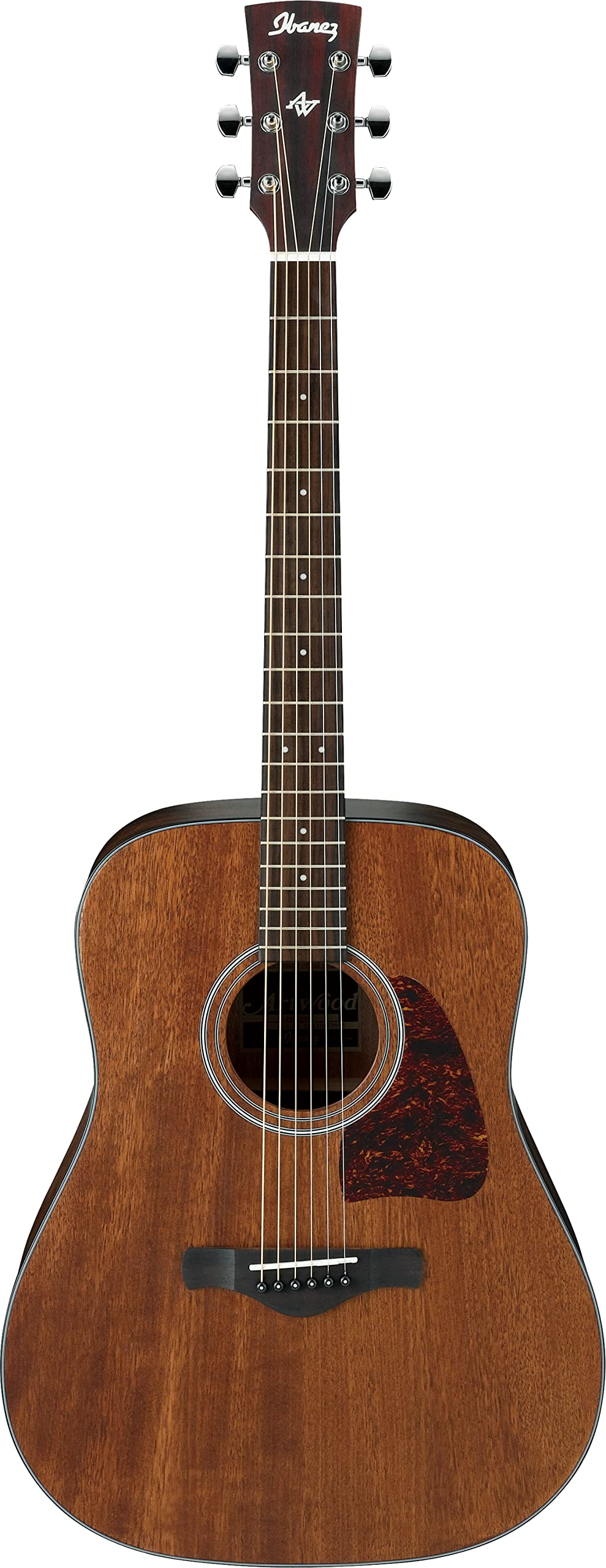
A solid-top dreadnought with a rosewood fretboard and a rich, resonant voice.
A solid mahogany top is the reason this guitar sounds bigger than its price suggests. Solid wood vibrates more freely than the layered laminate tops used on cheaper instruments, which gives you richer, more resonant tones. The dreadnought body shape itself is the big one — matching the Fender CD-60S in overall presence — so your fretting hand gets a wide, stable platform to work across. The mahogany back and sides add warmth, and the rosewood bridge and fretboard give your fingertips a smooth, dense surface to press against.
What reviewers point out most is that this guitar exceeds expectations. It’s described as having clean sound with beautiful open pores that make it look like a more expensive instrument. Intonation is precise, there’s no fret buzz, and the action is comfortable. Several owners compare it favorably to solid-wood guitars at higher tiers, even noting that the finish looks better than instruments selling for noticeably more. For a beginner who wants a guitar that won’t sound like a beginner’s guitar, that’s a strong signal.
The recurring complaint is tuning stability — it tends to fall out of tune faster, particularly the B and high E strings. The stock setup is also described as slightly hard to fret for some players, which is worth knowing if finger pressure is already a challenge. These are manageable issues with a fresh set of strings and a good setup, but they’re real trade-offs worth weighing.
Combined with a rosewood fretboard that feels smooth under your fingers, this is an acoustic that rewards an expressive touch.
Keep a tuner handy: Tuning stability is the weak point, with the B and high E strings drifting most often. Fresh strings and a proper stretch will reduce the issue, but it won’t disappear entirely.
Worth it for: Players who want solid-wood tone at a budget-tier price and can manage tuning upkeep.
Think twice if: You need an acoustic that holds tune through a long set without a mid-song check.
9. Yamaha FG800J Solid Top Acoustic Guitar

A solid spruce top and dreadnought body built for beginners who don’t want a toy.
The solid spruce top here is what separates this from the pack of beginner acoustics. Spruce gives you a bright, balanced tone with bold low-end projection, and because it’s solid rather than laminate, it vibrates more fully and tends to age into a richer sound over time. The neck is nato and mahogany with a rosewood fingerboard, offering a warm, full-bodied tone and lasting resilience. For fingers that need room, the dreadnought body gives your fretting hand a wide, stable platform.
Owners consistently highlight how comfortable this guitar is for long sessions — it holds tuning well from the start and produces a warm, balanced sound. One player with a first guitar described the dreadnought size as comfortable for large hands and noted it stays in tune well. That’s the exact combination a wide-fingered beginner is looking for: a big enough neck to ease cramped fingers, and a build that doesn’t need constant fussing.
Yamaha notes this is designed to be a lifelong partner, built with quality controls and hand-applied finishes. The one flag worth mentioning is durability — one owner reports it broke after minimal use, but that’s a rare note against a strong overall pattern. A quick inspection for shipping damage when it arrives, as one owner recommends, catches anything before it becomes a problem. Overall, this stands as among the most beginner-friendly solid-top acoustics here.
Go with this if: You’re a beginner who wants a solid-top acoustic with a comfortable dreadnought neck for larger hands.
Worth noting: Rare reports of durability issues mean you should inspect the guitar on arrival and check for shipping damage before your return window closes.
Know the Specs
Nut Width and String Spacing
The nut is the slotted strip at the top of the neck that holds the strings in place. Its width determines the gap between strings at the headstock end. A wider nut gives your fingers more separation on the fretboard, so pressing one string doesn’t accidentally mute the next. If your fingers feel cramped, measure the nut width before anything else — it’s the single most important number for hand comfort.
Neck Profile and Thickness
Neck profile is the shape of the back of the neck — how round or flat it feels in your palm. A slim “C” profile (a shallow, rounded carve) suits hands that need a shorter reach across the strings. A fuller profile gives larger hands something to grip without the palm wrapping awkwardly. Neither is better; matching the profile to your hand is what makes a guitar feel easy versus tiring.
Fretboard Radius
Fretboard radius measures how curved the fretboard surface is, quoted in inches. A flatter radius feels more even under the fingers and helps barred chords ring cleanly. A more curved radius suits thumb-over-the-top playing. For crowded fingers, a flatter fretboard reduces the amount you need to angle your hand to sound each note clearly.
Scale Length and Action
Scale length is the distance from the nut to the bridge. A longer scale spaces the frets further apart, giving your fingers more room up the neck; a shorter scale brings them together. Action is how high the strings sit above the frets — high action forces you to press harder, which is bad for tired fingers. Look for a guitar with comfortable action and cleanly finished fret ends so your hand travels without snagging.
Common Questions
What nut width is best for players with fat fingers?
Should I choose electric or acoustic if my fingers feel cramped?
Does a wider neck make it harder to play barre chords?
How do I know if a guitar’s neck will fit my hand before buying?
Can I change my guitar’s string spacing after I buy it?
Why do my fingertips feel like they’re muting other strings?
Is a dreadnought body too big for someone with wide fingers?
Do stainless steel frets really make a difference for finger comfort?
How much does action height affect playing with thick fingers?
Should a beginner with fat fingers start on a full-size or a smaller guitar?
The Bottom Line
The best guitar for fat fingers is the Yamaha Pacifica PAC012DLX: its full-size 43-inch body and hand-finished fretwork give adult hands a roomy neck, and its 4.7-star rating across a solid base of owners is the strongest combined score here. If jazz and blues are your sound, the WestCreek 333 pairs a slim C neck with a bone nut for a hand-friendly semi-hollow. For a budget-friendly first acoustic with a forgiving “C”-shaped neck, the Fender FA-25 is the safest place to start, lessons included.
How we choose
We do not accept paid placement. Every pick is matched to a real buyer and a real use-case; we do not hands-on test units.
Sources
Specifications: manufacturer listings and product documentation. Review insights: verified customer reviews, as of October 2026. Pricing: not shown on this page (it changes often); check the current price via the retailer link.
As an Amazon Associate, Aappliancez earns from qualifying purchases. This does not affect which products we feature.