Disclosure: Some links in this post are affiliate links. As an Amazon Associate I earn from qualifying purchases, at no extra cost to you. Learn more
Specs are compiled from manufacturer listings and verified buyer reviews and can change over time — please confirm the key details on the product page before buying.
If you supinate, your ankle rolls outward every time you land, so the outer edge of your shoe wears down first and your arch takes the load on its own. The fix is an insole with a genuinely high, firm arch and a deep heel cup, not a flat cushion that collapses under your weight. Below are the seven picks that actually hold a supinating foot in line, with the real specs and owner feedback that separate them.
This guide is built by comparing the manufacturers’ published specifications and the patterns across verified customer reviews, so you get each pick’s real strengths and trade-offs instead of marketing spin.
The fastest fix for an outward roll is matching arch height and heel stability to your stride, not buying the thinnest insert. The pick that suits most feet is the one with the firmest arch and a heel cup that keeps you tracking straight, which is exactly what the guide to insoles for supination below explains.
Top Picks
How To Choose The Best Insoles for Supination
Supination (also called underpronation) means your foot rolls outward as you step, so your weight rides the outer edge and your arch gets little help from the shoe. A flat, floppy cushion does nothing for that. What you want is an insert that stands tall under the arch and holds your heel centered, so your foot stops leaning to the outside. The sections below cover the handful of specs that decide whether an insole helps or just feels squishy.
Arch height and firmness
An outward-rolling foot needs an arch that is both high and firm — a soft arch simply flattens the moment you put weight on it. Look at the profile the maker publishes: high arch with firm support is built for exactly your stride. Medium or low-arch inserts will feel like they are holding your foot in the wrong place.
The heel cup and how it fits
A deep heel cup is a raised pocket at the back of the insole that cradles your heel so it cannot slide sideways. That pocket is what stops the outward lean at the source. Pair it with a trim-to-fit design — cut to match your shoe’s own liner — so the cup sits in the right spot rather than floating forward.
Length and shoe type
Full-length inserts run the whole length of the shoe and suit most sneakers and running shoes. 3/4-length inserts stop at the ball of the foot and are made for dress shoes or shoes with liners you cannot remove. If your daily shoes are loafers or work shoes, the shorter style is often the only one that fits without crowding your toes.
Side-by-Side Comparison
| Model | Best For | Arch Profile | Length | Weight | Amazon |
|---|---|---|---|---|---|
| CURREX RunPro★ Best Overall | Runners who want arch-specific support | Low, medium, or high profiles | Full-length | 4.23 ounces | Amazon |
| CRUVHEAL Running GelShock Absorber | Long-standing days and recovery runs | TPE arch support | Full-length | 8.78 ounces | Amazon |
| Sof Sole High Arch | Women chasing a taller arch in sneakers | Enhanced arch height, high | Full-length | 3.84 ounces | Amazon |
| Pure Stride 3/4 Length | Dress shoes and non-removable liners | High arch | 3/4-length | 5.61 ounces | Amazon |
| 10 Seconds 3720 Stability | All-day standing on high arches | High, firm | Full-length | 6.88 ounces | Amazon |
| Superfeet Run Cushion | Wide flat feet and plantar fasciitis | Low arch | Full-length | 4.83 ounces | Amazon |
| Arches Insoles Type 3 | Specific supination and high arches | Molded cork, high | Full-length | 7.2 ounces | Amazon |
Detailed Reviews
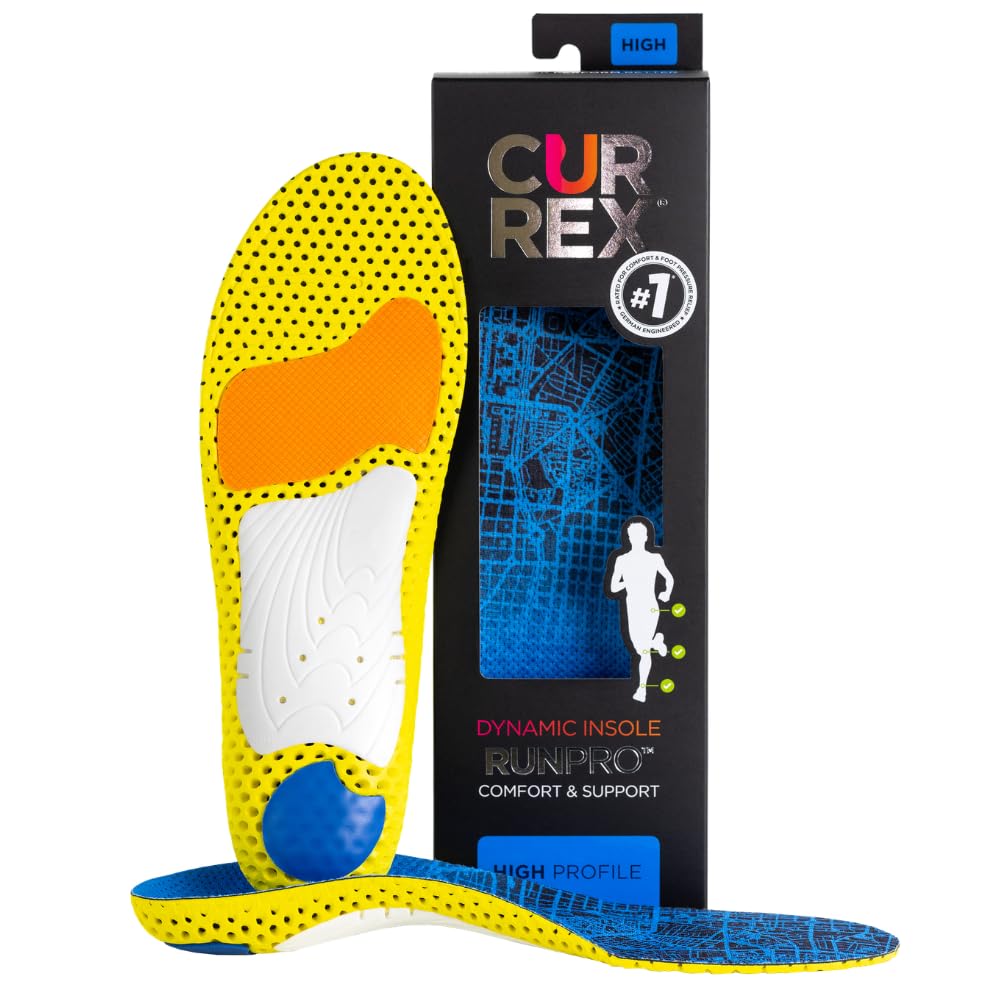
1. CURREX RunPro Insoles for Running Shoes
Our pick — over 4.5★ from 2,000+ verified ratings; the strongest balance of quality and price.
The pick that lets you pick your arch height before you pick your shoe.
The RunPro earns the top spot because it is the only insole here sold in three arch profiles — low, medium and high. An outward-rolling foot gets the support shaped specifically for a high arch, not a one-size compromise. Beyond the profile, its 3D Dynamic Arch Technology (a molded arch that flexes with your stride) pairs with a deep decoupled heel cup that fits, wraps and locks the heel in place.
The numbers back the daily comfort. The rebound cushioning and controlled power transmission are built to return energy with every stride, and a zero heel drop means the insert sits flat in most running shoes. The top mesh layer over premium foam moves moisture out, so feet stay drier through a long run. CURREX also is the only brand here that tailors a full line of activity-specific insoles, and this one folds at the flex point so it moves with your foot instead of fighting it.
Buyers report these insoles feel comfortable right from the start and support your high arch, which cuts foot fatigue on short and long runs. The fit is what wins people over most — the trim-to-shape design and heel lock are the qualities reviewers mention again and again. One buyer summed it up simply: “These insoles are great. They provide lots of support for my arches. My feet have not felt this good in a long time.” The recurring gripe is value — several note the price runs high for a single pair, and the maker says replace them after 500+ miles or 12 months, whichever comes first.
Where the RunPro pulls ahead
- Three arch profiles (low, medium, high) so a supinating foot gets the right shape
- Deep decoupled heel cup locks the heel and reduces outward lean
- Zero heel drop fits most running shoes without lifting the heel
- Mesh top over PORON foam keeps feet drier and fresher
What to weigh before buying
- Costs more than the budget picks here, and value is the mixed note in reviews
- Rated for replacement after 500+ miles or 12 months
- XL-sized versions may need trimming to match your shoe
Made for: runners and walkers with a genuinely high arch who want the arch profile chosen for them rather than guessed at.
Think twice if: you want the cheapest pair on the shelf — this is the premium end, and the maker flags a replacement window.
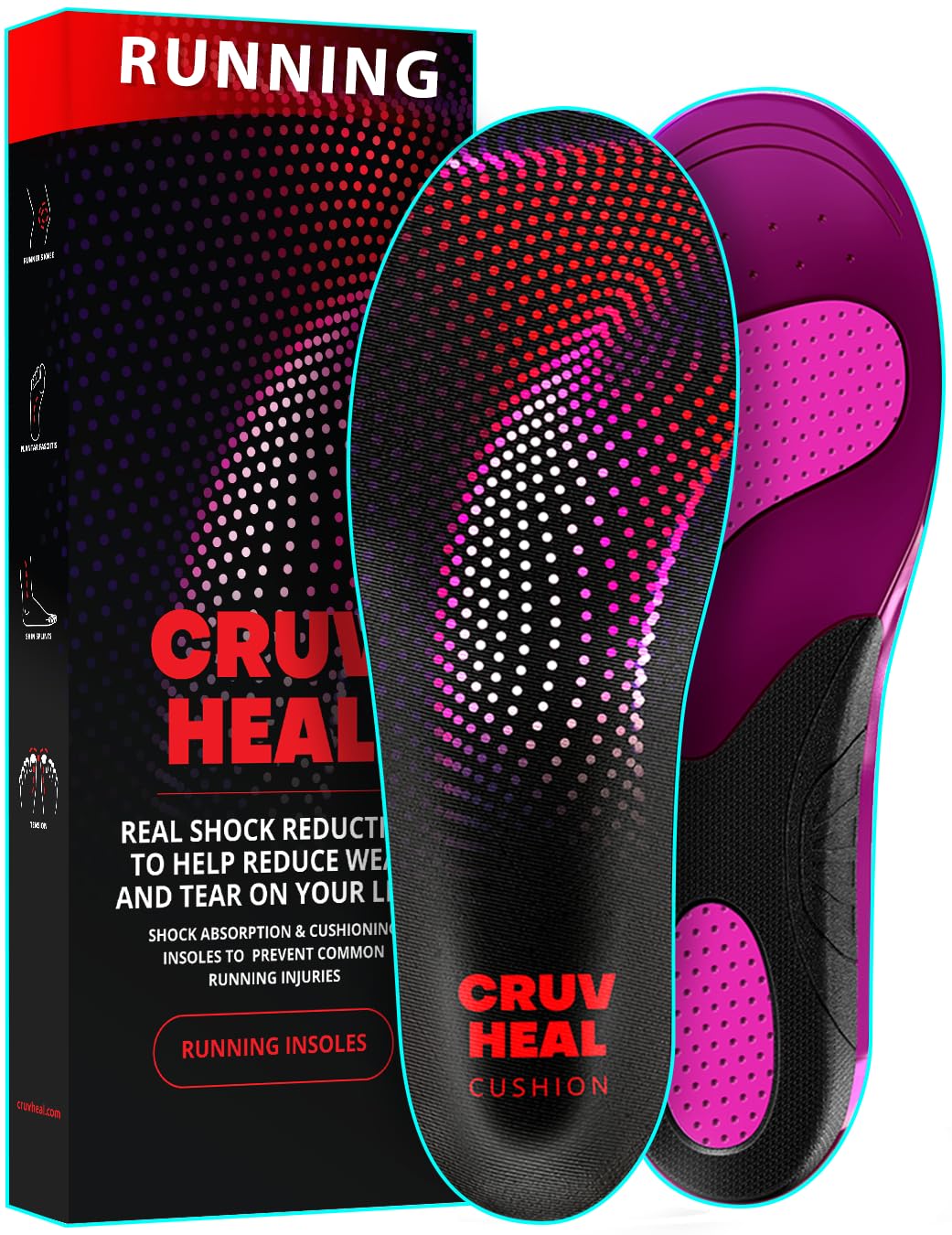
2. CRUVHEAL Running Gel Insoles
Gel-padded support built for the hours you spend standing, not sprinting.
If your day is a long shift on hard floors rather than a fast race, the CRUVHEAL makes its case on shock absorption. A curved U-shaped heel and TPE arch support (a flexible plastic arch that holds its shape) add stability, while gel cushioning softens each landing. At 8.78 ounces it is the heaviest full-length pick in this group — more than twice the Sof Sole’s 3.84 ounces — which is noticeable on the foot.
The velvet cover is skin-friendly and designed to keep feet fresh, and a non-slip gel heel pad is meant to hold the insert in place all day. The brand suggests allowing 3–7 days to adapt, starting with 2–5 hours of daily wear, and backs it with a one-year commitment to customer satisfaction. As with most inserts here, it trims to fit a range of running, tennis, basketball and casual shoes.
Owners mention the real payoff is extra time on your feet — as one put it, “they have increased the amount of time I can stand to be on my feet by a couple of hours.” Comfort is the split note: some feel relief within a week, others find them uncomfortable and lean on the refund policy instead. The other honest catch is bulk — the thick, gel-heavy build can push you into a larger shoe size and feels slower underfoot, so it suits recovery runs and standing shifts more than speed work.
What the gel gets right
- Gel cushioning and shock absorption soften hard-floor impact
- U-shaped heel and TPE arch add a measure of stability
- One-year commitment to customer satisfaction backs the buy
Where it can let you down
- Heaviest full-length option here at 8.78 ounces
- Thick profile may require sizing up your shoe
- Comfort divides opinion — some adapt, some do not
Reach for this if: you want maximum cushioning for long standing shifts, recovery runs, or casual walking.
Look elsewhere if: you are chasing speed, since the weight and thickness work against a fast stride.
3. Sof Sole High Arch Performance Full-length Insole

A women’s-specific high arch with a gel heel to steady the roll.
Built and sized for women’s feet, this Sof Sole leads with its enhanced arch height — support aimed squarely at high arches. A deep heel cup helps prevent heel slip and keeps the heel stable, which is the part a supinating foot needs most. A targeted gel drop in the heel adds cushioning right where the outward lean lands hardest.
It is genuinely light in the hand at 3.84 ounces, the lightest full-length option here. The profile is also far shorter than the men’s-oriented CURREX insert, measuring 10.13 inches against the CURREX’s 14.25 inches. That compact shape suits women’s athletic and casual shoes, and it is built for walking, running, cross training and everyday wear.
The fit story: arch support is the standout here, the quality buyers single out most. Fit, though, is the split note — the recurring gripe is that some pairs arrive larger than the size requested, so measure against your shoe before committing.
Cushioning verdict: the gel heel lands well for some, while others expected a softer feel underfoot than the insert delivers. That makes it best suited to a buyer who wants arch support and heel stability first, with cushioning second.
Suits you if: you are a woman with a high arch who wants a light insert that steadies the heel without adding bulk.
Skip the gamble if: you cannot double-check the sizing, since some pairs run large and the fit is the one thing reviews flag.
4. Pure Stride Professional 3/4 Length Orthotics

The short insert that slides into dress shoes a full-length pad cannot.
Full-length inserts crowd a dress shoe; this one solves that by running only from the ball of the foot to the heel, which is exactly what you want when your shoe has a liner you cannot pull out. Four layers do the work: an odor-free breathable mesh up top, a soft EVA layer (a foam that cushions the foot), a polypropylene shell for structure, and a high durometer EVA that firms up the base.
The brand lists plantar fasciitis, heel spurs and metatarsalgia as the conditions it targets. Cleaning is straightforward — warm soap and water, then air dry. The break-in guidance is gradual: wear a few hours at a time, and if pain develops, remove them and try again the next day until your feet adjust.
What wins people over most is the foot support, followed closely by fit. It is a pick that earns its place in loafers and structured shoes, with buyers reporting it works better than other 3/4 inserts they tried. The honest limit: the shape can run about an inch long for some feet and feel uncomfortable under the ball of the foot, so this is the one insert where you may want to trial it before trusting it in every pair.
Why dress-shoe wearers pick it: the 3/4 cut and four-layer build give high-arch support without pushing your toes into the front of a slim shoe.
The trade-off to know: the length can be a little generous, and a snug fit under the ball of the foot is the main complaint worth watching.
Pick this for: dress shoes and any shoe with a non-removable liner that a full-length insole will not fit.
Only if sizing works: feet that need the insert shortened will find the standard length runs long at the ball.
5. 10 Seconds 3720 Stability Insole

Firm arch and a stability plate for the long-shift crowd.
Start with the profile: this insert is high arch, firm support, firm cushioning and high shock absorption, built for people who stand for a long workday. A stability plate adds structure under the arch, and full PORON cushioning (a shock-absorbing foam) reduces the stress from impacts across the whole foot. It slips into a range of shoes, including narrow dress shoes, which is unusual for an insert this supportive.
For a supinating foot, the firm high arch is the key spec — it resists the collapse that a softer insert allows, and customers note it is better for medium to medium-high arches than for flat or low ones. Buyers praise comfort most, with pain relief and arch support close behind. The foam layer is thin and flexible, which keeps it trim underfoot, and it is trimmable to fit a range of shoes.
Strengths that hold up
- Firm high arch is built to resist collapse under a supinating foot
- Stability plate adds structure under the arch
- Full PORON foam plus high shock absorption for all-day standing
- Fits narrow dress shoes as well as active footwear
Honest limits
- Cushioning is firm — several wish for more padding under the ball of the foot
- Durability is a mixed note, with some describing it as minimal
- Arch is too high for genuinely flat or low arches
Best for: high-arch feet that spend all day standing and want firm support over plush cushioning.
Not for: flat or low arches, where the aggressive arch can cause soreness on longer walks.
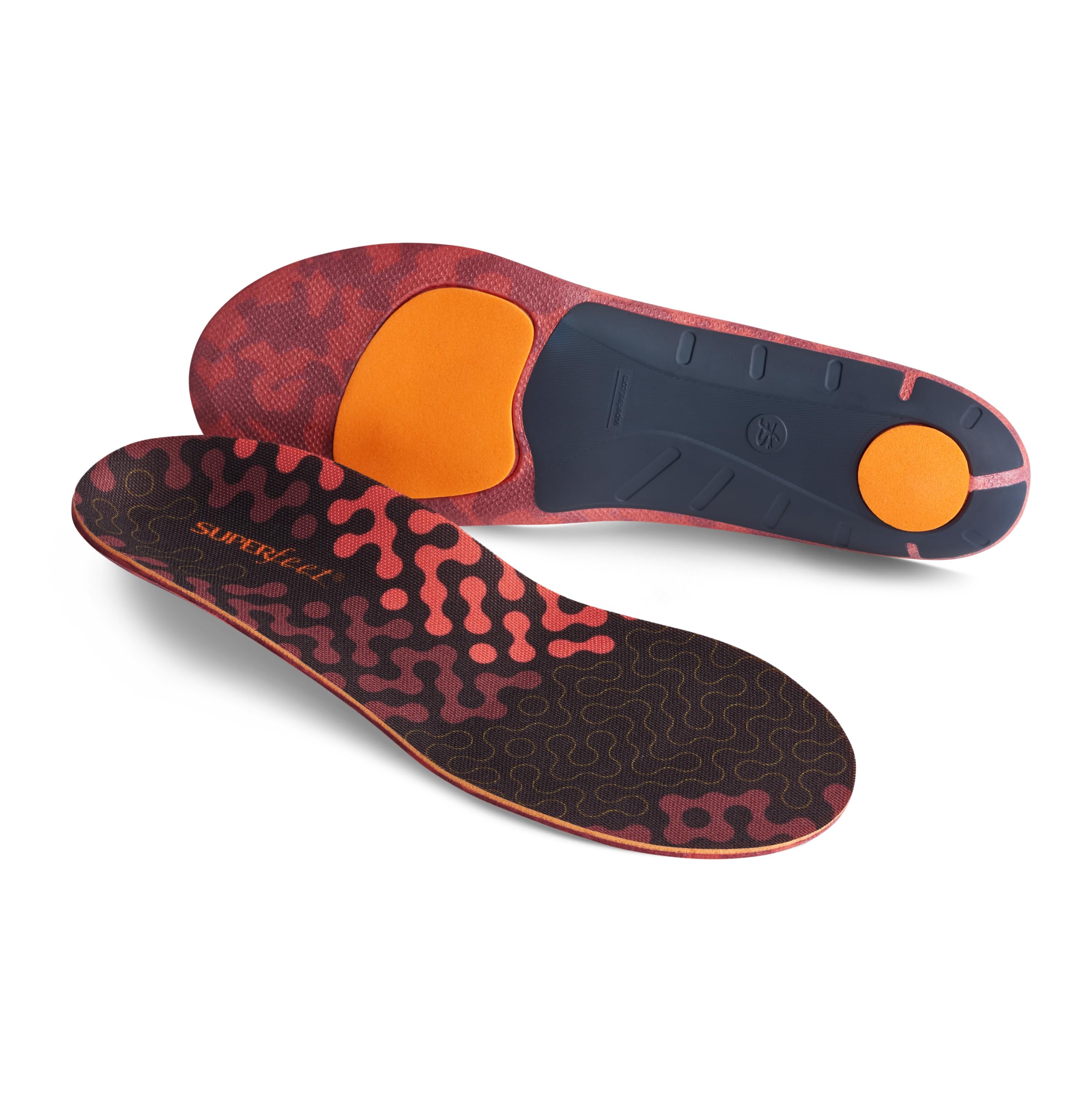
6. Superfeet Run Cushion Low Arch Insoles
Technically a low-arch pick — but worth knowing if your “high” arch is really flat.
Not every foot that rolls outward has a tall arch; some supinate on an arch that is actually low. This Superfeet is built for that foot. Patented Adaptive Comfort Technology flexes with the foot for efficient heel-to-toe turnover, and a medium-depth heel cup adds a steadying pocket without feeling aggressive. A Moisturewick top cover helps control odor and keep feet fresher through the run.
What you get is a firmer low-arch insert that reviewers point out beats doctor-provided ones and works especially well for wide flat feet. Buyers rate its arch support highly and report it eases hip flexor and outer-hip pain, and it drops into common running shoes without trimming. If you have tried low-arch inserts that felt too aggressive and digging, this is the one built to sit under the arch rather than push into it.
Where it shines: people with very low arches finally find enough support and cushion in one insert, and several say they fit Adidas, ASICS and Nike without sizing up.
One thing to watch: after a few miles some feet develop a burning, blistery sensation on the sole, so build up your mileage gradually rather than going long on day one.
Choose it if: your arch is low or flat — the opposite of a classic supination profile — and you want firm support that stays put.
Pass if: you have a genuinely tall, high arch, since this is tuned for a low profile.
7. Arches Insoles Type 3 – Supination/High Arch

The insert that names supination on the label — build the whole system around it.
Few insoles here are built specifically for underpronation, and this one is. The foundation is a form-correcting molded cork that provides high-arch support, absorbs shock, and is designed to hold alignment and keep the correction in place over time. On top of that sits a heel-stabilizing padded foam that steadies the heel, a comfort layer of EVA foam for persistent shock absorption, and a stay-dry B.K. mesh to control perspiration and odor.
Its primary strength is pain relief: shoppers say real easing of knee and foot pain from walking on hard surfaces. For anyone walking on the outside of their feet, that combination of cork arch plus a stabilizing heel is the mechanical fix: it stops the foot from rolling over the outer edge. The insert fits true to shoe size for many, and it works in thin-soled shoes where a lesser insole would leave you sore.
The catches: the size runs small for some, with the stated maximum coming up short so the toes reach the end of the support — order a size up. And at 7.2 ounces it is the heaviest pick here, with several noting the price runs high for a single pair.
Ideal for: anyone who underpronates and wants an insert literally built for supination with a molded cork arch and a stabilizing heel.
Size up if: you are near the top of the stated range, since the fit runs small and the price is the steepest here.
Know the Specs
Arch profile and firmness
The arch profile is how tall and how stiff the hump under your foot is. A supinating foot needs a high and firm arch, because a soft one simply flattens the instant your weight lands on it. When a maker lists “high arch, firm support,” that is the build meant to resist the outward collapse rather than cushion it.
Heel cup depth
The heel cup is the raised pocket at the back of the insole that cradles your heel. A deeper cup holds the heel centered so it cannot slide sideways, which is the first place an outward roll starts. Pair a deep cup with a trim-to-fit insert — cut to match your shoe’s own liner — so the pocket sits in the right spot instead of floating forward.
Full-length vs 3/4-length
Full-length inserts run the entire length of the shoe and suit sneakers and running shoes. 3/4-length inserts stop at the ball of the foot and are made for dress shoes or shoes with liners you cannot remove. If your daily pair is a loafer or work shoe, the shorter style is often the only one that fits without crowding your toes.
Shock absorption and cushioning
Shock absorption is how well the insert spreads the impact of each step before it reaches your joints. Gel, foam and cork are the common materials, and firmer builds trade some softness for steadier support. For an outward-rolling foot, high shock absorption protects the outer edge and ankle, while the firmness keeps the correction from squashing flat.
Common Questions
What makes an insole good for supination?
How do I know if I supinate or overpronate?
Will these insoles fit my running shoes?
Can I use a high-arch insole for flat feet?
How long should an insole last before replacing it?
Do I need to trim a trim-to-fit insole?
What is the difference between a full-length and a 3/4-length insole?
How long does it take to get used to a new insole?
Can a supination insole help with knee and hip pain?
Are firmer insoles better for high arches than soft ones?
The Bottom Line
For most feet that roll outward, the insoles for supination winner is the CURREX RunPro because it is the only pick sold in three arch profiles and its deep decoupled heel cup locks the heel to cut the outward lean. If your priority is cushioning for long standing shifts, grab the CRUVHEAL Running Gel Insoles. And for anyone who underpronates and wants an insert literally built for it, the Arches Insoles Type 3 is the one to reach for. If you have been weighing a fix for a while, the RunPro is the safest single starting point — start there and size the arch to your own foot.
How we choose
We do not accept paid placement. Every pick is matched to a real buyer and a real use-case; we do not hands-on test units.
Sources
Specifications: manufacturer listings and product documentation. Review insights: verified customer reviews, as of October 2026. Pricing: not shown on this page (it changes often); check the current price via the retailer link.
As an Amazon Associate, Aappliancez earns from qualifying purchases. This does not affect which products we feature.