Disclosure: Some links in this post are affiliate links. As an Amazon Associate I earn from qualifying purchases, at no extra cost to you. Learn more
Specs are compiled from manufacturer listings and verified buyer reviews and can change over time — please confirm the key details on the product page before buying.
Raspberries are heavy feeders with a picky streak — they want steady nutrients and a soil pH that sits on the acidic side, and when they don’t get it, the canes sulk and the fruit set is thin. The good news is you don’t need a shelf of bottles. You need one feed matched to how raspberries actually grow: a spring push for new canes and a second round around bloom time. This guide covers five real options, from granular organics you scratch into the soil to liquids you mix in a watering can, so you can match the product to your patch instead of guessing.
This guide is built by comparing the manufacturers’ published specifications and the patterns across verified customer reviews, so you get each pick’s real strengths and trade-offs instead of marketing spin.
Raspberries reward a grower who feeds twice a year on schedule, and a granular or liquid feed matched to your patch does most of the work. Below you’ll find the best fertilizer for raspberries matched to your patch, your pots, and your patience.
Top Picks

How To Choose The Best Fertilizer for Raspberries
Raspberries are not fussy about brand, but they are fussy about three things: steady nitrogen for cane growth, enough potassium for fruit fill, and soil that stays on the acidic side. Pick a feed that hits those three marks and suits how you water, and the patch mostly takes care of itself.
Read the NPK number before anything else
The three digits on the bag — say 4-3-4 or 6-2-4 — are the percentages of nitrogen, phosphorus, and potassium. Nitrogen drives leafy cane growth in spring, phosphorus supports roots and flowering, and potassium helps fruit size and sweetness. For raspberries a moderate, balanced ratio works better than a hot all-purpose blend, because you are feeding twice a year rather than blasting the bed once.
Granular or liquid — pick by how you garden
Granules get scratched into the top inch of soil and release slowly, so you handle them a couple of times a season. Liquids are mixed into a watering can and delivered straight to the root zone, which suits pots, raised beds, and anyone who wants a fast response. If your raspberries live in containers, a liquid concentrate is easier to control; in open ground, granules save you repeat mixing.
Watch the pH, especially with blueberries nearby
Raspberries tolerate a wider pH range than blueberries, but they still lean acidic. If your bed also holds blueberries or other acid lovers, a feed blended low-pH keeps everything happy. For a first planting in fresh ground, you may still need a separate soil acidifier to bring the bed down before the fertilizer can hold it there.
Side-by-Side Comparison
| Model | Best For | NPK Ratio | Form | Weight / Volume | Amazon |
|---|---|---|---|---|---|
| Berry Tone Plant Food 4-3-4★ Best Overall | Best Overall | 4-3-4 with 5% Sulfur | Granules | 4 lb (two packs) | Amazon |
| Down To Earth Organic Fruit Tree 6-2-4Orchard Specialist | Backyard orchard and mixed fruit | 6-2-4 | Powder | 5 lb | Amazon |
| Bloom City Organic Berry Fertilizer | Potted and raised-bed berries | Not stated | Liquid | 32 fl oz | Amazon |
| TPS Nutrients Raspberry Liquid Plant Food | Raspberry-only feeding | 1:0:0 mixing ratio | Liquid | 32 fl oz | Amazon |
| Down To Earth Organic Acid Mix 4-3-6 | Acid-loving patches and bulk feeding | 4-3-6 | Granules | 25 lb | Amazon |
Detailed Reviews
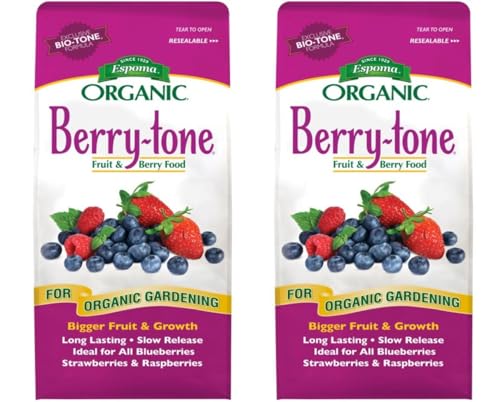
1. Berry Tone Plant Food, 4-3-4, 4-Lbs.
Our pick — 4.5+★ from 500+ verified ratings; the strongest balance of quality and price.
The straightforward all-berry feed that asks nothing more than a scoop and a rake.
If you grow raspberries in open ground and want one product that simply gets on with it, this is the pick. It is a 4-3-4 granular blend — 4% nitrogen, 3% phosphorus, 4% potassium — with 5% sulfur added, and it needs no mixing at all. You scatter, water, and move on. That granular form is the reason it holds up: it sits in the soil and releases gradually instead of washing straight past the roots.
Espoma rates it for blueberries, strawberries, raspberries, and blackberries, so a mixed berry patch runs on one bag. It is a registered Organic Input Material, meaning it meets the requirements for organic production, and it carries no sludges or fillers. The sulfur in the formula suits raspberries because they lean acidic. You get two 4-pound packs, and the maker suggests feeding twice a year, early and late spring, which matches the raspberry growth push.
What wins people over is that a single scoop-and-water pass produces heavy fruit set, not just greener leaves. And when this feed goes into the ground for a whole berry patch, the response shows up as heavy fruit set rather than just greener leaves. A raspberry grower’s real-world note is worth repeating here: “This is really good stuff for strawberry plants and blueberry plants. Any kind of berry. I’ve been buying it for a few years now.” One honest caution sits in the pet department — the organic mix smells appealing to dogs, so keep them off the bed for a few weeks until it is absorbed.
What earns it the top spot
- 4-3-4 granular ratio plus 5% sulfur suits acid-leaning raspberry beds
- No mixing required — scoop and water it in
- Registered Organic Input Material with no sludges or fillers
- Two 4-pound packs stretch across a full berry patch
Where it gives ground
- Granular slow release means no fast correction if canes look pale now
- The organic scent draws dogs — fence the bed until it settles in
- Not the cheapest per-pound route if you only keep two or three bushes
Best for: ground-planted raspberry rows and mixed berry patches where you want a two-feeds-a-year routine.
Think twice: if your raspberries are in pots and you want liquid control, a concentrate serves you better.
2. Down To Earth Organic Fruit Tree 5 lb
Five pounds of powder built for fruit, with calcium added for proper development.
This one is aimed at growers who keep raspberries alongside apples, plums, or figs and want one box that handles the whole fruiting row. The 6-2-4 formula gives you more nitrogen than the Berry Tone (6% versus 4%), which is useful for pushing new raspberry canes in spring. Calcium is added specifically for fruit development. It is OMRI listed for organic production.
Compare the formats and the shopping math gets clear. This box is 5 pounds against the Bloom City bottle’s 2 pounds, and it is a single item where the Berry Tone ships as a two-pack. If you are feeding a long row of canes plus a few fruit trees, the single larger box goes further per scoop. The downside of powder is dust — it is finer than granules, so pour it low and close to the soil.
Growers report the fruiting response is what justifies the price, and that a 5-pound box goes far for its size. It is also close to odorless in the ground, which matters if the bed sits near a patio. The honest trade-off is that this is a fruit-tree-first blend; raspberries do fine on it, but a dedicated berry feed is more precisely matched to heavy berry production.
The real draw: a 5-pound single box of 6-2-4 with calcium, OMRI listed, at a size that covers a whole orchard row.
Fair warning: it is a powder, so it dusts more than granules do — pour close to the soil and water it in promptly.
Reach for this if: your raspberries share a bed with fruit trees and you want one box for all of it.
Look elsewhere if: raspberries are your only crop and you want a ratio tuned purely to berry production.
3. Bloom City Organic Berry Fertilizer 32 oz

A liquid feed that goes straight into the watering can for potted and raised-bed berries.
For raspberries in containers or raised beds, liquid beats granular on control. This is a 32-fluid-ounce concentrate — 2 pounds of product — that you dilute and pour, so you deliver food right to the root zone without waiting for granules to break down. It is formulated for berry-producing plants and suits backyard patches, raised beds, and potted berries. Made in USA.
The bottle’s size relative to the Down To Earth box tells the story of how you’ll use it. That box is 5 pounds of dry powder; this is a 2-pound, 32-ounce liquid you mix by the watering can. The concentrate lasts because a little goes into each gallon. For a couple of potted raspberry canes on a patio, that is a season or more of feeding.
Where the experience splits is odor. Buyers talk most about the blend and its effectiveness, and strawberry and blueberry growers in particular report strong results. But smell is a split verdict — some notice it and some do not, so mix it outdoors and water it in. A potted-blueberry grower’s note captures the value: keep the mix going through the season and the plants throw new growth and berries.
Why container growers like it
- 32-ounce liquid concentrate delivers fast to potted roots
- Built for backyard patches, raised beds, and potted berries
- Bottle lasts because a little goes into each gallon of water
- Made in USA and formulated for berry-producing plants
What to plan around
- Smell is a mixed verdict — mix outdoors and water in promptly
- You need to mix by the gallon, which is extra steps over granules
- No stated NPK number on the listing, so you trust the berry-specific blend
Suits: patio pots, raised beds, and anyone who prefers mixing a can to raking in granules.
Less ideal: a long in-ground row where a dry granular feed covers the bed in one pass.
4. Raspberry Fertilizer 32 oz
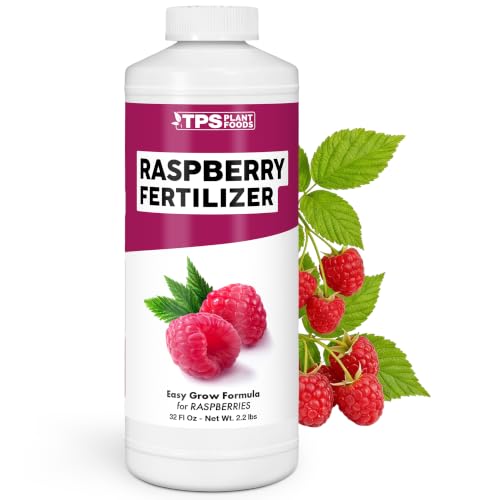
The one product on the list named for raspberries and nothing else.
Most berry feeds spread their claims across blueberries, strawberries, and blackberries. This TPS Nutrients bottle names raspberries specifically — red, yellow, and black — and adds calcium and magnesium for cane strength and fruit set. It is a 32-fluid-ounce liquid with a 1:0:0 mixing ratio, applied as a soil drench through a watering can or hose-end sprayer.
What separates it from other liquid berry feeds is the 1:0:0 dilution, which stretches one 32-ounce bottle across a long feeding run. A 1:0:0 mixing ratio means a little product goes into a lot of water, and that small dose per gallon is the reason one bottle covers a raspberry row for a long stretch. Buyers who run a multi-bush patch note it lasts a long time at the directed dilution. It is made in USA and goes into the soil rather than onto the leaves.
The honest catch is scale and patience. This bottle is 32 fluid ounces — 2 pounds by weight — and a few raspberry growers find the portion small for what it costs. The new-growth and bigger-berry reports come from steady, once-a-week feeding, not from one dose. Treat it as a season-long routine rather than a quick fix.
The case for it: a raspberry-only liquid with calcium and magnesium, diluted at 1:0:0 so one 32-ounce bottle covers an extended feeding run.
What to expect: results build over weeks of weekly drenching, and the 32-ounce size feels modest next to dry bulk feeds.
Pick it when: you want a feed built for raspberries only and will commit to a weekly drench through the season.
Pass it over: if you want one big bag to cover a mixed berry and vegetable garden.
5. Down To Earth Organic Acid Mix 25 lb
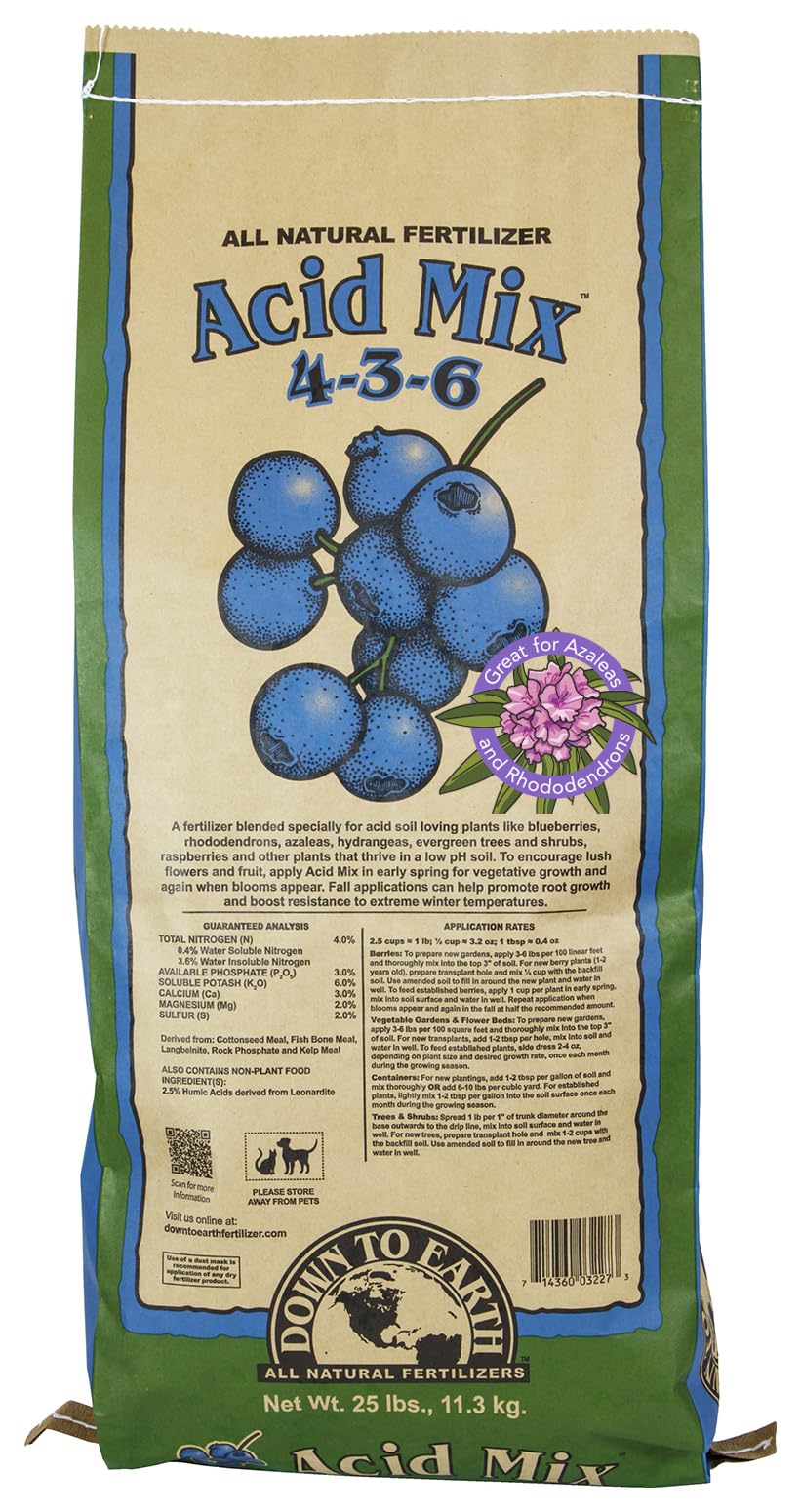
A 25-pound bag of low-pH feed for growers who think in seasons, not scoops.
If you keep raspberries next to blueberries, azaleas, or rhododendrons, this is the bag that covers the whole acid-loving row. The 4-3-6 formula is blended for plants that need a low pH, and the ingredient list is real food for soil — cottonseed meal, langbeinite, fish bone meal, rock phosphate, humates, and kelp meal. It is granules, so you scratch it in and the soil does the rest.
The scale is the headline. This is a 25-pound bag — 400 ounces — built for repeat seasonal feeding rather than a single spring dose. Down To Earth suggests applying in early spring for vegetative growth and again at bloom, or in fall to push root growth and help plants ride out extreme winter temperatures. Treated as a twice-yearly routine, one bag runs a berry patch for multiple seasons.
Long-time buyers credit the ingredient list first and the foliage and fruit set it delivers second. Growers who have used it for years on blueberries, boysenberries, blackberries, and strawberries report foliage and fruit set that beat the usual all-purpose blends. One thing to know: if you are planting new ground, reach for a separate soil acidifier first to bring the bed down, because this mix holds the level once it is there — it does not drag fresh soil into range on its own. And it is bulk, so plan a dry, covered spot to store it.
Best value at scale: a 25-pound acid-leaning granular blend that covers a mixed acid-loving bed for multiple seasons of twice-yearly feeding.
Know before you buy: it maintains low pH rather than lowering fresh soil, so a first planting may still need a dedicated acidifier alongside it.
Go here if: you have a big acid-loving patch and want one bag that feeds it season after season.
Look away if: you have two or three bushes, where a smaller bag is easier to store and handle.
Know the Specs
The NPK Ratio Explained
The three numbers on any bag are the percentages of nitrogen, phosphorus, and potassium. A 4-3-4 like Berry Tone gives 4% nitrogen for cane growth, 3% phosphorus for roots and flowering, and 4% potassium for fruit fill. A 6-2-4 like the Down To Earth Fruit Tree leans harder on nitrogen for spring push. Lower, balanced ratios suit twice-yearly raspberry feeding better than a hot all-purpose blend, because you are topping up rather than flooding the bed once.
Granular vs Liquid Form
Granules are scratched into the top inch of soil and release slowly, so you mix nothing and feed a couple of times a season. Liquids are diluted into a watering can or hose-end sprayer and delivered straight to the root zone, which is easier in pots and raised beds. A 25-pound granular bag like the Acid Mix is built for large beds and repeat seasons. A 32-ounce liquid concentrate is built for control on a few plants.
Common Questions
How often should I fertilize raspberries?
Is a low-pH fertilizer better for raspberries?
Can I use a fruit tree fertilizer on raspberries too?
Granular or liquid fertilizer for raspberries in pots?
How do I apply a liquid raspberry fertilizer?
Is organic fertilizer enough for raspberry fruit production?
Why does this fertilizer smell and is that a problem?
How long does a bag or bottle of raspberry fertilizer last?
Can I overfeed raspberries with a concentrated liquid?
Do raspberries need a different feed from blueberries?
The Bottom Line
For a ground-planted raspberry patch with nothing fancy going on, the Berry Tone Plant Food 4-3-4 is the pick because its sulfur-aided organic granule suits acid-leaning beds without any mixing. If your raspberries share space with fruit trees, the Down To Earth Fruit Tree 6-2-4 boxes both into one feed. For potted canes or a raised bed where you want liquid control, reach for the Bloom City Organic Berry Fertilizer. And if you tend a larger acid-loving collection alongside your raspberries, the Down To Earth Acid Mix 4-3-6 in its 25-pound bag carries you through multiple seasons on one purchase. Match granular or liquid to how you garden, feed twice a year, and let the canes do the rest.
How we choose
We do not accept paid placement. Every pick is matched to a real buyer and a real use-case; we do not hands-on test units.
Sources
Specifications: manufacturer listings and product documentation. Review insights: verified customer reviews, as of October 2026. Pricing: not shown on this page (it changes often); check the current price via the retailer link.
As an Amazon Associate, Aappliancez earns from qualifying purchases. This does not affect which products we feature.